

Why MSTY Stock Matters for Income-Focused Investors
MSTY stock has captured significant attention from investors seeking high-yield alternatives in today’s market. The YieldMax MSTR Option Income Strategy ETF (MSTY) offers an extraordinary dividend yield of over 170%, making it one of the highest-yielding ETFs available.
Quick Facts About MSTY Stock:
- Current Dividend Yield: 173.23%
- Annual Dividend: $26.07 per share
- Assets Under Management: $4.76 billion
- Inception Date: February 21, 2024
- Primary Strategy: Synthetic covered call options on MicroStrategy (MSTR)
- Monthly Distributions: Paid every month
- Expense Ratio: 0.99%
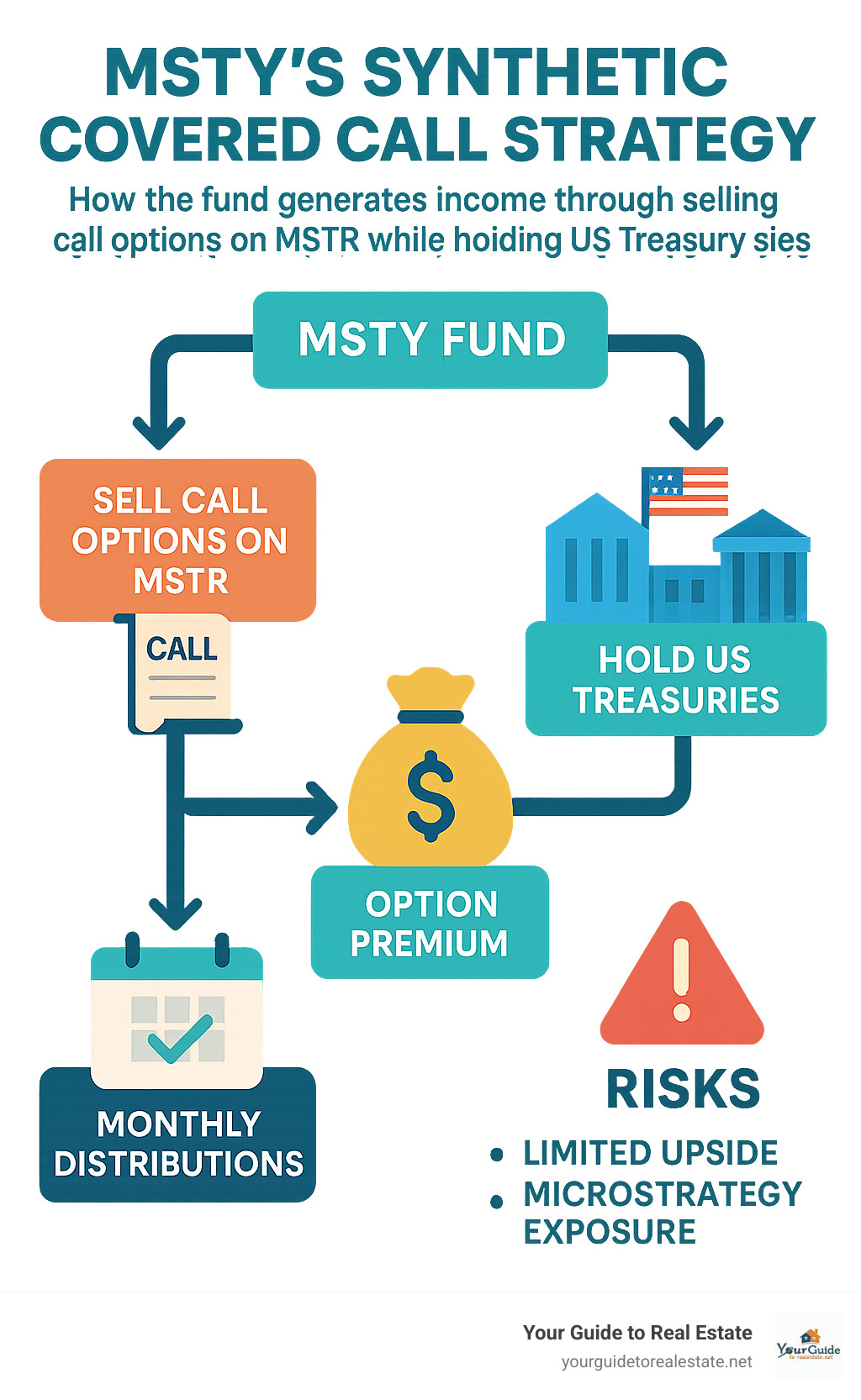
MSTY doesn’t invest directly in MicroStrategy stock. Instead, it uses a synthetic covered call strategy with options contracts to generate income while providing capped exposure to MSTR’s price movements. The fund collateralizes these positions with US Treasury bills and notes.
The ETF has attracted over $6.65 billion in fund flows within its first year, demonstrating strong investor appetite for high-yield alternatives. However, this extreme yield comes with significant risks, including capped upside potential and exposure to the volatile cryptocurrency market through MSTR’s Bitcoin holdings.
As one analyst noted: “MSTY is mathematically pressured into an exponentially decay relative to MSTR.” This highlights the trade-off between current income and long-term capital appreciation that investors must consider.
Simple guide to msty stock:
What is the YieldMax MSTR Option Income Strategy ETF (MSTY)?
Think of MSTY stock as a clever financial invention designed to squeeze income out of one of the market’s most volatile stocks. The YieldMax MSTR Option Income Strategy ETF is an actively-managed fund with a straightforward mission: generate current income for investors while providing limited exposure to MicroStrategy’s wild price swings.
Unlike traditional ETFs that simply track an index, MSTY has real people making daily decisions about its strategy. This active management approach helps explain why the fund can offer such attractive monthly distributions – but it also means you’re paying for that expertise through higher fees.
The fund’s secret weapon is something called a synthetic covered call strategy. If that sounds like financial jargon, don’t worry – we’ll break it down in simple terms. Essentially, MSTY creates a position that acts like it owns MicroStrategy stock without actually buying shares. Then it sells call options against this position to generate income. It’s like renting out a house you don’t technically own, but with a lot more math involved.
For those new to options trading, understanding the Stock Market Terminology can feel overwhelming at first. But here’s what matters: this strategy lets MSTY collect regular payments while giving up some of the upside if MicroStrategy’s stock price rockets higher.
How MSTY Generates Income
The magic behind MSTY’s impressive income generation lies in its sophisticated use of options contracts. Instead of buying MicroStrategy shares outright, the fund creates what’s called “synthetic exposure” through a combination of buying and selling different types of options.
Here’s where it gets interesting: MSTY makes money by selling call options on MSTR stock. When you sell a call option, you collect a premium upfront – think of it as getting paid to make a promise. The promise is that if MSTR’s stock price rises above a certain level, you’ll sell the stock at that predetermined price.
The fund also engages in writing puts, which is another way to collect premiums. These premiums from selling options become the primary fuel for MSTY’s generous monthly distributions to shareholders.
But there’s a catch – and it’s a big one. By selling those call options, MSTY accepts capped gains on MSTR’s performance. If MicroStrategy’s stock doubles overnight, MSTY won’t capture all of those gains. The fund essentially trades unlimited upside potential for steady monthly income.
To keep everything secure and stable, MSTY backs up these options positions with rock-solid US Treasurys and cash as collateral. This conservative approach helps ensure the fund can meet its obligations even when markets get choppy.
Primary Holdings of MSTY
When you peek under the hood of MSTY stock, you’ll find a fascinating mix of financial instruments working together to generate that eye-catching yield. The fund doesn’t actually own a single share of MicroStrategy – instead, it’s built like a financial Swiss Army knife with multiple moving parts.
The portfolio consists of MSTR Call Options that give the fund the right to buy MicroStrategy shares at specific prices and dates. You’ll also find MSTR Put Options that work in the opposite direction, along with the call options sold to generate income.
The boring but crucial part of the portfolio includes United States Treasury Notes and United States Treasury Bills – these aren’t flashy, but they’re the foundation that keeps everything stable. Finally, the fund maintains Cash reserves to handle day-to-day operations and meet obligations.
What’s particularly interesting is how much of the fund is actually invested in these Treasury securities. They serve as the bedrock that supports all those complex options strategies, providing the stability and liquidity needed to operate smoothly. It’s like having a solid savings account backing up your more adventurous investment moves.
This unique structure allows MSTY to offer exposure to one of the market’s most volatile stocks while generating substantial monthly income – though as we’ll explore later, this approach comes with its own set of trade-offs and risks.
Analyzing MSTY Stock Performance and its High Yield

When you first look at MSTY stock, that massive yield number probably made you do a double-take. I mean, who wouldn’t be intrigued by a fund promising yields over 170%? But here’s the thing – impressive numbers on paper don’t always tell the whole story. Let’s dig into what’s really happening under the hood.
Understanding the Historical Performance of msty stock
Since MSTY stock only launched on February 22, 2024, we’re working with less than a year of performance data. It’s like trying to judge a movie from the trailer – you get some idea, but the full picture takes time to develop.
The fund’s NAV (Net Asset Value) returns paint an interesting picture of volatility mixed with impressive gains. Over its 1-month period, MSTY showed a -15.07% NAV return, which might seem concerning at first glance. The 3-month return of -7.25% shows similar short-term challenges. However, zoom out a bit, and the story changes dramatically.
The 6-month NAV return of 25.82% and year-to-date return of 12.79% start looking more promising. But here’s where it gets really interesting – the 1-year NAV return hit 100.94%, essentially doubling investors’ money. The since inception cumulative NAV return of 267.41% is truly eye-catching, though remember this covers less than a full year.
What’s particularly noteworthy is how MSTY trades relative to its underlying value. The premium/discount to NAV currently sits at -0.06%, meaning the market price is trading very close to what the fund’s assets are actually worth. This tight tracking is generally a good sign for ETF efficiency.
The wild swings in monthly performance reflect the underlying volatility of MSTR, which itself moves dramatically with Bitcoin’s price action. It’s like riding a roller coaster – thrilling, but definitely not for the faint of heart.
The High Dividend Yield Explained
Now, let’s talk about that elephant in the room – MSTY’s astronomical dividend yield that’s been reported as high as 322.13% in some periods, with a current rate around 173.23%. Before you start planning your early retirement, it’s crucial to understand how this number works.
MSTY reports two very different yield figures that tell completely different stories. The distribution rate, which has ranged as high as 322.13% and was recently at 92.73%, includes all the income from selling those call options we discussed earlier. This is where the big numbers come from.
Meanwhile, the 30-day SEC yield sits at just 2.75%. This represents traditional investment income from the Treasury securities the fund holds. The massive gap between these numbers shows you exactly where MSTY’s income really comes from – it’s almost entirely from options premiums, not traditional dividends.
MSTY pays distributions monthly, making it attractive for those seeking Monthly Dividend Stocks. However, these payments vary significantly from month to month, ranging from $1.0899 to $4.4213 per share. This variability isn’t a bug – it’s a feature of the options strategy. When MSTR is more volatile, option premiums tend to be higher, leading to bigger distributions.
The big question many analysts are asking is whether such extreme yields can last. As one analysis explores in Can MSTY’s 120%+ Yield Hold Up? (MSTY), sustainability depends largely on MSTR’s continued volatility and the fund’s ability to manage its capital base effectively.
Key Fund Statistics
The numbers behind MSTY stock tell the story of a fund that’s quickly gained serious traction in the market. With assets under management of $4.76 billion, MSTY has attracted massive investor interest in less than a year. That’s not pocket change – it shows real confidence from institutional and retail investors alike.
The fund’s expense ratio of 0.99% reflects the active management and complex options strategies involved. While higher than your typical index fund, it’s reasonable for an actively managed ETF dealing with derivatives. Think of it as paying for the expertise to steer these complicated waters.
With 299.8 million shares outstanding and an average daily volume of 11.56 million shares, MSTY offers excellent liquidity. This means you can typically buy or sell shares without worrying about moving the price significantly – important when dealing with volatile investments.
The 52-week range from $17.10 to $46.50 showcases the fund’s roller-coaster nature. That’s a massive spread, reflecting both the opportunities and risks inherent in MSTY’s strategy. The current 50-day moving average of $21.80 and 200-day moving average of $26.30 provide some technical context for where the fund stands relative to recent trends.
These statistics paint the picture of a substantial, liquid fund that’s successfully captured investor attention, but one that operates in inherently volatile territory. It’s like a well-built sports car – impressive performance capabilities, but you need to know how to handle it.
MSTY vs. MSTR: Comparing Income Generation to Underlying Growth
When you’re considering MSTY stock, you’ll naturally want to compare it to MicroStrategy (MSTR) itself. After all, MSTY’s entire strategy revolves around MSTR’s price movements. But here’s the thing – these two investments are as different as night and day when it comes to what they’re trying to achieve.
Think of it this way: MSTR is like buying a racehorse with dreams of winning the Kentucky Derby, while MSTY is like owning a stable that rents out horses for steady monthly income. Both involve horses, but your goals and risks are completely different.
| Feature | MSTY (YieldMax MSTR Option Income Strategy ETF) | MSTR (MicroStrategy Inc.) |
|---|---|---|
| Investment Strategy | Synthetic covered calls on MSTR, collateralized by Treasurys | Direct ownership and accumulation of Bitcoin, software business |
| Primary Goal | Current Income (monthly distributions) | Capital Appreciation (through MSTR stock and Bitcoin holdings) |
| Upside Potential | Capped (limited by option strike prices) | Uncapped (direct exposure to MSTR’s growth and Bitcoin’s ascent) |
| Downside Exposure | Full (exposed to MSTR’s downside through synthetic long and short puts) | Full (direct exposure to MSTR’s stock and Bitcoin’s volatility) |
| Dividends | High monthly distributions (from option premiums) | No dividends (MSTR does not pay dividends) |
Growth Potential: MSTR
MicroStrategy has essentially reinvented itself as a Bitcoin proxy with a software business on the side. When you buy MSTR directly, you’re making a pure growth play – betting that Bitcoin (and therefore MSTR) will continue climbing higher.
Direct stock ownership gives you the full roller coaster experience. If Bitcoin rockets to the moon, MSTR typically follows with uncapped gains. There’s no ceiling on your potential returns, which is exactly what growth investors want to hear.
But let’s be honest about what you’re signing up for. MSTR experiences high volatility that can make even seasoned investors queasy. Bitcoin’s legendary price swings get amplified through MSTR’s stock price, sometimes dramatically. And unlike MSTY stock, MSTR pays no dividends whatsoever – your only hope for returns is capital appreciation.
This makes MSTR a pure growth bet for investors with strong stomachs and long-term bullish views on cryptocurrency.
Income Focus: MSTY
MSTY stock takes a completely different approach. Instead of chasing explosive growth, it focuses on generating steady monthly cash flow through its options strategy. This makes it particularly appealing for investors seeking Income Stocks to supplement their regular expenses or retirement income.
The trade-off is that capped upside potential we keep mentioning. MSTY benefits from MSTR’s price increases, but only up to the strike prices of the call options it sells. If MSTR absolutely skyrockets, MSTY investors watch from the sidelines beyond a certain point.
There’s another crucial consideration: NAV decay risk. Over time, MSTY’s Net Asset Value per share may decline due to its high monthly distributions and the nature of its options strategy. While you’re collecting substantial monthly income, the underlying value of your investment might be slowly eroding.
As one industry analysis put it in MSTR vs. MSTY: Growth or Income? A 12-Month Showdown, this decision comes down to your fundamental investment philosophy. Do you want the potential for explosive growth, or do you prefer a steady, high-income stream that helps pay your bills each month?
Both approaches have merit, but they serve very different types of investors with different goals and risk tolerances.
Risks, Tax Implications, and Outlook for msty stock

Let’s be honest – that eye-catching yield from MSTY stock comes with some serious strings attached. While the monthly income potential is exciting, we need to talk about what could go wrong and what you’re really signing up for.
Major Risks Associated with Investing in MSTY
The biggest red flag with MSTY stock is its single issuer risk. This fund puts all its eggs in one basket – MicroStrategy (MSTR). Since MSTR’s stock moves largely based on Bitcoin’s price swings, you’re essentially betting on crypto without owning it directly. If Bitcoin crashes or MSTR faces company-specific problems, MSTY gets hit hard.
Then there’s the capped gains situation. Remember how MSTY sells call options to generate income? Well, that means when MSTR rockets higher, you’re stuck watching from the sidelines after a certain point. You collect your premium, but you miss the moonshot. It’s like selling your lottery ticket for a guaranteed $20 when it might win $20,000.
NAV decay is perhaps the scariest risk for long-term investors. Think of it like this: if MSTY keeps paying out high distributions month after month, but the fund’s actual assets aren’t growing fast enough to support those payments, the value of your shares slowly erodes. You might get great monthly checks, but your principal investment shrinks over time.
The fund’s heavy use of derivatives and options adds another layer of complexity and risk. Options are tricky instruments that can lose value quickly due to time decay, changes in volatility, or unexpected price movements. Since MSTY is built on these contracts, any hiccup in the options market directly affects your investment.
High volatility is baked into MSTY’s DNA. MSTR can swing 10-20% in a single day, and MSTY often follows along for the ride. This makes it unsuitable for investors who need stable, predictable returns.
As a non-diversified fund, MSTY can concentrate more of its assets in MSTR-related positions than typical funds. This amplifies both the potential rewards and risks. Plus, with its new fund risk – having launched only in February 2024 – we simply don’t know how it will perform during different market cycles or economic conditions.
Tax Implications for MSTY Investors
Here’s where things get complicated fast. Those monthly MSTY stock distributions aren’t as straightforward as regular stock dividends from a tax perspective.
Most of your distributions will likely be taxed as ordinary income, which means they get hit with your regular income tax rate – not the lower rates that apply to qualified dividends. If you’re in a high tax bracket, this can take a significant bite out of your returns.
Things get trickier with return of capital (ROC) distributions. When MSTY can’t generate enough actual income to support its distributions, part of your payment might be classified as ROC. While you don’t pay taxes on ROC immediately, it reduces your cost basis in the fund. This means you’ll owe more taxes when you eventually sell your shares.
The fund may also distribute capital gains from its trading activities, adding another tax layer to consider. At year-end, you’ll receive a Form 1099-DIV that breaks down exactly what type of income you received and how much tax you owe.
Given the complexity, it’s smart to work with a tax professional who understands these nuances, especially if MSTY makes up a significant portion of your portfolio.
Current Market Sentiment for msty stock
The investment community is split on MSTY stock, and frankly, that makes sense given its unique risk-reward profile.
Bull case supporters point to the current market environment as ideal for MSTY’s strategy. High implied volatility in MSTR stock means the options premiums MSTY collects are substantial. Some analysts maintain buy ratings, arguing that as long as Bitcoin and MSTR remain volatile, the income stream should continue flowing.
Bear case critics raise serious concerns about sustainability. As one analysis put it, MSTY is “mathematically pressured into exponential decay relative to MSTR.” They argue that Can MSTY’s 120%+ Yield Hold Up? is the million-dollar question, and many believe the answer is no.
The Bitcoin cycle impact looms large over MSTY’s future. If Bitcoin enters a prolonged bear market, MSTR’s volatility could decrease, reducing the premiums MSTY can collect. Conversely, a sideways or moderately bullish Bitcoin market with high volatility might be the sweet spot for MSTY’s strategy.
Current analyst ratings vary widely, reflecting the fundamental disagreement about whether trading upside potential for current income makes sense in today’s market. Some see it as a clever way to generate income in a low-yield environment, while others view it as “selling your upside for cents on the dollar.”
The bottom line? MSTY represents a new breed of income-generating tools that didn’t exist in previous market cycles. Whether it succeeds long-term depends largely on Bitcoin’s continued volatility and investors’ appetite for complex, high-yield strategies.
Frequently Asked Questions about MSTY
When it comes to MSTY stock, we get asked the same questions over and over. And honestly, we totally understand why. This ETF is pretty unique – it’s sitting right at the crossroads of high yields, complex options strategies, and the wild world of cryptocurrency-linked investments. Let’s tackle the big questions that keep coming up.
Does MSTY invest directly in MicroStrategy (MSTR) stock?
This is probably the biggest misconception about MSTY stock – and the answer is a clear no. MSTY doesn’t actually buy and hold MicroStrategy shares like you might expect. Instead, it creates what’s called “synthetic exposure” through options contracts.
Think of it like this: instead of buying a house, MSTY signs a contract that gives it many of the benefits and risks of owning that house, but without actually holding the deed. The fund uses a combination of MSTR call options and put options, backed by cash and U.S. Treasury securities, to mimic the experience of owning MSTR stock.
Since MSTY isn’t technically a shareholder of MicroStrategy, investors don’t get any of the traditional shareholder perks. You won’t have voting rights in MicroStrategy’s corporate decisions, and you won’t receive any dividends that MSTR might pay in the future (though MSTR doesn’t currently pay dividends anyway).
This synthetic approach is what allows MSTY to implement its income-generating strategy while avoiding the complexities of direct stock ownership.
Is MSTY’s high dividend yield guaranteed?
Here’s where we need to be crystal clear: absolutely not. While MSTY stock has made headlines for its eye-popping dividend yields, these payments are anything but guaranteed. The yield can swing dramatically from month to month, and there are several reasons why.
The distributions vary monthly based on how much premium the fund collects from selling call options. Some months might deliver hefty payouts, while others could be disappointingly small. It all depends on how volatile MSTR is acting and what kind of premiums buyers are willing to pay for those options.
Market volatility is the real driver here. When MSTR is bouncing around like a ping-pong ball (which happens a lot given its Bitcoin connection), option premiums tend to be higher. But during calm periods, those premiums can shrink, taking your distributions down with them.
There’s another wrinkle to consider: some of those distributions might actually be return of capital. This means the fund is essentially giving you back some of your own money rather than paying you from actual earnings. While this isn’t immediately taxable, it does reduce your cost basis and can contribute to that NAV decay we’ll discuss next.
The bottom line? While MSTY aims to provide consistent income, the amount is completely at the mercy of market conditions and the fund’s options strategy performance.
What is NAV decay and how does it affect MSTY?
NAV decay is one of those technical terms that sounds scarier than it needs to be, but it’s absolutely critical to understand if you’re considering MSTY stock. NAV stands for Net Asset Value, and decay simply means it’s gradually declining over time.
Here’s what’s happening: MSTY is committed to paying out those high monthly distributions we talked about. But sometimes, the fund doesn’t generate enough income from its options strategy to cover these payments. When that happens, it essentially dips into its own capital to make up the difference.
Imagine you’re running a business that promises to pay customers $100 every month, but some months you only earn $70. You’d have to use $30 from your savings to keep that promise. Over time, your savings account would shrink – that’s essentially what NAV decay looks like for MSTY.
The volatile nature of MSTR makes this problem worse. When MicroStrategy’s stock takes a dive, the value of MSTY’s synthetic positions drops too, putting additional downward pressure on the NAV.
This creates a real tension in your total return. You might be collecting impressive monthly payments, but if the underlying value of your investment is eroding faster than those payments are coming in, you could end up losing money overall. It’s like getting paid well at a job while your savings account slowly empties out.
Understanding NAV decay helps you see the complete picture of what you’re getting into with high-yield option income funds like MSTY. The monthly income might look attractive, but you need to weigh it against the potential long-term impact on your principal investment.
Conclusion
When we step back and look at the big picture, MSTY stock represents one of the most fascinating—and polarizing—investment options in today’s market. The YieldMax MSTR Option Income Strategy ETF has certainly captured attention with its eye-popping yields and innovative approach to income generation.
For income-focused investors, MSTY offers something truly unique. Its synthetic covered call strategy creates monthly cash flows that most traditional investments simply can’t match. With yields that have reached over 170%, it’s no wonder the fund has attracted nearly $5 billion in assets within its first year. That’s real money from real investors who see value in this approach.
But here’s the thing—MSTY isn’t magic. Those impressive distributions come with significant trade-offs that every investor needs to understand. The capped upside potential means you’re essentially trading explosive growth opportunities for steady income. If MicroStrategy’s stock rockets to the moon alongside Bitcoin, MSTY investors will watch from the sidelines after a certain point.
The NAV decay risk is perhaps even more concerning for long-term investors. While those monthly checks might feel great, your principal investment could be slowly eroding over time. It’s like having a beautiful house that generates rental income but gradually loses value—you’re getting paid, but your equity is disappearing.
MSTY doesn’t actually own MicroStrategy stock. You’re not getting a piece of the company or its Bitcoin holdings. Instead, you’re betting on an options strategy that aims to harvest income from volatility. It’s sophisticated, but it’s also complex and risky.
The decision to invest in MSTY stock ultimately comes down to your personal financial goals and risk tolerance. Are you nearing retirement and need current income more than growth? MSTY might deserve a look. Are you young and building wealth for the long term? The capped gains and decay risks might not align with your objectives.
Just like in real estate, where we help clients understand the full picture before making major decisions, investing in innovative products like MSTY requires careful consideration of all the moving parts. The high yield is attractive, but it’s not free money—it comes with very real risks that could impact your financial future.
Whether you’re exploring high-yield investments or building a diversified portfolio, making informed decisions based on your unique situation is what matters most. That’s the same philosophy we bring to helping people steer their real estate journeys.
Explore our virtual real estate brokerage services and let us help you build your financial future, one informed decision at a time.