
Understanding the Cos Value List for Real Estate Math
A cos value list is a reference table containing cosine values for common angles, helping you quickly solve trigonometry problems without a calculator. Whether you’re calculating roof slopes, property boundaries, or solar panel angles, this mathematical tool can save you time and improve accuracy in real estate calculations.
Quick Reference: Common Cosine Values
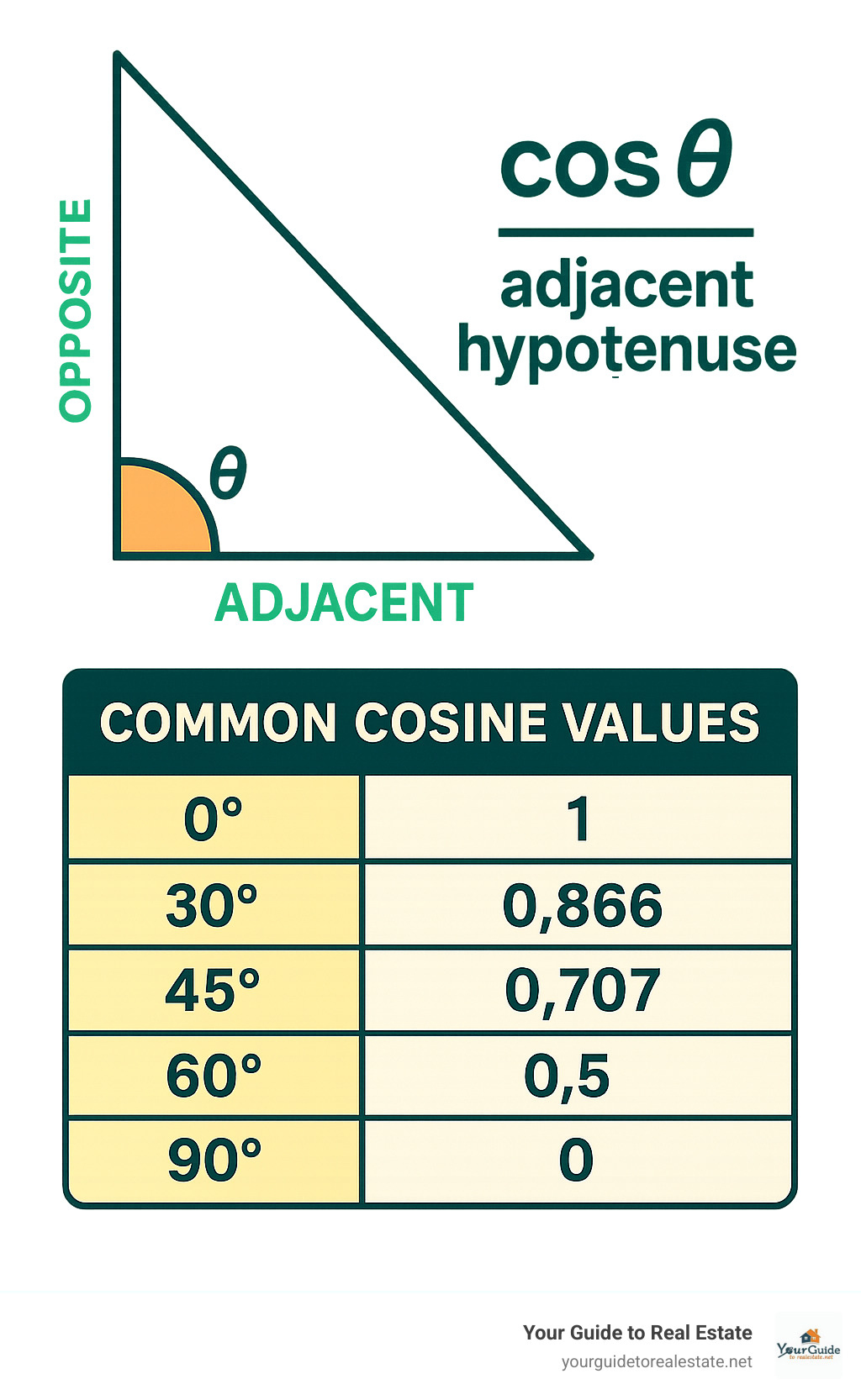
- 0° = 1.000
- 30° = 0.866
- 45° = 0.707
- 60° = 0.500
- 90° = 0.000
- 180° = -1.000
If you’ve ever wondered how surveyors determine exact property lines or how contractors calculate the perfect roof pitch, the answer often involves trigonometry. The cosine function measures the relationship between the adjacent side and hypotenuse of a right triangle, making it essential for countless real estate applications.
From measuring irregular lot sizes to determining optimal solar panel placement, trigonometry appears everywhere in property transactions. A cos value list eliminates the guesswork and speeds up these calculations significantly.
While you might think advanced math has no place in real estate, the truth is quite different. Property professionals use cosine calculations daily – often without realizing it. Understanding these fundamentals can help you make more informed decisions about everything from lot purchases to home improvements.
Easy cos value list glossary:
What is a Cosine and Why Does it Matter?
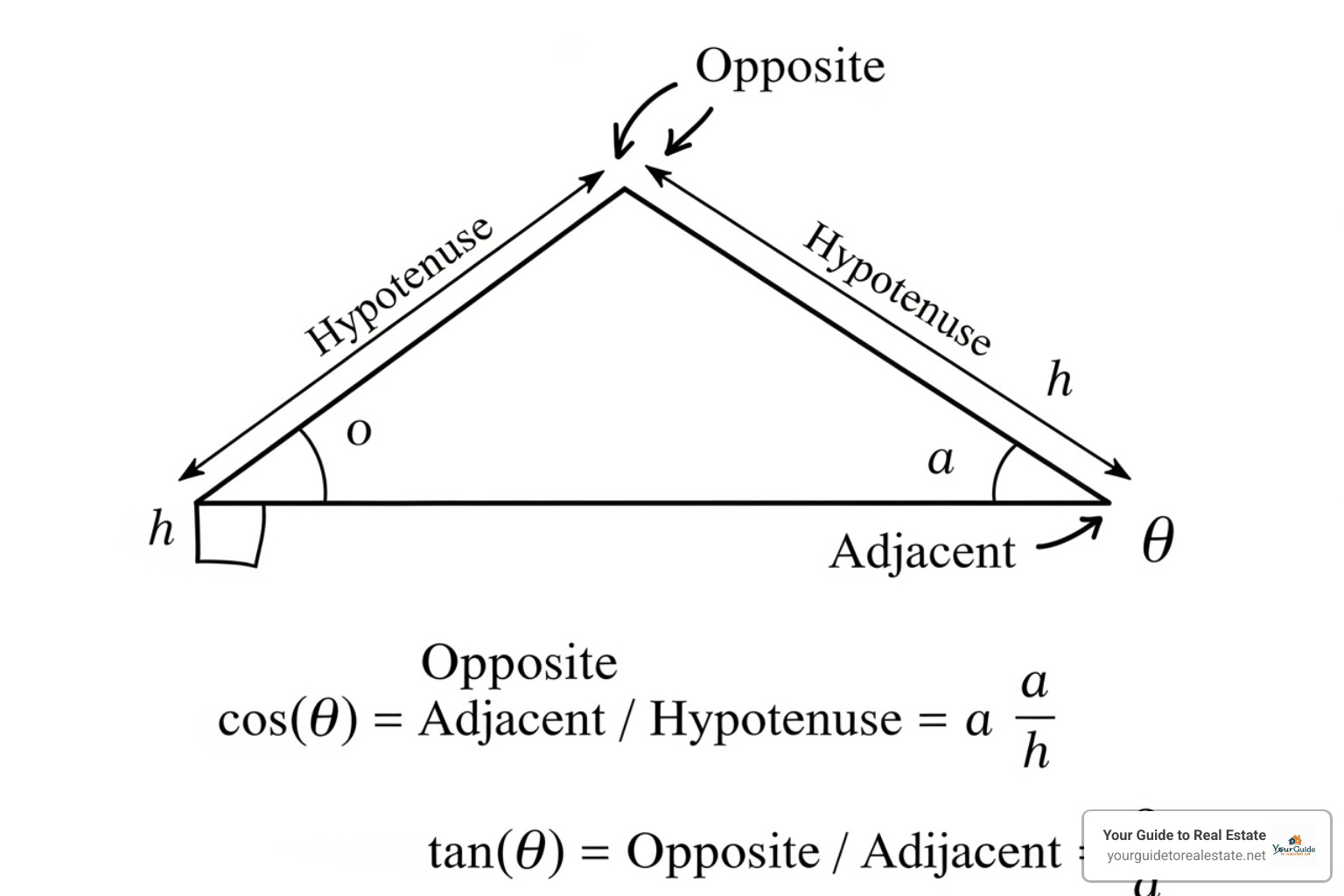
Let’s start with the basics. Cosine is one of the core functions in trigonometry – that branch of math that deals with triangles and angles. When you’re looking at a right-angled triangle, the cosine of an angle tells you something specific: it’s the ratio of the adjacent side (the side next to your angle) divided by the hypotenuse (the longest side of the triangle).
Think of it like this: if you’re standing at the corner of a triangular plot of land, cosine helps you understand the relationship between the ground stretching out beside you and the diagonal property line cutting across the lot.
The unit circle gives us another way to visualize cosine. Picture a perfect circle with a radius of one, centered right at the origin of a graph. Draw a line from the center to any point on the circle’s edge. The x-coordinate of that point? That’s your cosine value for the angle that line makes with the horizontal axis.
Cosine has a close relationship to sine – they’re mathematical siblings, you might say. While cosine deals with the adjacent side and x-coordinates, sine focuses on the opposite side and y-coordinates. Together, they help us understand everything from wave patterns to spatial relationships.
Whether you’re working in degrees (where a full circle equals 360°) or radians (where a full circle equals 2π), cosine behaves consistently. These foundational math concepts might seem abstract, but they’re incredibly practical tools for solving real-world problems with precision.
If you’re working with complex calculations and need to understand different Calculator Functions | Kubotek Kosmos, having a solid grasp of trigonometric functions like cosine can make all the difference.
From Theory to Practice
Here’s where cosine gets exciting – it’s everywhere in the real world. Need to calculate distance across a river without getting wet? Cosine can help. Want to measure the height of a building from ground level? Cosine’s got you covered.
Wave patterns are another fascinating application. Cosine describes the smooth, rhythmic rise and fall of waves – whether they’re sound waves in sound engineering or light patterns in computer graphics. That gentle curve you see on an oscilloscope or the way shadows move across a building? That’s cosine in action.
In real estate, precision matters just as much as it does in engineering or architecture. When you’re dealing with property measurements, boundary calculations, or even understanding the financial aspects of a deal, mathematical accuracy becomes crucial.
Speaking of financial precision, understanding complex transactions like mortgages requires the same attention to detail that makes cosine so valuable in other fields. The underlying principles of accuracy and systematic calculation apply whether you’re working with trigonometry or home loans. For a comprehensive look at this topic, check out Understanding Mortgages: A Beginner’s Guide to Home Loans.
The beauty of cosine is that it bridges the gap between abstract mathematical theory and tangible, practical results. Just like a cos value list helps you quickly reference common angles without reaching for a calculator, understanding these fundamental concepts helps you steer complex real-world situations with confidence.
The Ultimate Cheat Sheet: Your Cos Value List
Picture this: you’re standing on a property with a client, trying to quickly estimate the slope of a roof or the angle of a hillside lot. You could pull out your phone and fumble with a calculator app, or you could have the answer at your fingertips with a cos value list. This simple reference tool is essentially your mathematical cheat sheet—a pre-calculated table of cosine values for the angles you’ll encounter most often.
Back in the day, before smartphones existed, professionals carried thick books filled with trigonometric tables. Engineers, architects, and surveyors would flip through pages of these precise calculations daily. While we now have powerful computers in our pockets, a cos value list still proves incredibly valuable for quick mental checks and building your mathematical confidence.
Think of it as your secret weapon for quick calculations without the hassle of typing numbers into a device. When you’re trying to impress a client with your expertise, there’s something satisfying about knowing that a 60-degree angle has a cosine of exactly 0.5. Plus, having these values readily available serves as a fantastic memorization aid—the more you see them, the more they stick in your brain.
The real beauty of a cos value list lies in how it reveals patterns. You’ll start to notice relationships between angles and their values, making trigonometry feel less mysterious and more intuitive. It’s like having a roadmap for understanding how angles behave in the real world.

A Practical Cos Value List for Common Angles
Let’s get to the good stuff—the actual numbers you’ll use time and again. These common angles appear everywhere in construction, surveying, and property analysis. Master these six values, and you’ll handle most real-world situations with ease.
| Angle (Degrees) | Angle (Radians) | Cosine (Fraction Form) | Cosine (Decimal Approx.) |
|---|---|---|---|
| 0° | 0 | 1 | 1.000 |
| 30° | π/6 | √3 / 2 | 0.866 |
| 45° | π/4 | √2 / 2 | 0.707 |
| 60° | π/3 | 1 / 2 | 0.500 |
| 90° | π/2 | 0 | 0.000 |
| 180° | π | -1 | -1.000 |
How to read the table is straightforward—find your angle on the left, then grab the corresponding cosine value from the right columns. The fraction form gives you the exact mathematical answer, while the decimal version works perfectly for practical applications. When you’re calculating roof slopes or property boundaries, that decimal approximation is usually all you need.
Here’s where it gets really useful: using the list for inverse problems. Sometimes you’ll measure a cosine value and need to work backward to find the angle. Let’s say you calculate that the cosine of an unknown angle equals 0.707. A quick glance at your reference table tells you that’s a 45-degree angle. This reverse lookup saves tons of time when you’re verifying measurements or double-checking calculations in the field.
The beauty of this approach is its simplicity. No complex formulas to remember, no wondering if you pressed the right calculator buttons—just reliable, proven values you can trust when making important property decisions.
Applying the Cos Value List in Real Estate
Here’s where things get really interesting – your cos value list isn’t just a math exercise gathering dust in a textbook. It’s actually a powerful tool that shows up in real estate more often than you’d think!
Every time you see a surveyor setting up equipment on a lot, they’re using trigonometry to nail down exact property boundaries. One small miscalculation could mean the difference between a smooth closing and a costly boundary dispute. These professionals break down complex land shapes into triangles, then use cosine to calculate precise distances and areas.
Think about it – when you’re dealing with an oddly shaped lot, how do you figure out the exact square footage? The answer often involves our trusty cos value list. Surveyors use these values to transform irregular plots into manageable calculations.
Construction and development lean heavily on these concepts too. Roof pitch calculations are a perfect example. Getting the angle right affects everything from proper water drainage to structural integrity. A roof that’s too flat might pool water, while one that’s too steep could create unnecessary stress on the frame.
Property valuation gets more accurate when we have precise measurements to work with. While market conditions drive most pricing decisions, the exact details matter too. When we dive into Valuation and Market Analysis in Real Estate, having spot-on measurements for square footage, roof dimensions, and even sunlight exposure angles can make a real difference in determining a property’s true worth.

Calculating Property Features
Let’s get practical about how cosine shows up in everyday property scenarios. You’ll be surprised how often these calculations pop up!
Roof slope calculations are probably the most common application. Most roofs are described with ratios like 6/12 (rises 6 inches for every 12 inches horizontally). But sometimes you need the actual angle, especially when you’re planning renovations or assessing structural issues. That’s where your cos value list becomes incredibly handy.
Solar panel planning is another area where cosine shines. Homeowners investing in solar want maximum sun exposure for their panels. By understanding roof angles and the sun’s path throughout the day, you can calculate optimal panel positioning. This isn’t just about being environmentally friendly – it’s about maximizing return on investment.
Boundary verification might sound boring, but it can save you thousands. Old property deeds often describe boundaries using angles and distances. While modern GPS makes surveying easier, understanding how these measurements work helps you spot potential problems before they become expensive disputes.
These detailed calculations become especially valuable when you’re preparing comprehensive market analyses. Understanding these technical aspects gives you an edge when advising clients. For more insights on leveraging property details effectively, check out our guide on How to Do a Competitive Market Analysis Real Estate.
The beauty of having a cos value list at your fingertips is that you can quickly verify calculations or make rough estimates on the spot, whether you’re walking a property with clients or reviewing survey documents in your office.
Frequently Asked Questions about Cosine Values
When people first encounter a cos value list, they often have some pretty interesting questions. Don’t worry – we’ve all been there! Let’s tackle the most common ones with simple explanations that actually make sense.
Why is the cosine of 90 degrees equal to zero?
This one trips up a lot of people at first. Picture yourself standing at the center of a circle, holding a rope that reaches to the edge. When you point the rope straight to the right (0 degrees), you’re at position (1,0) on the circle. The cosine value is that first number – the horizontal distance from center.
Now slowly rotate that rope upward. As you reach 90 degrees, you’re pointing straight up to position (0,1). Notice something? The horizontal distance is now zero. That’s why cosine of 90 degrees equals zero.
Think of it another way. In a right triangle, cosine measures the adjacent side divided by the hypotenuse. At 90 degrees, there’s basically no adjacent side left – it’s shrunk down to nothing. It’s like trying to cast a shadow when the sun is directly overhead. No shadow, no adjacent side, no cosine value.
Can the value of cosine be greater than 1?
Nope! Cosine values are always between -1 and +1. They can’t escape this range, and here’s why.
Cosine equals the adjacent side divided by the hypotenuse. In any triangle, the hypotenuse is always the longest side – it’s the champion, the big kahuna. Since you’re dividing a smaller number by a larger number, you’ll never get an answer bigger than 1.
It’s like comparing a slice of pizza to the whole pizza. The slice can never be bigger than the whole thing! The hypotenuse represents the whole, and the adjacent side is just a piece of it. Math keeps everything in check this way.
How is a cos value list different from a sin value list?
While both lists contain similar-looking numbers, they’re actually quite different under the hood.
Cosine uses the adjacent side in its calculations, while sine uses the opposite side. They’re looking at completely different parts of the triangle. It’s like asking two people to describe the same house – one facing the front door, the other facing the back yard. Same house, different perspectives.
Here’s something cool: these two functions are actually complementary. The sine of 30 degrees equals the cosine of 60 degrees. They’re like dance partners, always in sync but never quite in the same position.
If you look at both lists side by side, you’ll notice the cosine values going from 1 down to 0, while sine values go from 0 up to 1. They’re mirror images of each other, shifted by exactly 90 degrees. Pretty neat how math works out sometimes!
This relationship is why having a reliable cos value list is so handy – you can actually figure out sine values too, just by looking at the complementary angles.
Conclusion
What a journey we’ve taken together! From understanding the basic definition of cosine as a ratio in right triangles to exploring how a simple cos value list can open up precision in real estate calculations. We’ve finded that mathematics isn’t just an abstract concept confined to dusty textbooks—it’s a living, breathing tool that shapes the world around us every single day.
Think about it: every time a surveyor maps a property boundary, every time a contractor calculates the perfect roof pitch for proper drainage, every time someone positions solar panels for maximum efficiency, they’re using the principles we’ve explored. The cos value list we’ve shared transforms what could be complex calculations into quick, confident decisions. It’s like having a mathematical compass that always points toward precision.
In real estate, where a few degrees can mean the difference between a properly drained foundation and a costly water damage issue, this knowledge becomes genuinely empowering. When you understand how cosine works—whether you’re a buyer evaluating a property’s solar potential or a seller highlighting unique architectural features—you’re equipped with insights that go beyond surface-level observations.
At Your Guide to Real Estate, we believe knowledge is your greatest asset in any property transaction. Just as our cos value list gives you the tools to understand angles and measurements, our comprehensive resources give you the framework to steer the real estate market with confidence. We’re here to transform complex concepts into actionable insights, whether you’re calculating roof angles or calculating your next investment move.
The beauty of mathematics, much like real estate success, lies in having reliable tools and trusted guidance. From abstract formulas to tangible results, from theoretical concepts to practical applications—this is what happens when knowledge meets opportunity.
Ready to apply this same level of precision to your real estate decisions? Whether you’re looking to buy, sell, or invest, having the right professional guidance makes all the difference. For insights on finding the perfect partner for your real estate journey, explore our comprehensive guide on How to Choose a Broker as a Real Estate Agent.
Every successful property transaction starts with the right foundation of knowledge. Just like cosine helps us understand the relationships between angles and sides, we help you understand the relationships between market trends, property values, and investment opportunities. Your real estate success story begins with making informed decisions—and we’re here to guide you every step of the way.