
Your Essential Guide to the DSCR Loan Calculator
The dscr loan calculator is a vital tool for anyone looking to invest in rental properties. It helps you quickly understand a property’s financial health.
Here’s what a DSCR loan calculator helps you do:
- Determine a property’s Debt Service Coverage Ratio (DSCR).
- Figure out if a rental property’s income can cover its mortgage and expenses.
- See how much loan a property might qualify for.
- Quickly screen potential investment opportunities.
This ratio is key for lenders when they decide whether to give you a loan. It’s all about the property’s ability to pay for itself.
Dscr loan calculator helpful reading:
Understanding the Fundamentals: DSCR Loans vs. Traditional Mortgages
Understanding your financing options is a key step in real estate investing. For investment properties, DSCR loans offer a unique path compared to traditional mortgages, and we’re here to explain the process stress-free.
A DSCR (Debt Service Coverage Ratio) loan is a non-qualified mortgage (non-QM) designed for real estate investors. Unlike a traditional mortgage that scrutinizes personal income, a DSCR loan focuses on the property’s income-generating potential. The property’s expected cash flow is the primary factor for qualification, which is a game-changer for investors. It allows you to qualify based on the asset’s performance, not personal W2s or tax returns.
Traditional mortgages are typically for owner-occupied homes and require extensive documentation of personal income, employment, and debt-to-income ratio. Lenders review W2s, tax returns, and pay stubs, which can be a hurdle for investors with multiple properties or fluctuating income. DSCR loans simplify this by shifting the focus from your income to the property’s income.

If you’re looking to dive deeper into investment strategies, we recommend exploring our guide on How to Invest in Real Estate.
What is the DSCR Formula?
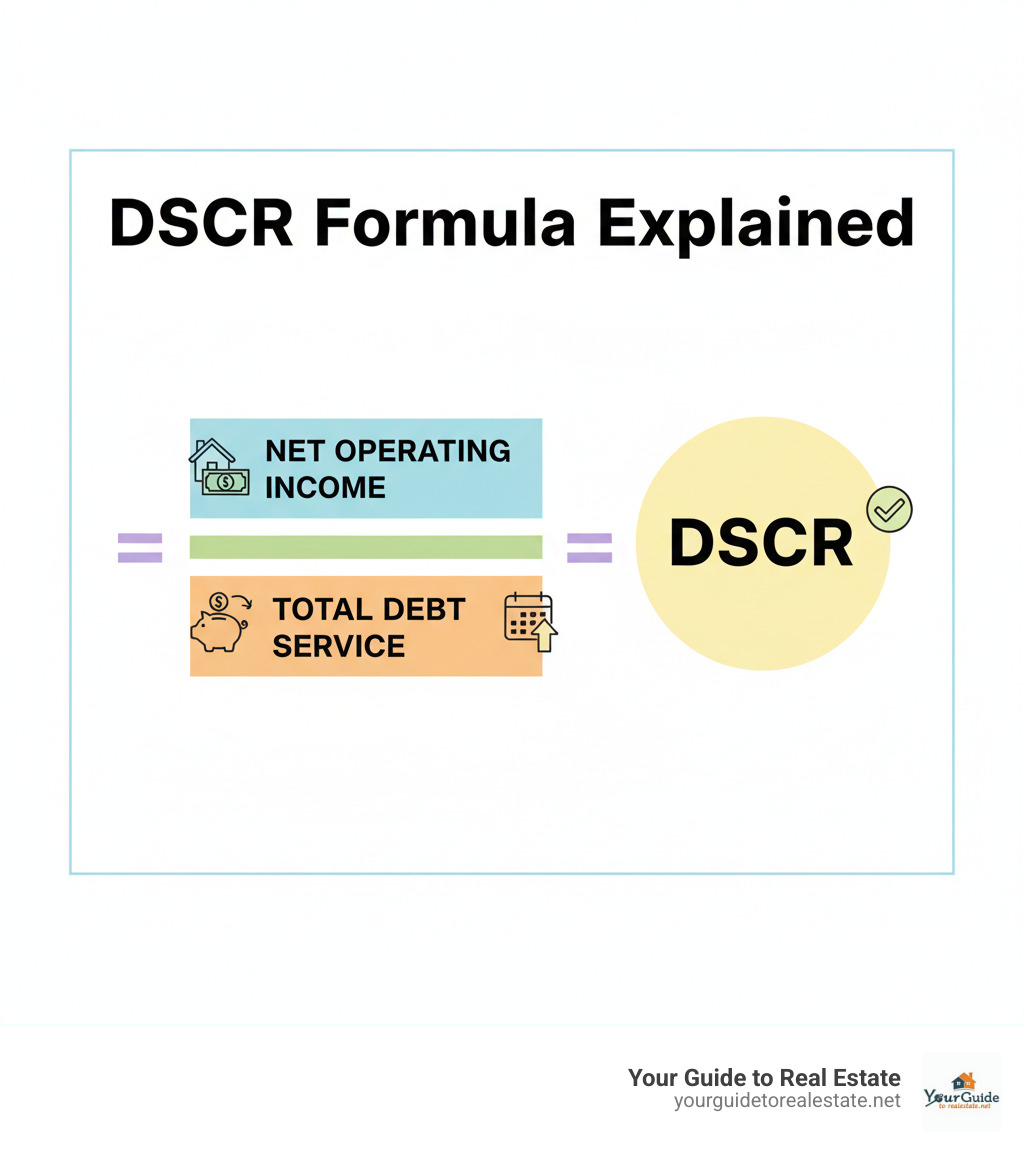
At the heart of every dscr loan calculator lies a simple yet powerful formula:
DSCR = Net Operating Income (NOI) / Total Debt Service
Let’s break down these components:
-
Net Operating Income (NOI): This is the property’s income after operating expenses but before debt payments. To calculate NOI, subtract operating expenses (property management, maintenance, repairs, utilities, vacancy rate) from the Gross Rental Income. This helps us understand the true profitability of the property. A common formula for NOI is:
NOI = (Gross Rental Income - Operating Expenses)
More specifically, some calculators use:
NOI = (1 - expenses)(1 - vacancy) x Gross Income -
Total Debt Service: This is the total annual payment required to service the loan. For a mortgage, this typically includes:
- Principal: The portion of your payment that goes towards reducing the loan balance.
- Interest: The cost of borrowing money.
- Taxes: Annual property taxes.
- Insurance: Homeowners or landlord insurance.
- Association Dues (HOA fees): If the property is part of a homeowners’ association.
Collectively, these are often referred to as PITIA.
Let’s look at a quick example:
Imagine a property generates $3,000 in monthly rental income. After accounting for a 10% vacancy rate and $500 in monthly operating expenses (like property management and maintenance), the monthly NOI would be:
Gross Monthly Rent: $3,000
Vacancy (10%): $300
Operating Expenses: $500
Monthly NOI: $3,000 - $300 - $500 = $2,200
Annual NOI: $2,200 * 12 = $26,400
Now, let’s say the property’s annual debt service (PITIA) is $20,000.
DSCR = $26,400 (NOI) / $20,000 (Debt Service) = 1.32
This DSCR of 1.32 indicates that the property’s income is 1.32 times its debt obligations, a healthy sign for lenders!
Key Differences from Conventional Loans
The distinctions between DSCR loans and conventional mortgages are crucial for investors. Here’s a quick rundown:
-
Qualification Basis:
- DSCR Loans: Based on the property’s cash flow (DSCR), not personal income.
- Traditional Mortgages: Primarily based on the borrower’s personal income, credit history, and debt-to-income ratio.
-
Down Payment Requirements:
- DSCR Loans: Typically require a higher down payment (20% or more) as they are considered higher risk.
- Traditional Mortgages: Can have down payments as low as 3-5% for some programs, especially for first-time homebuyers.
-
Property Type Eligibility:
- DSCR Loans: Exclusively for investment properties, including single-family homes, condos, townhomes, and 2-4 unit properties. They are not for owner-occupied residences.
- Traditional Mortgages: Primarily for owner-occupied primary residences, though some conventional loans can be used for investment properties with stricter qualification criteria.
-
Borrower Income Verification:
- DSCR Loans: Do not require W2s, tax returns, or personal income verification. This is a huge benefit for self-employed investors or those with complex income structures.
- Traditional Mortgages: Mandate thorough documentation of the borrower’s income and employment.
-
Loan Purpose:
- DSCR Loans: Designed for purchasing, refinancing, or cash-out refinancing investment properties.
- Traditional Mortgages: Primarily for purchasing or refinancing a primary residence.
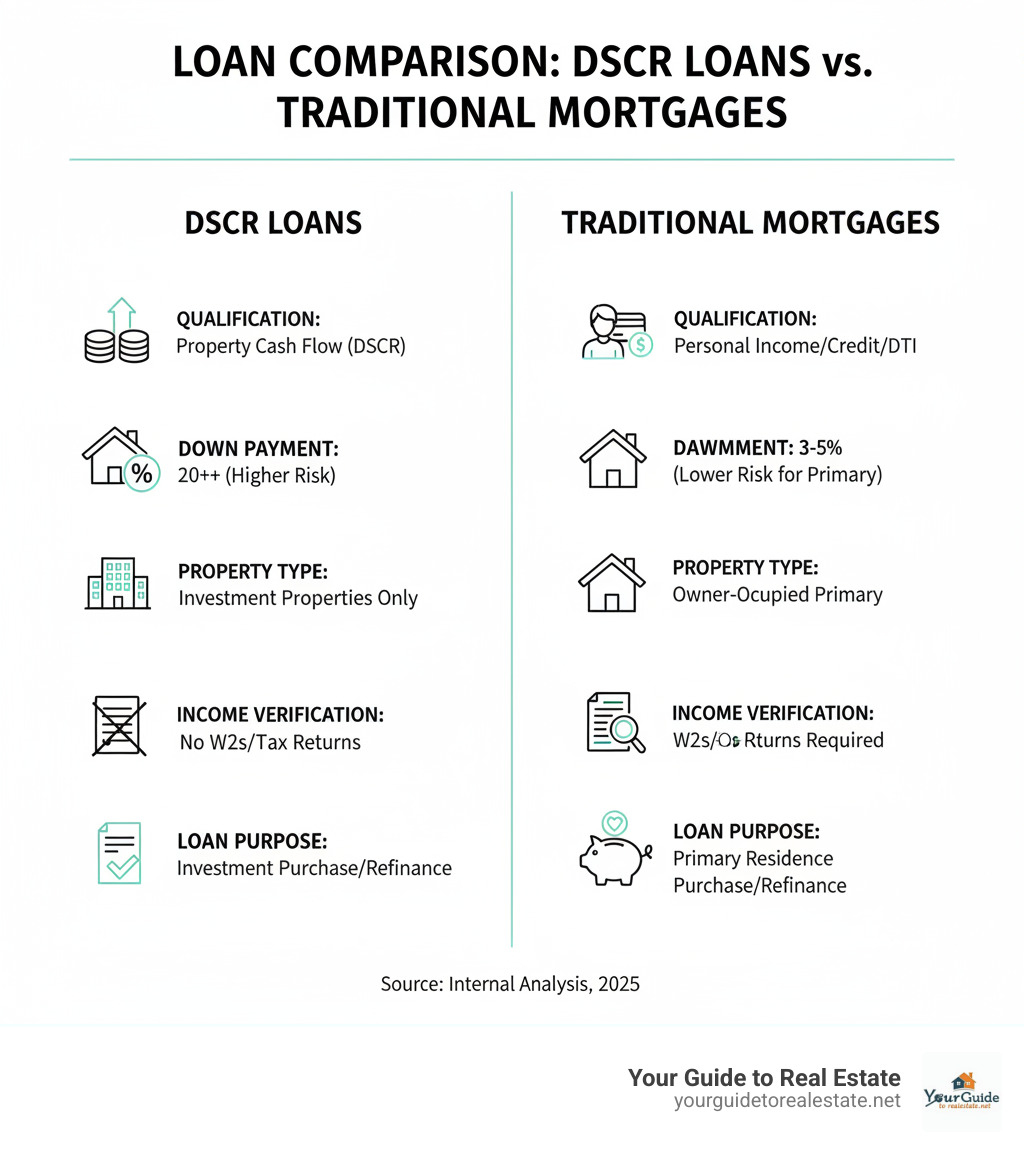
Understanding these differences helps us choose the right financing tool for our real estate goals. For a more comprehensive look at various mortgage options, check out our guide on Understanding Mortgages: A Beginner’s Guide to Home Loans.
Mastering the DSCR Loan Calculator: Key Inputs and Ratios
A dscr loan calculator is a powerful tool for navigating investment property financing. It helps you understand how factors like expenses, interest rates, and loan terms interact with rental income to determine a property’s financial viability. It’s about gaining clarity and confidence in your investment decisions.
The calculator allows you to simulate different scenarios by adjusting variables to see their impact on the DSCR. For instance, you can assess how an interest rate increase or a higher vacancy rate could change a property’s profitability. In a dynamic market, modeling these changes is invaluable. If you’re curious about market movements, you might find our article on Why Are Mortgage Rates Going Up? insightful.

Key Inputs for a DSCR Loan Calculator
To get an accurate DSCR calculation, you’ll need to provide the dscr loan calculator with precise data. Let’s walk through the essential inputs.
First up is the Purchase Price/Property Value. This is simply what you’re paying for the property, or its appraised value if you’re refinancing. From this, we subtract your Down Payment, which is the amount of cash you’re putting in upfront. The remaining figure gives us the Loan Amount, the total money you’ll be borrowing.
Next, we need the Interest Rate – the annual percentage charged on your loan. You’ll also need the Loan Term, which is how long you have to pay back the loan, usually 30 years.
Don’t forget the property’s ongoing costs. These include Property Taxes (Annual) and Homeowners Insurance (Annual). If your property is part of a community with shared amenities, you’ll also have HOA Dues (Monthly).
Finally, and perhaps most importantly, we need the Monthly Rental Income. This is the projected or actual gross rent the property will generate. For properties that are currently vacant, lenders often use about 90% of the appraised market rent. Making sure this number is realistic is crucial.
By carefully entering all these figures, the dscr loan calculator can then determine your Net Operating Income, your total monthly debt service (PITIA), and your all-important DSCR.
What is a Good DSCR Ratio?
A common question is, “What’s a good DSCR?” This ratio is the lender’s way of assessing risk, showing them if your investment property is a reliable income generator or a potential money pit.
Lenders typically want to see a DSCR of 1.25 or higher. This means the property’s Net Operating Income is 1.25 times its annual debt obligations, providing a comfortable buffer.
Here’s what different DSCR values generally mean:
- DSCR < 1.0: This is a red flag. A DSCR under 1.0 means the property’s income doesn’t cover its debt payments, which lenders see as high risk. You’ll likely face a loan rejection.
- DSCR = 1.0: This is a break-even scenario where income barely covers debt. Some lenders might accept a 1.0 DSCR, but it leaves no room for unexpected expenses or vacancies.
- DSCR > 1.0 but < 1.25: This range is often the minimum acceptable for many lenders. It shows the property can cover its debts with a little extra, but the buffer is still slim and somewhat risky.
- DSCR >= 1.25: This is generally considered a “good” DSCR. It gives lenders confidence that the property can comfortably cover its debt service with a healthy margin for unforeseen circumstances, increasing your chances of loan approval and better terms.
While 1.25 is a common benchmark, specific lender requirements can vary. Some may have higher thresholds depending on the property type, market conditions, or your financial profile. Always aim for the highest DSCR possible to demonstrate strong financial health and minimize risk.
How a DSCR Calculator Boosts Your Investment Strategy
For real estate investors, the dscr loan calculator is a strategic weapon. It empowers you to make smarter, more profitable decisions by simplifying complex financial analysis. It helps you assess profitability, screen deals, and maximize your borrowing power.
Manually calculating cash flow for dozens of potential properties is time-consuming. The dscr loan calculator streamlines this process, allowing you to quickly get a snapshot of a property’s financial viability. This rapid assessment is crucial for effective deal screening, helping you identify gems and discard properties that won’t make financial sense.
Beyond this initial screening, the calculator helps us understand how much loan a property might qualify for, which is essential for structuring competitive offers. It also becomes invaluable when we’re considering refinancing options, perhaps a Cash Out Refinancing Explained scenario. With the calculator, we can easily see how new loan terms would impact our cash flow and equity. It’s a key ingredient in building a robust Property Investment portfolio that truly works for us.
How a DSCR Loan Calculator Determines Maximum Loan Amount
A powerful feature of the dscr loan calculator is determining the maximum loan amount a property can support while meeting lender requirements.
Often, this process works backward. Instead of starting with a loan amount and calculating the DSCR, we begin with a target DSCR—for example, the lender-preferred 1.25. We then input the property’s Net Operating Income (NOI). With the target DSCR and NOI, we can calculate the maximum allowable annual debt service. From that figure, we can work backward to find the maximum loan amount based on current interest rates and loan terms.
Lenders also have limits on the Loan-to-Value (LTV), which caps how much of the property’s value they’re willing to finance. For DSCR loans, many private lenders have a maximum LTV of 75% for cash-out refinances, while for purchases, it can go up to 80%. So, even if a property’s DSCR suggests a higher loan amount, the LTV limit might be the deciding factor.
Other factors, like your experience as a real estate investor and your credit score, also play a big part. A higher credit score (720 is often ideal) can lead to more favorable interest rates and terms. While DSCR loans can sometimes be secured with a credit score as low as 620, a stronger score always helps. Plus, showing a track record of successful property management, or “borrower experience,” reassures lenders.
We can also adjust the loan terms within the calculator to see their impact. For instance, choosing a longer loan term (like a 30-year fixed-rate mortgage) would lower monthly payments. This could potentially increase the maximum loan amount we qualify for while still maintaining a healthy DSCR. Some DSCR loans even offer interest-only periods, which can further reduce initial monthly payments.
Benefits of Using a DSCR Loan Calculator
Integrating a dscr loan calculator into our investment toolkit brings a host of benefits. For starters, it offers quick analysis and deal screening, allowing us to rapidly assess numerous properties and identify those with strong cash flow potential. This saves immense time and effort.
This tool also leads to far more informed decision-making. By understanding a property’s DSCR, we gain insight into its financial health, making choices based on solid data, not just gut feelings. It’s fantastic for comparing properties side-by-side.
The calculator excels at financial modeling and scenario planning. We can experiment with different variables—like adjusting the rent or interest rate—to see how they impact the DSCR. This helps us prepare for various market conditions and strategically structure deals for maximizing borrowing power.
A clear DSCR understanding is also a powerful negotiation tool. For seasoned investors, it helps with portfolio optimization by evaluating existing properties for refinancing or selling. Most importantly, it provides stress-free guidance, reducing anxiety around complex financial decisions and giving you control over your investments.
Common Pitfalls and Limitations to Avoid
Even the most sophisticated dscr loan calculator is only as good as the information we put into it. Think of it like cooking – you can have the best recipe in the world, but if you use spoiled ingredients, the final dish won’t turn out well. The same principle applies to our DSCR calculations.
One of the biggest mistakes we see investors make is underestimating their property expenses. It’s tempting to focus only on the obvious costs like principal, interest, taxes, and insurance. But real estate ownership comes with a whole host of additional expenses that can quickly eat into your cash flow. Property management fees typically run 8-10% of your gross rental income. Then there are repairs and maintenance costs, which seem to pop up at the most inconvenient times. Don’t forget about landscaping, pest control, and utilities if they’re your responsibility as the landlord.
Another common trap is ignoring vacancy rates entirely. We get it – when you’re excited about a property, it’s easy to assume it’ll be rented 100% of the time. But even the most desirable properties experience turnover. Most lenders automatically factor in a vacancy rate of 5-10% when calculating your Net Operating Income, and for good reason. For properties that are vacant at settlement, many lenders will use only 90% of the appraised rent amount, effectively building in that 10% vacancy buffer.
Maintenance costs deserve special attention because they’re often the most underestimated expense. Properties need regular upkeep, and occasionally they need major work like a new roof or HVAC system. These aren’t monthly expenses, but they’re annual realities that can significantly impact your bottom line if you haven’t planned for them.
Don’t forget about HOA fees if your property is part of a homeowners’ association. These monthly dues are a fixed expense that must be included in your total debt service calculation. It’s an easy detail to overlook when you’re focused on the bigger numbers, but lenders will definitely include them in their calculations.
Using outdated rent comparables is another pitfall that can throw off your entire analysis. The rental income projection needs to reflect current market rates, not what the seller thinks the property might rent for or what it rented for two years ago. We always recommend getting a professional rent analysis or conducting thorough research on comparable rentals in the area.
Finally, while a dscr loan calculator is an incredibly powerful tool, it shouldn’t be your only source of decision-making. The calculator provides numbers, but it doesn’t understand neighborhood trends, upcoming developments, or potential regulatory changes that could affect your investment. Use it as your financial compass, but combine those results with your own market research and due diligence.
For those who want to dive deeper into the mechanics, you might find this DSCR Loan Calculator Excel Formula Google Sheet helpful for creating your own customized calculations and exploring different scenarios in detail.
Frequently Asked Questions about DSCR Loans
As you learn about DSCR loans, questions are natural. Let’s tackle some common inquiries to provide clear, stress-free guidance so you can invest with confidence.
What credit score is needed for a DSCR loan?
While DSCR loans focus on property income, your personal credit score is still important. A good score can open up better terms and more favorable rates.
For many lenders, a minimum credit score of 620 is often enough to qualify for a DSCR loan. This is fantastic news for investors who might have a few dings on their credit history but are ready to make a smart real estate investment.
However, if you’re aiming for the very best interest rates and potentially higher Loan-to-Value (LTV) ratios, a favorable credit score of 720 or higher is often considered ideal. This “magic number” signals to lenders that you’re a lower risk, and they’ll likely reward you with more attractive loan terms. A higher score can mean significant savings on interest over the life of your loan.
Can I get a DSCR loan for a vacant property?
Yes, you can get a DSCR loan for a vacant property. Lenders understand this common scenario and have ways to handle loans for properties not yet generating income.
Since there’s no tenant paying rent yet, lenders rely on an appraised rent amount. This figure is determined by a professional appraiser who researches the market rent for similar properties in the area, often using a standardized form like Form 1007.
Here’s a crucial detail: if your property is vacant at settlement, many lenders will use 90% of that appraised rent amount for their DSCR calculation. This is a conservative approach, effectively building in a 10% vacancy factor. It’s important to factor this into your own calculations with your dscr loan calculator to ensure your projections are realistic.
Are there interest-only DSCR loans?
Yes, many DSCR loan programs offer interest-only (IO) options, which can be a game-changer for investors looking to maximize cash flow flexibility or keep initial monthly expenses low.
With an interest-only period, your monthly payments cover only the interest that accrues on the loan balance. These IO periods typically last for 5 or 10 years. This extra liquidity can be invaluable for making improvements or building up reserves.
These interest-only periods are usually part of a longer fixed-rate mortgage. You’ll often find them offered within 30-year fixed-rate mortgages, and sometimes even 40-year fixed terms are available. Once the interest-only period ends, your payments will then adjust to include both principal and interest for the remainder of the loan term. For more on loan structures, check out our guide on 30-Year Mortgage Options.
Conclusion
What an incredible journey we’ve taken together through dscr loan calculator tools! We’ve transformed what might seem like intimidating financial jargon into something you can confidently use to build your real estate empire.
Think about where we started – maybe you felt overwhelmed by terms like “debt service coverage ratio” or wondered how investment property financing actually works. Now you’re armed with the knowledge to quickly assess any rental property’s financial health, understand exactly what lenders are looking for, and make smart decisions that can boost your investment returns.
The dscr loan calculator isn’t just another financial tool gathering digital dust – it’s your new best friend in the investment world. Whether you’re eyeing that duplex down the street or considering a cash-out refinance on an existing property, you now know how to crunch the numbers like a pro. You understand that a DSCR of 1.25 or higher makes lenders smile, and you can spot the red flags that might sink a deal before you waste time and money.
We’ve also equipped you with the insider knowledge about common mistakes that trip up even experienced investors. Remember those vacancy rates and maintenance reserves we talked about? That’s the kind of real-world wisdom that separates successful investors from those who learn expensive lessons the hard way.
Most importantly, we’ve taken the stress out of what used to be a complex process. No more wondering if a property will actually make money or if you can qualify for the financing you need. The clarity you now have transforms uncertainty into confidence, and that confidence is what builds wealth in real estate.
At Your Guide to Real Estate, empowering investors like you with practical, stress-free guidance is exactly what we’re here for. We believe everyone deserves access to the proven frameworks that create real estate success, without the overwhelm that often comes with financial analysis.
Ready to put this knowledge into action and explore even more financing strategies? Dive deeper into our comprehensive guide on Real Estate Financing and take the next step toward building the investment portfolio you’ve always dreamed of.