

The Retained Earnings Formula: Your Quick Answer
Understanding the retained earnings formula is crucial for any business, especially for real estate investors keen on growing their wealth. It shows you how much profit your company has kept over time after paying out dividends.
Here’s the simple formula:
- Beginning Retained Earnings
- + Net Income (or – Net Loss)
- – Dividends Paid
- = Ending Retained Earnings
This calculation helps you track the money your business has accumulated to reinvest. It’s a key indicator of financial health and how much capital is available for future growth, like buying new properties or funding renovations.
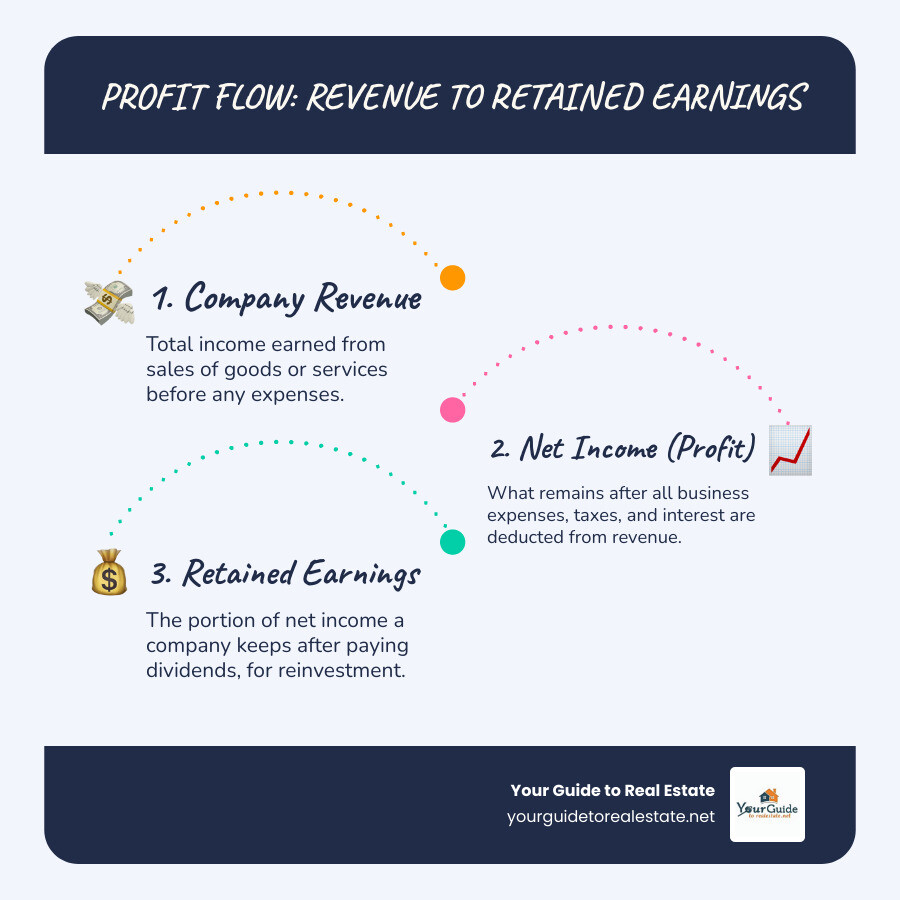
Simple guide to retained earnings formula terms:
What Are Retained Earnings and Why Do They Matter?
Let’s face it, numbers can sometimes feel like a foreign language, but understanding retained earnings is like open uping a secret level in your business’s financial game. At its core, retained earnings represent the accumulated profits a company has kept over its lifetime after accounting for all expenses, taxes, and any dividends paid out to shareholders. Think of it as your business’s “earnings surplus” or its very own savings account, brimming with wealth that can be reinvested back into the company.
This pool of accumulated profits is a critical component of your company’s equity, which is essentially the value of the business that belongs to its owners or shareholders. It’s not just a number on a balance sheet; it’s a powerful indicator of financial health and a strategic asset for future growth.
Why does it matter so much? Because retained earnings are an “organic” source of funding. This means your business can finance new projects, invest in research and development, upgrade existing operations, or even expand into new markets without having to take on external debt or dilute ownership by issuing more shares. It provides a crucial financial cushion, allowing your business to weather economic downturns or seize unexpected opportunities without scrambling for outside capital.

A healthy and growing retained earnings balance can significantly increase your business’s borrowing capacity. Banks and other financial institutions often look at a company’s equity, of which retained earnings are a major part, when assessing loan applications. For example, some banks might lend about three or four times what a company has in terms of equity. If your business boasts substantial retained earnings, you’re signaling financial strength and a lower risk profile, which can lead to better loan terms or a larger loan amount. This can be particularly useful for expanding your real estate portfolio or financing significant property improvements.
Strong retained earnings contribute directly to increasing your business’s overall value and building investor confidence. It shows a track record of profitability and sound financial management, making your company more attractive to potential investors or buyers. It also gives us a clear picture of how effectively a company manages and reinvests its profits.
The Importance for Real Estate Investors
For us, as real estate investors, understanding and managing retained earnings is not just good practice—it’s a game-changer. Our business model often relies on strategic capital allocation, and retained earnings can be the engine that drives our growth.
Here’s how retained earnings play a pivotal role in real estate:
- Funding Property Acquisitions: Imagine spotting a fantastic investment opportunity. With healthy retained earnings, you have the capital to fund down payments for new properties or even purchase smaller assets outright, reducing your reliance on external financing. This internal funding mechanism can put you in a stronger negotiating position and allow for quicker closings. We provide guidance on various mortgage options explained and how retained earnings can strengthen your position.
- Improving Borrowing Capacity: As mentioned, banks love to see a strong equity position. When we approach lenders for real estate financing, our retained earnings directly contribute to our overall equity, making us a more attractive borrower. This can translate into access to larger loans, better interest rates, and more flexible terms—all crucial for expanding our real estate portfolio.
- Demonstrating Financial Stability to Lenders: Whether it’s for a new mortgage or a line of credit for renovations, lenders scrutinize our financial health. A consistent history of accumulating retained earnings assures them that our business is stable, profitable, and capable of managing its obligations, including property-related debts.
- Real Estate Investment Strategies: For those of us pursuing long-term strategies like buy and hold real estate, retained earnings provide the financial backbone. They can fund ongoing maintenance, cover vacancies, or even allow us to hold onto properties during market downturns without financial strain.
- Self-Funding Renovations and Upgrades: Want to boost the value of a property? Retained earnings can be strategically deployed to fund significant renovations, upgrades, or property improvements. This allows us to improve our assets, attract higher rents, or command better sale prices, all while keeping external borrowing to a minimum.
Retained earnings empower us to act decisively, grow sustainably, and maintain greater control over our real estate investments. It’s about building a robust financial foundation that supports our long-term vision.
Retained Earnings vs. Revenue: What’s the Difference?
It’s easy to confuse these two terms, especially when we’re talking about money coming into a business. However, revenue and retained earnings are fundamentally different and represent distinct aspects of a company’s financial performance. Let’s clear up the confusion.
Revenue, often called the “top line,” is the total amount of money a company generates from its primary operations, such as selling goods or services, before any expenses are deducted. If you’re a real estate investor, your revenue might come from rental income, property sales, or consulting fees. It’s a measure of how much business you’re doing over a specific period (e.g., a month, quarter, or year).
Retained earnings, on the other hand, represent the cumulative profit a company has kept after paying all its operating costs, taxes, and any dividends to shareholders. It’s derived from the “bottom line” (net income) and accumulates over the entire life of the business. It tells you how much profit has been reinvested back into the business rather than distributed.
Here’s a quick comparison:
| Feature | Revenue | Retained Earnings |
|---|---|---|
| Definition | Total income from sales/services before expenses | Cumulative profit kept after expenses, taxes, & dividends |
| Location | Top of the Income Statement | Shareholder’s Equity section of the Balance Sheet |
| Purpose | Measures sales activity | Measures accumulated reinvested profits |
| Timing | Period-by-period (e.g., annual, quarterly) | Cumulative since inception of the business |
| Impact | Indicates sales volume and market reach | Indicates financial strength and reinvestment capacity |
While high revenue is fantastic, it doesn’t automatically mean a business is profitable or financially sound. A company can have high revenue but also high expenses, leading to low or even negative net income. Retained earnings, however, reflect the actual profit that has been successfully generated and held within the company over time. They paint a more complete picture of a business’s enduring financial health and its capacity for self-funded growth.
The Retained Earnings Formula Explained Step-by-Step
Now that we understand what retained earnings are, let’s get our hands dirty with the actual calculation. Don’t worry – this isn’t rocket science, and you don’t need an accounting degree to master it. The retained earnings formula is beautifully straightforward once you break it down.
Here’s the formula that ties everything together:
Beginning Retained Earnings + Net Income (or Loss) – Dividends Paid = Ending Retained Earnings
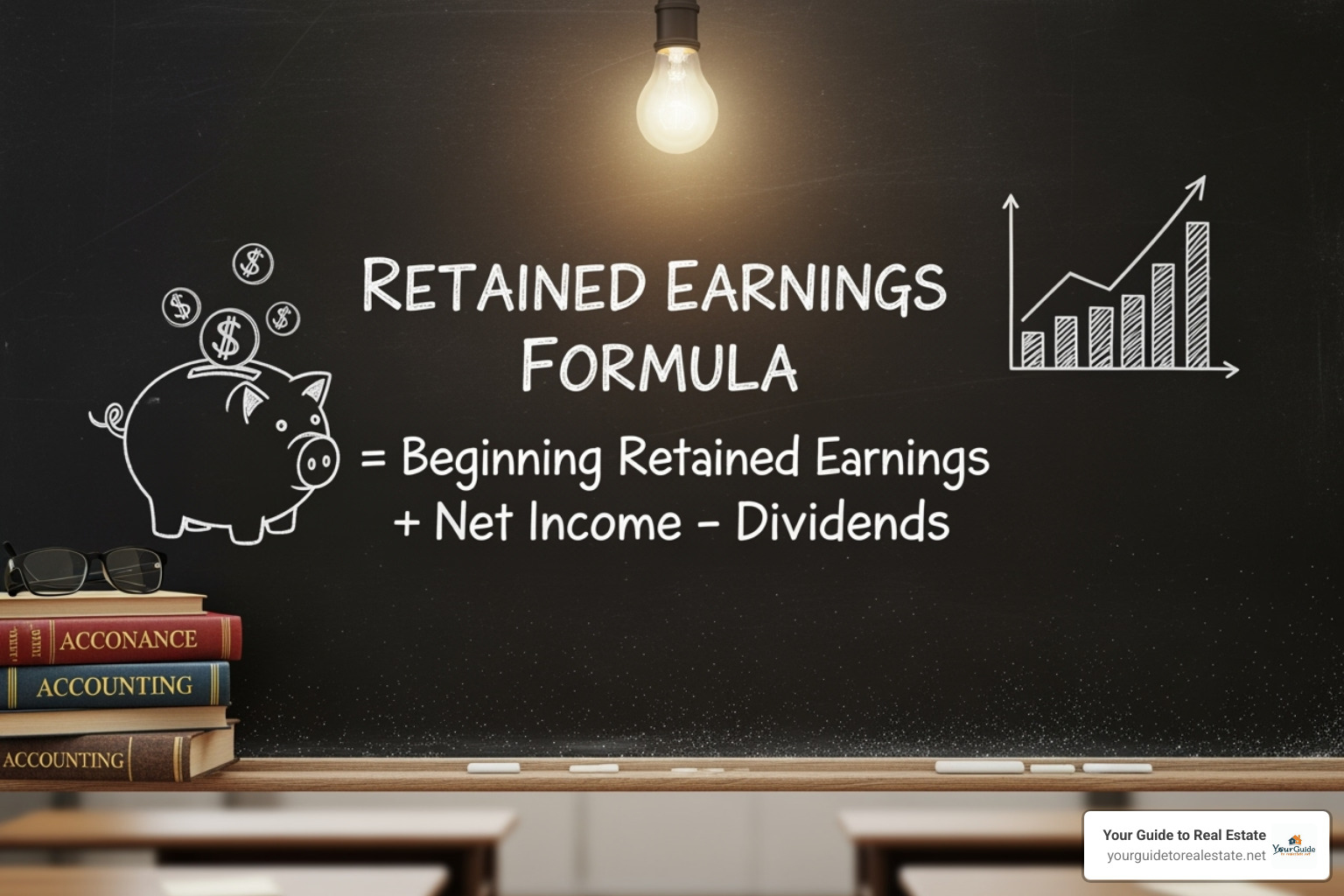
Think of this formula as a bridge connecting your income statement to your balance sheet. It shows how the profits you earned during a specific period flow into your company’s overall financial position. Each piece of this puzzle tells part of your business’s financial story.
Let’s walk through a quick calculation example. Say your real estate business started the year with $75,000 in retained earnings. During the year, you earned a net income of $25,000 from rental properties and property sales. You decided to pay yourself $5,000 in dividends. Your ending retained earnings would be: $75,000 + $25,000 – $5,000 = $95,000.
How to Determine Beginning Retained Earnings
Every story needs a starting point, and for the retained earnings formula, that’s your beginning retained earnings. This number comes straight from your prior period’s balance sheet – specifically, the ending retained earnings from your last accounting period.
If you finished last year with $50,000 in retained earnings, that becomes your starting point for this year’s calculation. It’s like checking your bank account balance before you start tracking this month’s deposits and withdrawals.
For new businesses, this number starts at zero. You can’t have accumulated profits from previous periods if you’re just getting started! Every successful business begins this journey with a clean slate.
Here’s where many people get confused: this isn’t about cash in the bank. Your beginning retained earnings represent the cumulative profit your business has kept over its entire lifetime, whether that money is sitting in cash, invested in equipment, or tied up in inventory.
How Net Income (or Loss) Affects the Retained Earnings Formula
The heart of our retained earnings formula is net income – that crucial “bottom line” figure from your income statement. This is where your business’s performance during the current period directly impacts your accumulated wealth.
When your business generates a profit, every dollar of that net income gets added to your retained earnings. If your real estate investment company earned $30,000 in net income this quarter, your retained earnings grow by exactly that amount (before considering any dividends).
But life isn’t always smooth sailing. When your business experiences a net loss – maybe you had unexpected repair costs or a property sat vacant longer than expected – that loss reduces your retained earnings. A $10,000 loss means $10,000 less in your accumulated profits.
This connection between current performance and long-term financial health is what makes retained earnings such a powerful indicator. It shows not just how you’re doing right now, but how consistently you’ve been adding profit to your business over time.
The Role of Dividends in the Retained Earnings Formula
Here’s where business owners face a classic dilemma: keep the money in the business or take some profits home. Dividends represent the portion of your accumulated profits that you choose to distribute to yourself and other shareholders.
Every dollar you pay in dividends is a dollar that comes directly out of your retained earnings. It’s money that’s no longer available for reinvestment in your business – whether that’s buying new properties, funding renovations, or building up your financial cushion.
Cash dividends are the most straightforward – you literally write yourself a check from business profits. Stock dividends are less common for most real estate investors, but they involve issuing additional shares instead of cash payments.
The key insight here is balance. While it’s tempting to take out large dividends when times are good, reducing retained earnings can limit your future borrowing capacity and growth opportunities. Banks love seeing strong retained earnings because it demonstrates financial stability and gives them confidence in your ability to handle larger loans.
Think of it this way: dividends are like spending from your business’s savings account. Sometimes it makes sense, but you want to make sure you’re leaving enough in there to fund your next big opportunity or weather any storms that come your way.
How to Analyze Retained Earnings and Avoid Common Pitfalls
Understanding the retained earnings formula is one thing, but knowing how to analyze what those numbers mean for your business is where the real value lies. Think of it this way: calculating retained earnings is like taking your business’s financial temperature, but analyzing it tells you whether you’re healthy or need to see a doctor.
When banks evaluate loan applications, they don’t just glance at your retained earnings and move on. They dig deeper, looking at trends over time and comparing your accumulated profits to your total debt. A strong, growing retained earnings balance tells lenders that your business consistently generates profits and reinvests them wisely. This translates directly into better loan terms and higher approval chances for your next property purchase.

From an investor’s perspective, retained earnings reveal your business philosophy. Are you focused on aggressive growth by reinvesting every penny back into new properties? Or do you prefer taking profits out regularly to diversify your investments? Neither approach is wrong, but understanding your pattern helps you make more strategic decisions about future capital allocation.
The key is looking at retained earnings in context. A real estate investment company with $500,000 in retained earnings might seem incredibly strong, but if they’ve been in business for twenty years, that might actually signal sluggish growth. Conversely, a three-year-old company with $100,000 in accumulated profits could be on a fantastic trajectory.
Where to Find Retained Earnings on Financial Statements
Let’s get practical about where to actually locate this important number on your financial statements. You won’t have to hunt around like you’re searching for hidden treasure – retained earnings have specific homes in your financial reports.
The balance sheet is where retained earnings live most of the time. Look for the shareholder equity section, usually found at the bottom right of your balance sheet. You’ll see it listed alongside other equity accounts like common stock and additional paid-in capital. This section shows everything that belongs to the business owners, and retained earnings represent the portion that’s been earned through profitable operations and kept in the business.
Some businesses, particularly larger ones, also prepare a separate statement of retained earnings. This dedicated financial statement walks you through the entire journey from your beginning balance to your ending balance, showing exactly how net income and dividends affected your accumulated profits during the period. It’s like having a detailed story of your retained earnings rather than just the final chapter.
For smaller real estate investment businesses, you might find retained earnings information embedded within other financial reports, but the balance sheet remains your most reliable source. When you’re preparing financial statements for lenders or investors, make sure this figure is clearly visible and accurately calculated.
What Does a Negative Retained Earnings Balance Mean?
Seeing negative retained earnings on your balance sheet can feel like finding your business bank account is overdrawn – it’s concerning, but it’s not necessarily the end of the world. When retained earnings drop below zero, accountants call this an accumulated deficit, which sounds scarier than it often is in practice.
The most straightforward explanation for negative retained earnings is consistent net losses over time. If your real estate business has been spending more than it’s earning for several periods, those losses pile up and eventually eat through any previous profits. This is particularly common during economic downturns when property values decline or rental income drops significantly.
Sometimes, accumulated deficits result from high dividend payouts relative to earnings. Perhaps you’ve been taking regular distributions from your business to fund personal expenses or other investments, even during periods when profits were modest. While this isn’t necessarily poor management, it does reduce the capital available for future growth and can limit your borrowing capacity.
For startup phase real estate investors, negative retained earnings are almost expected. You might spend months or even years acquiring properties, handling renovations, and building your rental portfolio before generating consistent positive cash flow. Those initial investments and operating losses create an accumulated deficit that should reverse as your business matures.
However, for established businesses, persistent negative retained earnings can raise red flags for lenders. Banks want to see that you can generate profits and build equity over time. An accumulated deficit suggests either operational challenges or poor capital management decisions, both of which make lenders nervous about your ability to repay loans.
The context matters enormously. A new real estate investment company with a small accumulated deficit is very different from a ten-year-old business that’s never managed to accumulate profits.
Common Mistakes to Avoid
Even with the straightforward retained earnings formula, it’s surprisingly easy to make errors that can throw off your entire financial analysis. These mistakes don’t just affect your internal records – they can mislead lenders, investors, and even your own strategic decisions.
Mixing up revenue with net income is probably the most common error we see. Revenue is the total money coming into your business before any expenses. Net income is what’s left after paying all your bills, taxes, and operating costs. Using revenue instead of net income in your retained earnings calculation will make your accumulated profits look artificially high, giving you a false sense of financial strength.
Forgetting about all types of dividends is another frequent oversight. Most people remember cash dividends, but stock dividends and special distributions also reduce retained earnings. If you’ve taken any money out of the business – whether as regular distributions, special bonuses, or even informal loans to yourself – these need to be accounted for in your calculation.
Using the wrong beginning balance might seem like a simple mistake, but it happens more often than you’d think. Your beginning retained earnings should always equal the ending retained earnings from your previous accounting period. Using an outdated figure or accidentally pulling from the wrong time period will skew your entire calculation.
Ignoring prior period adjustments can also create problems. Sometimes you find errors from previous years or need to change accounting methods. These adjustments typically require restating your beginning retained earnings balance, and forgetting to make these corrections will carry the error forward into your current calculations.
The best defense against these mistakes is developing a systematic approach to your financial record-keeping and regularly reconciling your retained earnings with other financial statements. When your numbers don’t match up across different reports, it’s usually a sign that one of these common errors has crept into your calculations.
Frequently Asked Questions about Retained Earnings
Let’s be honest – diving into financial concepts can feel a bit like learning a new language. Even after understanding the retained earnings formula, you probably have some lingering questions. That’s completely normal! Here are the most common questions we hear about retained earnings, answered in plain English.
Are retained earnings the same as cash?
This might be the biggest myth in business finance, so let’s clear it up right away: No, retained earnings are definitely not the same as cash.
Think of it this way – retained earnings show you how much profit your business has accumulated over time, but that doesn’t mean all that money is sitting in your checking account. Your business has likely been busy putting those profits to work.
Maybe you’ve reinvested in new assets like that duplex you bought last year, or increased your inventory of renovation supplies. Perhaps you’ve got money tied up in accounts receivable – rent that tenants owe you but haven’t paid yet. You might have even used some profits to pay down debt or invest in property improvements that boosted your portfolio’s value.
Here’s a reality check that might surprise you: a company can have millions in retained earnings but only a few thousand dollars in actual cash. This happens all the time with growing real estate businesses that are constantly reinvesting their profits into new properties or improvements.
If you want to know how much cash you actually have on hand, you need to look at your cash flow statement, not your retained earnings. They’re two completely different financial pictures.
What is a good level of retained earnings?
Ah, the million-dollar question! Unfortunately, there’s no magic number that works for everyone. It’s kind of like asking “What’s the perfect house?” – it depends on your situation, goals, and where you are in your journey.
Industry matters a lot. A tech startup might plow almost every penny back into research and development, while a well-established property management company might keep substantial reserves and pay out regular dividends to owners.
Your business’s growth stage plays a huge role too. If you’re in growth mode, you might actually have lower retained earnings (or even that scary-sounding accumulated deficit we talked about earlier) because you’re aggressively reinvesting everything into expansion. Think about it – if you’re flipping houses or rapidly building a rental portfolio, your profits are probably going straight into the next deal.
On the flip side, mature businesses often have substantial retained earnings. They’ve got their systems down, fewer high-growth opportunities to chase, and might be focused on steady income rather than explosive growth.
Here’s what really matters: the trend over time. A consistently positive and growing retained earnings balance tells a great story about your business. It shows you’re profitable, you’re managing your money well, and you’re building a solid foundation for the future.
Don’t get too hung up on hitting some arbitrary benchmark. Focus on steady, sustainable growth that aligns with your real estate investment strategy.
How are retained earnings analyzed by banks for a loan?
This is where understanding your retained earnings formula becomes really valuable for your real estate ambitions. Banks absolutely love to see strong retained earnings, and here’s why.
Retained earnings are a major piece of your company’s equity, and banks view equity as your skin in the game. The more equity you have, the more financially stable you appear. It shows you’ve got something to lose, which makes you a safer bet in their eyes.
Banks pay close attention to your debt-to-equity ratio. This compares how much debt your company carries versus how much equity you have. Strong retained earnings help keep this ratio in your favor, signaling that you’re not over-leveraged and can handle additional debt responsibly.
From a lender confidence perspective, consistent retained earnings tell a compelling story. They show your business is profitable, well-managed, and has the internal resources to weather storms. This builds trust that you’ll make your loan payments on time.
Here’s where it gets exciting for real estate investors: strong retained earnings can dramatically increase your borrowing capacity. Many banks will lend three or four times your equity amount. So if your business has built up $400,000 in retained earnings as part of its equity, you might qualify for an additional $1.2 million to $1.6 million in borrowing power.
That kind of leverage can be transformative when you’re looking to acquire new investment properties or fund major developments. It’s also why banks look more favorably on your application when you’re exploring different real estate financing options.
Strong retained earnings essentially act as a powerful endorsement of your business’s creditworthiness, making it easier and more affordable to secure the capital you need for your real estate goals.
Conclusion: Putting Your Financial Knowledge to Work
We’ve taken quite a journey together through the retained earnings formula, and I hope you’re feeling more confident about this crucial financial concept. What started as a simple equation has revealed itself to be so much more—it’s truly a window into your business’s financial soul.
Think about what we’ve finded. The retained earnings formula isn’t just about crunching numbers on a spreadsheet. It’s about understanding the strategic reinvestment choices that shape your business’s future. Every dollar you keep in retained earnings is a dollar that can fuel your next property acquisition or fund that renovation project you’ve been eyeing.
For us real estate investors, this knowledge is pure gold. When you walk into a bank armed with a solid understanding of your retained earnings, you’re not just another loan applicant—you’re demonstrating financial stability and business acumen. Lenders respect that, and it shows in the terms they’re willing to offer.
The beauty of mastering this concept lies in how it transforms your decision-making process. You’ll start viewing your business profits differently, weighing the benefits of strategic reinvestment against immediate cash flow needs. Should you keep those earnings to fund your next property purchase, or distribute them as dividends? Now you have the framework to make that choice confidently.
Every successful real estate investor started somewhere. By taking the time to understand concepts like retained earnings, you’re building the foundation for long-term wealth creation. Your future self—the one closing on that dream property or celebrating another successful investment—will thank you for putting in this groundwork today.
Ready to dive even deeper into the financial side of real estate? Check out our comprehensive guide on valuation and market analysis in real estate to master the art of identifying profitable opportunities and making smart investment decisions.