

Your First Step to Homeownership
A mortgage calculator is a free online tool that estimates your monthly home loan payment based on the loan amount, interest rate, and loan term. Here’s what you need to know:
Key inputs for accurate calculations:
- Home purchase price
- Down payment amount (typically 3-20%)
- Loan term (15 or 30 years most common)
- Interest rate (currently averaging 6.88% for 30-year fixed)
- Property taxes, insurance, and HOA fees
What you’ll get:
- Monthly principal and interest payment
- Total monthly payment including taxes and insurance
- Total interest paid over the loan life
- Loan payoff date
Buying a home is likely the biggest financial decision you’ll ever make. Before you start house hunting or meet with lenders, you need to know what you can actually afford.
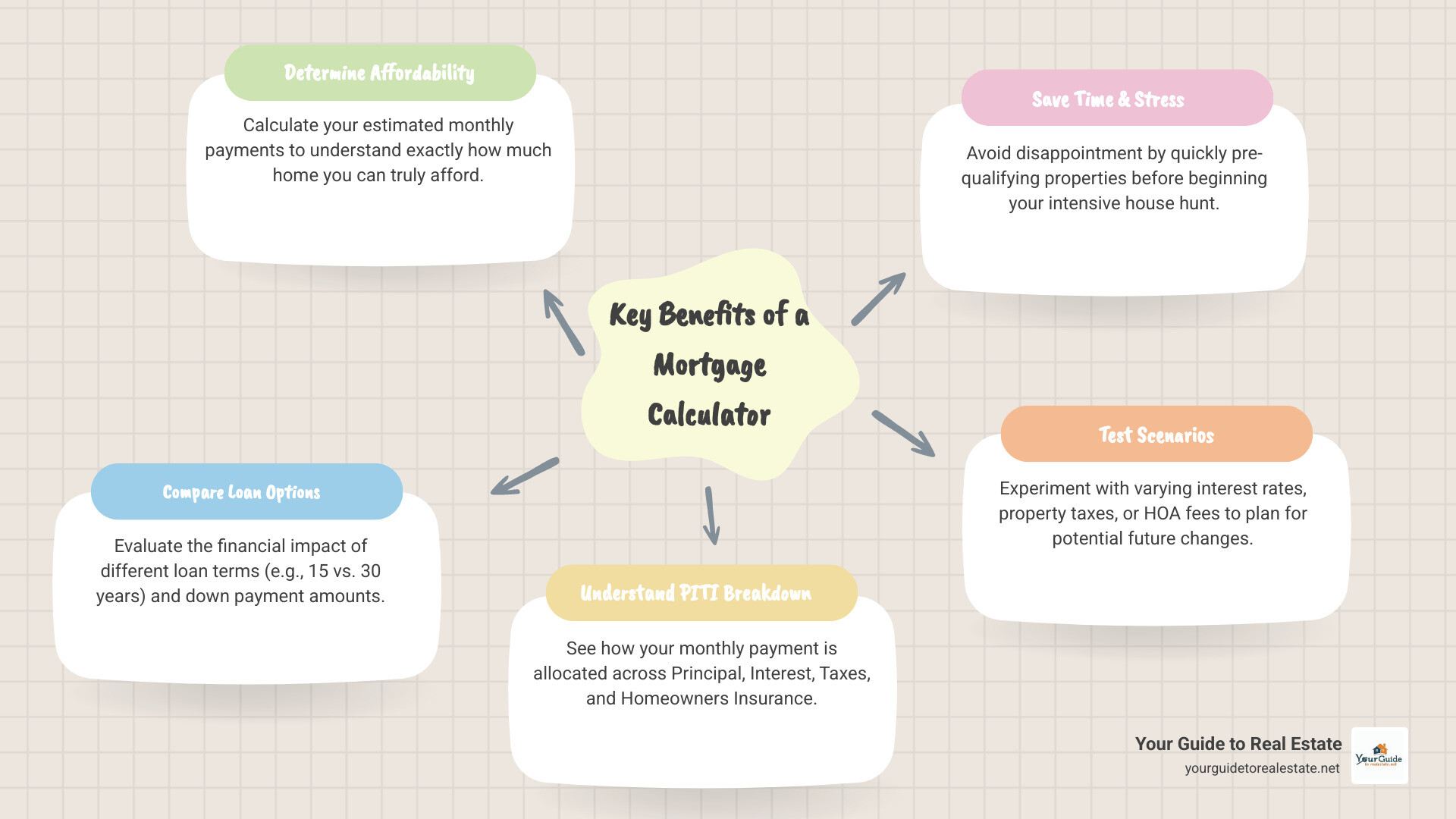
A mortgage calculator takes the guesswork out of home affordability. Instead of wondering “Can I afford that $400,000 house?” you can plug in the numbers and see exactly what your monthly payment would be.
The tool helps you answer critical questions:
- How much house can I afford with my income?
- Should I choose a 15-year or 30-year loan?
- How much will a larger down payment save me monthly?
- What happens if interest rates change?
Smart homebuyers use these calculators before they fall in love with a property. This prevents the disappointment of finding your dream home, only to find the payments would stretch your budget too thin.
The 28/36 rule suggests spending no more than 28% of your gross income on housing costs. For someone earning $5,000 monthly, that means keeping total housing expenses under $1,400.
For comprehensive guidance on your homebuying journey, check out our First-Time Homebuyer Tips.
Find more about mortgage calculator:
How to Use a Free Mortgage Calculator
Think of a mortgage calculator as your financial compass—it points you in the right direction before you start your homebuying journey. The good news? These tools are designed to be straightforward, even if you’re not a numbers person.
Before you dive in, gather your information first. Having your numbers ready makes the process smooth and gives you more accurate results. Most online calculators follow the same basic format, so once you learn one, you’ll be comfortable with any of them.
Entering Your Core Loan Details
Let’s start with the big four—the essential details that shape your monthly payment.
Home Price is simply the purchase price of the house you’re considering. Even if you’re just exploring options, use a realistic number for your area. This gives you a solid foundation for planning.
Your Down Payment Amount is the cash you bring to the table upfront. You can enter this as a dollar amount or percentage—whatever feels easier. Here’s where things get interesting: a larger down payment doesn’t just lower your monthly payment, it can save you money in other ways too.
The magic number is 20% down payment. Hit this target, and you’ll avoid Private Mortgage Insurance (PMI)—a significant monthly expense we’ll talk about shortly. On a $400,000 home, that’s $80,000 down, but it eliminates PMI entirely.
Loan Term is how long you have to pay back the mortgage. Most people choose between 15 and 30 years. A 30-year loan gives you lower monthly payments, while a 15-year loan saves you thousands in interest over time. It’s like choosing between a comfortable monthly budget or getting debt-free faster. Our 30-Year Mortgage Options guide breaks down the pros and cons of each.
The Interest Rate might seem like just a number, but small changes make big differences. As of late 2024, 30-year rates averaged around 6.88%, while 15-year loans averaged 6.14%. Even a half-percent difference can change your payment by hundreds of dollars monthly. For deeper insights into how rates work, check out Understanding Mortgage Rates.
Adding Other Homeownership Costs for Accuracy
Here’s where many first-time buyers get surprised—your mortgage payment includes more than just paying back the loan. These additional costs, often called escrow items, are bundled into your monthly payment for convenience.
Property Taxes fund your local schools, police, and fire departments. They typically run about 1.1% of your home’s value annually, but this varies dramatically by location. A mortgage calculator often estimates these based on your ZIP code, giving you a realistic starting point.
Homeowners Insurance protects your investment from fire, theft, and natural disasters. Think of it as essential armor for your biggest asset. The calculator will estimate this cost, but getting an actual quote gives you more precision.
If you’re looking at condos or planned communities, HOA fees cover shared amenities and maintenance. These can range from modest monthly amounts to several hundred dollars, especially in communities with pools, gyms, or extensive landscaping.
PMI costs kick in when your down payment is less than 20%. This insurance protects your lender (not you) if you can’t make payments. PMI typically costs between 0.3% and 1.9% of your loan amount annually—that’s $100 to $600 monthly on a $300,000 loan.
Most lenders use Escrow accounts to handle your property taxes and insurance. They collect extra money with each mortgage payment and pay these bills when they’re due. It’s like having a responsible friend manage these important payments for you.
When you include all these numbers in your mortgage calculator, you get the complete picture of homeownership costs. No surprises, no budget-busting revelations later—just clear, honest numbers to guide your decisions.
Understanding Your Estimated Monthly Payment (PITI)
After you punch in all your numbers, your mortgage calculator will show you that magic number—your estimated monthly payment. But here’s the thing: that payment isn’t just one lump sum. It’s actually made up of four distinct parts that work together like pieces of a puzzle.
Think of it like ordering a combo meal. You see the total price, but inside you’re getting the burger, fries, drink, and maybe a cookie. Your mortgage payment works the same way, with four components we call PITI: Principal, Interest, Taxes, and Insurance.
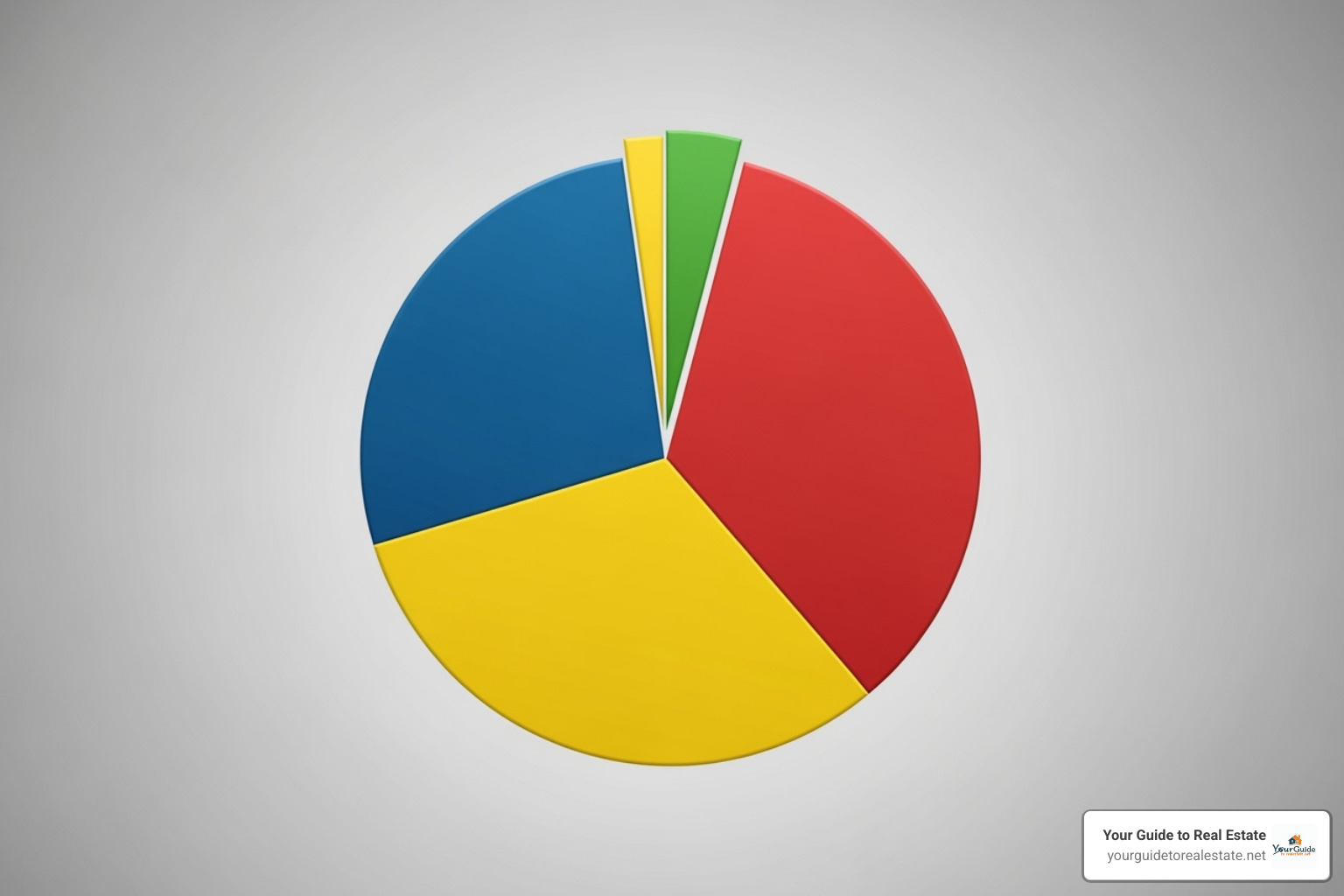
The calculator doesn’t just give you this breakdown—it also creates something called an amortization schedule. This fascinating table is like a crystal ball for your mortgage. It shows you exactly how each payment gets divided between principal and interest over the entire life of your loan. You’ll be amazed to see how dramatically this split changes over time.
Principal & Interest (P&I)
The heart of your mortgage payment is the principal and interest portion. These two work as a team, but they have very different jobs.
Principal is simply the money you actually borrowed. Every month, part of your payment chips away at this debt. Think of it as paying yourself back—because as you reduce the principal, you’re building equity in your home. That equity is real wealth you can tap into later.
Interest is the price you pay for borrowing the lender’s money. It’s how they make their profit from the loan. Here’s where things get interesting: in your early mortgage years, most of your payment goes to interest rather than principal.
Let’s talk about amortization—it sounds fancy, but it’s actually a pretty clever system. Your monthly principal and interest payment stays exactly the same for the entire loan term. But here’s the twist: the mix of principal versus interest changes dramatically over time.
Picture this: on a $320,000 mortgage, your first payment might send $400 to principal and $1,800 to interest. Fast forward 15 years, and you might be paying $1,200 toward principal and only $1,000 in interest from that same monthly payment. By the end of your loan, almost your entire payment goes to principal.
This happens because interest is calculated on your remaining balance. As that balance shrinks, less interest accumulates each month, which means more of your fixed payment can attack the principal. It’s like a snowball effect working in your favor.
Want to understand the complete journey from application to keys in hand? Our Loan Process for Buying a House guide walks you through every step.
What’s the Difference Between Interest Rate and APR?
When shopping for a mortgage, you’ll see two numbers that look similar but tell different stories: the interest rate and the APR. Most mortgage calculators use the interest rate for basic calculations, but understanding both helps you make smarter decisions.
The interest rate is straightforward—it’s the percentage your lender charges you to borrow their money. If you see 6.88%, that’s what determines your monthly principal and interest payment. Simple enough.
APR (Annual Percentage Rate) is the big picture view. It includes your interest rate plus other loan costs spread out over the loan’s life. Think of the interest rate as the sticker price on a car, while APR is the total cost after you add taxes, fees, and extended warranties.
The APR captures costs like closing costs, which typically run 2% to 5% of your loan amount. On a $400,000 home purchase, that could mean $10,000 in fees for things like appraisals, title searches, and attorney fees. These aren’t part of your monthly payment, but they’re real costs of getting the loan.
Discount points also get rolled into APR calculations. These are optional upfront fees—each point costs 1% of your loan amount—that you can pay to lower your interest rate. It’s like buying a discount on your future payments.
Here’s why this matters: two lenders might offer the same interest rate, but different APRs. The one with the lower APR is actually the better deal because it has fewer hidden costs baked in.
When you’re ready to compare different loan offers side by side, our guide on How to Compare Mortgages will help you spot the best deal beyond just the interest rate.
Strategic Planning with a Mortgage Calculator
Think of a mortgage calculator as your personal financial crystal ball. It’s not just about finding out what your monthly payment will be – it’s about finding what’s truly possible with your homebuying journey.

The real magic happens when you start playing the “what if” game. What if you put down 15% instead of 10%? What if you chose a 15-year loan instead of 30 years? What if rates drop by half a percent next month? These aren’t just idle questions – they’re strategic decisions that could save you tens of thousands of dollars.
Determining affordability becomes crystal clear when you can see the numbers in black and white. 28/36 rule we talked about earlier? Your mortgage calculator helps you stay within those boundaries by showing exactly how much of your income would go toward housing costs. If that dream home pushes your debt-to-income ratio too high, you’ll know before you fall in love with the property.
The calculator also shines when you’re comparing loan options. Maybe you’re torn between an FHA loan with a lower down payment or a conventional loan that avoids mortgage insurance. Plug in both scenarios and see which one actually costs less over time.
And here’s where it gets exciting: extra payment strategies. Even adding $50 or $100 to your monthly payment can dramatically change your financial future. The calculator shows you exactly how much time and money you’ll save, turning abstract concepts into concrete motivation.
For a comprehensive overview of what’s available to you, explore our guide on Mortgage Options Explained.
How to Use a Mortgage Calculator to Compare Loans
Here’s where your mortgage calculator becomes your best financial advisor. Comparing loans side-by-side reveals truths that might surprise you – and potentially save you a fortune.
Let’s walk through a real example. Imagine you’re considering a $300,000 loan, and you’re torn between the security of a longer term versus the savings of a shorter one:
| Loan Term | Monthly Payment (approx.) | Total Interest Paid (approx.) | Total Cost (P&I) (approx.) |
|---|---|---|---|
| 15-Year | $2,693 (at 6.14%) | $184,740 | $484,740 |
| 30-Year | $1,979 (at 6.88%) | $412,440 | $712,440 |
Note: Interest rates used are average U.S. rates as of Sept 4, 2024. These are illustrative examples.
The numbers tell a compelling story. With the 30-year option, you get breathing room in your monthly budget – that $714 difference could cover car payments, groceries, or emergency savings. But look at the total interest paid: you’re essentially buying that monthly flexibility for an extra $227,700 over the life of the loan.
Fixed-rate versus adjustable-rate mortgages present another fascinating comparison. ARMs typically start with rates 0.5% to 2% lower than fixed-rate options, which can mean substantial monthly savings initially. But here’s the catch – those rates can rise after the introductory period, potentially making your payments higher than a fixed-rate loan would have been.
Different loan programs also have unique characteristics that impact your bottom line. FHA loans might allow smaller down payments but require mortgage insurance premiums. VA loans might offer no down payment options for eligible veterans. Conventional loans might avoid mortgage insurance with 20% down but require higher credit scores.
The beauty of using a calculator for these comparisons is that you can see how each option fits your specific financial picture. For detailed information about FHA requirements, check out our FHA Loan Requirements guide.
How to Use a Mortgage Calculator for an Early Payoff
Paying off your mortgage early isn’t just a pipe dream – it’s a achievable goal that can save you incredible amounts of money. Your mortgage calculator transforms this aspiration into a concrete plan with real numbers.
Extra monthly payments are the simplest strategy to implement. Adding just $100 to your monthly payment on a $300,000, 30-year loan at 6.88% would save you over $40,000 in interest and shave about 4 years off your loan term. The calculator shows you exactly how this works, payment by payment.
Bi-weekly payments offer an almost magical solution. Instead of 12 monthly payments per year, you make 26 bi-weekly payments (half your monthly amount every two weeks). This simple switch means you’re making the equivalent of 13 monthly payments annually instead of 12. That extra payment each year can cut 6-8 years off a 30-year mortgage and save tens of thousands in interest.
When life brings you windfalls – a work bonus, tax refund, or inheritance – lump-sum payments toward your principal create immediate and lasting impact. A $5,000 lump sum payment in year five of your mortgage doesn’t just reduce your balance by $5,000; it eliminates all the future interest that would have accrued on that amount.
Calculating interest savings becomes addictive once you see the numbers. Every extra dollar you pay toward principal is a dollar that stops generating interest charges for the remaining life of your loan. On a 30-year mortgage, an extra $100 payment in year one saves you from paying interest on that $100 for 29 more years.
The psychological boost of seeing your payoff date move closer and your interest savings grow makes the sacrifice of extra payments feel worthwhile. Sometimes, though, refinancing might be a better strategy than extra payments, especially if rates have dropped significantly. Learn more about this option in our Mortgage Refinancing Explained guide.
Limitations and When to Get Expert Advice
Let’s be honest – as much as we love our trusty mortgage calculator, it’s not a magic crystal ball. These handy tools give you excellent estimates, but they can’t predict every twist and turn of your unique financial situation.
Think of a mortgage calculator as your friendly neighborhood weather app. It gives you a good idea of what to expect, but sometimes you still get caught in an unexpected downpour. The same principle applies here – your actual lender’s quote might look different from your calculator results, and that’s perfectly normal.
Several factors can create these differences. Your specific credit score plays a huge role in determining your interest rate, but most calculators use average market rates. Market conditions change constantly too. Interest rates can shift daily, and broader economic factors influence everything from home prices to lending requirements.
For insight into how these market forces affect your homebuying journey, check out our U.S. Housing Market Update 2025: Prices, Inventory, and Buyer Behavior.
Why Your Estimate Might Differ from a Lender’s Quote
Don’t panic if your lender’s numbers don’t match your mortgage calculator results exactly. This happens more often than you might think, and there are several perfectly reasonable explanations.
Your credit score is probably the biggest wild card. Lenders use your credit score to determine risk, and even a small difference can change your interest rate significantly. If your score is higher than average, you might get a better rate than the calculator predicted. If it’s lower, the rate might be higher.
Your debt-to-income ratio also matters tremendously. This measures how much of your monthly income goes toward debt payments. Lenders scrutinize this number carefully because it shows how comfortably you can handle a mortgage payment alongside your other financial obligations.
Lender-specific fees can throw off your calculations too. Every lender has their own fee structure – some charge origination fees, others don’t. Some have higher processing fees but lower interest rates. It’s like comparing cell phone plans – the devil is always in the details.
Interest rate timing creates another variable. Rates change constantly based on economic conditions, and the rate you see today might be different when you actually apply for your loan. Some lenders let you lock in rates for a certain period, which can help reduce this uncertainty.
Property appraisals can also surprise you. Before approving your loan, the lender will have the home professionally appraised. If the appraisal comes in lower than your offer price, it affects how much the lender will loan you, potentially changing your down payment requirements and monthly payment.
The Next Step: Consulting a Professional
Here’s where the rubber meets the road. Your mortgage calculator has done its job beautifully – it’s helped you understand the basics and explore different scenarios. Now it’s time to talk to a real human who can guide you through the complexities of actual loan approval.
When should you reach out to a lender? Once you’ve played around with different scenarios and have a realistic sense of your budget, it’s time to make that call. This is especially important if your financial situation has any unique aspects – maybe you’re self-employed, have irregular income, or are interested in special loan programs.
The value of personalized advice can’t be overstated. A qualified lender looks at your complete financial picture, not just the basic numbers you plug into a calculator. They consider your job stability, savings patterns, future income potential, and long-term goals. This holistic view often reveals opportunities or challenges that a calculator simply can’t detect.
Getting pre-approved is one of the most valuable services a lender provides. This process involves a thorough review of your finances and results in a conditional commitment for a specific loan amount. Pre-approval gives you confidence when house hunting and makes your offers more attractive to sellers – it shows you’re a serious buyer who can actually close the deal.
Complex loan products really benefit from professional guidance. While a mortgage calculator can estimate payments for adjustable-rate mortgages, government-backed loans, or jumbo mortgages, understanding their specific requirements and long-term implications requires expert knowledge.
Buying a home is likely your largest financial decision. The small investment of time spent consulting with professionals can save you thousands of dollars and countless headaches down the road.
For additional educational resources to support your homebuying journey, explore our comprehensive Homebuyer Education Resources.
Conclusion: From Calculation to Closing
Think about where you started this journey. Maybe you were wondering if homeownership was even possible, or perhaps you were overwhelmed by all the numbers and decisions ahead. Now, armed with knowledge about how a mortgage calculator works, you’re in a completely different position.
This simple tool has shown you how to estimate monthly payments, understand what PITI really means, and see the dramatic difference between 15-year and 30-year loans. You’ve learned that even small changes in interest rates or down payments can save you thousands of dollars over time.
The real power lies in the confidence you’ve gained. You now know how to use a mortgage calculator to answer those big questions: How much house can I afford? Should I make extra payments? What happens if I put down 20% instead of 10%? These aren’t mysteries anymore – they’re calculations you can do yourself.
But remember, the calculator is just your starting point. It gives you the knowledge to have informed conversations with lenders and real estate professionals. When you sit down with a mortgage advisor, you’ll understand what they’re talking about. When you see a home listing, you can quickly estimate what the monthly payment might look like.
Your next steps are clear. Start exploring different scenarios with online calculators. Get a feel for what works with your budget. Then, when you’re ready, reach out to a lender for that crucial pre-approval process.
We at Your Guide to Real Estate believe that informed buyers make better decisions. Our proven framework and stress-free guidance are designed to help you succeed, whether you’re buying your first home or your fifth.
Ready to dive deeper into home financing? Our comprehensive guide Understanding Mortgages: A Beginner’s Guide to Home Loans will take you to the next level of mortgage knowledge.
The path from your first calculation to holding those house keys is an exciting one. You’re already well on your way.