Why the Unit Circle Chart is Essential for Understanding Trigonometry
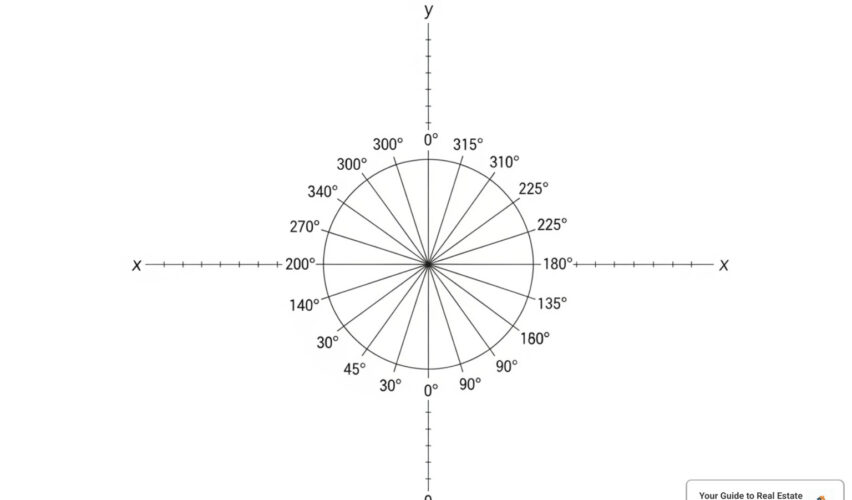
A unit circle chart is a fundamental mathematical tool that shows a circle with radius 1 centered at the origin of a coordinate plane. This simple yet powerful diagram connects angles to their corresponding trigonometric values in a visual way that makes complex concepts easier to grasp.
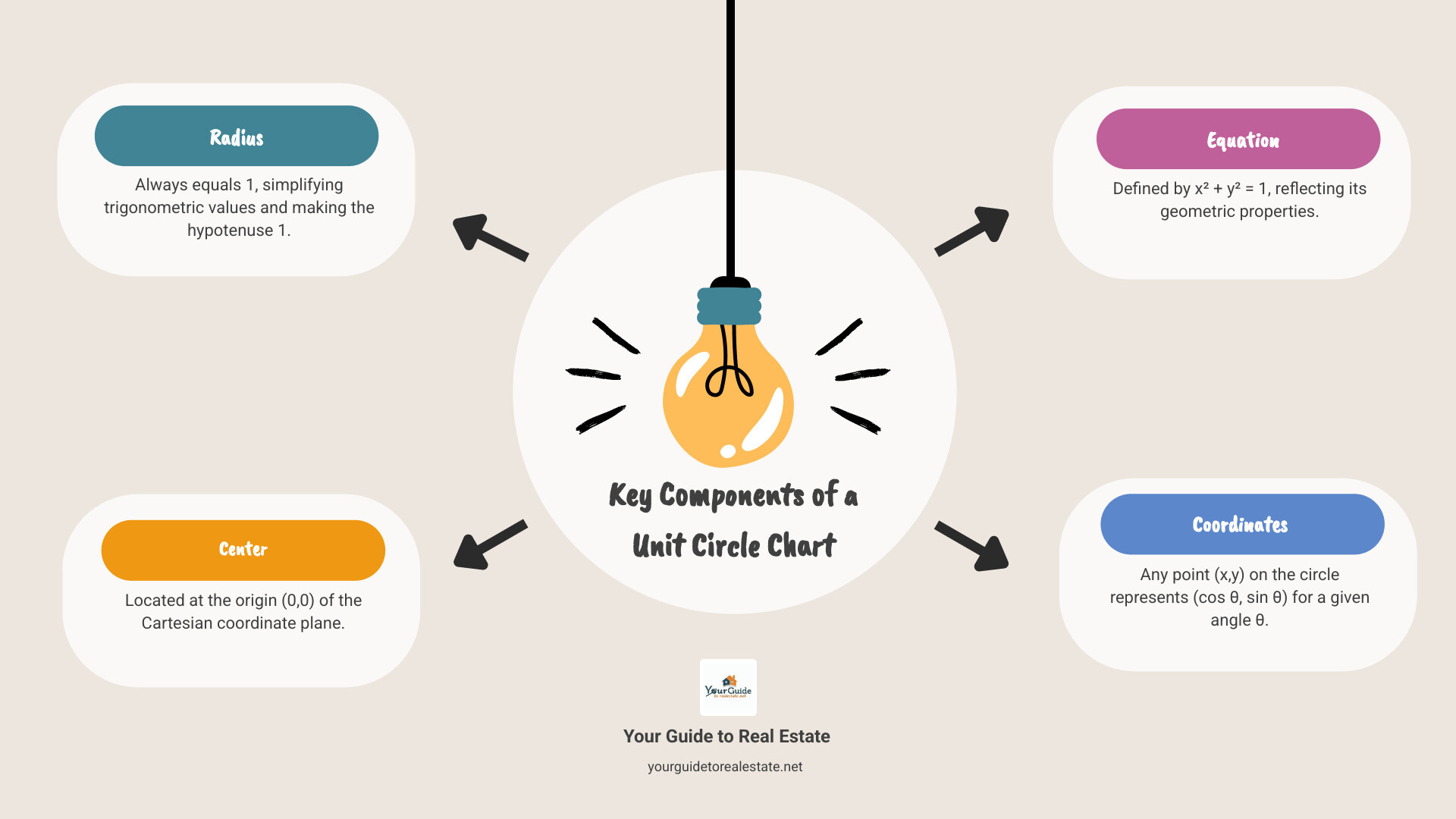
Key components of a unit circle chart:
- Radius: Always equals 1
- Center: Located at origin (0,0)
- Equation: x² + y² = 1
- Purpose: Shows relationship between angles and sine/cosine values
- Coordinates: Any point (x,y) on the circle represents (cos θ, sin θ)
The unit circle serves as the foundation for understanding trigonometry because it transforms abstract angle measurements into concrete coordinate pairs. When you measure an angle θ from the positive x-axis, the point where that angle intersects the circle gives you the cosine (x-coordinate) and sine (y-coordinate) of that angle.
This visual approach makes it much easier to understand why sine and cosine values always fall between -1 and 1 – they’re simply the coordinates of points on a circle with radius 1. The chart also reveals the periodic nature of trigonometric functions and helps explain concepts like reference angles and quadrant signs.
Whether you’re solving trigonometric equations, deriving identities, or working with complex numbers, the unit circle chart provides the visual framework that connects geometry to algebra in mathematics.
Unit circle chart word roundup:
Understanding the Unit Circle’s Foundation
The unit circle chart might look simple, but it’s actually one of the most powerful tools in mathematics. Picture this: you have a standard coordinate system with x and y axes crossing at the origin (0,0). Now draw a perfect circle around that center point with a radius of exactly 1 unit. That’s your unit circle!
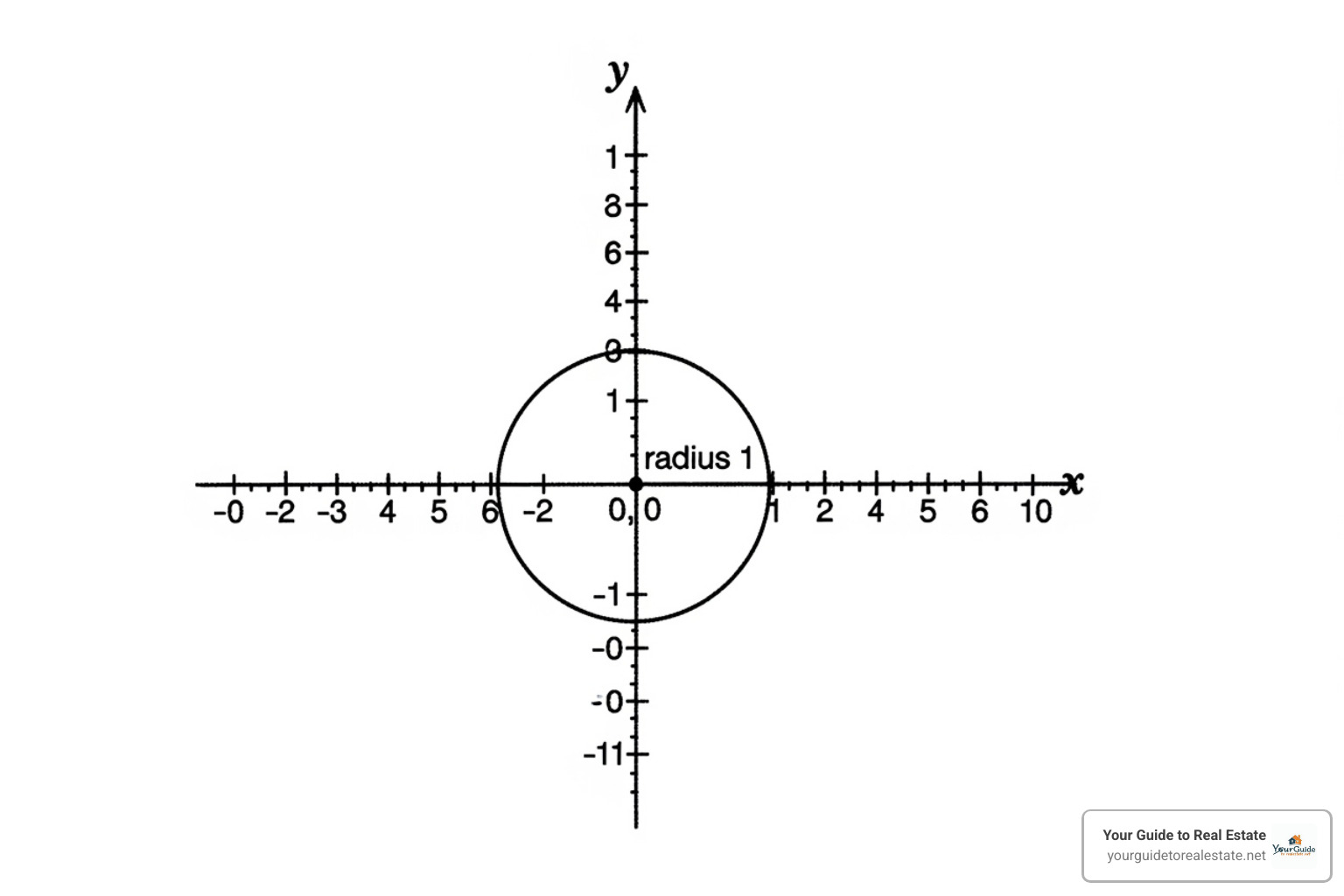
What makes this circle special is its simplicity. Remember the general equation for any circle? It’s (x-h)² + (y-k)² = r², where (h,k) is the center and r is the radius. Since our unit circle sits right at (0,0) with radius 1, the equation becomes beautifully simple: x² + y² = 1.
This isn’t just math for math’s sake. That equation is actually the Pythagorean theorem in action! Every point (x,y) on the circle creates a right triangle when you draw lines to the x-axis and back to the origin. The legs of that triangle are x and y, while the hypotenuse is always 1. So x² + y² = 1² makes perfect sense.
The coordinate plane naturally splits our unit circle into four sections called quadrants. We number them counterclockwise starting from the upper right: Quadrant I, II, III, and IV. Each quadrant covers 90 degrees (or π/2 radians), making the full circle 360 degrees (or 2π radians).
Want to really understand the unit circle? Try making your own chart! There’s nothing like drawing it yourself to see how all the pieces fit together. You can even practice with this blank unit circle worksheet to test what you’ve learned.
How Sine, Cosine, and Tangent Relate to the Circle
Here’s where the unit circle becomes truly magical. When you measure any angle θ from the positive x-axis, that angle creates a point where it hits the circle. That point has coordinates (x, y), and here’s the amazing part: those coordinates ARE your trigonometric values.
For any angle θ, the point on the unit circle gives you:
- x = cos(θ)
- y = sin(θ)
Think about the right triangle we talked about earlier. The angle θ sits at the origin, with the adjacent side being x, the opposite side being y, and the hypotenuse being 1. Using good old SOH CAH TOA:
- sin(θ) = opposite/hypotenuse = y/1 = y
- cos(θ) = adjacent/hypotenuse = x/1 = x
No complicated calculations needed! The coordinates tell you everything.
And tangent? Since tan(θ) = sin(θ)/cos(θ), we get tan(θ) = y/x. So tangent is simply the slope of the line from the origin to your point on the circle.
Reciprocal Functions and Quadrant Signs
The unit circle also helps us understand the three reciprocal trigonometric functions. These are just the flipped versions of our main three:
Secant (sec) is the reciprocal of cosine, so sec(θ) = 1/x. Cosecant (csc) flips sine, giving us csc(θ) = 1/y. Cotangent (cot) flips tangent, so cot(θ) = x/y.
Now here’s something crucial: as you move around the circle, the x and y coordinates change signs depending on which quadrant you’re in. This means your trigonometric functions change signs too.
In Quadrant I, both x and y are positive, so all six trig functions are positive. In Quadrant II, x becomes negative while y stays positive, making sine and cosecant positive but everything else negative. Quadrant III has both x and y negative, so tangent and cotangent become positive (negative divided by negative equals positive), while sine, cosine, and their reciprocals stay negative. Finally, Quadrant IV has positive x and negative y, making only cosine and secant positive.
There’s a helpful memory trick for this: “All Students Take Calculus.” All functions are positive in Quadrant I, Sine is positive in Quadrant II, Tangent is positive in Quadrant III, and Cosine is positive in Quadrant IV. Once you know which main function is positive, its reciprocal is positive too.
Understanding these sign patterns will save you countless headaches when solving trigonometric problems!
The Complete Unit Circle Chart: Angles and Values
Now we’re getting to the exciting part! The unit circle chart truly comes alive when we start filling it with specific angles and their coordinates. Think of it like learning the alphabet before you can read – certain key angles are the building blocks that open up everything else in trigonometry.
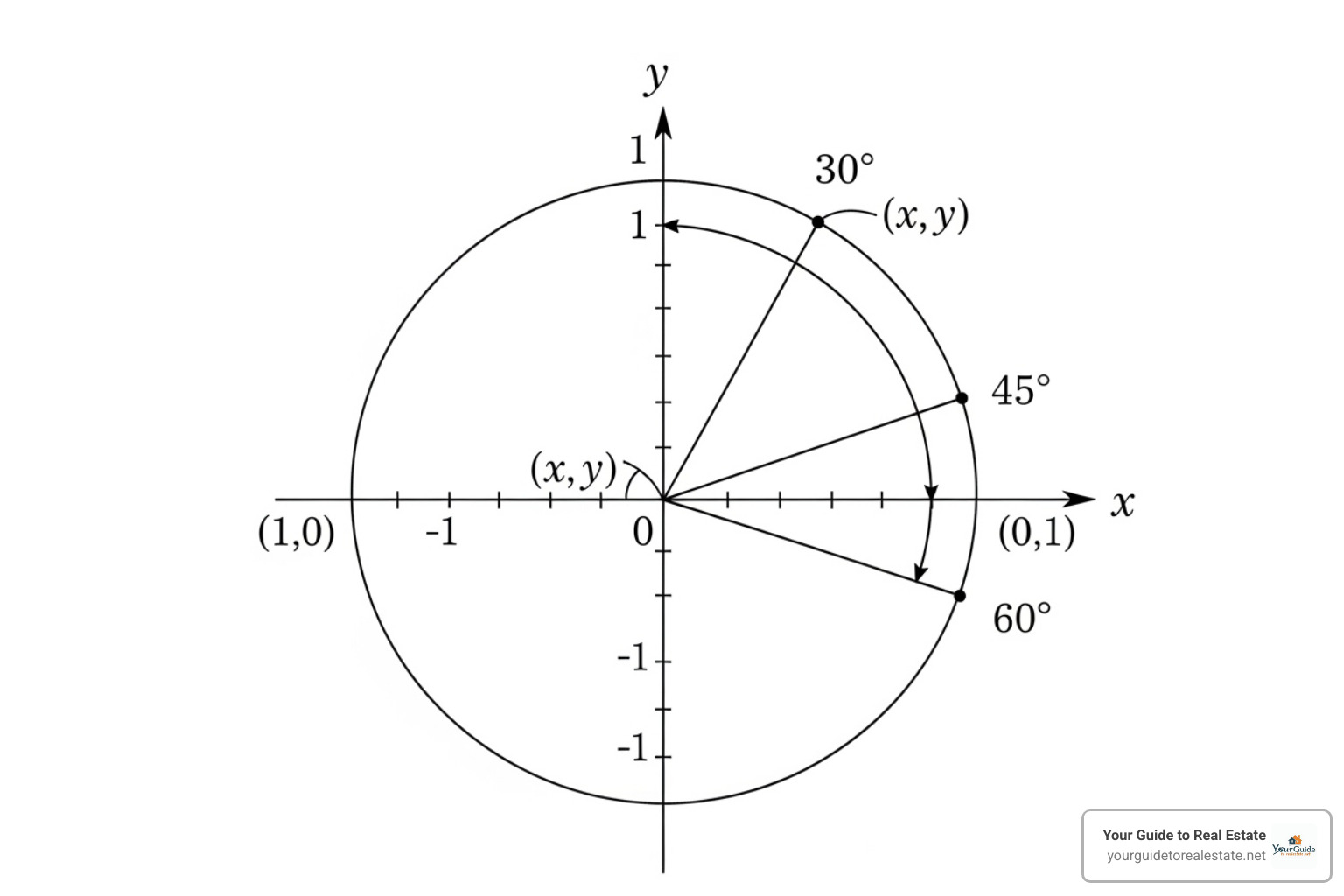
Before we dive into specific angles, let’s talk about the two ways we measure them. You’re probably comfortable with degrees from geometry class – a full circle is 360°. But in higher math, especially calculus, we use radians. Don’t worry, it’s not as scary as it sounds! Radians are actually based on the arc length of the circle itself, which makes certain calculations much cleaner.
The magic conversion to remember is that 360° equals 2π radians. This means 180° equals π radians. To convert from degrees to radians, multiply by π/180°. To go from radians to degrees, multiply by 180°/π. Once you get used to radians, you’ll find they make many formulas more neat.
Here’s where the unit circle gets really clever: symmetry and reference angles. Once you master the angles in the first quadrant (0° to 90°), you can find any other angle using patterns. A reference angle is simply the acute angle between your angle’s terminal side and the x-axis. Combined with the quadrant sign rules we learned earlier, this symmetry means you only need to memorize a handful of values!
Key Angles and Coordinates on the unit circle chart
Let’s start with the quadrantal angles – these are the angles that land right on the axes. They’re like the cardinal directions of the unit circle:
0° (0 radians) sits on the positive x-axis with coordinates (1, 0). 90° (π/2 radians) points straight up at (0, 1). 180° (π radians) aims left at (-1, 0). 270° (3π/2 radians) points down at (0, -1). And 360° (2π radians) brings us full circle back to (1, 0).
Now for the first quadrant angles – these come from those special right triangles you might remember. They’re the foundation of your unit circle chart:
30° (π/6 radians) has coordinates (√3/2, 1/2). This means cos(30°) = √3/2, sin(30°) = 1/2, and tan(30°) = √3/3.
45° (π/4 radians) lands at (√2/2, √2/2). Notice how both coordinates are equal! That’s because we’re dealing with an isosceles right triangle. So cos(45°) = sin(45°) = √2/2, and tan(45°) = 1.
60° (π/3 radians) sits at (1/2, √3/2). Interestingly, this is like the 30° angle flipped – cos(60°) = 1/2, sin(60°) = √3/2, and tan(60°) = √3.
These relationships aren’t random! They come from the 30-60-90 and 45-45-90 triangles. Once you know these five angles (0°, 30°, 45°, 60°, 90°), you can use symmetry to find values anywhere on the circle. For example, 150° in Quadrant II has a 30° reference angle, so cos(150°) = -√3/2 (negative because x is negative in Quadrant II) and sin(150°) = 1/2 (positive because y is positive there).
Full Trigonometric Values Table
Here’s your complete reference guide for the most common angles on the unit circle chart. This table shows degrees, radians, and the three main trigonometric values:
| Degrees | Radians | cos(θ) | sin(θ) | tan(θ) |
|---|---|---|---|---|
| 0° | 0 | 1 | 0 | 0 |
| 30° | π/6 | √3/2 | 1/2 | √3/3 |
| 45° | π/4 | √2/2 | √2/2 | 1 |
| 60° | π/3 | 1/2 | √3/2 | √3 |
| 90° | π/2 | 0 | 1 | Undefined |
| 120° | 2π/3 | -1/2 | √3/2 | -√3 |
| 135° | 3π/4 | -√2/2 | √2/2 | -1 |
| 150° | 5π/6 | -√3/2 | 1/2 | -√3/3 |
| 180° | π | -1 | 0 | 0 |
| 210° | 7π/6 | -√3/2 | -1/2 | √3/3 |
| 225° | 5π/4 | -√2/2 | -√2/2 | 1 |
| 240° | 4π/3 | -1/2 | -√3/2 | √3 |
| 270° | 3π/2 | 0 | -1 | Undefined |
| 300° | 5π/3 | 1/2 | -√3/2 | -√3 |
| 315° | 7π/4 | √2/2 | -√2/2 | -1 |
| 330° | 11π/6 | √3/2 | -1/2 | -√3/3 |
| 360° | 2π | 1 | 0 | 0 |
Notice the beautiful patterns in this table! The values repeat and flip signs based on quadrant rules. Once you see these patterns, memorizing becomes much easier. You’re not just memorizing random numbers – you’re learning a logical system that makes perfect geometric sense.
Using the Unit Circle in Advanced Mathematics
Now that you’ve mastered the basics, let’s explore how the unit circle chart becomes an essential tool in more advanced mathematics. Think of it as graduating from using training wheels to riding a professional bike – the fundamentals remain the same, but the applications become much more sophisticated and powerful.
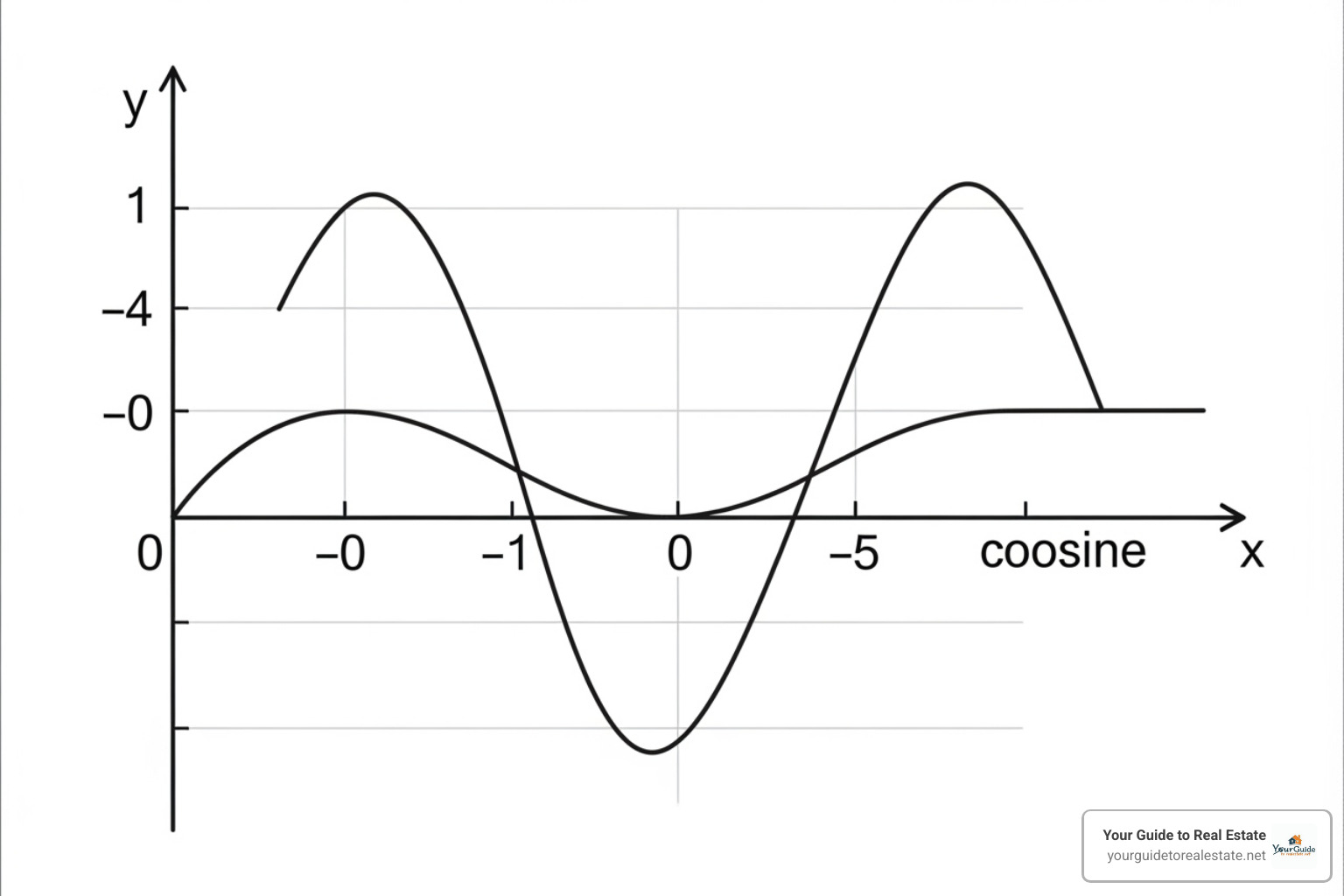
One of the most beautiful findies you’ll make with the unit circle chart is periodicity – the way trigonometric functions repeat their values in predictable cycles. As you travel around the circle once (360° or 2π radians), you return to your starting point with identical coordinates. This means sin(θ) = sin(θ + 2πn) and cos(θ) = cos(θ + 2πn) for any whole number ‘n’.
This cyclical behavior isn’t just mathematical curiosity – it mirrors countless real-world patterns. Ocean tides, sound waves, seasonal temperature changes, and even your heartbeat all follow similar periodic patterns that can be modeled using the unit circle.
When it comes to solving trigonometric equations, this periodicity becomes your secret weapon. Let’s say you need to find all solutions for sin(θ) = 1/2. The unit circle quickly shows you two angles between 0 and 2π: π/6 (30°) and 5π/6 (150°). But here’s where periodicity shines – you can express all possible solutions as θ = π/6 + 2πn and θ = 5π/6 + 2πn, where n represents any integer. It’s like finding every time a Ferris wheel reaches a specific height – once you know the pattern, you can predict it infinitely.
Deriving Identities from the unit circle chart
The unit circle chart transforms abstract trigonometric identities into visual, intuitive concepts. Remember our fundamental equation x² + y² = 1? Since we know that x = cos(θ) and y = sin(θ), we can substitute these values directly:
(cos(θ))² + (sin(θ))² = 1
This gives us the famous Pythagorean Identity: cos²(θ) + sin²(θ) = 1. It’s not just a formula to memorize – it’s a geometric truth that every point on the unit circle must satisfy.
This core identity becomes the foundation for finding other relationships. When we divide the entire Pythagorean Identity by cos²(θ) (assuming cos(θ) isn’t zero), something magical happens:
We get 1 + tan²(θ) = sec²(θ)
Similarly, dividing by sin²(θ) (when sin(θ) isn’t zero) reveals another identity: cot²(θ) + 1 = csc²(θ)
These aren’t random mathematical facts – they’re logical consequences of the unit circle’s geometry. Each identity tells a story about how the trigonometric functions relate to each other, making complex calculations much more manageable.
Applications in Calculus and Complex Numbers
Here’s where the unit circle chart really shows its versatility, extending far beyond basic trigonometry into the sophisticated fields of calculus and complex numbers.
In complex numbers, the unit circle provides an neat geometric interpretation. Any complex number z can be written as z = r(cosθ + i sinθ), where r represents its distance from the origin and θ shows its direction. When that distance equals 1 (written as |z|=1), the complex number sits perfectly on our unit circle.
This connection leads us to Euler’s formula: e^(iθ) = cosθ + i sinθ. This remarkable equation bridges exponential functions with trigonometry and forms the backbone of fields like electrical engineering and quantum mechanics. The set of all complex numbers where |z|=1 creates the unit circle in the complex plane – a beautiful marriage of algebra and geometry.
For calculus students, the unit circle becomes indispensable for understanding how trigonometric functions behave. The periodic nature we discussed earlier helps analyze oscillating systems and wave patterns. When you study derivatives, you’ll find that the derivative of sin(x) is cos(x), and the derivative of cos(x) is -sin(x). These relationships reflect the circular movement and changing rates around our unit circle.
This visual intuition makes complex differential equations more approachable, especially when describing waves, vibrations, and other periodic phenomena that surround us in the natural world.
For deeper exploration of these concepts, check out this further reading on trigonometry and the unit circle.
Frequently Asked Questions about the Unit Circle Chart
The unit circle chart can feel overwhelming when you first encounter it, but don’t worry – you’re definitely not alone in finding it challenging! We’ve helped countless students master this fundamental tool, and we’re here to answer the most common questions that come up time and time again.
How do you memorize the unit circle?
Here’s the truth: you don’t need to memorize every single angle on the unit circle chart. Instead, focus on understanding patterns and using smart techniques that make the whole thing click into place.
Start with pattern recognition for the most important angles in the first quadrant. The sine values follow a beautiful pattern when you look at them as fractions under a square root. For angles 0°, 30°, 45°, 60°, and 90°, the sine values are √0/2, √1/2, √2/2, √3/2, and √4/2. When you simplify these, you get 0, 1/2, √2/2, √3/2, and 1. The cosine values? They’re exactly the same pattern, just in reverse order!
One of our favorite memory tricks is the hand method for the first quadrant. Hold up your left hand with your palm facing you. Assign each finger an angle: thumb is 0°, index finger is 30°, middle finger is 45°, ring finger is 60°, and pinky is 90°. When you want to find sine and cosine for any angle, bend down that finger. The number of fingers below the bent finger (square rooted and divided by 2) gives you sine, while the fingers above give you cosine.
Let’s try it with 60°. Bend your ring finger. You have three fingers below it, so sine of 60° is √3/2. You have one finger above it, so cosine of 60° is √1/2, which equals 1/2. Pretty neat, right?
Once you master the first quadrant, you can use symmetry to find values everywhere else on the circle. Remember our “All Students Take Calculus” mnemonic for quadrant signs, and you’ll be able to figure out any angle using reference angles and the correct signs.
Why is the radius of the unit circle equal to 1?
This is actually one of the most brilliant design choices in all of mathematics! Setting the radius to 1 creates a beautiful simplification that makes everything else work smoothly.
Think about it this way: when you’re working with right triangles inside the circle, the hypotenuse is always the radius. If the radius equals 1, then the hypotenuse equals 1. This means that when you calculate sine (opposite over hypotenuse) and cosine (adjacent over hypotenuse), you’re dividing by 1 – which doesn’t change the value at all!
So the coordinates (x,y) of any point on the unit circle chart directly equal (cos θ, sin θ). No extra calculations needed, no messy fractions with radius values in the denominator. It’s mathematical elegance at its finest.
This simplification also makes the fundamental Pythagorean identity incredibly clean: cos²(θ) + sin²(θ) = 1. If we used any other radius, this identity would be more complicated and harder to work with.
When is tangent undefined on the unit circle?
This trips up a lot of students, but once you understand why it happens, it makes perfect sense.
Tangent equals sine divided by cosine, or tan(θ) = y/x when looking at coordinates on the unit circle chart. Tangent becomes undefined whenever we try to divide by zero – which happens when the denominator (cosine or x-coordinate) equals zero.
On the unit circle, the x-coordinate is zero at exactly two points: 90° (π/2 radians) and 270° (3π/2 radians). These are the points where the angle lands directly on the vertical y-axis.
At 90°, we’re at the point (0, 1), so tan(90°) = 1/0, which is undefined. At 270°, we’re at the point (0, -1), so tan(270°) = -1/0, which is also undefined.
Think of it visually: when you’re standing exactly on the y-axis, there’s no horizontal component to measure, so the ratio of vertical to horizontal doesn’t make sense. It’s like trying to describe the slope of a perfectly vertical line – mathematically, it just doesn’t work!
Conclusion
The unit circle chart truly is one of those beautiful mathematical tools that makes everything click into place. Think of it as your mathematical compass – once you understand how it works, you can steer through trigonometry, algebra, and even advanced calculus with confidence.
We’ve journeyed through the fundamentals together, starting with that simple yet powerful circle of radius 1 centered at the origin. Remember how its equation x² + y² = 1 connects directly to the Pythagorean theorem? And how every point (x,y) on that circle gives us the cosine and sine values for any angle? It’s this direct relationship that makes the unit circle so incredibly useful.
The beauty doesn’t stop there. We explored how the circle organizes the reciprocal functions – secant, cosecant, and cotangent – and how the “All Students Take Calculus” mnemonic helps us remember which functions stay positive in each quadrant. Those key angles we memorized (30°, 45°, 60°, and the quadrantal angles) become the building blocks for understanding any angle on the circle.
What’s really exciting is how the unit circle chart opens doors to advanced mathematics. Its periodic nature explains why trigonometric functions repeat their patterns, making it possible to solve complex equations that would otherwise seem impossible. The Pythagorean identity cos²(θ) + sin²(θ) = 1 flows naturally from the circle’s equation, and this foundation supports everything from complex number theory to calculus applications.
Whether you’re working with Euler’s formula in complex numbers or finding derivatives of trigonometric functions in calculus, the unit circle provides that visual framework that transforms abstract concepts into something you can actually see and understand. It’s like having a roadmap for mathematical relationships that might otherwise feel disconnected.
Mastering the unit circle chart isn’t just about memorizing coordinates – it’s about developing mathematical intuition that will serve you throughout your academic journey and beyond.
Just as a unit circle chart provides a clear framework for complex mathematical concepts, our resources at Your Guide to Real Estate provide a proven framework and stress-free guidance for navigating complex real estate transactions. Whether you’re decoding market trends or understanding investment opportunities, we’re here to help you make informed decisions with the same clarity and confidence.
Learn how to analyze complex data in our guide to competitive market analysis in real estate.