Why the Unit Circle is Your Compass for Trigonometry
The unit circle is a circle with radius 1 centered at the origin of a coordinate plane, and it’s the single most important tool for understanding trigonometry. If you’ve ever wondered why some students breeze through trigonometry while others struggle, the secret often lies in mastering this fundamental concept.
Quick Answer: What is the Unit Circle?
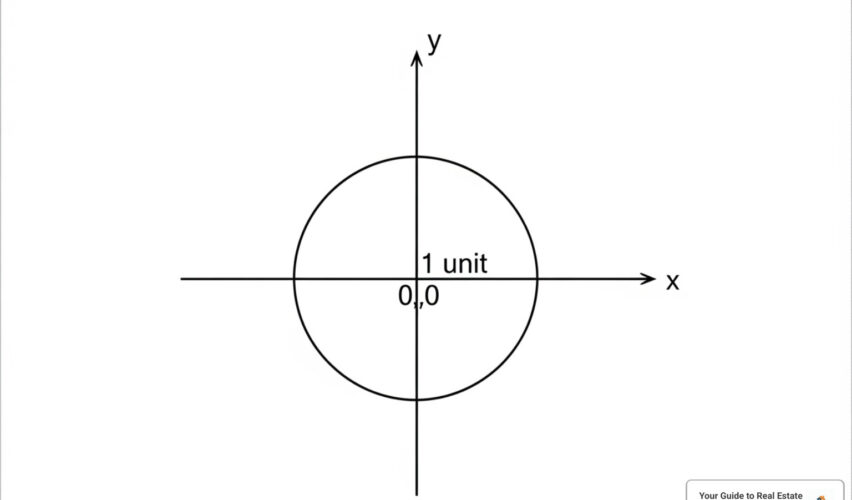
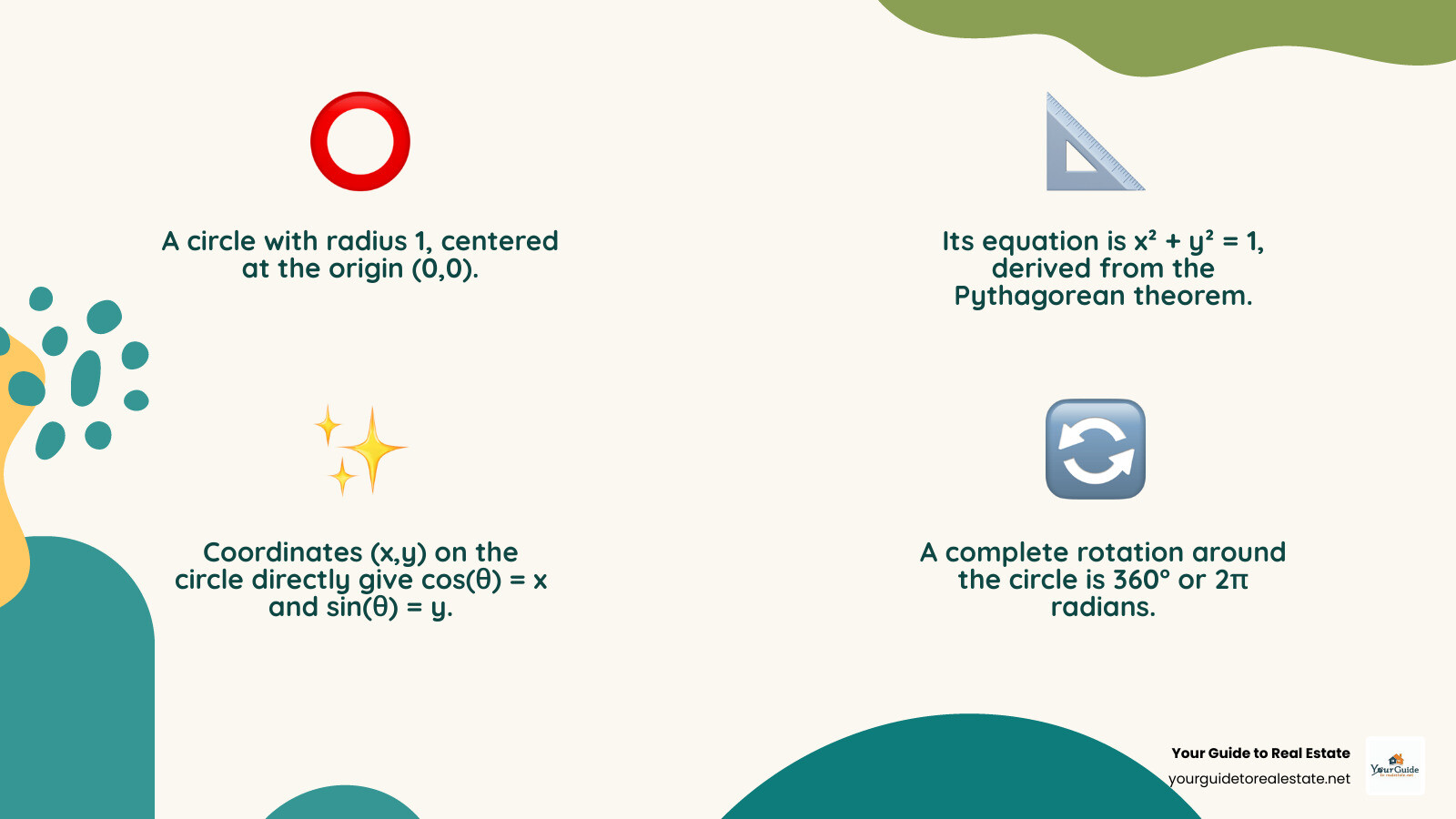
- Definition: A circle with radius = 1, centered at origin (0,0)
- Equation: x² + y² = 1
- Purpose: Defines trigonometric functions for all angles
- Key Property: Any point (x,y) on the circle gives cos(θ) = x and sin(θ) = y
- Complete rotation: 360° or 2π radians around the circumference
The unit circle serves as a bridge between geometry and algebra. It transforms abstract trigonometric concepts into visual, concrete relationships you can see and understand. When the radius equals 1, the math becomes beautifully simple – the coordinates of any point on the circle directly represent the cosine and sine values of that angle.
This neat simplification is why engineers use unit circle principles to design bridges and analyze rotating machinery. It’s why physicists rely on it to understand wave behavior and oscillations. And it’s why mastering the unit circle open ups the door to advanced mathematics, from calculus to complex analysis.
Whether you’re a student struggling with trig identities or someone who needs to understand periodic functions for real-world applications, the unit circle provides the foundation you need.
Common the unit circle vocab:
Building Blocks: The Anatomy of the Unit Circle
Picture yourself standing at the center of a perfectly round room, looking straight ahead. Now imagine drawing a circle around yourself with a rope that’s exactly one unit long. That’s essentially what the unit circle is – a perfect circle with its center right at the intersection of the x and y axes, with a radius of exactly 1 unit. It might sound simple, but this neat setup is about to open up the mysteries of trigonometry for you.
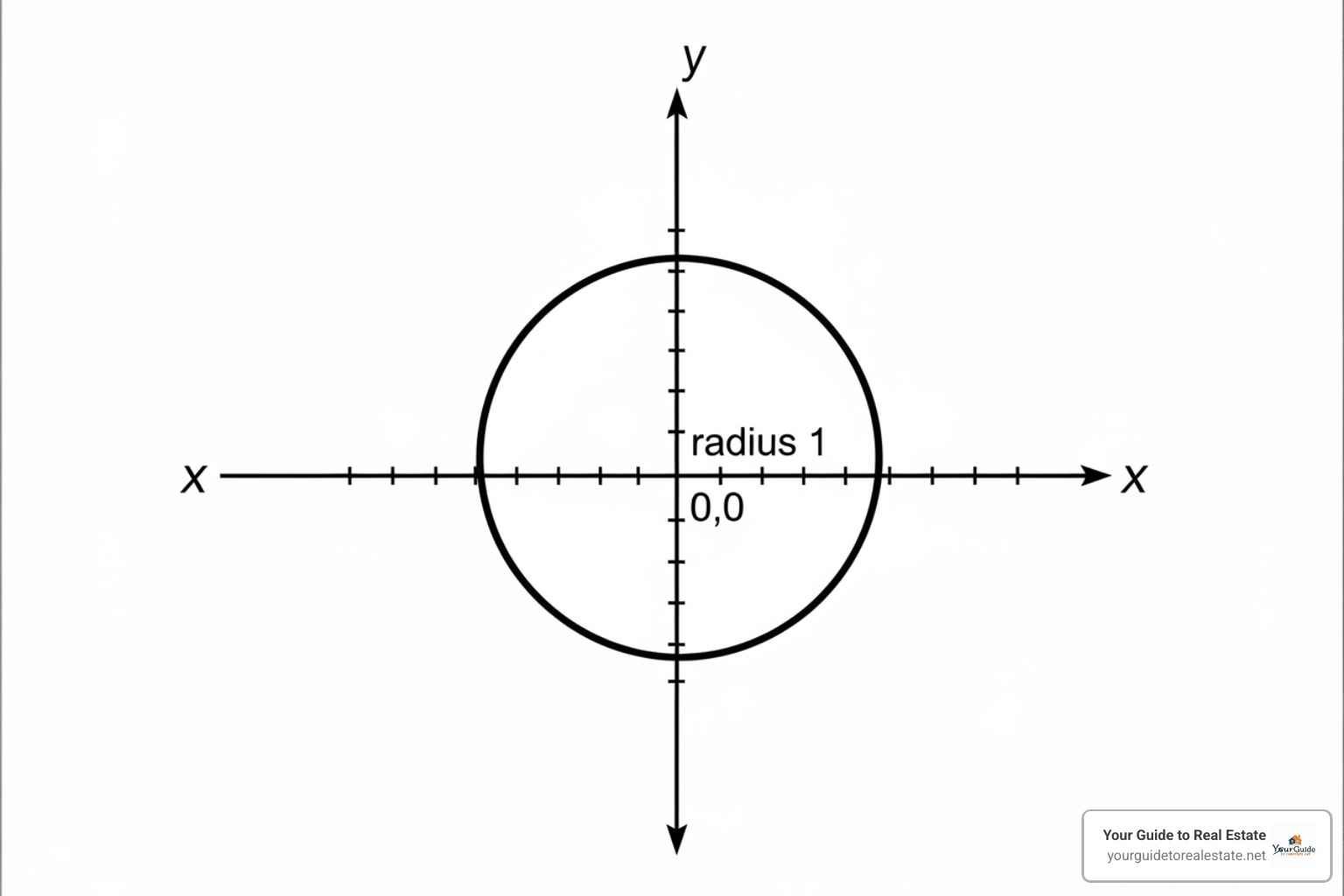
What is the Unit Circle? The Core Definition
The unit circle gets its name from two defining features: it’s centered at the origin (0,0) of a coordinate plane, and it has a radius of exactly 1 unit. This isn’t just a random choice – it’s mathematical genius in action.
Here’s where things get interesting. Every point (x, y) on the unit circle creates a right triangle with the x-axis and the origin. Since the radius is always 1, that means the hypotenuse of every triangle is also 1. Thanks to the Pythagorean theorem (remember a² + b² = c²?), we get the beautiful equation x² + y² = 1 for any point on the circle.
This simple equation is like a master key that opens doors throughout trigonometry. When the radius equals 1, the math becomes wonderfully clean and neat. The circumference of our circle is exactly 2π units, which connects perfectly to how we measure angles in radians.
Want to dive deeper? Check out this further reading on the unit circle for more mathematical details.
Measuring Rotation: Degrees and Radians
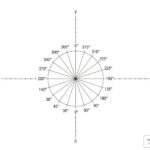
When we measure angles on the unit circle, we always start from the positive x-axis and rotate counterclockwise. This is called standard position – think of it as the official starting line for all angle measurements.
We have two ways to measure how far we’ve rotated, and both are important to understand.
Degrees are probably familiar to you already. A complete trip around the unit circle is 360 degrees. So 90° gets you a quarter of the way around, 180° is halfway, and 270° takes you three-quarters of the way around.
Radians might seem trickier at first, but they’re actually more natural for advanced math. A full rotation around the unit circle equals 2π radians. This comes directly from the circle’s circumference being 2π (since circumference = 2πr, and r = 1).
Converting between degrees and radians is straightforward once you know the trick. To go from degrees to radians, multiply by π/180. To go from radians to degrees, multiply by 180/π. For example, 90° becomes (90 × π/180) = π/2 radians.
Sometimes you’ll encounter angles bigger than 360° or negative angles like -45°. These are called coterminal angles – they end up at the same spot on the unit circle even though they took different paths to get there. You can find coterminal angles by adding or subtracting full rotations (360° or 2π radians).
The Four Quadrants and Their Signs
The unit circle divides naturally into four sections called quadrants, and each one has its own personality when it comes to positive and negative coordinates.
Quadrant I (the upper right) covers angles from 0° to 90°. Here, both x and y coordinates are positive (+, +). This is the “happy quadrant” where everything is positive and cheerful.
Quadrant II (upper left) spans 90° to 180°. The x-coordinate turns negative while y stays positive (-, +).
Quadrant III (lower left) covers 180° to 270°, where both coordinates become negative (-, -).
Quadrant IV (lower right) goes from 270° to 360°, with positive x but negative y (+, -).
There’s a clever mnemonic that math students love: “All Students Take Calculus.” This tells you which trigonometric functions are positive in each quadrant. All functions are positive in Quadrant I, Sine is positive in Quadrant II, Tangent is positive in Quadrant III, and Cosine is positive in Quadrant IV.
Understanding these quadrants isn’t just academic – it’s practical. When you know which quadrant an angle falls into, you instantly know whether your sine, cosine, or tangent values will be positive or negative, even before you calculate them.
The Unit Circle and Trigonometric Functions
This is where the unit circle transforms from a simple geometric shape into the powerhouse tool that makes trigonometry click! You’re about to see how this neat circle provides a crystal-clear way to define sine, cosine, and tangent for any angle – not just the neat little acute angles hiding inside right triangles.
Defining Sine, Cosine, and Tangent on the Unit Circle
Here’s where the magic happens. Picture any point (x, y) sitting on the unit circle, connected to an angle θ (theta) measured from the positive x-axis. The beauty of the unit circle reveals itself in this simple truth:
The coordinates themselves ARE the trigonometric functions!
When you look at that point (x, y), the x-coordinate is your cosine value: cos(θ) = x. Meanwhile, the y-coordinate is your sine value: sin(θ) = y. It’s that straightforward! No more wrestling with opposite sides, adjacent sides, or hypotenuses – the coordinates tell you everything you need to know.
Since the unit circle has a radius of 1, something wonderful happens to the range of sine and cosine. They can never venture beyond the circle’s boundaries, which means both sine and cosine are forever trapped between -1 and 1. Their range is exactly [-1, 1], and this limitation becomes incredibly useful when solving equations or analyzing wave patterns.
Now for tangent – this function has a bit more personality. Tangent equals the ratio of sine to cosine, or simply tan(θ) = y/x. This definition immediately reveals tangent’s rebellious nature: it becomes undefined whenever that x-coordinate (cosine) equals zero. This mathematical drama unfolds at 90° and 270°, where you’d be dividing by zero – a definite no-go in mathematics!
The trigonometric family also includes three reciprocal functions that flip the original definitions: cosecant (csc θ) = 1/sin θ, secant (sec θ) = 1/cos θ, and cotangent (cot θ) = 1/tan θ. These follow the same logic about when they’re defined or undefined, depending on whether their denominators hit zero.
Mapping the Special Angles and Coordinates
While the unit circle works beautifully for any angle you throw at it, certain “special angles” appear so frequently in trigonometry that memorizing them becomes a superpower. These mathematical celebrities are 30°, 45°, 60°, and 90°, along with their radian cousins π/6, π/4, π/3, and π/2.
Let’s take a tour of the first quadrant, where all coordinates are positive and life feels manageable:
At 0° (0 radians), you’re standing at point (1, 0) on the positive x-axis. Here, cos(0°) = 1, sin(0°) = 0, and tan(0°) = 0.
At 30° (π/6 radians), the magic of the 30-60-90 triangle places you at (√3/2, 1/2). At 45° (π/4 radians), the symmetry of a 45-45-90 triangle creates the perfectly balanced point (√2/2, √2/2). At 60° (π/3 radians), you’ll find yourself at (1/2, √3/2) – notice how this flips the 30° coordinates!
Finally, at 90° (π/2 radians), you’ve reached the top of the circle at (0, 1), where cos(90°) = 0, sin(90°) = 1, and tan(90°) throws a mathematical tantrum by becoming undefined.
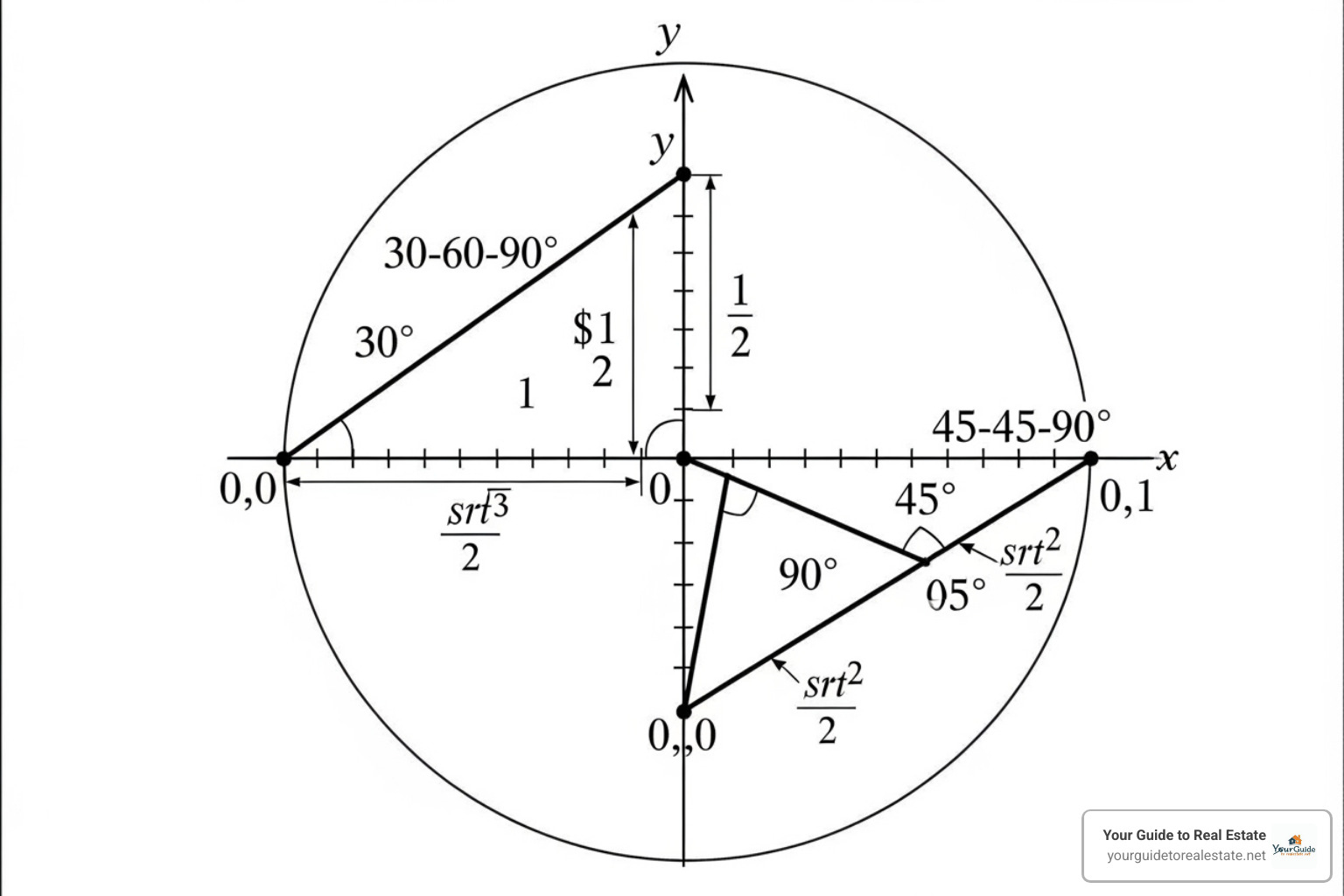
The beautiful symmetry in these coordinates isn’t accidental – it’s the unit circle showing off its neat patterns. Once you’ve mastered these first quadrant values, you’ve essentially cracked the code for the entire circle. The other quadrants simply involve flipping signs based on the quadrant rules we covered earlier.
Open uping Key Trigonometric Identities
The unit circle doesn’t just define trigonometric functions – it reveals the fundamental relationships between them in ways that make perfect visual sense.
The crown jewel of these relationships is the Pythagorean Identity: cos²(θ) + sin²(θ) = 1. This isn’t just some random mathematical rule someone invented – it’s literally the equation of the unit circle in disguise! Since any point (x, y) on the circle satisfies x² + y² = 1, and we know that x = cos(θ) and y = sin(θ), substituting gives us this beautiful identity. It works for every single angle, making it one of the most reliable tools in your trigonometry toolkit.
The unit circle also makes the periodicity of trigonometric functions visually obvious. Take a complete lap around the circle – 360° or 2π radians – and you’re right back where you started. This means sine and cosine values repeat every 2π radians (or 360 degrees). Mathematically, this looks like sin(θ) = sin(θ + 2πk) and cos(θ) = cos(θ + 2πk), where k represents any whole number of complete rotations.
Tangent marches to its own drummer, repeating every π radians (180 degrees) instead. This happens because moving 180 degrees from any angle flips both the x and y coordinates’ signs, but their ratio y/x returns to its original value. This periodic behavior becomes crucial when you’re working with wave functions, analyzing cyclical patterns, or solving equations that repeat their solutions.
Understanding these patterns through the unit circle transforms abstract mathematical concepts into visual, intuitive relationships that stick with you long after the textbook closes.
Mastering the Unit Circle in Practice
Now comes the fun part – taking everything you’ve learned about the unit circle and putting it to work! Think of this as moving from studying a map to actually navigating the territory.
Finding Trig Values for Any Angle Using Reference Angles
Here’s a scenario that trips up many students: you need to find the sine of 150°, or maybe the cosine of 5π/3. These aren’t the nice, neat angles we memorized from the first quadrant. Don’t panic – this is where reference angles become your secret weapon.
A reference angle is simply the acute angle (between 0° and 90°) that your angle makes with the x-axis. Think of it as finding the “shadow” of your angle in the first quadrant. No matter how big or weird your angle looks, its reference angle will always be one of those familiar first-quadrant angles you already know.
Here’s how the magic works. First, you identify which quadrant your angle lives in. Then you find the reference angle using these simple formulas:
In Quadrant II, your reference angle is 180° minus your angle (or π minus your angle in radians). For Quadrant III, subtract 180° from your angle (or subtract π). In Quadrant IV, subtract your angle from 360° (or from 2π).
Next, you calculate the trig value for that reference angle using your memorized first-quadrant values. Finally, you apply the correct sign based on which quadrant you’re in. Remember “All Students Take Calculus” – it tells you which functions are positive in each quadrant.
Let’s walk through that tricky sin(150°) example. Since 150° sits in Quadrant II, our reference angle is 180° – 150° = 30°. We know sin(30°) = 1/2. In Quadrant II, sine stays positive, so sin(150°) = 1/2. Beautiful!
For cos(5π/3), we first notice this angle is in Quadrant IV (it’s between 3π/2 and 2π). Our reference angle is 2π – 5π/3 = π/3. Since cos(π/3) = 1/2, and cosine is positive in Quadrant IV, we get cos(5π/3) = 1/2.
This same approach works perfectly for negative angles too. Just find the coterminal positive angle first, or think about which quadrant you land in when rotating clockwise. The reference angle method never lets you down.
Simple Tricks to Memorize the Unit Circle
Let’s be honest – memorizing the unit circle can feel overwhelming at first. But with a few clever tricks, you’ll have those coordinates locked in your memory faster than you might think.
The “counting fingers” method is surprisingly effective. For the special angles 30°, 45°, and 60°, notice that their sine values follow a pattern: √1/2, √2/2, √3/2 (which is just 1/2, √2/2, √3/2). Their cosine values are the exact reverse: √3/2, √2/2, 1/2. It’s like they’re mirror images of each other!
There’s also the amazing hand trick that works like magic. Hold up your left hand with your palm facing you. Your thumb represents 0°, index finger is 30°, middle finger is 45°, ring finger is 60°, and pinky is 90°. To find sine, bend down the finger for your angle and count the fingers below it – take the square root and divide by 2. For cosine, count the fingers above the bent finger and do the same math. Try it with 60° (ring finger) – you’ll get sin(60°) = √3/2 and cos(60°) = 1/2. It actually works!
But here’s the real game-changer: recognizing the beautiful symmetry in the unit circle. Once you master the first quadrant, the other three quadrants are just variations with different signs. The actual numbers stay the same – only the positive and negative signs change based on which quadrant you’re in.
The most powerful memorization tool, though, is simply drawing the circle over and over. Grab a piece of paper and sketch the unit circle with all the key angles and coordinates. Do this a few times a week, and you’ll be amazed how quickly it becomes second nature. There’s something about the physical act of drawing that helps cement these patterns in your mind.
Real-World Applications of the Unit Circle
You might be wondering, “When will I actually use this stuff?” The answer might surprise you – the unit circle is everywhere once you know where to look.

Engineers use the unit circle constantly, often without even thinking about it. When civil engineers design bridges, they need to understand how forces act at different angles. Breaking down these forces into horizontal and vertical components is exactly like finding coordinates on the unit circle. Mechanical engineers working with rotating machinery – think turbines, engines, or even simple gears – rely on sine and cosine to analyze circular motion and understand vibrations.
In physics, the unit circle describes the fundamental patterns of our universe. Sound waves, light waves, the swing of a pendulum, the bounce of a spring – all these follow sinusoidal patterns rooted in the unit circle. Even in quantum mechanics, unit complex numbers (which live on the unit circle) help describe the mysterious behavior of subatomic particles.
Computer graphics wouldn’t exist without the unit circle. Every time you see an object rotate smoothly in a video game or watch an animated character move in a circular path, there are sine and cosine calculations happening behind the scenes. The programmers are essentially plotting points on the unit circle to create that smooth motion.
Astronomers use these same principles to track celestial bodies and understand orbital mechanics. When they calculate where Jupiter will be six months from now, or when the next solar eclipse will occur, they’re working with the same circular relationships you’re learning about.
Even in fields like signal processing (how your smartphone filters background noise), music theory (understanding harmonics and frequencies), and navigation systems (GPS calculations), the unit circle provides the mathematical foundation. You can explore more real-world applications of trigonometry to see just how widespread these concepts really are.
The beauty of the unit circle is that it takes complex, cyclical patterns in the real world and gives us a simple, visual way to understand and work with them. Once you master it, you’re not just learning math – you’re learning to see the hidden patterns that shape our world.
Frequently Asked Questions about the Unit Circle
Students often have burning questions about the unit circle, and honestly, we love answering them! These are the questions that pop up again and again in math classes, and understanding the answers will deepen your grasp of this fundamental concept.
Why is the radius of the unit circle equal to 1?
This question gets to the heart of what makes the unit circle so brilliant! The radius of 1 isn’t arbitrary – it’s a carefully chosen value that creates mathematical magic.
Think back to those basic trigonometric ratios you learned in right triangle trigonometry. Sine equals opposite over hypotenuse, and cosine equals adjacent over hypotenuse. When we place this triangle on the unit circle, something beautiful happens: the hypotenuse becomes the radius, which is 1.
This means sine becomes opposite divided by 1, which just equals the opposite side. Similarly, cosine becomes adjacent divided by 1, which equals the adjacent side. Since the opposite side corresponds to the y-coordinate and the adjacent side to the x-coordinate, we get our neat result: the coordinates (x, y) directly equal (cos θ, sin θ).
No extra calculations, no messy fractions – just pure, simple relationships. This simplification is why engineers and physicists love the unit circle. It gives them a consistent scale where all trigonometric values are normalized, making comparisons and calculations across different problems incredibly straightforward.
How are radians actually defined on the unit circle?
Radians might seem mysterious at first, but they’re actually quite intuitive once you see them in action on the unit circle.
Picture walking along the edge of the unit circle. If you walk a distance equal to the radius (which is 1 unit), the angle you’ve traced out from the center is exactly 1 radian. It’s that simple! The radian is defined as the angle that corresponds to an arc length equal to the radius.
Since the unit circle has a circumference of 2π (because circumference = 2πr, and r = 1), a complete trip around the circle covers 2π radians. This is why a full rotation equals 2π radians instead of 360 degrees.
Here’s what makes radians special: they’re a unitless measure. A radian is simply the ratio of arc length to radius, so the units cancel out. This property makes radians incredibly useful in calculus and advanced mathematics, where they create cleaner, more natural formulas.
The relationship is beautifully direct – on the unit circle, the angle in radians literally equals the arc length you’ve traveled along the circle’s edge.
What is the Pythagorean Identity and why is it important?
The Pythagorean Identity is the crown jewel of trigonometric relationships: cos²θ + sin²θ = 1. This isn’t just another formula to memorize – it’s a direct consequence of the unit circle itself.
The unit circle has the equation x² + y² = 1? Since any point (x, y) on the circle gives us x = cos θ and y = sin θ, we can substitute these values into the circle’s equation. This gives us (cos θ)² + (sin θ)² = 1, which we write as cos²θ + sin²θ = 1.
This identity is incredibly powerful because it holds true for every single angle – no exceptions. Whether you’re dealing with 30 degrees, 157 degrees, or -243 degrees, this relationship never fails.
The practical applications are enormous. If you know the sine of an angle, you can immediately find its cosine using this identity (just remember to check which quadrant you’re in for the correct sign). It’s also the foundation for simplifying complex trigonometric expressions and proving other identities.
Think of the Pythagorean Identity as the mathematical equivalent of a master key – it opens doors to solving countless trigonometric problems and understanding deeper relationships between the functions.
Conclusion: The Power of a Simple Circle
What started as a simple circle with a radius of one has revealed itself to be so much more. The unit circle is truly your mathematical compass for navigating the entire world of trigonometry, changing what could be abstract and confusing into something visual and intuitive.
Throughout our journey together, we’ve seen how the unit circle neatly defines sine, cosine, and tangent for any angle you can imagine. We’ve explored the relationship between degrees and radians, finded how the four quadrants determine the signs of our trigonometric functions, and mapped out those crucial special angles that appear everywhere in mathematics.
The beauty of the unit circle lies in its simplicity. When you place any point on that circle, the coordinates immediately tell you the cosine and sine values. The Pythagorean Identity cos²θ + sin²θ = 1 flows naturally from the circle’s equation. The periodicity of trigonometric functions becomes obvious when you see that a full rotation brings you back to where you started.
But the unit circle isn’t just confined to textbooks. It’s the hidden force behind the oscillations in physics, the AC circuits in electrical engineering, the rotating machinery in mechanical systems, and even the wave patterns in computer graphics. From designing bridges to understanding quantum mechanics, this simple circle provides the foundation for countless real-world applications.
We’ve also equipped you with practical tools for success. Reference angles help you find trigonometric values for any angle. Memorization tricks like the hand method and pattern recognition make mastering the circle achievable. Most importantly, you now understand why everything works the way it does, not just how to memorize formulas.
Just as mastering the unit circle provides a framework for understanding complex mathematical relationships, having a solid framework is key to navigating the complexities of the real estate market. Whether you’re analyzing market trends, evaluating property values, or making investment decisions, the same analytical thinking that helps you understand trigonometry can empower your real estate journey.
Ready to apply your problem-solving skills to real estate? Learn more about valuation and market analysis in real estate and find how mathematical thinking can guide your path to real estate success.