Understanding the Unit Circle as Your Mathematical Foundation
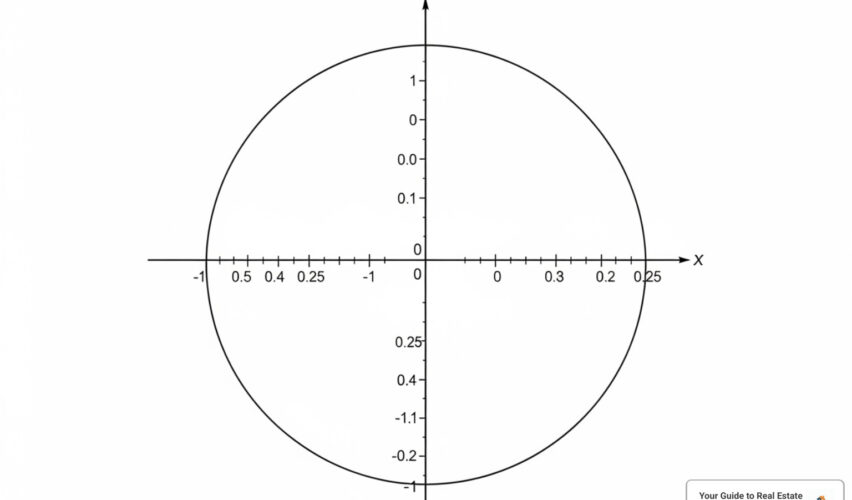
A blank unit circle is an empty template of the standard unit circle used for practicing and memorizing trigonometric values, angles in degrees and radians, and coordinate points.
Quick Reference for Blank Unit Circle:
- Purpose: Practice tool for memorizing trigonometric values
- What to fill in: Angle measures (degrees and radians), coordinates (x,y), and trig function values
- Key angles: 0°, 30°, 45°, 60°, 90° (and their multiples)
- Common formats: PDF worksheets, printable templates, online interactive versions
- Best practice: Start with quadrantal angles, then add special angles using pattern recognition
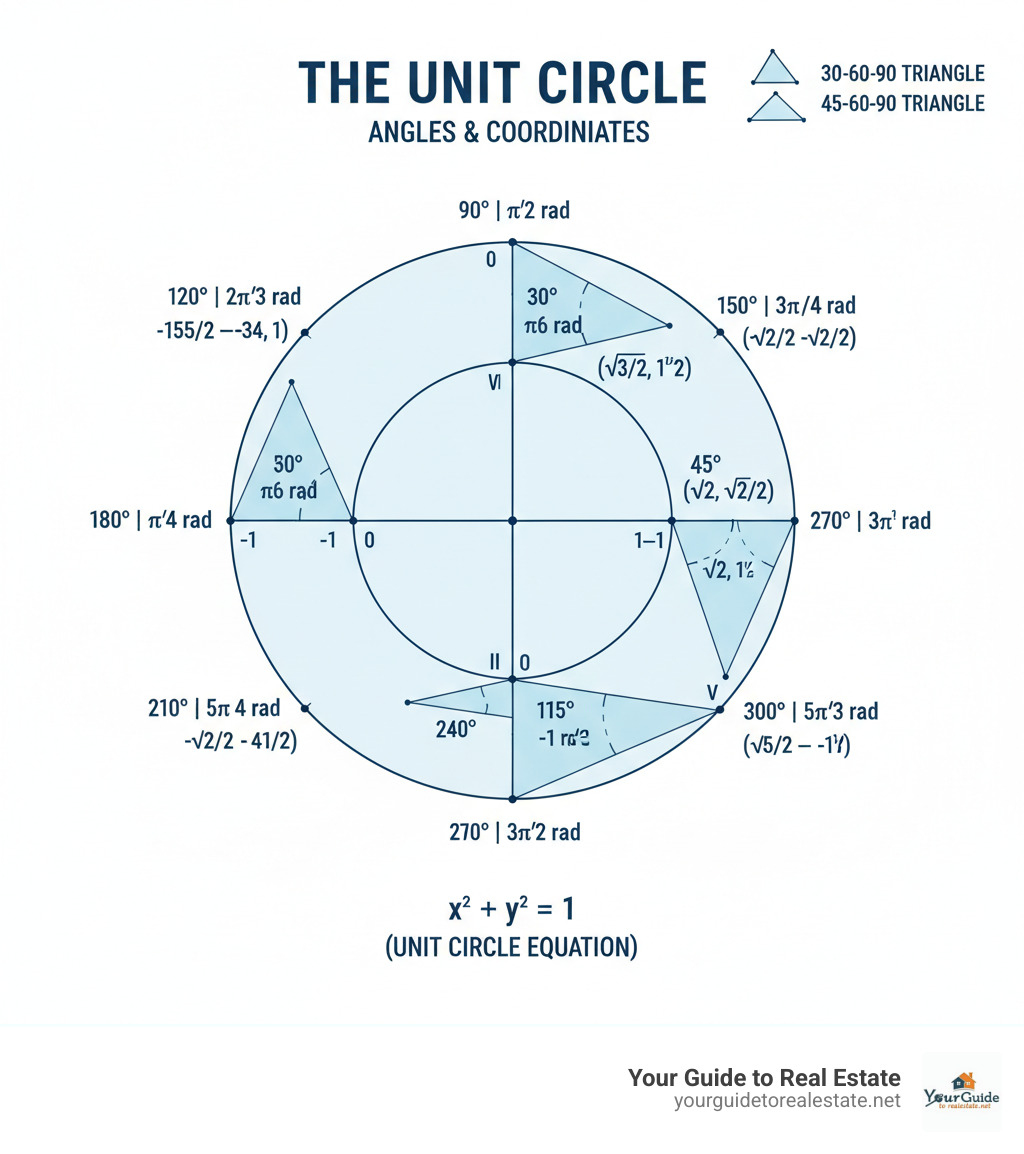
The unit circle is one of the most important concepts you’ll encounter in trigonometry and advanced mathematics. Defined by the equation x² + y² = 1, this circle has a radius of 1 and sits centered at the origin (0,0) of a coordinate plane.
Think of the unit circle as the foundation that supports everything else in trigonometry. Just like how understanding market fundamentals helps you steer real estate decisions, mastering the unit circle gives you the tools to tackle sine, cosine, tangent, and countless other mathematical concepts with confidence.
Why does this matter? The unit circle connects angles to coordinates in a way that makes trigonometric functions visual and intuitive. When you know that the point (1/2, √3/2) corresponds to 60° or π/3 radians, you instantly know that cos(60°) = 1/2 and sin(60°) = √3/2.
Using a blank unit circle for practice transforms passive reading into active learning. Instead of just staring at a completed circle, you’re building the muscle memory and pattern recognition that leads to true understanding.
Introduction to the Unit Circle
Picture a perfect circle sitting right at the center of a coordinate plane. This circle has its center perfectly positioned at the origin (0,0), and every point on its edge is exactly one unit away from the center. Welcome to the unit circle – one of the most neat and useful tools in all of mathematics.
The mathematical definition is beautifully simple: x² + y² = 1. Here, ‘x’ and ‘y’ represent the coordinates of any point you can find on the circle’s edge. The radius of 1 is what gives this special circle its name – “unit” literally means one.
Don’t let its simplicity fool you, though. This humble circle serves as a foundational tool that bridges the gap between basic geometry and advanced mathematics. Whether you’re diving into trigonometry, exploring geometry, or tackling calculus, the unit circle will be your trusted companion.
Think of it this way: just like understanding neighborhood values gives you confidence when evaluating real estate opportunities, mastering the unit circle gives you the confidence to tackle complex mathematical concepts. It’s your mathematical foundation – solid, reliable, and surprisingly powerful.
The real magic happens when you realize how the unit circle simplifies trigonometry. Since the radius is exactly 1, something wonderful occurs: the x-coordinate of any point on the circle directly gives you the cosine of the angle, while the y-coordinate gives you the sine. No complicated calculations needed – the coordinates are your trigonometric values.
This direct relationship between coordinates (cos θ, sin θ) transforms abstract trigonometric functions into something you can actually see and touch. When you’re working with a blank unit circle during practice, you’re not just memorizing numbers – you’re building an intuitive understanding of how angles connect to their trigonometric values.
The unit circle also helps you understand the relationship between degrees, radians, and coordinates in a visual way. With its circumference of 2π, every angle measurement finds its natural place on the circle, making conversions between degrees and radians much more intuitive.
Decoding the Unit Circle: Angles, Radians, and Coordinates
Now that we understand what the unit circle is, let’s dive into the three key elements that make it so powerful: angles, their measurements, and the coordinates they create. Think of this as learning the “language” of the unit circle – once you speak it fluently, everything else becomes much clearer.
Degrees and Radians
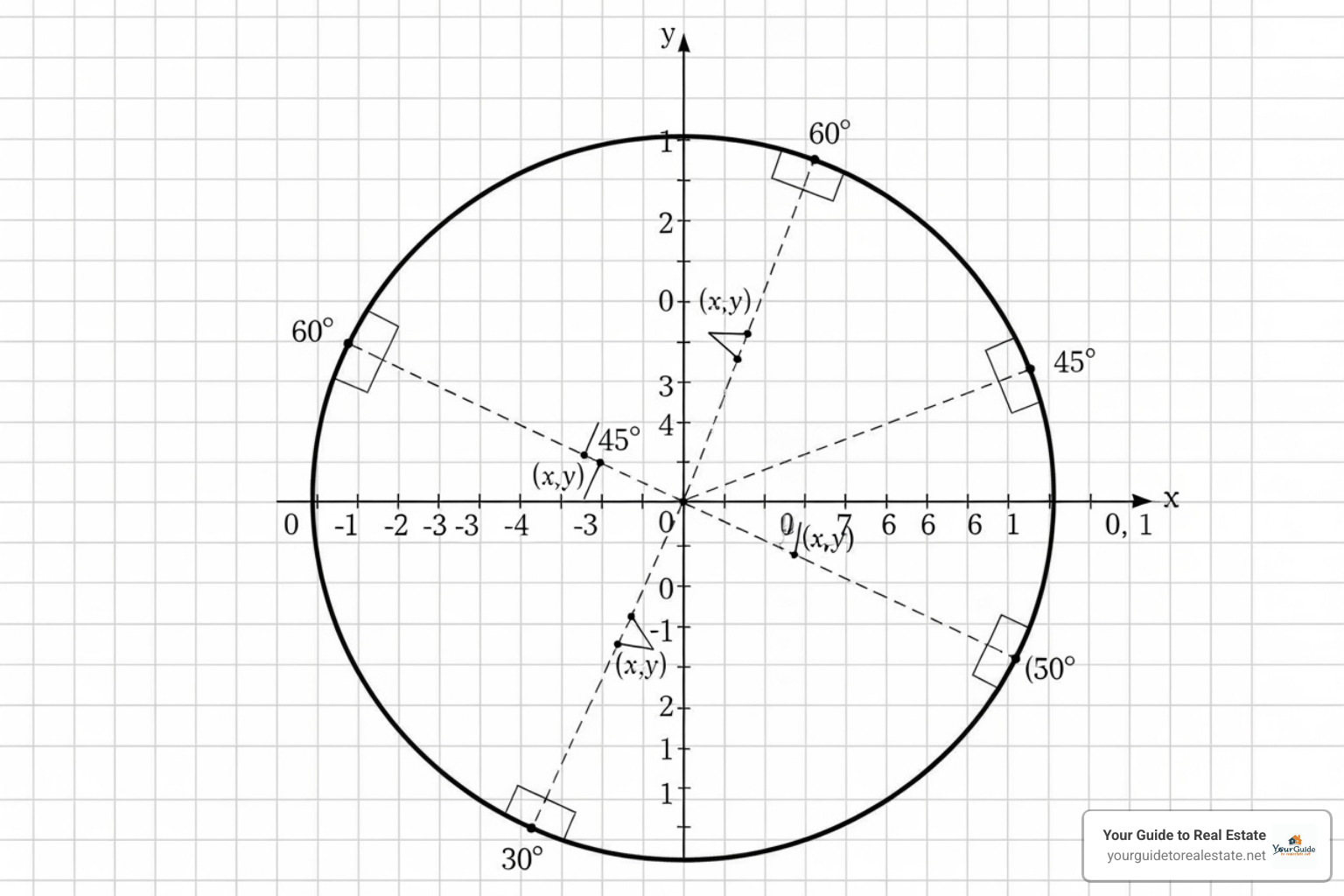
When we work with the unit circle, we measure angles by starting from the positive x-axis and moving counter-clockwise. It’s like reading a clock, but backwards! We use two different “measurement systems” for these angles, and both are important to understand.
Degrees are probably familiar to you already. A complete trip around the circle equals 360°, and we often start by learning key angles like 30°, 45°, 60°, and 90°. These aren’t random numbers – they come from two special triangles that fit perfectly into our unit circle.
The 30-60-90 triangle is actually half of an equilateral triangle. Its sides follow a specific pattern: if the shortest side is 1, then the other sides are √3 and 2. When we scale this triangle to fit our unit circle (where the longest side becomes 1), we get sides of 1/2 and √3/2. These numbers show up constantly in trigonometry.
The 45-45-90 triangle is an isosceles right triangle where both legs are equal. Its sides follow the ratio 1:1:√2. Scale it for our unit circle, and the legs become √2/2 each.
Radians might seem trickier at first, but they’re actually more natural for mathematics. Here’s the beautiful part: one radian is simply the angle you get when the arc length equals the radius. Since our unit circle has a radius of 1, one radian equals an arc length of 1 unit.
The circumference of our unit circle is 2π (since circumference = 2πr and r = 1). This means a full rotation equals 2π radians, which is the same as 360°.
Converting between degrees and radians becomes straightforward once you remember that 180° = π radians. To go from degrees to radians, multiply by π/180. To go from radians to degrees, multiply by 180/π.
Coordinates: (cos θ, sin θ)
Here’s where the unit circle becomes truly magical. For any angle θ (pronounced “theta”), the point where that angle intersects our circle has coordinates (cos θ, sin θ). Let me say that again because it’s so important: the x-coordinate is the cosine of the angle, and the y-coordinate is the sine of the angle.
This direct relationship means that once you know where a point sits on the unit circle, you instantly know the sine and cosine values for that angle. No complex calculations needed!
The key values you’ll see over and over are 1/2, √2/2, and √3/2 (plus their negative versions). These come directly from those special triangles we talked about earlier.
For example, at 30° (which equals π/6 radians), the coordinates are (√3/2, 1/2). This immediately tells us that cos(30°) = √3/2 and sin(30°) = 1/2. At 45° (or π/4 radians), both coordinates equal √2/2, so cos(45°) = sin(45°) = √2/2.
Understanding these patterns is like learning to read market trends in real estate – once you recognize the underlying structure, everything starts making sense. This kind of pattern recognition is similar to how data analysis works in other fields, much like how the Empirical Rule helps us understand and predict data distributions.
When you practice with a blank unit circle, you’re training your brain to see these relationships automatically. Instead of memorizing isolated facts, you’re building a complete picture of how angles, measurements, and coordinates work together.
Your Printable Blank Unit Circle and How to Use It
Think of a blank unit circle as your personal training ground for trigonometry mastery. It’s essentially an empty template of the standard unit circle, waiting for you to fill in the angles, coordinates, and trigonometric values that make this mathematical tool so powerful.

When you work with a blank unit circle, you’re not just copying information – you’re actively engaging your brain through active recall. This powerful learning technique forces you to retrieve information from memory rather than simply recognizing it. It’s like practicing your pitch before meeting with a potential home buyer. The more you rehearse, the more confident and natural you become.
This approach transforms your study sessions into effective test preparation. You’re building the kind of muscle memory that kicks in during high-pressure situations, whether that’s a timed exam or solving a complex problem. Plus, it serves as an excellent self-assessment tool – you’ll quickly identify which angles or coordinate pairs you need to review.
Why Use a Blank Unit Circle for Practice?
Using a blank unit circle offers incredible benefits that go far beyond simple memorization. When you actively write down the values instead of just staring at a completed chart, you’re creating stronger neural pathways in your brain. This memorization aid approach helps information stick much more effectively.
As you repeatedly fill out your circle, something magical happens – you start recognizing patterns. You’ll notice how the coordinates in different quadrants mirror each other, how certain angles relate to their reference angles, and how the signs of coordinates change predictably. This pattern recognition is where real understanding begins to bloom.
The practice also helps you build speed and accuracy. Many students set a goal of completing their unit circle in under five minutes, which is fantastic preparation for timed exams. This kind of fluency gives you tremendous confidence for exams – you’ll walk in knowing you can quickly and accurately reproduce one of trigonometry’s most important tools.
You can get started right away with this downloadable practice sheet that provides the perfect template for your practice sessions.
How to Fill Out Your Blank Unit Circle
Let me walk you through a systematic approach that makes filling out your blank unit circle both manageable and effective.
Start with the quadrantals – these are your anchors at 0°, 90°, 180°, and 270°. These points sit right on the axes, making their coordinates straightforward: (1,0), (0,1), (-1,0), and (0,-1) respectively. Getting these down first gives you a solid foundation.
Next, fill in the degrees for your key angles. Focus on the first quadrant initially with 30°, 45°, and 60°. These come from those special triangles we discussed earlier. Then add the radians – π/6, π/4, and π/3. Converting between degrees and radians becomes second nature with practice.
Now comes the fun part – derive coordinates using symmetry. Once you know the first quadrant coordinates, you can find all the others by understanding how signs change in different quadrants. For example, if you know that 30° gives you (√3/2, 1/2), then 150° in the second quadrant becomes (-√3/2, 1/2) – same y-coordinate, but the x-coordinate flips negative.
The key is to practice until it’s second nature. Set aside time each day to fill out a blank circle. Start slowly, focusing on accuracy, then gradually build speed. Soon you’ll find yourself completing the entire circle smoothly and confidently, ready for whatever trigonometry throws your way.
Applying the Unit Circle: Trig Functions and Quadrants
Now that you’ve mastered filling out your blank unit circle, let’s explore how this powerful tool transforms into your gateway for understanding all trigonometric functions. Think of this as moving from knowing your neighborhood streets to understanding the entire city’s traffic patterns.
The beauty of the unit circle lies in how it directly gives you the values for every trigonometric function. Once you know the coordinates of any point on the circle, you’ve essentially open uped a treasure chest of mathematical information.
Sine (sin θ) is simply the y-coordinate of your point on the unit circle. When you look at 30° and see the coordinates (√3/2, 1/2), you instantly know that sin(30°) = 1/2. It’s that straightforward.
Cosine (cos θ) works the same way but uses the x-coordinate. From that same 30° example, cos(30°) = √3/2. No complex formulas to memorize – just read the coordinates.
Tangent (tan θ) requires one simple division: y divided by x, or sin θ divided by cos θ. For our 30° example, tan(30°) = (1/2) ÷ (√3/2) = 1/√3 or √3/3. Just remember that tangent becomes undefined when cosine equals zero (at 90° and 270°), because you can’t divide by zero.
The reciprocal functions follow naturally. Cosecant (csc θ) is 1/sin θ, secant (sec θ) is 1/cos θ, and cotangent (cot θ) is 1/tan θ or simply x/y.
Quadrant Signs and Reference Angles
Here’s where the unit circle becomes your mathematical compass. Each quadrant has its own personality when it comes to which trigonometric functions are positive or negative. Students often remember this with the cheerful mnemonic “All Students Take Calculus” or ASTC.
In Quadrant I (0° to 90°), All functions are positive. Both x and y coordinates are positive, so everything works out nicely. This is your comfort zone where all trigonometric functions have positive values.
Quadrant II (90° to 180°) is where only Sine and its reciprocal cosecant stay positive. Here, x-coordinates turn negative while y-coordinates remain positive. It’s like having a mixed market in real estate – some indicators are up, others are down.
In Quadrant III (180° to 270°), only Tangent and cotangent remain positive. Both x and y coordinates are negative, but since tangent is y/x, dividing two negative numbers gives you a positive result.
Quadrant IV (270° to 360°) keeps Cosine and secant positive. The x-coordinate returns to positive territory while the y-coordinate stays negative.
Understanding reference angles makes finding trigonometric values for any angle amazingly simple. A reference angle is the acute angle between your angle’s terminal side and the x-axis. It’s like finding the shortest route to your destination.
For example, let’s find cos(210°). First, we notice 210° sits in Quadrant III. The reference angle is 210° – 180° = 30°. Since cosine is negative in Quadrant III, cos(210°) = -cos(30°) = -√3/2.
This systematic approach transforms what could be overwhelming calculations into a manageable process. You’re essentially using the patterns and symmetry you’ve practiced with your blank unit circle to tackle any angle that comes your way.
Just like understanding market trends helps you make smart real estate decisions, mastering these quadrant relationships and reference angles gives you the confidence to handle any trigonometric problem with ease.
Mastering the Unit Circle: Tips, Tricks, and Practice
Let’s be honest – the unit circle can feel overwhelming at first. You’re staring at this circle packed with angles, coordinates, and fractions that seem to have no rhyme or reason. Many students tell us they feel like they’re drowning in numbers. But here’s the good news: once you understand the patterns, the unit circle becomes as predictable as a well-organized neighborhood map.
Common Challenges and How to Overcome Them
The two biggest problems we see students face are memorization overload and sign errors. Sound familiar?
Memorization overload happens when you try to brute-force every single value into your brain. It’s like trying to memorize every house address in a city instead of understanding the street layout. The solution? Focus on understanding patterns and symmetry. Master that first quadrant – those key angles at 0°, 30°, 45°, 60°, and 90° – then use reflection and sign changes to fill out the rest. Don’t just memorize; derive the values using what you already know.
Sign errors are the sneaky mistakes that trip up even prepared students. You know the coordinate values, but you can’t remember if they should be positive or negative in a particular quadrant. The fix is simple: consistently use the “All Students Take Calculus” (ASTC) mnemonic or visualize the coordinate plane. In Quadrant II, for example, you’re to the left of the y-axis (negative x) but above the x-axis (positive y), so cosine is negative while sine is positive.
Memorization Tips
Here are the strategies that have helped thousands of students crack the unit circle code:
Focus on Quadrant I first and foremost. If you truly know the angles and coordinates for 0°, 30°, 45°, 60°, and 90°, you’re already halfway to mastering the entire circle. Everything else builds from these foundation pieces.
The “Hand Trick” is a favorite among visual learners. Hold up your left hand with your palm facing you. For 30° (π/6), bend your ring finger down. Count the fingers below the bent finger for the numerator under the square root for sine, and the fingers above for cosine. You get 1 below and 3 above, giving you sin(30°) = √1/2 = 1/2 and cos(30°) = √3/2. For 45° (π/4), bend your middle finger to get 2 below and 2 above, so both sine and cosine equal √2/2. For 60° (π/3), bend your index finger to get 3 below and 1 above.
Look for symmetry everywhere. The beauty of the unit circle is that values repeat with different signs. The 30° angle in Quadrant I has the exact same absolute coordinate values as 150°, 210°, and 330° – only the signs change based on which quadrant you’re in.
Practice daily with your blank unit circle. Just like building any skill, consistency beats intensity. Spend 5-10 minutes each day filling out a blank template. You’ll be amazed at how quickly muscle memory develops and how natural it becomes.
Practice Activities
Beyond the standard blank unit circle practice, try mixing up your approach to keep things interesting.
Worksheets give you targeted practice. Look for ones that ask you to fill in specific parts of the unit circle or evaluate trigonometric functions for various angles. The repetition helps cement the patterns in your mind.
Online quizzes provide instant feedback, which is incredibly valuable for learning. When you get immediate confirmation that you’re right (or correction when you’re wrong), your brain forms stronger connections to the correct information.
Review games transform learning from a chore into something enjoyable. Unit Circle Bingo or “Evaluating Trig Functions Leap Frog” turn practice into friendly competition. These games reinforce concepts while keeping you engaged. You can even try an interactive Unit Circle Game online for additional practice.
Think of mastering the unit circle like learning to steer your local area. At first, you might need GPS for every trip. But with practice, you develop an internal map that guides you automatically. The unit circle becomes that internal mathematical GPS, helping you steer trigonometry with confidence and speed.
This foundational tool will serve you well in all future math courses. You’re not just memorizing numbers – you’re building mathematical intuition that compounds over time.
Frequently Asked Questions about the Unit Circle
Learning the unit circle brings up lots of questions – and that’s completely normal! We’ve helped countless students work through these same challenges. Here are the questions we hear most often, along with clear answers that will help you master this essential math concept.
What is the fastest way to memorize the unit circle?
Here’s the secret: don’t memorize it – understand it instead. The fastest path to unit circle mastery comes from recognizing patterns and learning to derive values rather than cramming every single coordinate into your brain.
Start with the first quadrant and really nail those key angles: 0°, 30°, 45°, 60°, and 90°. Once these feel natural, you can use symmetry and quadrant signs (remember “All Students Take Calculus”?) to figure out everything else. It’s like learning the blueprint of a house – once you understand the structure, you can steer any room.
Regular practice with a blank unit circle is absolutely crucial. The more you fill it out from scratch, the more these patterns become second nature. Set a goal to complete your blank unit circle accurately in just a few minutes. You’ll be amazed how quickly your speed and confidence improve with daily practice.
Why is the radius of the unit circle 1?
The radius of 1 isn’t random – it’s brilliant mathematical design that makes everything simpler. Think back to those basic trigonometry definitions you learned: sin(θ) equals opposite over hypotenuse, and cos(θ) equals adjacent over hypotenuse.
On the unit circle, the hypotenuse is always the radius. Since our radius equals 1, those fractions become incredibly straightforward. Sin(θ) becomes opposite divided by 1, which just equals the opposite side (the y-coordinate). Cos(θ) becomes adjacent divided by 1, which equals the adjacent side (the x-coordinate).
This neat simplification means that every point on the unit circle directly gives us the cosine and sine values. No extra calculations needed! The coordinates (x, y) literally are (cos θ, sin θ). It’s like having a built-in calculator right in the geometry.
How is the unit circle used outside of math class?
You might think the unit circle only matters for passing your next test, but it actually shows up everywhere in the real world. The circular patterns and relationships you’re learning have practical applications across many fascinating fields.
Physics relies heavily on unit circle principles for describing waves, oscillations, and circular motion. When scientists model sound waves, light waves, or even the swing of a pendulum, they’re using the same sine and cosine relationships you’re studying. Engineers use these concepts for signal processing and analyzing electrical currents that alternate in predictable cycles.
Computer graphics and animation depend on the unit circle for rotating objects and creating smooth movements on screen. Every time you see a character spin or an object rotate in a video game, unit circle math is working behind the scenes.
Even music theory connects to these concepts, since sound waves follow the same mathematical patterns that the unit circle describes. The harmonic relationships that make music pleasant to our ears can be understood through trigonometric functions.
These applications extend far beyond any single classroom, much like how understanding market fundamentals helps you succeed across different real estate situations. The unit circle provides a visual framework for understanding the cyclical nature of countless processes around us. If you enjoy exploring foundational concepts that shape our understanding of the world, you might find Astronomy 101 equally fascinating.
Conclusion
The unit circle stands as one of the most neat and powerful tools in all of mathematics. What starts as a simple circle with radius 1, centered at the origin, transforms into your gateway for understanding trigonometry, calculus, and countless real-world applications.
Think about the journey we’ve taken together. We began with basic definitions and moved through angles, radians, and coordinates. We explored how the blank unit circle becomes your practice partner, helping you build the muscle memory and pattern recognition that leads to true mastery. We finded how trigonometric functions come alive through coordinates, and how quadrant signs follow predictable patterns.
The beauty of working with a blank unit circle lies in how it transforms passive learning into active findy. Each time you fill one out, you’re not just memorizing numbers – you’re reinforcing the neat relationships between angles and their trigonometric values. You’re building the confidence that comes from truly understanding rather than just memorizing.
Just as we provide stress-free guidance for navigating complex real estate decisions at Your Guide to Real Estate, the unit circle offers a clear framework for tackling trigonometry. Both require practice, patience, and the right approach, but both reward you with skills that last a lifetime.
Your mathematical journey doesn’t end here. The analytical thinking you develop while mastering the unit circle applies far beyond math class. These same problem-solving skills will serve you well in any field, whether you’re calculating mortgage payments, analyzing market trends, or making data-driven decisions.
So grab that pen, print out another blank unit circle, and keep practicing. Every expert was once a beginner, and every complex problem becomes manageable when you have the right foundation.
Ready to apply your newfound analytical skills to real-world scenarios? Find how to conduct a comprehensive competitive market analysis in real estate and make informed decisions in today’s market.