Why Understanding Unit Circle Tangent Matters
Unit circle tangent is the ratio of sine to cosine (tan θ = sin θ/cos θ) for any angle on a circle with radius 1. Here’s what you need to know:
- Definition: Tangent equals y-coordinate divided by x-coordinate on the unit circle
- Formula: tan θ = sin θ/cos θ
- Key Values: tan(0°) = 0, tan(30°) = √3/3, tan(45°) = 1, tan(60°) = √3
- Undefined Points: tan(90°) and tan(270°) are undefined (division by zero)
- Period: Tangent repeats every π radians (180°)
- Signs: Positive in quadrants I and III, negative in quadrants II and IV
The unit circle makes trigonometry visual and practical. Instead of memorizing dozens of formulas, you can see how angles create specific coordinate points.
Many professionals use these concepts daily. Architects calculate roof slopes. Engineers design bridges with precise angles. Even real estate professionals analyze property boundaries and lot dimensions using trigonometric principles.
The beauty of the unit circle lies in its simplicity. Every point (x,y) on this circle gives you cosine and sine values instantly. Divide y by x, and you get tangent.
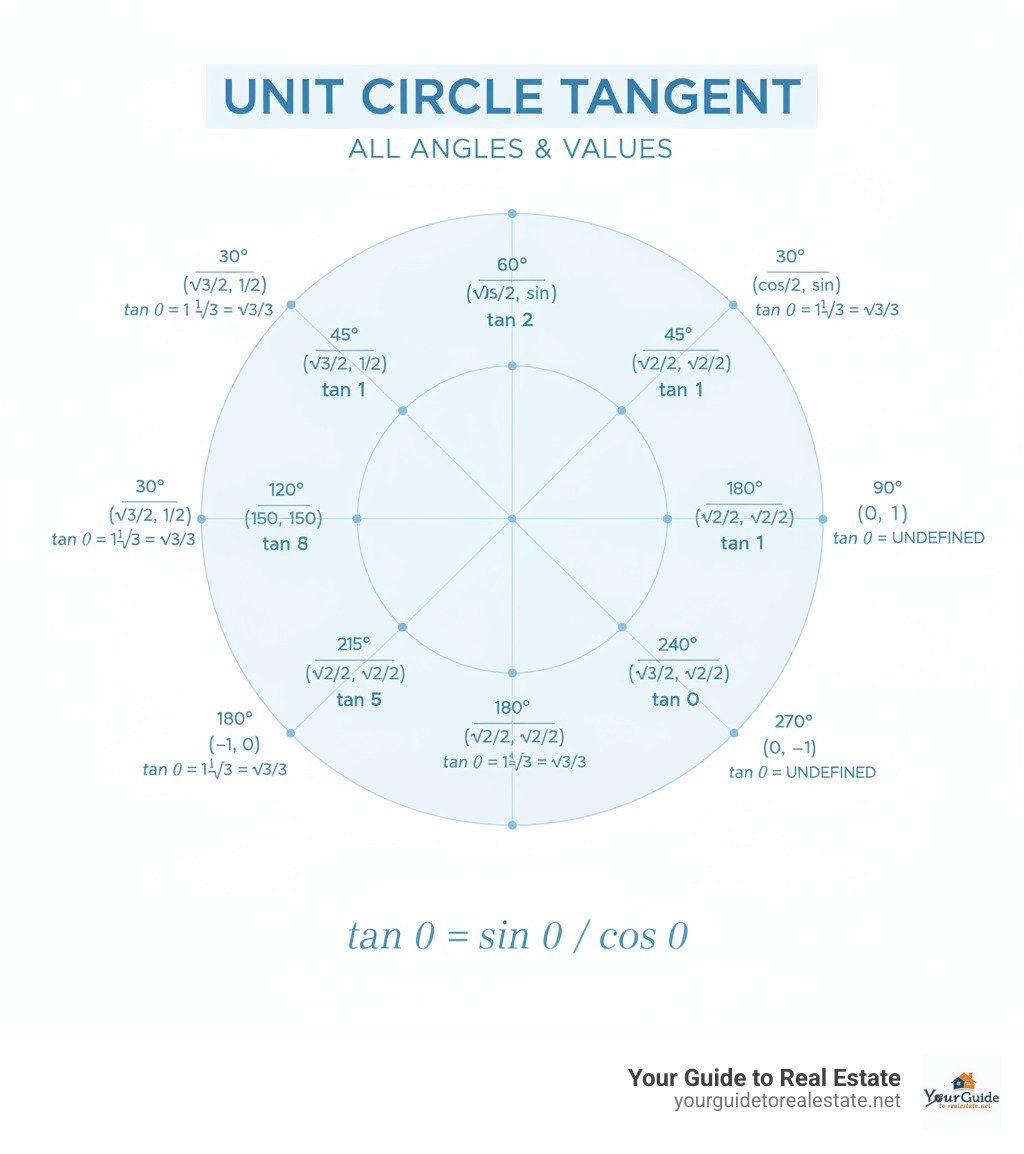
Simple unit circle tangent glossary:
Foundations: What Is the Unit Circle?
Let’s start our journey into unit circle tangent by building a rock-solid foundation. Think of the unit circle as your trusty compass in trigonometry – once you understand it, everything else clicks into place.
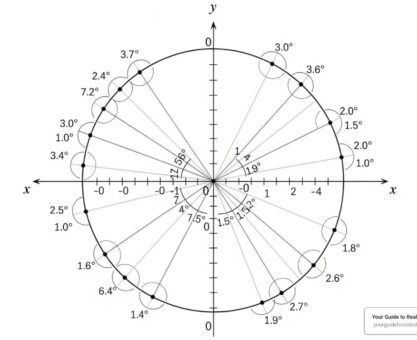
The unit circle is beautifully simple: it’s just a circle with a radius of 1 unit, sitting perfectly centered at the origin (0,0) of our coordinate system. That’s it! But don’t let this simplicity fool you – this little circle packs a mathematical punch.
Here’s where things get interesting. We can measure angles on the unit circle in degrees (the familiar 0° to 360°) or radians (0 to 2π). Starting from the positive x-axis, we sweep counter-clockwise for positive angles and clockwise for negative ones.
Now comes the magic moment. Every point on our unit circle can be written as (x,y), but these aren’t just any coordinates. The x-coordinate equals the cosine of our angle, and the y-coordinate equals the sine. So any point becomes (cos θ, sin θ). Pretty neat, right?
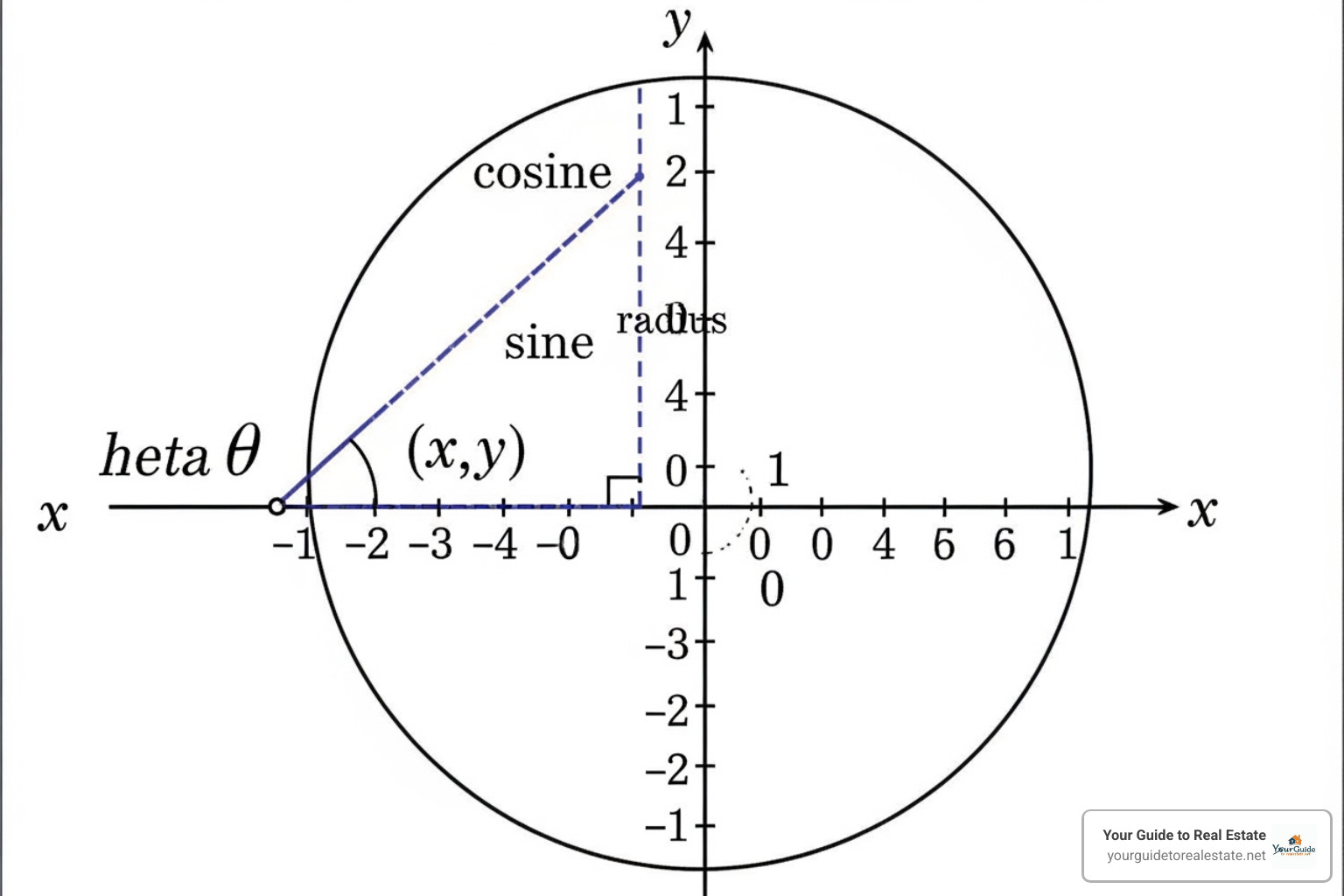
This direct relationship gives us something incredible: the fundamental Pythagorean identity. Since our circle has radius 1, every point satisfies x² + y² = 1. Substitute our trig functions, and we get cos²(θ) + sin²(θ) = 1. This identity becomes your best friend in trigonometry.
What makes the unit circle truly powerful is how it extends trigonometry beyond basic right triangles. You can find sine and cosine values for any angle – obtuse, reflex, even negative angles. It transforms abstract concepts into something you can actually see and understand.
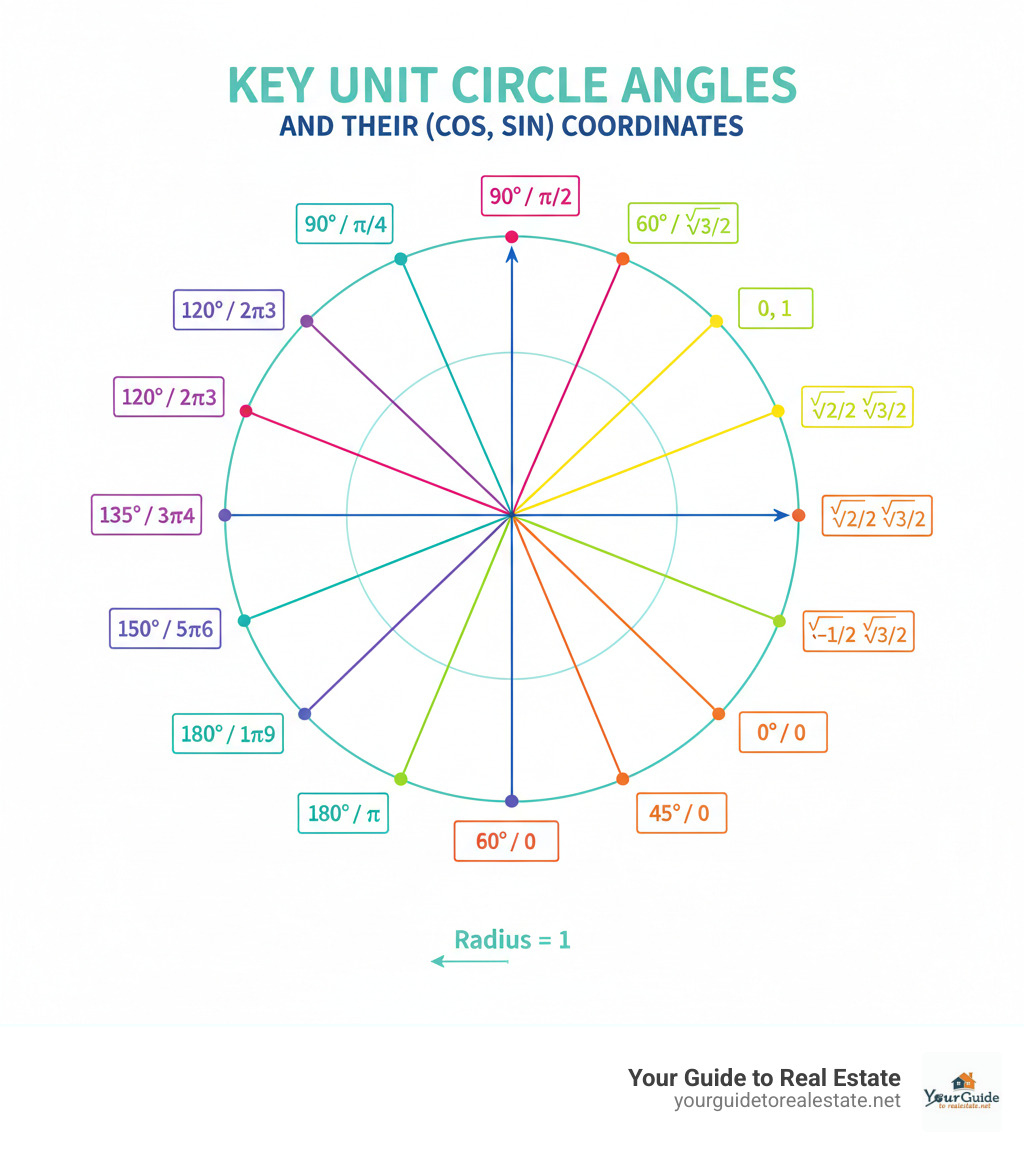
The beauty lies in the visual framework. Instead of memorizing endless formulas, you can see how angles create specific coordinate points. This foundation makes understanding tangent – our main focus – much more intuitive and meaningful.
Defining and Calculating the Tangent Function
Now that we’ve built our unit circle foundation, let’s explore the unit circle tangent – one of the most fascinating trigonometric functions. Think of tangent as the bridge between sine and cosine, creating something entirely new and powerful.
The tangent function starts with a beautifully simple idea: it’s just a ratio. Specifically, tangent is the ratio of sine to cosine for any given angle. This gives us our core formula that you’ll use again and again:
tan(θ) = sin(θ) / cos(θ)
Since we know that sine represents the y-coordinate and cosine represents the x-coordinate on our unit circle, we can also write this as:
tan(θ) = y / x
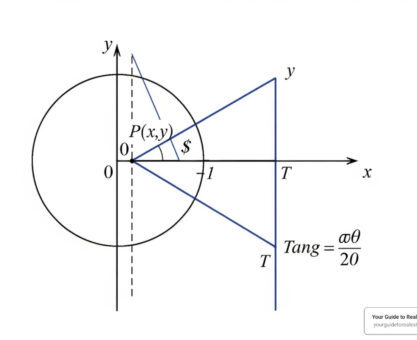
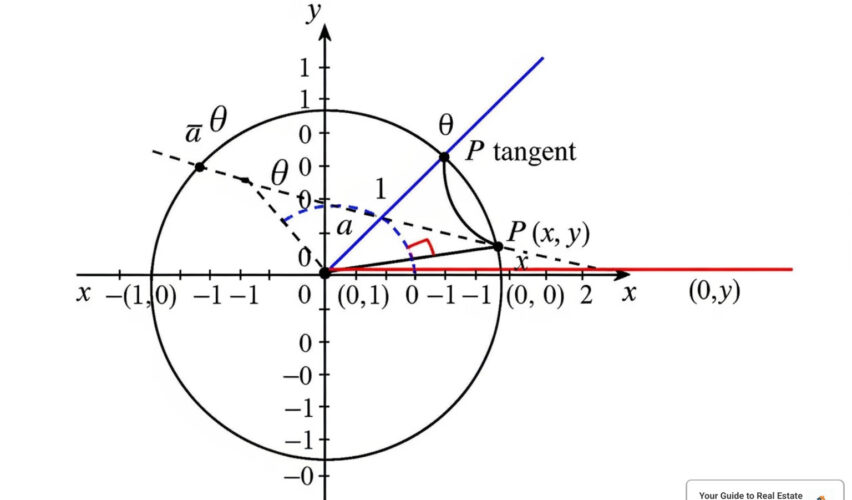
Here’s where things get really interesting from a geometric perspective. Picture a vertical line that just touches (is tangent to) the unit circle at the point (1,0) – right where the positive x-axis meets the circle. Now, if you extend the terminal side of any angle θ until it hits this vertical tangent line, the y-coordinate of that intersection point is actually the tangent of θ! This visual connection is why we call it “tangent” in the first place.
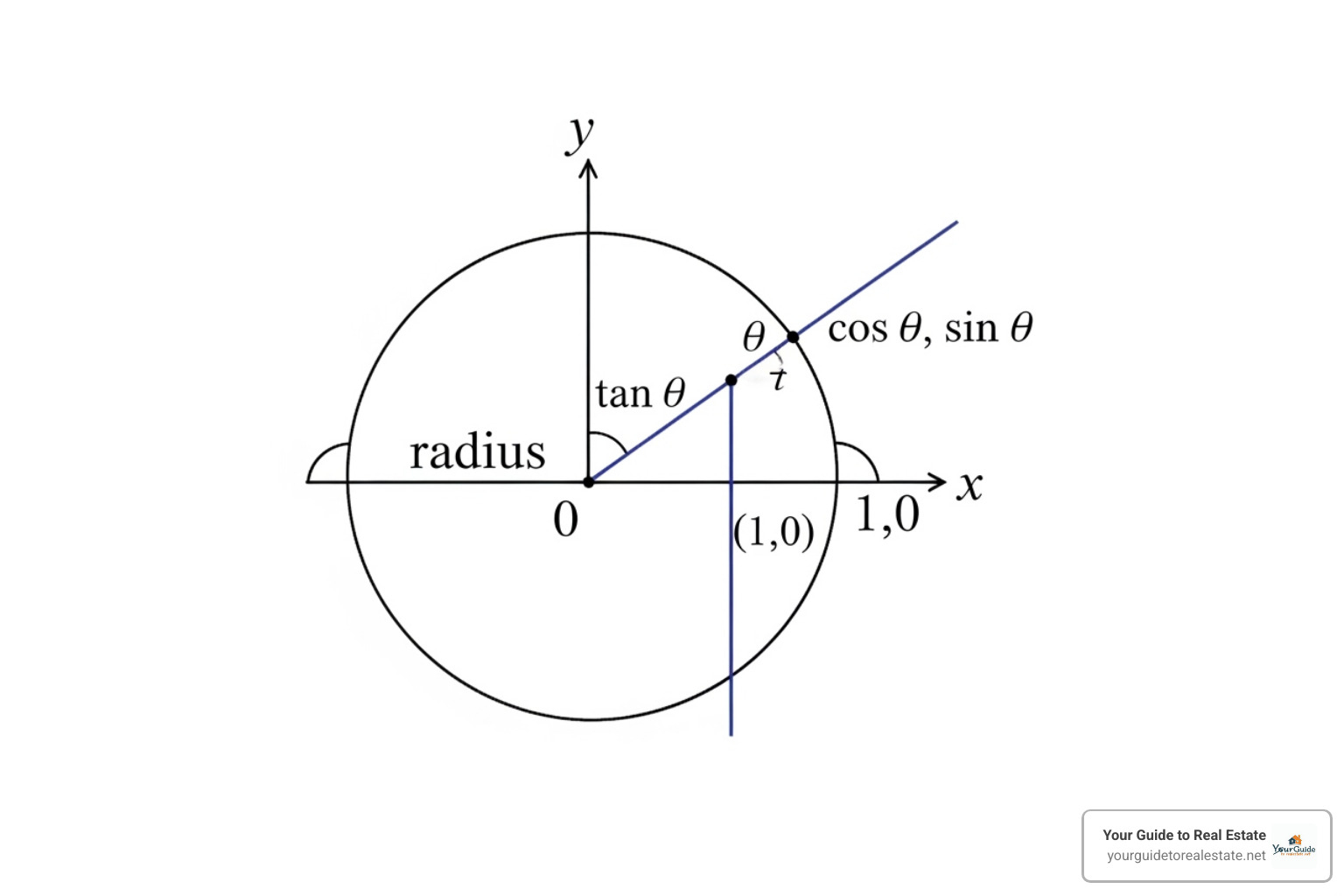
This geometric interpretation helps you understand how tangent values change as angles rotate around the circle. You can see this dynamic relationship in action through this helpful animation that shows how all the trigonometric functions relate to each other.
Computing the unit circle tangent follows a straightforward three-step process. First, identify your angle θ on the unit circle. Second, find the (x,y) coordinates where the angle’s terminal side meets the circle – remember that x equals cos θ and y equals sin θ. Third, divide the y-coordinate by the x-coordinate to get your tangent value.
How to Find Tangent for Any Angle
Let’s work through some real examples to make this crystal clear.
Finding tan(45°) or tan(π/4)
At 45 degrees, our unit circle coordinates are (√2/2, √2/2) – both coordinates are equal and positive since we’re in the first quadrant. When we calculate tan(45°) = y/x = (√2/2) ÷ (√2/2) = 1, we get our answer: tan(45°) = 1. This makes intuitive sense because at 45 degrees, we have equal rise and run, creating a slope of 1.
Finding tan(120°) or tan(2π/3)
Moving to 120 degrees puts us in the second quadrant, where our coordinates become (-1/2, √3/2). Notice how the x-coordinate is negative while the y-coordinate stays positive. Our calculation becomes tan(120°) = (√3/2) ÷ (-1/2) = -√3. The negative result makes perfect sense – in the second quadrant, we’re dividing a positive number by a negative number.
What happens when you encounter negative angles or angles beyond the standard 0° to 360° range? This is where coterminal angles become your best friend. Coterminal angles share the same terminal side and therefore the same trigonometric values.
For any angle, you can add or subtract full rotations (360° or 2π radians) to find an equivalent angle. For example, tan(405°) equals tan(405° – 360°) = tan(45°) = 1. Similarly, tan(-30°) has the same value as tan(330°), since -30° + 360° = 330°.
The beauty of the unit circle approach is that it reduces every tangent calculation to finding coordinates and performing simple division. No complex formulas to memorize – just clear, visual mathematics that makes sense.
Your Guide to the Unit Circle Tangent Values
Once you understand how the unit circle tangent works, the next logical step is getting comfortable with the actual values. Think of this as building your trigonometry vocabulary – just like learning a new language, having these common values at your fingertips makes everything else flow more naturally.
The beauty of the unit circle lies in its symmetry. We start with the first quadrant values because they’re like the foundation of a house – everything else builds from there. These angles from 0° to 90° give us positive, clean values that we can then use to figure out what happens in the other three quadrants.
Here’s where reference angles become your best friend. A reference angle is simply the acute angle between your terminal side and the x-axis. It’s like finding the “closest relative” of any angle in the first quadrant. The magnitude stays the same, but the sign might flip depending on which quadrant you’re in.
The unit circle’s symmetry across both axes means we’re not actually learning hundreds of different values – we’re learning a handful and then applying some simple rules about positive and negative signs.
The Complete Unit Circle Tangent Chart
Let’s lay out all the standard unit circle tangent values in one comprehensive table. This isn’t just about memorization – it’s about seeing the patterns that make trigonometry click.
| Angle (Degrees) | Angle (Radians) | (cos θ, sin θ) Coordinates | tan θ = sin θ/cos θ |
|---|---|---|---|
| 0° | 0 | (1, 0) | 0 / 1 = 0 |
| 30° | π/6 | (√3/2, 1/2) | (1/2) / (√3/2) = 1/√3 = √3/3 |
| 45° | π/4 | (√2/2, √2/2) | (√2/2) / (√2/2) = 1 |
| 60° | π/3 | (1/2, √3/2) | (√3/2) / (1/2) = √3 |
| 90° | π/2 | (0, 1) | 1 / 0 = Undefined |
| 120° | 2π/3 | (-1/2, √3/2) | (√3/2) / (-1/2) = -√3 |
| 135° | 3π/4 | (-√2/2, √2/2) | (√2/2) / (-√2/2) = -1 |
| 150° | 5π/6 | (-√3/2, 1/2) | (1/2) / (-√3/2) = -1/√3 = -√3/3 |
| 180° | π | (-1, 0) | 0 / -1 = 0 |
| 210° | 7π/6 | (-√3/2, -1/2) | (-1/2) / (-√3/2) = 1/√3 = √3/3 |
| 225° | 5π/4 | (-√2/2, -√2/2) | (-√2/2) / (-√2/2) = 1 |
| 240° | 4π/3 | (-1/2, -√3/2) | (-√3/2) / (-1/2) = √3 |
| 270° | 3π/2 | (0, -1) | -1 / 0 = Undefined |
| 300° | 5π/3 | (1/2, -√3/2) | (-√3/2) / (1/2) = -√3 |
| 315° | 7π/4 | (√2/2, -√2/2) | (-√2/2) / (√2/2) = -1 |
| 330° | 11π/6 | (√3/2, -1/2) | (-1/2) / (√3/2) = -1/√3 = -√3/3 |
| 360° | 2π | (1, 0) | 0 / 1 = 0 |
Notice how the values repeat with different signs? That’s the power of symmetry working for you, not against you.
Simple Tricks to Remember Tangent Values
Here’s the truth about memorizing unit circle tangent values: you don’t need to memorize them all. You just need to understand the patterns and have a few reliable tricks up your sleeve.
Start with the first quadrant pattern. The tangent values from 0° to 90° follow a beautiful sequence: 0, √3/3, 1, √3, undefined. These five values are like the DNA of the entire unit circle. Once you know tan(0°) = 0, tan(30°) = √3/3, tan(45°) = 1, tan(60°) = √3, and tan(90°) = undefined, you’ve got the building blocks for everything else.
Tangent equals sine divided by cosine. This might seem obvious, but it’s your safety net. If you blank out on a tangent value, just recall the sine and cosine values and do the quick division. For 30°, sine is 1/2 and cosine is √3/2, so tangent becomes (1/2) ÷ (√3/2) = 1/√3 = √3/3. It’s like having a calculator built into your understanding.
Think of tangent as slope. This geometric insight can be incredibly helpful. At 0°, you’re moving horizontally along the x-axis – that’s a slope of 0. At 45°, you’re moving diagonally at equal rates in both directions – that’s a slope of 1. At 90°, you’re moving straight up – that’s an undefined slope, just like a vertical line. This “tangent is slope” concept turns abstract numbers into visual understanding.
The key insight here is that mastering the unit circle tangent isn’t about brute force memorization. It’s about recognizing patterns, understanding relationships, and having reliable methods to derive what you need when you need it.
Key Properties of the Tangent Function
Now that we’ve explored specific unit circle tangent values, let’s step back and look at the bigger picture. Understanding how the tangent function behaves overall will help you predict its values and visualize its graph with confidence.
The tangent function has some fascinating characteristics that set it apart from sine and cosine. Most notably, its range extends from negative infinity to positive infinity (-∞, ∞). While sine and cosine are politely contained between -1 and 1, tangent can take on any real value imaginable. This happens because as the cosine approaches zero in our ratio sin(θ)/cos(θ), the tangent value shoots off toward infinity – either positive or negative.
Another key property is tangent’s periodicity. The unit circle tangent repeats its pattern every π radians (180°), which is exactly half the period of sine and cosine. This means tan(θ) = tan(θ + π) for any angle θ. We’ll dive deeper into why this happens in our FAQ section, but for now, just remember that tangent has this shorter repeating cycle.
Signs of Tangent: The ASTC Rule
Determining whether your tangent value should be positive or negative is crucial for accurate calculations. The ASTC rule – which stands for “All Students Take Calculus” – is your trusty memory tool for remembering which trigonometric functions are positive in each quadrant.
In Quadrant I (0° to 90°), all functions are positive. Both x and y coordinates are positive, so y/x gives us a positive tangent value. Moving to Quadrant II (90° to 180°), only sine is positive. Here, x is negative and y is positive, making y/x negative – so tangent is negative in this quadrant.
Quadrant III (180° to 270°) is where tangent shines positive again. Both x and y coordinates are negative, and dividing a negative by a negative gives us a positive result. Finally, in Quadrant IV (270° to 360°), only cosine is positive. With x positive and y negative, our y/x ratio becomes negative once more.
The pattern is clear: tangent values are positive only in the first and third quadrants, negative in the second and fourth. This simple rule will save you from sign errors in your calculations.
Where is the unit circle tangent undefined and why?
Here’s where things get mathematically interesting – and a bit dramatic. The unit circle tangent isn’t always defined, and understanding why helps illuminate the function’s behavior.
Remember our fundamental formula: tan(θ) = sin(θ)/cos(θ). Mathematics has one firm rule about division: you cannot divide by zero. It’s undefined, impossible, mathematically forbidden. So whenever cos(θ) equals zero, our tangent function hits a wall.
On the unit circle, cosine represents the x-coordinate. The x-coordinate equals zero at exactly two points: 90° (π/2 radians) where we have the point (0, 1), and 270° (3π/2 radians) where we find (0, -1). At these angles, we’re essentially trying to calculate 1/0 or -1/0, which sends mathematicians into a mild panic.
These undefined points create vertical asymptotes on the tangent graph – invisible barriers that the function approaches but never actually reaches. It’s like trying to calculate the exact profit margin when your costs are zero – the math just doesn’t work that way.
Graphing the Tangent Function Using the Unit Circle
The unit circle makes graphing the tangent function surprisingly intuitive. By plotting the tangent values from our unit circle chart, you can see the function’s distinctive wave-like pattern emerge.
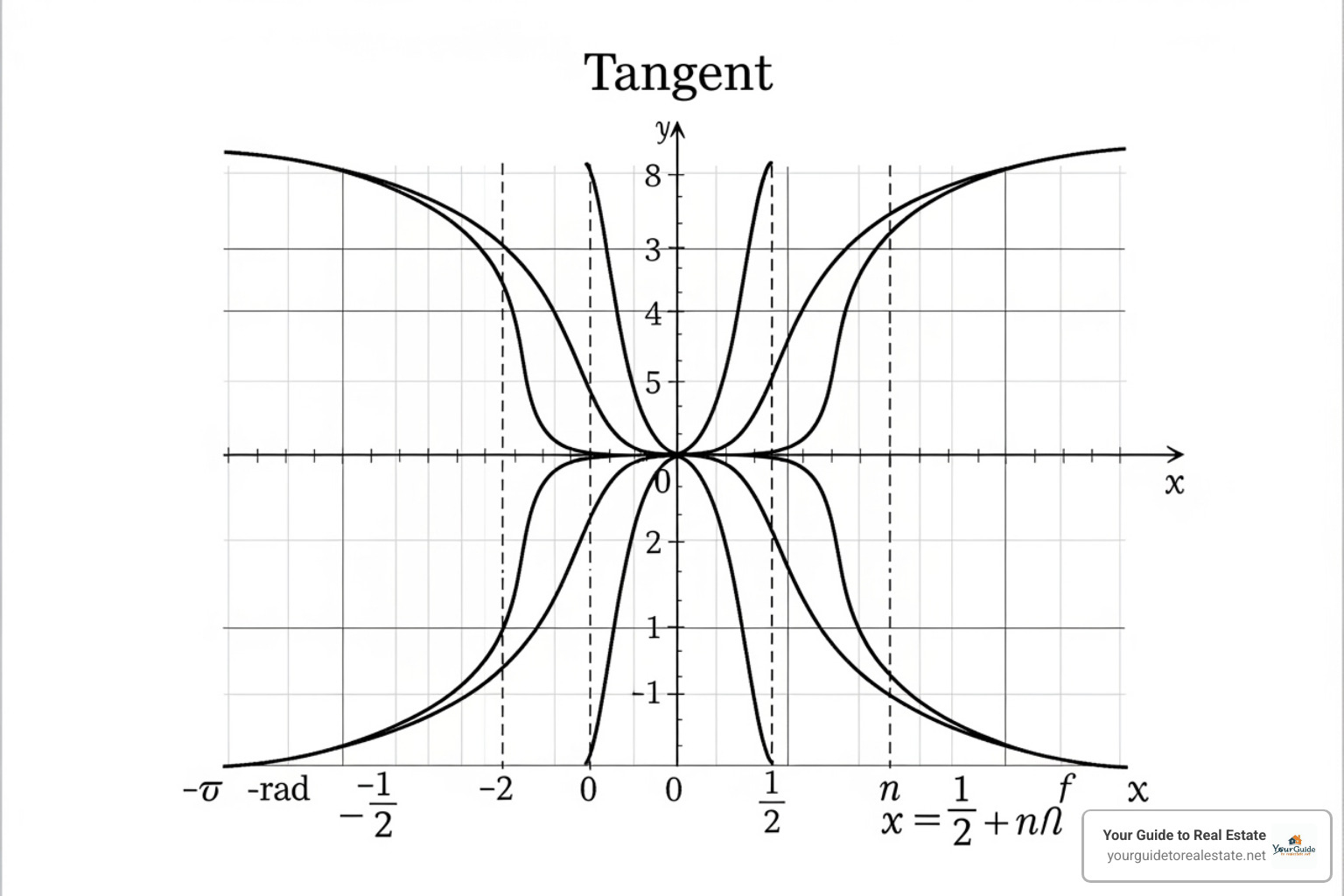
Start with familiar points: (0°, 0), (45°, 1), (90°, undefined), (135°, -1), and (180°, 0). Notice how the function starts at zero, climbs to 1, then shoots toward infinity as it approaches 90°. Just past 90°, it plunges from negative infinity back toward finite values.
This creates the tangent function’s signature look: a series of repeating S-shaped curves separated by vertical asymptotes. Each complete curve spans exactly π radians, visualizing that period of π we discussed earlier. The function approaches infinity at each asymptote, creating those dramatic vertical breaks in the graph.
Understanding how the tangent function approaches infinity at asymptotes helps explain why it’s so useful in real-world applications. Those steep slopes represent rapid changes – perfect for modeling everything from architectural angles to market trends that change dramatically over short periods.
Frequently Asked Questions
Understanding the unit circle tangent can feel a bit like learning the ins and outs of a new neighborhood. You might have questions about how everything connects, and that’s perfectly normal! Let’s tackle the most common questions that come up when people are mastering this important trigonometric concept.
How do you find the tangent of an angle using the unit circle?
The beauty of the unit circle tangent lies in its simplicity. Once you grasp the basic relationship, finding tangent becomes as straightforward as reading coordinates on a map.
Here’s the process: First, locate where your angle’s terminal side intersects the unit circle. That intersection point gives you coordinates (x, y). The magic happens next – that x-coordinate is your cosine value, and the y-coordinate is your sine value.
The tangent is simply the ratio of these coordinates: tan(θ) = y/x. Think of it as finding the slope of the line from the origin to your point on the circle. When you have coordinates like (1/2, √3/2) for a 60° angle, you divide the y by the x to get √3/2 ÷ 1/2 = √3.
It’s really that straightforward – no complex formulas to memorize, just a simple division of the coordinates you can read directly from the unit circle.
Why is the period of tangent π (180°) instead of 2π (360°)?
This question reveals one of the most fascinating aspects of the tangent function. While sine and cosine need a full 360° rotation to complete their cycles, tangent only needs 180°.
The reason becomes clear when we think about what happens as we move around the circle. Consider any angle θ and its coordinates (x, y). Now, if we rotate exactly 180° more, we end up at the point (-x, -y) – directly opposite on the circle.
When we calculate the tangent at this new position, something interesting happens. We get tan(θ + 180°) = (-y)/(-x) = y/x, which is exactly the same as our original tan(θ)! The negative signs cancel each other out perfectly.
This means the tangent function repeats its entire pattern every π radians (180°), making it quite different from its trigonometric cousins. For a deeper dive into how all three functions relate to each other, check out this helpful resource on understanding sine, cosine, and tangent.
What are the most important tangent values to memorize?
While having the complete unit circle chart at your fingertips is helpful, there are five key unit circle tangent values that form the foundation of everything else. Master these, and you’ll have the building blocks for the entire function.
tan(0°) = 0 represents a completely flat line – no rise over the run. tan(30°) = √3/3 gives you a gentle upward slope. tan(45°) = 1 is special because it represents a perfect diagonal line where the rise equals the run. tan(60°) = √3 creates a much steeper slope, and finally, tan(90°) is undefined because you can’t have a slope for a perfectly vertical line.
These five values cover the first quadrant completely. Once you know them and understand the sign patterns in each quadrant (remember our ASTC rule!), you can figure out tangent values throughout the entire circle. It’s like knowing the key landmarks in a city – once you have those reference points, navigating anywhere else becomes much easier.
Conclusion: Mastering the Tangent
We’ve taken quite a journey together through the fascinating world of unit circle tangent! From those first tentative steps understanding what a unit circle actually is, to confidently calculating tangent values for any angle, you’ve built a solid foundation in one of trigonometry’s most important concepts.
Think about how far you’ve come. You started with a simple circle of radius 1, and now you understand how every point on that circle tells a story about angles, coordinates, and ratios. The unit circle tangent isn’t just some abstract mathematical formula – it’s a powerful tool that reveals the relationship between sine and cosine in a visual, intuitive way.

The beauty of mastering these concepts goes far beyond the classroom. When you understand how to break down complex problems into manageable pieces, recognize patterns, and apply logical thinking, you’re developing skills that serve you everywhere. Architects use these principles to calculate perfect roof angles. Engineers rely on them to design bridges that won’t collapse. Even in real estate, professionals constantly use analytical thinking to assess property boundaries, understand lot dimensions, and make smart investment decisions.
The unit circle has shown you something profound: mathematics isn’t just about memorizing formulas. It’s about seeing connections, understanding relationships, and using visual tools to make sense of complex ideas. When you look at that simple circle with radius 1, you’re seeing a gateway to understanding slopes, periodic functions, and the neat dance between sine and cosine.
Your analytical skills are now sharper than when you started. You can look at an angle and immediately know its tangent’s sign based on which quadrant it falls in. You understand why tangent shoots off to infinity at certain points, and why it repeats every π radians instead of 2π. These aren’t just mathematical curiosities – they’re evidence of your growing ability to think systematically and solve problems step by step.
This kind of analytical thinking is exactly what makes professionals successful in any field. Whether you’re evaluating market trends, making investment decisions, or simply trying to understand the world around you, the problem-solving approach you’ve learned here will serve you well. Mastering valuation and market analysis requires strong analytical skills, just like mastering the unit circle tangent.
Keep practicing with those key angles. Tan(0°) = 0, tan(45°) = 1, and tan(90°) is undefined. Use the ASTC rule to determine signs in different quadrants. Most importantly, keep visualizing that unit circle – it’s your roadmap to trigonometric success.
The unit circle tangent has taught you more than just mathematics. It’s shown you that complex concepts become manageable when you break them down, use visual aids, and build understanding step by step. That’s a lesson that will serve you well, whether you’re calculating angles or navigating life’s challenges.