

Why Finance Internships Are Your Gateway to a Successful Career
Finance internships offer students the chance to gain real-world experience, build professional networks, and launch successful careers in one of the most dynamic industries. These programs provide hands-on training in financial analysis, budgeting, and strategic planning while giving you a competitive edge in today’s job market.
What are finance internships?
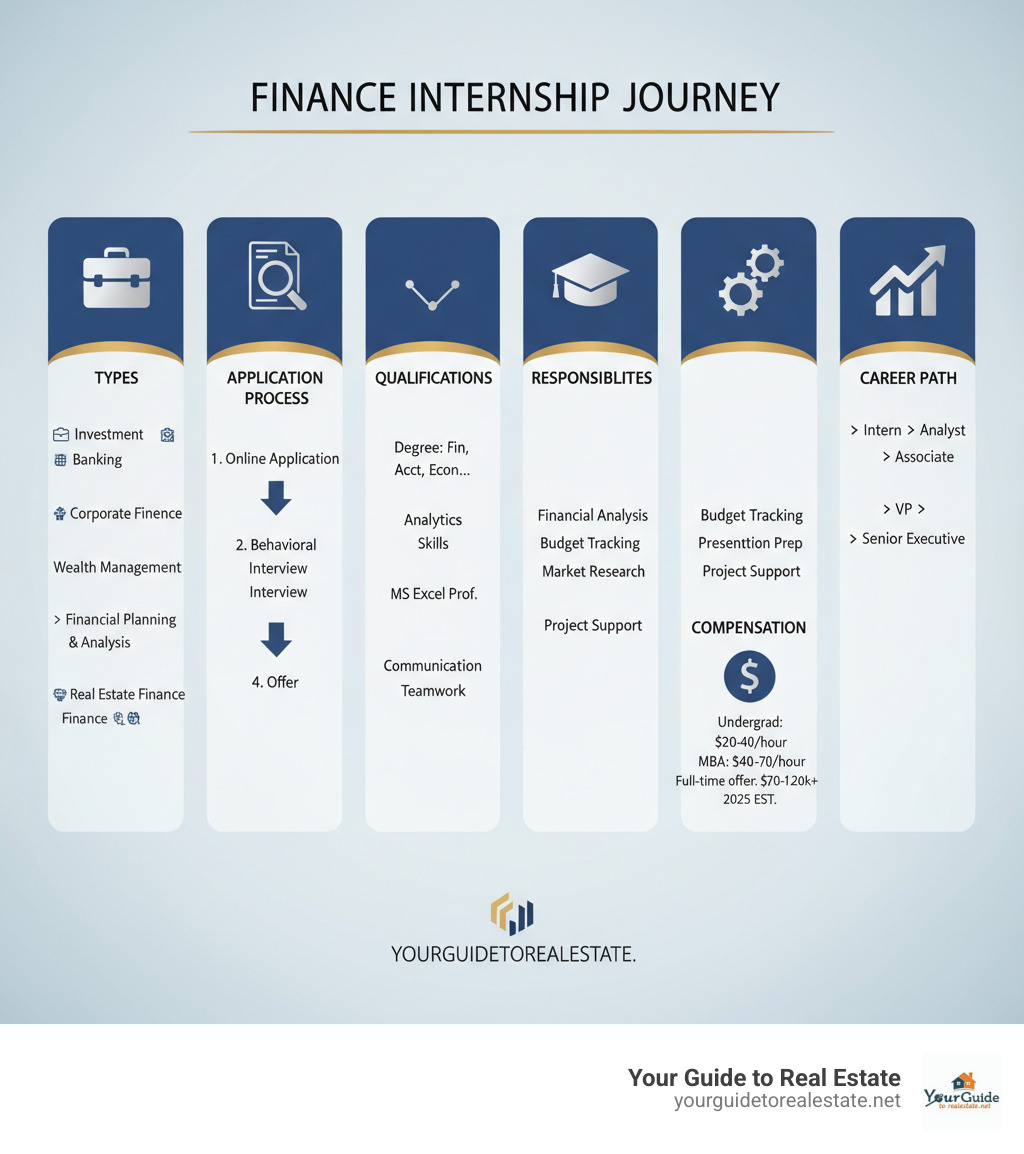
- Paid positions lasting 10-12 weeks (typically summer programs)
- Real business impact through challenging projects with dedicated mentorship
- Diverse specializations including investment banking, corporate finance, wealth management, and financial planning & analysis
- Career advancement with many programs leading to full-time job offers
Key responsibilities include:
- Supporting financial reporting and data analysis
- Assisting with budget tracking and market research
- Preparing presentations and improving business processes
- Working alongside professional teams on live projects
Required qualifications typically include:
- Pursuing a degree in Finance, Accounting, Economics, Mathematics, or Business
- Strong analytical and problem-solving skills
- Proficiency in Microsoft Excel and communication abilities
- Learning agility and team collaboration skills
The numbers speak for themselves – there are currently 685 finance intern jobs in Canada and 870 in Texas alone. Major companies like Capital One, TD, and Scotiabank actively recruit interns through structured 10-week programs that combine mentorship with meaningful project work.
With the financial industry expected to grow at about 5% annually, these internships aren’t just resume builders – they’re essential stepping stones to roles like Investment Analyst, Financial Planner, or Corporate Treasurer. The experience you gain can be particularly valuable in specialized areas like real estate finance, where understanding market trends and financing options creates unique career opportunities.
Finance internships vocab to learn:
1. Leverage Online Job Boards and Company Career Pages
Your journey to landing a finance internship starts with mastering the digital job hunt. Think of online job boards and company career pages as your personal treasure map – they’re packed with opportunities just waiting for the right person to find them.
The numbers alone will blow you away. LinkedIn currently shows over 11,000+ Finance Internship jobs in United States, with Texas leading the charge at 870 positions. Even in Canada, there are 685 active finance internships available right now. That’s a lot of doors waiting to open for ambitious students like you.
Start with strategic keyword searches to cut through the noise. Try terms like “finance intern,” “accounting intern,” “financial analyst intern,” or “investment banking intern.” Each search will reveal different opportunities, so don’t stick to just one phrase.
The real goldmine lies in company career pages. Major players like Capital One offer structured 10-week finance internship programs that welcome students from various backgrounds – Finance, Accounting, Mathematics, Business, Economics, and Engineering. SLB (Schlumberger) posts accounting and finance roles in specialized areas like General Accounting, Tax, and Treasury departments.
Other industry leaders actively recruiting interns include TD, Scotiabank, Deloitte, Amazon, Shell, and Barclays. Each company has its own application portal and timeline, so visiting their career pages directly gives you insider access to their specific requirements and culture.
Here’s your secret weapon: job alerts. Set them up on multiple platforms to get instant notifications when new positions drop. This is crucial because many summer 2025 and winter 2026 internships are posted months in advance. Being among the first applicants can make all the difference in competitive hiring.
The job market moves fast – Texas alone saw 769 new finance internship postings in the past month. Filter your searches by “recently posted” to focus on fresh opportunities where you’ll face less competition.
Don’t limit yourself to the big-name platforms either. Specialized sites often feature unique opportunities that others miss. The key is casting a wide net while staying organized with your applications.

Pro tip: Bookmark the career pages of companies you’re genuinely excited about. Check them weekly, even if they don’t have current openings. Many firms post internships in cycles, and you’ll want to be ready when they do.
Persistence pays off in this process. The perfect finance internship might be just one search away, so keep refining your approach and stay consistent with your efforts.
2. Tap Into Your University’s Career Services and Alumni Network
Your university is sitting on a goldmine of finance internship opportunities that many students completely overlook. Think about it – you’re already paying for these services through your tuition, so why not use them to their fullest potential?
Your campus career center is like having a personal job search team working just for you. These folks maintain relationships with employers specifically looking to hire students from your school. They host on-campus recruiting events where companies like Deloitte and Capital One send their best recruiters to meet students face-to-face. There’s something magical about shaking hands with a recruiter instead of being just another resume in their inbox.
Career fairs are where the magic really happens. They can feel overwhelming with all those company booths and polished recruiters, but here’s the secret – most students just grab brochures and move on. The smart ones have real conversations. They ask thoughtful questions about company culture, specific internship projects, and career paths. This is your chance to be remembered when application review time comes around.
Don’t sleep on your university’s job portal either. Many companies post exclusive opportunities there that never make it to the big job boards. It’s like having access to a private club where the competition is automatically smaller.
Now, let’s talk about your alumni network – this is where things get really interesting. Your school’s alumni database is full of professionals who were once exactly where you are now. They remember what it was like to search for their first finance internships, and most are surprisingly willing to help.
Informational interviews with alumni are pure gold. These aren’t job interviews – they’re friendly conversations where you can learn about someone’s career journey, get insider tips about their company, and maybe even score a referral. The best part? Alumni often know about openings before they’re posted publicly.
Mentorship relationships that start during your internship search can last throughout your entire career. That alumni connection who helps you land your first internship might be the same person who recommends you for a promotion five years down the road.
The beauty of these warm introductions is that they cut through all the noise. Instead of being applicant #847 in an online system, you become “Sarah’s mentee from State University who she thinks would be perfect for this role.”

Your university wants you to succeed – it makes them look good too. So take advantage of every networking event, workshop, and resource they offer. The relationships you build now will pay dividends throughout your entire career.
3. Explore Niche and Specialized Finance Internships
While traditional finance internships at big banks are great, some of the most exciting opportunities hide in specialized corners of the industry. Think of it like choosing between a crowded highway and a scenic back road – both get you there, but one offers a much more interesting journey.
The finance world is incredibly diverse, and finding your niche early can set you apart from other candidates. Instead of competing with hundreds of students for the same corporate finance role, you might find your passion lies in wealth management, where you’ll build relationships with clients and analyze investment portfolios. Or maybe financial planning & analysis (FP&A) is your calling, where you’ll dive deep into budgeting and forecasting that directly shapes business decisions.
One area that’s particularly close to our hearts at Your Guide to Real Estate is real estate finance. This field combines financial expertise with property market knowledge, creating opportunities that are both challenging and rewarding. You might find yourself evaluating commercial property acquisitions, structuring financing for residential developments, or analyzing market trends that influence investment decisions. It’s a perfect blend of numbers and real-world impact. To get a better sense of where the market is heading, check out our insights on Real Estate Market Projections for 2025: Key Numbers to Watch.

Understanding Different Types of Finance Internships
Each type of finance internship offers a completely different experience, almost like choosing different majors in college. Investment banking interns spend their days mastering financial modeling and valuation techniques, often working on exciting mergers & acquisitions deals that make headlines. It’s intense but incredibly educational.
Corporate finance roles focus more on a company’s internal financial health. You’ll work on budgeting and forecasting projects that help executives make strategic decisions. Abbott’s finance intern program, for example, involves tracking marketing budget performance and analyzing how pricing strategies affect profit margins – real work that impacts the bottom line.
Wealth management internships are perfect if you enjoy client relations and portfolio analysis. You’ll work alongside financial advisors, learning how to match investment strategies with client goals. It’s more personal and relationship-focused than other finance areas.
Morgan Stanley’s finance program in Mexico City shows how specialized these roles can get. Interns there handle daily foreign exchange positions, calculate capital requirements, and prepare regulatory reports for financial authorities. It’s detailed, technical work that gives you insider knowledge of how global finance really operates.
Finding Opportunities in Growing Sectors
The smartest career moves often happen in emerging fields, and finance has several exciting growth areas right now. Venture capital and private equity are booming, offering chances to work with high-growth companies and complex deal structures. These internships expose you to entrepreneurship and innovation in ways traditional finance roles can’t match.
Sustainable finance is another hot area. Companies increasingly care about environmental and social impact, not just profits. ESG (Environmental, Social, and Governance) investing internships might have you analyzing companies’ sustainability practices or developing impact investment strategies.
For those interested in where technology meets real estate, PropTech represents an incredible opportunity. These startups are revolutionizing how properties are bought, sold, and managed using cutting-edge technology. A PropTech internship could involve financial analysis for innovative real estate solutions or market research for new property platforms. We’ve identified some exciting companies in this space – check out our article on the Top 6 PropTech Startups to Watch in 2025.
By targeting these specialized areas, you’re not just gaining unique experience – you’re positioning yourself at the forefront of financial innovation. While others follow traditional paths, you’ll be building expertise in tomorrow’s most important financial sectors.
4. Master Your Application Materials and Interview Skills
Landing your dream finance internship isn’t just about finding the right opportunities – it’s about presenting yourself as the candidate they can’t say no to. With thousands of students competing for these coveted positions, your application materials and interview performance can make or break your chances.
Think of your resume as your personal marketing brochure. It shouldn’t read like a boring job description, but rather tell the compelling story of your achievements and potential. Customizing your resume for each application is absolutely essential – generic resumes get lost in the pile faster than you can say “quarterly earnings.”
Focus on quantifiable achievements that showcase your impact. Instead of writing “Helped with budget analysis,” try something like “Analyzed quarterly budget data for three departments, identifying cost-saving opportunities worth $25,000.” Numbers speak louder than vague descriptions in the finance world.
Your cover letter is where you get to show your personality and genuine interest. Research the company thoroughly – their recent projects, company culture, and even the team you’d be joining. This isn’t just about impressing them; it’s about showing you’ve done your homework and truly want to be there.
| Weak Resume Bullet Point | Strong Resume Bullet Point for a Finance Role |
|---|---|
| Assisted with analysis. | Conducted in-depth financial analysis of market trends, contributing to a 5% increase in projected revenue. |
| Supported accounting team. | Collaborated with the accounting department to reconcile quarterly financial statements, ensuring 100% accuracy. |
| Worked on a project. | Led a project to optimize budget allocation across departments, identifying cost savings of $50,000 annually. |
When it comes to interviews, you’ll likely face two types: technical and behavioral. Technical interviews might test your knowledge of financial concepts, Excel skills, or current market trends. Don’t panic if you don’t know everything – showing your thought process and willingness to learn often matters more than perfect answers.
Behavioral interviews are where the STAR method becomes your best friend. This stands for Situation, Task, Action, Result – it’s a simple framework for structuring your answers with concrete examples. Instead of saying “I’m good at teamwork,” tell them about that time you collaborated with classmates on a complex financial modeling project and how your contribution led to an A+ grade.
What Skills and Qualifications Do You Need for finance internships?
Let’s get real about what employers actually want when they’re hiring finance internships. After analyzing countless job postings and successful applications, certain qualifications consistently rise to the top.
Your academic background matters, but it’s more flexible than you might think. While a Finance degree is obviously great, companies like Capital One actively recruit from Accounting, Economics, Mathematics, Business, and even Engineering programs. What matters most is showing you can think analytically and handle numbers confidently.
Excel proficiency isn’t optional – it’s the language of finance. You’ll live in spreadsheets, creating financial models, analyzing data, and preparing reports. If pivot tables and VLOOKUP functions make you nervous, spend some time getting comfortable with them before you apply.
Analytical thinking is what separates good finance interns from great ones. You need to look at complex data, spot patterns, and draw meaningful conclusions. Companies like Abbott expect their interns to evaluate pricing strategies and identify process improvements – tasks that require sharp analytical skills.
Don’t underestimate the power of communication skills. You might be crunching numbers all day, but you’ll also need to explain your findings to teammates, present to managers, and collaborate on projects. Being able to translate complex financial concepts into plain English is incredibly valuable.
Problem-solving abilities are crucial because finance is full of puzzles. Markets fluctuate, budgets don’t balance, and unexpected challenges pop up daily. Employers want interns who can approach problems systematically and propose creative solutions.
Attention to detail can’t be overstated in finance. A misplaced decimal point or overlooked figure can have serious consequences. Whether you’re reconciling accounts or preparing regulatory reports, precision is non-negotiable.
Finally, integrity and learning agility are the soft skills that tie everything together. You’ll handle sensitive financial information and work in environments where continuous learning is essential. Companies value interns who are ethical, adaptable, and eager to grow.
The good news? Most of these skills can be developed through coursework, personal projects, and even part-time jobs. The key is recognizing what employers value and working to strengthen these areas before you apply.
Frequently Asked Questions about Finance Internships
Let’s address the questions we hear most often about finance internships. Getting clear answers can help you make smart decisions and set realistic expectations as you start your career journey.
What are the typical responsibilities of a finance intern?
Finance internships offer hands-on experience with real business challenges, and your day-to-day tasks will vary depending on the company and department. However, most interns share similar core responsibilities that form the foundation of financial work.
Data analysis sits at the heart of most finance roles. You’ll spend significant time collecting, cleaning, and analyzing financial information to spot trends and support important decisions. This might involve researching market conditions or diving deep into company performance metrics.
Financial reporting is another cornerstone responsibility. Many interns help prepare monthly, quarterly, or annual reports for internal teams and external stakeholders. For example, at Morgan Stanley’s Mexico City program, interns prepare monthly reports for Banxico (Mexico’s central bank) and contribute to annual stress testing scenarios.
Budget tracking keeps companies financially healthy, and interns play a vital role here. Abbott’s finance intern program focuses heavily on tracking marketing, digital, and CRM budget utilization to ensure teams follow proper accounting principles and stay within their limits.
You’ll also tackle market research projects, studying industry trends and competitor activities that inform investment decisions. Supporting senior analysts gives you incredible learning opportunities as you work alongside experienced professionals on complex financial operations.
Preparing presentations helps you develop crucial communication skills as you translate complex data into clear, digestible visuals for meetings and client pitches. Many companies also involve interns in process improvement projects, where you might help streamline reporting procedures or implement automated templates.
Specialized tasks vary by area but can include fascinating work like FX position monitoring for daily currency exposures, capital index calculations, or trading product reconciliation to ensure accuracy in financial records. Some programs like SLB’s offer departmental rotations through General Accounting, Tax, and Treasury to give you broader exposure.
What is the typical duration and compensation for these roles?
Most finance internships follow a predictable structure designed to fit your academic schedule while providing meaningful work experience.
The standard duration is 10-12 weeks, typically running through the summer break. Capital One’s program exemplifies this with their structured 10-week experience. However, some programs extend longer – Abbott’s 2025 finance intern program runs from May through November, offering deeper immersion into the business cycle.
The excellent news is that reputable finance internships are paid positions. This financial support lets you focus on learning without worrying about covering your expenses during the program.
Compensation varies significantly by location and company size. In Singapore, finance interns typically earn between $1,000 and $1,200 monthly. Major U.S. financial centers offer higher compensation, with some LinkedIn listings showing salary ranges starting above $40,000 annually (which translates to substantial weekly intern pay).
Regional differences matter quite a bit. Internships in financial hubs like New York, Toronto, or Dallas generally offer better compensation than smaller markets. This reflects both the higher cost of living and the competitive nature of these markets.
Many programs also offer the possibility of full-time job offers upon successful completion. Companies often use internships as their primary talent pipeline, evaluating interns for entry-level positions after graduation. This makes your internship a strategic investment in your future career prospects.
What career paths can a finance internship lead to?
A finance internship opens doors to diverse and rewarding career paths across the financial sector and beyond. The practical experience, professional connections, and skills you develop create a solid foundation for long-term success.
Many interns receive full-time offers directly from their host companies, transitioning seamlessly into entry-level roles after graduation. This represents the most straightforward path, but even without a direct offer, your internship experience significantly improves your career prospects.
Investment Analyst roles naturally follow internships involving financial modeling, valuation, or market research. You’ll evaluate securities, companies, or real estate investments to guide decision-making.
Financial Planner positions appeal to those who enjoyed wealth management aspects of their internship. These professionals help individuals and families manage finances, plan retirement, and make smart investment choices.
Corporate Treasurer or Financial Manager roles suit interns who worked in corporate finance or FP&A. These positions focus on managing company financial resources, cash flow, budgeting, and overall financial strategy.
Risk Manager careers are increasingly important as financial markets grow more complex. Internships emphasizing regulatory compliance, data analysis, or market dynamics provide excellent preparation for these roles.
For those with accounting-focused internships (like SLB’s programs in General Accounting, Tax, and Treasury), Auditor or Accountant careers offer natural progression paths in auditing, tax consulting, or corporate accounting.
Real estate finance represents a particularly exciting specialization that aligns with our expertise at Your Guide to Real Estate. Internships with real estate focus can lead to careers in real estate investment banking, property development finance, mortgage lending, or asset management for real estate portfolios. This specialized knowledge remains highly sought after as technology continues changing the industry – explore more in our article on How Technology Is Revolutionizing Real Estate: 2025 Trends to Watch.
The analytical thinking, problem-solving, communication, and technical skills you develop transfer across industries, making you a versatile candidate for various business roles. Your finance internship provides invaluable clarity on career interests while building a robust professional network and equipping you with practical skills needed to thrive in finance’s dynamic world.
Conclusion
Your journey to land that perfect finance internship doesn’t have to feel overwhelming. We’ve walked through four powerful strategies together – from mastering online job boards and tapping into your university’s hidden network, to exploring specialized niches and perfecting your application materials. Each approach gives you a different angle to stand out in this competitive field.
The secret ingredient is persistence paired with smart preparation. Yes, the finance world is competitive – with thousands of students vying for those coveted spots at companies like Capital One, TD, and Scotiabank. But here’s the thing: every successful finance professional started exactly where you are now. They faced the same challenges, submitted countless applications, and pushed through rejections to land their breakthrough opportunity.
Think of your finance internship as more than just a summer job. It’s your gateway to understanding how money moves through our economy, how businesses make critical decisions, and how financial markets shape our daily lives. Whether you end up analyzing investment opportunities in Dallas, supporting budget tracking for a major corporation, or diving into the exciting world of real estate finance, you’re building skills that will serve you for decades.
At Your Guide to Real Estate, we see how financial literacy transforms lives. The analytical thinking you’ll develop, the attention to detail you’ll master, and the problem-solving skills you’ll sharpen during your internship create a foundation for success in any field. These same skills help our clients make smart property investments and understand complex topics like Understanding Mortgages: A Beginner’s Guide to Home Loans.
Your career story starts with that first application. Every networking conversation, every interview, and every rejection teaches you something valuable. The finance industry is evolving rapidly, especially where it intersects with technology and real estate. The experience you gain now positions you perfectly for the future of finance.
We believe in providing proven frameworks and stress-free guidance – the same approach that helps people succeed in real estate works for launching your finance career. Stay focused, keep applying, and trust the process. Your future self will thank you for taking this important step today.