

Why Your Future Success Depends on Remembering to Remember
Prospective memory is your brain’s ability to remember and carry out planned actions at the right time in the future. Whether it’s remembering to call a client back, attend a closing meeting, or review market reports, this cognitive function shapes how successfully you steer daily tasks and long-term goals.
Key Facts About Prospective Memory:
- Definition: Remembering to perform intended actions in the future
- Two Main Types: Event-based (triggered by cues) and time-based (triggered by time)
- Daily Impact: Nearly 15% of all daily thoughts involve planning future intentions
- Failure Rate: At least half of everyday forgetting stems from prospective memory failures
- Brain Regions: Involves prefrontal cortex, hippocampus, and parietal lobe
Unlike retrospective memory (recalling past events), prospective memory focuses entirely on the future. It’s the difference between remembering what happened at yesterday’s property showing versus remembering to prepare for tomorrow’s client meeting.
Research shows that thoughts about planning and executing future intentions make up nearly 15% of our daily mental activity. This “remembering to remember” function becomes especially critical in complex fields like real estate, where missed deadlines, forgotten appointments, or overlooked contract details can derail entire transactions.
The stakes are remarkably high across professions. In aviation, almost 1 in 5 major accidents can be traced back to prospective memory failures. In healthcare, patients who forget to take prescribed medication even once face significantly higher risks of heart attacks or death compared to those who maintain consistent routines.
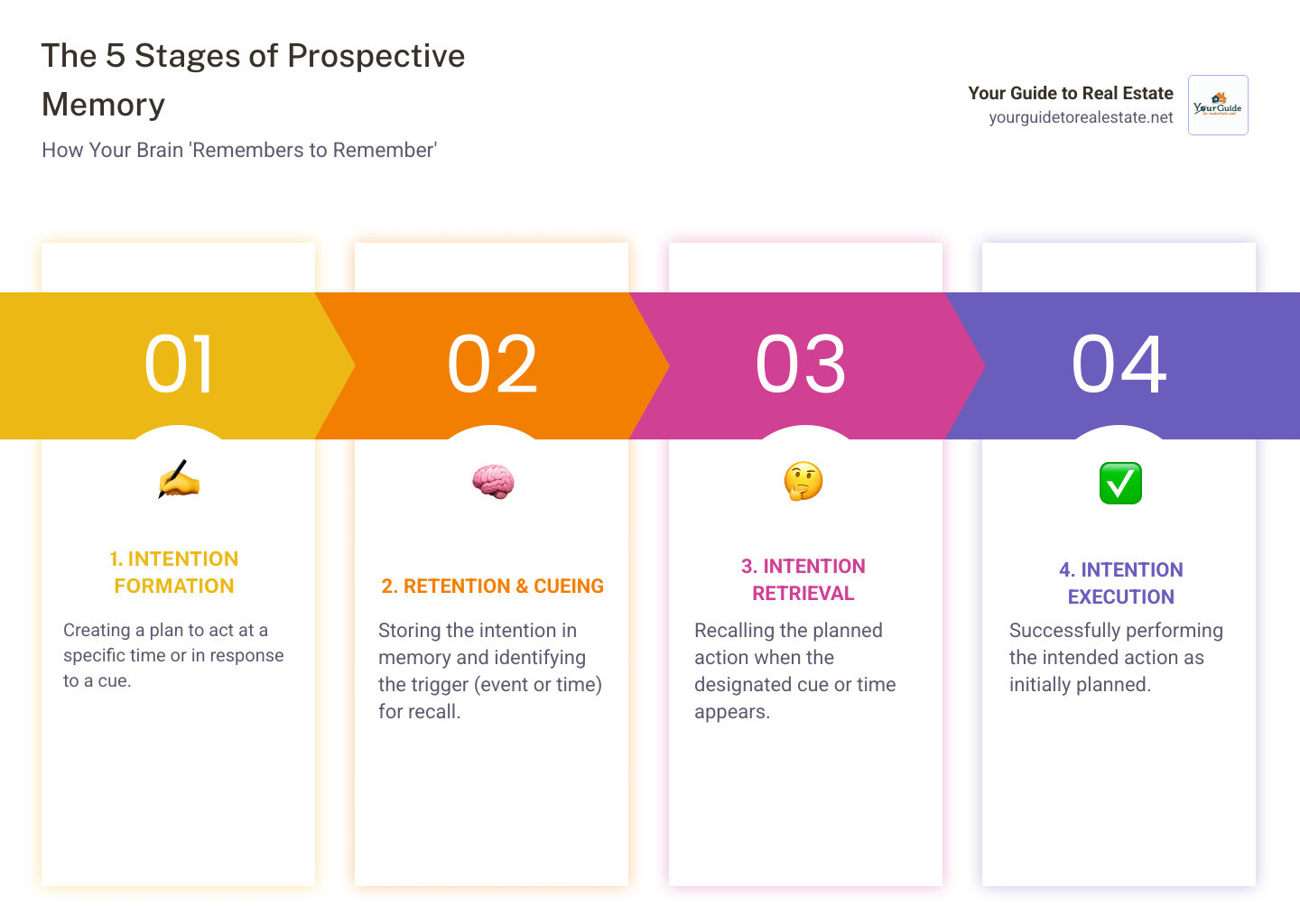
Prospective memory terminology:
The Critical Role of Prospective Memory in Daily Life
Think about everything you planned to do today. Maybe you intended to call a client back after lunch, pick up dry cleaning on your way home, or remember to take your vitamins with dinner. Every single one of these intentions relies on prospective memory – and without it, our carefully planned lives would quickly fall apart.
Prospective memory isn’t just some fancy psychology term. It’s the invisible force that keeps our world running smoothly. From the moment we wake up and remember to check our phones for overnight messages, to setting that mental reminder to lock the front door before bed, we’re constantly forming intentions for future actions.
The real-world impact is staggering. Consider medication adherence – something as simple as remembering to take your blood pressure pills. Research shows that people who forget their medication even once face significantly higher risks of heart attacks or death. That’s not just forgetting; that’s literally life or death.
Social appointments depend entirely on this memory system too. Remembering your friend’s birthday, showing up for dinner plans, or calling your mom on Sunday – these aren’t just nice gestures. They’re the building blocks of our relationships. When we forget, we don’t just miss an event; we potentially hurt the people we care about.
In the workplace, prospective memory becomes even more critical. Work deadlines aren’t suggestions – they’re commitments. Missing them can damage our reputation, cost money, or derail entire projects. For those of us in real estate, this hits especially close to home.
Real estate tasks are particularly unforgiving. Imagine forgetting to submit an offer before it expires, missing a client’s inspection deadline, or failing to follow up on a hot lead. These aren’t minor slip-ups – they’re deal-breakers that can cost thousands of dollars and destroy client trust.
The consequences of prospective memory failures extend far beyond personal embarrassment. In aviation, almost 1 in 5 major accidents can be traced back to someone forgetting a critical step in a procedure. Pilots are highly trained professionals working with sophisticated equipment, yet human memory remains their weakest link.
Healthcare shows us similar patterns. When medical professionals forget to administer medication on schedule or miss crucial follow-up procedures, patient outcomes suffer dramatically. The statistics are sobering – individuals who forget their prescribed medications face significantly higher health risks compared to those who maintain consistent routines.
Event-Based vs. Time-Based: The Two Types of Prospective Memory
Not all future intentions work the same way. Prospective memory actually comes in two distinct flavors, and understanding the difference can help you become much better at remembering what you need to do.
Event-based cues are like having a helpful friend tap you on the shoulder. You see something in your environment that triggers your memory. Seeing a post office suddenly reminds you to mail that letter you’ve been carrying around for three days. Spotting your neighbor reminds you to ask about their contractor recommendation. Driving past the grocery store triggers your mental note to grab milk.
These external triggers are incredibly powerful because they don’t require you to actively monitor anything. The world basically does the remembering for you.
Time-based cues are trickier. They rely on your internal clock and constant vigilance. Taking medication at 8 PM means you need to somehow keep track of time throughout your evening. Remembering to call a client at exactly 10 AM requires you to monitor the clock, not just hope you’ll naturally remember.
Here’s how these two types stack up against each other:
| Feature | Event-Based Prospective Memory | Time-Based Prospective Memory |
|---|---|---|
| Trigger | External cue (seeing something/someone) | Time or internal monitoring |
| Difficulty Level | Generally easier | More challenging |
| Success Rate | Higher (when cues are obvious) | Lower (requires active monitoring) |
| Real Estate Example | Seeing a “For Sale” sign reminds you to call the listing agent | Remembering to call a client at exactly 2 PM |
Relative difficulty between these types is significant. Event-based tasks typically have higher success rates because the environmental cue does most of the work. Time-based tasks demand much more from your brain – you need to continuously track time while focusing on other activities.
The reliance on external vs. internal cues explains why some people seem naturally better at remembering things. They’ve either gotten better at noticing environmental triggers or they’ve developed strong internal time-monitoring skills.
The High Stakes of Forgetting in Critical Professions
Some jobs simply don’t allow room for memory mistakes. When prospective memory fails in these high-stakes environments, the consequences can be catastrophic.
Aviation safety depends on pilots, air traffic controllers, and ground crews remembering hundreds of sequential steps. Missing one item on a pre-flight checklist, forgetting to communicate a critical instruction, or delaying a planned maneuver can lead to tragedy. The fact that almost 1 in 5 major airline accidents stem from these memory failures shows just how vulnerable even highly trained professionals can be.
Healthcare management presents similar challenges. Nurses managing multiple patients must remember medication schedules, doctors need to recall specific patient instructions, and entire medical teams coordinate complex procedures that depend on everyone remembering their planned actions. When someone forgets to order a crucial test or delays a time-sensitive intervention, patients suffer.
Medication adherence failures create a ripple effect throughout the healthcare system. When patients forget their prescriptions, they’re more likely to end up in emergency rooms, require more intensive treatments, or face serious complications that could have been prevented.
In real estate, while we’re not dealing with life-or-death situations, the stakes for our clients are enormous. A home purchase might represent someone’s entire life savings. Forgetting to submit paperwork on time, missing inspection deadlines, or failing to follow up on financing requirements can derail dreams and cost people their financial future.
Remembering critical steps in complex procedures becomes essential when guiding clients through major transactions. The home-buying process involves dozens of coordinated actions, each with specific timing requirements. For more detailed guidance on managing these complex procedures, check out our comprehensive home-buying guide that breaks down every critical step.
The Brain’s Inner Planner: How We Remember Future Tasks
Your brain is like a sophisticated personal assistant, constantly juggling current tasks while keeping track of what you need to do later. When you tell yourself “I need to call that client after lunch,” your brain doesn’t just file that thought away and hope for the best. Instead, it activates a complex network of regions working together to ensure you actually make that call.
Prospective memory relies heavily on what scientists call executive functions. Think of these as your brain’s management team. They help you plan ahead, stay organized, and control your behavior when it matters most. Without these functions, you’d struggle to balance your current work with remembering future tasks.
The real magic happens when several key brain areas team up:
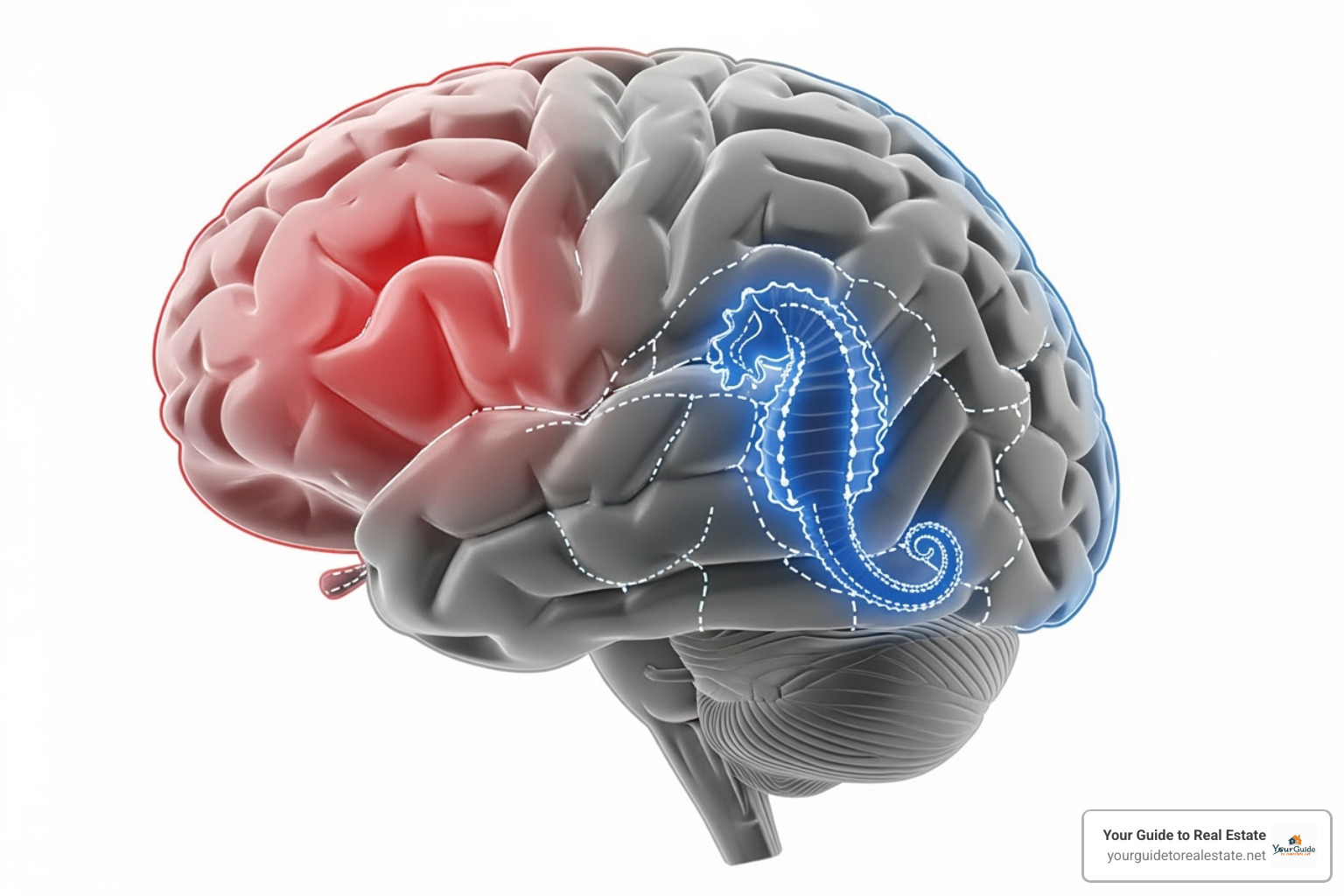
The prefrontal cortex acts like your brain’s project manager. Located right behind your forehead, this region handles the heavy lifting of planning and monitoring. When researchers scan brains during prospective memory tasks, they consistently see increased activity in this area. The front part of the prefrontal cortex is especially busy, constantly scanning for the right moment to act. It’s like having a vigilant assistant who never stops watching the clock for your 3 PM appointment.
Your hippocampus, that seahorse-shaped memory center, plays a different but equally important role. This region specializes in forming new memories and retrieving old ones. In prospective memory, it’s responsible for those “aha!” moments when an intention suddenly pops into your mind. You might walk past a coffee shop and suddenly remember you promised to pick up pastries for tomorrow’s open house. That’s your hippocampus connecting the dots.
The parietal lobe rounds out this memory team by handling attention and spatial awareness. When you’ve planned to grab important documents from a specific filing cabinet, your parietal lobe helps you recognize that cabinet and shift your focus to the task at hand.
These regions don’t work alone – they form intricate neural networks that communicate constantly. This teamwork allows you to stay focused on current tasks while keeping future intentions ready to spring into action when needed.
Theories Explaining How Prospective Memory Works
Scientists have developed fascinating theories to explain how we actually remember to do future tasks. These theories help us understand whether remembering future intentions requires constant mental effort or happens more automatically.
The Preparatory Attentional and Memory Processes (PAM) theory suggests that successful prospective memory works like a security guard who never takes a break. According to this theory, your brain constantly monitors your environment, scanning for the right cue to trigger your intended action. This process has two main parts: actively watching for your trigger (like checking the time for that 3 PM call) and remembering what you’re supposed to do when that trigger appears.
This constant vigilance comes with a cost. When your brain is busy monitoring for future tasks, it has less energy available for whatever you’re doing right now. That’s why you might work a bit slower when you’re trying to remember an important deadline.
The Multiprocess Framework offers a more flexible explanation. Researchers McDaniel and Einstein realized that we don’t always need to actively monitor for our intentions. Sometimes remembering happens through strategic monitoring – the effortful watching described in PAM theory. This typically happens when the task is really important or when the trigger isn’t obvious.
But other times, intentions pop into our minds through spontaneous retrieval. This is more automatic and happens when triggers are obvious or when we’ve created strong mental connections. For example, seeing your neighbor might automatically remind you to ask about their recent home renovation, without any conscious effort on your part.
The beauty of this framework is its flexibility. Your brain can switch between these approaches depending on the situation. When you’re dealing with a crucial real estate deadline, you might actively monitor the calendar. But when you pass your favorite coffee shop, the intention to stop for your usual order might pop up automatically.
Recent scientific research on the prospective brain continues to explore these theories using advanced brain imaging techniques. Scientists can now watch in real-time as different brain regions activate during prospective memory tasks.
Even more fascinating, researchers are studying whether animals can remember future intentions. They observe rats and primates to see if these animals can plan ahead and remember to perform actions later for bigger rewards. This research helps us understand the evolutionary roots of our ability to remember future tasks – a skill that’s clearly been important for survival throughout history.
Why We Forget: Factors That Impair Performance
We’ve all been there – standing in the grocery store, suddenly remembering we forgot to call that important client back. Or realizing at 9 PM that we never sent the contract we promised to deliver by end of day. Despite how crucial prospective memory is to our success, it’s surprisingly fragile.
Think of your brain like a smartphone trying to run too many apps at once. Eventually, something’s got to give. When we’re juggling multiple tasks or completely absorbed in finding the perfect property for a client, our cognitive load increases dramatically. This leaves fewer mental resources available for monitoring our future intentions.
Divided attention creates an even bigger challenge. Ever tried to review market comparables while simultaneously listening to a client’s concerns and mentally noting that you need to call the lender at 3 PM? Your brain simply can’t give full attention to everything at once. Something will slip through the cracks.
Stress and anxiety act like memory thieves, quietly stealing our ability to form and retrieve intentions. Dr. Rizwan Bashir, a neurologist specializing in cognitive functions, explains that “psychological factors such as stress, anxiety, and overall mental health can also affect how well one can manage [prospective memory] tasks.” When we’re overwhelmed by a difficult transaction or worried about meeting our monthly goals, our “remember to remember” system takes a hit.
Sleep deprivation might seem like a badge of honor in our busy industry, but it’s actually sabotaging our success. Poor sleep directly impairs prospective memory and limits our thinking skills. Those late nights reviewing contracts might feel productive, but they’re setting us up for forgotten follow-ups and missed opportunities the next day.
Substance use can also interfere with our memory systems. Research shows that persistent smoking, chronic heavy alcohol use, and various other substances can lead to lasting decrements in prospective memory performance. Even former users of substances like methamphetamine can experience ongoing cognitive challenges.
Certain health conditions present additional problems. ADHD, Alzheimer’s disease, Parkinson’s disease, schizophrenia, and multiple sclerosis can all significantly impact our ability to remember future tasks. Even mild cognitive impairment can make it harder to keep track of our intentions.
The tricky part? These factors often work together, creating a perfect storm for memory failures. Understanding what’s working against us is the first step toward building better systems to support our prospective memory.

How Prospective Memory Changes Across the Lifespan
Here’s something fascinating: our prospective memory follows what researchers call an inverted U-shaped curve throughout our lives. Picture a mountain – we climb up during childhood and young adulthood, reach a peak, then gradually descend as we age.
Children start with relatively weak prospective memory skills. A seven-year-old might genuinely forget to feed the family dog, not because they don’t care, but because their executive functions and frontal lobe are still developing. As they grow, their ability to form and execute future intentions steadily improves.
Young adults hit the sweet spot. This is when we’re typically at our cognitive peak – juggling college courses, part-time jobs, social commitments, and somehow managing to remember most of what we need to do. It’s no coincidence that many people enter demanding careers like real estate during this phase of life.
But here’s where it gets interesting. While older adults might show some decline in laboratory tests, they often outperform younger people in real-world situations. This creates what scientists call the age-prospective memory paradox.
Why does this happen? Older adults have learned something valuable: they don’t rely solely on their memory. They’ve developed sophisticated systems of calendars, reminder notes, and daily routines. They’ve learned to work with their limitations rather than against them.
However, the type of memory task does matter. Time-based tasks (remembering to call someone at exactly 2 PM) tend to become more challenging with age because they require constant self-monitoring. Event-based tasks (remembering to mention something when you see a particular person) often remain more manageable because external cues provide natural reminders.
Older adults might also struggle more if they’re interrupted after remembering an intention but before completing it. That brief delay can cause the task to slip away again.
The encouraging news? Age doesn’t doom us to memory failure. Our strategies, environment, and lifestyle choices play huge roles in maintaining effective prospective memory throughout life. For deeper insights into how cognitive aging affects memory, you can explore scientific research on cognitive aging and prospective memory.
The key takeaway for anyone in real estate – regardless of age – is that understanding how our memory works helps us build better systems for success.
Strategies to Sharpen Your Ability to Remember
The good news is that prospective memory isn’t set in stone. Like any cognitive skill, we can strengthen it with the right approach and consistent practice. Think of it as training your brain’s personal assistant to become more reliable and efficient.
The foundation of better prospective memory starts with how we form our intentions. Vague plans are memory’s worst enemy. Instead of thinking “I’ll call that client today,” be specific: “I’ll call John Smith about the 123 Main Street property at 2 PM right after lunch.” The more detailed your intention, the stronger the memory trace becomes.
One of the most powerful techniques is creating implementation intentions, also known as “if-then” plans. This strategy works by linking your intended action to a specific cue or situation. The formula is simple: “If [specific situation occurs], then I will [perform specific action].” For example, “If I walk into my office in the morning, then I will immediately check my client follow-up list.” Research shows these if-then plans can create almost habit-like behavior, making your future actions feel more automatic.
Creating strong, noticeable cues can be a game-changer for your memory. Think of these as breadcrumbs you leave for your future self. Place that important contract right on top of your car keys so you can’t miss it. Put a sticky note on your computer screen that says “Call Sarah about closing documents at 3 PM” rather than just “Call Sarah.” The more specific and unavoidable the cue, the better it works.
Don’t be afraid to rely on external aids – they’re not cheating, they’re smart strategy. Your smartphone can become your memory’s best friend through calendar alerts, reminder apps, and even location-based reminders that ping you when you arrive somewhere important. Digital calendars with multiple alerts can catch you even on your busiest days. For complex processes like preparing a listing or navigating a closing, detailed checklists ensure nothing falls through the cracks.
Mental rehearsal and visualization might sound fancy, but it’s simply imagining yourself successfully completing your intended action. Before that important client meeting, picture yourself bringing up their financing options and mentioning how a DSCR loan might benefit their investment strategy. This mental practice strengthens the neural pathways associated with your intention.
Here’s something that might surprise you: reducing multitasking can dramatically improve your prospective memory. While juggling multiple tasks might make us feel productive, it actually overloads our cognitive resources and makes us more likely to forget important intentions. When you have critical tasks to remember, try focusing on one primary activity at a time.
Building consistent routines transforms memory tasks into automatic habits. Always review your client follow-ups before leaving the office. Check your calendar first thing every morning with your coffee. These routines create a safety net that catches important tasks before they slip away.
Finally, your prospective memory is only as strong as your overall well-being. Getting adequate sleep, managing stress, and maintaining good health all contribute to sharper cognitive function. When you’re well-rested and less stressed, your brain has more resources available for remembering those crucial future intentions.
The beauty of these strategies is that they work together. You might use implementation intentions combined with phone reminders, or pair mental rehearsal with environmental cues. Experiment to find the combination that works best for your lifestyle and professional demands.
Frequently Asked Questions about Prospective Memory
People often reach out to us with questions about memory, especially when they’re struggling to keep track of all the moving pieces in their daily lives. Here are the most common questions we hear about prospective memory:
What is the difference between prospective and retrospective memory?
Think of it this way: prospective memory is your brain’s appointment book, while retrospective memory is your photo album.
Prospective memory focuses entirely on the future. It’s your ability to remember that you need to call a client back at 3 PM, pick up dry cleaning on the way home, or submit an offer before the deadline expires. We like to call it “remembering to do” – it’s all about those planned actions waiting in your mental queue.
Retrospective memory looks backward instead. This is how you remember what happened at last week’s open house, recall the details of a property you showed six months ago, or remember your high school graduation. It’s “remembering what was” – the storehouse of your past experiences and learned information.
Here’s where it gets interesting: these two types of memory actually work together. When you remember to call that client (prospective), you also need to remember their phone number and what you wanted to discuss (retrospective). Your brain seamlessly blends both to help you succeed.
Can you improve your prospective memory?
The short answer is absolutely yes! While some factors like age and genetics play a role, you have tremendous power to strengthen your prospective memory through smart strategies and consistent habits.
The secret is reducing how much your brain has to work on its own. Instead of relying purely on willpower and mental notes, you can create reliable systems that make remembering almost automatic.
Implementation intentions are one of the most powerful tools available. These “if-then” plans create clear triggers for your actions: “If I finish showing a property, then I will immediately log the details in my CRM.” This type of planning builds habit-like responses that don’t drain your mental energy.
External aids like smartphone alarms, calendar notifications, and strategic sticky notes act as your memory’s backup system. The goal isn’t to replace your natural memory – it’s to support it so you can focus your mental resources on the complex, creative work that really matters.
Mental rehearsal also works wonders. Before heading into a busy day, take a few minutes to visualize yourself completing your planned tasks. Picture yourself seeing the cue and taking the action. This mental practice strengthens the neural pathways that make remembering more likely.
Why do I forget to do things even when I’ve made a mental note?
This is probably the most frustrating question we hear, and you’re definitely not alone! Even when we’re sure we’ve mentally committed to something, our prospective memory can still let us down. Here’s what’s usually happening behind the scenes:
Weak intention encoding is often the culprit. That quick mental note – “I need to follow up with the Johnsons” – might not have been specific or detailed enough for your brain to hold onto. Vague intentions are like trying to grab smoke; they slip away easily.
Invisible cues create another common problem. Maybe you planned to remember something when you saw a particular person, but they were wearing sunglasses or approached from an unexpected direction. If your brain doesn’t clearly recognize the trigger, the whole system breaks down.
Cognitive overload is a huge factor, especially in demanding fields like real estate. When you’re deep in conversation with a client about mortgage options, or focused on reviewing contract details, your brain’s resources are fully occupied. That gentle nudge from your prospective memory simply can’t compete with the immediate demands of your ongoing task.
Interruptions and delays can derail even successful memory retrieval. You might remember exactly what you need to do, but then your phone rings or someone asks you a question. By the time you finish dealing with the interruption, that carefully retrieved intention has vanished again.
This is exactly why external systems and structured planning work so well – they create multiple safety nets that catch you when your natural memory stumbles. Think of them as insurance policies for your important intentions.
Conclusion
Throughout this journey into prospective memory, we’ve finded something remarkable: the ability to “remember to remember” isn’t just a neat psychological trick—it’s the invisible foundation that holds our entire lives together. Every successful day depends on our brain’s capacity to juggle dozens of future intentions while staying focused on what’s happening right now.
Think about it. When you wake up tomorrow morning, you’ll automatically start running through mental checklists. Call that client back. Review the market analysis. Remember to grab lunch before the afternoon showing. Each of these seemingly simple thoughts represents a complex dance between different regions of your brain, working together to keep you on track.
We’ve seen how prospective memory operates on two main levels—event-based tasks triggered by environmental cues and time-based tasks that rely on our internal clock. Both play crucial roles, though time-based tasks tend to be trickier since they demand more active monitoring from our already busy minds.
The stakes couldn’t be higher in many professions. Aviation accidents, medication errors, and missed opportunities all trace back to failures in this fundamental cognitive process. In real estate, where timing often makes the difference between closing a deal and losing it entirely, these memory skills become absolutely essential.
But here’s the encouraging part: we’re not stuck with whatever prospective memory abilities we were born with. The strategies we’ve explored—from creating specific “if-then” plans to using external aids like calendars and alarms—can dramatically improve our success rate. When we understand how cognitive load and stress impact our memory, we can design our work environment to support rather than sabotage our intentions.
Your brain changes throughout your lifetime, and so does your prospective memory. While laboratory studies might show some decline with age, real-world research tells a different story. Experienced professionals often outperform younger colleagues because they’ve learned to work with their memory rather than against it.
The most powerful insight? Prospective memory isn’t about having a perfect brain—it’s about creating reliable systems. Whether you’re managing multiple property listings or coordinating complex transactions, success comes from understanding your cognitive strengths and building scaffolding around your natural abilities.
At Your Guide to Real Estate, we know that managing the intricate details of real estate transactions requires more than just market knowledge. It demands the mental clarity and organizational skills that come from mastering your own cognitive processes. When you can confidently remember what needs to happen when, you’re free to focus on what really matters: serving your clients and building your success.
Ready to put these insights into practice? Our proven framework takes the guesswork out of real estate success by providing the structure and support your prospective memory needs to thrive. More info about our stress-free real estate framework.