

Key Social Security Changes Taking Effect in 2025
What changes are coming to social security in 2025 affects over 72 million Americans who rely on these benefits. Here’s what you need to know right now:
Major 2025 Changes at a Glance:
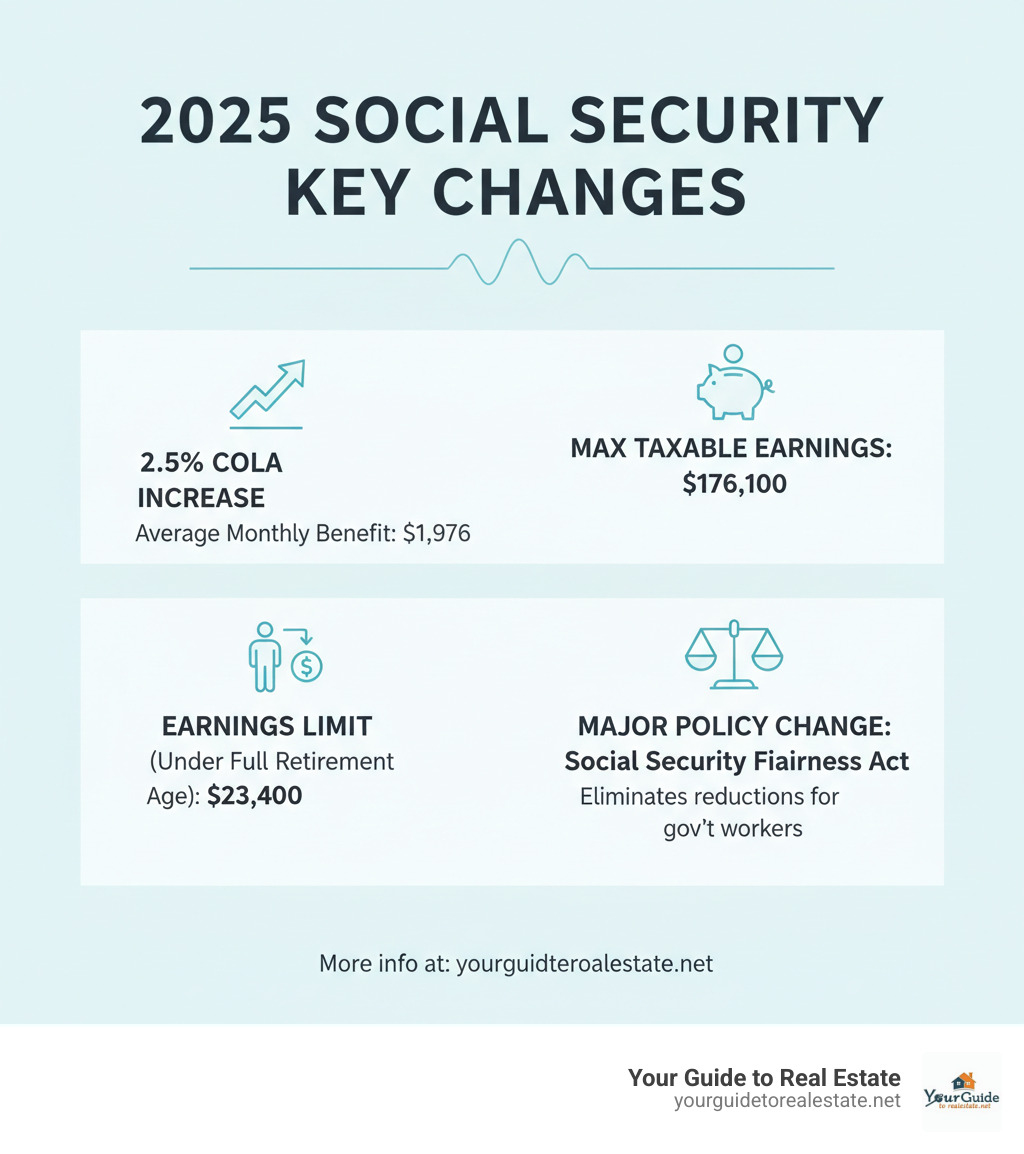
- 2.5% Cost-of-Living Adjustment (COLA) – Average monthly benefit increases from $1,927 to $1,976
- Higher earnings limits – You can earn up to $23,400 (under full retirement age) without benefit reduction
- Increased tax cap – High earners pay Social Security tax on income up to $176,100
- Social Security Fairness Act – Eliminates benefit reductions for government workers with pensions
- Electronic payments mandatory – Paper checks end for most recipients by September 2025
If you’re planning your retirement or currently receiving benefits, these changes directly impact your monthly income and long-term financial security. The 2.5% COLA translates to roughly $50 more per month for the average retiree – not huge, but every dollar counts when managing living expenses.
The biggest game-changer? The Social Security Fairness Act affects over 2.8 million people, including teachers, firefighters, and other public workers who previously saw their benefits reduced. Some individuals could see increases of over $1,000 per month.
Whether you’re buying your first home, planning for retirement, or helping aging parents steer these changes, understanding Social Security’s evolving landscape helps you make smarter financial decisions.
Learn more about what changes are coming to social security in 2025:
The 2025 Cost-of-Living Adjustment (COLA) and Your Monthly Check
Here’s the moment millions of Americans wait for each year: the announcement of Social Security’s Cost-of-Living Adjustment. If you’re wondering what changes are coming to social security in 2025, the COLA is probably your biggest concern – and rightfully so.
The Social Security Administration announced a 2.5% COLA for 2025, which might not sound like much, but it’s designed to help your benefits keep up with rising prices. This increase kicks in with January 2025 payments for nearly 68 million Social Security beneficiaries. If you receive SSI, your adjusted payment actually starts on December 31, 2024, affecting about 7.5 million recipients.
Think of the COLA as Social Security’s way of saying, “We know groceries cost more than they did last year.” It’s calculated using something called the Consumer Price Index, which tracks how much everyday items cost compared to previous years.
For all the official details straight from the source, check out the Cost-of-Living Adjustment (COLA) Information for 2025 on the Social Security Administration’s website.
How the 2025 COLA Impacts Average and Maximum Benefits
Let’s talk real numbers. The average Social Security payment jumps from about $1,927 to $1,976 per month in 2025. That’s an extra $49 monthly – enough for a nice dinner out or help with utilities.
But your actual increase depends on what you’re already receiving. The 2.5% applies across the board, so if you get more than average, your dollar increase will be bigger too.
Here’s where it gets interesting for different claiming strategies. If you’re thinking about retiring at age 62 in 2025, the maximum benefit you could receive is $2,831 per month. Wait until your full retirement age, and that maximum jumps to $4,018. Hold off until age 70 to really maximize things, and you’re looking at $5,108 monthly.
Those numbers show why timing matters so much when claiming Social Security. The difference between claiming at 62 versus 70 is substantial – we’re talking about $2,277 more per month for waiting.
SSI recipients see increases too. Individual payments rise to $967 monthly (up from $943), while couples receive up to $1,450 (from $1,415). These adjustments help millions of Americans who depend on these payments for basic needs.
Survivors and disabled workers also benefit from the same 2.5% adjustment. Every type of Social Security benefit gets the COLA boost, ensuring no one gets left behind when living costs rise.
Comparing the 2025 COLA to Previous Years
The 2025 COLA of 2.5% tells an interesting story when you look at recent history. It’s actually lower than what we’ve seen lately, and that’s not necessarily bad news.
In 2024, the COLA was 3.2%. Go back to 2023, and we saw a whopping 8.7% increase – the highest in 40 years! That massive jump happened because inflation was running hot, making everything from gas to groceries more expensive.
A smaller COLA in 2025 suggests that inflation is cooling down, which is generally good for everyone’s wallets. But here’s the catch many retirees face: the official inflation measure might not match what you’re actually experiencing.
The COLA calculation uses the Consumer Price Index for Urban Wage Earners and Clerical Workers. That’s a mouthful, but it basically tracks what working-age people spend money on. The problem? Retirees often spend differently, with more money going to healthcare and housing – two areas where prices can rise faster than the overall index.
This creates what some call the “COLA catch-22.” You want a higher COLA for more money, but a higher COLA usually means inflation is eating away at your purchasing power anyway. It’s like getting a raise that doesn’t quite cover your increased expenses.
The good news is that any COLA beats no COLA at all. These annual adjustments help ensure your Social Security benefits don’t lose value over time, even if the protection isn’t perfect.
What Changes Are Coming to Social Security in 2025 for Workers?
If you’re still working while collecting Social Security benefits, or you’re among the higher earners contributing to the system, what changes are coming to social security in 2025 will definitely affect your paycheck and benefit calculations. The good news? These updates are pretty straightforward once you understand the basics.
The two main areas where working folks will see changes involve how much you can earn before your benefits get reduced, and how much of your income gets taxed for Social Security. Let’s break this down so you can plan accordingly.

Updated Earnings Limits for Beneficiaries Under Full Retirement Age
Here’s where things get interesting if you’re working and collecting Social Security before reaching your full retirement age. The Social Security Administration has what’s called the “retirement earnings test” – basically, they want to make sure you’re not double-dipping too much before you officially retire.
For 2025, if you haven’t reached your full retirement age yet, you can earn up to $23,400 without any impact on your benefits. That’s up from $22,320 in 2024, so you’ve got a bit more breathing room. But here’s the catch – if you earn more than that limit, Social Security will temporarily withhold $1 for every $2 you earn above the threshold. Think of it as the government’s way of saying “we’ll hold onto this for you until you’re fully retired.”
Now, if you’re reaching your full retirement age during 2025, you get a much more generous deal. The earnings limit jumps to $62,160 for the year, and the penalty is gentler too – Social Security only withholds $1 for every $3 you earn above this amount. Plus, this only applies to the months before you hit your full retirement age.
Once you reach your full retirement age? The earnings test disappears completely. You can earn as much as you want without any benefit reductions. It’s like getting the green light to work without penalty – finally!
Increased Maximum Taxable Earnings for High-Income Earners
If you’re doing well financially, you’ll want to pay attention to this change. Social Security is funded through payroll taxes, but there’s always been a cap on how much of your income gets taxed. For 2025, that cap is moving up.
The maximum amount of your earnings subject to Social Security tax increases from $168,600 in 2024 to $176,100 in 2025. That’s an additional $7,500 of income that will now be subject to the 6.2% Social Security tax rate (or 12.4% if you’re self-employed).
For high earners, this translates to paying up to $465 more in Social Security taxes during 2025. While nobody loves paying more taxes, this increase helps keep the Social Security system funded for everyone. Plus, higher contributions generally mean higher future benefits when you do retire.
It’s worth noting that once you hit this maximum during the year, you stop paying Social Security taxes on any additional earnings. So if you’re wondering why your December paycheck sometimes looks a bit fatter – that’s probably why!
Major Policy and System Updates for 2025
Beyond the annual COLA increases and earnings adjustments, 2025 brings some truly significant changes that could transform how millions of Americans experience Social Security. These aren’t just tweaks to the numbers – we’re talking about major legislative victories and system-wide modernization efforts that have been years in the making.

The Social Security Fairness Act: Ending WEP and GPO
Here’s some genuinely great news that affects over 2.8 million Americans: the Social Security Fairness Act became law on January 5, 2025. This landmark legislation finally eliminates two provisions that have frustrated public servants for decades – the Windfall Elimination Provision (WEP) and the Government Pension Offset (GPO).
If you’re scratching your head wondering what these acronyms mean, you’re not alone! These provisions previously reduced Social Security benefits for people who also received pensions from jobs where they didn’t pay into Social Security. Think teachers, firefighters, police officers, and some federal employees who worked under different retirement systems.
The impact is immediate and substantial. Some affected individuals could see their monthly benefits increase by over $1,000. Even better, the changes are retroactive to cover 2024 benefit payments, meaning eligible beneficiaries may receive significant lump-sum repayments for past benefit reductions.
The Social Security Administration moved quickly to implement these changes. They began adjusting monthly benefits on February 25, 2025, with most affected individuals seeing their new amounts by April 2025. By July 7, 2025, the SSA had already sent over 3.1 million payments totaling $17 billion to eligible beneficiaries – well ahead of their original timeline.
If you think you might be affected but never applied for benefits because of WEP or GPO, you may need to file an application now. For complete details about how this affects your specific situation, check out the SSA’s dedicated page: Social Security Fairness Act details.
The Mandatory Shift to Electronic Payments
Paper checks are officially becoming a thing of the past. By September 30, 2025, the Social Security Administration will end paper check payments for most beneficiaries. If you’re still receiving that familiar envelope in your mailbox each month, it’s time to make the switch.
This isn’t just bureaucratic red tape – electronic payments offer real advantages. Your benefits arrive faster, more securely, and you don’t have to worry about checks getting lost in the mail or stolen from your mailbox. You have two options: direct deposit to your bank account or a Direct Express debit card.
The transition process is straightforward, but don’t wait until the last minute. Visit Set up electronic payments to get started. Trust us, making this change now will save you potential headaches later in the year.
What changes are coming to social security in 2025 regarding retirement age and family benefits?
What changes are coming to social security in 2025 also includes the ongoing evolution of retirement age requirements. If you were born in 1959, your Full Retirement Age (FRA) in 2025 will be 66 years and 10 months. But for anyone born in 1960 or later, your FRA is age 67 – marking the end of a gradual increase that began with 1983 legislation.
This might seem like a small detail, but it has huge implications for your claiming strategy. Claiming benefits before your FRA means accepting a permanently reduced monthly payment – up to 30% less if you claim at age 62. On the flip side, waiting until age 70 can boost your monthly benefits by 8% for each year you delay past your FRA.
While the Social Security Fairness Act addresses specific benefit reductions, broader discussions about spousal and survivor benefits continue in Washington. Some proposals have suggested reducing spousal benefits from 50% to 33% of a worker’s benefit amount. These changes aren’t happening in 2025, but they’re worth monitoring as you plan your long-term financial strategy.
Understanding these timing rules becomes especially important when you’re thinking about major financial decisions like buying a home or planning for retirement expenses. Every year you delay claiming (up to age 70) significantly impacts your monthly income for the rest of your life.
Preparing for the Future: 2026 Projections and Long-Term Solvency
Planning for your financial future means looking beyond just what changes are coming to social security in 2025. Smart retirement planning involves understanding what’s on the horizon for 2026 and beyond. While nobody has a crystal ball, early projections give us valuable insights to help shape our financial decisions today.
Think of it like planning a road trip – you need to know not just your next stop, but what lies ahead down the road. That’s especially true when Social Security benefits form the foundation of your retirement income.

A Look Ahead: 2026 Projections and Earning Credits
While we’re still adjusting to 2025’s changes, early estimates for 2026 are already taking shape. The projected Social Security COLA for 2026 sits at 2.7% – slightly better than this year’s 2.5% increase. That’s good news for beneficiaries who depend on these adjustments to keep pace with rising costs.
If you’re still working while collecting benefits, the earnings limits will likely increase again. For 2026, beneficiaries under full retirement age could earn up to an estimated $24,360 before seeing benefit reductions. That’s nearly $1,000 more than 2025’s limit. Those reaching their full retirement age in 2026 may be able to earn up to $64,800 without penalties – a meaningful jump from this year’s $62,160.
High earners will face another increase in the taxable wage ceiling. The estimated maximum taxable earnings for 2026 is $183,600, up $7,500 from 2025. This translates to an additional $465 in Social Security taxes for those earning above the current limit.
Here’s something that affects everyone building their Social Security record: earning credits. In 2025, you need $1,810 in earnings to earn one Social Security credit, with a maximum of four credits per year at $7,240 in total earnings. You need 40 credits (about 10 years of work) to qualify for retirement benefits. These amounts typically tick up each year to keep pace with average wage growth.
What changes are coming to social security in 2025 that affect long-term solvency and Medicare?
Let’s talk about the elephant in the room – Social Security’s long-term financial health. The latest Trustees Report shows the Trust Fund facing potential challenges, with projections suggesting it could face shortfalls in about seven years without legislative action. Before you panic, this doesn’t mean Social Security disappears. It likely means benefits could be reduced by roughly 23% if Congress doesn’t act.
Think of it as a warning light on your car’s dashboard – serious, but fixable with the right attention. Policymakers have multiple tools available to address this challenge, from adjusting the tax cap to tweaking benefit formulas.
But there’s another factor quietly eating into your Social Security increase: Medicare premiums. The 2025 Social Security Trustees Report projects Medicare Part B premiums will jump to $206.50 monthly in 2026 – that’s a hefty $21.50 increase from 2025, or about 11.6% higher.
Here’s why this matters: if the 2026 COLA delivers an estimated $54 monthly increase for the average beneficiary, but Medicare premiums rise by $21.50, your actual net increase drops to just $32.68. It’s like getting a raise at work, only to find out your health insurance costs went up too.
Higher-income beneficiaries face an additional challenge through the Income-Related Monthly Adjustment Amount (IRMAA), which means they pay even more for Medicare coverage. This double-hit of higher premiums and income-based surcharges can significantly reduce the real value of COLA increases.
For those of you planning your financial future – whether you’re considering downsizing, buying a retirement home, or making investment decisions – understanding these Social Security trends is crucial. Your benefits form a key pillar of retirement security, and changes here ripple through all your other financial choices. To help you see the bigger picture, we encourage you to Explore U.S. housing market updates and understand how broader economic trends might affect your plans.
Frequently Asked Questions about 2025 Social Security Changes
Let’s tackle the most common questions we’re hearing about what changes are coming to social security in 2025. These are the real-world concerns that affect your monthly budget and retirement planning.
How much will my Social Security check increase in 2025?
Your Social Security benefits will increase by 2.5% thanks to the 2025 COLA. But what does that actually mean for your bank account?
If you’re receiving the average retiree benefit, you’ll see your monthly payment jump from approximately $1,927 to $1,976 – that’s about $49 more each month. Not enough for a luxury vacation, but certainly helpful for groceries or utilities!
Here’s the thing though – your specific increase depends entirely on your current benefit amount. Someone receiving $2,500 monthly would see a $62.50 increase, while someone getting $1,500 would gain $37.50. The percentage stays the same, but the dollar amounts vary.
Want to know your exact new amount? Check your official COLA notice from the SSA in your ‘my Social Security’ account starting December 2024. No guesswork needed – it’ll show you the precise numbers.
Can I work and still receive full Social Security benefits in 2025?
This depends entirely on whether you’ve reached your full retirement age (FRA). Think of it as Social Security’s version of “you can have your cake and eat it too” – but only after a certain birthday!
If you’ve reached your FRA, congratulations! You can work as much as you want without any benefit reductions. Earn $50,000 or $500,000 – Social Security doesn’t care anymore.
But if you’re younger than your FRA, there are earning limits that can temporarily reduce your benefits. For 2025, you can earn up to $23,400 if you’re under FRA all year. Go over that amount, and Social Security takes back $1 for every $2 you earn above the limit.
There’s a special rule if you’re reaching FRA during 2025. For those months before you hit FRA, you can earn up to $62,160 with a more generous penalty of $1 for every $3 over the limit. Once you reach FRA, the earnings test disappears completely for the rest of your life.
Any benefits withheld aren’t lost forever – they’re recalculated and added back to your future payments once you reach FRA.
What is the Social Security Fairness Act?
This is huge news for millions of public service workers! The Social Security Fairness Act was signed into law on January 5, 2025, and it’s already changing lives.
For decades, the Windfall Elimination Provision (WEP) and Government Pension Offset (GPO) unfairly reduced Social Security benefits for people who also received pensions from jobs where they didn’t pay into Social Security. We’re talking about teachers, firefighters, police officers, and other government workers who dedicated their careers to public service.
The act eliminates both WEP and GPO entirely, effective retroactively to January 2024. This means affected beneficiaries are seeing their Social Security benefits increase significantly – some by over $1,000 per month! Plus, they’re receiving lump-sum payments covering the retroactive period.
Over 2.8 million people benefit from this change. If you were affected by WEP or GPO and your contact information is current with Social Security, you don’t need to do anything – the adjustments happen automatically. However, if you never applied for benefits because these provisions made it seem pointless, now might be the time to file that application.
This represents one of the most significant improvements to Social Security fairness in decades, finally recognizing that public servants deserve their full earned benefits.
Conclusion
When we started exploring what changes are coming to social security in 2025, we knew these updates would touch millions of lives. What we’ve finded is a mix of good news, necessary adjustments, and some changes that require immediate action on your part.
The 2.5% COLA increase might not feel like a windfall, but it’s real money in your pocket – about $49 more per month for the average retiree. That’s enough to cover a few extra groceries or help with rising utility bills. More importantly, it shows the system is working to protect your purchasing power, even if it doesn’t always feel like enough.
The Social Security Fairness Act is where the real celebration happens. If you’re one of the 2.8 million people who’ve been shortchanged by WEP or GPO, you’re finally getting the benefits you earned. Some folks are seeing increases of over $1,000 per month – now that’s life-changing money.
But here’s what demands your immediate attention: electronic payments become mandatory by September 2025. If you’re still getting paper checks, don’t wait until August to make the switch. Set up direct deposit or get your Direct Express card now. Trust me, dealing with this paperwork when you’re not rushed is much less stressful.
For those still working, the higher earnings limits give you a bit more breathing room. You can now earn up to $23,400 (if you’re under full retirement age) without touching your benefits. And high earners? Yes, you’ll pay Social Security tax on income up to $176,100 – that’s about $465 more in taxes if you’re at the top end.
Looking ahead to 2026 and beyond, the numbers tell us to stay vigilant. Medicare premiums are projected to eat up a big chunk of future COLA increases. The Social Security Trust Fund’s long-term challenges haven’t disappeared either.
At Your Guide to Real Estate, we see how Social Security benefits connect to your bigger financial picture every day. Whether you’re downsizing to reduce expenses, buying your first home, or helping aging parents with their housing decisions, these benefit changes matter. They affect your monthly budget, your borrowing power, and your long-term financial security.
The key is staying informed and planning ahead. These 2025 changes are just one piece of your financial puzzle. Understanding them helps you make smarter decisions about everything from housing to investments.
Ready to tackle other major financial decisions with the same confidence? A Beginner’s Guide to Home Loans can help you steer the mortgage process with the same clarity we’ve brought to Social Security changes.