
Your Guide to Getting Out of Student Loan Default
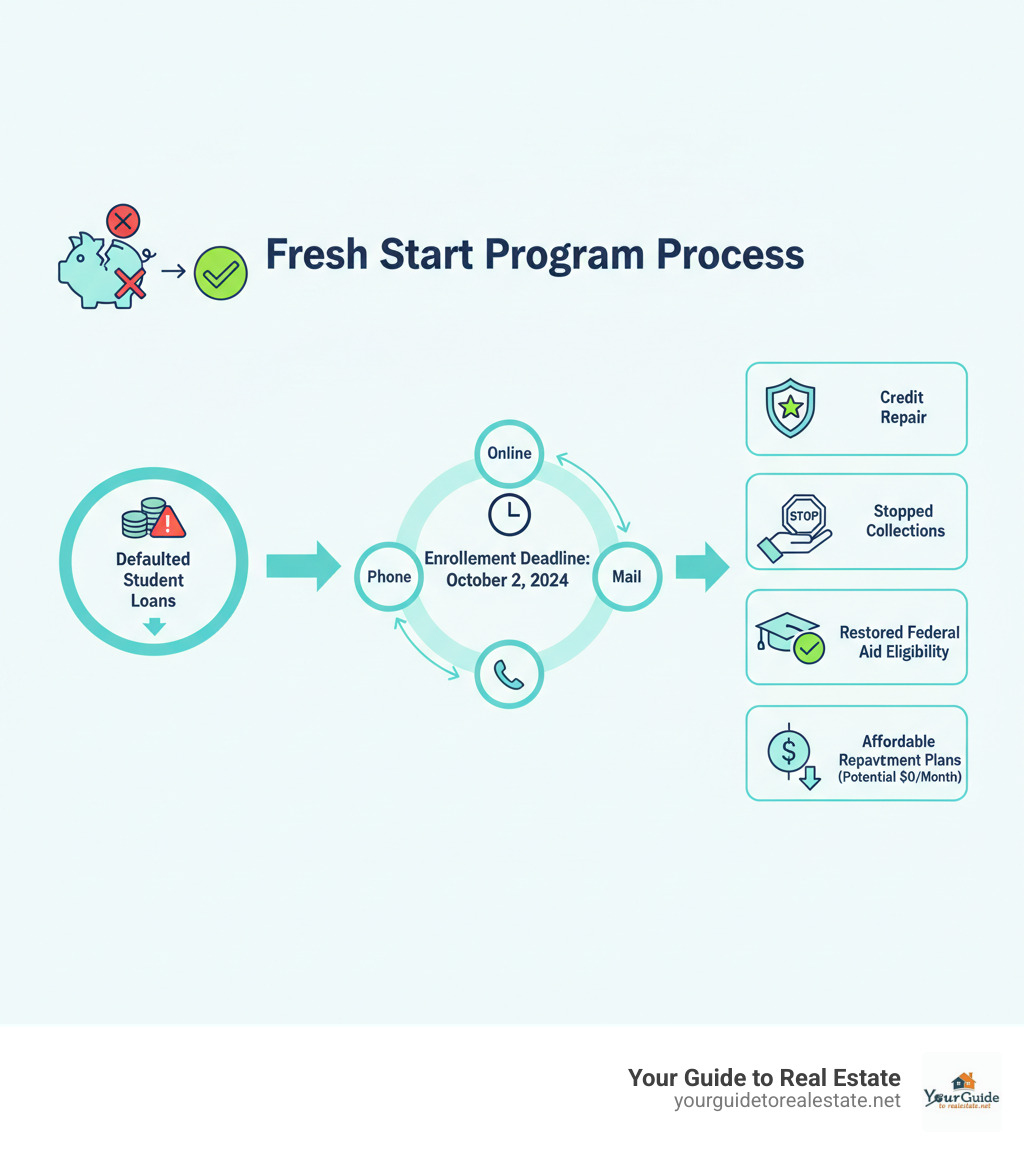
Fresh start program student loans offer a lifeline for millions of borrowers struggling with defaulted federal student loans. This temporary government program, officially ending October 2, 2024, helps borrowers escape the damaging consequences of default and regain financial stability.
Quick Answer: Fresh Start Program Student Loans
- What it is: A one-time temporary program from the U.S. Department of Education
- Who qualifies: 7.5 million borrowers with federal loans in default before March 13, 2020
- Key benefits: Removes default from credit report, stops wage garnishment, restores federal aid eligibility
- How to apply: Online at myeddebt.ed.gov, by phone (800-621-3115), or by mail
- Deadline: October 2, 2024 (extended from September 30)
- Cost: Completely free
If you’ve been avoiding your defaulted student loans, you’re not alone. Default brings serious consequences – wage garnishment, damaged credit, and loss of federal aid eligibility. But there’s hope.
The Fresh Start program automatically provides some relief to all eligible borrowers. However, to keep these benefits permanently, you must actively enroll before the October deadline. Without enrollment, collections will resume, and your credit will suffer further damage.
This matters for your real estate goals too. Defaulted student loans can block you from qualifying for government-backed mortgages like FHA and VA loans. Fresh Start can restore this eligibility, opening doors to homeownership that seemed permanently closed.
About 80% of Fresh Start participants choose income-driven repayment plans, with half paying $0 monthly and 60% paying less than $50. The program offers a genuine fresh start – not just a temporary pause.
Know your fresh start program student loans terms:
What is the Fresh Start Program for Student Loans and Who Qualifies?
Think of the fresh start program student loans as your financial reset button. Launched by the U.S. Department of Education on April 6, 2022, this temporary program offers something rarely seen in government policy – a genuine second chance.
Here’s what makes it special: if you’ve been struggling with defaulted federal student loans, this program can literally remove that black mark from your credit report. It’s not just about stopping collections or reducing payments (though it does both). It’s about giving you a clean slate to rebuild your financial future.
The numbers tell the story of how much this program is needed. An estimated 7.5 million borrowers are eligible for Fresh Start. That’s millions of people who’ve been locked out of federal aid, watched their wages get garnished, and seen their credit scores tank because of student loan default.
But here’s the catch – this is a one-time opportunity with a firm deadline. The program won’t be around forever, and once it’s gone, it’s gone. That’s why understanding your eligibility and taking action before the deadline is so crucial.
For those dreaming of homeownership, this program can be life-changing. Defaulted student loans often block you from FHA and VA loan eligibility. Fresh Start can restore those options, bringing your real estate goals back within reach.
You can find complete details about the program benefits at the Official Fresh Start benefits information page from the Department of Education.

Who is Eligible for the fresh start program student loans?
The eligibility rules for fresh start program student loans are straightforward but specific. Your federal student loans must have been in default before March 13, 2020 – the date when the COVID-19 payment pause began.
This timing matters because it shows the program targets borrowers who were already struggling before the pandemic hit. If your loans went into default after March 13, 2020, they won’t qualify for Fresh Start.
Here’s some good news: even if you’ve tried to fix your situation before, you might still be eligible. Maybe you rehabilitated your loans in the past, or you’ve made some payments since the pause began. Those actions don’t disqualify you from Fresh Start benefits.
Incarcerated borrowers have special pathways to participate in the program. If you’re currently incarcerated, you can still access Fresh Start benefits, including through FAFSA applications for Pell Grant-eligible programs in correctional facilities.
The program covers several types of federal loans, but the key word here is “federal.” William D. Ford Federal Direct Loans are eligible, along with Federal Family Education Loan (FFEL) Program loans and ED-held Perkins Loans. Private student loans, unfortunately, don’t qualify for any federal relief programs.
What Types of Federal Student Loans Are Eligible?
Let’s get specific about which loans can benefit from Fresh Start. The program focuses on loans that are held or guaranteed by the U.S. Department of Education.
William D. Ford Federal Direct Loans make up the biggest group of eligible loans. This includes Direct Subsidized and Unsubsidized Loans, PLUS Loans, and Direct Consolidation Loans. If you’ve borrowed for college in recent years, these are likely what you have.
Federal Family Education Loan (FFEL) Program loans are trickier. These loans were made by private lenders but backed by the federal government. Many FFEL loans are now owned by the Department of Education, making them eligible. Even some commercially-held FFEL loans can qualify if they defaulted before March 13, 2020.
ED-held Perkins Loans also qualify. These loans were originally made by colleges using federal funds. The key word is “ED-held” – meaning the Department of Education now owns them.
Now for what doesn’t qualify. School-held Perkins Loans are out – if your college still owns the loan, Fresh Start can’t help. Health Education Assistance Loan (HEAL) Program loans don’t qualify either. And obviously, private student loans from banks and credit unions are completely separate from federal programs.
If your loan is already with the Department of Justice for legal action, or if it defaulted after the payment pause ended, it won’t be eligible for Fresh Start.
The bottom line? If you’re not sure about your loan types or who holds them, don’t worry. We’ll show you exactly how to find that information and get the help you need.
Key Benefits of Enrolling in the Fresh Start Program
The fresh start program student loans can truly transform your financial landscape. When you’re trapped in student loan default, it feels like you’re stuck in quicksand – the harder you struggle, the deeper you sink. But Fresh Start offers a real way out, and the benefits extend far beyond just getting collectors off your back.

What are the benefits of the fresh start program student loans?
The most exciting benefit? Fresh Start removes the default record from your credit report entirely. This isn’t just a minor credit bump – we’re talking about potentially massive improvements. Some borrowers report credit score jumps of 150 points or more after enrolling. That kind of improvement can mean the difference between getting denied for a mortgage and qualifying for excellent rates.
Once you enroll, your loan gets transferred to a new servicer and shows up as “current” on your credit report. Think of it as hitting the reset button on that part of your financial history. This positive change ripples through every aspect of your credit profile.
The immediate relief is equally powerful. All collection activities stop – no more wage garnishments eating into your paycheck, no more losing your tax refunds, and no more dreading those collection calls. If you’re on Social Security, those withholdings stop too. The peace of mind alone is worth the enrollment effort.
But here’s where it gets really interesting for your long-term financial goals. Fresh Start restores your eligibility for federal student aid, meaning you can go back to school or pursue additional training if you need to. More importantly for many of our clients, it restores your eligibility for government-backed mortgages like FHA and VA loans.
When you’re in default, you’re locked out of the Credit Alert Verification Reporting System (CAIVRS), which means no FHA, VA, or USDA loans. Fresh Start changes that, opening doors to homeownership that seemed permanently closed. If you’re ready to explore your mortgage options, our Understanding Mortgages: A Beginner’s Guide to Home Loans can help you steer the next steps.
There’s another smart benefit many people miss: Fresh Start doesn’t count as your one-time loan rehabilitation opportunity. So if something goes wrong in the future (hopefully not!), you still have that traditional rehabilitation option in your back pocket.
The program also restores access to loan forgiveness programs like Public Service Loan Forgiveness and Income-Driven Repayment forgiveness. Plus, you regain access to helpful options like forbearance and deferment when life throws you curveballs.
Access to Affordable Repayment Plans
Here’s where the fresh start program student loans really shines in practical terms. Getting out of default is great, but what happens next? You’re not stuck with whatever payment plan caused problems before – you get to choose something that actually fits your budget.
Income-Driven Repayment (IDR) plans are the game-changer here. Instead of basing your payment on what you owe, these plans look at what you actually earn and what you can afford. The numbers tell an amazing story: about 80% of Fresh Start participants choose an IDR plan.
Even better, half of Fresh Start borrowers end up paying $0 monthly, and 60% pay less than $50. Let that sink in – more than half the people in this program go from having their wages garnished to paying nothing at all on their student loans.
The newer SAVE Plan takes affordability even further, protecting more of your income from payment calculations and preventing interest from growing if you make your required payments. While the SAVE plan faces some legal challenges right now, it remains a powerful option for many borrowers. You can learn more about its potential benefits at the SAVE plan information page.
This payment flexibility means your student loans don’t have to control your entire financial life anymore. Instead of every dollar going to catch up on old debt, you can finally start building toward your goals – like saving for a house down payment or investing in your future.
The beauty of Fresh Start isn’t just escaping the past; it’s about creating space for the future you actually want.
How to Enroll in Fresh Start Before the Deadline
Time is running out for the fresh start program student loans opportunity! This life-changing program has a firm deadline of Wednesday, October 2, 2024, at 3 a.m. ET. Originally scheduled to end on September 30, the Department of Education granted a brief extension – but this is truly your final chance.
The good news? Enrollment takes just about 10 minutes according to the U.S. Department of Education. That’s less time than it takes to grab lunch, yet it could transform your financial future. Whether your loans are with the Default Resolution Group or a guaranty agency, the process is straightforward and designed with busy people in mind.
Don’t let this deadline slip by. Once October 2nd passes, these incredible benefits disappear forever, and you’ll be back to dealing with collections, damaged credit, and blocked access to federal aid.

Step-by-Step Enrollment Process
Getting enrolled in Fresh Start is simpler than you might expect. Let’s walk through it together, step by step.
First, figure out who holds your loans. This is crucial because you’ll need to contact them directly. If you’re not sure, don’t worry – it happens to the best of us. You can call the Default Resolution Group at (800) 621-3115 (TTY users can call 877-825-9923). They’re helpful and can quickly identify your loan holder. You can also log into StudentAid.gov, where your loan servicer information should be clearly listed.
Next, contact your loan holder directly. The process varies slightly depending on who holds your loans, but both paths are user-friendly.
If the U.S. Department of Education holds your loans, you have three convenient enrollment options. The online method is often fastest – simply visit myeddebt.ed.gov and log into your account to enroll. Prefer talking to a real person? Call the Default Resolution Group at (800) 621-3115 – they’ll walk you through everything. If you’re more comfortable with mail, send a letter to P.O. Box 5609, Greenville, TX 75403. Include your full name, Social Security number, date of birth, and a clear request like “I would like to use Fresh Start to bring my loans back into good standing.”
If a guaranty agency holds your loans, you’ll need their specific contact information. The Default Resolution Group can help you track down these details if you don’t have them handy.
The deadline is firm: October 2, 2024. Mark your calendar, set a phone reminder, do whatever it takes – but don’t let this opportunity pass you by.
What Happens After You Enroll?
Once you’ve enrolled in the fresh start program student loans, the wheels start turning behind the scenes to get your financial life back on track.
Your loans get transferred to a new servicer. This is actually great news – it means you’re officially leaving the default world behind. Your loans move from the Default Resolution Group (or your guaranty agency) to a regular loan servicer, just like borrowers in good standing.
The process takes about 4-6 weeks for most people. We know waiting isn’t fun, especially when you’re eager to see positive changes. But this timeframe is normal and necessary for all the paperwork and system updates to happen correctly.
Your loans officially enter “in repayment” status. This is your golden ticket back to good standing in the federal student loan system. Initially, your loans might be placed on a Standard Repayment Plan, but that’s just temporary.
You’ll receive important mail about your transfer. Keep an eye on your mailbox during this period. You’ll get updates about your new loan servicer and next steps. Don’t toss anything that looks official!
You get to choose your repayment plan. This is where the real magic happens. Contact your new loan servicer as soon as possible to discuss Income-Driven Repayment plans. Half of Fresh Start participants pay $0 monthly, and 60% pay less than $50. Your new servicer can help you find the plan that works best for your budget.
Need proof of enrollment? Whether you’re applying for financial aid or re-enrolling in school, you can contact the Default Resolution Group to get documentation of your Fresh Start participation.
If it’s been more than 45 days since you enrolled and you haven’t heard anything, don’t panic. Simply reach out to the Default Resolution Group to confirm your contact information and check on your transfer status. Sometimes mail gets lost or addresses change – they’re there to help make sure everything goes smoothly.
Fresh Start vs. Other Options for Default
Understanding your options is crucial when dealing with defaulted student loans. While the fresh start program student loans offers an exceptional temporary opportunity, it’s worth comparing it to the traditional methods that have been available for years: loan rehabilitation and consolidation.
Each path has its own timeline, requirements, and impact on your credit history. The differences can be significant, especially when it comes to how quickly you can restore your financial standing and access to future loans.
| Feature | Fresh Start Program (Temporary) | Loan Rehabilitation (Permanent) | Loan Consolidation (Permanent) |
|---|---|---|---|
| Credit Report Impact | Removes default record, loan reported as “current.” | Removes default record, removes related negative history. | Default record remains, but loan becomes “current.” |
| Default Occurred Before | March 13, 2020 | Anytime | Anytime |
| Eligibility | Specific federal loans in default before 3/13/2020. | Most federal loans in default. | Most federal loans in default. |
| Requirements | Contact loan holder, enroll, choose repayment plan. | 9 voluntary, reasonable, affordable payments over 10 months. | Agree to IDR OR 3 voluntary payments on defaulted loan. |
| Time to Exit Default | 4-6 weeks for transfer after enrollment. | 9-10 months of payments. | Varies, but faster than rehabilitation if conditions met. |
| “One-Time” Rule | Does not count as your one rehabilitation. | Can only rehabilitate a loan once. | Can consolidate multiple times, but specific rules for defaulted loans. |
| Collection Actions | Immediately stops wage garnishment, tax offsets. | Stops after 5 voluntary payments. | Stops upon consolidation. |
| Restores Aid Eligibility | Yes, immediately. | Yes, after 6 payments. | Yes, after consolidation. |
| Cost | Free. | No fees, but requires payments. | No fees, but interest capitalization can increase total cost. |
The differences become especially important when you consider timing. Fresh Start offers immediate relief from collections and credit damage, while traditional methods require months of payments before you see similar benefits.
Fresh Start vs. Loan Rehabilitation
Loan rehabilitation has been the gold standard for escaping default for many years. It requires nine voluntary, reasonable, and affordable monthly payments within a 10-month period. These payments can be surprisingly low – sometimes as little as $5 per month – based on your income and expenses.
The biggest advantage of rehabilitation is that it completely removes the default record from your credit history. This erasure can boost your credit score dramatically, just like Fresh Start does.
But here’s the catch: rehabilitation is a one-time opportunity. Once you’ve successfully rehabilitated a loan, you can never use this option again if you default in the future. It’s your single “get out of jail free” card.
This is where Fresh Start shines differently. Using the fresh start program student loans does not count against your one-time rehabilitation opportunity. Think of it as getting an extra life in a video game – you still have your traditional rehabilitation option saved for later if you ever need it.
The timeline also matters. Rehabilitation takes nearly a full year to complete, and collection actions like wage garnishment continue until you’ve made five successful payments. Fresh Start stops these painful collection activities immediately upon enrollment.
Fresh Start vs. Loan Consolidation
Consolidation takes a different approach entirely. Instead of rehabilitating your existing loans, you create a brand-new Direct Consolidation Loan that pays off your defaulted loans. To consolidate a defaulted loan, you must either agree to an Income-Driven Repayment plan or make three consecutive payments on your defaulted loan first.
The major downside? The default record stays on your credit report. While your new consolidated loan appears as current, that black mark from your original default remains visible to future lenders. This means your credit score won’t see the dramatic improvement that Fresh Start and rehabilitation can provide.
Consolidation can also cost you more money over time. Any unpaid interest from your old loans gets added to your new loan’s principal balance – a process called capitalization. This increases your total debt and means you’ll pay interest on what used to be just interest.
For those looking toward homeownership, this credit difference matters enormously. Mortgage lenders scrutinize credit histories carefully, and a visible default record can affect your loan terms or approval chances. For more guidance on preparing for homeownership, check out our resource on Debt Consolidation Loan.
The fresh start program student loans clearly offers the best combination of speed, credit repair, and preserved future options for eligible borrowers. With the October deadline approaching, it’s the most powerful tool available for escaping the consequences of default.
Frequently Asked Questions about the Fresh Start Program
Let’s address some of the most common questions we hear about the fresh start program student loans. These answers will help you make informed decisions and understand exactly what to expect from this life-changing opportunity.
How long will it take for my Fresh Start application to go through?
The good news is that enrolling takes just about 10 minutes of your time. But once you’ve completed that step, you’ll need to be patient while the system works in your favor.
After you enroll, it typically takes 4-6 weeks for your defaulted loans to be transferred from the Default Resolution Group to a new servicer and returned to “in repayment” status. This isn’t just paperwork shuffling – it’s a complete change of your loan status that removes the default from your credit report.
During this waiting period, the U.S. Department of Education and loan servicers are updating your records, coordinating the transfer, and preparing your fresh start. You’ll receive all important communications through postal mail, so keep checking your mailbox for updates about your new servicer and loan status.
If you haven’t heard anything after 45 days, don’t panic. Simply contact the Default Resolution Group to verify your contact information and check on your application status. Sometimes addresses change, and they want to make sure you receive all the important updates about your financial fresh start.
What are the consequences of not using the Fresh Start Program?
Here’s the reality we don’t want you to face: if you’re eligible for the fresh start program student loans but don’t enroll by October 2, 2024, you’ll miss this once-in-a-lifetime opportunity. The consequences of inaction are serious and long-lasting.
Collections will resume with full force starting in October 2024. This means the government can restart wage garnishment, taking up to 15% of your disposable income directly from your paycheck. Your tax refunds will be seized to pay down your debt, and if you receive Social Security benefits, those can be withheld too. The collection calls and letters that may have stopped will resume with renewed intensity.
Your credit report will continue showing the default, keeping your credit score depressed and making it nearly impossible to qualify for favorable interest rates on any type of loan. This directly impacts your ability to buy a home, finance a car, or even rent an apartment in many cases.
Perhaps most importantly for your future, you’ll remain ineligible for federal student aid. This blocks you from returning to school for career advancement or retraining. You’ll also stay locked out of government-backed mortgage programs like FHA, VA, and USDA loans – programs that often provide the most accessible path to homeownership for people rebuilding their finances.
The Biden administration’s “on-ramp” period, which prevented missed payments from being reported to credit agencies, is also ending. This means any future payment problems will immediately damage your credit score even further.
Missing this deadline means returning to the full weight of default consequences, potentially for years to come. That’s why we’re so passionate about helping eligible borrowers understand this opportunity before it’s gone forever.
Can I use Fresh Start if I’ve already rehabilitated a loan?
Absolutely! This is one of the most misunderstood aspects of the fresh start program student loans, and we’re excited to clear up the confusion.
Even if you’ve previously rehabilitated a defaulted federal student loan, you can still use Fresh Start for any loans that were in default before March 13, 2020. The programs are completely separate, and your past rehabilitation doesn’t disqualify you from this new opportunity.
Here’s the really great news: using Fresh Start doesn’t count as your one-time loan rehabilitation opportunity. Traditional loan rehabilitation can only be used once per loan, but Fresh Start operates outside that restriction. This means you’re getting the benefits of rehabilitation (like removing the default from your credit report) while still preserving your future rehabilitation option.
Think of it as having an extra safety net. If life throws you another curveball down the road and you face financial difficulties again, you’ll still have that traditional rehabilitation path available. Fresh Start gives you the immediate relief you need now while keeping your options open for the future.
This flexibility makes Fresh Start an incredibly valuable opportunity, especially for borrowers who have already steerd the federal student loan system and understand how challenging it can be to recover from default. You’re not being penalized for past efforts to get back on track – you’re being rewarded with even more tools for financial stability.
Secure Your Financial Future Today
Time is running out. The fresh start program student loans opportunity ends on October 2, 2024, and this chance won’t come around again. If you’re eligible, those 10 minutes it takes to enroll could completely transform your financial life.
Think about where you are right now. Maybe you’re dodging calls from collectors, watching your credit score stay stubbornly low, or feeling like homeownership is just a distant dream. The weight of defaulted student loans can make everything feel impossible.
But here’s what we know from helping countless people steer their financial journeys: taking action changes everything. The Fresh Start program isn’t just about getting out of default – it’s about reclaiming your financial freedom and opening doors that seemed permanently locked.
When you enroll, you’re not just stopping the wage garnishments and collection calls (though that relief feels amazing). You’re repairing your credit in a way that can boost your score dramatically. You’re regaining access to federal aid if you want to go back to school. Most importantly for our clients, you’re restoring your eligibility for government-backed mortgages like FHA and VA loans.
At Your Guide to Real Estate, we see this connection every day. Regaining control of your finances is the first step toward achieving major life goals, like homeownership. We’ve watched clients go from feeling trapped by defaulted loans to confidently shopping for their first home. It’s not magic – it’s the power of taking that crucial first step.
The beauty of this program is its flexibility. Half of Fresh Start participants pay $0 monthly, and 60% pay less than $50. This isn’t about creating another impossible burden – it’s about finding a payment that actually works for your life.
Don’t let this limited-time opportunity slip away. Those 10 minutes of enrollment today could be the turning point that leads to holding your house keys tomorrow. For more on how healthy finances connect to homeownership, explore our comprehensive guide: Understanding Mortgages: A Beginner’s Guide to Home Loans.
Your financial future is waiting. Take that first step today.