Understanding the Social Security Administration’s Controversial Email
If you received a social security email big beautiful bill message from the Social Security Administration in early 2025, you weren’t alone – and you had every right to be confused. Here’s what you need to know:
Key Facts About the SSA “Big Beautiful Bill” Email:
- 71 million people received this email through their “My Social Security” accounts
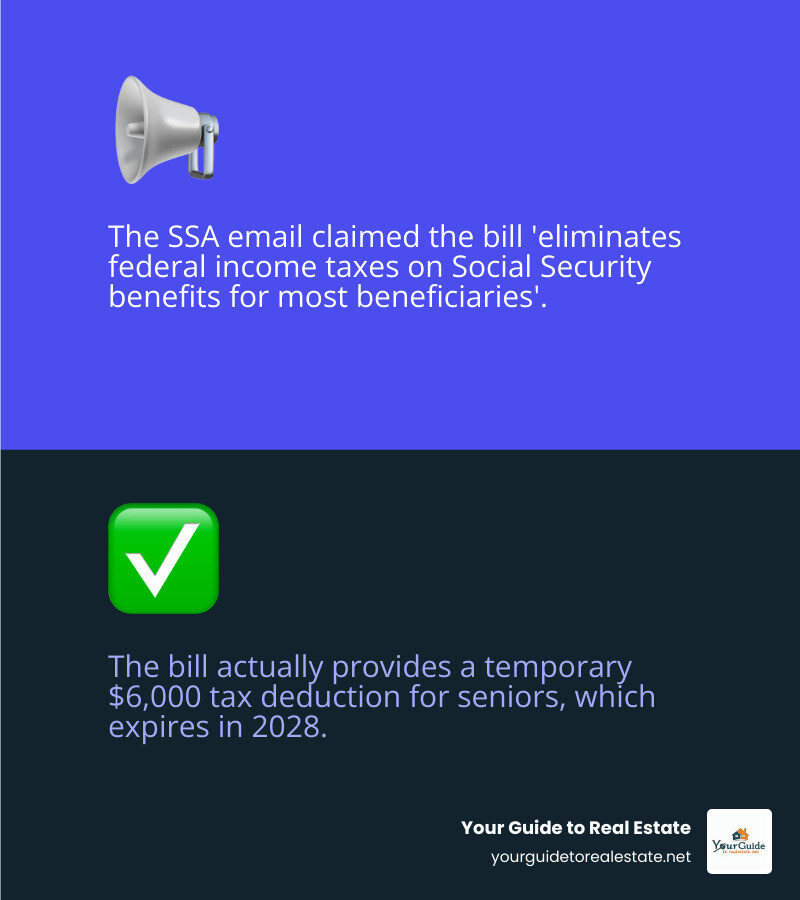
- The email claimed the bill “eliminates federal income taxes on Social Security benefits for most beneficiaries”
- This claim was misleading – the bill only provides a temporary tax deduction for seniors
- Former SSA officials called it an “unconscionable” political statement that broke agency norms
- Many recipients thought it was a scam because of its unusual political tone
The email celebrated passage of what it called the “One Big Beautiful Bill,” claiming it provided historic tax relief. But experts quickly pointed out the problems with these claims.
What actually happened: The Social Security Administration sent an unprecedented political message to its massive email list, making overstated claims about tax legislation. The bill doesn’t eliminate taxes on Social Security benefits – it creates a temporary $6,000 tax deduction for seniors that expires in 2028.
This controversy highlights a bigger problem: how do you tell the difference between legitimate government emails and scams? The SSA’s decision to send politically charged messages has made it harder for people to trust official communications.
Decoding the “Social Security Email Big Beautiful Bill” Controversy
When the social security email big beautiful bill controversy broke, it caught everyone off guard – including the 71 million Americans who received the message in their “My Social Security” accounts. The email praised what it called the “big, beautiful bill,” using language that sounded more like a campaign rally than official government communication.
The White House was quick to back up the claims, with their Council of Economic Advisers estimating that 88% of older adults receiving Social Security benefits would pay no taxes under the new law. But here’s where things got messy – experts immediately started pushing back on how the SSA was describing the legislation.

Howard Gleckman, a senior fellow at the Tax Policy Center, didn’t mince words when he told the Washington Post: “There is no provision in the budget bill that directly ‘eliminates’ or even reduces taxes on Social Security benefits.”
That statement set off alarm bells everywhere. If one of the country’s top tax policy experts was saying the SSA got it wrong, what exactly was going on?
What the SSA’s “social security email big beautiful bill” Actually Claimed
The social security email big beautiful bill made some pretty bold promises. The SSA told recipients that the new legislation “eliminates federal income taxes on Social Security benefits for most beneficiaries.” They claimed this would help 90 percent of recipients and provide “meaningful and immediate relief.”
The agency called it “historic tax relief” and posted the same message on their official blog through their blog post on the legislation. When you read those claims, it sounds like Social Security benefits would no longer be taxed at all – a massive change that would affect millions of people.
But that’s not what actually happened.
The Reality: What the Bill Actually Does
Here’s the truth: the bill doesn’t eliminate taxes on Social Security benefits. Instead, it creates a temporary tax deduction that might help reduce your overall tax bill.
The legislation adds an improved standard deduction of $6,000 for seniors aged 65 and older, and $12,000 for married couples. This deduction runs from 2025 through 2028, so it’s not even permanent.
Think of it this way – instead of directly changing how Social Security benefits are taxed, the bill gives you a bigger deduction when you file your taxes. If that deduction lowers your total taxable income enough, you might end up paying less tax on your benefits (or no tax at all). But the tax on Social Security benefits itself hasn’t changed.
The Bipartisan Policy Center’s analysis of the deduction explains how this works in more detail. The deduction also phases out for higher incomes – individuals making over $75,000 and married couples over $150,000 won’t get the full benefit.
The Tax Policy Center estimates that fewer than half of older adults would actually benefit from this change. The biggest winners are seniors making between $80,000 and $130,000. For more context on other changes affecting seniors, check out our guide on the Social Security 2025 COLA Increase.
Why Experts Called the Email Misleading
The social security email big beautiful bill got experts fired up for good reason. The claims were way overstated, and the communication created unnecessary confusion.
First, let’s talk about that 90% claim. The SSA made it sound like almost everyone would stop paying taxes on their Social Security benefits. But here’s the kicker – about two-thirds of Social Security recipients already don’t pay taxes on their benefits because their income is too low to trigger the tax in the first place.
So when the SSA claimed this “historic” change would help 90% of people, they were really talking about helping a much smaller group of middle-income seniors. That’s still good news for those folks, but it’s not the sweeping change the email suggested.
Howard Gleckman’s criticism hit the nail on the head – the Washington Post expert opinion on the bill showed there was no direct provision to eliminate or reduce taxes on Social Security benefits. The SSA was describing a general tax deduction as if it specifically changed Social Security taxation.
This distinction matters more than you might think. Taxes paid on Social Security benefits go directly back into the program’s trust funds. When government agencies misrepresent how these taxes work, it creates public confusion about a program that’s already complicated enough.
Many people who received the email thought it might be a scam because of its unusual political tone. When a government agency that usually sends dry, technical updates suddenly starts celebrating “big, beautiful bills,” people get suspicious – and rightfully so.
The Broader Impact: Politicization and Trust Fund Solvency
The social security email big beautiful bill controversy goes way beyond confusing tax details. It’s really about something much bigger: can we trust our government agencies to give us straight facts? And what happens when political messaging starts messing with programs that millions of Americans depend on?
When a federal agency sends out what sounds like a campaign email to 71 million people, it raises some serious red flags. Government communications are supposed to stick to the facts, not spin them. This email crossed a line that most agencies have respected for decades.
An Unprecedented Political Message
The Social Security Administration has always prided itself on staying out of politics. For good reason – when you’re managing benefits for tens of millions of Americans, people need to trust that you’re giving them accurate information, not political talking points.
This email shattered that tradition. Nathan Osburn, who worked as a deputy commissioner during the Biden administration, didn’t mince words on LinkedIn: “The Social Security Administration’s communications shop has been politicized.”
Jeff Nesbit, another former deputy commissioner, was equally shocked. He pointed out that the agency had never issued such a blatantly political statement in all his years of experience. That’s saying something from people who’ve seen how these agencies are supposed to work.
Rep. Frank Pallone didn’t hold back either, calling the email’s claims outright lies and expressing concern about a public institution being hijacked to push misinformation. When you’ve got former officials and current lawmakers from both sides raising alarms, you know something’s gone seriously wrong.
Here’s what made this so unusual: while government agencies might put out press releases that could be seen as political, sending a mass email with this tone to 71 million people was completely unprecedented. Many recipients actually thought it was a scam because it sounded so different from normal government communications.
There’s historical context here too. Back in 1972, President Nixon wanted to include a political insert in Social Security checks taking credit for benefit increases. The commissioner at the time, Robert Ball, threatened to quit over it. That’s how seriously these agencies have traditionally taken their neutrality. Our Social Security Transparency Initiatives article explores why this kind of clear, honest communication matters so much.
The Financial Cost to Social Security
Here’s where things get really concerning: this isn’t just about political messaging. The tax changes in this bill could actually hurt Social Security’s long-term health.
When people pay taxes on their Social Security benefits, that money doesn’t just disappear into the general treasury. It goes right back into shoring up the Social Security and Medicare trust funds. So when you reduce those taxes, you’re also reducing the money flowing into the programs themselves.
The Committee for a Responsible Federal Budget ran the numbers, and they’re not pretty. They estimate this package will reduce Social Security taxation by about $30 billion per year. That might sound like good news for taxpayers, but it’s terrible news for the program’s solvency.
Their analysis shows that Social Security’s trust fund could now face insolvency in late 2032 instead of early 2033. That might not sound like a huge difference, but when you’re talking about a program that millions depend on, every month matters. If Congress doesn’t act before then, we could be looking at a 24% cut in benefits for everyone.
It’s a cruel irony: a bill that’s supposed to help seniors could end up hurting the very program they rely on. The Committee for a Responsible Federal Budget warns that this could accelerate insolvency, putting future benefits at risk.
For more details about what’s changing with Social Security this year, check out our guide on What Changes Are Coming to Social Security in 2025?. Understanding these changes is crucial for planning your financial future.
How to Verify Any Email from the Social Security Administration
The social security email big beautiful bill controversy has left many people wondering: how can I tell if an email from the Social Security Administration is real? It’s a fair question, especially when even legitimate government emails can sound confusing or unusual.

The truth is, scammers love to impersonate government agencies because people tend to trust official-looking messages. But after seeing how the SSA’s own email caused widespread confusion, it’s clear that even real government communications can raise red flags.
Red Flags for a Scam or Misleading Email
When you receive an email claiming to be from the Social Security Administration, trust your instincts. If something feels off, it probably is.
Watch out for unusual or overly political language. As we learned from the “big beautiful bill” email, government communications should typically stick to neutral, informational content. If an email sounds like a campaign ad or uses inflammatory language, be suspicious.
Be wary of urgent requests for personal information. Real government agencies rarely ask for sensitive details like your Social Security number, bank information, or passwords through email. They especially won’t threaten to suspend your account if you don’t respond immediately.
Don’t fall for scare tactics. Messages that threaten legal action, account suspension, or benefit loss unless you act right away are classic scam techniques. The SSA doesn’t operate this way.
Question generic greetings and poor grammar. If an email addresses you as “Dear Beneficiary” instead of your actual name, or if it’s full of spelling mistakes, it’s likely fake. While even official emails can have typos, frequent errors are a major warning sign.
Be cautious about unsolicited emails asking you to click links. If you haven’t recently contacted the SSA or requested information, an unexpected email should raise your guard. Clicking suspicious links can lead to fake websites designed to steal your information.
Steps to Verify a Legitimate SSA Email
Here’s how to protect yourself and verify whether that Social Security email is real:
Start by checking the sender’s email address. Legitimate government emails always come from addresses ending in “.gov” – like something@ssa.gov. If you see .com, .org, or any other ending, it’s not from the real SSA.
Never click links in questionable emails. When in doubt, don’t click anything. Instead, open a new browser window and type www.ssa.gov directly into the address bar. This way, you know you’re going to the real website.
Use your secure “my Social Security” account for all official business. This is your safest bet for receiving genuine SSA communications. When the agency has something important to tell you, they’ll send a notification email, but the actual message will be waiting in your secure Message Center online.
Follow the SSA’s own guidance about email contact. The agency provides clear information about how they communicate with the public through their official SSA guidance on email contact. They’re upfront about when they will and won’t email you.
After the confusion caused by the social security email big beautiful bill, even the SSA acknowledges that their communications weren’t as clear as they should have been. When government agencies make mistakes like this, it becomes even more important for you to double-check everything.
For the latest updates on Social Security changes and news, you can always check our Social Security News section. We keep track of developments so you don’t have to guess what’s real and what’s not.
Frequently Asked Questions about the SSA “Big Beautiful Bill” Email
We know the social security email big beautiful bill left many people scratching their heads. After helping countless clients steer confusing government communications, we’ve gathered the most common questions people are asking about this controversial email.
Did the “big, beautiful bill” eliminate taxes on Social Security?
Here’s the short answer: No, it absolutely did not.
Despite what the SSA email claimed, the bill doesn’t eliminate taxes on Social Security benefits. What actually happened is much more limited – and temporary.
The bill created an improved standard deduction of up to $6,000 for people 65 and older ($12,000 for married couples). This deduction can lower your overall taxable income, which might reduce or eliminate what you owe in taxes – including taxes on your Social Security benefits.
But here’s the key difference: it’s not a direct elimination of the tax on benefits themselves. It’s more like getting a bigger tax break that could help offset those taxes. Plus, this deduction is only temporary and expires in 2028.
Think of it like this: if you owe $100 in taxes on your Social Security benefits, the old email made it sound like that $100 tax disappeared. In reality, you might get a $200 deduction elsewhere that helps you pay that $100 – but only if your income falls within certain limits.
Why did the Social Security Administration send this email?
The SSA said they wanted to share “helpful information” about the new legislation and how it benefits seniors. Sounds reasonable, right?
The problem is how they did it. Critics – including former SSA officials who know how these things usually work – called it an “unconscionable” political statement that completely broke with how the agency normally communicates.
Instead of sticking to dry, factual language (which, let’s be honest, government agencies are famous for), the email read more like a campaign announcement. Former officials were shocked because the SSA has always prided itself on staying neutral and nonpartisan.
Many experts believe this was less about sharing helpful information and more about promoting a specific political agenda – something the SSA just doesn’t do.
Is it normal for the SSA to send political emails?
Not even close. This was so unusual that many recipients thought it was a scam.
The Social Security Administration is supposed to be a nonpartisan agency. Their typical emails are about as exciting as watching paint dry – and that’s exactly how it should be. They usually stick to things like “Your statement is ready” or “Here’s how to update your address.”
This social security email big beautiful bill was completely different. It used political language, made bold claims, and had a tone that sounded more like a press release from a political campaign than a government agency.
That’s precisely why it caused such an uproar. When a government agency that’s supposed to stay neutral suddenly starts sending politically charged emails to 71 million people, it breaks decades of established norms. Former commissioners who worked under different administrations – both Republican and Democrat – were equally critical of this departure from standard practice.
The controversy highlights something important: when government agencies step outside their usual role, it can make people lose trust in legitimate communications. And in a world where scams are everywhere, that trust is precious.
Conclusion
The social security email big beautiful bill controversy teaches us an important lesson: even official government communications can be misleading or confusing. This incident reminds us that we need to stay alert and question what we receive, no matter how official it looks.
What we learned from this situation:
First, always verify communications before acting on them. The fact that 71 million people received a misleading email from their own government shows how easily misinformation can spread. When something seems too good to be true – like completely eliminating taxes on Social Security – it probably is.
Second, understanding your finances matters more than ever. The difference between a tax deduction and tax elimination might seem small, but it can mean thousands of dollars in your pocket. The more you know about how taxes, benefits, and government programs actually work, the better you can protect yourself from confusion and scams.
At Your Guide to Real Estate, we see similar challenges in our industry every day. Just like the social security email big beautiful bill made people question government communications, misleading information about real estate can lead to costly mistakes. That’s why we focus on giving you clear, honest facts – whether you’re buying your first home or planning your retirement finances.
Moving forward, here’s what we recommend:
Always go directly to official websites when you need to verify information. Don’t click links in suspicious emails. Use your secure accounts to check for real updates. And remember, if something sounds too political or too good to be true, take a step back and do your own research.
Financial literacy and careful decision-making go hand in hand. Whether you’re dealing with Social Security benefits or choosing a real estate broker, the same principles apply: verify information, understand the details, and don’t rush into decisions based on one source.
We’re here to help you steer complex decisions with confidence, providing the clear guidance you need to make smart choices for your financial future.