

A New Era for Public Sector Retirees
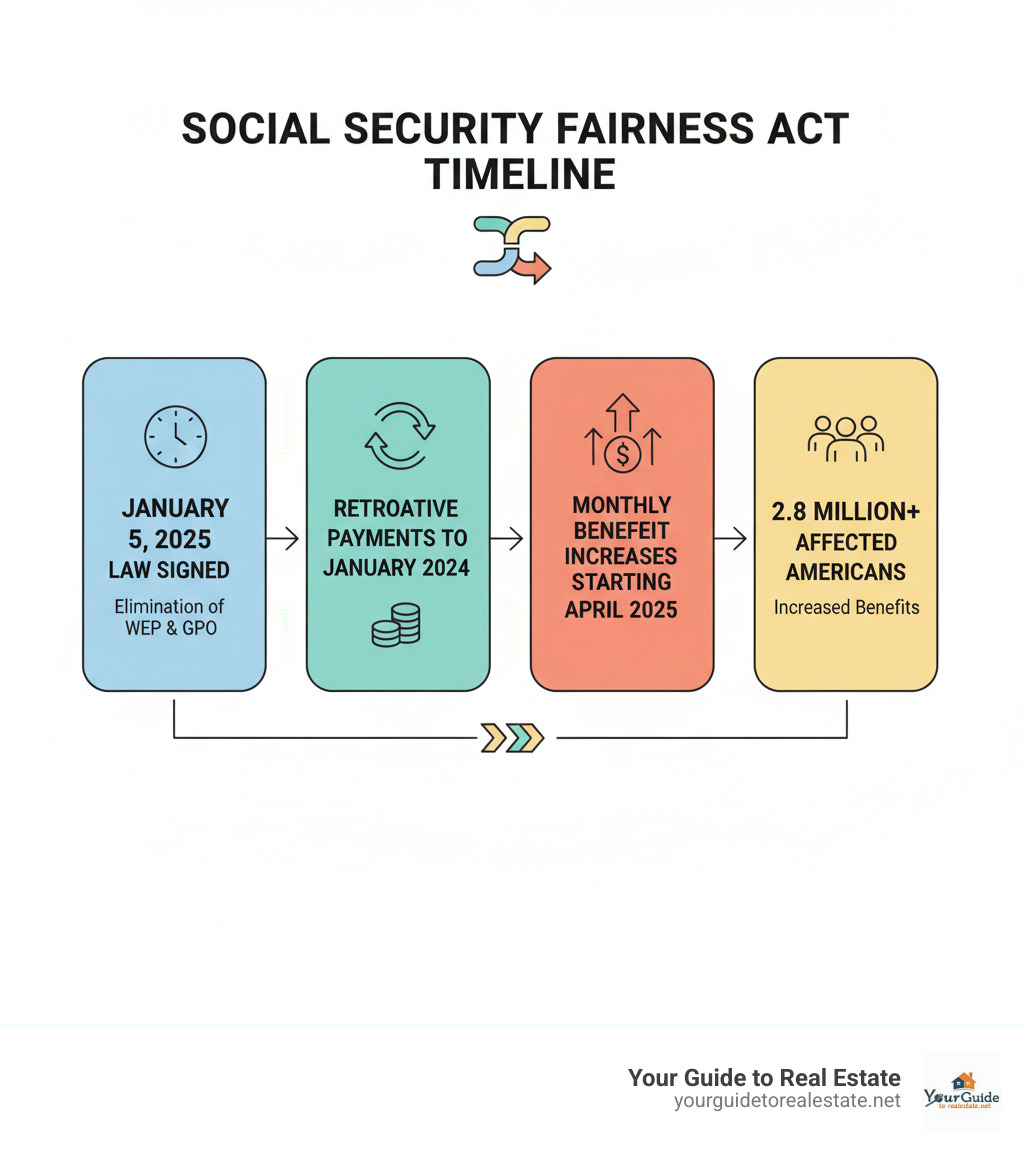
When will the Social Security Fairness Act go into effect – it’s already happening. The law was signed on January 5, 2025, and benefits began rolling out just weeks later.
Key Timeline:
- Law signed: January 5, 2025
- Retroactive to: January 2024 payments
- Monthly increases started: April 2025
- Retroactive payments: Over 3.1 million sent by July 2025
- Full implementation: Expected by December 2025
This historic legislation eliminates two provisions that unfairly reduced Social Security benefits for millions of public sector workers. The Windfall Elimination Provision (WEP) and Government Pension Offset (GPO) previously cut benefits for teachers, firefighters, police officers, and other government employees who earned pensions from jobs not covered by Social Security.
The impact is massive – over 2.8 million Americans are now receiving increased monthly payments, with some seeing boosts of $360 to over $1,000 per month. The Social Security Administration has already distributed $17 billion in retroactive payments, finishing the task five months ahead of schedule.
For many public sector retirees, this represents the biggest change to their financial picture in decades. The increased income could affect everything from retirement planning to housing decisions – making it more important than ever to understand how these changes impact your overall financial strategy.
Key terms for when will the social security fairness act go into effect:
- what changes are coming to social security in 2025
- financially free
- a is a plan in which an individual balances available resources and expenses
What is the Social Security Fairness Act and What Does It Change?
If you’re wondering when will the Social Security Fairness Act go into effect, the answer is simple – it already has. But what exactly does this game-changing law do?
The Social Security Fairness Act (H.R. 82) represents decades of advocacy finally paying off. After being signed into law on January 5, 2025, this legislation tackles a problem that has frustrated public sector workers for years: unfair cuts to their Social Security benefits.
For too long, over 2.8 million Americans found themselves caught in a financial squeeze. These weren’t wealthy retirees trying to game the system – they were teachers who shaped young minds, firefighters who ran toward danger, and police officers who protected our communities. Despite paying into Social Security during parts of their careers, they watched their benefits get slashed simply because they also earned a pension from government work.
The heart of the problem lay in two provisions that sounded reasonable on paper but created real hardship in practice. The Windfall Elimination Provision (WEP) and Government Pension Offset (GPO) were designed to prevent “double-dipping,” but they often punished people who had legitimately earned benefits from both systems.
Now, with the repeal of both WEP and GPO, those artificial reductions are gone forever. If your Social Security benefits were previously cut because of these provisions, you’re now getting your full, earned benefits. For many retirees, this means hundreds or even over a thousand dollars more each month – money that can make the difference between just getting by and truly enjoying retirement.
Understanding the Repealed Provisions: WEP and GPO
Let’s break down what these provisions actually did, so you can understand why their elimination is such big news.
The Windfall Elimination Provision (WEP) targeted people who worked in both regular jobs (where they paid Social Security taxes) and government positions that didn’t pay into Social Security. Think of a teacher who worked summers in retail, or someone who switched from private sector work to a state government job.
Social Security benefits are calculated using a formula that gives lower-income workers a better deal – they get back a higher percentage of what they paid in. The problem arose when someone had a government pension from non-covered employment (work where they didn’t pay Social Security taxes). The system would look at their Social Security earnings alone and think, “This person was a low-wage worker their whole career,” when in reality, they were earning good money in their government job too.
The WEP tried to “fix” this by reducing the Social Security benefit calculation for anyone with a substantial non-covered pension. You can see the full technical details in this Windfall Elimination Provision explained document from the SSA, but the bottom line was simple: your Social Security check got smaller.
The Government Pension Offset (GPO) hit spouses and survivors even harder. If you received a government pension from non-covered work and were also eligible for Social Security benefits based on your spouse’s work record, the GPO would slash those spousal or survivor benefits. The reduction was typically two-thirds of your government pension amount – and in many cases, this wiped out the spousal benefit entirely.
Imagine losing your spouse and then finding that your survivor benefits would be eliminated because of your teaching pension. That’s the harsh reality many faced under the GPO. The Government Pension Offset explained document shows just how complex and punitive this system was.
State and local government employees bore the brunt of these provisions. Teachers, police officers, firefighters, and other public servants who dedicated their careers to serving their communities found their retirement security undermined by rules that seemed to punish them for their service.
With both provisions now repealed, the era of these unfair benefit reductions is over. Public sector retirees can finally receive the full Social Security benefits they earned, without penalties for also having a government pension.
When Will the Social Security Fairness Act Go Into Effect?
If you’ve been wondering when will the Social Security Fairness Act go into effect, here’s the wonderful news: it’s already happening! The law was signed on January 5, 2025, and the Social Security Administration has been working at lightning speed to get these long-awaited benefits into the hands of those who deserve them.
What makes this legislation truly special is how quickly things moved once it became law. The SSA began adjusting payments on February 25, 2025 – just seven weeks after the signing. That’s remarkably fast for a government agency handling such a massive undertaking affecting millions of people.
The Act works retroactively to January 2024, which means you’re not just getting increased benefits going forward – you’re also entitled to make-up payments for over a year of benefits you should have been receiving. Think of it as the government finally paying back what was rightfully yours all along.
Full benefit increases are expected to be complete by December 2025, though most people started seeing their higher payments much sooner than that. The SSA has been processing these changes in waves, tackling the simpler cases first and working through the more complex situations systematically.
For a broader look at how this fits into other changes happening with Social Security this year, check out what changes are coming to Social Security in 2025.

When will individuals start seeing an increase in their monthly Social Security benefits?
The moment many retirees had been waiting for arrived in April 2025. That’s when most people affected by WEP and GPO saw their first increased Social Security payment hit their bank accounts. This April payment actually covered benefits for March 2025, reflecting the new, higher amounts they were entitled to.
The SSA had been working behind the scenes since February 25, 2025, when they began the massive task of recalculating and adjusting benefits. For most people, this process was completely automatic – no paperwork, no phone calls, no hassle. One month their payment was the reduced amount, and the next month it was the full amount they had always deserved.
Some cases took a bit longer to process, particularly those with complex benefit calculations or unusual circumstances. If your work history involved multiple types of pensions or if your records needed manual review, your adjustment might have come a few weeks later. But the SSA has been steadily working through these cases, ensuring everyone gets their fair share.
The beauty of the SSA’s automated process is that it removed the burden from retirees. After years of advocacy and waiting, the system finally worked in their favor, delivering results without requiring additional effort from those who had already waited long enough.
When will the Social Security Fairness Act go into effect for retroactive payments?
Here’s where the story gets really exciting. This law applies to benefits starting from January 2024, even though it wasn’t signed until January 2025. That means eligible retirees were owed over a year’s worth of back payments – and the SSA delivered in spectacular fashion.
Starting on February 25, 2025, the SSA began sending out these retroactive lump-sum payments alongside the monthly adjustments. By July 7, 2025, they had accomplished something truly remarkable: over 3.1 million payments totaling $17 billion had been distributed to eligible beneficiaries.
What makes this achievement even more impressive? They finished five months ahead of schedule. The original timeline suggested this massive undertaking might take well into 2026, but the SSA’s dedicated team made it happen by mid-2025.
These weren’t small payments either. We’re talking about substantial lump sums that represented more than a year of benefit increases. For many retirees, receiving this money felt like winning the lottery – except they had actually earned every penny through their years of public service.
If you want to dive deeper into how these retroactive payments were calculated and distributed, our detailed guide on retroactive payments breaks down everything you need to know.
The SSA processed these payments in waves throughout the spring of 2025, with most people receiving their retroactive benefits well before the summer. It was a masterclass in government efficiency when it really mattered.
Who Is Eligible and What Actions Should You Take?
If you’re wondering whether when will the Social Security Fairness Act go into effect applies to your situation, the answer depends on whether you were previously affected by those pesky WEP and GPO provisions. The good news is that millions of hardworking Americans are now eligible for increased benefits.
The Act specifically helps public sector workers with non-covered pensions – think teachers who dedicated their careers to educating our children, firefighters who risked their lives to keep us safe, and police officers who protected our communities. If you worked for state or local government and receive a pension from a job where you didn’t pay Social Security taxes, you’re likely eligible. This also includes federal employees under the Civil Service Retirement System (CSRS) rather than the newer FERS system.
Spouses and survivors who saw their benefits vanish or shrink because of GPO are also covered. If you were eligible for Social Security benefits based on your spouse’s work record but had those benefits reduced because you also received a government pension, your full benefits should now be restored.
Here’s something important to keep in mind: not every government worker will see changes. About 72% of state and local public employees already work in jobs covered by Social Security, meaning they pay Social Security taxes and were never affected by WEP or GPO in the first place. If that’s your situation, your benefits won’t change – but that’s because they were already fair to begin with.
The best place to stay updated on your specific situation is the Social Security Administration’s official website. They’ve created a dedicated page with all the latest information: Official SSA updates on the Act.
Actions for Current Beneficiaries
If you’re already receiving Social Security benefits that were reduced by WEP or GPO, here’s the best news you’ll hear all day: you don’t need to do anything. No paperwork, no phone calls, no standing in line at the Social Security office. The SSA is handling everything automatically.
Their computer systems are smart enough to identify who was affected and make the necessary adjustments. Think of it as getting a raise without having to ask for it – the government is finally doing the heavy lifting for you.
However, there’s one simple step that can save you headaches down the road: make sure your contact information is current. You want those increased payments and any retroactive lump sums to find their way to you without any detours. Log into your my Social Security account and double-check that your address and direct deposit information are up to date. If you don’t have an online account yet, setting one up takes just a few minutes and gives you 24/7 access to your benefit information.
There’s one small detail that might affect some beneficiaries: Medicare premium adjustments. If your Social Security benefits were so low due to WEP or GPO that you had to pay Medicare premiums directly to CMS, your situation is about to change. Once your benefits increase, Medicare will likely start deducting premiums from your Social Security payment again.
Keep paying your Medicare bill directly until you get official word from the SSA. If you use automatic payments through Medicare Easy Pay, you’ll need to fill out form SF-5510 to stop those payments. If you pay through your bank’s online system, give them a call to stop those automatic transfers. It’s a small step that prevents you from accidentally paying twice.
Actions for New Applicants
Here’s where things get exciting for a whole group of people who might have given up hope years ago. If you never applied for Social Security benefits because you knew WEP or GPO would slash them to almost nothing, it’s time to dust off those documents and apply.
Maybe you calculated that your spousal benefits would disappear entirely due to GPO, or perhaps WEP would have reduced your retirement benefits to pocket change. Those days are over. The benefits you earned through years of work are now available in full.
Applying online is usually your fastest option. Head over to Apply online here and start the process from the comfort of your home. If you prefer talking to a real person, call 1-800-772-1213 and ask to speak with the dedicated claims team that handles Social Security Fairness Act cases. These folks are specially trained to help people in your exact situation.
When you apply, you’ll need the usual suspects for documentation: your birth certificate, Social Security card, military service papers if you served before 1968, and your most recent W-2 forms or tax returns. The SSA will also ask about any non-covered pensions you receive – but here’s the beautiful part: that information won’t be used against you anymore. They need it to calculate your benefits correctly under the new, fairer rules.
Don’t let past disappointments keep you from claiming what you’ve rightfully earned. The landscape has completely changed, and those benefits that seemed out of reach are now waiting for you to claim them.
Financial Impact and Other Key Considerations
When will the Social Security Fairness Act go into effect for your wallet? The answer is clear – the financial benefits are already flowing, and they’re more substantial than many people expected.
Let’s talk real numbers here. Based on careful estimates from the Congressional Budget Office, eliminating the Windfall Elimination Provision means affected retirees are seeing an average monthly increase of $360. That’s over $4,300 extra per year – enough to cover a nice vacation, help with unexpected medical bills, or simply provide breathing room in your monthly budget.
The Government Pension Offset changes are even more dramatic. Affected spouses are receiving an average monthly boost of $700, while surviving spouses are seeing increases of around $1,190 per month. These aren’t small adjustments – we’re talking about life-changing amounts that can transform retirement security.
Think about what this means for retroactive payments too. Someone affected by WEP could have received a lump sum of roughly $4,320 covering those 12 months from January 2024. For GPO-affected spouses, that retroactive payment could be around $8,400 or more. These are the kinds of payments that can help people catch up on deferred home maintenance, pay off debt, or finally make that move they’ve been considering.
The scope of this financial relief is enormous. The Congressional Budget Office estimates these changes will cost $196 billion over the next decade. While that’s a significant investment, it represents justice for millions of public servants who dedicated their careers to serving their communities.
There’s even more good news. These increases happened alongside the regular 2.5% cost-of-living adjustment (COLA) for 2025. So many retirees are experiencing a double boost to their monthly income – something that hasn’t happened in a very long time.
This kind of income increase often leads people to reconsider their living situations and housing options. If you’re thinking about how your new financial picture might affect your housing decisions, you’ll find helpful resources at Read the latest Social Security news.
Are there tax implications for the increased benefits?
Here’s where we need to have an honest conversation about taxes. Yes, your increased Social Security benefits might mean you’ll owe more in taxes – but don’t let that overshadow the good news of higher income.
The key concept to understand is “provisional income.” This includes your adjusted gross income, any tax-exempt interest you earn, and half of your Social Security benefits. When your Social Security payments increase, your provisional income goes up too. Cross certain thresholds, and more of your Social Security becomes taxable.
For single filers, if your provisional income falls between $25,000 and $34,000, up to 50% of your benefits may be taxable. Above $34,000, and up to 85% could be subject to federal taxes. For married couples filing jointly, those thresholds are $32,000 to $44,000 for the 50% level, and above $44,000 for the 85% level.
Let’s put this in perspective. If you were previously receiving $800 monthly in Social Security and now you’re getting $1,160 (a $360 WEP increase), that extra $4,320 annually might push you into a higher tax bracket or make more of your benefits taxable.
Your increased income could also affect other government benefits that are income-dependent. Some programs have strict income limits, and your new, higher Social Security payments might impact your eligibility.
The smart move? Consult with a tax professional who can look at your specific situation. They can help you understand exactly how these changes affect your tax picture and suggest strategies to manage any additional tax liability. Consider it an investment in peace of mind – and proper planning can often minimize any unwelcome tax surprises.
Frequently Asked Questions about the Social Security Fairness Act
When major changes happen to Social Security, it’s completely natural to have questions. We’ve gathered the most common concerns we’ve heard about when will the Social Security Fairness Act go into effect and what it means for you.
How can I find out if I am affected by the WEP or GPO repeal?
The quickest way to find out if you’re affected is to check your Social Security statement. If you’ve been receiving benefits that seemed lower than expected, and you also get a pension from work where you didn’t pay Social Security taxes, there’s a good chance WEP or GPO was reducing your payments.
Here’s what to look for: Did you work for a state or local government – perhaps as a teacher, police officer, or firefighter – where Social Security taxes weren’t taken from your paycheck? If you’re getting a pension from that job, WEP likely affected your Social Security benefits.
For spouses and survivors, the situation is a bit different. Are you receiving Social Security benefits based on your spouse’s work record, while also getting your own government pension from non-covered employment? If so, GPO was probably reducing or eliminating your spousal or survivor benefits.
The most reliable way to get personalized information is through the official Social Security Administration FAQ page. The SSA updates this page regularly with the latest details, and it can give you specific guidance based on your situation.
How do I avoid scams related to the Social Security Fairness Act?
Unfortunately, whenever there’s big news about Social Security benefits, scammers see an opportunity. They know people are excited about potential increases and might let their guard down. But don’t worry – protecting yourself is straightforward once you know what to watch for.
The Social Security Administration will never call you asking for payment to process your benefits or speed up your retroactive payment. If someone calls claiming you need to pay a fee to get your increased benefits, hang up immediately. It’s a scam, plain and simple.
You don’t need to pay anyone for help with these benefit increases. The SSA is handling most adjustments automatically. Even if you need to apply for benefits for the first time, the application process is completely free.
Be especially cautious about unsolicited phone calls, emails, or text messages claiming to be from Social Security. Real SSA communications typically come through official mail, not surprise phone calls asking for your Social Security number or bank details.
If you receive suspicious contact, don’t engage. Instead, report it to the SSA’s Office of the Inspector General through their website. When in doubt, hang up and call the official SSA number directly to verify any claims.
What if I pay my Medicare premiums directly?
If you’ve been paying your Medicare premiums directly to the Centers for Medicare and Medicaid Services because your Social Security benefits were too low, you’ll need to make some adjustments as your benefits increase.
Keep paying your Medicare premiums directly until you get official word from the Social Security Administration. Don’t stop these payments just because you know your benefits are increasing – wait for confirmation.
Once your Social Security benefits go up enough, the SSA will start deducting your Medicare premiums from your monthly Social Security payment again. This is actually more convenient for most people, but you need to avoid double-paying during the transition.
If you’re using Medicare Easy Pay for automatic payments, you’ll need to fill out a form (SF-5510) to stop those automatic withdrawals. Check your Medicare bill for specific instructions about stopping automatic payments.
For those using online bill pay through their bank, contact your bank directly to stop the scheduled Medicare payments once the SSA starts deducting them from your Social Security benefits. It’s a small administrative step, but it’ll save you from accidentally paying twice for the same coverage.
Conclusion: What This Means for Your Financial Future
The Social Security Fairness Act represents a watershed moment for millions of public sector retirees who spent their careers serving our communities. If you’ve been wondering when will the Social Security Fairness Act go into effect, the answer is reassuring: it’s already happening, and the results have been remarkable.
The speed and efficiency of this rollout have exceeded everyone’s expectations. The Social Security Administration didn’t just meet their deadlines – they crushed them, delivering over $17 billion in retroactive payments to more than 3.1 million beneficiaries five months ahead of schedule. That’s the kind of government efficiency we love to see!
For those receiving these increased benefits, this isn’t just about extra money in the bank account. It’s about restored dignity and financial security after years of unfair reductions. Whether you’re seeing an extra $360 per month from WEP elimination or over $1,000 monthly from GPO repeal, these increases can fundamentally change your retirement picture.
This newfound financial stability opens doors that may have seemed closed before. Maybe you’ve been dreaming of downsizing to a cozy condo near your grandchildren, or perhaps you’re considering that retirement home in a warmer climate. With higher, more predictable income, these dreams might suddenly feel within reach.
Your increased Social Security benefits could also affect your borrowing power if you’re considering a mortgage or refinancing. Lenders look at stable income sources, and Social Security is considered one of the most reliable. This change might qualify you for better loan terms or allow you to purchase a home you previously couldn’t afford.
At Your Guide to Real Estate, we understand that major income changes – like those brought by the Social Security Fairness Act – can create new opportunities in your housing situation. Whether you’re thinking about buying, selling, or simply exploring your options, we’re here to help you steer these decisions with confidence.
The key is understanding how your improved financial position translates into real estate possibilities. If you’re curious about how your increased income might affect your home buying power, we encourage you to explore our comprehensive guide: Understand how your new income affects your home loan options.
This legislation has delivered on its promise, and now it’s time to make the most of your improved financial future. The possibilities are exciting, and we’re here to help you explore them.