
Why Mortgage Rates Bad News Affects Every Home Purchase Decision
Mortgage rates bad news has become a daily reality for millions of Americans trying to buy homes. If you’re wondering what this means for your homebuying plans, here’s what you need to know right now:
Current Impact of High Mortgage Rates:
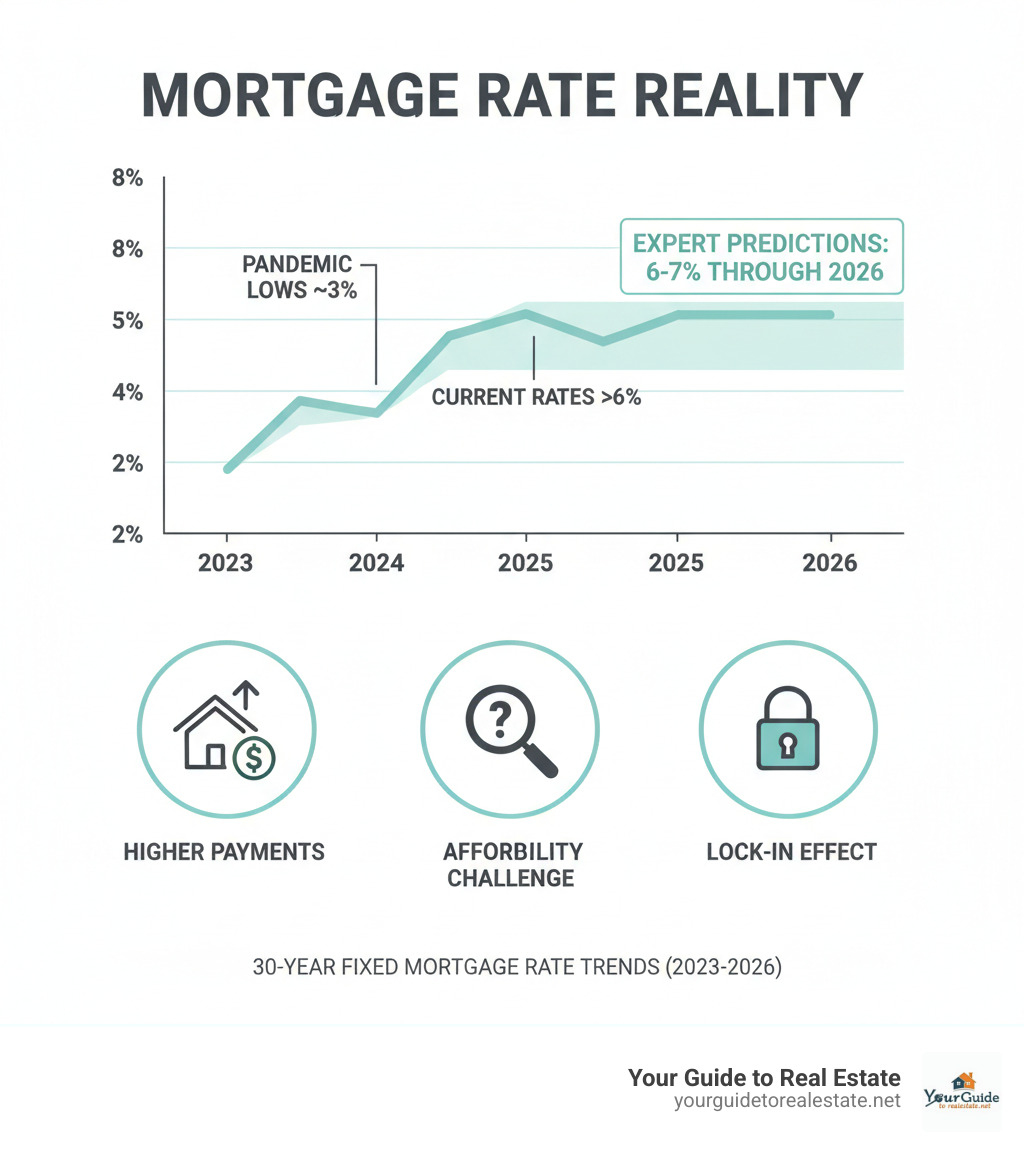
- 30-year fixed rates are around 6.5-7%, much higher than pandemic lows
- Monthly payments are up nearly $200 from just four months ago
- Home sales are heading for their worst year since 1995
- 85% of homeowners have rates below 6%, creating a “lock-in effect”
- Rates are predicted to stay above 6% through 2026
Today’s mortgage rates have priced out many buyers, creating a stagnant housing market. As one expert noted, “Americans looking to purchase a home in the next few years will have a tough pill to swallow.”
But here’s the twist that confuses many people – bad economic news can actually be good news for mortgage rates. When job reports disappoint or the economy shows weakness, mortgage rates often drop because investors seek safer investments like Treasury bonds.
The challenge for homebuyers is that mortgage rates are expected to stay stuck above 6% for at least two years, according to major forecasts from Wells Fargo and Fannie Mae. This represents a “new normal” compared to the 3-4% rates many remember from recent years.
Understanding why rates are high is crucial for making smart decisions about buying, selling, or refinancing your home.
Quick mortgage rates bad news definitions:
The Current Landscape: Why Are Mortgage Rates Bad News for Buyers?
If you’re house hunting right now, you’ve probably felt the sting of today’s mortgage rates bad news firsthand. The numbers tell a sobering story: 30-year fixed mortgage rates are sitting between 6.5% and 7%, the highest since the early 2000s. That’s a dramatic jump from the rock-bottom rates many remember.
In real dollars, a home financed today could cost nearly $200 more per month than just four months ago. That’s an extra $2,400 per year. This affordability crunch is reshaping the housing market. Home sales are on track for their worst year since 1995 as high payments price buyers out.
A staggering 71% of aspiring homeowners are waiting on the sidelines for rates to drop. As a result, mortgage demand continues to fall, showing how sensitive buyers are to borrowing costs.
For real-time updates on how these rates are moving, check our Weekly Mortgage Rate Analysis. And if you’re feeling overwhelmed by all the rate talk, our guide to Understanding Mortgage Rates breaks it down in plain English.
The Impact on Housing Affordability
Let’s look at the impact on your budget. For a $300,000 loan, a rate jump from 3% to 6.5% increases the monthly payment from about $1,265 to $1,896. That’s over $600 more each month for the same house.
Higher payments also affect your debt-to-income ratio (DTI), a key factor for lenders. Most lenders prefer a DTI under 36% of your gross income, though some allow up to 50%.
Frustratingly, you might not qualify for the same loan amount as two years ago, even with better income and credit. The lending math has simply shifted against you.
This leaves millions of potential buyers on the sidelines, creating a stagnant market. It’s especially tough for first-time buyers without equity from a previous home. If you’re wondering what you can realistically afford, our guide “I Make $70,000 a Year: How Much House Can I Afford?” can help you crunch the numbers.
The ‘Lock-In Effect’ on Housing Inventory
An unexpected problem from mortgage rates bad news is the “lock-in effect.” About 85% of homeowners have mortgage rates below 6%, with many in the 2-4% range. These homeowners are reluctant to sell.
Few would trade a 2.75% mortgage for a 6.5% one unless a move is necessary for work or family. This “lock-in effect” means fewer homes are on the market, reducing inventory for already-struggling buyers.
The housing shortage predates the rate spikes, with an estimated need for 1.5 to 4.5 million more homes. New construction is helping, with builders expecting to complete 1.1 million new homes in 2025, up 14% from 2024.
Good news: builders are focusing on smaller, more affordable homes, with sales under $300,000 growing from 14% to 17% in the past year. However, new construction takes time, and existing home inventory remains low.
This inventory crunch means that even with higher rates discouraging some buyers, competition for available homes can still be fierce. For a deeper look at how these dynamics are playing out, check out our “U.S. Housing Market Update 2025: Prices, Inventory, and Buyer Behavior.”
The Economic Puzzle: What’s Driving High Mortgage Rates?
To understand today’s mortgage rates bad news, you need to see the bigger economic picture. Rates don’t move randomly; they respond to interconnected economic forces.
The main drivers are inflation and Federal Reserve policy. When inflation exceeds the Fed’s 2% target (it’s currently around 2.7%), they raise the federal funds rate to cool the economy.
The Fed doesn’t set mortgage rates directly. Instead, rates closely follow the 10-year Treasury yield, typically staying about 1.8 percentage points higher. When investors worry about inflation, they demand higher Treasury yields, which in turn pushes mortgage rates up.
It’s a domino effect that can feel overwhelming, but understanding these connections helps explain why we’re seeing such persistent mortgage rates bad news. For a deeper dive into these relationships, check out our guide on Why Are Mortgage Rates Going Up?
Why Bad Economic News Can Be Good for Mortgage Rates
It sounds backward, but bad economic news can be good for mortgage rates. When reports show economic weakness, like poor jobs numbers, investors move money from stocks to safer U.S. Treasury bonds.
This increased demand for bonds pushes their yields lower. Since mortgage rates are tied to Treasury yields, they tend to drop as well.
For example, when a recent U.S. Bureau of Labor Statistics jobs report showed weaker-than-expected hiring, mortgage rates tumbled. The 30-year fixed rate dropped about 0.75% in four weeks, showing how mortgage rates bad news can quickly become good news for buyers.
J.P. Morgan Chase projects a 35% chance of recession in 2024 and 45% in 2025. While nobody wants a recession, it could actually speed up the decline in mortgage rates. Our article Will Mortgage Rates Go Down? explores this delicate balance in more detail.
The Role of the Federal Reserve and Inflation
The Federal Reserve doesn’t control mortgage rates directly, but its actions are influential. The Fed’s dual mandate is to keep inflation around 2% and maximize employment, a difficult balancing act.
To combat high inflation, the Fed raises the federal funds rate to slow the economy. This influences the entire interest rate environment, including the 10-year Treasury yield.
Fed officials have hinted at rate cuts, but stubborn inflation has delayed them. They are closely watching all economic data, especially inflation reports.
A Fed rate cut doesn’t guarantee lower mortgage rates. Sometimes, mortgage rates have even risen after a Fed cut, showing the bond market’s significant influence.
The Fed’s 2.0% inflation target is its guide. They will hesitate to ease policy if inflation remains high, even with a weaker job market. For more insights into how rate cut expectations affect the housing market, read our Analysis: Rate Cut Expectations and the Housing Market.
How Future Economic Policies Could Keep Rates High
Broader economic policies could also contribute to mortgage rates bad news. Policies like major tax cuts or increased spending could increase the national debt (already over $30 trillion).
To fund these policies, the government issues more Treasury bonds. Increased supply can lower bond prices and raise yields, leading to higher mortgage rates.
Policies like new tariffs can also reignite inflation by making imported goods more expensive. If inflation heats up, the Fed may keep rates higher for longer.
Investor Paul Tudor Jones has expressed concern over this scenario, a reminder that today’s policy decisions can impact tomorrow’s mortgage rates.
The national debt is a long-term concern affecting investor confidence and borrowing costs, which can keep mortgage rates liftd. To understand how these macro-economic forces might impact your specific situation, check out our article on Mortgage Rates and Economic Policy.
Future Outlook: Will the Mortgage Rates Bad News Continue?
Will the streak of mortgage rates bad news end? While no one has a crystal ball, experts offer a realistic, if sobering, picture for homebuyers.
The consensus is that rates will likely stay above 6% for the foreseeable future. Wells Fargo forecasts an average of 6.3% by late 2025. Fannie Mae is slightly more optimistic, predicting a gradual decline from 6.2% in Q1 2025 to 5.9% by year’s end.
These predictions have caveats. Rates could climb if the economy strengthens. Some analysts see rates between 5.75% and 6.00% in 2025, but only with a mild recession, and they don’t expect rates to fall below 5.5%.
Experts like Lisa Sturtevant and Lawrence Yun (NAR) agree that rates will likely remain above 6%, calling it the “new normal” and dismissing hopes of a return to 3-4%.
The bottom line? Those ultra-low pandemic rates are looking more and more like a once-in-a-lifetime opportunity. For detailed insights, check out our Housing Market Forecast and Real Estate Market Projections for 2025: Key Numbers to Watch.
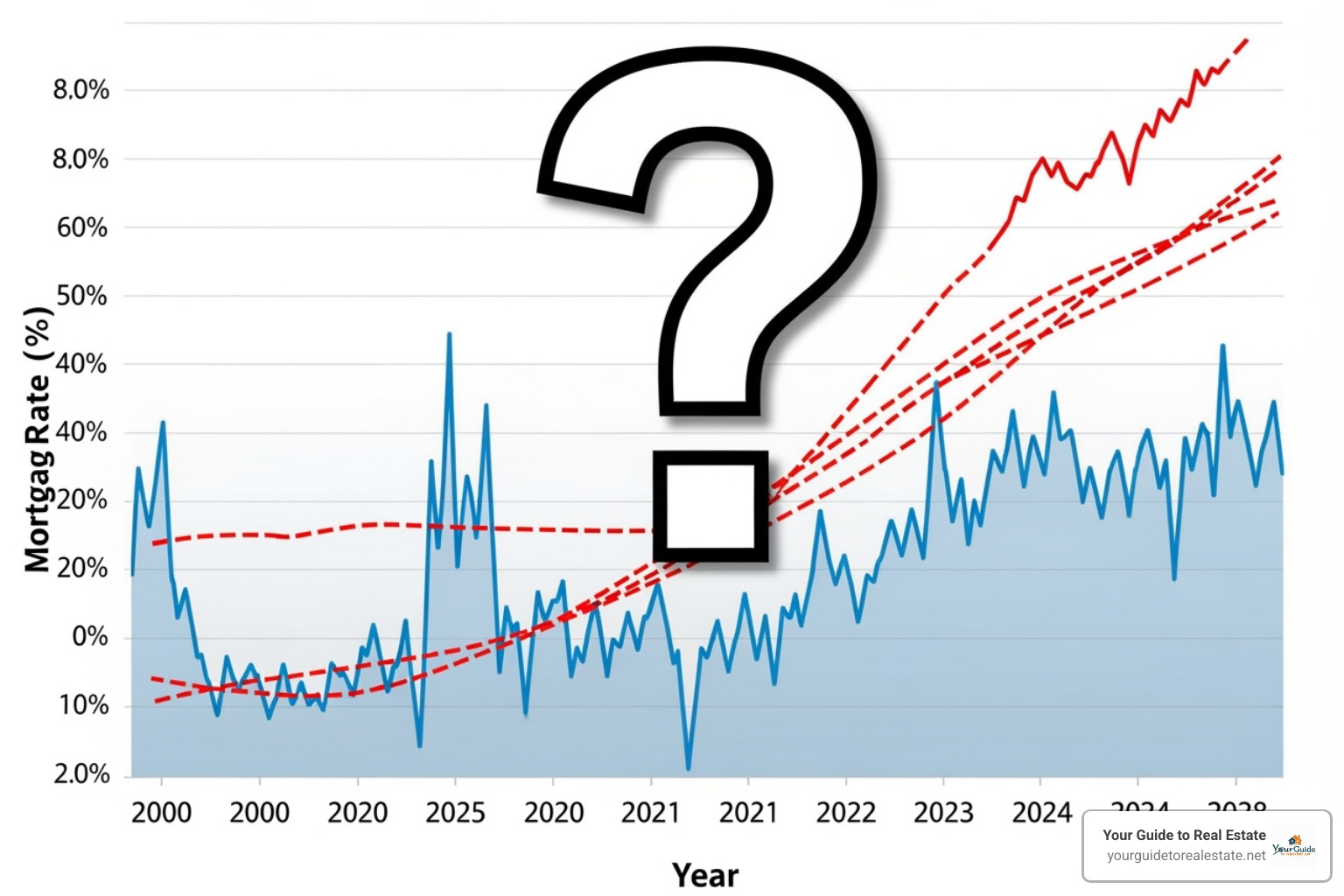
Expert Predictions for 2025 and Beyond
Here’s a summary of 2025 mortgage rate forecasts from leading voices in real estate, including our own analysis:
| Source | 2025 Average Mortgage Rate Prediction | Key Rationale |
|---|---|---|
| Wells Fargo | 6.3% (end of year) | Persistent economic pressures keep rates near this level through 2026 |
| Fannie Mae | 6.2% (Q1), 5.9% (Q4) | Assumes improving inflation and Fed rate cuts |
| Zonda | 5.9% – 6.2% | Rates could spike if economy strengthens |
| Andrew Whatley | 5.75% – 6.00% | Mild recession could push rates down, but not below 5.5% |
| Lisa Sturtevant | Above 6% (new norm) | Rates will stabilize above 6%, the new standard |
| Lawrence Yun (NAR) | Around 6% | 6% is the “new normal”; a return to 3-5% is unlikely |
| Your Guide to Real Estate | 5.9% – 6.5% | Gradual easing as inflation moderates, but a return to pandemic lows is unlikely. |
The striking consensus is that rates above 6% are the new reality. The record-low rates of recent years are now seen as a historical anomaly. This alignment among forecasters suggests we’re entering a period of more predictable, albeit higher, borrowing costs. For a deeper dive, our guide How low could mortgage rates drop in 2025? breaks down the factors that could influence these predictions.
Historical Context: Are Today’s Rates Really That High?
Perspective is key when discussing mortgage rates bad news. If you only know the post-2008 market, today’s 6-7% rates feel shocking. Let’s look at the bigger picture.
The 30-year mortgage rate has averaged 7.72% since 1971. Today’s rates are actually below this average. For perspective, rates hit an eye-watering 18.63% in October 1981.
The ultra-low rates after 2008 and during the pandemic were the outliers. The 3-4% rates were the anomaly, not today’s rates. This context helps reset expectations, even if current rates are painful for your budget.
This historical context is crucial. Recognizing that 6-7% is a return to more typical borrowing costs, not a disaster, can help you make pragmatic choices. For more insights, explore our analysis at 3-4% rates may have been the anomaly and our comprehensive Housing Market Forecast.
Navigating the Market: Strategies for Homebuyers and Owners
Don’t let the constant mortgage rates bad news derail your homeownership goals. You can steer this market by focusing on what you can control.
The key is to make smart decisions now, not wait for perfect conditions. Today’s market has advantages over the pandemic years, like more time to decide and better negotiating power.
Our proven framework centers on personal financial readiness and strategic planning rather than trying to time the market perfectly. Whether you’re a first-time buyer or a seasoned homeowner, there are actionable steps you can take right now. Our comprehensive First-Time Homebuyers Toolkit: Everything You Need to Know Before You Buy walks you through every aspect of this journey.
For Potential Homebuyers: To Buy or to Wait?
Should you buy now or wait for rates to drop? The answer depends more on your personal situation than on interest rates.
We advise clients to “marry the house, date the rate.” If you find the right home that fits your budget, buy it. You can refinance later if rates fall, but you can’t go back in time to buy a home someone else bought.
Timing the market is nearly impossible. Focus on your financial readiness. With stable income, good credit, and savings, you may find today’s market favorable, with fewer bidding wars and more negotiating power.
The most important step is to improve your financial position. Start by:
- Boosting your credit score for better rates.
- Saving for a down payment. While some loans require as little as 3-3.5%, a larger down payment reduces your loan and can eliminate private mortgage insurance (PMI).
- Getting pre-approved. This is crucial to know your budget and show sellers you’re serious.
Don’t stop at one lender. Shopping around for mortgages can save you thousands over the life of the loan. Our guide on How to Shop Mortgage breaks down exactly how to do this effectively.
Finally, spend time with our Mortgage Calculator to understand how different rates and loan amounts affect your monthly payments.
For Current Homeowners: Is Refinancing an Option?
For current homeowners, especially those who bought when rates were in the high 7s, a refinance window may have opened. The key question is whether it makes financial sense for you.
Refinancing can lower payments, shorten loan terms, or provide cash-out equity. A general rule is to consider it when rates are at least 0.50% below your current rate, but this varies by individual situation.
The critical factor is your break-even point: how long it takes for savings to cover refinancing costs (typically 2-5% of the loan). If you plan to move soon, refinancing may not be worthwhile.
Refinancing applications surge when rates dip, showing homeowners are watching their options. If you bought recently at a high rate, know there’s no waiting period for a rate-and-term refinance.
Our Mortgage Refinancing Explained guide covers everything you need to know about this process. We can help you track rate movements and determine whether refinancing aligns with your financial goals.
Frequently Asked Questions about Mortgage Rates
Let’s address the most common questions we hear from homebuyers and homeowners dealing with today’s mortgage rates bad news.
How low could mortgage rates drop in 2025?
While no one knows for sure, most experts predict rates will settle in the 5.9% to 6.2% range in 2025. A mild recession could potentially push them toward 5.75%.
The 3-4% rates seen during the pandemic were an anomaly due to extraordinary stimulus measures and are unlikely to return soon.
The new standard appears to be rates around 6%, which is closer to the historical average. Many people have successfully built wealth buying homes at rates well above 6%.
Should I buy a house before rates drop?
The fear of missing out on lower rates is real, but our advice is to focus on your personal financial readiness, not on timing the market.
If you find a home that fits your needs and budget, buying now can be a smart move. You can always refinance later if rates drop. This “marry the house, date the rate” strategy is a proven path to building wealth.
If you wait for rates to drop, home prices may rise, offsetting any savings. Waiting also means paying rent instead of building your own equity.
Evaluate your job stability, savings, and debt-to-income ratio. If your finances are solid and you plan to stay put for 5-7 years, don’t let rate anxiety sideline you.
What is the ‘lock-in effect’ with mortgage rates?
The ‘lock-in effect’ is a major reason for today’s tight housing inventory. Roughly 85% of homeowners have mortgage rates below 6%, many in the 2-4% range.
These homeowners are reluctant to sell and take on a new mortgage at 6-7%, unless a move is absolutely necessary. This has a domino effect on the market.
With fewer existing homes for sale, buyers have limited options and face more competition. This is why new construction has become so important to fill the inventory gap.
This effect may persist for years, but inventory will slowly return as life changes force moves. Understanding this dynamic helps explain why patience is key for buyers today. It also means that when you find a home you love, you may need to act decisively due to competition for limited properties.
Conclusion: Turning Bad News into a Smart Strategy
Mortgage rates bad news has dominated headlines, but understanding the ‘why’ behind them leads to clarity and smarter decisions.
We’ve learned that bad economic news can sometimes lower rates, the Fed’s actions have wide-ranging effects, and the ultra-low pandemic rates were an exception, not the new rule.
The reality is simple: rates around 6-7% are not historically outrageous, though they feel high compared to recent years. Experts agree that 6% is the new baseline. This isn’t bad news, just a different reality.
Your personal situation is what matters most. If you’re financially ready and find the right home, don’t wait for the ‘perfect’ rate. Remember: marry the house, date the rate. You can always refinance later.
For homeowners, small rate dips might create refinancing opportunities. The key is to run the numbers and know your break-even point.
At Your Guide to Real Estate, we believe knowledge beats anxiety. The market always has challenges, but informed buyers and sellers make better decisions. Our proven framework helps you focus on what you can control: your credit, savings, loan shopping, and financial planning.
Don’t let today’s rate environment paralyze your homeownership dreams. Instead, use this knowledge to make choices that align with your goals and timeline. Whether you’re just starting to explore homebuying or you’re a seasoned owner considering your next move, our comprehensive guide “Understanding Mortgages: A Beginner’s Guide to Home Loans” provides the foundation you need.
The mortgage rates bad news won’t last forever, but your housing needs are real right now. Let’s turn market challenges into personal opportunities – that’s what smart real estate decisions are all about.