
Decoding Your Paycheck: Understanding OASDI Tax
What is OASDI tax – it’s the Old-Age, Survivors, and Disability Insurance tax that funds Social Security benefits. Most workers see this deduction on every paycheck, yet many don’t understand what it means or how it impacts their financial future.
Quick Answer:
- OASDI = Old-Age, Survivors, and Disability Insurance
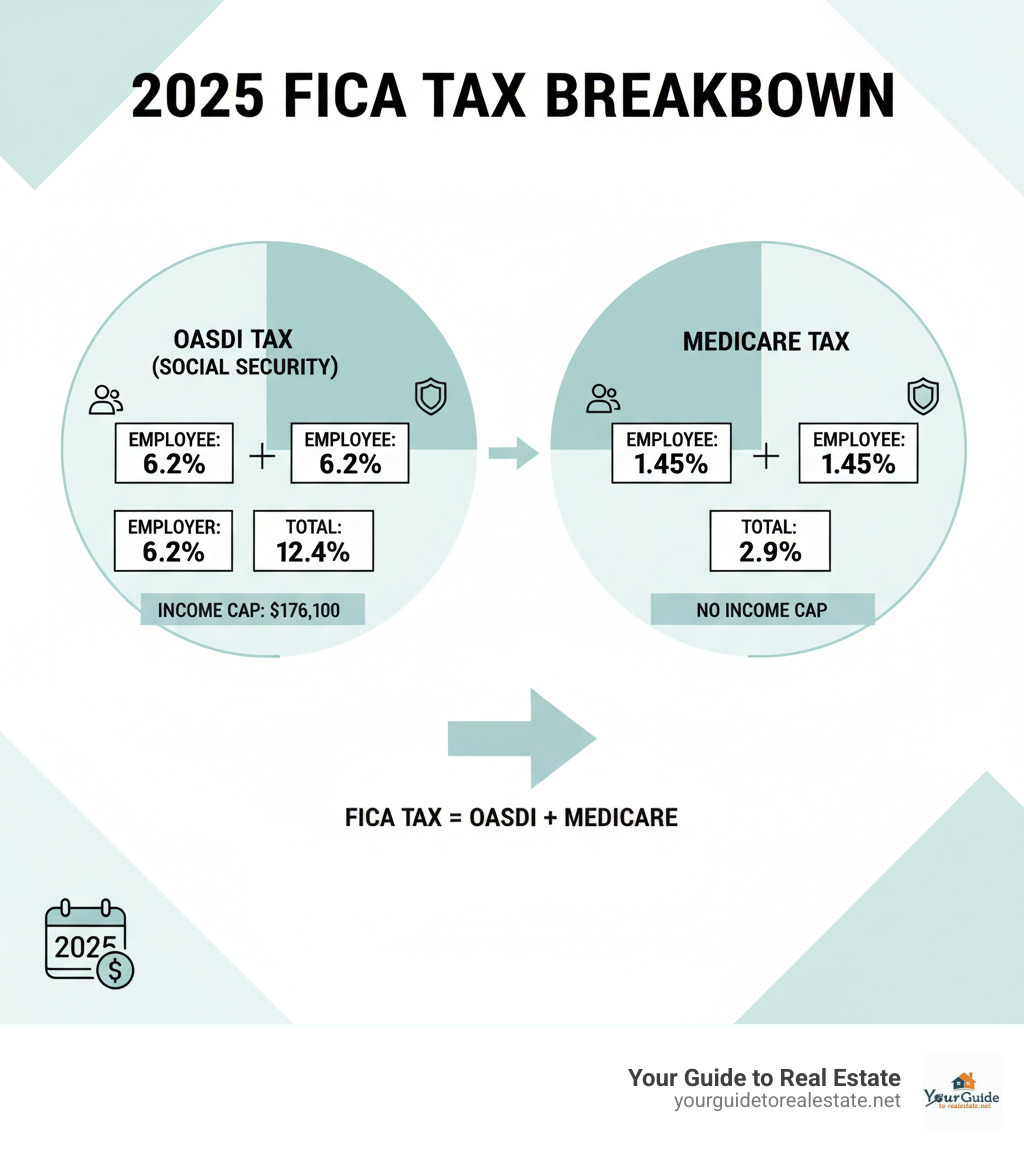
- Tax Rate: 6.2% for employees, 6.2% for employers (12.4% total)
- 2025 Income Limit: $176,100 (no tax on income above this amount)
- Self-Employed Rate: 12.4% of net earnings
- Purpose: Funds Social Security retirement, disability, and survivor benefits
Whether you’re a real estate professional managing variable income or a homebuyer trying to understand your financial picture, OASDI tax affects everyone who works. This tax appears on your pay stub alongside Medicare tax as part of FICA (Federal Insurance Contributions Act) deductions.
The OASDI tax has remained at 6.2% for employees since 1990, but the income subject to this tax increases annually. In 2025, you’ll pay OASDI tax on the first $176,100 of your earnings – an increase from $168,600 in 2024.
For real estate agents and other self-employed individuals, understanding OASDI tax becomes even more critical. You’ll pay the full 12.4% rate on your net self-employment earnings, though you can deduct half of this amount when calculating your income taxes.
What is oasdi tax terms made easy:
- social security fairness act news
- what changes are coming to social security in 2025
- ssdi benefits suspension termination 2025
What is OASDI Tax and How Does It Work?
What is OASDI tax exactly? Think of it as your contribution to one of America’s most important safety nets. This mandatory federal payroll tax funds the Social Security program that’s been protecting workers and families since 1935. Every time you see that OASDI deduction on your paycheck, you’re investing in financial security for your future self and your loved ones.
The system works on a simple principle: you contribute during your working years, and the program provides benefits when you need them most. The Historical Background and Development of Social Security shows how this program has evolved to serve millions of Americans through decades of economic changes.
Here’s what makes OASDI unique: there’s an annual income limit called the taxable maximum. Once your yearly earnings hit this ceiling, you stop paying OASDI tax on any additional income for that year. This limit adjusts annually based on changes in average wages across the country, ensuring the system stays current with economic realities.
What OASDI Stands For and Its Purpose
The letters in OASDI tell the whole story: Old-Age, Survivors, and Disability Insurance. Each part protects you and your family during different life challenges.
Old-Age Insurance is what most people picture when they think about Social Security. It provides monthly retirement benefits to eligible workers, offering steady income during your golden years. In January 2025, the average monthly benefit reached $1,976, helping millions of retirees maintain their independence.
Survivors Insurance steps in during life’s most difficult moments. When a worker passes away, this coverage provides financial support to eligible family members including spouses, children, and dependent parents. It’s like having a life insurance policy that’s automatically built into your work history.
Disability Insurance offers a lifeline when serious health conditions prevent you from working. If you become severely disabled and can’t perform substantial work, this insurance provides monthly benefits to you and your eligible family members. The protection is based on your work history and the severity of your condition.
These three components work together to create a comprehensive safety net. Your contributions today help current beneficiaries while building your own future protection. It’s a system where everyone looks out for everyone else.
OASDI vs. Medicare Tax: Understanding FICA
When you see FICA on your pay stub, you’re looking at two separate taxes bundled together. FICA stands for the Federal Insurance Contributions Act, and it includes both OASDI tax and Medicare tax. While they both come out of your paycheck, they fund completely different programs with different rules.
OASDI tax funds Social Security benefits at a rate of 6.2% for employees in 2025, with employers matching that amount. This tax stops once you earn above $176,100 for the year. Medicare tax, on the other hand, runs at 1.45% for employees (also matched by employers) and applies to every dollar you earn with no income limit.
| Feature | OASDI Tax | Medicare Tax |
|---|---|---|
| Tax Rate (Employee) | 6.2% | 1.45% |
| Tax Rate (Employer) | 6.2% | 1.45% |
| 2025 Income Cap | $176,100 | No limit |
| Purpose | Social Security benefits | Medicare health insurance |
For self-employed individuals, you pay both the employee and employer portions: 12.4% for OASDI and 2.9% for Medicare. High earners also face an additional 0.9% Medicare tax on income above $200,000 (or $250,000 for married couples).
Understanding this difference matters for your financial planning. Once you hit the OASDI income limit, you’ll see more take-home pay for the rest of the year since that 6.2% deduction disappears.
The 2025 OASDI Taxable Maximum
The 2025 OASDI taxable maximum is set at $176,100, up from $168,600 in 2024. This means you’ll pay OASDI tax on the first $176,100 of your earnings, but nothing above that amount.
If you earn exactly $176,100 or more in 2025, you’ll contribute $10,918.20 to OASDI (that’s 6.2% of $176,100), and your employer will match this amount. Earn less than the maximum? You’ll pay OASDI tax on every dollar you make.
This limit isn’t random. It adjusts each year based on the national average wage index, helping the Social Security system keep pace with economic growth and inflation. The Contribution and Benefit Base page shows how this figure has steadily increased over time.

For high earners, reaching this maximum brings a nice surprise: your take-home pay increases for the rest of the year once you stop paying OASDI tax. It’s like getting an automatic raise, though temporary. This income limit also plays a crucial role in calculating your future Social Security benefits, making it important to understand how it affects your long-term financial picture.
OASDI Tax Rates for Different Workers
The amount of OASDI tax you pay depends entirely on how you earn your money. Are you clocking in at a traditional job, or are you hustling as a self-employed real estate agent? The difference isn’t just philosophical – it directly impacts your tax obligations and how much comes out of your pocket each year.
For those working in real estate, this distinction becomes especially important. Many agents work as independent contractors, which changes everything about how they handle what is OASDI tax. Understanding these differences helps you plan better and avoid surprises come tax time. If you’re building your career in real estate, mastering these financial basics is just as crucial as developing your Real Estate Agent Skills.
Tax Rates for Employees and Employers
If you’re a traditional employee – maybe working for a real estate brokerage as staff or in any other W-2 position – the OASDI tax system works like a well-oiled machine behind the scenes.
Your part is simple: you contribute 6.2% of your gross wages up to that annual taxable maximum we talked about earlier. Your employer automatically withholds this amount from each paycheck and sends it straight to the IRS. No fuss, no quarterly payments to remember.
But here’s the beautiful part – you’re not carrying the full load. Your employer kicks in another 6.2% on your behalf, matching your contribution dollar for dollar. This means 12.4% of your wages (up to the taxable maximum) flows into the OASDI program, but you only feel half of that hit to your paycheck.
Let’s make this real with an example. Say you earn $60,000 in a year. You’d pay $3,720 in OASDI tax (that’s 6.2% of $60,000), and your employer would contribute another $3,720. Together, that’s $7,440 building your future Social Security benefits. Not bad for something that happens automatically!
What is the OASDI Tax Rate for Self-Employed Individuals?
Now, if you’re self-employed – like many real estate agents, freelancers, or independent contractors – the game changes completely. Under the Self-Employment Contributions Act (SECA), you become both the employee and the employer in the eyes of the tax system.
This means you pay the full 12.4% OASDI tax rate on your net self-employment earnings. Yes, that’s double what employees see coming out of their paychecks. But before you panic, there’s a silver lining that makes this more manageable.
You can deduct half of your self-employment tax when calculating your income taxes. This deduction reduces your adjusted gross income, which can lower your overall tax burden significantly. It’s the government’s way of recognizing that you’re playing both roles in the employment relationship.
The tricky part about being self-employed is that nobody’s withholding taxes for you. You need to calculate and pay these taxes yourself through quarterly estimated tax payments. Miss these payments or underpay, and you’ll face penalties that nobody wants to deal with.
For detailed guidance on navigating these waters, the IRS provides comprehensive information on Self-Employment Tax (Social Security and Medicare Taxes). If you’re just starting your freelance journey, our Freelancing Tips can help you manage the broader challenges of independent work.
While paying that full 12.4% might sting a bit, you’re building your own Social Security benefits. Every dollar you contribute today helps secure your retirement, disability protection, and survivor benefits for your family. It’s an investment in your future that pays dividends when you need it most.
How OASDI Contributions Shape Your Future Benefits
Here’s something that might surprise you: understanding what is OASDI tax isn’t just about watching money disappear from your paycheck each month. Every dollar you contribute is actually building something much more valuable – your financial safety net for the future. Think of it as planting seeds today that will grow into a steady income stream when you need it most.
Your OASDI contributions throughout your working years directly determine whether you’ll qualify for Social Security benefits and how much you’ll receive. It’s like having a long-term savings account that also provides insurance protection for you and your family. With changes like the Social Security 2025 COLA Increase affecting future payouts, understanding how your contributions work becomes even more important for your overall financial planning.
Earning Social Security Work Credits
The Social Security system operates on a credit-based approach that’s surprisingly straightforward once you understand it. Every time you work and pay OASDI tax, you’re earning “work credits” that open up your future benefits. It’s like collecting stamps in a rewards program, except these stamps determine your retirement security.
In 2025, you earn one work credit for every $1,810 you make in wages or self-employment income. The beauty of this system is that you can earn up to four credits per year, regardless of whether you make $7,240 or $200,000. Once you hit that four-credit maximum, you’re set for the year.
To become eligible for retirement benefits, you need to accumulate 40 work credits over your lifetime. That translates to about 10 years of work – not necessarily consecutive years, just 10 years total where you earned at least four credits annually. For disability or survivor benefits, you might need fewer credits depending on your age when the need arises.

The Social Security Administration keeps track of your credits automatically, creating a permanent record of your working life. You can check your progress anytime by creating an account on their website. For detailed information about how the credit system works, visit the SSA’s guide: How you earn credits.
What is the OASDI Tax Impact on Retirement Planning?
Here’s where OASDI tax gets really interesting from a retirement planning perspective. While your contributions fund the entire Social Security system, your personal benefit amount isn’t simply based on how much total tax you’ve paid over the years. Instead, the Social Security Administration uses a formula that focuses on your 35 highest-earning years to calculate your “average indexed monthly earnings.”
This means that consistently higher earnings throughout your career generally translate to higher Social Security benefits. However, there’s an important reality check here: Social Security was never designed to be your only source of retirement income. The average monthly benefit of $1,976 in January 2025, while certainly helpful, probably won’t cover all your golden years expenses.
Smart retirement planning treats Social Security as one leg of a three-legged stool, alongside personal savings and employer-sponsored retirement plans. For real estate professionals and others with variable income, diversifying your wealth-building strategies becomes even more crucial. Consider exploring opportunities like How to Invest in Real Estate to create additional income streams for retirement.
Want to see what your future Social Security benefits might look like? The SSA offers a free online tool that estimates your benefits based on your actual earnings record: SSA’s online benefit calculator. It’s eye-opening to see how your current contributions translate into future monthly payments, and it can help you make more informed decisions about your overall retirement strategy.
Frequently Asked Questions about OASDI Tax
When you’re looking at your paycheck or planning your finances, questions about what is OASDI tax naturally come up. Whether you’re a real estate professional juggling multiple income streams or someone trying to understand their tax obligations, these are the questions we hear most often.
Are there exemptions from paying OASDI tax?
Here’s the reality: almost everyone who works in the United States pays OASDI tax. It’s part of the social contract that keeps our safety net strong. But there are a few very specific situations where exemptions exist.
Religious exemptions are the most well-known exception. Members of certain religious groups like the Amish or Mennonites can apply for exemption if their faith opposes accepting insurance benefits and they provide for their own community members. But here’s the catch – if you get this exemption, you’re also giving up your right to future Social Security and Medicare benefits. You’ll need to file Application for Exemption From Social Security and Medicare Taxes and Waiver of Benefits to start this process.
Certain non-resident aliens might also be exempt, depending on their visa status and employment type. This usually applies to foreign government employees, some students and researchers, or crew members on foreign ships. The rules here get pretty complex and often involve tax treaties between countries.
If you’re self-employed and earn less than $400 in net earnings for the year, you won’t owe self-employment tax, which includes the OASDI portion.
These exemptions are rare and come with serious trade-offs. For most of us, paying into the system means we’re building our future security.
What happens if I overpay OASDI taxes?
This actually happens more often than you might think, especially if you’re working multiple jobs or have variable income like many real estate agents do.
The most common scenario is when you work for multiple employers during the same year. Let’s say you earn $100,000 from one job and $90,000 from another. Each employer will withhold OASDI tax on your full earnings from them, not knowing about your other income. Since the 2025 limit is $176,100, you should only pay OASDI tax on $176,100 total – but you might end up paying it on the full $190,000.
The good news? You can get that money back. The IRS doesn’t automatically refund overpayments, so you’ll need to claim it when you file your tax return using IRS Schedule 3 (Form 1040). Keep track of your year-to-date earnings from all sources to catch this early, or just make sure to claim your refund come tax time.
Is OASDI the same as Supplemental Security Income (SSI)?
This confusion comes up all the time, and it’s totally understandable since both programs are run by the Social Security Administration. But they’re completely different animals.
OASDI is an insurance program – think of it like a policy you pay premiums on through your payroll taxes. Your benefits are based on how much you’ve paid in and your work history. You earn your way into the system through those work credits we talked about earlier.
SSI is a needs-based program that helps aged, blind, or disabled people who have limited income and resources, regardless of whether they’ve ever worked. It’s funded by general tax revenues, not by the OASDI taxes coming out of your paycheck.
Some people qualify for both programs, but they serve different purposes. You can learn more about SSI specifically at Supplemental Security Income (SSI).
The key difference? OASDI is something you earn through work and contributions. SSI is assistance based on financial need. Both are important parts of our social safety net, but they work in very different ways.
Conclusion: Integrating OASDI into Your Financial Strategy
You’ve made it through the maze of payroll deductions, tax rates, and benefit calculations. Now you know that what is OASDI tax isn’t just another mysterious line on your pay stub – it’s your ticket to future financial security through Social Security benefits.
Think of OASDI as a long-term investment you can’t opt out of, but one that provides real value. Every paycheck, you’re putting money into a system that will be there when you need it most. Whether that’s in retirement, if you become disabled, or to protect your family if something happens to you.
The numbers tell a clear story. As an employee, you pay 6.2% of your earnings up to $176,100 in 2025, with your employer matching that amount. If you’re self-employed like many real estate professionals, you handle the full 12.4% yourself, but you get to deduct half of it on your taxes. Those contributions build your work credits – you need 40 for retirement benefits, which typically means 10 years of work.

Here’s the reality check though – Social Security was designed to be a safety net, not a hammock. The average monthly benefit of $1,976 might cover your basic needs, but it probably won’t fund that dream retirement you’re picturing. That’s where smart financial planning comes in.
Your OASDI contributions are just one piece of your financial puzzle. Building additional income streams, whether through real estate investments or other savings vehicles, gives you the freedom to truly enjoy your golden years. The beauty of understanding how OASDI works is that you can plan around it, knowing roughly what to expect from Social Security and how much more you’ll need to save.
For those rare cases where you might be exempt from OASDI tax – like certain religious groups or specific visa holders – remember that exemption means giving up future benefits too. For most of us, those paycheck deductions are actually a pretty good deal when you consider the protection they provide.
At Your Guide to Real Estate, we believe knowledge is power, especially when it comes to your financial future. Understanding your OASDI tax is just the beginning. For more guidance on home financing and financial planning, explore our Understanding Mortgages: A Beginner’s Guide to Home Loans.
Your financial well-being matters, and we’re here to help you steer every step of building lasting wealth and security.