

Understanding the Key Differences Between Operating Income and Net Income
When analyzing business profitability, operating income vs net income represents one of the most fundamental comparisons investors and business owners need to understand. These two financial metrics tell very different stories about a company’s health and performance.
Quick Answer:
- Operating Income = Revenue from core business operations minus operating expenses (excludes interest, taxes, and non-operating items)
- Net Income = Operating income plus/minus ALL income and expenses, including interest, taxes, and one-time events
- Key Difference = Operating income shows how profitable your core business is, while net income shows your final bottom-line profit after everything
Operating income strips away the noise of financing decisions, tax strategies, and unusual events to reveal how well a business performs its primary activities. It’s like looking at a restaurant’s profit from just selling food – before considering loan payments or tax bills.
Net income, on the other hand, is the complete financial picture. It’s what’s left after everything is accounted for – the true bottom line that determines what shareholders actually earn and what cash flows to business owners.
Understanding both metrics is crucial for real estate investors and business owners. A company could have strong operating income but negative net income due to high debt payments. Conversely, a business might show low operating income but high net income from selling assets.
The gap between these numbers reveals important insights about operational efficiency, financial leverage, and overall business sustainability that every investor should understand.
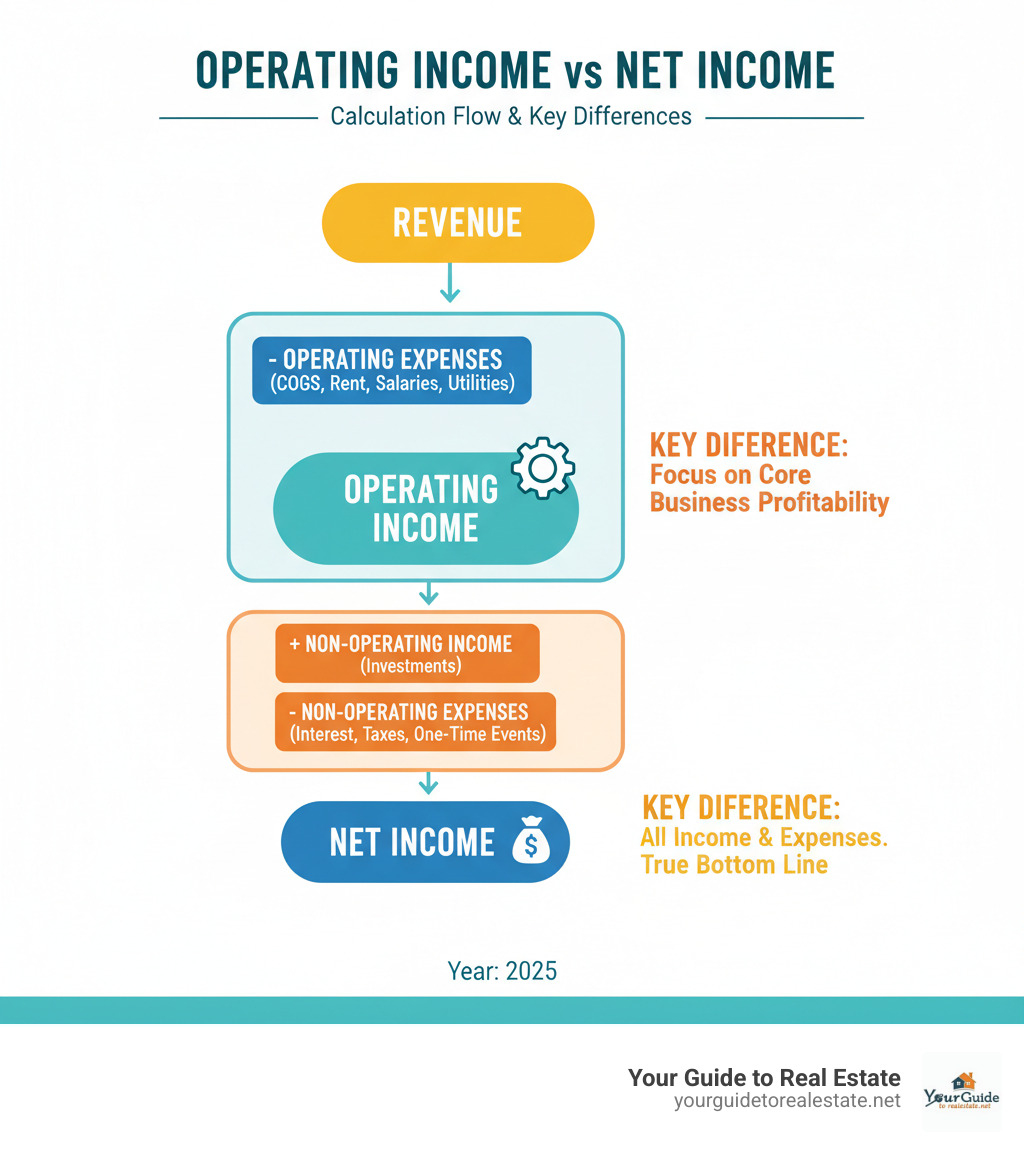
Important operating income vs net income terms:
Introduction to Business Profitability
[IMAGE] of an income statement highlighting operating income and net income; Profitability metrics; Core business health; Overall financial picture; Income statement explained; What Is an Income Statement?; [INFOGRAPHIC] showing the flow from Revenue down to Net Income
Think of analyzing a business like getting a health checkup – you wouldn’t rely on just your blood pressure to understand your overall wellness, right? The same goes for understanding business profitability. You need multiple metrics to paint the complete picture.
When we dive into operating income vs net income, we’re looking at two of the most telling indicators of how well a business is really doing. These numbers live on something called an income statement, which is basically a financial report card that shows how much money came in and how much went out over a specific period.
The income statement (sometimes called a profit and loss statement) is like a detailed story of a company’s financial journey. It starts with revenue at the top – all the money flowing in from sales. Then it walks you through various expenses until you reach the final number at the bottom. This journey reveals crucial insights about both the core business health and the overall financial picture.
Here’s what makes this so important for real estate investors and anyone looking at businesses: profitability metrics tell different stories depending on where you look. Operating income shows you how well the core business operations are performing – think of it as the engine of the company. Net income, on the other hand, gives you the complete financial picture after everything is accounted for.
Understanding these differences is essential whether you’re evaluating a real estate investment trust, analyzing a property management company, or simply trying to make sense of any business’s financial health. The U.S. Securities and Exchange Commission provides excellent foundational information in their guide: What Is an Income Statement?
At Your Guide to Real Estate, we believe that mastering these financial fundamentals gives you the confidence to make informed decisions. Once you understand how money flows from revenue down to net income, you’ll have a powerful framework for evaluating any investment opportunity that comes your way.
[INFOGRAPHIC] showing the flow from Revenue down to Net Income
What is Operating Income?
When you’re looking at a business – whether it’s a property management company or your favorite local restaurant – operating income is like checking how well they do their main job. It’s the money left over after paying for all the day-to-day costs of running their core business, but before worrying about loan payments or taxes.
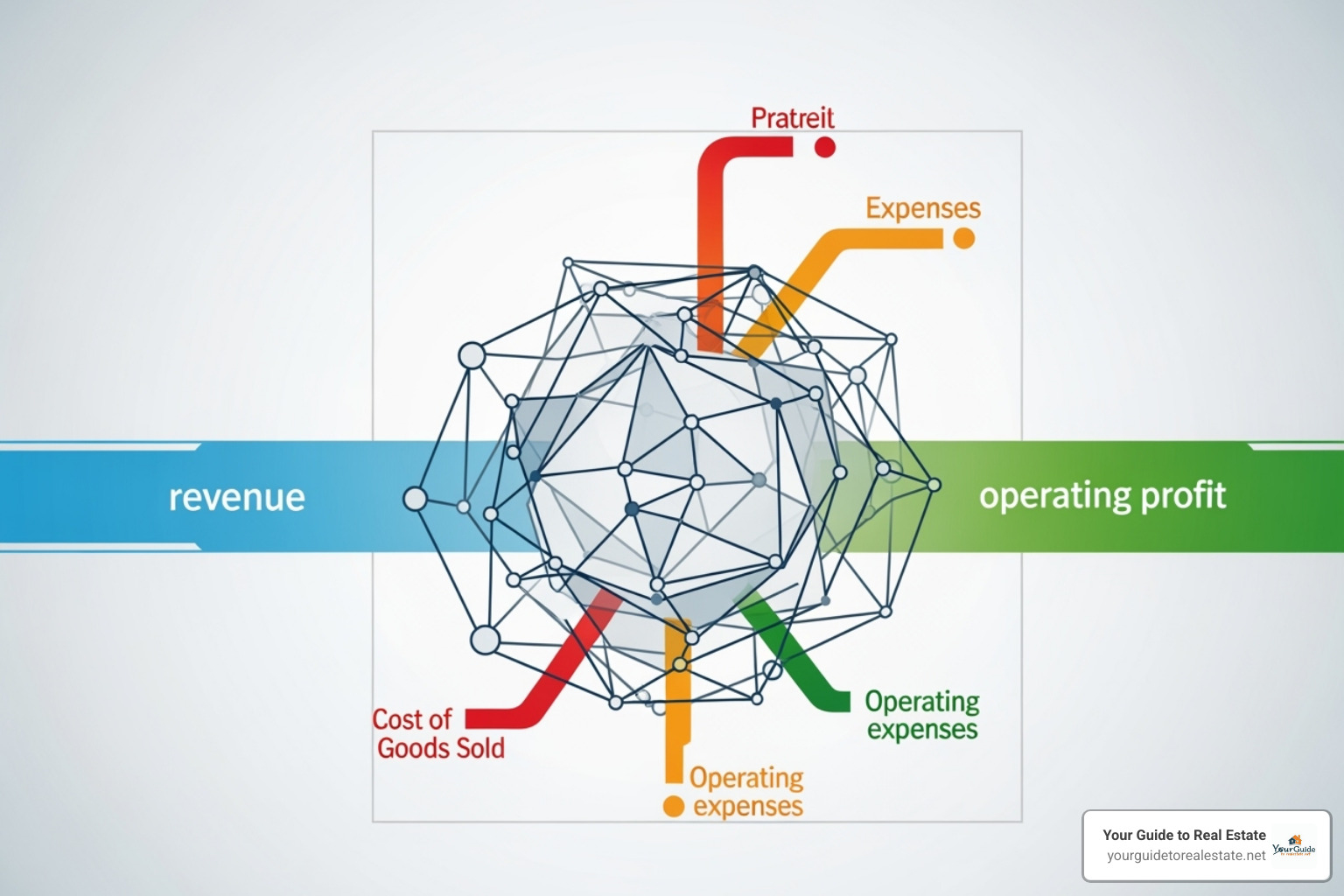
Think of it this way: if you owned a real estate brokerage, your operating income would show how much profit you made from helping people buy and sell homes – after paying your agents, office rent, and marketing costs – but before considering the interest on your business loan or what you owe in taxes.
Operating income is often called operating profit or earnings from operations, and it’s a pure gauge of how efficiently a company runs its main business. This focus on core operations makes it incredibly valuable when comparing the operating income vs net income of different companies.
Operating expenses are the costs that get subtracted to reach operating income. These include your Cost of Goods Sold (COGS) – the direct costs of whatever you’re selling. For a real estate developer, that might be land and construction materials. Then there’s Selling, General, and Administrative expenses (SG&A) like staff salaries, office utilities, and marketing. Don’t forget depreciation and amortization – those accounting entries that spread the cost of big purchases like office equipment over several years.
What operating income doesn’t include is equally important. It excludes interest expense from loans, taxes owed to the government, and any non-operating items like selling off old equipment or investment gains. These exclusions help us see how the core business performs without the noise of financing decisions or one-time events.
For more detailed insights, check out our comprehensive resource: What is Operating Income? A Comprehensive Guide.
How to Calculate Operating Income
The operating income formula is refreshingly straightforward once you break it down. You start with your company’s revenue and subtract the costs directly related to running your main business.
Here’s the basic formula: Operating Income = Revenue – Cost of Goods Sold (COGS) – Operating expenses
You can also think of it as: Operating Income = Gross Profit – Operating Expenses
Let’s walk through what each piece means. Revenue is all the money coming in from your main business activities. Cost of Goods Sold covers the direct costs of producing whatever you’re selling. Gross profit is what’s left when you subtract COGS from revenue – it shows how much you make before considering overhead costs.
Example calculation time: Picture a small real estate brokerage that earned $500,000 in commissions last year. Their direct costs (agent splits, transaction fees) totaled $150,000, giving them a gross profit of $350,000.
Now for their operating expenses: $80,000 for administrative salaries, $20,000 for office rent, $5,000 for utilities, $15,000 for marketing, and $2,000 in equipment depreciation. That’s $122,000 total.
Their operating income calculation: $350,000 (gross profit) – $122,000 (operating expenses) = $228,000
This brokerage generated $228,000 from their core business before any loan payments or taxes. That’s a solid foundation for understanding their operational health.
Why Operating Income is Important
Operating income matters because it cuts through the financial complexity to show how well a business does what it’s supposed to do. When you’re measuring operational efficiency, this metric tells you if management is keeping costs under control while generating good revenue from their main activities.
It’s also a fantastic gauge of management effectiveness. Are the leaders making smart decisions about staffing, marketing, and operations? Operating income reveals whether their strategies are actually working in the real world.
For core business viability, think about a real estate development project. Strong operating income means the actual work – building and selling homes – is profitable, regardless of how the project was financed. This helps you determine if the underlying business model makes sense.
Investor analysis becomes much clearer when you focus on operating income. You can compare two property management companies and see which one is genuinely better at managing properties, even if one has more debt than the other. The operating income vs net income comparison becomes especially valuable here – a company might have lower net income due to high loan payments, but strong operating income shows the core business is healthy.
When comparing competitors, operating income levels the playing field. Different companies might have wildly different debt structures or tax situations, but operating income strips all that away to show pure operational performance. It’s like comparing two athletes’ raw talent before considering their different training budgets or equipment.
At Your Guide to Real Estate, we know that understanding these fundamentals helps you make smarter investment decisions and evaluate opportunities with confidence.
What is Net Income?
If operating income shows us how well a business handles its day-to-day operations, net income reveals the complete story. Think of it as the final chapter in a company’s financial book – after all the plot twists, surprises, and unexpected expenses have played out.
Net income is famously called “the bottom line” because it literally appears at the bottom of the income statement. It’s the ultimate answer to the question: “After everything is said and done, how much money did this business actually make?”
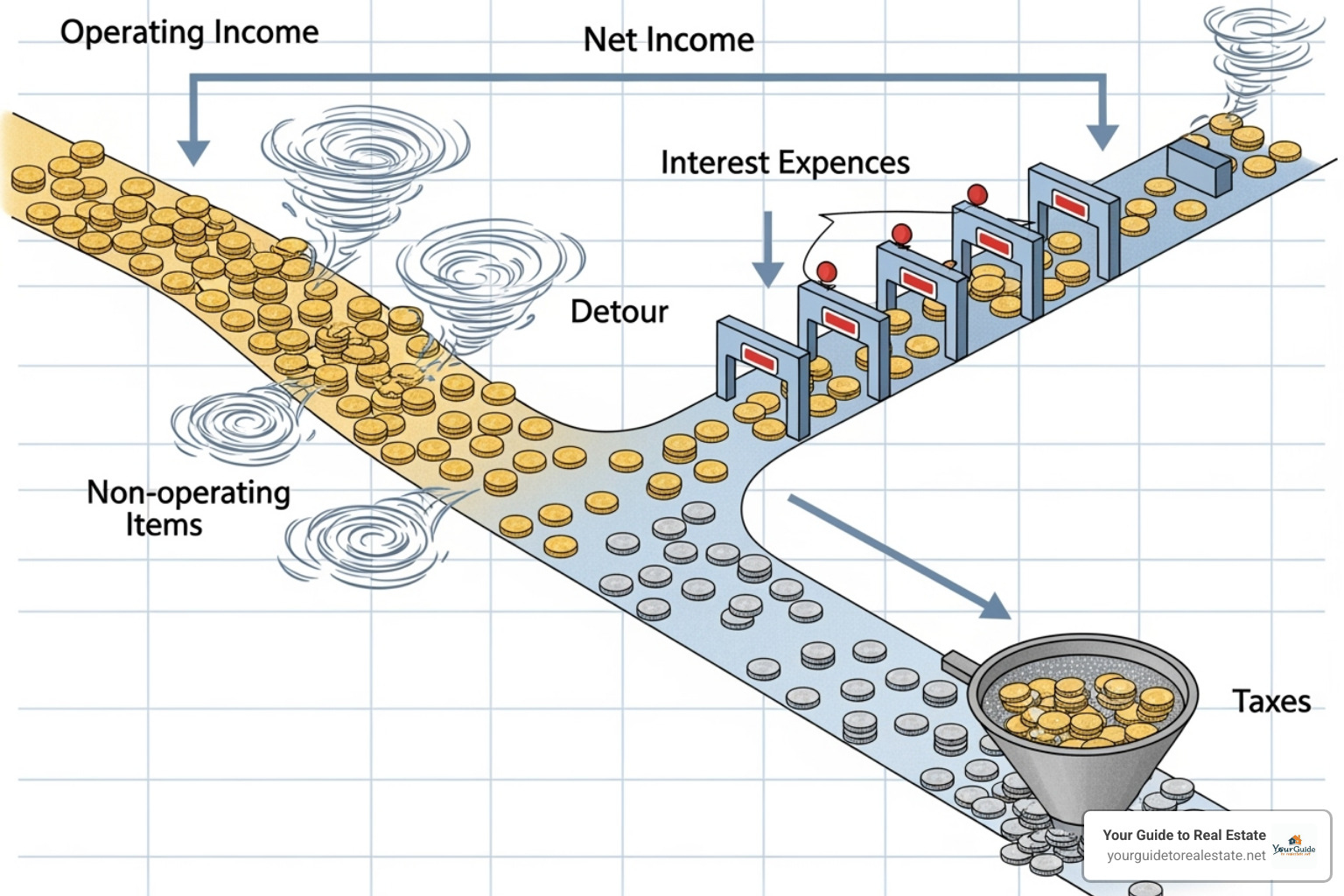
While operating income focuses purely on core business activities, net income takes a much broader view. It starts with operating income and then adds or subtracts everything else that affects the company’s financial position.
This includes non-operating items that might surprise you. Maybe the company earned interest on money sitting in the bank, or perhaps they sold an old office building for a profit. On the flip side, they might have paid hefty interest expenses on business loans or faced unexpected legal costs.
Then there’s the inevitable: taxes. Uncle Sam always wants his share, and income taxes can significantly impact what’s left over for business owners.
The beauty (and sometimes the challenge) of understanding operating income vs net income lies in recognizing that a company might excel at its core business but struggle with financial management, or vice versa. For a comprehensive deep-dive into this crucial metric, check out our resource: Understanding Net Income: A Complete Guide.
How to Calculate Net Income
Calculating net income is like following a recipe – you start with your main ingredient (operating income) and then add all the other flavors that make up the final dish.
The formula is straightforward:
Net Income = Operating Income + Non-Operating Income – Non-Operating Expenses – Interest Expense – Taxes
Let’s continue with our real estate brokerage example. We calculated their operating income at $228,000. Now we need to account for everything else that happened during the year.
Our brokerage had some additional financial activity:
- They earned $5,000 in interest from their business savings account
- They paid $10,000 for a one-time legal settlement (a non-operating expense)
- Their business loan cost them $12,000 in interest payments
- They owed $30,000 in income taxes
Plugging these numbers into our formula:
Net Income = $228,000 + $5,000 – $10,000 – $12,000 – $30,000 = $181,000
So while this brokerage generated $228,000 from their core business operations, their final profit after all expenses was $181,000. That’s the money available to the owners – their true reward for running the business.
Why Net Income is Important
Net income isn’t just another number on a financial statement – it’s the metric that determines whether a business truly succeeds or fails. Here’s why it matters so much:
Net income represents the final profit that belongs to the business owners. It’s what’s left after every bill is paid, every obligation is met, and every expense is covered. This is the money that can go into the owners’ pockets or back into growing the business.
For shareholder value, net income directly impacts what investors care about most. In publicly traded companies, it drives earnings per share, which often moves stock prices. For private real estate investors, consistent net income signals a healthy, valuable investment.
Dividend decisions hinge entirely on net income. A real estate investment trust (REIT) can only distribute what it actually earns after all expenses. Strong net income means happy investors receiving regular distributions.
The relationship between net income and business sustainability is crucial. Companies need profits to reinvest in growth, upgrade equipment, or expand into new markets. Without healthy net income, businesses struggle to fund their future. These profits often become retained earnings – money kept in the business for future opportunities. Learn more about managing these funds effectively: Retained Earnings Formula: A Complete Guide.
Finally, lenders pay close attention to net income when evaluating loan applications. A strong bottom line demonstrates that a business can handle its financial obligations, making it easier to secure financing for expansion or improvements.
Understanding the difference in operating income vs net income helps you see both the operational strength of a business and its overall financial health – two pieces of information that together paint the complete picture.
Operating Income vs Net Income: A Direct Comparison
When we examine operating income vs net income side by side, it’s like comparing a car’s engine performance to its overall trip efficiency. Both tell important stories, but from completely different angles. Understanding how these metrics differ gives you the complete picture of any business’s financial health.
Let’s break down the key differences in a way that makes sense:
| Feature | Operating Income | Net Income |
|---|---|---|
| Scope | Core business activities only | All business activities, including core and non-core |
| Included Expenses | COGS, SG&A, Depreciation, Amortization (Operating Expenses) | All expenses: Operating Expenses + Non-Operating Expenses + Interest + Taxes |
| Excluded Items | Interest, Taxes, Non-Operating Income/Expenses | None (it’s the final bottom line) |
| Purpose | Measures operational efficiency and core viability | Measures overall profitability and shareholder earnings |
| Focus | How well the “engine” of the business runs | How much money is ultimately left after everything |
Think of it this way: operating income shows you how profitable the core business is – like asking “How good is this restaurant at actually making and serving food?” Net income asks the bigger question: “After paying the rent, loan payments, taxes, and everything else, how much money does the restaurant owner actually take home?”
The gap between these numbers tells a fascinating story. Take Macy’s department stores as a perfect example. In their 2024 Annual Report, they reported some eye-opening numbers:
- Total Revenue: $23.0 billion
- Operating Income: $909 million
- Net Income: $582 million
Notice that massive $327 million drop from operating income to net income? That’s the real world hitting hard – interest payments, taxes, and other financial realities that every business faces. Macy’s core retail operations were clearly profitable, but those “other expenses” took a significant bite out of what shareholders actually received.
Key Differences in What They Measure
The beauty of understanding operating income vs net income lies in recognizing what each metric reveals about a company’s strengths and challenges.
Operating income is your pure operational efficiency gauge. It strips away all the financial engineering, tax strategies, and one-time events to ask one simple question: “Is this business good at what it does?” For a property management company, operating income shows whether they’re efficiently collecting rent and maintaining properties. For a home builder, it reveals if they can construct and sell homes profitably.
Net income takes the gloves off and shows you reality. It includes the debt impact – those monthly loan payments that can make or break a business. A real estate developer might have fantastic operating income, but if they’re drowning in construction loan interest, their net income tells the true story.
Tax strategies also play a huge role in this difference. Some companies are tax-efficient wizards, while others face heavy tax burdens. Operating income doesn’t care about taxes, but net income shows you exactly how much Uncle Sam is taking.
Then there are one-time events – the curveballs that life throws at every business. Maybe a company sold an old building for a huge profit, or perhaps they had to pay a large legal settlement. These events don’t affect operating income, but they can dramatically swing net income up or down.
Positive Operating Income, Negative Net Income: How is it Possible?
Here’s where things get really interesting – and it happens more often than you might think. A company can be absolutely crushing it operationally while still losing money overall. It’s like being an amazing chef whose restaurant fails because the rent is too high.

High interest payments are the biggest culprit. When a business takes on substantial debt, those monthly interest payments come due regardless of how well operations are going. This is especially common in real estate, where properties are typically financed with significant mortgages.
Large tax burdens can also flip profitable operations into net losses. Sometimes companies lose valuable tax breaks or face unexpected tax bills that wipe out their operational gains.
One-time losses provide another path to this scenario. A major lawsuit settlement, equipment write-offs, or restructuring costs can all push a company from positive operating income into negative net income territory.
Let’s look at a real estate example that shows this perfectly. Imagine a savvy real estate investor who owns a beautiful apartment complex. The property generates excellent rental income, and after paying for maintenance, property management, utilities, and all operating expenses, she has a positive operating income of $1,000,000. Her core business is rock solid.
But here’s the twist – she financed this property with a large construction loan that requires $1,200,000 in annual interest payments. Suddenly, her financial picture looks very different:
- Operating Income: +$1,000,000 (Great job running the property!)
- Interest Expense: -$1,200,000 (Ouch, that’s expensive financing)
- Net Income: -$200,000 (Despite operational success, she’s losing money overall)
This scenario perfectly illustrates why both metrics matter. The positive operating income tells us the property itself is a good investment – it’s generating solid profits from its core function. The negative net income warns us that the financing structure might be unsustainable.
For investors, this insight is golden. It helps you separate operational problems from financial structure problems, which require completely different solutions.
Applying These Metrics to Real Estate Investing
When you’re diving into real estate investing, understanding operating income vs net income becomes incredibly practical. These aren’t just academic concepts – they’re the tools that help you determine whether a property will actually put money in your pocket or drain your bank account.
In the real estate world, we have our own version of operating income called Net Operating Income (NOI). Think of NOI as your property’s report card for its day-to-day performance. It shows you exactly how much money your property generates from rent after paying all the bills to keep it running – things like property management fees, insurance, utilities, repairs, maintenance, and property taxes.
The key difference? NOI deliberately ignores your mortgage payments. This gives you a clear picture of how profitable the property itself is, regardless of how you chose to finance it. It’s like asking, “If I owned this building free and clear, how much would it earn me?”
Here’s where mortgage interest impact becomes crucial. Your property might have fantastic NOI, but once you subtract those monthly mortgage payments, your actual cash flow could tell a very different story. This is exactly what happened to many investors during the high-interest periods – properties that looked great on paper suddenly became cash flow negative when financing costs soared.
Property taxes typically get included in your operating expenses when calculating NOI, but mortgage interest doesn’t. This distinction matters because it helps you separate the property’s performance from your financing decisions.
Don’t forget about capital expenditures either. These are the big-ticket items that don’t happen every month but will eventually need your attention – new roofs, HVAC systems, flooring replacements. While they don’t directly impact your NOI calculation, they absolutely affect your long-term profitability and should factor into your investment analysis.
Evaluating a rental property’s health requires looking at both sides of this equation. A property with strong NOI shows you’ve got a solid asset. But if the cash flow after financing is weak, you might need to reconsider your loan terms, increase your down payment, or negotiate a better purchase price.
Key metrics every property investor should track include Gross Rental Income (your total potential rent), Net Operating Income (after operating expenses), Cash Flow Before Tax (NOI minus debt service), Cash-on-Cash Return (your annual return on invested cash), and Capitalization Rate (NOI divided by property value for comparing investments).
Using operating income vs net income for property analysis
The beauty of understanding operating income vs net income in real estate lies in how it guides your decision-making process. These metrics work together to paint a complete financial picture.
Assessing a property’s day-to-day profitability starts with NOI. When you calculate this number, you’re essentially asking: “Can this property cover its own expenses and still generate profit?” If the NOI is strong, you know the fundamentals are sound. The rent covers the costs, and there’s money left over. If NOI is weak, you’ve got an operational problem – either rents are too low, expenses are too high, or both.
Understanding cash flow after financing is where reality hits. This is your “net income equivalent” – what actually lands in your bank account after the mortgage company gets paid. A property might have impressive NOI, but if you’re carrying a large mortgage with high interest rates, your actual cash flow could be minimal or even negative.
This happened to a client of ours who fell in love with a duplex showing $2,000 monthly NOI. Looked great until we factored in the $1,800 monthly mortgage payment. Suddenly, that impressive operating income translated to just $200 monthly cash flow – before taxes. The property was operationally sound, but the financing structure made it a poor investment.
Making investment decisions becomes much clearer when you analyze both metrics. Strong NOI with weak cash flow after financing? That’s typically a financing problem, not a property problem. You might negotiate a lower purchase price, increase your down payment, or shop for better loan terms.
Comparing investment properties requires looking at both numbers too. Property A might show higher NOI but also carry higher debt service, resulting in lower net cash flow than Property B with slightly lower NOI but minimal debt. At Your Guide to Real Estate, our proven framework helps you weigh these factors systematically, ensuring you make decisions based on complete financial pictures rather than just the flashy numbers.
The bottom line? NOI tells you if you’ve got a good property. Cash flow after financing tells you if you’ve got a good investment. You need both to succeed in real estate.
Frequently Asked Questions
When you’re diving into operating income vs net income, certain questions naturally come up. We hear these all the time from real estate investors and business owners who want to make sure they truly understand these crucial metrics. Let’s clear up some of the most common confusion points.
Are operating income and EBIT the same thing?
This question comes up constantly, and honestly, it’s a smart one to ask! The short answer is: they’re usually the same, but not always.
EBIT stands for Earnings Before Interest and Taxes. Just like operating income, EBIT excludes interest payments and tax expenses from its calculation. So far, so good – they sound identical.
Here’s where it gets interesting though. Operating income is very strict about only including income and expenses from your core business operations. It won’t include things like investment income, gains from selling old equipment, or other non-operating activities.
EBIT is a bit more flexible. Some companies include non-operating income (like interest earned on cash reserves or gains from asset sales) in their EBIT calculation, even though these aren’t part of their main business.
For most companies, especially those without significant investment activities, operating income and EBIT will be identical numbers. But if you’re analyzing a company with substantial non-operating income, you might see a difference between the two.
The key takeaway? Always check how a company defines its EBIT calculation to avoid any surprises in your analysis.
What is the relationship between gross profit, operating income, and net income?
Think of these three metrics as stepping stones down a waterfall – each one takes you deeper into the company’s true profitability story.
Gross Profit is your starting point. It’s simply:
Gross Profit = Revenue – Cost of Goods Sold (COGS)
This tells you whether the company can sell its products or services for more than it costs to make them. For a real estate developer, this would be the sales price of homes minus the direct construction costs.
Operating Income takes the next step down:
Operating Income = Gross Profit – Operating Expenses
Now we’re subtracting all the overhead costs – salaries, rent, marketing, utilities, and everything else needed to run the business day-to-day. This shows whether the entire operation is profitable, not just the products themselves.
Net Income is the final destination:
Net Income = Operating Income + Non-Operating Income – Non-Operating Expenses – Interest – Taxes
This is what’s actually left after every single expense, gain, and obligation. It’s the money that truly belongs to the owners.
Here’s a simple way to think about it: Gross profit asks “Are we pricing our products right?” Operating income asks “Is our business model working?” Net income asks “How much money do we actually get to keep?”
Which metric is more important for investors?
Ah, the million-dollar question! And like most important questions in finance, the answer is: it depends on what you’re trying to figure out.
From an analyst perspective, many seasoned investors actually prefer operating income for evaluating a company’s fundamental strength. Why? Because it shows you how well the core business performs without getting distracted by financing decisions, tax strategies, or one-time events. It’s like judging a restaurant based purely on how good the food is, not whether they got a great deal on their lease.
For core health assessment, operating income (or NOI in real estate) is incredibly valuable. If this number is strong and growing consistently, you know the underlying business model works. The company makes money from what it’s supposed to be doing.
But you absolutely cannot ignore the bottom line. Net income tells you what shareholders actually receive and what’s available for future growth or dividends. A company might have fantastic operating income, but if it’s drowning in debt payments, the net income will tell that story.
The smart approach? Use both metrics together and consider the industry context. A manufacturing company might naturally have different patterns than a tech company or a real estate investment trust.
If operating income is healthy but net income is poor, you’re looking at a financing or tax issue, not a business problem. If both are struggling, that points to deeper operational challenges that need addressing.
At Your Guide to Real Estate, we always encourage looking at the complete financial picture. Just like you wouldn’t buy a house based on only the kitchen or only the price, you shouldn’t evaluate an investment based on just one metric.
Conclusion: Getting a Complete Financial Picture
Understanding operating income vs net income isn’t just about memorizing financial formulas – it’s about gaining the insight to see through the numbers and understand what’s really happening with a business. Think of these metrics as your financial detective tools, each revealing different clues about a company’s true health and potential.
Operating income shows you the heart of the business. It strips away all the noise – the debt payments, tax strategies, and one-time windfalls – to reveal how well a company does what it’s supposed to do. When you see strong, consistent operating income, you’re looking at a business that knows how to generate profit from its core activities.
Net income tells the complete story. It’s the final chapter that includes every twist and turn – the interest payments on that ambitious expansion loan, the tax bill that came due, or the unexpected gain from selling an old building. This is what actually lands in the bank account at the end of the day.
For real estate investors, this distinction becomes even more powerful. A property’s Net Operating Income (NOI) might look fantastic on paper, showing strong rental income and well-controlled operating expenses. But once you factor in the mortgage payments, that attractive NOI could translate to minimal monthly cash flow – or worse, negative cash flow that requires you to feed money into the property each month.
The magic happens when you analyze both metrics together. The gap between them tells a story. A wide gap might reveal heavy debt loads or significant tax burdens. A narrow gap could indicate conservative financing or efficient tax management. Analyzing trends over time becomes crucial – are both metrics growing together, or is one lagging behind?
Context is everything in financial analysis. A tech startup might show negative net income for years while building market share, but if operating income is steadily improving, that’s a positive sign. A mature real estate investment might show modest operating income but strong net income due to low debt and tax advantages.
At Your Guide to Real Estate, we believe in making informed financial decisions through our proven framework of comprehensive analysis. We never recommend relying on just one number or making snap judgments. Instead, we guide you through the complete financial picture, helping you understand not just what the numbers say, but what they mean for your specific situation.
Whether you’re evaluating your first rental property or your tenth, understanding these fundamental concepts gives you the confidence to see beyond surface-level profits. You’ll know when a deal looks good on paper but might struggle in reality, and when a seemingly modest investment could be a hidden gem.
The journey to financial success in real estate starts with understanding the basics, and these profitability metrics are foundational building blocks. As you continue developing your investment knowledge, every great investor started by mastering these core concepts. For those ready to dive deeper into property financing, our comprehensive resource Understanding Mortgages: A Beginner’s Guide to Home Loans provides the next level of insight for your real estate journey.