
The Global Rate Rollercoaster
Will interest rates go down? The short answer is yes, but the path forward is complicated. Here’s what you need to know:
Current Status:
- US Federal Reserve: Cut rates to 4.00%-4.25% range, projects 2 more cuts in 2025, one in 2026
- Bank of Canada: Holding at 2.75% after cutting 175 basis points in 2024
- Market Expectations: Financial markets price in at least 2 US rate cuts by end of 2025
Key Timeline:
- 2025: Most experts predict gradual rate declines
- Canada: Big 6 banks forecast rates could drop to 2.25% by year-end
- US: Fed officials see rates falling by full percentage point through 2026
If you’re a homeowner facing mortgage renewal or thinking about buying, you’re probably feeling whipsawed by conflicting signals. One day you hear rates are dropping, the next day mortgage rates actually go up despite central bank cuts.
The reality is that interest rates are influenced by far more than just central bank decisions. Bond markets, inflation fears, and economic uncertainty all play major roles. As one market analyst put it, “Bond traders saw the Fed’s rate cut as an opportunity to ‘sell the news'” – meaning they pushed longer-term rates higher even as the Fed cut short-term rates.
For real estate markets, this creates a complex puzzle. In Canada, about 60% of all outstanding mortgages are due for renewal within the next two years, creating massive pressure on household budgets. In the US, mortgage rates have been sliding modestly lower based on expectations of future Fed cuts, but they don’t always move in lockstep with Fed policy.
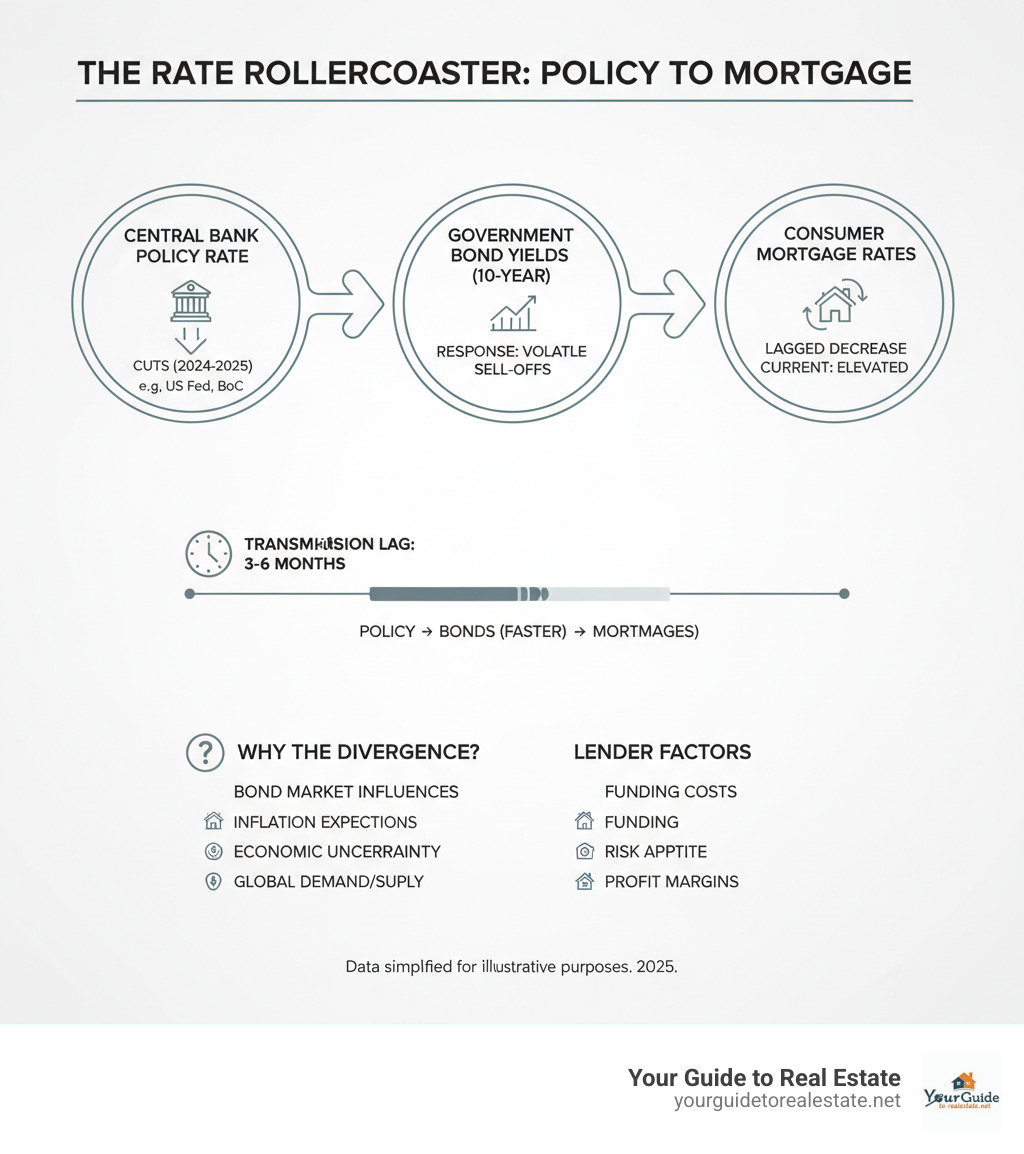
Will interest rates go down terms at a glance:
Will Interest Rates Go Down? A Look at US and Canadian Forecasts
The big question everyone’s asking – will interest rates go down – has a surprisingly nuanced answer. While both the US Federal Reserve and Bank of Canada are signaling lower rates ahead, the journey isn’t as straightforward as you might expect.
Think of central banks as the captains of massive ships. They can steer the direction, but it takes time for those changes to ripple through the entire financial system. And sometimes, the waters get choppy in unexpected ways.
The U.S. Federal Reserve’s Cautious Easing
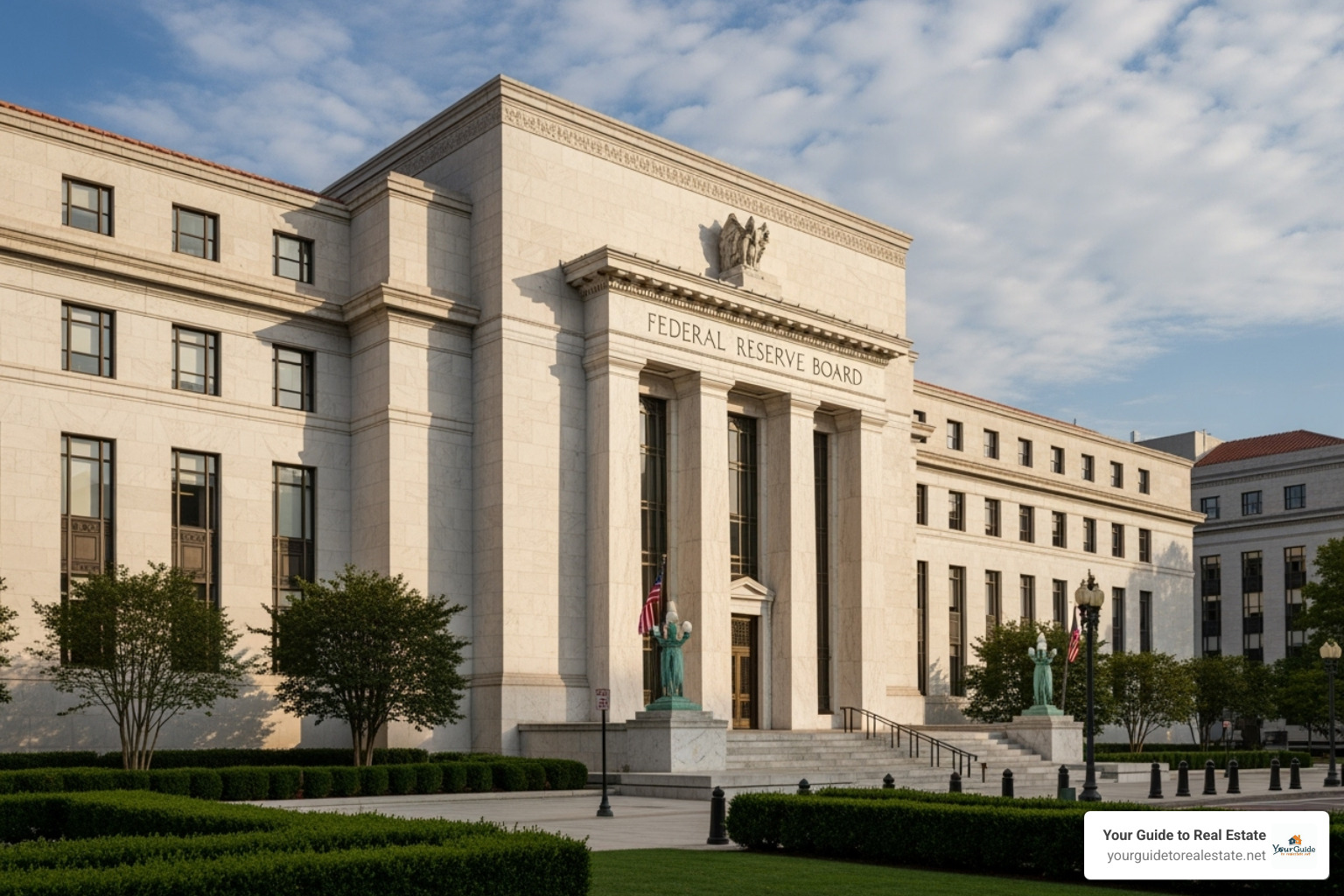
The Federal Reserve has been walking a tightrope lately. After raising rates to a 23-year high to fight inflation, they’ve started cutting again. Their most recent move brought the federal funds rate down to a range of 4% to 4.25%.
But here’s where it gets interesting – in January, the Fed hit the pause button. They decided to hold rates steady, showing they’re not in any rush to slash rates dramatically.
Fed officials are penciling in two more cuts for 2025, followed by another in 2026. If they stick to this plan, rates could drop by a full percentage point over the next couple of years. That’s meaningful relief for anyone carrying debt.
The Fed’s latest statement makes their priorities clear: they want to keep unemployment low while getting inflation back to their 2% target. It’s a delicate balance, and they’re being careful not to tip too far in either direction.
For a deeper understanding of how these decisions affect your home loan, check out our guide on understanding mortgage rates.
How Fed Decisions Impact Your Wallet
Here’s something that confuses a lot of people: the Fed doesn’t directly set your mortgage rate. They control the rate banks charge each other overnight, but your mortgage rate follows a different path.
Mortgage rates typically dance to the tune of the 10-year Treasury yield, not the Fed’s short-term rate. This creates some head-scratching moments. Sometimes the Fed cuts rates, but mortgage rates actually go up because bond investors are worried about future inflation.
Recent data shows some encouraging news though. The average rate for a 30-year fixed-rate mortgage has dropped to 6.35% – its lowest level in nearly a year. This happened largely because investors are betting on future Fed cuts.
HELOCs tell a different story. These home equity lines of credit are tied directly to the prime rate, which moves almost lockstep with Fed decisions. If you have a HELOC, you’ll see your rate drop within a month or two of any Fed cut. With HELOC rates averaging around 8.05% today, even a quarter-point cut saves you about $173 annually on every $100,000 you owe.
Our HELOC rates guide explains these dynamics in more detail.
Savers face the flip side of this equation. Those high-yield savings accounts and CDs that have been paying attractive rates? They’ll likely offer less as banks adjust to lower Fed rates. If you’re earning good returns on cash, consider locking in current rates with a CD before they potentially fall.
The bond market adds another layer of complexity. Bond traders don’t just react to what the Fed does today – they’re constantly guessing what might happen months ahead. If they think the economy is heating up or inflation is returning, they might push longer-term rates higher even as the Fed cuts short-term rates.
Understanding these dynamics becomes crucial if you’re considering cash out refinancing explained.
The Bank of Canada’s Balancing Act
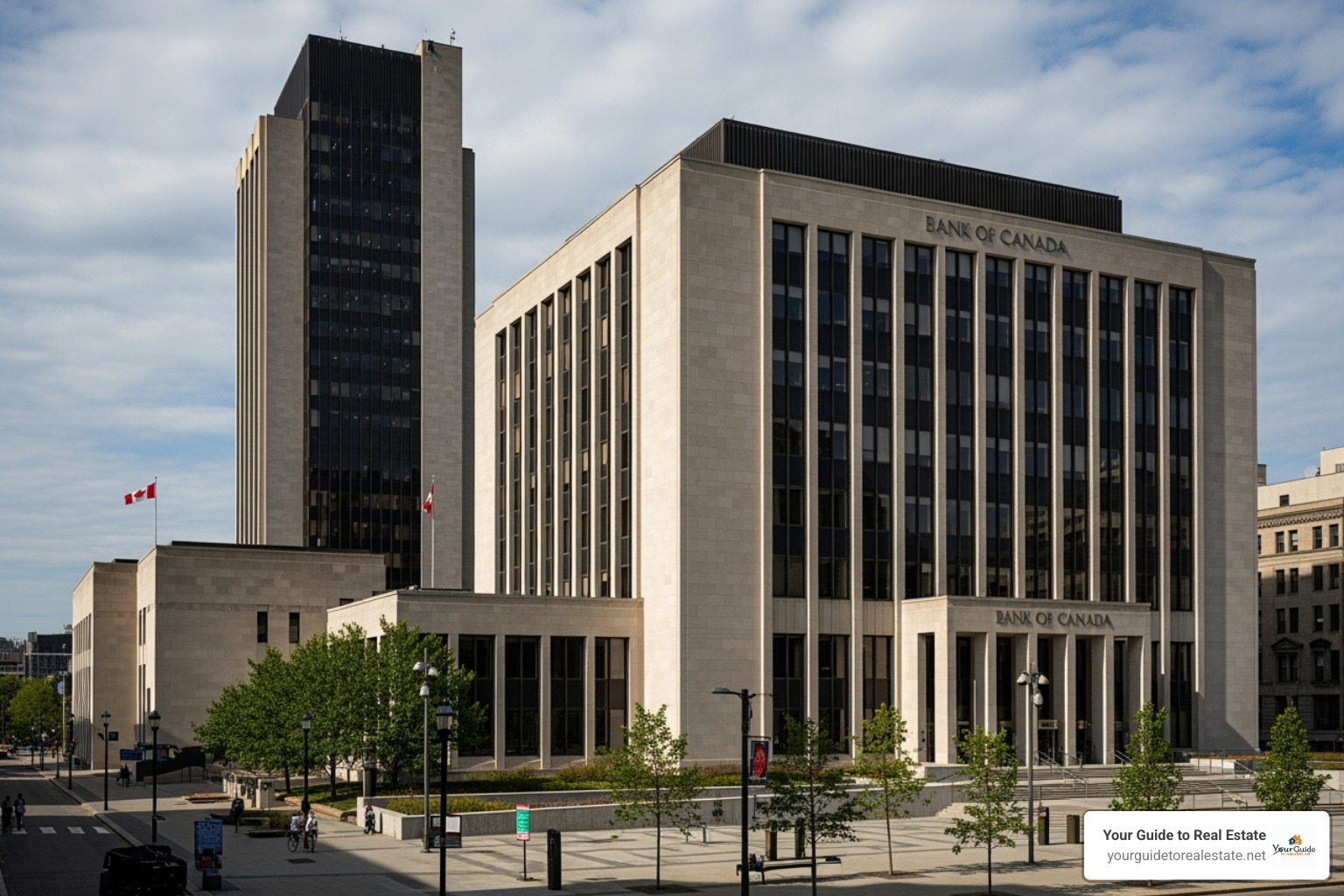
Up north, the Bank of Canada is dealing with its own set of challenges. They’ve been more aggressive than the Fed, cutting their policy rate by 175 basis points throughout 2024. But in their most recent July 30th announcement, they decided to hold steady at 2.75%.
The BoC’s policy rate (also called the overnight rate) is the heartbeat of Canadian lending. When they cut, variable mortgage rates follow almost immediately. Fixed mortgage rates are trickier – they’re more influenced by bond yields and longer-term economic expectations.
Canada’s economic picture is giving the BoC some serious food for thought. Unemployment jumped to 7.1% in August, with 66,000 jobs disappearing. The economy actually contracted over the last three months – not exactly the kind of news that makes central bankers sleep easy.
These warning signs are creating pressure for more rate cuts. The BoC wants to keep inflation in their 1% to 3% target range while supporting employment. Right now, their policy rate sits at what economists call the “neutral rate” – theoretically the level that neither stimulates nor restricts the economy.
You can dive deeper into their decision-making process through the Bank of Canada’s policy rate decisions.
Canadian Mortgage Rate Forecasts: 2025-2027
So will interest rates go down in Canada? The smart money says yes, but gradually.
Canada’s Big 6 banks are forecasting rate cuts of up to 75 basis points in 2025. The Bank of Canada’s own Market Participant Survey suggests two more quarter-point cuts this year – likely in September and December – which would bring the policy rate down to 2.25% by year-end.
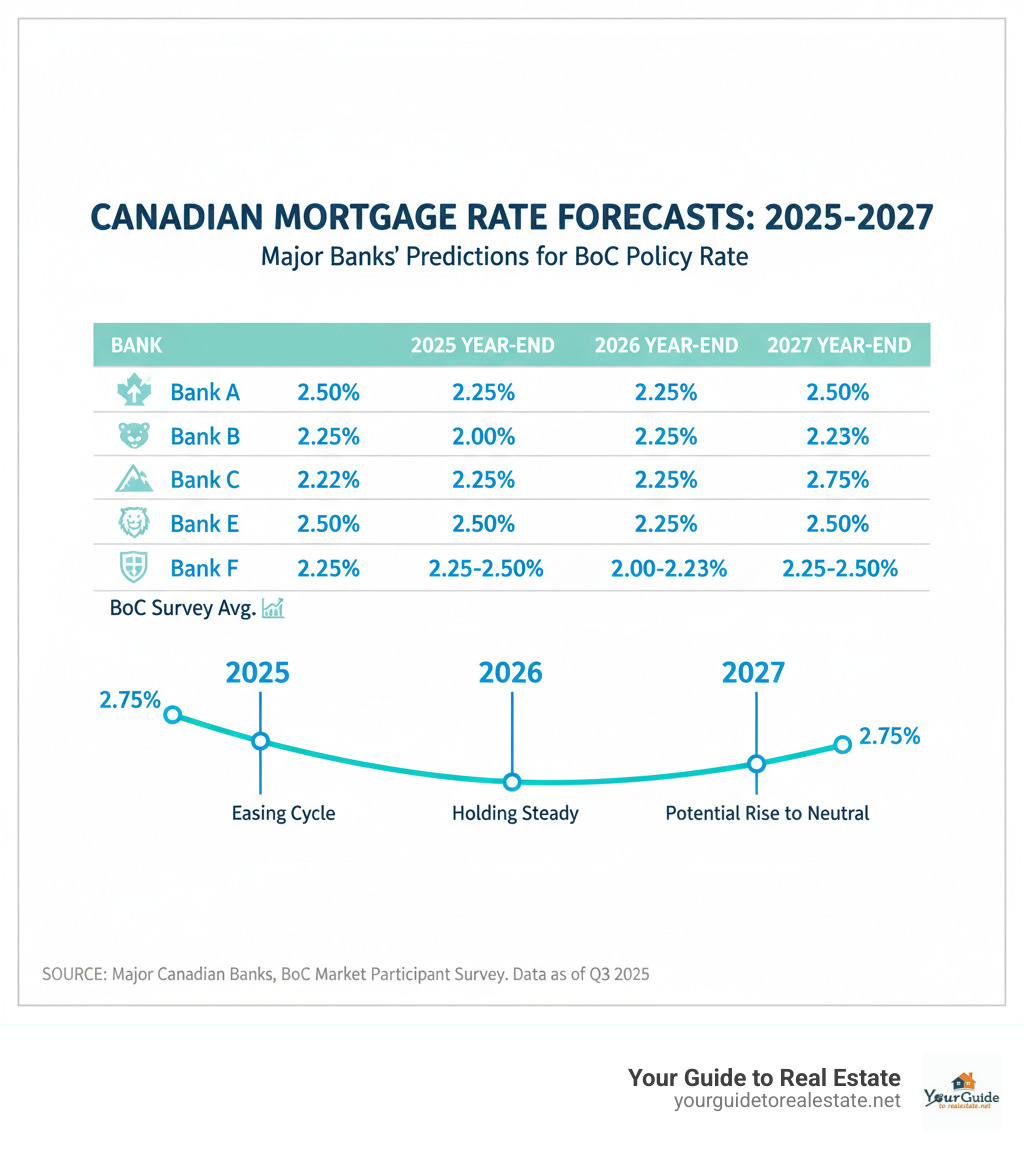
Source: Major Canadian Banks, BoC Market Participant Survey
Looking at 2025, most banks expect the policy rate to settle between 2.25% and 2.50% by December. This reflects efforts to give the economy a boost while inflation remains under control.
For 2026, forecasts show rates holding steady or possibly dropping slightly to the 2.00% to 2.25% range. Some banks see a modest uptick toward year-end as economic conditions potentially improve.
By 2027, predictions vary more widely. Some analysts see rates staying in the 2.25% to 2.50% range, while others anticipate a gradual return toward the BoC’s neutral rate of 2.75%.
These forecasts hinge on several key factors: inflation staying tame, the job market stabilizing, and global economic conditions not throwing any major curveballs.
For the latest insights on how these changes might affect your mortgage strategy, our mortgage rates drop guide 2025 offers practical advice. The complete Market Participant Survey provides even more detailed projections for those who want to dig deeper into the data.
Key Economic Factors Influencing Rate Decisions
Beyond central bank announcements, a complex web of economic indicators determines the direction of interest rates. Understanding these factors provides a clearer picture of what’s to come.
The Inflation Tug-of-War: Headline vs. Core

When central bankers debate will interest rates go down, they’re essentially having an argument with inflation. But here’s the thing that catches most people off guard: there are actually two different inflation numbers they’re watching, and they don’t always tell the same story.
Headline inflation is what you see in the news – it’s the total price increases across everything we buy, measured by the Consumer Price Index (CPI). In Canada, this number hit 1.9% in August, sitting comfortably just below the Bank of Canada’s 2% target. Sounds great, right? Not so fast.
The problem with headline inflation is that it includes volatile items like food and energy prices. Remember when gas prices spiked after geopolitical tensions? Or when grocery bills jumped because of supply chain issues? These dramatic swings can make headline inflation look scary one month and perfectly fine the next. If you’ve been wondering why are eggs so expensive, you’re experiencing this volatility firsthand.
Core inflation strips out these roller-coaster items to show what’s really happening underneath. Think of it as the steady drumbeat of price increases that won’t disappear when gas prices normalize. The Bank of Canada watches two specific measures – CPI-trim and CPI-median – and averages them together.
Here’s where things get interesting for anyone hoping rates will drop: Canada’s core inflation average remained stuck at 3.05% in August, well above that 2% target. This is why central bankers lose sleep at night. While headlines might suggest everything’s under control, that persistent underlying pressure means they can’t just slash rates without worrying about inflation roaring back.
The Conference Board of Canada noted something particularly important: some of that low headline inflation comes from temporary factors like the removal of federal carbon tax and “base year” effects. These artificial suppressions won’t last forever, which makes central bankers even more cautious about cutting rates too aggressively.
For the latest numbers that central bankers are actually looking at, you can check the latest CPI data from StatsCan.
Employment, Growth, and the Risk of Recession
Central banks have what economists call a “dual mandate” – they need to keep inflation in check while also supporting full employment. It’s like trying to balance on a seesaw while juggling flaming torches.
When the job market is strong and the economy is growing robustly, central bankers can afford to keep rates higher to fight inflation. But when unemployment starts climbing and GDP growth starts shrinking, they face pressure to cut rates to stimulate the economy back to health.
Canada’s recent employment picture is painting a troubling story. August delivered a gut punch with the unemployment rate jumping to 7.1% and a staggering 66,000 jobs lost, mostly part-time positions. To put this in perspective, that’s like an entire small city suddenly finding themselves out of work in just one month.
Even more concerning, Canada’s economy slipped into economic contraction over the last three months, with Q2 2025 showing a 0.2% decline in real GDP. When economists see numbers like this, they start using words like “recession” in hushed tones.
This creates a dilemma for the Bank of Canada. Their mandate requires them to support maximum sustainable employment while keeping inflation stable. A deteriorating labor market and contracting economy strongly push them toward rate cuts, even if core inflation remains stubborn.
But here’s the catch that affects your mortgage: if a recession actually hits, will interest rates go down quickly? Historically, yes – central banks respond to recessions by cutting rates aggressively to stimulate borrowing and spending. This would indeed push mortgage rates down faster.
However, recessions come with their own problems: job losses, reduced consumer confidence, and tighter lending standards from banks. Even if rates drop, getting approved for that mortgage might become harder if lenders worry about your job security.
Understanding these economic crosscurrents is crucial for navigating our housing market forecast. For the most current employment data that central bankers are monitoring, check Statistics Canada’s Labour Force Survey.
External Pressures: Tariffs, Trade, and U.S. Influence
Canada doesn’t exist in a bubble, especially when it comes to interest rates. Our economy is so intertwined with the United States that American economic policies can dramatically influence whether will interest rates go down north of the border.
Trade policies and tariffs create a particularly tricky situation for Canadian interest rates. When the U.S. imposes higher tariffs on goods, it’s like adding a tax that Canadian businesses and consumers ultimately pay. National Bank recently found that 36% of Canadian businesses have already felt the sting through higher prices, supply chain disruptions, or changing demand patterns.
These tariffs are projected to cost Canadians and businesses billions of dollars. Think of it this way: if your grocery bill goes up because of trade disputes, that’s inflationary pressure. But if those same trade disputes hurt business confidence and reduce economic activity, that’s recessionary pressure. Central bankers have to figure out which force is stronger.
Currently, the economic headwinds from trade conflicts appear to be nudging the Bank of Canada toward rate cuts to help offset the damage. When external forces are already making life harder for businesses and consumers, keeping interest rates high would be like adding insult to injury.
U.S. economic health also plays a massive role. When the American economy is strong, the Federal Reserve might keep rates higher, which puts pressure on the Bank of Canada to do the same. Why? If Canadian rates fall too far below U.S. rates, investors might move their money south, weakening the Canadian dollar and potentially fueling inflation through higher import costs.
Conversely, when the Fed is cutting rates aggressively (as they’re projected to do), it gives the Bank of Canada more room to cut without worrying about capital flight.
Government spending on both sides of the border adds another layer of complexity. Massive U.S. government debt is seen by bond markets as potentially inflationary, which can push up longer-term interest rates regardless of what central banks do. Similarly, Canadian government spending plans – whether for defense, infrastructure, or bailouts for tariff-affected sectors – could add to federal debt and create inflationary pressures.
For more detailed analysis on how these trade dynamics specifically affect Canadian mortgage holders, our articles on mortgage rates tariffs and the impact of U.S. tariffs on Canada provide deeper insights.
The bottom line? Interest rate decisions aren’t made in isolation. They’re the result of central bankers weighing domestic economic conditions against a complex web of international pressures, trade policies, and global economic trends.
Navigating the Rate Environment: Advice for Consumers
With rates in flux and economic signals pointing in different directions, you might be wondering how to protect your financial future. The good news? There are smart strategies you can use right now, whether you’re buying your first home or dealing with an upcoming mortgage renewal.
Let’s be honest – navigating interest rates feels a bit like trying to predict the weather. But just like you wouldn’t leave the house without checking the forecast, you shouldn’t make major financial decisions without understanding what’s coming.
The Great Canadian Mortgage Renewal Wave
Here’s something that should be on every Canadian homeowner’s radar: approximately 60% of all outstanding mortgages are due to renew within the next two years. If you’re one of these homeowners, you’re not alone in feeling a bit anxious about what this means for your monthly budget.
Many of these mortgages were secured during the pandemic years of 2020-2021, when the Bank of Canada’s policy rate was sitting at or below 1%. Those were the days when money was cheap and mortgage payments were blissfully low.
But here’s the reality check: if you’re renewing a mortgage from 2021, you could see your payments jump by up to 25%. For those lucky enough to have locked in rates back in 2020, the increase could be as steep as 40%. That’s what financial experts call “payment shock,” and it’s exactly as unpleasant as it sounds.
This massive wave of renewals isn’t just affecting individual households – it’s reshaping the entire housing market. Some homeowners might be forced to sell if they can’t handle the higher payments, while others might delay moving or renovating. It’s a critical period that requires some serious financial planning.
The Bank of Canada has been tracking this trend closely, noting in their analysis of 60% of mortgages due for renewal how it could impact the broader economy. If you’re facing renewal soon, understanding mortgage refinancing explained could open up new options for managing your payments.
To Lock In or To Float? That Is the Question
One question we hear constantly is whether to choose a fixed-rate or variable-rate mortgage. It’s like asking whether to take an umbrella when there might be rain – the answer depends on how much risk you’re comfortable with.
Fixed-rate mortgages are the umbrella approach. Your interest rate stays the same for your entire term, no matter what happens with will interest rates go down or up. Your monthly payments won’t budge, which makes budgeting a breeze. You’ll sleep well knowing exactly what you owe each month.
The downside? If rates drop significantly, you’ll be stuck paying the higher rate while your neighbor with a variable mortgage enjoys lower payments. Currently, with bond yields sitting around 2.7%, we’re seeing 5-year fixed rates edge down by about 0.05% – not huge, but every bit helps.
Variable-rate mortgages are for the more adventurous types. These rates dance along with the Bank of Canada’s policy rate and the prime rate. When central banks cut rates, your payments typically drop within a month or two. When they raise rates, well, your payments go up too.
Variable rates often start lower than fixed rates, which can mean more money in your pocket initially. But you need steady income, a solid emergency fund, and nerves of steel to handle the uncertainty. If you believe will interest rates go down over the coming years, a variable rate could save you thousands.
The choice really comes down to your personal situation. Can you handle payment fluctuations? Do you have stable income? Are you planning to move in a few years anyway? These questions matter more than trying to predict where rates are headed.
Our guides on how to shop mortgage and mortgage options explained can help you work through these decisions with confidence.
Expert Tips for Homebuyers and Homeowners
Here’s the thing about navigating interest rate uncertainty – it doesn’t have to keep you up at night. Our experts have seen every type of market condition, and they’ve developed some practical strategies that actually work.
Lock in your savings now if you’re earning high yields on savings accounts or CDs. As rates come down, so will these returns. Consider moving some money into longer-term CDs while you can still get decent rates.
Think strategically about refinancing if you’re a current homeowner. The old rule of thumb was to refinance when you could cut your rate by at least one percentage point. That guideline still holds – it helps ensure the savings outweigh the costs of refinancing.
Don’t try to time the perfect moment if you’re house hunting. We’ve seen too many buyers wait for rates to hit bottom and prices to crater, only to watch both move against them. If you find a home you love and can afford the payments at today’s rates, that might be your green light.
Stress test your own budget beyond what lenders require. Build in cushions for rate increases, job changes, or unexpected expenses. Your future self will thank you for being conservative with your calculations.
Focus on your financial foundation before anything else. Job security, manageable debt levels, and a robust emergency fund matter more than getting the absolute lowest rate. These fundamentals give you options when markets get choppy.
The key is remembering that interest rates are just one piece of your financial puzzle. A slightly higher rate on a home you love in a neighborhood where you want to build your life often beats waiting indefinitely for perfect conditions that may never come.
For those taking their first steps into homeownership, our first time homebuyer tips provide a roadmap for making smart decisions in any rate environment.
Frequently Asked Questions About Interest Rates
Interest rates can feel like a mystery wrapped in an economic riddle. You’re not alone if you’ve found yourself scratching your head when mortgage rates go up despite central bank cuts, or wondering what all this talk about “neutral rates” really means. Let’s clear up some of the most common questions we hear.
Why don’t mortgage rates drop immediately when the central bank cuts its rate?
This question comes up constantly, and for good reason. It seems logical that when the Bank of Canada or Federal Reserve cuts rates, your mortgage rate should drop too, right? Unfortunately, it’s not that simple.
The markets work differently. The Fed’s policy rate and the Bank of Canada’s overnight rate are short-term rates that affect what banks charge each other. Your mortgage rate, especially if it’s fixed, is tied to longer-term bonds – like the 10-year Treasury in the US or 5-year government bonds in Canada.
Bond investors look ahead. These investors are constantly trying to predict the future. If they think inflation might come back or the economy will heat up later, they might actually demand higher yields even when central banks cut rates. This is exactly what happened recently when Treasury yields jumped after a Fed cut because investors weren’t convinced the economy was really slowing down.
Lenders have their own considerations. Banks and mortgage companies factor in their own costs, risks, and profit margins. They might not pass along the full benefit of a central bank cut immediately, especially if they’re uncertain about what’s coming next.
This complex dance is why you sometimes see headlines asking why are mortgage rates going up? even when interest rates go down at the central bank level.
What is the ‘neutral rate’ and why does it matter?
Think of the neutral rate as the economic equivalent of a thermostat setting. It’s the interest rate that keeps the economy running at just the right temperature – not too hot, not too cold.
For the Bank of Canada, this magic number is around 2.75%. When rates are above neutral, the central bank is essentially putting the brakes on the economy to cool down inflation. When rates are below neutral, they’re hitting the gas pedal to stimulate growth.
Why should you care? Because it tells you where we stand. The Bank of Canada recently reached this neutral rate after cutting from a high of 5%. This suggests they’re no longer actively trying to slow down the economy. Future decisions will depend on whether Canada needs more economic stimulus (cuts below 2.75%) or if inflation proves stubborn (holding steady or even raising rates).
Understanding this helps you gauge how much further rates might fall. We’re now in the zone where each decision becomes more data-dependent rather than following a clear downward path.
If a recession happens, will interest rates go down for my mortgage?
The short answer is yes, but it comes with a big asterisk. Will interest rates go down in a recession? Almost certainly.
Central banks typically slash rates aggressively during recessions to encourage borrowing and spending. We saw this playbook during the 2008 financial crisis and again during the COVID-19 pandemic. Variable mortgage rates would fall quickly in line with these cuts.
Fixed mortgage rates would likely drop too. During economic uncertainty, investors flock to the safety of government bonds, driving their prices up and yields down. This directly translates to lower fixed mortgage rates.
But here’s the catch – while your mortgage payments might decrease, a recession brings job losses, reduced income, and general economic uncertainty. Your mortgage might be cheaper, but your paycheck could be at risk.
It’s a bit like getting a discount on groceries because the store is going out of business. The savings are real, but the underlying situation isn’t ideal. For a deeper look at how economic downturns affect real estate, check out our housing market crash ultimate guide.
The key is being prepared for various scenarios rather than hoping for any particular outcome. A strong financial foundation serves you well whether rates go up, down, or sideways.
Conclusion: Preparing for the Path Ahead
So, will interest rates go down? After diving deep into central bank policies, economic indicators, and market forces, the honest answer is: probably, but it’s going to be a bumpy ride.
The evidence points toward gradual rate declines in both the US and Canada. The Federal Reserve has signaled two more cuts in 2025, while Canada’s Big 6 banks predict the Bank of Canada could drop rates to 2.25% by year-end. These aren’t dramatic plunges, but they’re meaningful moves that could save you hundreds or thousands of dollars annually.
But here’s what makes this tricky: Interest rates don’t exist in a vacuum. We’ve seen how bond markets can push mortgage rates higher even when central banks are cutting. We’ve learned that core inflation is still running hot in Canada at 3.05%, well above the 2% target. And we know that external pressures like U.S. tariffs and trade policies can throw curveballs at any forecast.
The reality is that nobody has a crystal ball. Economic forecasts are educated guesses, not guarantees. What we do know is that about 60% of Canadian mortgages are due for renewal in the next two years, creating massive pressure on household budgets regardless of where rates go.

Your best strategy isn’t trying to time the market perfectly. Instead, focus on building financial resilience. Stress test your budget for different rate scenarios. Build up your emergency fund before making major housing decisions. And don’t let rate anxiety paralyze you from making sound financial moves.
If you’re a homeowner facing renewal, start preparing now rather than hoping rates will be lower when your term expires. If you’re a first-time buyer, waiting for the “perfect” rate environment often means missing out on the right home at the right time.
The interest rate environment will continue to evolve, shaped by inflation data, employment numbers, and global economic forces we can’t control. What you can control is how well-prepared you are for different scenarios.
At Your Guide to Real Estate, we believe knowledge is your best defense against uncertainty. Our proven framework helps you steer these choppy waters with confidence, whether rates go up, down, or sideways. For a solid foundation in understanding your options, explore our comprehensive guide on understanding mortgages a beginners guide to home loans.
The path ahead may be uncertain, but you don’t have to walk it alone. With the right information and guidance, you can make smart decisions that serve your long-term financial goals, regardless of what the rate environment throws your way.