

Why Understanding the Difference Between Condo and Apartment Matters
The difference between condo and apartment comes down to one key factor: ownership. While both may look identical from the outside, this fundamental distinction affects everything from your monthly costs to your daily responsibilities.
Quick Answer:
- Condo = You own the unit (can buy or rent from an owner)
- Apartment = You rent from a landlord or property management company
- Key Impact = Different costs, rules, maintenance responsibilities, and long-term financial outcomes
Many people use these terms interchangeably, but understanding the real differences is crucial whether you’re planning to buy your first home, looking for a rental, or considering an investment property. As one industry expert notes, “Choosing between an apartment and a condo is an important decision to make sure that you feel comfortable in your special space.”
The ownership structure affects:
- Who handles repairs and maintenance
- What fees you’ll pay beyond rent or mortgage
- How much control you have over your living space
- Whether you’re building equity or paying someone else’s mortgage
- What rules and regulations you must follow
This guide will walk you through the real-world implications of these differences, from day-to-day living to long-term financial planning. Whether you’re a first-time renter or an experienced homeowner, understanding these distinctions will help you make the right choice for your lifestyle and financial goals.
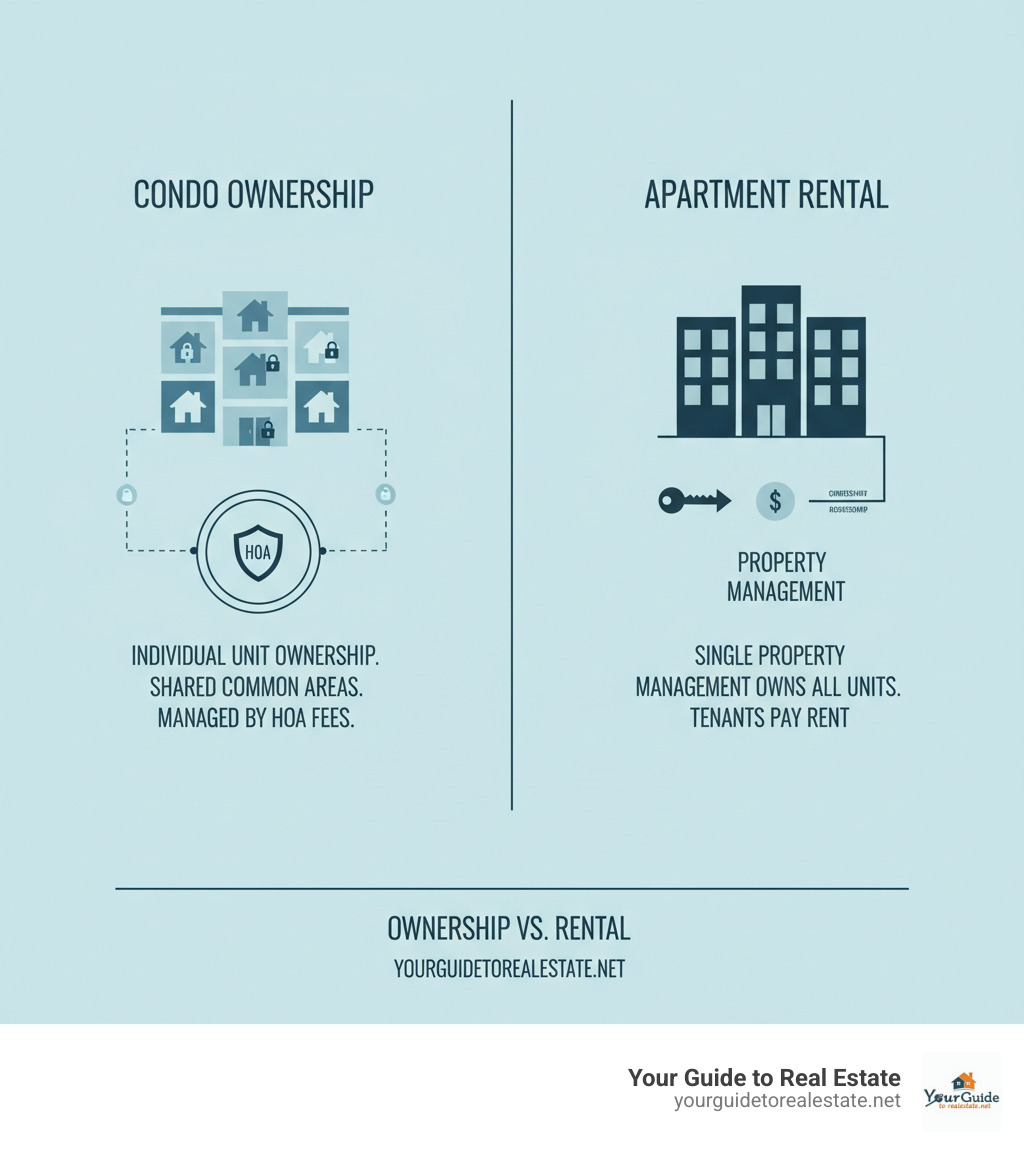
Simple difference between condo and apartment glossary:
The Fundamental Difference Between Condo and Apartment: Ownership
The difference between condo and apartment boils down to one simple concept: who owns what. Imagine two identical units side by side in the same hallway. They might look exactly the same, but their ownership structures tell completely different stories that affect everything from your monthly bills to your weekend plans.
What is a Condo?
When you buy a condo, you’re becoming a homeowner – just with neighbors really, really close by. You own your individual unit outright, complete with the deed and all the pride (and responsibilities) that come with it. Think of it like owning a house, except instead of owning the yard, you own a share of the building’s common areas.
Here’s what makes condo ownership special: you build equity with every mortgage payment. That monthly payment isn’t disappearing into someone else’s pocket – it’s building your financial future. You can paint your walls hot pink if you want, renovate your kitchen, or install that fancy smart home system you’ve been eyeing.
But ownership comes with community living. You’ll share lobbies, hallways, pools, and gyms with your neighbors. These shared spaces are managed by your Homeowner’s Association (HOA), which is basically a mini-government run by elected unit owners. The HOA creates the rules everyone follows and collects monthly fees to keep everything running smoothly.
The HOA operates under local condominium regulations and maintains what’s called CC&Rs (Covenants, Conditions, and Restrictions) – fancy legal terms for “the rules of living here.” When you’re ready to move on, you can sell your condo just like any other piece of real estate. If you need help with that process, check out our guide on how to Sell My Condo.
What is an Apartment?
Renting an apartment is refreshingly straightforward. You don’t own anything except your security deposit receipt and the right to live there for the duration of your lease. The entire building typically belongs to one owner – either an individual landlord or a property management company.
As a tenant, you sign a lease agreement that spells out everything: how much rent you’ll pay, how long you can stay, and what your responsibilities are. Your monthly rent payment gives you a place to live, but it doesn’t build any ownership stake in the property. Every dollar you pay is gone forever, but in exchange, you get flexibility and fewer headaches.
The landlord handles all the big stuff – broken water heaters, leaky roofs, and those mysterious noises in the walls at 2 AM. You call them, they fix it (hopefully). This arrangement works perfectly for people who want hassle-free living or aren’t ready for the commitment of homeownership. We have resources for all types of rentals, including Studio Apartments if you’re looking at smaller spaces.
Can a Building Have Both Condos and Apartments?
Absolutely! This is where the difference between condo and apartment gets interesting. Many buildings are mixed-use, meaning some units are individually owned condos while others operate as traditional rental apartments.
Here’s where it gets even more fascinating: condo owners can become landlords. Someone might own their condo but decide to rent it out instead of living there. If you rent from them, you’re technically renting a condo, but your experience might feel very similar to renting an apartment.
The big difference is your relationship with your landlord. Renting from an individual condo owner often means dealing directly with that person rather than a large management company. This can lead to more personal relationships and faster decision-making, but it can also mean less standardized processes and policies.
In the same building, you might find yourself living next to someone who owns their unit, someone renting from a condo owner, and someone renting from the building’s main management company. Different rules can apply to renters in the same building depending on whether they’re renting from individual owners or the building management.

Understanding these ownership structures helps explain why your neighbor might have different amenities access or why repairs in your unit might be handled differently than repairs in theirs. It all comes back to that fundamental question: who owns what?
Day-to-Day Living: Maintenance, Rules, and Amenities
Once you understand the ownership structure, the difference between condo and apartment becomes crystal clear in your daily routine. From who you call when something breaks to what amenities you can enjoy, these distinctions shape your everyday experience.
Maintenance & Repairs: Who’s Responsible?
Here’s where the ownership divide really shows up in your wallet and your weekend plans.
If you’re an apartment renter, life is pretty straightforward when something goes wrong. Your toilet won’t flush? Call the landlord. The oven stops working? That’s not your problem to solve. The property management company or on-site superintendent handles virtually everything, from leaky faucets to broken air conditioning units. You might wait a bit for repairs, but you won’t be opening your wallet or spending your Saturday researching contractors.
Condo owners face a different reality. You own everything inside those four walls, which means you’re responsible for maintaining it. When your garbage disposal needs installation or replacement, you’re the one hiring the plumber. New flooring? That’s on you. Fresh paint? Your project to manage.
But here’s the silver lining: condo owners don’t handle everything alone. The HOA takes care of the building’s exterior, common areas, hallways, and shared amenities. You won’t be climbing on the roof to fix shingles or cleaning the pool filters, but you will contribute to these costs through your monthly HOA fees.
What if you’re renting a condo? This creates an interesting middle ground. Your individual landlord (the condo owner) typically handles repairs within your unit, but the experience can vary dramatically. Some condo owners are incredibly responsive landlords who hire quality contractors quickly. Others might take their time or cut corners. Unlike large apartment complexes with dedicated maintenance staff, you’re relying on one person’s approach to property management.
Rules and Regulations: HOA vs. Landlord
The difference between condo and apartment extends far beyond who fixes the sink – it’s also about who makes the rules you live by.
Apartment living comes with landlord rules. These are usually spelled out in your lease agreement and tend to be fairly standard: no smoking, reasonable noise levels, maybe restrictions on pets or decorating. The property manager enforces these rules, and they’re typically the same for everyone in the building. It’s straightforward, but you have little say in changing them.
Condo communities operate under HOA bylaws, often called CC&Rs (Covenants, Conditions, and Restrictions). These can be incredibly detailed, covering everything from what color you can paint your front door to when you can use the barbecue on your balcony. Some HOAs even regulate holiday decorations or whether you can rent out your unit.
The interesting twist? As a condo owner, you have a voice. You can attend HOA meetings, vote on rule changes, and even run for the board. You’re not just following rules – you’re helping make them.
If you’re renting a condo, you get the most complex rule situation. You must follow both the HOA’s community rules and any additional restrictions your individual landlord sets. It’s like having two sets of parents with different rules. However, if your living situation becomes untenable, there are legal ways to break a lease when circumstances change.
A Look at Amenities
Walk into most apartment complexes and you’ll find the basics: maybe a fitness room with a few treadmills, a decent-sized pool, communal laundry facilities, and perhaps a community room for residents. These amenities are included in your rent, well-maintained by the property management, and perfectly functional.
Condos often take amenities to the next level. We’re talking concierge services, high-end fitness centers that rival expensive gyms, rooftop terraces with city views, business centers, and sometimes even pet spas or wine storage. The difference in quality can be striking.

Why the difference? Condo owners have a vested interest in maintaining and upgrading these shared spaces since they directly impact property values. Through their HOA fees (which can range from $100 to $700+ monthly for luxury buildings), owners collectively invest in keeping amenities top-notch. They also have voting power to approve upgrades or new facilities.
The catch for condo owners is that those amazing amenities come with a price tag beyond your mortgage. Those monthly HOA fees cover maintenance, utilities for common areas, insurance, and reserves for major repairs or improvements.
If you’re renting a condo, you get to enjoy these premium amenities without the long-term financial commitment. The cost is typically built into your rent, giving you access to luxury facilities that might cost hundreds of dollars monthly if you paid for them separately.
The bottom line? Condos generally offer more extensive and higher-quality shared spaces, reflecting the collective investment of owners who plan to stick around and want their property values to thrive.
The Financial Breakdown: Costs and Implications
When considering the difference between condo and apartment, the financial aspects are often the most impactful. It’s not just about monthly payments; it’s about upfront costs, long-term investments, and who covers unexpected expenses. Understanding these financial distinctions can help you make a decision that aligns with your budget and financial goals.
The difference between condo and apartment costs
The cost structures between condos and apartments are fundamentally different, reflecting their ownership models. Let’s break down what you can expect to pay for each option.
| Cost Category | Condo (Ownership) | Apartment (Rental) |
|---|---|---|
| Upfront Costs | Down payment (3-20% of purchase price), closing costs, inspection fees | Security deposit (1-2 months rent), first month’s rent, application fees |
| Monthly Housing Payment | Mortgage payment (principal & interest) | Monthly rent |
| Additional Monthly Fees | HOA fees ($100-$700+ per month), property taxes | Usually none (sometimes utilities) |
| Insurance | Condo insurance (interior coverage) | Renter’s insurance (personal belongings) |
| Maintenance | Interior repairs and improvements | Typically covered by landlord |
| Utilities | All utilities (often higher due to larger spaces) | Some or all utilities |
| Unexpected Costs | Special assessments for major building repairs | Generally none |
Condo ownership requires significantly more upfront capital. You’ll need a down payment, which can range from 3% to 20% of the purchase price, plus closing costs that typically run 2-5% of the home’s value. Your monthly Mortgage payment covers principal and interest, but you’ll also pay property taxes and HOA fees. These HOA fees can vary dramatically based on the building’s amenities and services, from a modest $100 per month to over $700 for luxury buildings with extensive facilities.
Apartment living has much lower barriers to entry. Most landlords require a security deposit equal to one or two months’ rent, plus the first month’s rent upfront. Your monthly rent typically covers your housing costs, though you may pay for some utilities. Renter’s insurance is usually required but costs significantly less than condo insurance, often just $15-30 per month.
One surprise cost that catches many new condo owners off guard is special assessments. When major building repairs or improvements are needed beyond what the HOA reserves can cover, all owners get billed for their share. This could be hundreds or even thousands of dollars with little advance notice.
Long-Term Financial Implications
The difference between condo and apartment becomes even more pronounced when you look at the long-term financial picture. This is where the ownership factor really shows its impact on your wealth building.
Building equity is the biggest financial advantage of condo ownership. Every mortgage payment includes principal reduction, which increases your ownership stake in the property. Over time, you’re essentially paying yourself instead of a landlord. Additionally, condos can appreciate in value, potentially providing significant returns on your investment. This makes condo ownership a form of Property Investment that can build long-term wealth.
Condo owners also benefit from tax advantages. You can typically deduct mortgage interest, property taxes, and some HOA fees on your income taxes. These deductions can result in substantial savings, especially in the early years of your mortgage when interest payments are highest.
Apartment renters, on the other hand, build no equity from their housing payments. While this means no financial stake in the property, it also means no risk if property values decline. However, renters face the reality of rent increases over time, which can make long-term budgeting challenging. In many markets, rent increases outpace salary growth, making apartment living more expensive over the years.
The predictability factor varies between the two options. Condo owners with fixed-rate mortgages have stable principal and interest payments for the life of their loan, though property taxes and HOA fees can increase. Apartment renters typically face annual rent increases, though these are often limited by local rent control laws.
If you’re considering the purchase route, tools like our Mortgage Payment Calculator Online can help you understand what your monthly payments might look like based on different purchase prices and down payment amounts.
The financial choice between a condo and apartment often comes down to your current financial situation, long-term goals, and risk tolerance. While condos require more upfront investment and ongoing responsibility, they offer the potential for wealth building and tax benefits that apartment living simply cannot match.
Why Understanding the Difference Between Condo and Apartment Matters
Here’s something that might surprise you: those two identical-looking units in the same building could have completely different ownership structures. The difference between condo and apartment isn’t about the physical space at all—it’s about who owns what.
If you’ve ever found yourself scratching your head over real estate listings or wondering why some places are called condos while others are apartments, you’re not alone. This confusion is incredibly common, and honestly, it makes perfect sense. From the outside, they often look exactly the same!
But here’s the thing: ownership changes everything. When you understand whether you’re dealing with a condo or an apartment, you’ll know exactly what to expect in terms of costs, responsibilities, and long-term benefits.
The simple breakdown goes like this: A condo is a unit you can own (even if you’re renting it from the owner), while an apartment is something you rent from a landlord or property management company. That single difference ripples out to affect your monthly budget, who fixes your broken dishwasher, and whether you’re building wealth or just paying someone else’s mortgage.
Think of it this way—the ownership structure determines who handles repairs and maintenance, what fees you’ll encounter beyond your basic housing payment, how much control you have over your living space, whether you’re building equity for your future, and what rules govern your daily life.
As one housing expert puts it, “Choosing between an apartment and a condo is an important decision to make sure that you feel comfortable in your special space.” And they’re absolutely right—your comfort extends far beyond the four walls to include your financial comfort too.
Whether you’re a first-time renter trying to decode confusing listings, someone considering their first home purchase, or an experienced homeowner exploring investment options, getting clear on these differences will save you time, money, and headaches down the road.
In this guide, we’ll walk you through everything from day-to-day living differences to long-term financial implications. By the time you’re done reading, you’ll be able to spot the difference between condo and apartment from a mile away—and more importantly, you’ll know which option fits your lifestyle and goals.
Simple difference between condo and apartment glossary:
The Fundamental Difference Between Condo and Apartment: Ownership
At the heart of the difference between condo and apartment lies one simple concept: ownership. While a condo and an apartment might look exactly the same from the outside—same building, same walls, same view—their legal structures are completely different. And trust me, this matters more than you might think.
What is a Condo?
A condominium (or condo for short) is essentially your own little slice of real estate heaven within a larger building. Think of it like owning a single-family home, except instead of owning the land underneath, you own everything inside your four walls. It’s what real estate pros call “a form of ownership, not a type of building.”
Here’s a fun fact: the first condo in the United States popped up in Salt Lake City back in 1960. Fast forward to today, and there are about 17 million privately owned condominiums across the country—that’s a lot of happy condo owners!
When you own a condo, you hold the actual title to your unit. This means you can paint those walls any color you want, remodel your kitchen to your heart’s content, or finally install that fancy lighting you’ve been dreaming about. Of course, you’ll need to follow your community’s rules, but the freedom is pretty sweet.
The real magic happens with building equity. Every mortgage payment you make is like putting money in your own pocket instead of your landlord’s. When you eventually pay off that mortgage, you’ll own your condo free and clear—now that’s a nice feeling.
But here’s the thing: you’ll be sharing some spaces with your neighbors. We’re talking about lobbies, hallways, roofs, pools, gyms, and elevators. These common areas are managed by something called a Homeowner’s Association (HOA)—basically a group of elected unit owners who keep everything running smoothly.
The HOA acts like a mini-government for your building. They create the rules (called CC&Rs—Covenants, Conditions, and Restrictions), collect monthly fees, and make sure the shared spaces stay nice. When you’re ready to move on, our guide on how to Sell My Condo can walk you through the process.
What is an Apartment?
An apartment is the complete opposite—it’s all about renting, not owning. When you live in an apartment, you’re essentially a guest who pays to stay. The entire building typically belongs to one owner, whether that’s an individual investor or a big property management company.
As an apartment tenant, you’ll sign a lease agreement—basically a contract that spells out how much you’ll pay, how long you can stay, and what your responsibilities are. You hand over your monthly rent check, and in return, you get to call that unit home. Whether you’re looking at a tiny Studio Apartments or a spacious three-bedroom, the concept stays the same.
The downside? You’re not building any equity. Every rent payment helps your landlord build wealth, but your bank account stays the same. Think of it like this: you’re paying for the privilege of living there, not investing in your future.
The upside? Your landlord handles pretty much everything. Broken dishwasher? Call the landlord. Leaky roof? Not your problem. This can be incredibly freeing, especially if you’re not handy with repairs or just want a hassle-free living experience.
Can a Building Have Both Condos and Apartments?
Absolutely! This is where the difference between condo and apartment gets really interesting. You might find yourself living in a building where some units are owned as condos while others are traditional rental apartments. It’s like a mixed community under one roof.
Here’s where it gets even more fascinating: condo owners can rent out their units. So you might be renting what’s technically a “condo,” but your landlord is the individual unit owner, not some big property management company. This often creates a more personal relationship—your landlord might live just a few floors up!
For renters, this creates an interesting dynamic. You could have neighbors who own their place, others who rent from individual condo owners, and still others who rent from the main building management. Everyone’s living in the same building, but the behind-the-scenes arrangements are totally different.
This mix can affect everything from how quickly your repairs get handled to what rules you need to follow. A condo owner-turned-landlord might fix your broken faucet faster than a large management company, or they might be slower—it really depends on the person.
Day-to-Day Living: Maintenance, Rules, and Amenities
The ownership structure behind the difference between condo and apartment doesn’t just affect your bank account—it shapes your entire daily experience. From who you call when the sink starts leaking at midnight to whether you can paint your bedroom walls purple, these distinctions matter more than you might think.
Maintenance & Repairs: Who’s Responsible?
Here’s where the difference between condo and apartment becomes crystal clear in your everyday life. When you’re renting an apartment, life is beautifully simple from a maintenance perspective. Your dishwasher decides to flood the kitchen? Call the landlord. Need a new Garbage Disposal Installation? That’s their problem too. The property management company handles virtually everything, from the broken air conditioner in your unit to the burnt-out lightbulb in the hallway.
This arrangement can feel like having a safety net. You’re not scrambling to find a reliable plumber or wondering if that weird noise from the heating system is going to cost you hundreds of dollars. As many renters find, this peace of mind is worth a lot, especially when you’re dealing with the unexpected expenses that homeownership can bring.
Condo ownership splits the responsibility right down the middle, and understanding this division is crucial. Inside your unit, you’re the boss—and that means you’re also the one footing the bill. When your garbage disposal stops working or you want to upgrade your kitchen faucet, you’re calling the contractors and paying the invoices. It’s your space, so it’s your responsibility.
But step outside your front door, and the Homeowner’s Association (HOA) takes over. They handle the building’s exterior, common areas like lobbies and pools, landscaping, and major systems. You won’t be up on the roof patching leaks or cleaning the gym equipment, but you’ll contribute to these costs through your monthly HOA fees.
If you’re renting a condo from an individual owner, you’re in an interesting middle ground. The owner should handle repairs inside the unit, but their responsiveness can vary dramatically. Some condo owners are incredibly attentive landlords who fix issues quickly, while others might be harder to reach or slower to address problems.
Rules and Regulations: HOA vs. Landlord
The rules governing your daily life depend entirely on whether you’re dealing with a traditional landlord or a homeowner’s association—another key aspect of the difference between condo and apartment.
Apartment living comes with straightforward rules. Your lease agreement spells out what you can and can’t do, and these rules are typically consistent across all units in the building. Want to hang pictures? You might need to use specific hooks. Thinking about getting a pet? Check your lease for pet policies and fees. Most apartments have pretty strict limitations on modifications—don’t expect to paint those beige walls without permission.
Condo communities operate under a completely different system. The HOA creates detailed bylaws called CC&Rs (Covenants, Conditions, and Restrictions) that can cover everything from the color of your window treatments to when you can fire up the barbecue on your balcony. These rules might seem overwhelming at first, but they’re designed to protect everyone’s property values and ensure peaceful coexistence.
As a condo owner, you have much more freedom inside your unit. Want to knock down a non-load-bearing wall or install hardwood floors? Generally, that’s your call. But if you’re planning changes that affect the building’s exterior or common areas, you’ll need HOA approval first.
Here’s what’s interesting: if you’re renting a condo, you’ll need to follow both the HOA rules and any additional restrictions your individual landlord sets. It’s like having two sets of parents with different rules—you need to keep both happy.
For apartment renters who value flexibility, there are legal options to break a lease if your circumstances change, though this typically comes with financial penalties.
A Look at Amenities
The amenities available to you often reflect the ownership structure, and this is where the difference between condo and apartment can really shine through in your quality of life.
Most apartment complexes offer solid, practical amenities. You’ll typically find a decent fitness center, a swimming pool, laundry facilities (sometimes shared), and maybe a community room for gatherings. These amenities are included in your rent, and the property management company handles all the maintenance and upkeep. It’s straightforward and reliable.
Condo buildings, especially newer developments, often take amenities to the next level. We’re talking about concierge services, state-of-the-art fitness centers, rooftop terraces with stunning views, business centers, and sometimes even pet spas or wine storage. These luxury touches reflect the fact that owners have a long-term investment in the property and are willing to pay for premium features.
The trade-off? Those monthly HOA fees can range from $100 to $700 for typical buildings, and luxury developments can charge several thousand dollars per month. But condo owners get a say in how these amenities are maintained and upgraded through their HOA board participation, often resulting in better-maintained facilities than you’d find in a typical apartment complex.
If you’re renting a condo, you get to enjoy these high-end amenities without the ownership responsibilities, though the cost is typically built into your higher rent. It’s one of the sweet spots of condo rental—luxury amenities without the long-term financial commitment.
The Financial Breakdown: Costs and Implications
When considering the difference between condo and apartment, the financial aspects are often the most impactful. It’s not just about monthly payments; it’s about upfront costs, long-term investments, and who covers unexpected expenses.
The difference between condo and apartment costs
Let’s break down the typical costs associated with each option in a way that makes sense for your budget planning.
| Cost Category | Condo (Ownership) | Apartment (Rental) |
|---|---|---|
| Upfront Costs | Down payment (typically 10-20%), closing costs, inspection fees | Security deposit (1-2 months rent), first month’s rent, application fees |
| Monthly Housing Costs | Mortgage payment, property taxes, HOA fees ($100-700+ monthly) | Monthly rent, utilities (sometimes included) |
| Insurance | Condo insurance (interior coverage) | Renter’s insurance (personal belongings) |
| Maintenance | Interior repairs, special assessments (unexpected) | Typically covered by landlord |
| Utilities | Usually your responsibility | May be included in rent |
Condo ownership comes with significant upfront costs that can be a barrier for many buyers. You’ll need a down payment, which can range from 10% to 20% of the purchase price, plus closing costs that typically add another 2-5% of the home’s value. Then there are ongoing expenses like property taxes, HOA fees, and condo insurance that covers your unit’s interior.
The HOA fees deserve special attention because they can vary dramatically. In a basic building, you might pay $100-200 monthly, but luxury condos with extensive amenities can charge $700 or even several thousand dollars per month. These fees cover building maintenance, amenities, and sometimes utilities, but they can also increase over time or include surprise special assessments for major repairs.
Apartment living requires much less money upfront. You’ll typically need a security deposit equal to one or two months’ rent, plus your first month’s payment. Some apartments also charge application fees, but these are usually under $100. Your monthly costs are more predictable – just rent, utilities (if not included), and renter’s insurance, which is much cheaper than condo insurance.
Long-Term Financial Implications
Here’s where the difference between condo and apartment becomes really significant for your financial future.
Building equity is the biggest advantage of condo ownership. Every mortgage payment you make increases your ownership stake in the property. Over time, as property values appreciate and you pay down your loan, you’re building wealth. When you eventually sell, you could walk away with a substantial profit. This is money that apartment renters never see again.
Condo owners also benefit from potential tax deductions. You can often deduct mortgage interest, property taxes, and sometimes HOA fees from your taxable income. These savings can add up to thousands of dollars annually. If you’re curious about the numbers, our Mortgage Payment Calculator Online can help you understand the financial picture.
The appreciation potential is another compelling factor. While there are no guarantees, real estate historically increases in value over time. Your condo could be worth significantly more in five or ten years than you paid for it. This makes condo ownership a form of Property Investment, even if it’s your primary residence.
Apartment renters, on the other hand, face the reality of rent increases. While your monthly housing costs might start lower, landlords typically raise rent annually. Over a decade of renting, you could end up paying significantly more than you would have with a fixed-rate mortgage. Plus, when you move out, you have no asset to show for all those payments.
However, apartment living does offer financial flexibility. You’re not responsible for major repairs, special assessments, or property taxes. If the roof leaks or the elevator breaks, that’s not your problem financially. This predictability can be valuable, especially for people just starting their careers or those who prefer not to deal with homeownership responsibilities.
The choice often comes down to your current financial situation and long-term goals. If you’re planning to stay in an area for several years and have stable income, condo ownership usually makes more financial sense. But if you value flexibility or aren’t ready for the upfront costs and ongoing responsibilities, apartment living might be the smarter choice for now.