
Understanding Non-Warrantable Condos and Why They Matter
A non warrantable condo is a condominium unit or building that doesn’t meet the specific guidelines set by government-sponsored entities like Fannie Mae and Freddie Mac, making it ineligible for conventional mortgage financing.
Quick Answer:
- Definition: Condos that fail to meet lender warrantability requirements
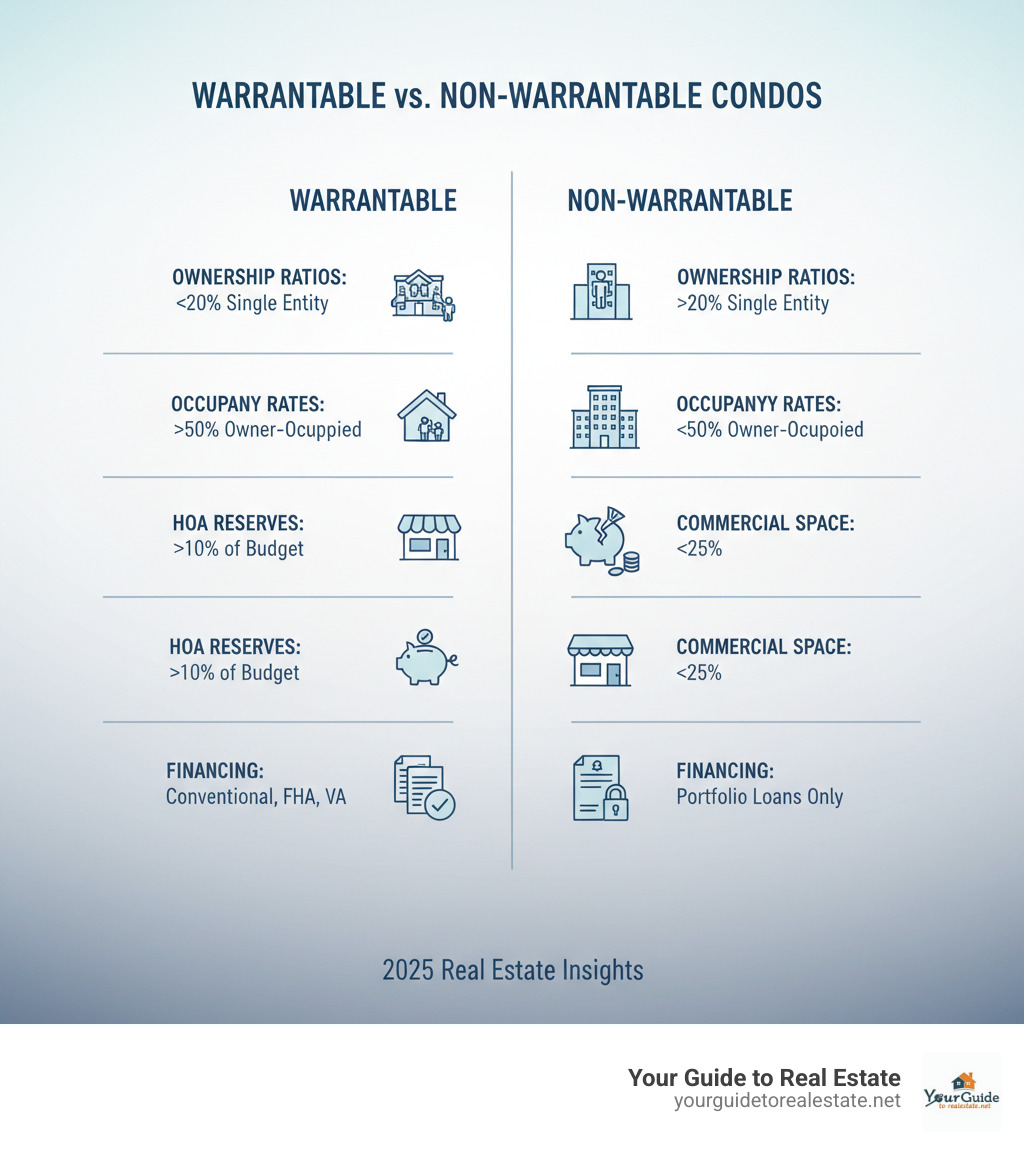
- Common Causes: High rental percentages (>50%), single entity owning >20% of units, insufficient HOA reserves (<10%), ongoing litigation, or excessive commercial space (>25%)
- Financing Impact: Cannot use conventional, FHA, or VA loans – must use portfolio loans with higher down payments (25%+) and interest rates
- Risk Factors: Limited resale market, potential HOA financial instability, and fewer financing options for future buyers
These condos become non-warrantable when they pose higher risks to lenders. Maybe the homeowners association doesn’t have enough money in reserves. Perhaps too many units are rentals instead of owner-occupied homes. Or the building might be caught up in legal disputes.
The financing challenge is real. While you can still buy a non-warrantable condo, you’ll need to find specialized lenders who offer portfolio loans. These loans typically require larger down payments and come with higher interest rates than conventional mortgages.
Understanding warrantability matters whether you’re buying your first condo or investing in rental property. It affects everything from your loan options to the condo’s future resale value.
Basic non warrantable condo glossary:
What Makes a Condo Project Non-Warrantable?
Picture this: you’ve found the perfect condo with granite countertops, a balcony with stunning views, and a price that fits your budget. Everything seems ideal until your lender delivers the disappointing news that it’s a non warrantable condo. What went wrong?
The answer lies in the condo project itself, not your individual unit. Lenders don’t just evaluate the four walls you want to buy—they scrutinize the entire building and its management through a detailed condo project review. They’ll request an HOA questionnaire filled with financial statements, occupancy reports, and legal disclosures. If the project fails to meet strict lender guidelines set by Fannie Mae and Freddie Mac, it gets labeled as non-warrantable.
Think of it like this: lenders see condo ownership as buying into a small community. If that community has financial problems, legal troubles, or unstable management, your investment becomes riskier. Here are the most common red flags that make lenders nervous:
- Financial red flags: Insufficient HOA reserves, high delinquency rates, pending litigation, or looming special assessments
- Ownership issues: Too many rental units, excessive investor concentration, or single-entity ownership of multiple units
- Project concerns: Incomplete construction, developer-controlled HOA, excessive commercial space, or short-term rental operations
Let’s break down why each of these factors matters so much to lenders.
HOA Financial Health and Reserves
Your HOA isn’t just there to enforce pool rules and organize holiday parties. It’s essentially a small corporation responsible for maintaining everything from the roof over your head to the elevators you ride daily. When this “corporation” struggles financially, lenders get very concerned about lender risk.
The 10% rule serves as a crucial benchmark for financial stability. If your HOA doesn’t set aside at least 10% of its budget for reserve funds, it’s like living paycheck to paycheck. What happens when the air conditioning system fails in the middle of summer or the parking garage needs major repairs? Without adequate reserves, the HOA might hit you with a surprise special assessment—or worse, defer critical maintenance that affects your property value.
Equally troubling is the 15% rule regarding delinquent dues. When more than 15% of unit owners fall behind on their HOA payments by 60 days or more, it signals widespread financial distress. This creates a domino effect: fewer dues collected means less money for maintenance, which can lead to declining property values and even more owners struggling to pay.
Pending litigation adds another layer of complexity. While not every lawsuit spells disaster, legal disputes involving safety issues, construction defects, or the HOA’s financial management can drag on for years and cost hundreds of thousands of dollars. Lenders worry about how these expenses will impact the community’s financial stability and your property’s value.
Special assessments represent perhaps the scariest scenario for both you and your lender. These one-time charges can range from a few hundred dollars for landscaping improvements to tens of thousands for major structural repairs. When an HOA lacks proper reserves, special assessments become more likely—and lenders know this.
Ownership and Occupancy Ratios
Here’s something that might surprise you: lenders care deeply about who your neighbors are. Specifically, they want to know whether they live in their units or rent them out.
The 50% threshold for owner-occupancy isn’t arbitrary. Communities with higher owner-occupancy rates tend to be better maintained, have more stable property values, and experience fewer management problems. Owner-occupants typically care more about long-term maintenance, participate more actively in HOA decisions, and create stronger community bonds.
When investor concentration gets too high, problems can emerge. Rental properties often experience higher turnover, which can strain building systems and common areas. Plus, tenants—through no fault of their own—may not feel the same investment in the community as owners do.
Single-entity ownership presents its own challenges. Imagine if one investor owned 30% of the units in your building. They’d have enormous influence over HOA decisions, from budget approvals to major renovations. If that investor faced financial difficulties, multiple units could go into foreclosure simultaneously, devastating property values. That’s why Fannie Mae limits single-entity ownership to 20% in larger buildings, while Freddie Mac allows up to 25%.
Rental caps create an interesting paradox. While these HOA-imposed restrictions help maintain owner-occupancy ratios, they can also limit your future options. Some government loan programs actually frown upon rental caps because they restrict property rights.
Project Status and Commercial Use
The physical state and mixed-use nature of your condo project can also trigger non-warrantable status.
Incomplete construction poses obvious risks. Lenders prefer established communities with proven track records over projects still working out construction bugs or dealing with warranty issues. Living in an active construction zone isn’t just inconvenient—it can affect property values and create ongoing financial obligations.
Developer control of the HOA raises red flags because it suggests the community hasn’t fully transitioned to resident control. Developers might make decisions that benefit their remaining unsold units rather than existing owners. Lenders prefer communities where unit owners have taken control of their HOA board and management decisions.
The 25% rule for commercial space reflects lenders’ preference for purely residential communities. Mixed-use buildings with ground-floor retail, office spaces, or restaurants operate under different dynamics than residential-only properties. They face different zoning regulations, have more complex insurance requirements, and can experience different market pressures.
Short-term rentals, condotels, and timeshares blur the line between residential and hospitality properties. These arrangements create constant turnover, require different management approaches, and often involve professional management companies rather than traditional HOAs. From a lender’s perspective, they’re more like commercial hotel investments than residential home purchases.
Understanding these factors helps you spot potential issues before you fall in love with a property. A non warrantable condo isn’t necessarily a bad investment—but it does require different financing strategies and more careful evaluation of risks.
The Financing Hurdle: Securing a Loan for a Non-Warrantable Condo

You’ve found the perfect condo. The location is ideal, the price feels right, and you can already picture yourself living there. Then comes the phone call from your lender: “I’m sorry, but this is a non warrantable condo. We can’t approve your conventional loan.”
It’s like having the rug pulled out from under you. But before you panic, take a deep breath. While financing a non warrantable condo is more challenging, it’s definitely not impossible.
The reason for this financing hurdle comes down to one thing: increased lender risk. When banks make conventional loans, they typically sell them to Fannie Mae or Freddie Mac on the secondary market. This process gets the loan off their books and frees up capital to make more loans.
But here’s the catch – these government-sponsored entities have strict rules about what loans they’ll buy. A non warrantable condo doesn’t meet their guidelines, which means the lender is stuck holding the loan. This creates much more risk for them, and many simply won’t take it on.
Understanding Portfolio Loans for a Non-Warrantable Condo
When conventional financing falls through, portfolio loans become your lifeline. Think of these as the custom-custom suits of the mortgage world.
A portfolio lender keeps your loan in-house rather than selling it off. Since they’re not bound by Fannie Mae and Freddie Mac’s rigid rules, they can be much more flexible with their customized terms. They look at your specific situation and the individual property, rather than checking boxes on a standardized form.
This flexible underwriting approach means they can consider factors that conventional lenders might overlook. Maybe the condo has some commercial space but the HOA finances are rock-solid. Or perhaps the owner-occupancy rate is slightly low, but you’re putting down a substantial down payment. A portfolio lender can weigh these factors and make a decision based on the complete picture.
The trade-off? These lenders are taking on more risk, and they’ll price their loans accordingly.
Typical Requirements for Non-Warrantable Condo Loans
Portfolio lenders aren’t doing you a favor out of kindness – they’re running a business. To offset the increased risk of a non warrantable condo, they’ll typically ask for more from you as a borrower.
Higher down payments are almost guaranteed. While you might qualify for a conventional loan with just 5% down, expect to put down 20-25% or more for a non-warrantable property. Some lenders may even require 30% down, depending on the specific risk factors involved.
Higher interest rates are another reality. Since the lender can’t sell your loan to reduce their risk, they’ll charge a premium – often 0.25% to 0.75% above conventional rates. It’s not ideal, but it’s the cost of accessing this specialized financing.
Your credit score needs to be excellent – typically 740 or higher. Lenders want to see that even if the property carries more risk, you’re a reliable borrower who pays bills on time.
A lower debt-to-income ratio is also crucial. While conventional loans might accept ratios up to 43%, portfolio lenders often prefer to see 36% or lower. They want confidence that you can handle the monthly payments even if property values fluctuate.
Finally, having cash reserves beyond your down payment shows financial stability. Lenders like to see 2-6 months of mortgage payments in the bank as a safety net.
How Government-Backed Loan Guidelines Differ
FHA and VA loans have their own approach to condo financing, and in some ways, they’re even pickier than conventional lenders.
Both agencies maintain approved condo lists that you can search online. The FHA database helps you check if a specific project qualifies for FHA financing, while the VA has its own separate approval system. Just because a condo meets Fannie Mae guidelines doesn’t automatically mean it’s approved for government-backed loans.
Stricter occupancy rules are common with these programs. FHA loans won’t work in buildings where more than 50% of units are rentals. For new construction, they require at least 30% owner-occupancy before they’ll approve financing.
The VA has its own quirks. They’re particularly sensitive to rental restrictions imposed by HOAs. If a condo association limits how many units can be rented out, the VA may reject the entire project. Their reasoning? These restrictions could hurt your ability to rent out the unit if you get transferred to a new duty station.
The general eligibility standards for government-backed loans often overlap with conventional requirements, but each agency adds its own specific criteria. This means a condo might be “almost warrantable” by conventional standards but still fail FHA or VA approval due to one specific issue.
The key takeaway? Don’t assume that government-backed financing will be easier for a non warrantable condo. In many cases, portfolio loans may actually be your best – or only – option.
Buyer’s Guide: Investigation and Risk Assessment
Think of buying a non warrantable condo like dating someone with a complicated past. You need to do your homework before making a commitment. This isn’t about being overly cautious – it’s about making smart decisions with your hard-earned money.
The good news? With proper due diligence, you can uncover whether that seemingly perfect condo is truly right for you. Your real estate agent becomes your detective partner in this process, and sometimes bringing in an attorney for document review is the wisest move you’ll make.
How to Determine a Condo’s Warrantability Status
Before you start planning where to put your couch, you need to know exactly what you’re dealing with. Determining warrantability isn’t something you can eyeball during a weekend open house – it requires some detective work.
Start with your lender immediately. Don’t wait until you’re ready to make an offer. Your mortgage professional will initiate what’s called a condo questionnaire or project review. They know the ins and outs of Fannie Mae and Freddie Mac guidelines better than anyone. It’s worth spending time with your mortgage broker to understand these requirements before you even start house hunting.
Dive deep into HOA documents. Your real estate agent should request a comprehensive package that includes the master deed, bylaws, CC&Rs (those are the community rules), recent financial statements, and meeting minutes. Think of these documents as the condo’s medical records – they’ll tell you everything about its health and history.
The HOA questionnaire completed for lenders is particularly revealing. It contains specific answers about occupancy ratios, pending litigation, and financial reserves that directly impact warrantability.
Check the government databases yourself. For FHA loans, you can search the HUD database to see if a project is approved. VA buyers can use the VA approved condos portal. While these won’t tell you about conventional loan eligibility, an FHA or VA approval is usually a good sign of overall project stability.
Weighing the Risks of Buying a Non-Warrantable Condo
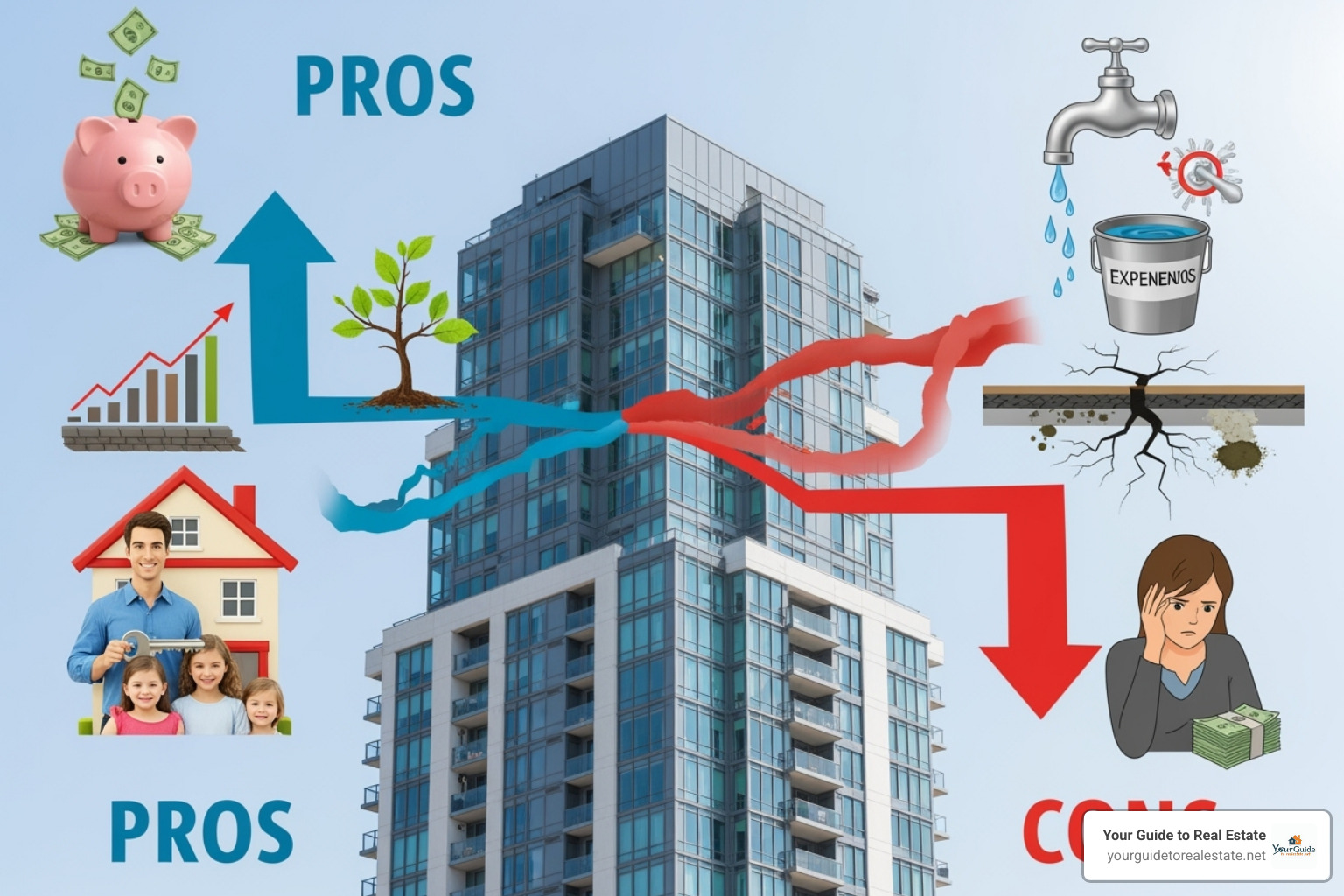
Let’s be honest about what you’re getting into. A non warrantable condo can feel like finding a designer dress at a thrift store – exciting price, but you need to check for hidden flaws.
The resale challenge is real. When it’s time to sell, you’ll face the same financing problems you did. Your buyer pool shrinks to cash purchasers or those who can secure portfolio loans. Fewer potential buyers often means longer time on market and potentially lower offers. It’s basic supply and demand.
Special assessments can blindside you. When an HOA doesn’t have adequate reserves, unexpected repairs become your problem. That leaky roof or broken elevator suddenly requires a special assessment – sometimes thousands of dollars with little warning. While any condo can have special assessments, financially unstable projects face higher risk.
HOA instability affects daily life. High investor concentration or developer control can create management chaos. You might deal with delayed maintenance, unresponsive boards, or decisions that prioritize short-term profits over long-term community health. This directly impacts your quality of life and property value.
Your ownership costs climb higher. Between potentially liftd interest rates on portfolio loans, special assessment risks, and possibly inflated HOA fees due to budget constraints, owning a non-warrantable condo typically costs more than a conventional one.
Maintenance standards may suffer. Buildings with many rental units often experience faster wear and tear. Investment owners might not maintain properties as carefully as residents who live there daily. Distressed owners sometimes sell at discounts, dragging down values for everyone.
But here’s the flip side – non warrantable condos aren’t automatically bad investments. Cash buyers or those with specialized financing access might find excellent opportunities at lower prices. The key is understanding exactly what you’re buying and planning accordingly.
Can a Non-Warrantable Condo Become Warrantable?
Absolutely! A non warrantable condo status isn’t a life sentence. With the right actions, these properties can transition to warrantable status, potentially boosting your investment value.
Litigation resolution opens doors. When lawsuits get settled or courts rule favorably, this major barrier disappears. Sometimes it’s about completing necessary repairs that were the subject of legal disputes, other times it’s reaching financial settlements that clear the air.
Developer turnover signals maturity. Once unit owners take control from the developer, it shows the community has become self-governing and independent. Lenders see this as a positive sign of stability and proper governance.
Financial health improvements matter most. The HOA needs to build reserves to at least 10% of the annual budget and reduce delinquent assessments below 15%. This might require stricter collection policies or temporary assessment increases, but the long-term benefits justify short-term inconvenience.
Occupancy ratios can shift naturally. As investor-owned units sell to owner-occupants, the rental percentage decreases. Some HOAs implement policies encouraging owner-occupancy, though they must be careful not to create restrictions that certain lenders (like the VA) find problematic.
Single-entity ownership gets diluted. When one owner controls too many units, they might sell some properties to meet the 20-25% limits required by major lenders. This reduces concentration risk and improves warrantability prospects.
Commercial space issues are trickier. If commercial usage exceeds 25%, solutions might involve structural changes or re-zoning – complex and expensive fixes. Sometimes a re-evaluation of space classification helps, but this requires professional expertise.
The path to warrantability requires active HOA board involvement, clear communication with residents, and sometimes professional guidance on financial or legal matters. It takes time and effort, but the payoff in increased property values and expanded financing options makes it worthwhile for the entire community.
Conclusion
Navigating non warrantable condo purchases might feel overwhelming at first, but it doesn’t have to derail your homeownership dreams. Think of it as taking a scenic route rather than the highway – it requires more attention and planning, but it can still lead you to your destination.
The reality is that higher risk often comes with potential opportunity. Yes, you’ll face financing problems that conventional condo buyers don’t encounter. You might need to put down 25% instead of 5%, or accept a higher interest rate on a portfolio loan. The pool of future buyers will be smaller when you’re ready to sell. But here’s the flip side: you might also snag a beautiful unit at a lower price point, or find that perfect location that’s been overlooked by other buyers who got scared off by the financing complexity.
The importance of thorough research cannot be overstated when dealing with these properties. This isn’t the time to skip steps or rush through due diligence. Review those HOA documents with a fine-tooth comb. Understand why the project lost its warrantable status. Is it something that can be fixed, like pending litigation that’s about to be resolved? Or is it a more permanent issue, like excessive commercial space?
Work with professionals who understand this specialized market. Your real estate agent should have experience with non-warrantable properties and know which lenders offer portfolio loans in your area. Your lender should be upfront about requirements and realistic about timelines.
A non warrantable condo isn’t a dead end – it’s simply a different path that requires more expertise and patience. Some of the most satisfied homeowners we know found their perfect match in properties that others passed over due to financing concerns.
At Your Guide to Real Estate, we believe every buyer deserves expert insights to make confident decisions, whether you’re exploring conventional properties or venturing into more specialized territory. The key is having the right information and support system to guide you through the process.

Ready to explore your real estate options with confidence? Steer the complexities of the real estate market with our virtual brokerage services.