

Introduction: More Than Just a Number
When you ask how much does a gold bar weigh, you’re asking about more than just its physical mass. The weight of gold bars varies greatly. From tiny grams to massive industrial ingots, the size impacts everything from investment cost to ease of storage.
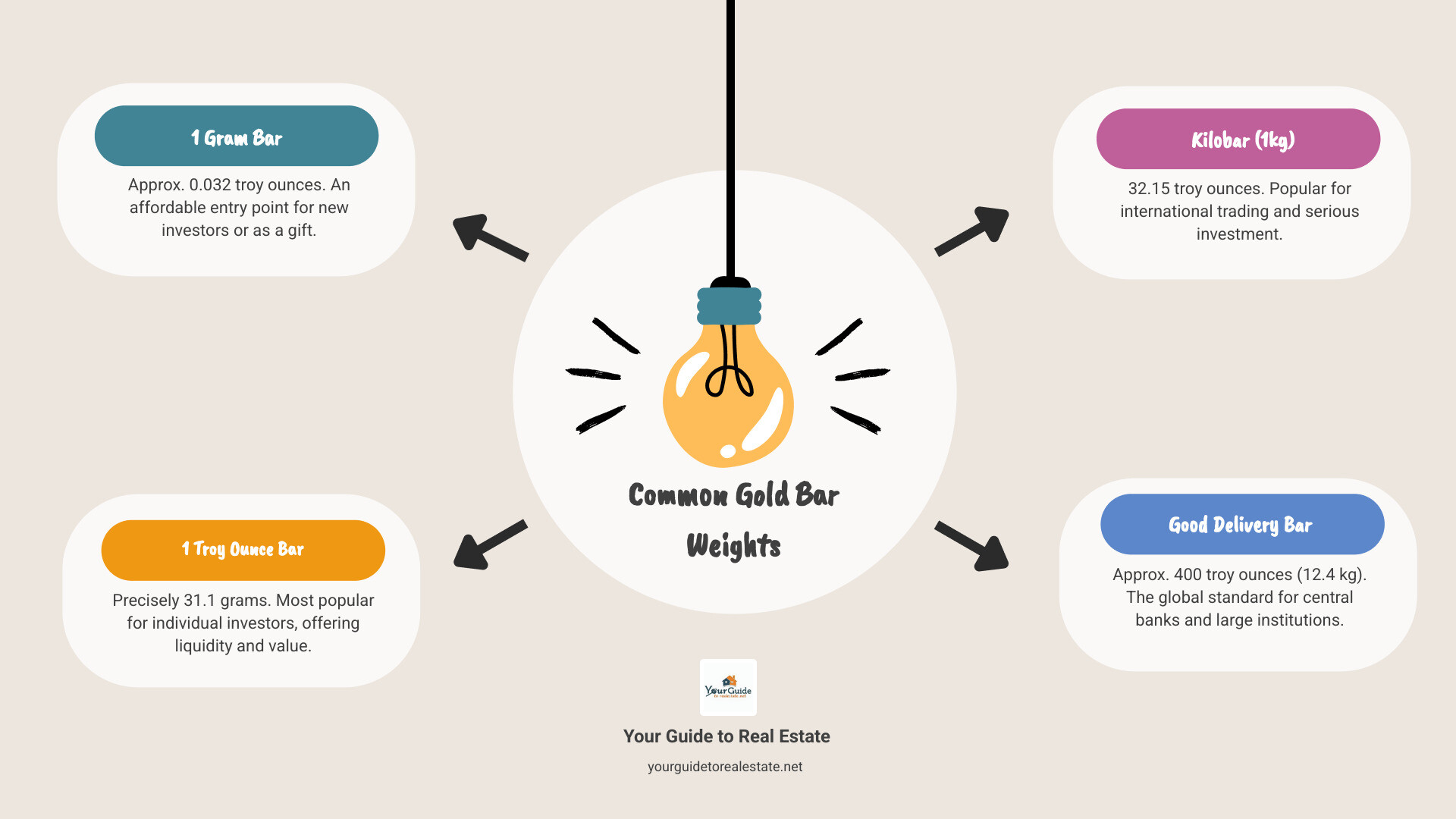
Here are the weights of the most common gold bars:
- Standard ‘Good Delivery’ Bar: Approximately 400 troy ounces (12.4 kilograms or 27.4 pounds). These are typically held by central banks.
- Kilobar: 1,000 grams (32.15 troy ounces). This size is popular for international trading and investment.
- 1 Troy Ounce Bar: Precisely 1 troy ounce (about 31.1 grams). This is the most common size for individual investors due to its balance of value and liquidity.
- 1 Gram Bar: Approximately 0.032 troy ounces. An affordable entry point for new investors or as a gift.
Gold bars often spark images of pirate treasure or bank vaults. But for investors, understanding these weights is crucial. It helps you make smart decisions about a tangible asset. Just as in real estate, knowing the specifics helps you invest wisely. Learn more about how to invest in real estate here.
How much does a gold bar weigh helpful reading:
The Global Standard: ‘Good Delivery’ Gold Bars
When we talk about the “standard” gold bar in the global market, we’re almost always referring to the “Good Delivery” bar. These aren’t the smaller pieces you might find in a jewelry store or a personal investment portfolio. Instead, these are the heavyweights, the true behemoths of the gold world. They’re primarily traded between central banks and major bullion dealers, forming the backbone of international gold reserves.
The rules for these impressive bars are set by the London Bullion Market Association (LBMA). Think of the LBMA as the ultimate referee for the wholesale gold market. They establish super strict standards to make sure every Good Delivery bar is top-notch in quality and authenticity. This means a bar from one approved producer is just as good as a bar from another, making global trade and storage much smoother. Want to dive deep into these rules? You can find the Full List of Official Good Delivery Rules on the LBMA’s website.
This standardization is key for maintaining trust and efficiency in the massive, worldwide gold market. These specific bars are crucial for national gold reserves and institutional trading. Given their immense value and size, they are stored securely in special, recognized gold bullion vaults to ensure they keep their “Good Delivery” status.
Good Delivery Bar Specifications
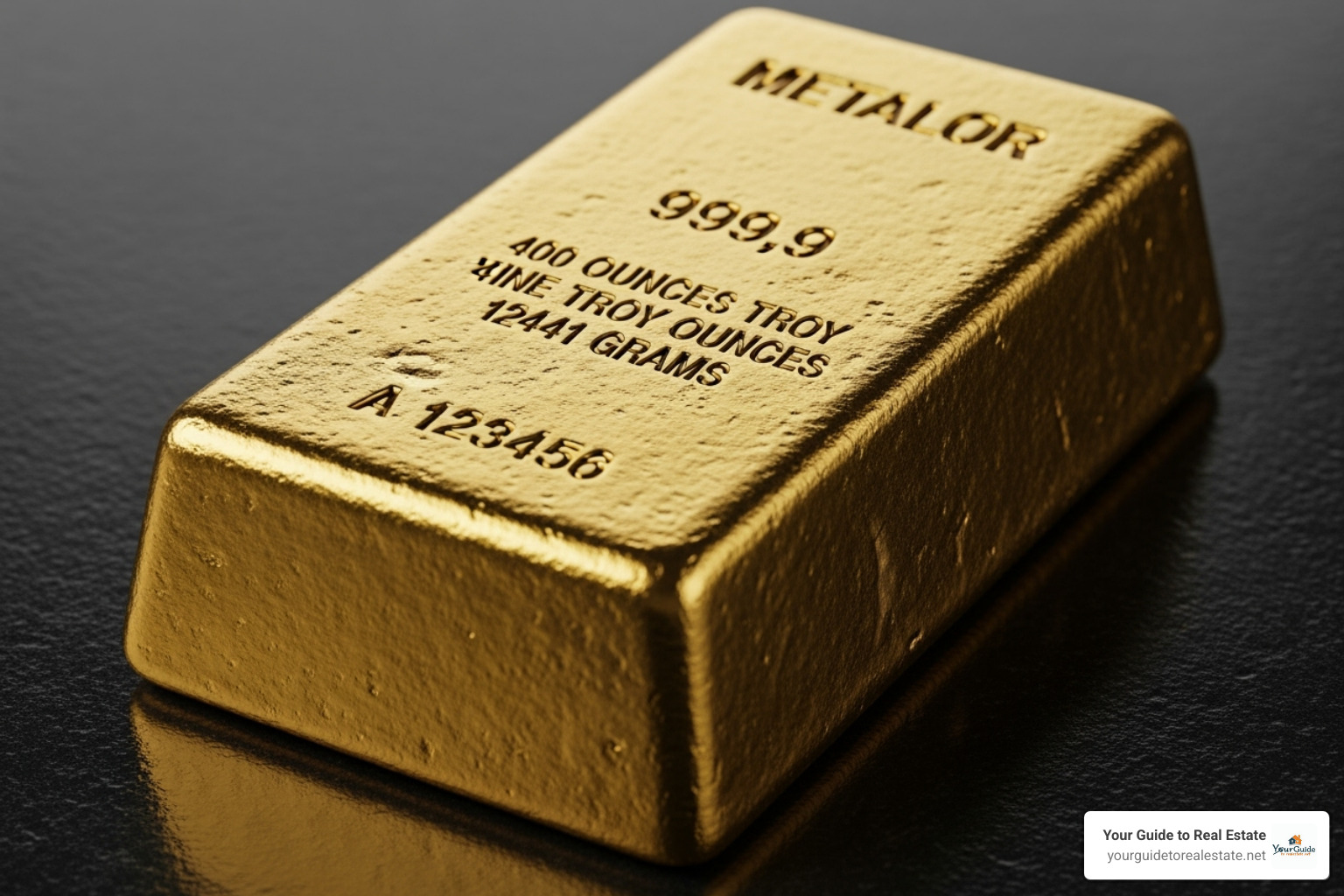
So, how much does a gold bar weigh when it’s one of these prestigious Good Delivery bars? The official, nominal weight for such a bar is a hefty 400 troy ounces. To give you a clearer picture, that’s about 12.4 kilograms or roughly 27.4 pounds. Imagine trying to pick one of these up – it’s quite the workout!
Now, while 400 troy ounces is the target, the LBMA’s standards do allow for a small range. An actual Good Delivery bar can weigh anywhere from 350 to 430 fine ounces (which is about 10.9 to 13.4 kilograms). This flexibility simply accounts for small differences during manufacturing, while still guaranteeing the bar meets all the strict market requirements.
Beyond just the weight, purity is incredibly important. A Good Delivery bar must have a minimum purity, or “fineness,” of 995 parts per 1,000 pure gold. This means it’s at least 99.5% pure gold. This incredibly high level of purity is what makes these bars so valuable and universally accepted.
Each Good Delivery bar also comes with its own unique “identity card” – special markings stamped right onto its surface. These markings are crucial for tracking and authenticity. You’ll typically find:
- A unique serial number for easy identification.
- The refiner’s stamp, which tells you exactly who the LBMA-approved producer was.
- The fineness (like .995) to confirm its purity.
- And the year of manufacture, giving it a clear timestamp.
These markings are absolutely critical for verifying the bar and keeping the global gold supply chain honest and transparent.
Understanding Gold’s Weight: Units of Measurement Explained
When you first start exploring gold investments, you’ll notice something interesting: the measuring system is completely different from what you use at the grocery store. While you might weigh your apples in regular ounces, how much does a gold bar weigh is always measured using a special system designed specifically for precious metals.
The troy ounce reigns supreme in the gold world. This ancient unit traces its roots back to medieval France, specifically to the trading city of Troyes where merchants needed a reliable way to measure valuable commodities. What started centuries ago as a practical solution has become the global standard for weighing gold, silver, platinum, and palladium today.
You’ll also encounter grams and kilograms frequently, especially when dealing with smaller bars or international markets. A kilogram equals exactly 1,000 grams, making it a clean, easy-to-understand measurement that many investors prefer. For a fascinating deep dive into this historical measurement system, check out What Is a Troy Ounce?.
Different regions around the world have kept their own traditional gold measurements alive. In India, the tola remains popular, weighing in at 3.75 troy ounces or about 116.64 grams. Chinese markets often use the tael, which equals roughly 1.20337 troy ounces or 37.429 grams. These regional differences show just how deeply gold is woven into cultures worldwide.
Troy Ounce vs. Standard Ounce
Here’s where many newcomers get confused, and honestly, who can blame them? The “ounce” you know from cooking and everyday life is called an avoirdupois ounce. But when dealing with gold, we always use the troy ounce. And yes, they’re different weights entirely!
A troy ounce actually weighs more than the standard ounce you’re familiar with. This distinction matters enormously when you’re dealing with valuable metals where every fraction counts.
| Unit | Grams (approx.) | Usage |
|---|---|---|
| Troy Ounce | 31.103 | Precious metals (gold, silver, etc.) |
| Avoirdupois Ounce | 28.35 | Everyday goods, groceries, general weight |
The troy ounce weighs 31.103 grams, while the avoirdupois ounce weighs 28.35 grams. So when someone mentions they own an “ounce” of gold, they’re talking about the heavier troy version. This historical quirk means we essentially use two different measuring systems – one for our precious metals and another for everything else in daily life.
Understanding this difference protects you from confusion and ensures you know exactly what you’re buying or selling. Just like in real estate, knowing the precise measurements matters when making significant investments.
How Much Does a Gold Bar Weigh for the Everyday Investor?
For most of us, owning one of those massive 400-troy-ounce “Good Delivery” bars is more of a grand dream than a practical reality! Unless you’re running a central bank or a huge financial institution, you’ll likely be looking at much smaller, more accessible gold bars. These are perfect for private investors like you and me. They offer a wonderful balance of being affordable, easy to buy and sell (that’s liquidity!), and convenient to store.
When you’re figuring out how much does a gold bar weigh for your personal investment, you’ll find a fantastic range of options. Your choice usually comes down to your budget, your financial goals, and how easily you might want to exchange your gold for cash.
Here’s a list of popular gold bar sizes that everyday investors commonly consider:
- 1 Gram Gold Bars
- 5 Gram Gold Bars
- 10 Gram Gold Bars
- 1 Troy Ounce Gold Bars
- 50 Gram Gold Bars
- 100 Gram Gold Bars
- 10 Troy Ounce Gold Bars
- 1 Kilogram Gold Bars
Let’s explore these common sizes a bit more to help you find the perfect fit for your investment journey.
Small Bars: 1 Gram to 10 Grams
These little treasures are often the first step into gold investment for many people. Small gold bars, ranging from 1 gram bars to 10 gram bars, are incredibly popular, and for good reason!
They offer a low entry cost, making them super accessible for first-time investors who want to dip their toes into precious metals without a huge upfront commitment. Imagine starting your gold portfolio with just a few grams! These also make fantastic gifting gold for special occasions like graduations or birthdays – a unique and lasting present.
A 1 gram bar weighs roughly 0.032 troy ounces. To give you an idea of its size, it’s often compared to a small paperclip! While these smaller bars sometimes have a slightly higher premium per gram (because the manufacturing cost is spread over less gold), their affordability and convenience make them a firm favorite.
Medium Bars: 1 Ounce to 100 Grams
As we move up in size, we hit the “sweet spot” for many more serious investors: the medium range of gold bars, from 1 troy ounce bars to 100 gram bars. These sizes perfectly balance value, liquidity, and how easy they are to handle.
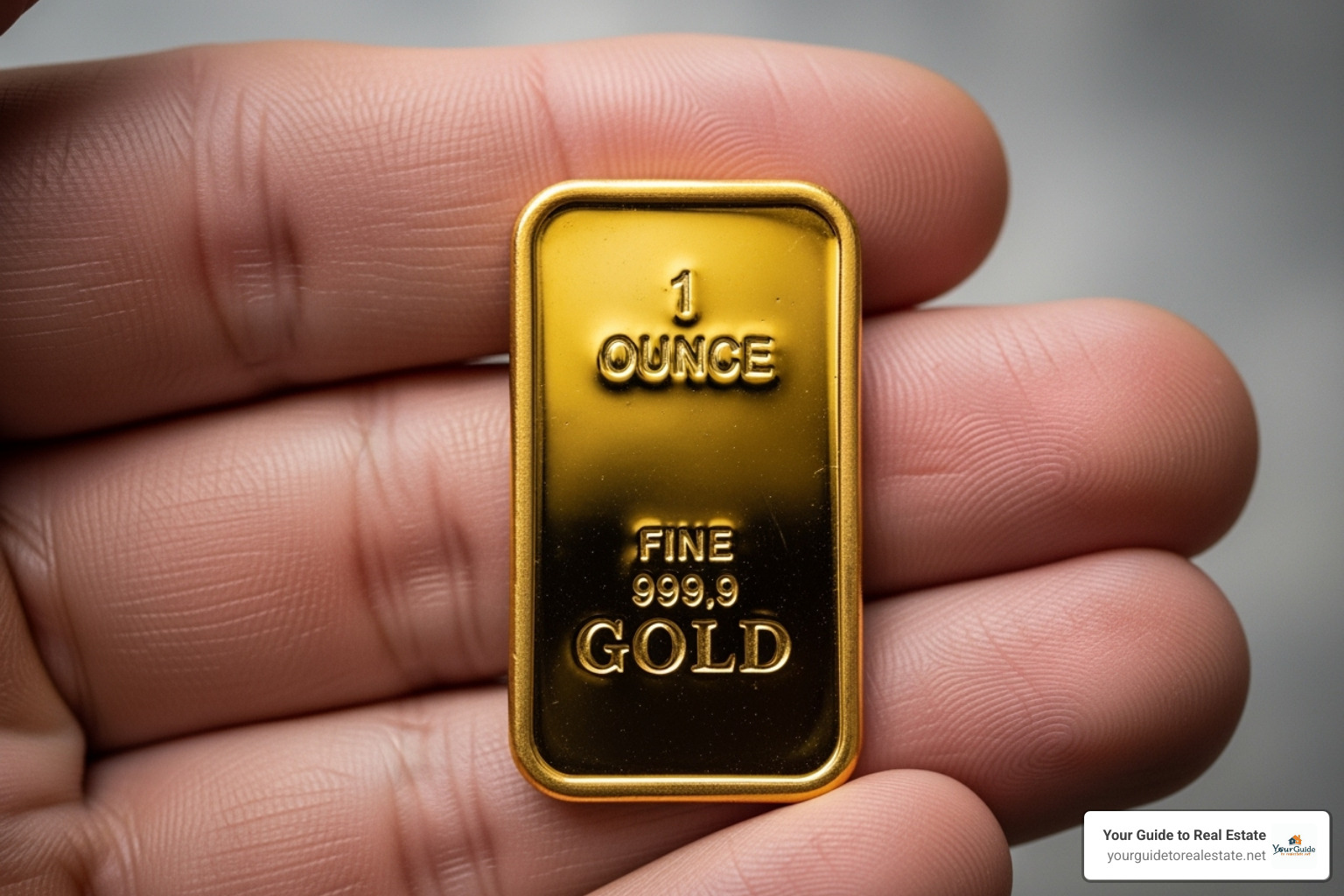
The 1 troy ounce bar is arguably the champion of individual investor choices. It weighs precisely 31.1034768 grams. It’s incredibly recognizable and highly liquid, meaning you’ll have no trouble buying or selling it. Picture its size as roughly equivalent to six US quarters stacked together – compact and easy to store securely.
For those looking to buy a bit more gold, 10 troy ounce bars are a popular pick. They offer a lower premium per troy ounce than their 1-ounce cousins, making them a more cost-effective choice for larger investments. Similarly, 50 gram bars and 100 gram bars are widely loved, especially in international markets. A 100-gram bar, which is about 3.215 troy ounces, offers even better savings per gram, appealing to investors making more significant purchases.
These medium-sized bars truly offer the best of both worlds: better per-ounce savings than the tiny bars, while still being much easier to manage and store than the giant Good Delivery bars.
How much does a gold bar weigh in larger formats?
Beyond what most individual investors typically buy, we get into the field of truly substantial gold bars. Here, the kilobar (1kg) stands out. It weighs a precise 1,000 grams, which translates to a hefty 32.15 troy ounces. If you imagine a small brick, maybe the size of a standard smartphone, but incredibly dense and heavy – that’s a kilobar.
These larger formats are often favored by institutional investors and high-net-worth individuals. They offer significant economies of scale. This means that because the costs of manufacturing and the dealer’s premium are spread over a much larger amount of gold, the premium per troy ounce is usually lower than for smaller bars. This makes them a very cost-effective option for bulk buying. You’ll often find kilobars particularly popular in Asian markets.
While a kilobar might not be in everyone’s immediate investment plan, understanding these larger sizes helps you grasp the full picture of how gold is traded and valued globally. They represent a substantial store of wealth in a compact form, ideal for those building a diverse portfolio with tangible assets.
Factors Influencing a Gold Bar’s Weight and Value
When you’re wondering how much does a gold bar weigh, you’re really asking about more than just the physical mass. The weight matters, sure, but it’s how that weight combines with other factors that determines what you’ll actually pay for your gold investment.
Think of it like buying a house. The square footage matters, but so does the location, condition, and market timing. With gold bars, the spot price serves as your baseline – that’s the current market price for one troy ounce of pure gold. But just like you rarely pay exactly the listing price for a home, you won’t pay exactly spot price for physical gold.
Premiums are where things get interesting. These are the extra costs covering manufacturing, shipping, insurance, and the dealer’s profit margin. A tiny 1-gram bar might carry a 20% premium, while a hefty kilobar might only add 3-5% above spot price. It’s all about economies of scale.
Understanding these financial dynamics is just as crucial as knowing your investment strategy. Just like building wealth through real estate requires understanding market fundamentals, gold investing demands similar financial literacy. Learn more about what it means to be financially free.
How Purity Affects Final Weight and Price
Here’s where things get really interesting. A gold bar’s fineness – its purity level – directly impacts its value, even if two bars weigh exactly the same. It’s like comparing two identical houses where one has been completely renovated and the other needs work.
Most investment-grade gold bars fall into these purity categories. The .995 fineness means 99.5% pure gold, which meets the minimum standard for those massive Good Delivery bars we discussed earlier. Step up to .999 fineness and you’re looking at 99.9% pure gold – what dealers call “three nines fine.”
The premium level is .9999 fineness, representing 99.99% pure gold or “four nines fine.” This is about as pure as gold gets for investment purposes.
When calculating a gold bar’s true value, you multiply its pure gold content (total weight times fineness) by the current spot price. So a 1-ounce bar that’s .999 pure contains slightly less actual gold than a 1-ounce bar that’s .9999 pure. That tiny difference in purity translates to real dollars in your pocket.
How much does a gold bar weigh based on its manufacturing?
The way a gold bar is made affects not just how it looks, but also what you’ll pay for it. There are two main production methods, each with its own character and cost structure.
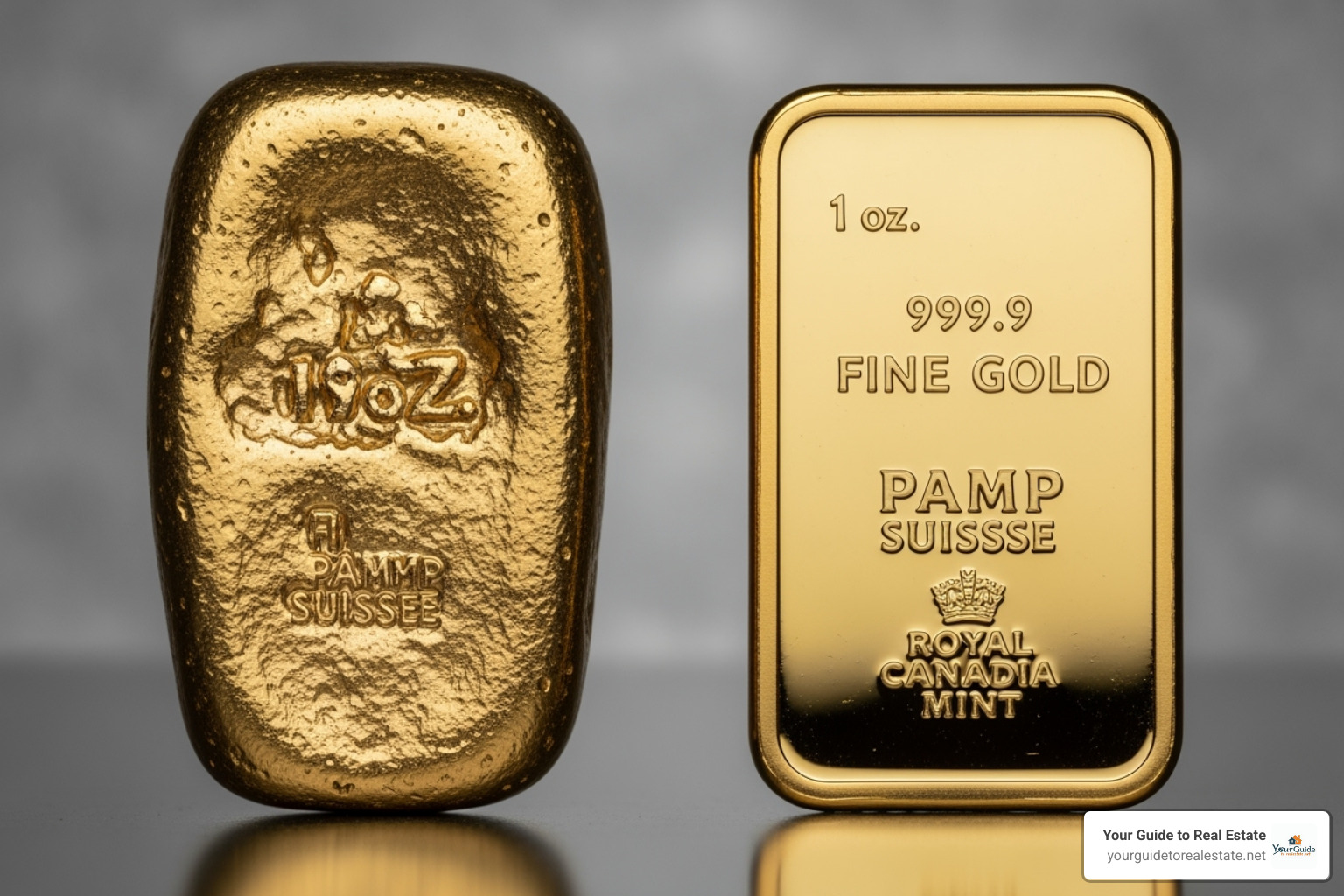
Cast bars are the old-school approach. Picture molten gold being poured into a mold, cooling naturally, and emerging with that classic “gold brick” look. These ingots have character – rough edges, unique textures, and that rustic appearance you see in movies. They’re less expensive to produce, which means lower premiums for you.
Minted bars are the sleek, modern alternative. These start as large gold sheets that get rolled to precise thickness, then cut and stamped with intricate designs. The result? Sharp edges, mirror-like surfaces, and those satisfying clean lines that stack perfectly.
Both types contain the same amount of gold and hold identical intrinsic value. The difference lies in the production process and the premium you’ll pay. Cast bars typically cost less over spot price, while minted bars command higher premiums due to the extra labor and precision involved.
Whether you prefer the rugged charm of cast bars or the refined elegance of minted ones, understanding their manufacturing helps explain why prices vary even when the gold content is identical.
Frequently Asked Questions about Gold Bar Weights
When you’re exploring gold investment, questions naturally arise about weight specifications and practical considerations. Let me address the most common concerns I hear from investors who are curious about how much does a gold bar weigh and what that means for their investment strategy.
What is the most common weight of a gold bar for investors?
The 1 troy ounce gold bar stands out as the clear favorite among individual investors, and for good reason. It’s like the “sweet spot” of gold investing – not too small to carry high premiums, yet not so large that it breaks the bank.
Think of it this way: a 1-ounce bar offers incredible liquidity because dealers and investors worldwide recognize and trade them easily. You won’t struggle to find buyers when it’s time to sell. The affordability factor also makes sense for most people – while it’s still a meaningful investment, it doesn’t require the massive capital commitment of larger bars.
What really makes 1-ounce bars special is their balance of premium and value. You’ll pay lower premiums per ounce compared to tiny gram bars, but you won’t need tens of thousands of dollars like you would for kilobars. Plus, they’re compact and portable – easy to store securely at home or in a safe deposit box.
Many investors find that building a collection of 1-ounce bars gives them flexibility to sell portions of their holdings when needed, rather than being forced to liquidate one massive bar.
What is the heaviest gold bar in the world?
Prepare to be amazed! The heaviest gold bar in the world weighs an incredible 300.12 kilograms (661 pounds 10 ounces). This massive creation comes from the Emirates Minting Factory LLC in Dubai, United Arab Emirates, and holds the official Guinness World Record.
To put this in perspective, that’s like trying to lift a small motorcycle made entirely of gold! Another famous heavyweight is the Mitsubishi Gold Bar in Izu, Japan, which weighs 250 kilograms (approximately 551 pounds). While slightly lighter than the record holder, it’s still an engineering marvel that showcases the incredible density and value of gold.
These colossal bars serve more as displays of wealth and metallurgical achievement than practical investments. They’re fascinating to learn about, but far removed from what any individual investor would ever consider purchasing!
Are bigger gold bars always a better investment?
This question doesn’t have a simple yes or no answer – it really depends on your personal situation and investment goals. Bigger bars do offer some compelling advantages, particularly lower premiums per troy ounce. When manufacturing costs get spread across more gold, you essentially get more value for your money compared to the spot price.
Storage efficiency is another benefit – one large bar takes up less space than dozens of smaller ones totaling the same weight.
However, bigger isn’t always better when you consider the practical challenges. Reduced liquidity becomes a real issue when you need cash quickly. If you own a 100-ounce bar but only need to sell $5,000 worth of gold, you might have to sell the entire bar, creating unnecessary complications.
The higher upfront cost also puts large bars out of reach for many investors. A kilogram bar requires a significant capital commitment that might strain your budget or prevent you from diversifying into other investments.
Storage and security concerns multiply with larger bars too. A single bar representing tens of thousands of dollars requires serious security measures, and professional storage costs can add up over time.
Perhaps most importantly, you face divisibility challenges with large bars. Unlike smaller bars that you can sell individually, you can’t break off a piece of a large bar without destroying its integrity and incurring expensive refining costs.
The “best” size really comes down to your individual circumstances, budget, and how you plan to use your gold investment. Many successful investors find that a mix of sizes, or focusing on highly liquid 1-ounce and 10-ounce bars, provides the most practical and flexible approach to gold ownership.
Conclusion: Weighing Your Options in Asset Investment
Wow, what a journey! We’ve covered a lot of ground, haven’t we? From the tiny 1-gram bar that fits in your palm to the colossal 400-troy-ounce bars held in secure vaults, the answer to “how much does a gold bar weigh” is truly diverse. We’ve explored how the troy ounce stands as the global standard, connecting us to centuries of precious metals trade.
Understanding these different weights, along with crucial details like purity and manufacturing methods, isn’t just trivia. It’s about empowering you to make smart, informed decisions when considering gold as an asset. Think of it as knowing the foundation of a house before you invest – the more you know, the stronger your investment.
Gold, much like real estate, offers a tangible asset that can bring stability and diversification to your portfolio. Both provide a sense of security, acting as a hedge against economic changes and a solid store of wealth. It’s about choosing to put your money into something real, something you can touch and understand.
Just like navigating the property market requires careful research and a clear strategy, so does stepping into precious metals. The principles are surprisingly similar: understand the value, assess your options, and make choices that align with your long-term goals.
Whether you’re looking at a small gold bar to start your precious metals journey or considering property investments, the key is making informed decisions. And just as choosing the right asset is vital, so is selecting the right expert to guide your investments. Learn more about choosing a real estate broker to secure your success in the property market.