
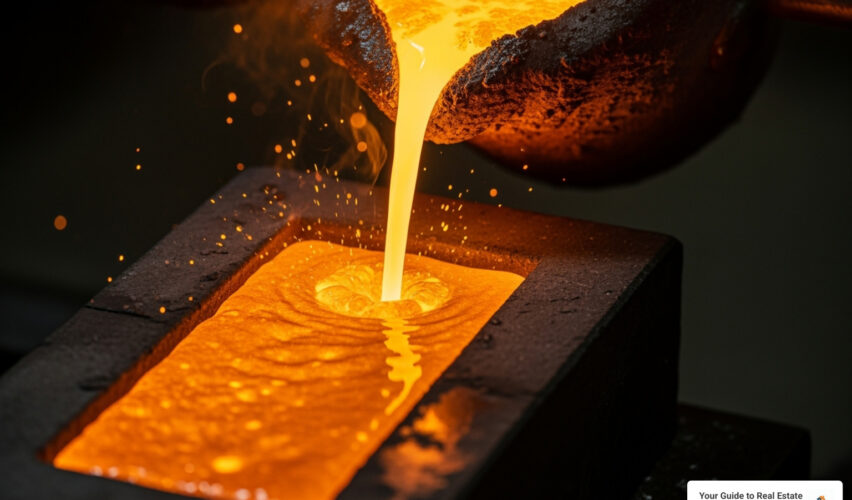
Understanding Gold’s Melting Temperature
Gold melting point is 1,064°C (1,947°F) for pure 24-karat gold. This critical temperature makes gold perfect for jewelry making, electronics, and industrial uses where heat resistance matters.
Quick Reference:
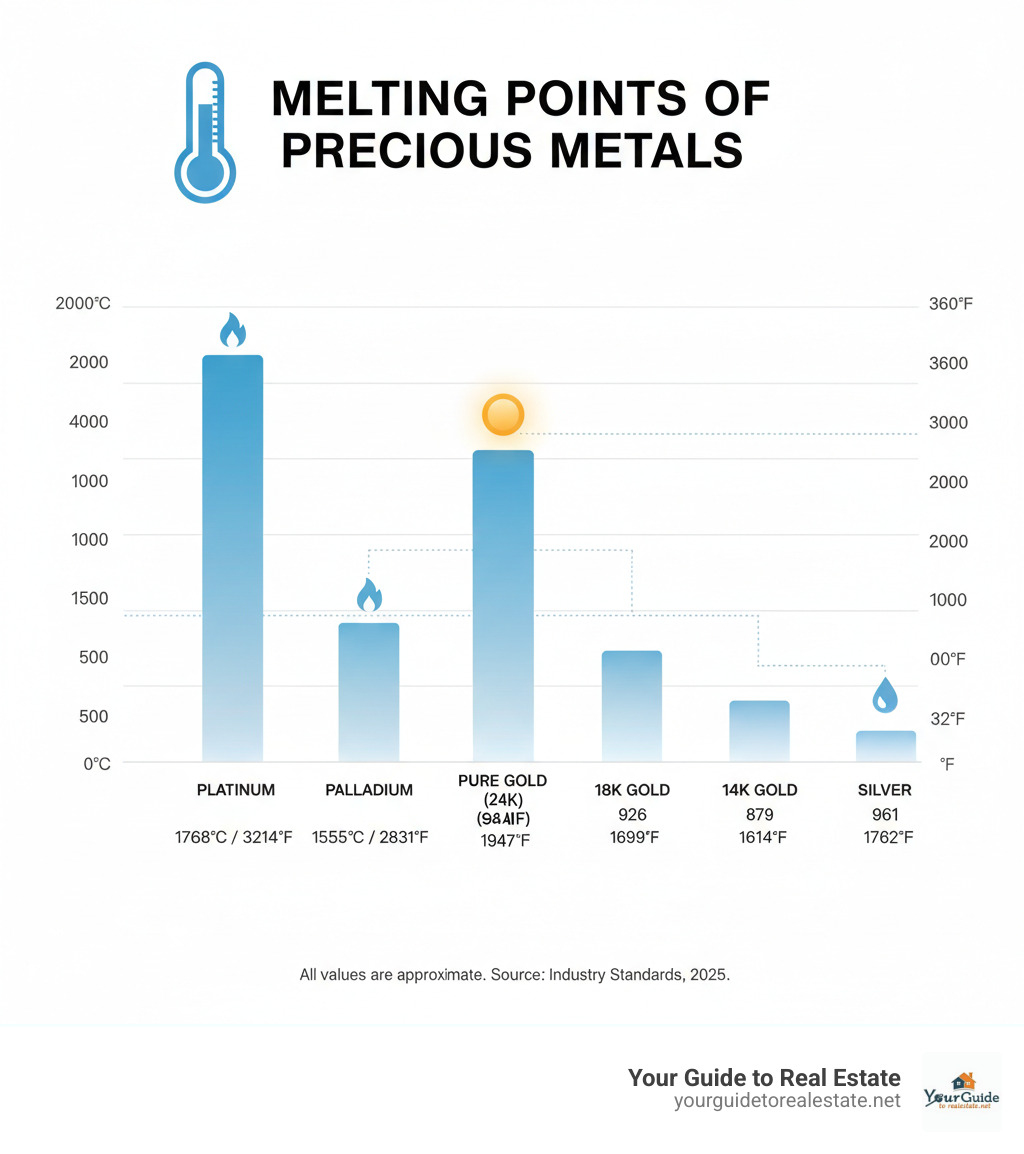
- Pure Gold (24k): 1,064°C (1,947°F)
- 18k Gold: ~926°C (1,699°F)
- 14k Gold: ~879°C (1,614°F)
- Silver: 961°C (1,762°F)
- Platinum: 1,768°C (3,214°F)
Gold’s melting point sits in the middle range compared to other precious metals. It melts at a higher temperature than silver but much lower than platinum. This makes it easier to work with than platinum while still being durable enough for long-lasting applications.
The exact temperature changes when gold gets mixed with other metals to create alloys. Lower karat gold contains more other metals, so it melts at lower temperatures. This is why jewelers can work with 14k gold more easily than pure gold.
Understanding gold’s melting point helps explain why this metal has been valued for thousands of years. Its moderate melting temperature made it workable for ancient craftsmen, while its durability ensured their creations lasted through the ages.
Explore more about gold melting point:
The Science Behind Gold’s Melting and Boiling Points
Gold’s beauty goes far beyond its shine. The real magic happens at the atomic level, where fascinating physics and chemistry create the thermal properties that make gold so special. Let’s explore why the gold melting point is exactly what it is and what that means for how we use this precious metal.
What is the Exact Gold Melting Point?
The gold melting point for pure 24-karat gold is precisely 1,064.18°C (1,947.52°F). Scientists also express this as 1,337.33 K on the Kelvin scale. This exact temperature is so reliable that it’s actually used as a reference point on the International Temperature Scale.
This precision isn’t random. Gold atoms lock together in a crystal structure through metallic bonds. When you heat gold to its melting point, you’re giving those atoms enough energy to break free from their rigid arrangement and start flowing as liquid.
Pure gold’s atomic structure is incredibly consistent. Every piece of 24-karat gold will melt at exactly the same temperature under standard atmospheric pressure. This reliability makes gold perfect for everything from creating precise jewelry to manufacturing electronic components.
The Royal Society of Chemistry provides detailed scientific data confirming these exact measurements. This consistency explains why gold has been trusted for thousands of years – you always know exactly how it will behave when heated.
Beyond Melting: Gold’s Boiling Point and Enthalpy of Fusion
Gold doesn’t just melt – it can actually turn into a gas. Gold’s boiling point reaches an incredible 2,856°C (5,173°F). That’s hot enough to vaporize the metal completely, creating gaseous gold that floats in the air.
This extreme temperature requires specialized equipment with electron beams. But the results are amazing. Gaseous gold creates ultra-thin coatings used in high-tech electronics, medical devices, and even spacecraft components. These coatings take advantage of gold’s excellent conductivity and resistance to corrosion.
There’s another important measurement called enthalpy of fusion. This tells us exactly how much energy it takes to melt gold – 12.55 kJ/mol to be precise. Think of it as the hidden energy cost of turning solid gold into liquid gold.
This energy requirement matters for anyone working with gold. Jewelers, refiners, and manufacturers all need to account for this energy when planning their heating processes. It’s the difference between efficient gold processing and wasting energy.
What Factors Determine a Metal’s Melting Point?
Several key factors work together to determine why gold melts at its specific temperature. Understanding these helps explain why the gold melting point is so important for practical applications.
Atomic structure and metallic bond strength form the foundation. Gold atoms share electrons in a “sea” that holds everything together. Stronger bonds need more heat to break apart. Gold has fairly strong metallic bonds, but not as strong as platinum or tungsten.
Crystal lattice energy describes how much force holds gold’s atomic structure together. Gold atoms arrange themselves in a specific pattern. Breaking this pattern requires the exact amount of heat we know as the melting point.
Impurities can dramatically change melting temperatures. Even small amounts of other metals disrupt gold’s perfect crystal structure. This makes the gold easier to melt, which is why pure gold always has the highest melting point.
Alloys create predictable changes in melting points. When jewelers mix gold with copper, silver, or zinc, they lower the melting temperature. This is why 18-karat gold melts around 926°C and 14-karat gold melts around 879°C – much lower than pure gold.
Atomic mass plays a smaller role, but heavier atoms generally create slightly stronger attractive forces. This contributes to gold’s moderate melting point compared to lighter metals like aluminum or heavier metals like tungsten.
These factors work together to give gold its perfect balance. It’s easy enough to work with using traditional tools, but durable enough to last for generations. This balance explains why ancient craftsmen could create stunning gold jewelry that still amazes us today.
How Purity and Alloys Affect the Melting Point of Gold
Here’s something fascinating about gold: its gold melting point isn’t set in stone. While pure gold has that precise melting temperature of 1,064°C, the moment you mix it with other metals, everything changes. This flexibility is actually what makes gold so valuable in jewelry and industry.
The temperature at which gold melts is not a fixed number; it changes significantly when other metals are introduced. This section explores how purity, measured in karats, and different alloys impact this crucial property.
Melting Points of Common Gold Alloys (18k vs. 14k)
Think of pure 24-karat gold as the baseline – it’s 99.9% pure and melts at that characteristic gold melting point of 1,064°C (1,947°F). But here’s the thing: pure gold is incredibly soft. It’s so malleable that you could literally dent it with your fingernail. That’s why jewelers rarely use pure gold for rings or necklaces that need to withstand daily wear.
The karat system tells us exactly how much pure gold is in an alloy. Higher karat numbers mean more gold, but they also mean the metal stays closer to gold’s original melting point. As we add other metals like copper, silver, and zinc, something interesting happens – the melting point drops.
18-karat gold contains 75% pure gold (that’s 18 parts gold out of 24 total). The remaining 25% consists of alloying metals that make it stronger and more durable. This mixture typically melts around 926°C (1,699°F) – significantly lower than pure gold. The exact temperature can shift slightly depending on whether the jeweler used more copper for a rosy tint or more silver for a paler color.
14-karat gold takes this even further. With only 58.3% pure gold, it’s much harder and more scratch-resistant than its 18k cousin. Its gold melting point drops to around 879°C (1,614°F). This lower melting temperature is actually a blessing for jewelers – it means they can work with the metal more easily and use less energy during the casting process.
10-karat gold, which contains just 41.7% pure gold, melts at an even lower temperature, typically between 870-900°C. The more other metals you add, the more you disrupt gold’s uniform atomic structure, making it easier for the material to transition from solid to liquid.
This isn’t just scientific trivia – it has real-world implications. A jeweler working on a delicate repair needs to know exactly what karat gold they’re dealing with to avoid accidentally melting the piece or not applying enough heat to get a proper bond.
Gold’s Melting Point vs. Other Precious Metals
Gold might be the star of the precious metals show, but how does its gold melting point compare to its glamorous relatives? The differences are more dramatic than you might expect.
| Metal | Melting Point (Celsius) | Melting Point (Fahrenheit) |
|---|---|---|
| Platinum | 1,768 °C | 3,214 °F |
| Palladium | 1,555 °C | 2,831 °F |
| Gold | 1,064 °C | 1,947 °F |
| Silver | 961 °C | 1,762 °F |
Silver melts at 961°C (1,762°F), making it the easiest precious metal to work with. This lower melting point is why silver has been used for centuries in everything from coins to elaborate tea sets. For beginning metalsmiths, silver’s forgiving temperature makes it perfect for learning the craft before moving on to gold.
Platinum sits at the opposite extreme with a whopping melting point of 1,768°C (3,214°F). This incredible heat resistance explains why platinum costs so much and why it’s used in the most demanding applications. Think spark plugs in your car’s engine or laboratory equipment that needs to withstand extreme conditions. In jewelry, platinum’s high melting point means it’s incredibly durable, but it also means working with it requires specialized equipment and expertise. You can learn more about this remarkable metal at Britannica’s platinum page.
Palladium falls right in the middle at 1,555°C (2,831°F). This “goldilocks” temperature – not too high, not too low – makes it valuable in electronics and automotive catalytic converters. It’s hot enough to be durable but not so extreme that it requires the specialized handling that platinum demands.
Gold’s melting point puts it in a sweet spot. It’s high enough to create durable, long-lasting jewelry and components, but low enough that craftsmen throughout history could work with it using relatively simple tools. To put this in perspective, tungsten – the metal with the highest melting point – requires a staggering 3,422°C (6,192°F) to melt. That’s more than three times gold’s melting point!
This moderate temperature requirement is one reason gold has been treasured across cultures for thousands of years. Ancient goldsmiths could achieve the gold melting point with wood-fired furnaces, allowing them to create the intricate artifacts we still admire in museums today.
Practical Applications: Why the Gold Melting Point Matters
Gold’s high melting point isn’t just a random scientific fact – it’s the secret behind why this precious metal has shaped human civilization for thousands of years. From ancient craftsmen to modern engineers, understanding the gold melting point open ups countless possibilities.
Significance in Jewelry and Industrial Manufacturing
Walk into any jewelry store, and you’re witnessing the practical magic of gold’s melting properties. The gold melting point of 1,064°C sits in that perfect sweet spot – hot enough to create durable pieces, yet manageable enough for skilled artisans to work with.
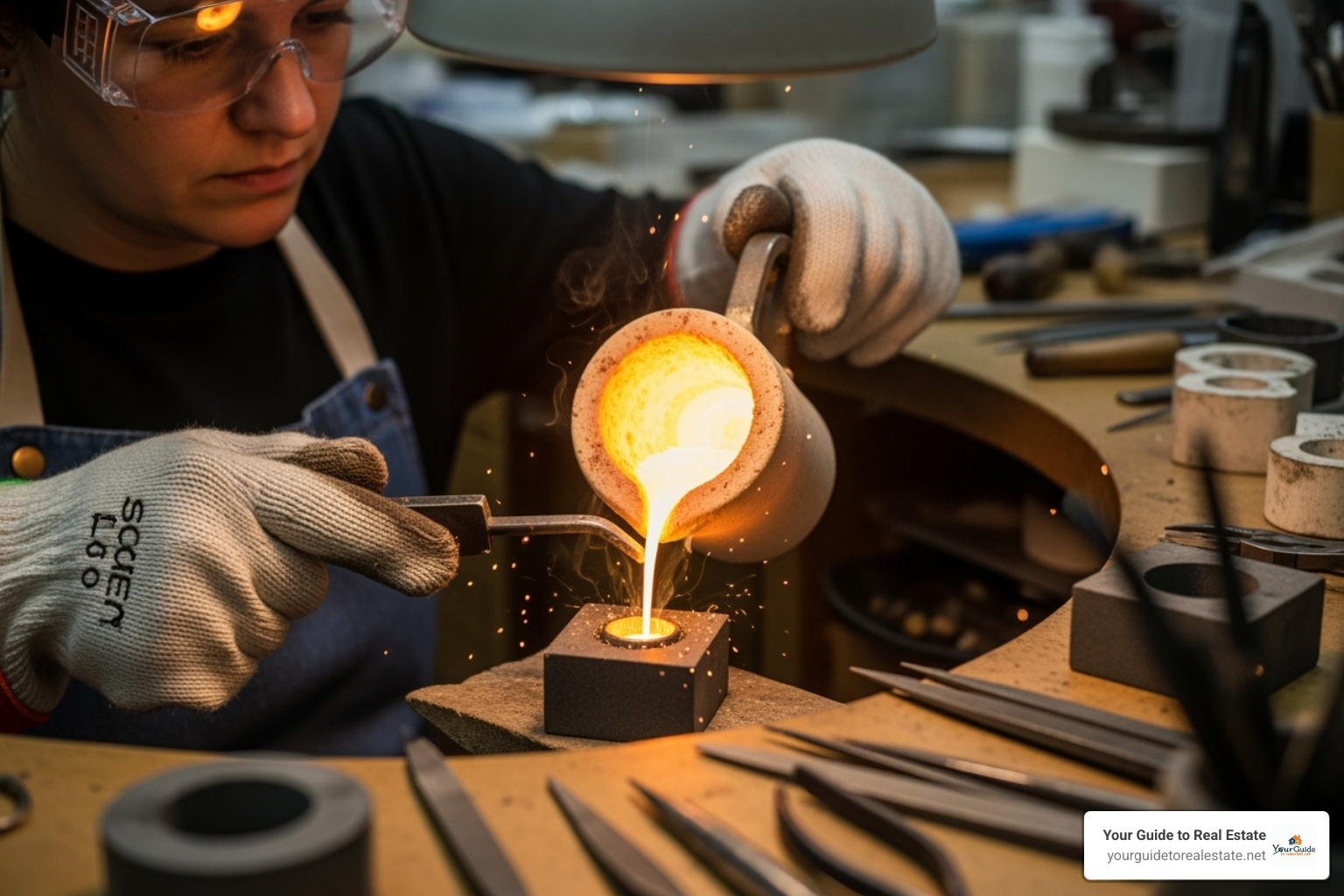
Jewelers love working with gold because once it melts, it becomes incredibly malleable – think of it like liquid sunshine that can be shaped into any design imaginable. Whether they’re creating delicate filigree earrings or sturdy wedding bands that’ll last decades, gold’s predictable melting behavior makes it reliable. The casting process becomes an art form when you can count on gold flowing smoothly into every corner of a mold.
But gold’s thermal properties shine far beyond jewelry counters. In the electronics world, gold’s moderate melting point combined with its excellent conductivity makes it indispensable. Your smartphone, computer, and countless other devices rely on gold connectors and circuit boards. Unlike cheaper metals that might corrode or fail under heat, gold maintains its integrity.
The aerospace industry takes this reliability even further. When a spacecraft faces the brutal temperature swings of space, thin gold coatings protect sensitive equipment. Gold wiring ensures critical systems keep communicating when failure isn’t an option. In dentistry, gold alloys remain popular because they can withstand the heat of your morning coffee while being gentle on your mouth.
Just like understanding material properties helps engineers build better products, grasping market trends helps investors make smarter decisions. The precision needed in metallurgy mirrors the careful analysis required in real estate markets. For insights into current market dynamics, check out Top 7 Real Estate Trends Shaping 2025 and Beyond.
The Role of Melting in Gold Refining and Processing
Every piece of gold jewelry and every gold bar started its journey in a furnace. The gold melting point is absolutely critical to changing raw ore into the pure metal we treasure.
Smelting kicks off the process by heating gold-bearing ore to temperatures well above 1,064°C. Picture a furnace so hot that gold flows like water while impurities either float away as slag or simply vaporize. It’s nature’s way of separating the precious from the ordinary.
Cupellation represents one of humanity’s oldest refining tricks. Ancient metalworkers finded they could heat impure gold with lead in special porous cups. The lead would oxidize and carry away base metals, leaving behind a gleaming bead of pure gold. Even today, this neat process amazes with its simplicity.
Modern refineries use the Miller process, which pumps chlorine gas through molten gold. The chlorine grabs onto impurities, forming compounds that can be skimmed off like foam on soup. This method quickly produces gold that’s 99.5% to 99.9% pure.
For the ultimate purity – the kind used in the most sensitive electronics – the Wohlwill process uses electricity to essentially “plate” ultra-pure gold onto a cathode. This electrolytic method can achieve 99.999% purity.
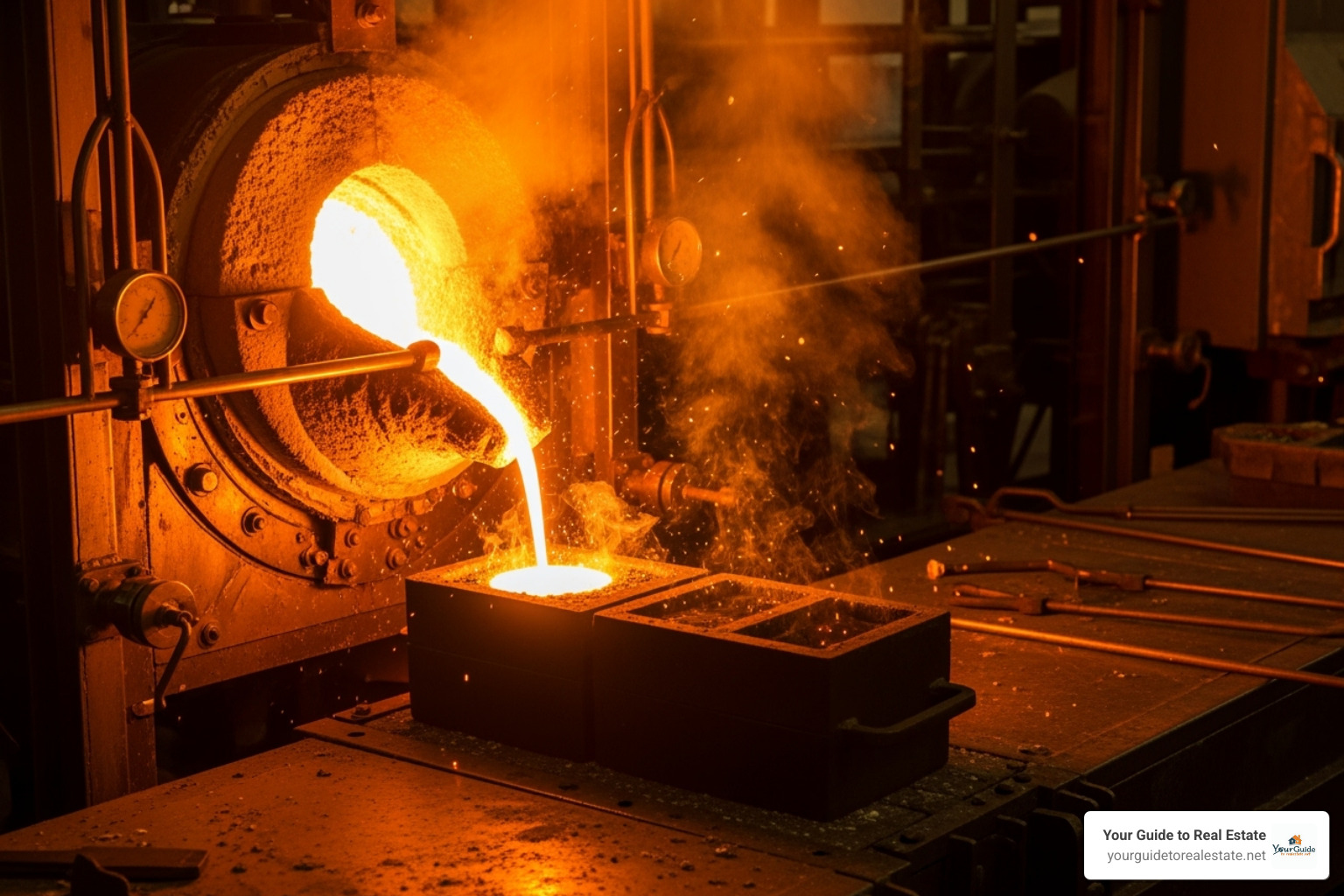
One of gold’s most remarkable qualities is that it can be melted and re-melted countless times without losing its properties. This makes recycling scrap gold incredibly efficient. Old jewelry, dental work, and electronic components can all be melted down and transformed into something new. It’s the ultimate sustainable luxury material.
Safety Precautions for Working with Molten Gold
Working with molten gold might sound glamorous, but it demands serious respect. We’re talking about metal heated to over 1,000°C – that’s hot enough to cause instant, severe burns just from being nearby.
Personal Protective Equipment isn’t optional when dealing with the gold melting point. Heavy-duty heat-resistant gloves that cover your forearms, full face shields, fire-resistant clothing, leather aprons, and closed-toe boots form your armor against extreme heat. Think of it like suiting up for battle against temperature itself.
The right tools matter just as much as protective gear. Crucibles must be rated for temperatures well above gold’s melting point, and they need regular inspection for cracks that could lead to catastrophic spills. Long, sturdy tongs keep you at a safe distance while giving you control over molten metal.
Proper ventilation protects your lungs from any toxic fumes released by impurities or fluxes during melting. Even though pure gold doesn’t produce dangerous gases, you’re rarely working with completely pure material.
Burn risks multiply when molten gold encounters moisture or contaminants – it can splatter unexpectedly like angry cooking oil, but at temperatures that make a kitchen accident seem mild. Work slowly, keep everything dry, and maintain emergency procedures including appropriate fire extinguishers and burn treatment supplies.
The golden rule of working with molten gold? Patience and respect for the extreme temperatures will keep you safe while you work with one of nature’s most precious materials.
Historical and Cultural Significance of Melting Gold
The act of melting gold has captivated humanity for millennia, symbolizing power, purity, and the quest for change. This section looks at the cultural and historical importance of molten gold.
Throughout history, humans have been fascinated not just by gold’s beauty, but by its change from solid to liquid. The gold melting point of 1,064°C made it one of the more accessible metals for ancient craftspeople to work with, leading to incredible artistic achievements and cultural significance that continues today.
From Ancient Forges to Alchemical Dreams
The story of melting gold begins with our earliest civilizations. Archaeological evidence shows that humans were working with gold as far back as 4600–4200 BC, with stunning artifacts finded in the Varna Necropolis in Bulgaria. These ancient artisans quickly realized that gold’s moderate gold melting point made it much easier to shape than harder metals like iron.
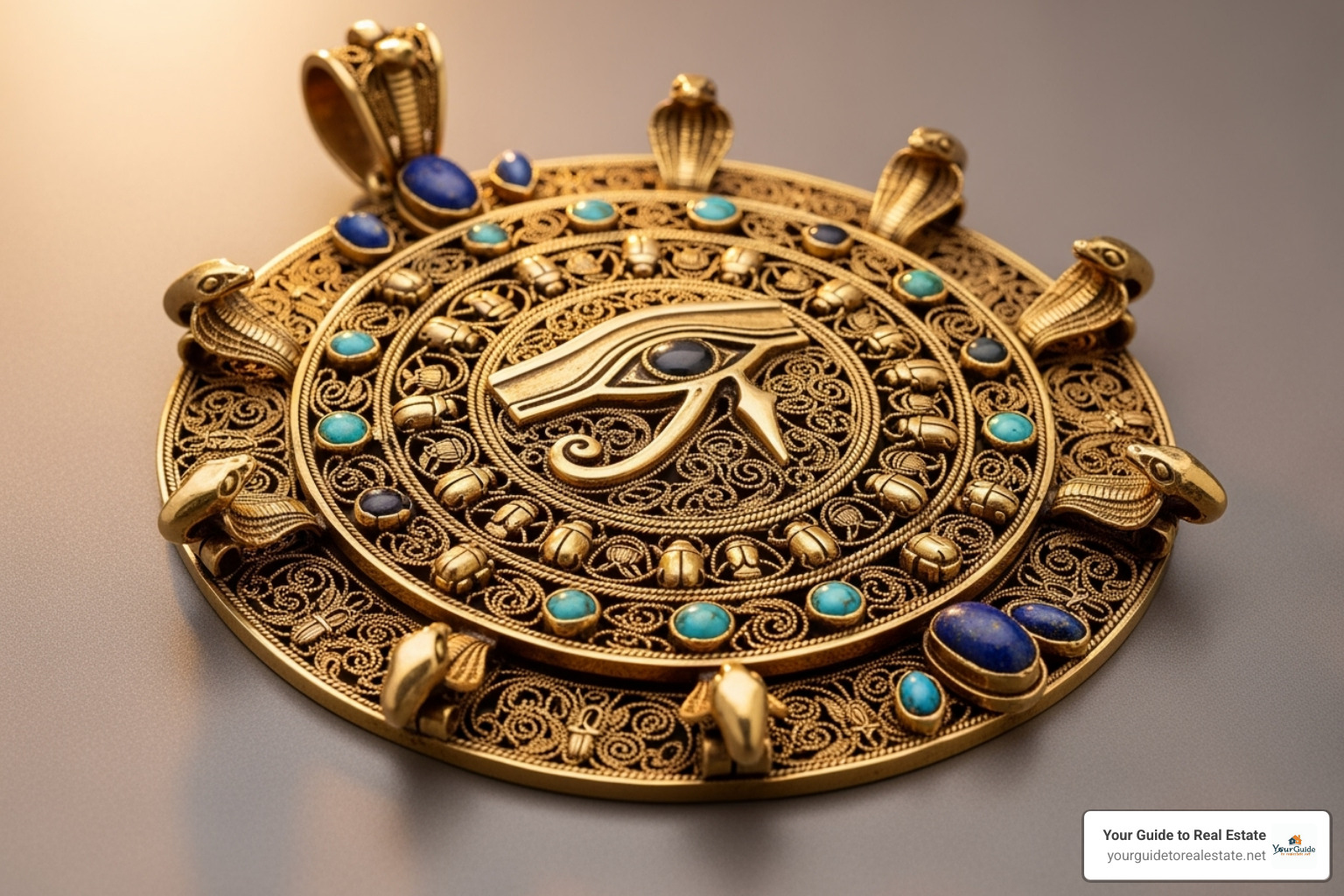
Ancient Egypt stands out as a master of gold craftsmanship. Egyptian metalworkers developed sophisticated techniques like lost-wax casting, where they created intricate molds, melted gold, and poured it to form complex shapes. This process allowed them to craft everything from delicate jewelry to massive ceremonial pieces. The famous death mask of Tutankhamun, with its gleaming gold surface, showcases their incredible skill in understanding how gold behaves when heated and cooled.
The Romans took gold working to new heights, especially in Roman coinage. Their ability to melt gold and cast it into standardized coins became the backbone of their vast empire’s economy. Consistent gold coins meant reliable trade across thousands of miles, all thanks to craftsmen who understood exactly how to heat gold to its melting point and shape it precisely.
But perhaps nowhere was the fascination with melting gold more intense than in alchemy. Medieval alchemists spent lifetimes trying to open up what they saw as gold’s magical properties. They believed that if they could perfect the process of melting and reforming gold, they might find the legendary Philosopher’s Stone – a substance that could turn base metals into gold.
These alchemists experimented endlessly with heating, cooling, and transmutation of metals. While they never achieved their dream of creating gold from lead, their careful observations of how different metals behaved at various temperatures laid important groundwork for modern chemistry and metallurgy.
Gold in Mythology and Symbolism
Gold’s unique properties have made it a powerful symbol across every culture and era. Its resistance to tarnishing, combined with its brilliant shine, has given it meanings that go far beyond simple wealth.
The concept of purity runs deep in gold symbolism. Unlike iron that rusts or silver that tarnishes, gold maintains its beauty forever. This led ancient peoples to associate gold with immortality and divine perfection. When something was described as “pure as gold,” it carried the weight of being incorruptible and eternal.
Wealth and power have always been gold’s most obvious associations. Kings wore golden crowns not just for beauty, but because gold represented ultimate authority. The myth of King Midas perfectly captures humanity’s complex relationship with gold – the king who could turn anything to gold with his touch, but learned that some things are more valuable than precious metal.
Many cultures connected gold directly to their gods and the heavens. The ancient Greeks told epic stories about The Golden Fleece, a symbol of divine favor and rightful kingship that Jason and the Argonauts risked everything to obtain. This wasn’t just about getting rich – it was about proving worthiness for leadership.
Biblical references to gold appear throughout religious texts, from the gold used in Solomon’s Temple to the gifts brought to baby Jesus. In these contexts, gold represented the highest form of offering to the divine, something pure enough to honor God.
The act of melting gold itself carried deep symbolic meaning. When craftsmen heated gold to its gold melting point and watched it transform from solid to liquid, many saw this as a metaphor for purification. Just as heating gold could separate it from impurities, life’s challenges could refine a person’s character, burning away the dross to reveal something more precious underneath.
This powerful imagery of change through fire has echoed through human culture for thousands of years, making gold not just a valuable commodity, but a symbol that speaks to our deepest hopes for improvement, perfection, and lasting worth.
Frequently Asked Questions about the Gold Melting Point
People often ask us about gold’s behavior under heat, especially when they’re curious about working with this precious metal or understanding its properties. The gold melting point is one of the most common topics that comes up. Let’s explore the questions we hear most often.
What temperature does gold melt at?
Pure gold – the kind you’d find in 24-karat form – melts at exactly 1,064°C (1,947°F). This temperature is so consistent that scientists actually use it as a reference point on temperature scales.
But here’s where it gets interesting: not all gold melts at the same temperature. When you have gold alloys like the 18k or 14k pieces you might wear as jewelry, they melt at lower temperatures. Why? Because those other metals mixed in – copper, silver, zinc – disrupt pure gold’s atomic structure.
Think of it like this: pure gold atoms are like perfectly organized dancers moving in sync. Add other metals, and suddenly you have different dancers with different moves, making the whole group easier to break apart with heat.
18k gold typically melts around 926°C, while 14k gold melts even lower at about 879°C. The more other metals you add, the lower that melting point goes.
Does white gold have a different melting point?
Absolutely! White gold is actually an alloy – pure gold mixed with other metals to give it that silvery-white appearance. Since it’s not pure gold, its gold melting point changes based on what’s mixed in.
Most white gold contains metals like nickel, palladium, or silver. Each of these affects the melting temperature differently. Generally, white gold alloys melt somewhere between 850°C to 1,000°C – lower than pure gold but the exact temperature depends on the recipe.
A white gold ring with lots of palladium will behave differently under heat than one with mostly nickel. It’s like baking – change the ingredients, and you change how the final product responds to temperature.
Can you melt gold with a propane torch?
Yes, you can melt gold with a propane torch, but there’s a big but here. While propane torches burn hot enough – reaching temperatures between 1,980°C to 1,995°C – melting gold safely requires much more than just pointing a flame at it.
You’ll need a proper heat-resistant crucible to hold the gold, the right safety gear (think face shields, heat-resistant gloves, and protective clothing), and excellent ventilation. Small amounts of lower-karat gold are definitely doable with this setup.
However, for anything beyond tiny quantities or hobby work, specialized furnaces work much better. They give you better temperature control, are safer to operate, and handle larger amounts more efficiently.
Safety warning: Never attempt to melt gold without proper equipment and safety measures. Molten gold at over 1,000°C can cause instant, severe burns. Always prioritize safety over curiosity.
Conclusion
The gold melting point of 1,064°C stands as one of nature’s most perfectly balanced properties. This precise temperature makes gold the goldilocks of precious metals – not too high like platinum, not too low like silver, but just right for countless applications that have shaped human civilization.
From the ancient Egyptian artisans who first finded they could mold this gleaming metal into intricate treasures, to today’s tech engineers creating the smartphones in our pockets, gold’s melting characteristics have been the secret ingredient in its enduring success. Its moderate melting temperature means craftsmen could work with it using relatively simple tools, while its durability ensures those creations last for millennia.
Understanding how the gold melting point varies with purity helps explain why different gold alloys serve different purposes. Pure 24k gold melts at that signature 1,064°C, but mix in some copper or silver to create 18k or 14k gold, and suddenly you have materials that are easier to work with and more durable for everyday wear. It’s this versatility that keeps gold relevant across industries and centuries.
The comparison with other precious metals reveals gold’s sweet spot in the thermal spectrum. While platinum’s sky-high melting point of 1,768°C makes it incredibly durable, it also makes it challenging to work with. Silver’s lower melting point of 961°C makes it accessible but less heat-resistant. Gold sits comfortably in between, offering the best of both worlds.
Just as understanding the intrinsic properties of materials like gold is essential for determining their value and applications, having deep knowledge of market dynamics is crucial for success in asset valuation. Whether you’re evaluating precious metals or navigating real estate investments, the principles remain the same – thorough analysis leads to better decisions.
Our expertise extends beyond the fascinating world of precious metals to the equally complex field of property valuation. The same attention to detail that helps us understand why gold melts at exactly 1,064°C guides our approach to real estate market analysis. We believe that precision in evaluation, whether for gold or property, is what separates successful investments from costly mistakes.
For expert guidance on assessing the value of your real estate assets and understanding market trends that could impact your investment decisions, let Your Guide to Real Estate help you steer these important financial waters. Learn more about our comprehensive approach to Valuation and Market Analysis in Real Estate and find how our proven framework can help you achieve success in your real estate endeavors.