Why Understanding the White House Floor Plan Matters
The white house floor plan is more than just architectural blueprints – it’s a fascinating look at how America’s most famous residence balances public ceremony with private family life, all within 132 rooms and 55,000 square feet of space.
Quick Overview: White House Floor Plan Basics
- Total Size: 55,000 square feet (Executive Residence only)
- Room Count: 132 rooms, 35 bathrooms across the entire complex
- Main Components: Executive Residence (6 floors), West Wing (3 floors), East Wing (2 floors)
- Key Floors: State Floor (formal events), Ground Floor (services), Second Floor (family quarters)
- Construction: Built 1792-1800, major renovations in 1902, 1948-1952
- Address: 1600 Pennsylvania Avenue NW, Washington, D.C.
The White House sits on just over 18 acres and serves dual roles that make its floor plan unique. Unlike typical residential properties, every room must work for both official state functions and as a home for the First Family.
John Adams, the first president to live there, famously wrote: “I pray Heaven to bestow the best of blessings on this House, and all that shall hereafter inhabit it. May none but honest and wise men ever rule under this roof.”
What makes the White House floor plan especially interesting is how it’s evolved over time. President Jefferson’s office in 1803 was located in what we now call the State Dining Room. The famous Oval Office didn’t exist until 1909, when President Taft had it built.
The layout reflects centuries of changing needs – from adding the West Wing in 1901 to house growing staff, to the complete interior reconstruction under President Truman between 1948-1952 when the building was literally falling down.
For real estate enthusiasts, the White House represents the ultimate example of adaptive architecture – a building that maintains its historic character while constantly updating to meet modern functional needs.

Explore more about white house floor plan:
The White House Complex: A Three-Part Layout
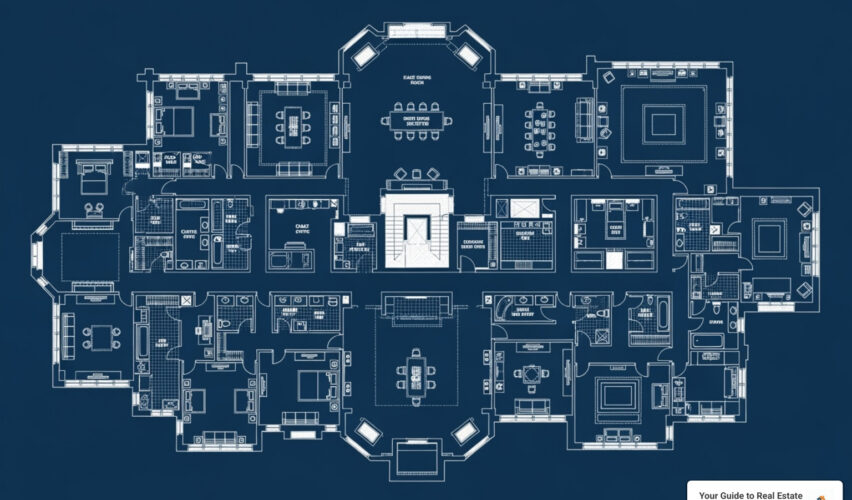
Think of the white house floor plan as three interconnected buildings working together like a well-orchestrated symphony. The White House isn’t just that iconic white building you see in photos – it’s actually a carefully designed complex with three distinct parts, each serving its own vital purpose.
The Executive Residence sits proudly in the center, serving as both the First Family’s home and the nation’s most formal entertaining space. Flanking it on either side are the West Wing (the business hub where presidential decisions happen) and the East Wing (the public face and First Lady’s domain). Neat colonnades connect these wings to the main residence, creating covered walkways that are both practical and beautiful.
The entire complex sprawls across 18 acres of carefully maintained grounds and gardens. To put that in perspective, 18 acres is roughly the size of 14 football fields – quite impressive for a downtown location! If you’re curious about land measurements and what an acre really looks like, our guide on How Big Is an Acre? breaks it down in simple terms.
With 132 rooms and 35 bathrooms spread across all three buildings, this complex makes even the largest luxury homes look modest by comparison.
The Executive Residence: Home and History
The Executive Residence is where the magic happens – it’s simultaneously America’s most important family home and its grandest entertainment venue. This six-story, 55,000-square-foot building has to work double duty every single day, hosting everything from intimate family dinners to elaborate state banquets.
Each floor tells its own story and serves a distinct purpose. The Ground Floor might sound like a basement, but it’s actually a busy hub of activity. Here you’ll find the Library, Map Room, China Room, and Diplomatic Reception Room, along with offices for the Curator and Secret Service. It’s essentially the building’s operational backbone.
The State Floor is where the real show-stopping happens. With those magnificent 18-foot ceilings (soaring even higher to 20+ feet in the East Room), this floor was designed to impress. The Entrance Hall with its sweeping Grand Staircase sets the tone for the eight formal rooms that host presidents, prime ministers, and dignitaries from around the world. You can explore detailed layouts of the White House Residence First Floor to see how these spaces connect.

The Second Floor offers a completely different atmosphere – this is the First Family’s private sanctuary. Here you’ll find the President’s Bedroom, the Yellow Oval Room (perfect for informal meetings), and famous guest rooms like the Lincoln Bedroom and Queen’s Bedroom. It’s designed for comfort and privacy, giving the family a break from the fishbowl of public life.
The Third Floor started life as an attic but has evolved into a recreational haven. It houses an exercise room, music room, wet bar, and sunroom – essentially everything a family needs to unwind and stay entertained.
Don’t miss the Truman Balcony on the South Portico, added during President Truman’s massive renovation. It gives the First Family a private outdoor space where they can actually step outside without causing a security incident.
The West Wing: The Nerve Center of Power
If the Executive Residence is the heart of the White House, then the West Wing is definitely the brain. This is where the real work of running America happens, and it’s busier than a real estate office during peak buying season.
President Theodore Roosevelt created the West Wing in 1901 because the main house was getting overcrowded with staff and official business. Smart move – it separated family life from the intense demands of governing. The West Wing might look impressive from the outside, but inside it’s surprisingly compact and efficient, designed for maximum productivity rather than grandeur.
The Oval Office is the crown jewel here – arguably the most famous office in the world. President Taft created the first Oval Office in 1909, though it’s moved locations a few times since then. This is where presidents make history, sign legislation, and address the nation. The famous Resolute Desk often serves as the room’s centerpiece.
Other critical spaces include the Cabinet Room (where the president meets with top advisors), the Situation Room (a high-tech underground command center that never sleeps), and the Roosevelt Room (named for both Theodore and Franklin Roosevelt). The Press Briefing Room is where the White House Press Secretary faces the media daily – definitely not a job for the faint of heart!
The intensity and variety of work happening in the West Wing reminds me of another demanding profession that juggles multiple priorities daily. If you’re curious about high-pressure careers, check out The Day-to-Day Life of a Real Estate Agent: What You Didn’t Know.
The East Wing: The Public Entrance
The East Wing might be the quietest of the three main buildings, but it plays a crucial role in how the White House connects with the public. Think of it as the welcoming committee and the First Lady’s headquarters all rolled into one.
This two-story building serves as the main visitor entrance for public tours. It’s designed to manage the flow of thousands of tourists while maintaining the security the White House requires. The White House Family Theater provides entertainment for the First Family and their guests – imagine having your own private movie theater!
The First Lady’s office and her staff are headquartered here, along with the Social Secretary who plans and executes all those elaborate state dinners and official functions you see on the news. These events don’t plan themselves – it takes a dedicated team to pull off entertaining world leaders.
The East Wing also houses the Presidential Emergency Operations Center (PEOC), a highly secure underground bunker designed to protect key officials during emergencies. It’s not something anyone hopes to use, but it’s reassuring to know it’s there.
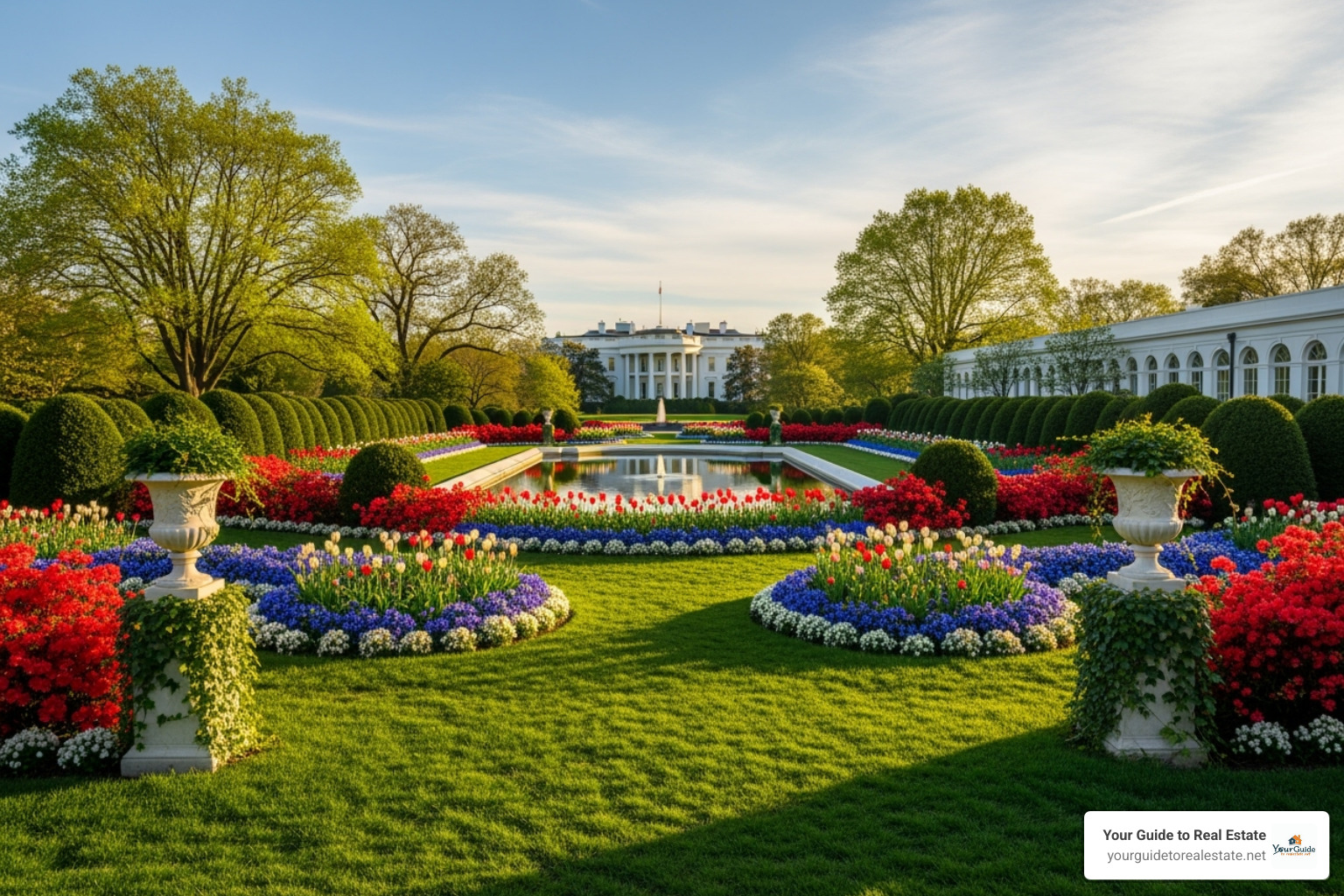
Step outside the East Wing and you’ll find the beautiful Jacqueline Kennedy Garden, a formal garden that’s perfect for ceremonies and outdoor events.
The Evolving White House Floor Plan: A Historical Journey
The white house floor plan we admire today tells a fascinating story that spans over two centuries. What started as one man’s architectural vision has transformed through wars, renovations, and the ever-changing needs of American presidents into the complex we know today.
Back in 1792, President George Washington launched an architectural competition to design the President’s House. The winner? James Hoban, an Irish-born architect whose Neoclassical style design captured exactly what the young nation wanted to project – dignity, stability, and democratic ideals.
Hoban drew inspiration from European architecture, particularly Dublin’s Leinster House and possibly France’s Château de Rastignac. His design featured Palladian influences with their emphasis on symmetry, proportion, and classical details. It was bold, it was beautiful, and it was meant to last.
Construction began immediately, but progress was slow. By 1800, when John Adams became the first president to move in, workers were still putting finishing touches on rooms. Adams famously had to hang laundry in the unfinished East Room!
Then came 1814 and the War of 1812’s most devastating moment for the White House. British forces marched into Washington and set the building ablaze, leaving only the exterior stone walls standing. The sight of America’s most important residence in ruins was heartbreaking, but it also showed the nation’s resilience.
James Hoban returned to oversee the reconstruction, and by 1817, the White House was ready for occupancy again. The experience taught everyone involved valuable lessons about construction quality and fire safety – lessons that still influence how we build important structures today. If you’re curious about modern construction costs and considerations, our guide on How Much Does It Cost to Build a House? offers helpful insights.
Comparing the Early White House Floor Plan to Today
Imagine walking into Thomas Jefferson’s White House in 1803. You’d find a much simpler, more intimate space than today’s complex. The early white house floor plan reflected a smaller government and the personal style of America’s third president, who had strong opinions about architecture and design.
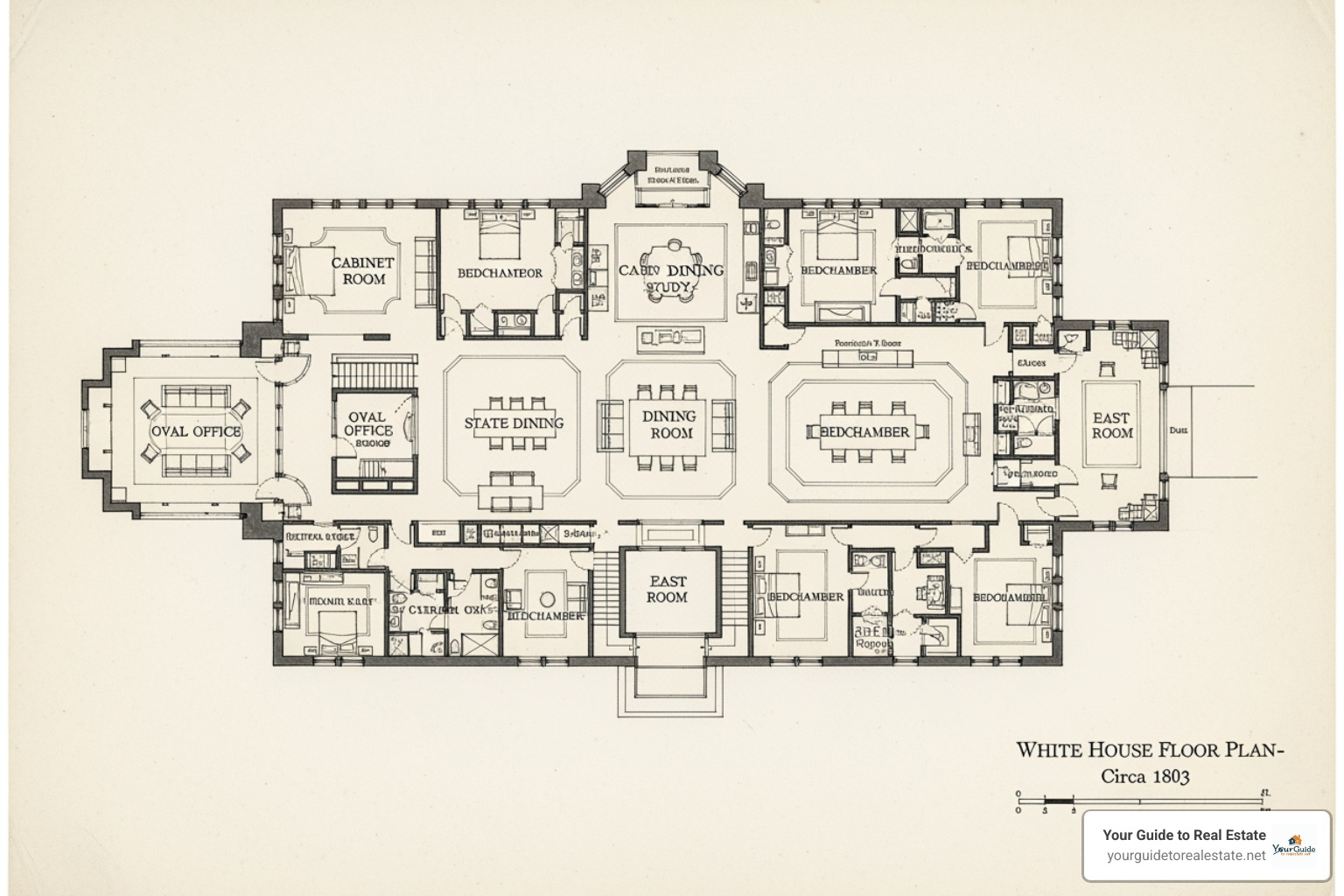
Jefferson set up his office in what we now call the State Dining Room. This wasn’t just any office – it was packed with maps, charts, globes, and books, reflecting his curiosity about the expanding American frontier. When he wanted to entertain guests for dinner, he used what we know today as the Green Room.
The architect Benjamin Henry Latrobe worked closely with Jefferson on modifications, helping create spaces that matched the president’s vision of democratic accessibility. Jefferson even installed the first water closets (early toilets) and had ice cream served at dinner parties – quite for the time!
The differences between then and now are striking. In Jefferson’s era, the original State Dining Room was where Jefferson conducted the nation’s business. The kitchen occupied space on the Ground Floor that now houses offices and storage. Most telling of all, the entire government operation fit within the main residence – something unthinkable today.
You can explore these fascinating historical layouts in detail through the Early White House Floor Plans collection, which shows just how dramatically the building’s use has evolved.
| Room/Area in 1803 (Jefferson’s Era) | Modern Equivalent/Function |
|---|---|
| “Library or Cabinet” Room (Jefferson’s Office) | Part of the State Dining Room |
| Jefferson’s Dining Room | The Green Room |
| Original Kitchen (Ground Floor) | North Hall & Curator’s Office |
| Overcrowded main residence | Offices moved to West Wing (1901) |
| Attic (often for servants) | Third Floor (Guest/Recreation) |
Major Renovations That Shaped the Layout
The white house floor plan has been reinvented several times, each change driven by necessity, disaster, or presidential vision. These weren’t just cosmetic updates – they were fundamental reimaginings of how America’s most important house should work.
The 1902 Roosevelt Renovation marked a turning point. Theodore Roosevelt looked around the Executive Residence and saw chaos – staff everywhere, children running through hallways, and no clear separation between family life and running the country. His solution was brilliant: move all the work spaces out of the main house entirely.
Roosevelt built what he called a “temporary” Executive Office Building (now the West Wing) and relocated every single presidential office there. Suddenly, the White House became both a home and an office complex, rather than one crowded building trying to do everything.
President Taft took things further in 1909 by creating the first Oval Office within the expanded West Wing. This wasn’t just about having a nice office – the oval shape was symbolic, representing equality and democracy with no head table or corner seats.
Disaster struck again in 1929 when a fire tore through the West Wing on Christmas Eve. President Hoover used this setback as an opportunity, rebuilding with modern steel and concrete construction and installing the building’s first air conditioning system.
But the most dramatic change came during Harry Truman’s presidency between 1948-1952. Engineers finded that the White House was literally falling apart – floors sagged, walls cracked, and the building was in danger of collapse. Truman made an extraordinary decision: gut the entire interior while preserving the historic exterior walls.
The Truman Reconstruction involved excavating new basement levels, installing a completely new steel frame structure, and rebuilding every interior space from scratch. At $5.7 million (about $69 million today), it was expensive, but it gave the White House the structural integrity to last for generations.
The 1960s brought a different kind of renovation when Jacqueline Kennedy launched her famous restoration project. Rather than changing the structure, she focused on changing the White House into a “living museum” of American history. Working with experts and even a Paris design firm, she collected period furniture and artifacts that told the story of American presidents.
Jackie’s vision was both practical and poetic – she wanted visitors to feel connected to history while ensuring the First Family had a beautiful home. Her meticulous approach to blending preservation with livability is beautifully documented in Designing Camelot: The Kennedy White House Restoration.
Deconstructing the Modern White House Floor Plan
Today’s white house floor plan represents a fascinating balance between public access and security needs, historical preservation and modern functionality. It’s a living example of how properties must adapt to changing times while maintaining their essential character.
The most visible change has been the dramatic shift toward security. The White House once welcomed visitors who could simply walk up to the front door. Pennsylvania Avenue bustled with traffic right past the North Lawn. But events like the Oklahoma City bombing in 1995 and especially September 11, 2001, changed everything.
Pennsylvania Avenue’s closure to vehicular traffic created a secure perimeter but also transformed the White House’s relationship with the city around it. What was once an accessible symbol of democracy became a fortress, though still open for carefully managed public tours.
Despite these security measures, the modern White House accepts contemporary amenities that would astonish early presidents. Hidden within this historic structure, you’ll find a single-lane bowling alley where presidents can unwind, a movie theater for private screenings, and a swimming pool for exercise and relaxation.
The grounds include a tennis court and putting green, while solar panels (first installed by Carter, removed by Reagan, then reinstalled by Obama) represent the building’s ongoing adaptation to environmental concerns.
These modern additions show how even the most historically significant properties can integrate new technologies while preserving their character. This balance between tradition and innovation mirrors trends we’re seeing throughout real estate today, as explored in our article about The Smart Home Boom: How Proptech Is Redefining Real Estate in 2025.
The White House proves that successful properties – whether historic landmarks or family homes – must evolve with their occupants’ changing needs while staying true to their fundamental purpose.
A Tour of Significant Rooms and Their Functions
The real magic of understanding the white house floor plan comes alive when you step inside and explore the individual rooms. Each space tells its own story, from the grandest ceremonial halls to the most intimate family retreats. These aren’t just rooms – they’re living pieces of American history where presidents have made world-changing decisions, hosted foreign dignitaries, and tried to maintain some semblance of normal family life.
What’s fascinating is how each room serves multiple purposes. The same space that hosts a formal state dinner might later witness a president signing historic legislation or holding a critical press conference with world leaders.

The State Floor: Rooms for Ceremony and Diplomacy
The State Floor is where America puts on its finest face for the world. With those impressive 18-foot ceilings soaring overhead, every room feels designed to inspire awe and respect. This is diplomacy in architectural form.
The East Room takes center stage as the largest room in the entire White House. Think of it as America’s living room for the world – it’s where presidents hold major press conferences, sign important bills, and host concerts that make headlines. The room has witnessed everything from children’s Easter egg rolls to solemn state ceremonies.
Moving through the State Floor, you’ll find the Green Room, Blue Room, and Red Room – each named for their distinctive color schemes. These parlors serve as neat reception areas where smaller, more intimate diplomatic conversations happen. The Blue Room, with its distinctive oval shape, is particularly special for receiving lines and formal greetings.
The State Dining Room is where culinary diplomacy unfolds. This grand space can accommodate over 100 guests for state dinners, where international relationships are often strengthened over carefully planned menus. It’s amazing to think that what was once President Jefferson’s office space has become this centerpiece of American hospitality.
Connecting these magnificent spaces, the Cross Hall serves as both a gallery for presidential portraits and a processional route during formal events. The Entrance Hall, with its soaring 19-foot ceilings, sets the tone from the moment distinguished guests step foot on the State Floor.
Here are some of the most memorable events that have taken place in the East Room:
- President Lincoln’s funeral viewing in 1865
- President Roosevelt’s children roller-skating and playing games
- The first White House wedding (Nellie Grant in 1874)
- Countless presidential press conferences and bill signings
- State performances by world-renowned musicians
- Holiday celebrations and receptions for thousands of guests
The Private Quarters: The Second and Third Floors
After all the pomp and ceremony downstairs, the second and third floors offer something every family needs – privacy and comfort. These floors represent the white house floor plan at its most personal, where First Families try to create normalcy amid extraordinary circumstances.
The Second Floor serves as the main family residence. The Yellow Oval Room often becomes the family’s informal living room, where presidents can relax with family or hold casual meetings away from the formal West Wing atmosphere.
The Lincoln Bedroom carries tremendous historical weight, though it’s somewhat misnamed – Lincoln actually used this space as his office, not his bedroom. Today, it serves as one of the most prestigious guest rooms in America, furnished with period pieces that transport visitors back to the Civil War era.
The Queen’s Bedroom and President’s Bedroom round out the sleeping quarters, providing comfortable spaces for the First Family and their most important guests.
The Third Floor shows how adaptable the White House really is. What started as simple attic space has evolved into a recreational haven. The Solarium offers bright, sunny relaxation space, while the Music Room provides a place for artistic expression. There’s even an exercise room and wet bar – proving that even presidents need places to unwind.
This separation between public and private spaces mirrors what we see in residential real estate today, where homeowners carefully balance entertaining areas with personal retreats. The concept isn’t unlike the distinctions you’ll find in different housing types, as explored in our guide on Difference Between Condo and Townhouse.
Iconic Workspaces: The Oval Office and Situation Room
No discussion of the white house floor plan would be complete without highlighting the two most powerful rooms in America – spaces where decisions affecting millions of lives are made daily.
The Oval Office stands as perhaps the most recognizable workspace in the world. Its distinctive oval shape, created by President Taft in 1909, was designed to promote equality in meetings – no one sits at the “head” of an oval room. The famous Resolute Desk, carved from a British ship and gifted to America, has supported the work of presidents for generations.
What makes this room truly special isn’t just its symbolic power, but its functionality. Presidents conduct daily briefings here, meet with world leaders, record addresses to the nation, and make decisions that shape global events. It’s both a Symbol of the Presidency and a highly practical workspace.
Deep beneath the West Wing lies the Situation Room – though calling it a single room understates its complexity. This is actually a suite of conference rooms and intelligence centers where the National Security Council operates around the clock. It’s the President’s window into global events, equipped with secure communications technology that allows for real-time response to international crises.
The Situation Room represents the modern presidency’s need for instant information and rapid decision-making. It’s a 24/7 operations hub where national security professionals monitor threats, coordinate responses, and brief the President on developing situations worldwide.
These workspaces highlight how the White House has adapted to meet the demands of modern governance, much like how technology is revolutionizing other professional environments. The efficiency and connectivity required here mirrors trends we’re seeing across industries, including the growing use of Virtual Real Estate Assistant services to manage complex, time-sensitive real estate transactions.
Frequently Asked Questions about the White House Layout
People are naturally curious about America’s most famous residence, and we get plenty of questions about how this iconic building actually works. Let’s explore some of the most common questions about the white house floor plan and what it’s like to visit this remarkable property.
How many rooms are in the White House?
When people ask about room count, they’re usually surprised by just how massive the White House complex really is. The entire structure contains 132 rooms and 35 bathrooms, but that’s just the beginning of this impressive inventory.
The complex also features 412 doors (imagine having to lock up each night!), 147 windows, 28 fireplaces, 8 staircases, and 3 elevators. These numbers span across all three main sections – the Executive Residence, West Wing, and East Wing.
To put this in perspective, most large family homes might have 10-15 rooms total. The White House has more than ten times that amount, making it one of the most substantial residential properties in America. It’s essentially a small village under one roof system!
Who was the first President to live in the White House?
Here’s a fun bit of presidential trivia that surprises many people. While George Washington selected the site and oversaw the early construction of the President’s House, he never actually got to sleep there. His presidency ended before the building was ready for occupancy.
John Adams, our second president, earned the honor of being the first to call the White House home. He moved in on November 1, 1800, even though the building was still very much a work in progress. Picture moving into a house where the plaster wasn’t dry and rooms were still unfinished – that was Adams’ reality!
Adams famously wrote to his wife Abigail about the experience, noting how cold and damp the unfinished residence felt. It’s a reminder that even the most prestigious properties sometimes come with moving-in challenges.
Can you tour the White House?
Yes, you absolutely can tour the White House, but it’s not as simple as showing up at the front door. This isn’t your typical open house situation!
Public tours are available but require advance planning and proper channels. You’ll need to request your tour through a member of Congress – either your representative or senator can help arrange this. The process typically involves submitting your request at least 21 days in advance, though we’d recommend even more lead time during busy seasons.
Security is extremely tight, as you’d expect for the President’s home and workplace. You’ll go through thorough background checks, and tour availability can change on short notice due to official events or security concerns. The tours are self-guided and cover the State Floor, including famous rooms like the East Room, Green Room, Blue Room, Red Room, and State Dining Room.
It’s truly a privilege to walk through these historic halls where so much American history has unfolded. Just remember to be flexible with your plans – the demands of running the country sometimes take priority over tour schedules!
Conclusion
The white house floor plan tells one of America’s most fascinating stories – how a nation’s home has grown and changed alongside the country itself. From John Adams moving into an unfinished house in 1800 to today’s high-tech complex with 132 rooms, it’s been quite a journey.
What strikes us most about the White House is how it perfectly balances being a symbol of American democracy and a practical, working home. The same building that hosts world leaders in the neat State Dining Room also has a family bowling alley in the basement. It’s both a living museum preserving our history and a modern workplace equipped with the latest technology.
The constant evolution of the White House teaches us something important about real estate: great properties adapt to changing needs while honoring their past. When Theodore Roosevelt added the West Wing because the main house was too crowded, or when Truman completely rebuilt the interior with a steel frame, they showed us that even the most historic buildings must evolve to stay functional.
The architectural evolution we see here – from James Hoban’s original neoclassical design through Jefferson’s modifications, the major Roosevelt renovations, and Jacqueline Kennedy’s beautiful restoration – demonstrates how thoughtful design can preserve character while meeting modern demands.
For us at Your Guide to Real Estate, the White House represents the ultimate example of functional design meeting historical significance. Every renovation decision, from creating the iconic Oval Office to adding modern security features, shows the importance of strategic space planning and long-term thinking.
The real estate lessons here are profound: location matters (1600 Pennsylvania Avenue is pretty prime!), adaptability ensures longevity, and good bones – like that Truman-era steel frame – provide the foundation for lasting value.
Whether you’re studying the floor plan of America’s most famous house or planning your own dream home, the principles remain the same. Smart design, quality construction, and the flexibility to grow with changing needs never go out of style.
And just like understanding the White House’s complex layout helps us appreciate its function, understanding the financial side of homeownership is crucial for your real estate journey. For guidance on one of the biggest decisions you’ll make, check out our comprehensive guide: Understanding Mortgages: A Beginner’s Guide to Home Loans.