

What the Housing Market Predictions 2026 Reveal About Canada’s Real Estate Future
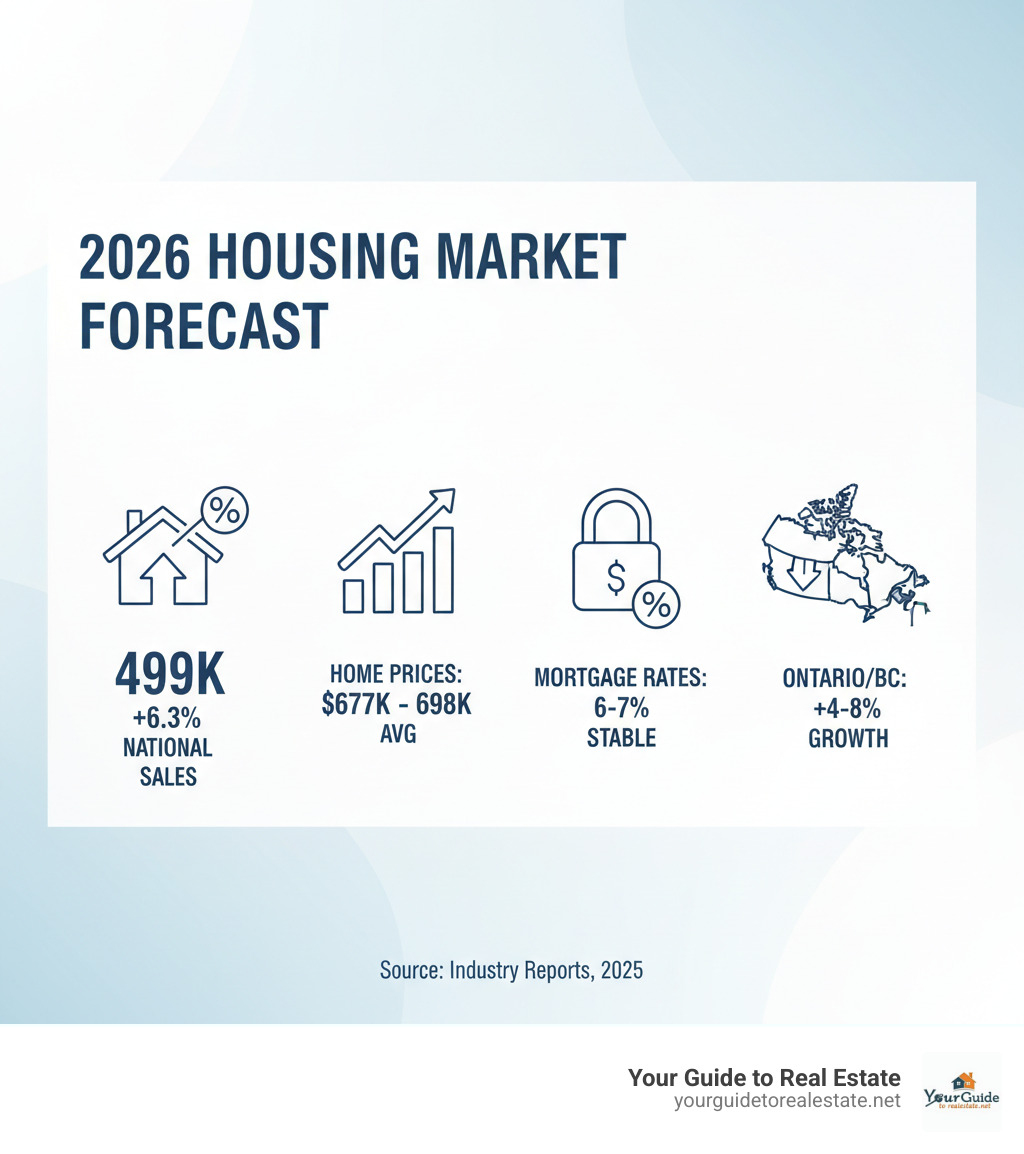
Housing market predictions 2026 show a market moving toward balance after years of extreme volatility. Here’s what experts are forecasting:
Key 2026 Predictions:
- Home Sales: 6.3% rebound to approximately 499,000 units nationally
- Home Prices: Mixed forecasts ranging from -0.7% to +3.0% growth
- Mortgage Rates: Expected to stabilize around 6-7% range
- Inventory: Gradual improvement but still below historical averages
- Regional Variations: Ontario and BC face price pressure while Prairies show growth potential
After the pandemic-driven chaos of 2020-2022 and the interest rate shock that followed, Canada’s housing market is finally approaching what experts call a “new equilibrium.” The days of runaway price increases are behind us, but so are the fears of a major crash.
The market is cooling but not reversing, according to recent analysis. While some regions will see modest growth, others face continued adjustments. What’s clear is that 2026 won’t bring the dramatic swings we’ve grown accustomed to.
Instead, buyers and sellers can expect a more predictable environment where fundamental economic factors like interest rates, immigration policy, and housing supply will drive regional performance. The challenge? These same factors carry significant uncertainty that could reshape any forecast.
Housing market predictions 2026 vocab to learn:
National Housing Market Outlook: A Measured Rebound
Canada’s housing market is finally catching its breath after years of wild swings. As we look toward 2026, the picture emerging is one of measured recovery rather than dramatic changes. Think of it like a pendulum that’s slowly settling into a gentler rhythm after years of extreme motion.
The experts are calling this our “new equilibrium” – a fancy way of saying the market is finding its balance again. While this is good news for anyone tired of constant surprises, it also means we won’t see the explosive growth or dramatic crashes that have dominated headlines recently.
Comparing Expert Forecasts for 2026
When Canada’s top financial institutions and real estate organizations put their heads together on housing market predictions 2026, they’re singing from similar songbooks – though not always in perfect harmony.
Home sales are expected to rebound across the board. The Canadian Real Estate Association (CREA) is forecasting a solid 6.3% increase in national home sales for 2026, reaching approximately 499,081 units. RBC is even more optimistic about sales volume, predicting a 7.9% jump to 504,100 units. That’s encouraging news for anyone who’s felt like the market has been stuck in slow motion.
But here’s where it gets interesting – and where the experts start to disagree. Price growth remains a hot debate. CREA sees the national average home price climbing 3.0% to $697,929 in 2026. Meanwhile, RBC takes a more cautious stance, expecting national prices to decline by 0.7% despite the sales rebound.
Other major players are weighing in too. TD Economics splits the difference with a 1.5% price increase and 2.5% sales growth. CMHC anticipates both prices and sales rebounding stronger than 2025, though they haven’t put specific numbers on it yet.
What does this mixed picture tell us? The market equilibrium everyone’s talking about isn’t a straight line. Different regions will perform differently, and even the smartest economists can’t agree on exactly where the national average home price will land.
The good news? Residential sales volume is expected to improve almost everywhere you look. That means more choice for buyers and more activity for sellers – a healthier market overall.
The Path from 2025 to 2026
To understand where we’re heading in 2026, we need to look at how 2025 is setting the stage. Think of 2025 as the warm-up act before the main event.
2025 market performance has been what experts politely call “tepid.” CREA projected sales would drop 3% in 2025, with the national average home price declining 1.7% to $677,368. RBC saw an even bigger dip, expecting a 3.5% decline in home resales to 467,100 units.
But here’s the plot twist – pent-up demand has been building like water behind a dam. As CREA Senior Economist Shaun Cathcart noted, “Markets appear to be entering their long-expected recovery phase, fuelled by pent-up demand, lower interest rates, and an economy that is expected to avoid worst-case tariff scenarios.”
This market recovery phase isn’t happening overnight though. The momentum has been building gradually through 2025, with many potential buyers watching from the sidelines, waiting for the right moment to jump in.
Economic uncertainty continues to keep things interesting. While the recovery is underway, it’s being tempered by challenges like a fragile labor market and reduced immigration targets. These factors explain why even the most optimistic forecasts keep the market below pre-pandemic highs.
For a deeper dive into these trends, check out our comprehensive Housing Market Forecast where we break down what these changes mean for your specific situation.
| Source | 2026 National Home Sales (Units) | 2026 National Average Price ($) | 2026 Price Change (%) |
|---|---|---|---|
| CREA | 499,081 | $697,929 | +3.0% |
| RBC | 504,100 | $697,929 (CREA) | -0.7% (RBC) |
| CMHC | Rebound (stronger than 2025) | Rebound (stronger than 2025) | N/A |
| TD Economics | Increase (2.5%) | Rise (1.5%) | +1.5% |
| NAR (US) | N/A | $420,000 (Median) | +2.0% |
| Fannie Mae (US) | N/A | N/A | +3.6% |
The bottom line? 2026 is shaping up to be a year of steady progress rather than spectacular fireworks. For buyers and sellers who’ve been waiting for some predictability, that might be exactly what the market needs.
Key Economic Drivers and Risks for the 2026 Market
Think of Canada’s housing market as a ship navigating through economic waters. The housing market predictions 2026 aren’t just about buyer sentiment or seasonal trends—they’re fundamentally shaped by the powerful currents of interest rates and the ongoing tug-of-war between immigration demand and housing supply.
These economic forces will determine whether 2026 becomes a year of steady recovery or continued market uncertainty. Let’s explore what’s really driving the numbers behind those forecasts.

The Enduring Impact of Interest Rates
If you’ve been waiting for rates to drop back to pandemic lows, we have some sobering news. The phrase “higher for longer” has become the new reality, and it’s reshaping every aspect of our housing market predictions 2026.
Central banks in both Canada and the U.S. are playing it safe after their aggressive rate hikes to fight inflation. Fannie Mae recently adjusted their forecasts upward, expecting mortgage rates to close 2025 at 6.5% and reach 6.3% by the end of 2026. Looking further ahead, 30-year fixed rates are anticipated to hover between 6.5% and 7.5% through 2027, with only modest relief coming in 2028-2029 when rates might dip to 5.5%-6%.
Why the cautious approach? The economy is actually doing well—perhaps too well for rate cuts. The Consumer Price Index rose 3% in January, with shelter costs being a major driver. The Federal Open Market Committee noted solid economic growth, low unemployment, and a robust job market. While that’s great news for employment, it gives central banks less reason to slash rates dramatically.
Here’s where things get interesting for homeowners. Mortgage affordability actually improved in early 2025, with National Bank data showing 8 out of 10 Canadian centers saw some relief. The mortgage payment as a percentage of income fell by 0.7%—a welcome break for many families.
But there’s a storm brewing on the horizon. A massive wave of fixed-rate mortgage renewals is coming, with roughly 85% of mortgages due in 2025 having been signed when the Bank of Canada rate was at or below 1%. Imagine going from a 2% mortgage to a 6% one—that’s a reality many homeowners will face, potentially forcing some to sell.
The popularity of Adjustable-Rate Mortgages has surged to 15.5% of all mortgage originations, up from just 4% in early 2021. Experts warn that around $200 billion of the $550 billion in ARM loans could adjust to higher rates in the next 1-3 years. This creates both opportunities for buyers (more inventory) and risks for current homeowners.
For those wondering about the future of borrowing costs, our detailed analysis in Will Mortgage Rates Go Down? provides additional insights into what borrowers can expect.
How Immigration and Inventory Will Shape Housing Market Predictions 2026
The second major force shaping our housing future is the complex relationship between who’s moving to Canada and where they’re going to live. It’s like a game of musical chairs, but with millions of people and not nearly enough houses.
Canada experienced a staggering 46% increase in new immigrants in 2023. While the federal government pumped the brakes in 2024 and we saw some temporary residents leave, the housing shortage created by rapid population growth isn’t disappearing overnight.
The numbers are sobering: Canada is currently down by over 5 million homes needed by 2030, on top of annual construction requirements. As Aled ab Iorwerth, Deputy Chief Economist at CMHC, puts it bluntly: “The private sector provides roughly 95% of housing in Canada and is central to increasing supply and improving affordability. All levels of government need to ensure it can build as much as possible.” You can dive deeper into these supply challenges in the CMHC housing supply report.
But building more homes isn’t as simple as snapping our fingers. “NIMBYism” (Not In My Backyard) remains a stubborn obstacle to building multi-family housing in established neighborhoods. While cities like Calgary and Edmonton have made progress by reducing red tape for multi-family units, many urban centers still struggle with local opposition and bureaucratic problems.
The construction industry is trying to keep up. Realtor.com predicts 1.1 million new homes will be built in 2025, representing a 13.8% increase from 2024. Builders broke ground on two homes for every person added in Q1 2025. Sounds good, right? Unfortunately, this pace will still see Canada hitting a record building low by next year—the demand is just that intense.
There’s some good news on the inventory front. Housing supply improved to 3.5 months in January 2025, up from a record low of 1.6 months in January 2022. It’s progress, but we’re still far from the balanced market that buyers and sellers need.
An interesting trend is emerging in the build-to-rent (BTR) sector. With 93,000 BTR single-family homes completed in 2023 and another 99,000 started in 2024, this sector is seeing explosive growth. It’s being driven by younger generations who value flexibility and face affordability challenges in traditional homeownership.
However, there’s a concerning flip side: apartment construction starts dropped 50% year-over-year in 2024 from 2022-2023 levels. This creates a potential problem—we might shift from an oversupply to an undersupply of rental units by 2026, adding another layer of complexity to our housing market predictions.
The interplay between these immigration and inventory factors means that housing market predictions 2026 will vary dramatically by region. Areas with better supply management and construction capacity will see more stable growth, while regions struggling with inventory shortages may continue to face price pressures despite broader market cooling.
Regional Hotspots and Housing Type Variances
When you look at housing market predictions 2026 from a national perspective, you’re getting the full picture—but not the whole story. It’s like checking the weather for all of Canada and seeing “partly cloudy.” That might be true overall, but it doesn’t tell you about the snowstorm in Calgary or the sunny skies in Vancouver.
The same applies to our housing market. While national averages suggest modest recovery, the reality is far more nuanced. Some regions are primed for growth, others face continued challenges, and the gap between different housing types is widening dramatically.

Provincial Market Breakdown: A Mixed Picture
Canada’s housing market in 2026 will truly be a tale of two countries. Ontario and British Columbia are heading into what experts describe as continued price pressure. RBC forecasts these provinces will see the steepest drops in home prices, extending well into early 2026.
Why the decline? These markets are dealing with high inventory levels and intense competition among sellers. After years of being seller’s markets, the tables have turned. Buyers now have more choices and negotiating power—a welcome change for many who’ve been priced out.
CREA’s analysis reinforces this trend, predicting that BC and Ontario will be the only provinces experiencing declines in both sales volume and average home prices through 2025 and into 2026.
But here’s where it gets interesting. The Prairie provinces—Alberta and Saskatchewan—are singing a completely different tune. These markets are expected to see robust price growth, with increases ranging from 4% to 8% in 2025 alone. The momentum is expected to carry into 2026.
Quebec and Atlantic Canada are also showing resilience, with modest but steady growth projected. The appeal is clear: relative affordability compared to the major urban centers, combined with strong local economies in many areas.
This regional divide creates opportunities for savvy buyers and investors. Those willing to look beyond traditional hotspots might find themselves ahead of the curve.
The Outlook for Single-Family Homes vs. Condos
Perhaps the most striking trend in our housing market predictions 2026 is the growing divide between detached homes and condos. As CIBC’s Benjamin Tal noted in the Globe & Mail, we’re seeing “a growing gap between [prices of] detached houses and condos.”
The condo market is facing headwinds. Toronto’s average condo price has dropped to $651,000—the lowest we’ve seen in more than four years. This isn’t just a Toronto story; it’s happening across major urban centers.
Several factors are driving this shift. We’re seeing an influx of new apartment completions, with over half a million units coming online in North America. At the same time, buyer preferences are evolving, with many seeking more space and value.
Single-family homes, however, are showing remarkable resilience. The rental market tells the story clearly: single-family rentals command an average of $2,174 per month according to recent data, compared to $1,812 for apartments. That’s a 20% premium that reflects genuine demand.
The build-to-rent sector is experiencing explosive growth. In 2023, 93,000 build-to-rent single-family homes were completed, with another 99,000 started in 2024. This trend addresses affordability challenges while meeting changing lifestyle needs.
Innovation is also reshaping the market. Modular, manufactured, and prefabricated homes are gaining traction as solutions to reduce construction times and costs. While their adoption in urban areas still requires zoning changes, the potential is significant.
For those considering their options, understanding our Condo vs Coop guide can provide valuable insights into different housing types and their investment potential.
The message is clear: housing market predictions 2026 point to a market where location and property type will matter more than ever. Success will come from understanding these nuances rather than following broad national trends.
Navigating the 2026 Housing Market: Advice for Buyers and Sellers
The housing market predictions 2026 paint a picture of opportunity mixed with caution. If you’re thinking about making a move—whether that’s buying your first home, upgrading to something bigger, or selling an investment property—this rebalanced market offers some real advantages. But success will require strategy, not just hope.
At Your Guide to Real Estate, we’ve seen clients thrive in every type of market. The key? Understanding what’s actually happening and adjusting your approach accordingly. Let’s break down what buyers and sellers need to know.
Strategic Moves for Prospective Homebuyers
Here’s some good news: 2026 could be your year if you’ve been waiting on the sidelines. The fierce bidding wars that left so many buyers frustrated are largely behind us. With inventory gradually improving and prices stabilizing, you’ll likely have more choices and—crucially—more time to make thoughtful decisions.
CREA’s Shaun Cathcart talks about the “pent-up demand” from buyers who’ve been waiting for exactly these conditions. As the market finds its new rhythm, this stored-up demand will fuel the recovery. But don’t get too excited about borrowing costs—those “higher for longer” interest rates mean mortgage payments will still be substantial.
Financial caution remains your best friend. With rates expected to hover in that 6-7% range through much of 2026, affordability challenges aren’t disappearing overnight. This makes getting your finances rock-solid even more critical. Our First-Time Homebuyer Tips can help you build that foundation.
The silver lining? You’ll have more bargaining power than buyers have enjoyed in years. More inventory means less competition, which translates to room for negotiation on both price and terms. If you’re looking at areas where forecasts show flat or declining prices, you might even consider making below-market offers.
Think beyond the expensive metros. Remember those regional differences we discussed? Areas like the Prairies in Canada or suburban markets in the U.S. (including places like Oklahoma) are showing stronger growth potential precisely because they’re more affordable. Sometimes the best value means expanding your search radius.
Mortgage pre-approval isn’t just smart—it’s essential. Knowing exactly what you can borrow and locking in a rate will make you a stronger buyer when you find the right property. As market experts in Las Vegas point out, don’t wait for rates to drop if you find the perfect home. You can always refinance later when conditions improve.
Don’t forget about ownership costs beyond the mortgage. Property taxes, insurance, and maintenance add up quickly, and some areas are seeing significant increases in these expenses. Factor them into your budget from day one.
It’s worth noting that more Canadians are buying their first home later in life—often in their 40s and beyond. If that sounds familiar, you’re not alone. The market has created challenges, but innovative solutions are emerging to help bridge affordability gaps.
Key Considerations for Sellers in 2026
If you’re planning to sell, let’s be honest: the easy days are over. No more listing your home and watching buyers fight over it. The 2026 market will reward sellers who are strategic, realistic, and well-prepared.
Strategic pricing isn’t just important—it’s everything. In markets like Ontario and British Columbia, where RBC forecasts continued inventory buildup, overpricing will backfire. Your home could sit longer, forcing eventual price cuts that signal desperation to buyers. As Las Vegas market experts put it bluntly: “Don’t overprice; buyers are savvy and data-driven.”
This is where a solid competitive market analysis becomes invaluable. Our Competitive Market Analysis Real Estate guide can help you understand exactly where your home fits in the current market.
Managing expectations might be the hardest part. While some regions will see modest gains, we’re nowhere near the pandemic-era price explosions. CREA anticipates small declines in BC and Ontario, with only modest gains elsewhere. Those runaway price increases? They’re largely history.
Home preparation becomes a competitive advantage. When buyers have more choices, they become pickier. Professional staging, high-quality photography, and addressing those minor repairs you’ve been putting off can make the difference between a quick sale and a long wait.
Watch out for “escape clauses” becoming more common, especially in cooler markets like Ontario. These clauses make a buyer’s offer contingent on selling their current home at their desired price. Understanding these conditions will help you evaluate offers more effectively.
Timing still matters. Even in a rebalanced market, experts predict recovery phases driven by that pent-up demand we mentioned. Spring and summer traditionally bring more active buyers, so aligning your listing with peak demand seasons could work in your favor.
The bottom line for sellers? Adaptability wins. Work closely with an experienced agent who understands your local market’s nuances. The housing market predictions 2026 suggest a more balanced environment, but that doesn’t mean it’s easier—just different.
Frequently Asked Questions about Housing Market Predictions 2026
When it comes to housing market predictions 2026, we hear the same questions from clients every day. The uncertainty can feel overwhelming, but understanding the key factors helps you make informed decisions. Let’s address the most common concerns we encounter.
Will home prices go up or down in Canada in 2026?
The honest answer? It depends on where you’re looking. Housing market predictions 2026 show a mixed picture across the country, which can be confusing but also creates opportunities for savvy buyers and sellers.
CREA forecasts a modest national average price increase of around 3%, bringing the average home price to $697,929. However, RBC takes a more cautious stance, predicting a slight national decline of 0.7%. This difference highlights how challenging it is to predict a market that’s still finding its balance.
Regional variations tell the real story. Ontario and British Columbia are expected to face continued downward pressure on prices, with high inventory levels creating strong competition among sellers. Meanwhile, the Prairie provinces are looking at gains of 4-8%, driven by their relative affordability and stronger local economies.
For our friends south of the border, the U.S. outlook is more optimistic. The National Association of Realtors predicts 2% growth to a median price of $420,000, while Fannie Mae projects 3.6% growth. This suggests that while Canada steers regional challenges, the American market may see steadier nationwide appreciation.
Is 2026 a good year to buy a house?
If you’ve been waiting on the sidelines, 2026 could offer some welcome relief. The market is shifting toward buyers after years of intense seller competition, but it’s not without its challenges.
The good news for buyers: Stabilizing prices and gradually increasing inventory mean more choices and genuine negotiating power. You might actually have time to think about an offer instead of making split-second decisions in bidding wars. This is especially true in markets like Ontario and BC, where inventory levels are creating real opportunities.
The reality check: Mortgage rates are expected to stay in the 6-7% range throughout 2026. This “higher for longer” environment means affordability remains a significant hurdle for many families. The days of ultra-low borrowing costs are behind us, making it crucial to get pre-approved and understand your true buying power.
Our advice? Don’t wait for perfect conditions that may never come. If you find the right home and the numbers work for your situation, 2026 could be an excellent time to buy. The market is cooling, not crashing, which means opportunities exist without the panic of a major downturn.
What are the biggest risks to the 2026 housing forecast?
No forecast is bulletproof, and housing market predictions 2026 come with their share of uncertainties. Understanding these risks helps you make better decisions and avoid unpleasant surprises.
Interest rate surprises top the list of concerns. If inflation proves more stubborn than expected, central banks might need to raise rates further or keep them liftd longer than anticipated. Conversely, an unexpected economic downturn could trigger rapid rate cuts, dramatically altering market dynamics.
Economic fragility poses another significant risk. Job losses from a weaker-than-expected economy could quickly dampen housing demand, regardless of interest rates. The labor market’s health remains crucial to sustaining any recovery in home sales.
Policy shifts can reshape markets overnight. Changes in immigration targets, housing supply initiatives, or mortgage regulations could significantly impact demand and supply dynamics. We’ve seen how government interventions can create ripple effects throughout the housing sector.
Global uncertainties also loom large. Geopolitical events, trade tensions, or unexpected economic shocks from major trading partners could derail even the most carefully crafted forecasts. The pandemic taught us that external events can completely reshape housing markets in ways no one anticipated.
The key takeaway? Stay informed, remain flexible, and work with professionals who can help you adapt as conditions change. At Your Guide to Real Estate, we monitor these factors closely to help our clients steer whatever the market brings.
Conclusion: Preparing for a Rebalanced Market
The housing market predictions 2026 paint a picture of stability returning to Canada’s real estate landscape after years of wild swings. Think of it like a pendulum finally finding its center after being pushed to extremes. We’re entering an era where fundamental economic principles will drive the market, not the pandemic-induced chaos we’ve grown accustomed to.
What does this mean for you? The days of dramatic price surges and overnight bidding wars are largely behind us. Instead, key factors like interest rates, housing supply, and immigration will quietly but powerfully shape how different regions perform. Some areas will see modest growth, others may face continued adjustments, but the extreme volatility is expected to fade.
This rebalancing creates a mixed bag of opportunities and challenges. First-time buyers might finally find some breathing room with increased inventory and more negotiating power. Sellers will need to be more strategic, especially in markets like Ontario and BC where competition is heating up among those looking to sell. Investors can expect more predictable returns based on local fundamentals rather than speculative fever.
Staying informed and adaptable will be your secret weapon in this evolving market. Whether you’re house hunting, considering a sale, or building an investment portfolio, understanding these intricate regional dynamics isn’t just helpful—it’s essential. The winners in 2026 will be those who recognize that real estate has become a more nuanced game requiring local knowledge and strategic thinking.
At Your Guide to Real Estate, we’ve been helping people steer these changing waters with expert insights and proven frameworks. Our commitment remains the same: offering you stress-free guidance and a clear path to achieving your real estate goals, no matter what the market throws your way. With the right knowledge and support, you can approach 2026 with confidence rather than confusion.
Explore our complete Housing Market Forecast