

Understanding the Two Main Types of Shared Housing
When searching for co op vs condo options, you’re comparing two completely different ownership structures that affect everything from your monthly costs to your ability to renovate or sell your home.
Quick Answer:
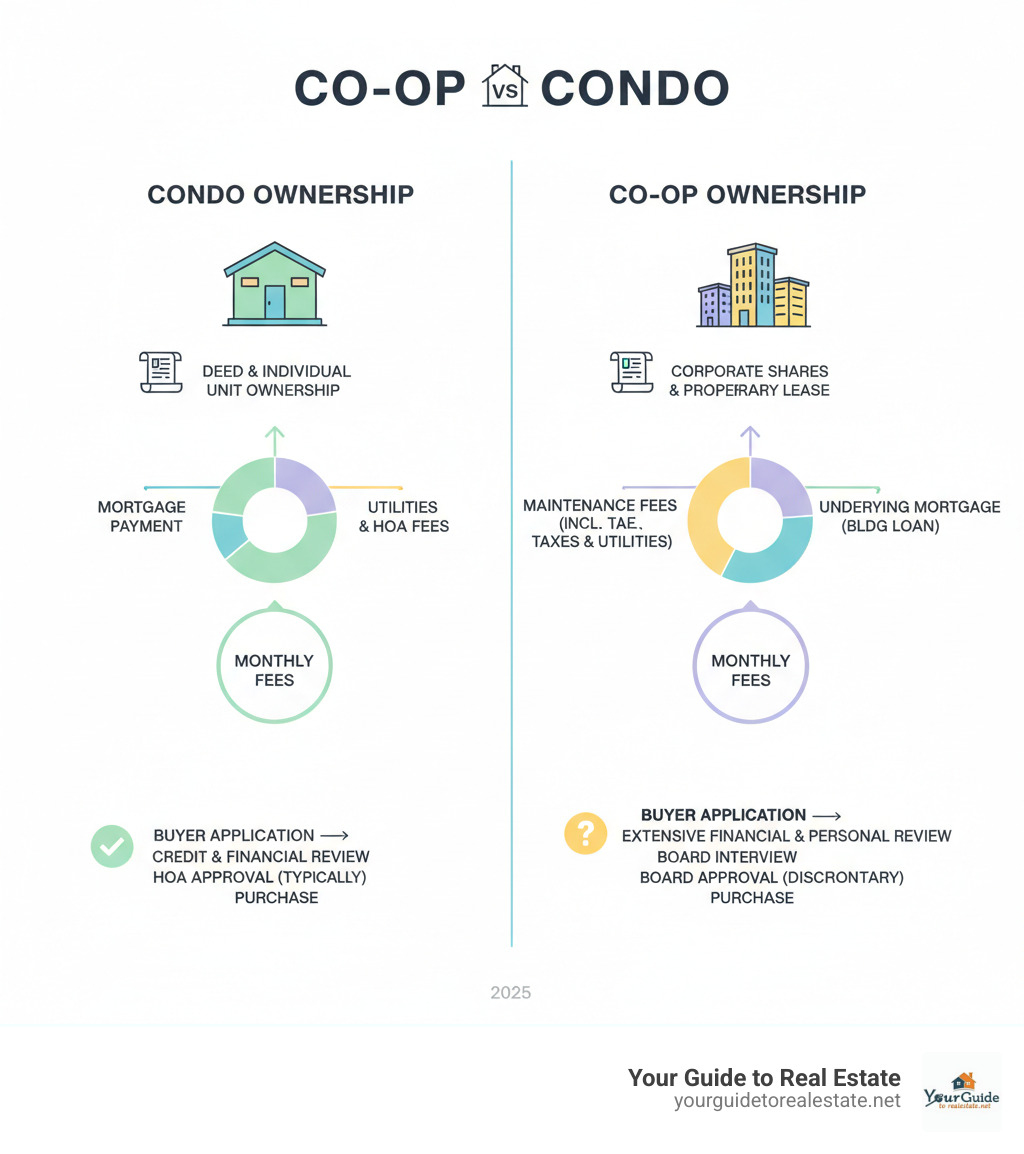
- Condo: You own your individual unit (real estate) + share of common areas. You get a deed.
- Co-op: You own shares in a corporation that owns the building. You get a proprietary lease.
The difference might seem small, but it impacts your finances, freedom, and future in big ways.
More than 74 million Americans live in community associations, with about 358,000 associations nationwide. In places like New York City, there are actually twice as many co-ops as condos – making this choice especially important for urban buyers.
Here’s what makes each option unique:
Condos work like traditional real estate. You buy a unit, own it outright, and can usually do what you want with it (within HOA rules). Getting a mortgage is straightforward, and selling is relatively simple.
Co-ops function more like exclusive clubs. You’re buying into a corporation that owns the entire building. The board can reject buyers, set strict rules, and even require cash purchases in some cases.
The financial differences are significant too. Co-ops often cost less upfront but require higher down payments (20-50% vs 3-20% for condos). Monthly fees are typically higher for co-ops because they include property taxes and utilities, while condo owners pay these separately.
Your choice between a co-op and condo will shape your homeownership experience – from how much control you have over your space to how easily you can sell and move on.
Simple co op vs condo glossary:
Ownership and Governance: Who’s in Control?
Here’s where the co op vs condo choice gets really interesting. What you actually own determines everything from how much freedom you have in your home to who gets a say in your daily life.
What You Own: Real Property vs. Corporate Shares
When you buy a condo, you’re getting something pretty straightforward – real property with a deed, just like buying a house. You own your individual unit outright, plus you get a slice of all the common areas like the lobby, gym, and that rooftop deck everyone loves.
Think of it this way: your unit is yours to do with as you please (within reason), and you share ownership of everything else with your neighbors. It’s clean, simple, and feels familiar to most buyers. If you’re still figuring out housing types, our guide on the Difference Between Condo and Apartment can help clear things up.
Co-op ownership is… well, it’s different. You don’t actually buy real estate at all. Instead, you’re buying corporate shares in the company that owns the entire building. Those shares come with a proprietary lease that gives you the right to live in a specific unit.
It’s like joining a very exclusive club where everyone owns the whole building together. You’re not just a shareholder – you’re part of a community that collectively owns everything from the basement to the roof.
The Rules of the Building: Condo Association vs. Co-op Board
Both types have people in charge, but the power dynamics are completely different.
Condo associations (also called HOAs) are run by a board of directors elected from among the owners. They manage common areas, enforce bylaws, and collect fees for maintenance. The rules exist, but they’re generally focused on shared spaces and keeping property values up.
You’ll still need to follow the rules, but condos typically have fewer restrictions on what you can do inside your own unit. Want to renovate your kitchen? Usually not a problem. Planning to rent it out? Most condos are pretty flexible about that too. Just make sure you understand Condo Association Insurance and how it protects the building’s common elements.

Co-op boards have way more vetting power. Since everyone owns shares in the same corporation, current shareholders get to decide who joins their community. This means a board interview process where potential buyers submit financial records, references, and sit down for what can feel like a job interview.
The board can reject buyers for almost any reason (as long as it’s legal), leading to stricter rules and more community control. Want to sublet your unit? Good luck – many co-ops don’t allow it at all. Planning major renovations? You’ll need board approval first.
This level of control can create incredibly stable, close-knit communities where neighbors actually know each other. But it also means giving up some of the freedom you might expect as a homeowner.
The Financial Breakdown: A Co-op vs Condo Cost Comparison
Money talks, and when it comes to the co op vs condo decision, understanding the complete financial picture is essential. While that co-op might look like a bargain at first glance, the true cost includes everything from your down payment to your monthly expenses and financing challenges.
Upfront Costs: Purchase Price, Down Payments, and Closing
The sticker shock starts right at the beginning, but not always where you’d expect it.
Purchase prices often favor co-ops initially. You’ll typically find co-ops priced lower per square foot than comparable condos. This happens because most condos are newer developments with modern amenities and shiny finishes that command premium prices. However, when you factor in the actual living space, condos usually cost only about 10% more than similar co-ops – not the huge difference many buyers expect.
Here’s where co-ops get expensive fast: the down payment. While condo buyers can often put down as little as 3-20%, co-ops demand much more skin in the game. Most co-ops require at least 20% down, and in competitive markets like Manhattan, you might need a whopping 50% down payment. That “cheaper” co-op suddenly requires twice the upfront cash.
Closing costs flip the script again. Co-ops typically have lower closing costs because you’re buying shares, not real property. You’ll skip expensive fees like title insurance and mortgage taxes that condo buyers face. Condo buyers should budget 2-5% of the purchase price for closing costs, while co-op buyers often pay significantly less.
The bottom line? Don’t just look at the listing price. A $500,000 co-op requiring 40% down needs $200,000 upfront, while a $550,000 condo at 10% down only needs $55,000 cash.
Ongoing Expenses: Monthly Fees and Property Taxes
Your monthly housing costs tell a different story than the purchase price, and this is where many buyers get surprised.
Co-op maintenance fees hit harder each month, but they’re actually quite comprehensive. Your single monthly payment typically covers property taxes for the entire building, the building’s underlying mortgage payments, all utilities like gas and electricity, plus building maintenance and management. It’s like an all-inclusive resort bill – higher upfront, but fewer surprise expenses.
Condo common charges look friendlier on paper because they’re usually lower than co-op fees. But here’s the catch: you’re paying property taxes separately to your local government, plus your own utilities, plus your mortgage payment. When you add everything up, your total monthly housing costs might actually exceed what co-op owners pay.
The tax situation gets interesting too. Co-op owners can deduct their share of the building’s property taxes and mortgage interest from their personal taxes. Condo owners deduct their individual property taxes and personal mortgage interest. Both offer tax benefits, just structured differently.
For condo owners, don’t forget to factor in insurance costs. Our guide on How Much Does Condo Insurance Cost? can help you budget for this additional expense.
Securing a Loan: Financing a Co-op vs Condo
Getting financing is where the co op vs condo comparison becomes dramatically different, and frankly, where many co-op dreams die.
Condo financing works like buying any other home. Lenders offer conventional loans, FHA loans, and VA loans. Your approval depends mainly on your credit score, income, and the property’s appraisal. It’s straightforward and familiar. If you’re considering FHA financing, check out our FHA Condo Approval List to ensure your building qualifies.

Co-op financing is where things get complicated fast. Since you’re buying shares in a corporation rather than real estate, you need a “share loan” instead of a traditional mortgage. Many lenders don’t even offer these loans, and those that do have stricter requirements.
But wait, there’s more complexity. The co-op board must approve both your lender and your loan terms. Some co-ops limit financing to 75% or less of the purchase price, forcing you into a larger down payment even if a lender would finance more. Some co-ops are so restrictive they only accept all-cash purchases.
Finding a lender is just the first hurdle. You’ll need to work with lenders who specialize in co-op financing and understand the unique requirements of share loans. This smaller pool of lenders often means less competitive rates and terms.
The financing challenge alone steers many buyers toward condos, even when they prefer the co-op lifestyle. It’s simply easier to get approved, close faster, and have more financing options available.
The Lifestyle and Logistics of Co-op vs Condo Living
Beyond the financial numbers, your choice in the co op vs condo debate will shape how you experience homeownership day-to-day. From the moment you make an offer to the day you eventually sell, these two housing types create very different journeys.
The Buying and Selling Process
Think of buying a condo like dating someone easygoing, while buying a co-op is like trying to join an exclusive club where everyone gets to vote on whether they like you.
Buying a condo feels familiar if you’ve ever bought a house. Once your financing gets approved, you’re essentially done with the hard part. The condo association might have something called a “right of first refusal” – meaning they could technically buy the unit themselves before selling to you – but this almost never happens. It’s more of a legal formality than a real hurdle. If you’re seeing terms like “contingent” during your search, our guide on What does contingent mean in real estate? can help decode the process.
Buying a co-op is an entirely different beast. After your offer gets accepted, the real work begins. You’ll need to prepare a comprehensive application package that makes your tax returns look simple. We’re talking about multiple years of financial records, bank statements, asset lists, personal and professional references, and often a heartfelt letter explaining why you’d be a great neighbor.
Here’s where it gets interesting: most NYC co-op boards won’t even consider you if your debt-to-income ratio exceeds 28%. That’s stricter than many mortgage lenders! The whole process culminates in a formal interview where board members essentially decide if you’re “their kind of people.” They can reject you without explanation (though they must follow fair housing laws), and there’s no appeal process.
Selling a condo returns you to familiar territory. List it, find a buyer, negotiate terms, and close – just like any other real estate transaction. You have the freedom to sell to whoever meets your price and terms. If you’re considering this route, our comprehensive guide on how to Sell My Condo walks you through the entire process.
Selling a co-op means your buyer must jump through the same hoops you did. Even if you find the perfect buyer who offers full price, the sale isn’t complete until the co-op board approves them. This adds uncertainty and potential delays that can make selling more stressful and unpredictable.
Subletting, Renovations, and Amenities
Your personal freedom within your own home varies dramatically between these two options.
When it comes to subletting, condos give you much more flexibility. You might face some association rules like minimum lease terms or small registration fees, but you generally have the right to rent out your property. This makes condos attractive for investors or people who might need to relocate temporarily for work.
Co-ops take a completely different approach to subletting. Many have strict restrictions or ban it entirely. If subletting is allowed, expect stringent rules: minimum residency periods before you can rent it out, board approval for every tenant, and potentially significant fees. Some co-ops require you to live in the unit for several years before considering any rental arrangement.
Renovations tell a similar story. As a condo owner, you have considerable freedom to renovate your unit since you actually own the interior space. You’ll still need to follow building codes and some aesthetic guidelines from the association, but major interior overhauls are usually fine.
Co-op renovations require board approval for virtually any significant change. Want to remove a wall? Board approval. Planning to change your flooring? Board approval. The process can be lengthy, involve detailed plans and specifications, and sometimes result in rejection if the board feels your changes might affect the building’s structure or character.

Amenities often favor condos, especially newer developments. Developers use impressive amenities as selling points: rooftop pools, state-of-the-art fitness centers, concierge services, pet spas, and co-working spaces. These features contribute to higher purchase prices and common charges, but they can significantly improve your lifestyle.
Co-ops, particularly older buildings, might offer fewer or less modern amenities. This isn’t necessarily bad – many co-op buildings have incredible character and charm that newer condos lack. The amenities that do exist are typically well-maintained and thoughtfully managed, reflecting the community’s long-term investment in the property.
Location and Availability
Geography plays a huge role in your co op vs condo decision, sometimes making the choice for you.
Co-ops are creatures of habit, clustering in specific metropolitan areas. New York City is co-op central, where they actually outnumber condos significantly. You’ll also find healthy co-op markets in Seattle, Philadelphia, and Chicago. This concentration stems largely from the co-op conversion boom of the 1980s, when many rental buildings transformed into cooperatives.
Condos are the adaptable option, thriving everywhere from busy downtown cores to quiet suburban neighborhoods. Their straightforward ownership structure and financing options make them appealing to developers nationwide. Whether you’re looking in a major city, growing suburb, or even a small town, you’re likely to find condo options.
This geographic reality means your location might determine your housing type more than your preferences do. If you’re set on living in Manhattan’s Upper East Side, you’ll probably be looking at co-ops. If you want a new construction unit with modern amenities in most other markets, condos will dominate your search.
For those exploring different attached housing options, understanding the Townhouse vs Condo distinction can also help clarify your preferences and expand your search options.
Pros and Cons at a Glance
After diving deep into the co op vs condo comparison, it helps to step back and see the big picture. Both options have clear advantages and trade-offs that might make one perfect for you while being completely wrong for your neighbor.
The ownership structure creates a ripple effect that touches every aspect of your homeownership experience. When you own a condo, you’re getting that traditional American dream of property ownership – you have a deed, direct control over your space, and the freedom that comes with it. Co-ops offer a different kind of ownership that’s more like joining an exclusive club where everyone has a say in who gets to join.
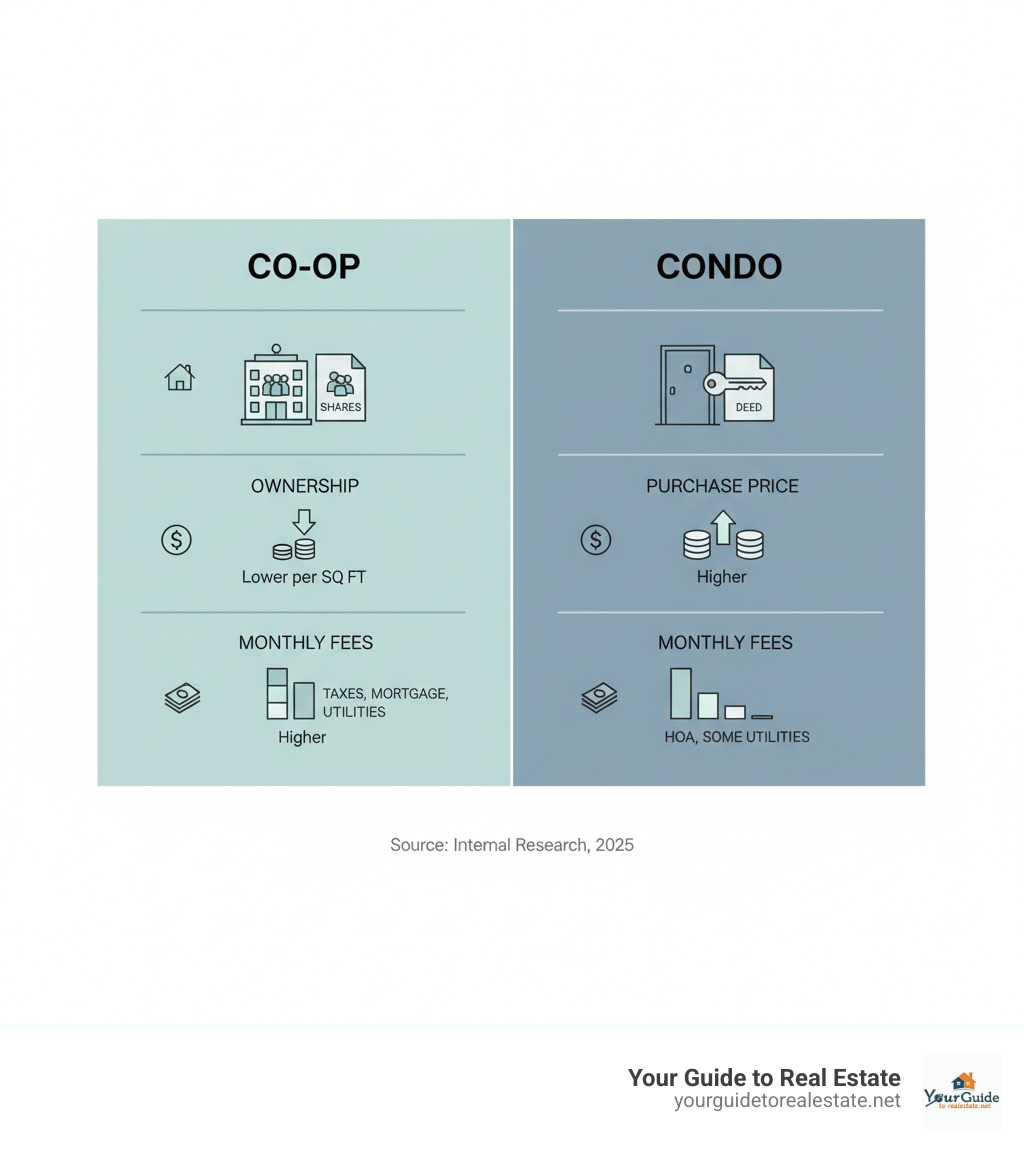
Financially, the differences are striking but not always obvious at first glance. Co-ops often win on purchase price – you might pay less per square foot than comparable condos. But that lower sticker price comes with strings attached: you’ll typically need a much larger down payment (20-50% versus as little as 3-20% for condos) and face more challenging financing options.
The monthly costs tell an interesting story too. Your co-op maintenance fee will likely be higher, but it’s covering more expenses rolled into one bill – property taxes, building mortgage payments, utilities, and maintenance. Condo owners pay lower monthly fees but handle property taxes and many utilities separately, so the total monthly housing cost often evens out.
Where the two really diverge is in lifestyle and control. Condo living gives you more autonomy – you can renovate more freely, sublet with fewer restrictions, and sell to whoever makes the best offer. The trade-off? You have less control over who your neighbors are and how the building is managed.
Co-op living flips this equation. You’ll face stricter rules about everything from renovations to subletting, and selling requires board approval of your buyer. But in exchange, you get a more stable, vetted community where everyone has skin in the game and a voice in building decisions.
The financing process alone can be a deciding factor. Getting a condo mortgage feels familiar – it’s like buying any other piece of real estate. Co-op financing involves share loans, board-approved lenders, and sometimes cash-only requirements that can shut out many buyers.
Think about your priorities: Do you want maximum flexibility and easier resale options? Condos typically deliver. Do you prefer lower purchase prices, stronger community bonds, and don’t mind jumping through more hoops? Co-ops might be your match.
The beauty of understanding these trade-offs is that there’s no universally “right” choice – just the right choice for your specific situation, finances, and lifestyle preferences.
Frequently Asked Questions about Co-op vs Condo
We know that choosing between a co op vs condo can feel overwhelming, especially when you’re trying to steer all the financial and lifestyle implications. Let’s tackle the questions we hear most often from buyers like you.
Is a co-op or a condo a better investment?
The honest answer? It depends on what you’re hoping to achieve with your investment.
Co-ops shine when you’re thinking long-term stability. Because of that rigorous board approval process we discussed earlier, you’re surrounded by financially stable neighbors who are committed to the community. This tends to create buildings that hold their value well over time and maintain excellent conditions. The downside? You can’t easily rent out your unit for extra income, which limits your investment flexibility.
Condos offer more investment versatility. Since you can typically rent them out without jumping through hoops, they’re attractive if you want to generate rental income or plan to move but keep the property. They’re also easier to sell when market conditions are right, giving you more control over your investment timing.
The “better” choice really comes down to your personal situation. Are you looking for a stable home base where you’ll stay for years? A co-op might be perfect. Want the option to rent it out or sell quickly if opportunities arise? A condo probably fits better.
Market conditions matter too. In some areas, condos appreciate faster due to their flexibility and broader buyer appeal. In others, well-managed co-ops in desirable neighborhoods can be excellent long-term holds.
Why are co-op fees so much higher than condo fees?
This is probably the biggest sticker shock for first-time co-op buyers, but there’s a logical explanation.
Co-op maintenance fees are like an all-inclusive resort bill – they cover nearly everything you need to live there. Your monthly fee typically includes property taxes for the entire building, payments toward any underlying mortgage the building carries, utilities like heat and hot water, and all the usual building maintenance and services.
Condo fees, on the other hand, are more like a shared services bill. They cover common area maintenance, building insurance, and shared utilities, but you pay your own property taxes, mortgage, and individual utilities separately.
Here’s what this looks like in practice: A co-op might charge $2,000 monthly, while a comparable condo charges $800. But that condo owner also pays $400 in property taxes, $300 in utilities, and their own mortgage payment. When you add everything up, the total monthly housing costs often end up surprisingly similar.
The co-op approach has advantages – fewer bills to manage and predictable monthly expenses. But it can make budgeting tricky since one large fee covers so many different costs.
Can a co-op board really reject me for any reason?
This is where co-op boards walk a fine line between having broad discretion and following the law.
Co-op boards cannot legally discriminate based on protected characteristics like race, religion, gender, national origin, disability, or family status. Fair housing laws apply to co-ops just like any other housing.
But beyond those protections, boards do have significant power. They’re primarily looking for financial stability and community fit. Common reasons for rejection include having a debt-to-income ratio that’s too high, insufficient liquid assets after closing, or poor references from previous landlords or employers.
The tricky part is that boards usually don’t have to explain their rejection, making it hard to know exactly why you were turned down. Some boards are more transparent than others, but many simply send a brief “not approved” letter.
Your best strategy is to be completely honest in your application, exceed their financial requirements if possible, and prepare thoroughly for the interview. Think of it like a job interview – you want to present yourself as someone who’ll be a great neighbor and contribute positively to their community.
This process works both ways. A board that’s very selective about residents often creates the stable, well-maintained community that makes co-op living appealing in the first place.
Conclusion: Which Is Right for You?
Choosing between a co op vs condo is one of the most important housing decisions you’ll make, and there’s no universally “right” answer. The best choice depends entirely on your personal situation, financial goals, and lifestyle preferences.
Think of it this way: condos offer freedom, while co-ops offer community. If you value the ability to renovate freely, rent out your space, and sell whenever you want, a condo’s direct ownership structure will likely suit you better. You’ll pay more upfront and handle property taxes separately, but you’ll have fewer restrictions and more control over your investment.
On the other hand, if you’re looking for long-term stability and don’t mind trading some autonomy for a tighter-knit community, a co-op might be perfect. Yes, you’ll face a rigorous application process and stricter rules, but you’ll often pay less initially and enjoy the peace of mind that comes with thoroughly vetted neighbors.
The financial picture matters too. Co-ops typically require larger down payments (20-50%) but offer lower purchase prices and all-inclusive monthly fees. Condos provide more financing flexibility (down payments as low as 3-5%) but come with higher purchase prices and separate utility bills.
Consider your timeline as well. If you’re planning to stay put for many years, a co-op’s restrictions might not bother you. But if you anticipate needing flexibility – whether for job relocations, family changes, or investment opportunities – a condo’s easier selling and subletting process could save you significant stress down the road.
Don’t forget about location either. In cities like New York, co-ops dominate the market, giving you more options in that format. In most other areas, condos are far more common, which might make your decision for you.
At Your Guide to Real Estate, we’ve seen buyers thrive in both types of properties. The key is honest self-reflection about your priorities and financial situation. Our proven framework focuses on stress-free guidance that helps you see past the marketing hype to what really matters for your situation.
Ready to move forward with confidence? Learn more about choosing a real estate broker who understands the nuances of both co-ops and condos. The right professional can help you steer whichever path makes sense for your homeownership journey.