

Why Understanding Cognitive Appraisal Can Change How You Experience Life
Cognitive appraisal is your brain’s instant interpretation of what’s happening around you – and it shapes every emotion you feel. Developed by psychologist Richard Lazarus, this concept explains why two people can experience the same event but have completely different emotional reactions.
Quick Definition:
- What it is: Your mental evaluation of whether a situation is good, bad, threatening, or beneficial to you
- Why it matters: It determines your emotional response, not the actual event itself
- Key insight: “It’s not what happens to you, but how you interpret what happens to you”
Think about it this way: hearing news about rising interest rates could make one home buyer panic while another sees it as a chance to negotiate better deals. Same news, different appraisals, completely different emotions.
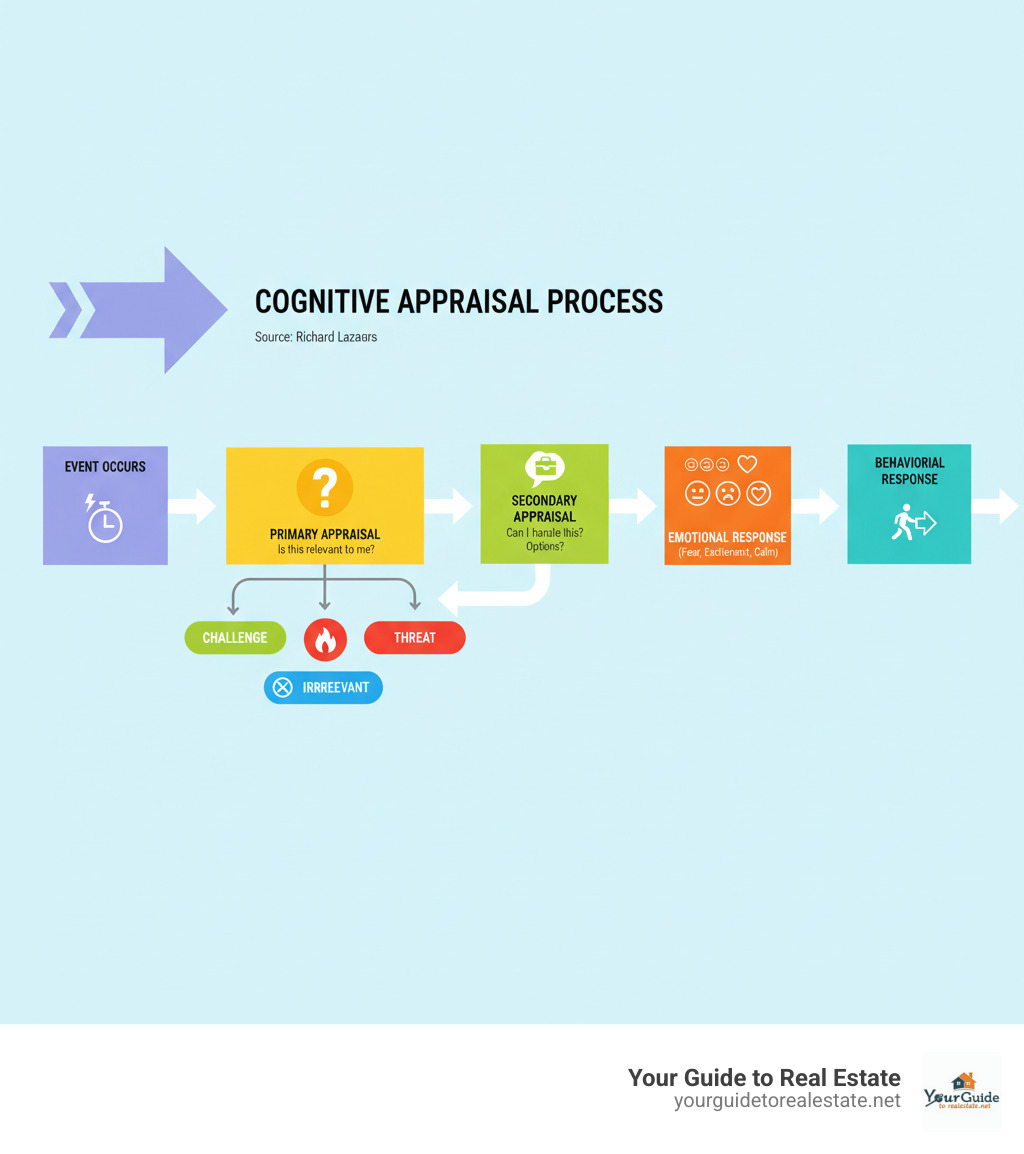
The process happens in two stages. Primary appraisal asks “Does this matter to me?” Secondary appraisal asks “What can I do about it?” Your answers to these questions create your emotional experience.
This isn’t just psychology theory – it’s a practical tool. When you understand how cognitive appraisal works, you can learn to reframe stressful situations and manage your emotions better. Whether you’re navigating a tough real estate market or dealing with any life challenge, mastering this skill gives you more control over how you feel and respond.
Find more about cognitive appraisal:
What is Cognitive Appraisal and How Does It Shape Our Emotions?
Cognitive appraisal is essentially your brain’s way of making sense of what’s happening to you. It’s that split-second mental evaluation where you decide if something is good, bad, threatening, or helpful. This concept comes from psychologist Richard Lazarus, who figured out something pretty amazing in the 1960s: it’s not what happens to you that creates your emotions – it’s how you interpret what happens.
Lazarus called this a “transaction between the individual and the environment.” Think of it like this: you and the world around you are constantly having a conversation, and cognitive appraisal is how you translate what the world is saying to you.
Here’s where it gets interesting. Your appraisals create your emotions, but your emotions can also influence your appraisals. It’s a two-way street. You might feel angry first, then your brain scrambles to find a reason why. Maybe you decide your coworker was being rude, which then reinforces your anger. It’s like your mind is constantly writing and rewriting the story of what’s happening to you.
This whole process can happen so fast you don’t even notice it. Your brain is constantly sizing up situations, drawing on past experiences to figure out how to react. That’s why two people can witness the same car accident and have completely different reactions – one feels intense fear while the other stays calm and focused. Their internal cognitive appraisal systems are running different programs.
The fascinating part? Most of this happens without you even thinking about it. But once you understand how it works, you can start to influence the process.
For a deeper dive into cognitive appraisal theory, you can explore its origins and development: A deeper dive into cognitive appraisal theory.

Primary and Secondary Appraisal: The Two-Step Process
Lazarus finded that cognitive appraisal happens in two stages, like a quick internal conversation you have with yourself whenever something new happens.
Primary appraisal is when your brain asks “Does this matter to me?” This happens lightning-fast, often before you’re even consciously aware of it. Your mind is checking if this situation affects your goals, your well-being, or anything you care about.
During this first step, you’re unconsciously evaluating goal relevance – is there anything at stake here? Then comes goal congruence – does this help or hurt what I’m trying to achieve? Finally, there’s ego involvement – does this affect how I see myself or my values?
Based on these quick assessments, your brain sorts the situation into one of four categories. A threat feels like potential future harm – like that difficult project at work that might lead to failure. A challenge looks like an opportunity for growth – the same project might be seen as a chance to learn and prove yourself. Harm-loss means damage has already happened – like a financial setback you’re dealing with. Benign-positive situations feel harmless or even good – like receiving an unexpected compliment.
If your brain decides something is irrelevant or positive, the process often stops there. But if it’s tagged as significant, you move to step two.
Secondary appraisal is when your brain asks “What can I do about it?” Now you’re evaluating your resources and options. This stage focuses on blame or credit – who’s responsible for this situation? It also assesses your coping potential – do you have what it takes to handle this? Can you change the situation itself, or do you need to manage your emotional response to it?
Your future expectations play a big role too. If you think things will improve, you might feel hopeful. If you expect things to get worse, anxiety or despair might creep in.
Understanding these stages can transform how you handle stress and emotional challenges. For more detailed information on this process, check out: More on the appraisal process. This process connects closely to how we remember past events and plan for future actions, which ties into our Prospective Memory.
The Great Debate: Are Appraisals Universal or Socially Constructed?
Here’s where things get really interesting in cognitive appraisal research. Scientists are split on whether we all appraise situations in basically the same way, or if our interpretations are shaped by our unique backgrounds and cultures.
Basic emotions researchers believe some appraisals are universal. They argue that core emotions like joy, fear, and anger trigger similar cognitive appraisals across all humans. In their view, an unexpected event will likely cause fear whether you’re in Tokyo or Toledo. Scherer’s 1997 study found evidence supporting this, especially for emotions like joy. This suggests our brains might be hardwired with some basic appraisal patterns that helped our ancestors survive.
Social constructivist theorists see it differently. They emphasize how much our cultural background, personal experiences, and social learning shape our appraisals. The same event can be interpreted completely differently depending on your context. A public display of emotion might be perfectly appropriate in one culture but embarrassing in another, leading to totally different appraisals of both the situation and the emotional response.
Most researchers today think both sides have valid points. We probably do have some universal, quick appraisal mechanisms tied to basic survival needs. But the more complex, thoughtful appraisals are definitely influenced by our unique life experiences and the social world we live in.
This flexibility is actually pretty amazing when you think about it. It means your cognitive appraisal system can adapt and learn, which gives you the power to change how you interpret and respond to life’s challenges.
Cognitive Reappraisal: A Powerful Tool for Emotion Regulation
Here’s something amazing: if your thoughts shape your emotions, then changing those thoughts can completely transform how you feel. That’s exactly what cognitive reappraisal does – it’s like having a mental reset button when stress and negative emotions take over.
Think of cognitive reappraisal as reframing a picture. The scene stays the same, but when you change the frame, suddenly it looks completely different. This emotion regulation strategy helps you step back from overwhelming feelings and look at situations through a fresh lens. It’s also called cognitive reframing or cognitive restructuring, and it’s one of the most powerful tools in cognitive behavioral therapy.
When you’re stressed or upset, your brain gets stuck in what researchers call a “negative feedback loop.” Your thoughts spiral downward, which makes your emotions more intense, which creates even more negative thoughts. It’s exhausting, and it keeps you trapped in patterns that don’t serve you well.
Cognitive reappraisal breaks this cycle. Instead of automatically reacting to whatever your mind throws at you, you learn to pause and ask: “Is there another way to see this?” This simple shift can dial down overwhelming emotions and help you respond thoughtfully instead of just reacting.
The science backs this up too. Research shows that people who master reappraisal techniques experience less stress, make better decisions, and bounce back faster from setbacks. You can dive deeper into the research here: Scientific research on cognitive reappraisal.

The Wide-Ranging Benefits of Mastering Cognitive Reappraisal
Learning to reappraise situations doesn’t just help you feel better in the moment – it creates positive changes that ripple through every area of your life.
Better emotion regulation is the most obvious benefit. When you can consciously shift how you view challenging situations, your emotions become more manageable. Instead of being overwhelmed by anger, fear, or sadness, you develop emotional stability that helps you stay centered even when life gets chaotic.
Your problem-solving abilities improve dramatically too. When emotions run high, clear thinking goes out the window. But when you can reframe stressful situations, your mind clears up. You start seeing creative solutions you missed before, whether you’re navigating a tricky real estate transaction or handling a personal crisis.
Increased resilience naturally follows. Life will always throw curveballs, but when you can reframe setbacks as learning opportunities instead of disasters, you bounce back faster. Each challenge becomes a chance to grow stronger rather than evidence that you’re failing.
Your relationships get better when you master reappraisal. Instead of immediately getting defensive or angry when someone upsets you, you can step back and consider their perspective. Maybe they’re having a bad day, or maybe there’s a misunderstanding. This shift in thinking reduces conflicts and builds deeper connections with the people you care about.
Perhaps most surprisingly, your physical health improves too. Chronic stress and negative emotions literally wear down your body – they raise cortisol levels, disrupt sleep, weaken your immune system, and strain your heart. When you can manage your emotional responses better, your body gets a break from this constant stress. You sleep better, get sick less often, and feel more energetic overall.
Just like understanding Why is Investing Important? helps secure your financial future, mastering cognitive reappraisal is an investment in your mental and physical wellbeing that pays dividends for years to come.
How to Practice Cognitive Reappraisal: A Step-by-Step Guide
Cognitive reappraisal is a skill that gets stronger with practice. Like learning to ride a bike, it might feel awkward at first, but soon it becomes second nature. Here’s how to develop this life-changing ability:
Start by catching your automatic thoughts. When something stressful happens, pause and notice your immediate reaction. What story is your mind telling you about the situation? Maybe you’re thinking “This is terrible” or “I can’t handle this” or “Everything always goes wrong for me.” These automatic appraisals happen so fast we often don’t realize they’re there.
Look for thinking traps. Once you’ve identified your first reaction, check if you’re falling into common mental pitfalls. Are you catastrophizing by imagining the worst possible outcome? Are you thinking in black-and-white terms where everything is either perfect or a total disaster? Are you predicting the future like you have a crystal ball? Recognizing these patterns is the first step to changing them.
Challenge your initial thoughts by asking yourself some key questions. What evidence do you actually have for this thought? Is there another way to look at what happened? What would a good friend tell you about this situation? How will this matter in five years? Are you only focusing on what went wrong and ignoring what went right?
Create a new, balanced perspective based on your investigation. This isn’t about forcing positive thinking or pretending problems don’t exist. It’s about finding a more realistic and helpful way to view the situation. Your new perspective should be based on facts, acknowledge both challenges and opportunities, and leave you feeling more capable of handling whatever comes next.
Here’s how this works in real life: Imagine you’re helping clients buy their dream home, and the deal falls through at the last minute.
Your first thought might be: “I’m a terrible agent. I’ve ruined everything for my clients. They’ll never trust me again, and I’ll probably lose them to another agent.”
But when you challenge this automatic appraisal, you might realize: “Wait, I’ve successfully closed many deals before. The other party made unreasonable demands that were beyond anyone’s control. My clients have already told me they appreciate how hard I’m working for them. This setback frees us up to find an even better property.”
Your new, balanced perspective becomes: “This is disappointing, but it doesn’t define my abilities as an agent. Sometimes deals fall through despite everyone’s best efforts. I learned valuable information about the market that will help me serve my clients better moving forward.”
This shift from self-blame to realistic assessment changes everything – your stress level drops, your confidence returns, and you can focus on finding your clients an even better opportunity.
Cognitive Appraisal in Action: Real-World Applications
Understanding cognitive appraisal isn’t just about theory – it’s a game-changer in real life. Whether you’re sitting in a therapist’s office, competing on the sports field, or making crucial real estate decisions, how you interpret what’s happening around you shapes everything from your emotions to your success.
The beauty of cognitive appraisal lies in its practical power. It explains why some people thrive under pressure while others crumble, why certain therapeutic approaches work so well, and why two investors can look at the same market data and make completely opposite decisions.

How cognitive appraisal is applied in therapeutic settings
In therapy, especially cognitive behavioral therapy (CBT), cognitive appraisal is the secret weapon. CBT works on a simple but powerful idea: our thoughts, feelings, and behaviors are all connected like pieces of a puzzle.
Here’s what happens when things go wrong. Negative thoughts create overwhelming emotions, which then fuel more negative thoughts. It’s like being stuck in a washing machine cycle – sadness spirals into depression, worry becomes panic attacks, and frustration explodes into anger.
Therapists help people break this cycle by identifying irrational beliefs and maladaptive thoughts. They guide clients to spot when their brain is playing tricks on them. For example, someone with anxiety might automatically see every unclear situation as dangerous. Through CBT, they learn to challenge this “everything is a threat” mindset.
The process involves reconstructing belief systems step by step. Instead of accepting their first panicky thought, clients learn to ask better questions: “Is this really as scary as I think? What evidence do I have? What would I tell a friend in this situation?”
This approach has proven incredibly effective for anxiety and depression treatment. When people master the art of reappraising their thoughts, they regain control over their emotional responses and start feeling genuinely better. For more detailed information on this therapeutic approach, you can explore: Cognitive behavioral therapy (CBT).
The role of cognitive appraisal in high-stakes competition
Sports offer a perfect window into how cognitive appraisal works under extreme pressure. When the stakes are high and everyone’s watching, an athlete’s mental game often determines who wins and who goes home disappointed.
Recent research with professional athletes revealed some fascinating patterns. 60% of athletes typically viewed stressful competitions as a challenge that motivated them to take action. These athletes often performed better because they saw pressure as fuel rather than fear.
Only 18% saw competitions as challenges but didn’t feel energized to act. 16% focused on past losses, getting stuck in what went wrong before. And surprisingly, just 5% viewed competitions as genuine threats – though when they did, it often led to fear and avoidance.
The study found three main appraisal styles. Athletes with positive appraisals took the most goal-oriented action and rarely needed to seek support from others. They preferred the coping strategy of pure determination – “I’m going to make this happen no matter what.”
Those with negative appraisals were more likely to look for seeking support from coaches, teammates, or family. About 79% of athletes maintained positive appraisals of their competition situations, showing how crucial an optimistic mindset is for success.
Interestingly, most athletes weren’t using formal mental training techniques. This suggests huge potential for improvement – imagine what could happen if more competitors learned to consistently use challenge vs. threat appraisal and specific coping strategies. These mental skills can even give us a Connections Sports Hint about how the right mindset translates to success in any field.
Applying cognitive appraisal to real estate decisions
At Your Guide to Real Estate, we see cognitive appraisal in action every single day. The difference between successful real estate decisions and costly mistakes often comes down to how people interpret market volatility, assess risk, and view opportunities.
Think about what happens when interest rates rise or home prices shift. The exact same market conditions can trigger completely different responses depending on your buyer and seller mindset.
Some buyers fall into threat appraisal mode. They see rising rates as a disaster, convinced they’re being priced out forever or that any purchase will lose value. This fear often leads to paralysis – they stop looking, delay decisions, or abandon their home-buying dreams entirely.
But other buyers accept challenge appraisal. They view the same market shifts as chances to negotiate harder, explore creative financing, or focus on properties with solid long-term value. Instead of panicking, they get strategic.
Sellers face similar choices. A slower market can feel like a devastating loss, leading to desperate price cuts and regret. Or it can become a challenge to get creative with marketing, highlight unique features, and find the right buyer who truly appreciates what they’re offering.
For investors, cognitive appraisal happens constantly when weighing opportunity vs. threat in potential deals. The most successful ones have learned to appraise situations objectively rather than getting swept up in fear or greed.
Our job is helping you shift from threat-thinking to challenge-thinking through strategic decision-making. This means looking at the facts about the market, honestly evaluating your resources and timeline, and identifying real opportunities that others might miss.
Tools like a Competitive Market Analysis Real Estate become incredibly valuable here. They provide objective data that helps you form accurate appraisals instead of relying on fear, speculation, or wishful thinking. When you can see the market clearly, you make confident choices that serve your long-term goals.
Frequently Asked Questions about Cognitive Appraisal
What’s the main difference between cognitive appraisal and cognitive reappraisal?
Think of cognitive appraisal as your brain’s first reaction – that split-second moment when you size up a situation. It’s automatic, like when you hear a loud noise and instantly decide if it’s dangerous or harmless. This happens without you even thinking about it.
Cognitive reappraisal is what comes next – if you choose to use it. This is when you consciously step back and say, “Wait, let me think about this differently.” It’s the deliberate act of changing your initial interpretation to help manage your emotions better.
For example, if you get news that home prices dropped in your area, your initial appraisal might be panic (“My investment is ruined!”). Cognitive reappraisal would be taking a breath and reframing it (“This could be a good time to buy that second property I’ve been considering”).
Can cognitive appraisal happen unconsciously?
Absolutely! Your brain is constantly working behind the scenes, making lightning-fast judgments about everything around you. The primary appraisal process is often completely unconscious – your mind rapidly scans situations for relevance or danger without you realizing it’s happening.
This makes perfect sense from an evolutionary standpoint. Our ancestors needed to quickly identify threats to survive, so our brains developed this automatic scanning system. Today, that same system kicks in whether you’re walking into a job interview, hearing unexpected news, or evaluating a potential real estate deal.
It’s only when situations require deeper thought – during secondary appraisal or when we consciously practice reappraisal – that the process becomes more intentional and aware.
Is a “challenge” appraisal always better than a “threat” appraisal?
Here’s where it gets interesting – not necessarily! While challenge appraisals typically lead to better performance and more positive emotions, threat appraisals actually serve an important purpose. They’re like your internal alarm system, alerting you to pay attention and take action.
The magic happens when you have flexibility in your thinking. A threat appraisal can be incredibly useful for motivating you to gather information, prepare thoroughly, or seek help when you need it. The problem only arises when you get stuck in threat mode and can’t shift your perspective.
Let’s say you’re considering buying in a volatile market. Initially appraising it as a “threat” might push you to do extra research, consult with experts, and carefully analyze your finances. Once you’ve done that homework, you can then reappraise the situation as a “challenge” – an opportunity to use your knowledge and make a smart decision.
The key is having the ability to move between different appraisals as situations change. Sometimes caution is wise; other times, viewing obstacles as opportunities will serve you better.
Conclusion
Your journey through cognitive appraisal reveals a powerful truth: you have more control over your emotions than you might think. It’s not just what happens to you that matters – it’s how you interpret what happens.
Richard Lazarus gave us the foundation with his two-step process of primary and secondary appraisal. Your brain constantly asks “Does this matter to me?” and “What can I do about it?” These split-second evaluations shape every emotion you feel, from the excitement of finding your dream home to the stress of a competitive market.
The real game-changer is cognitive reappraisal – your ability to consciously reframe situations. When you master this skill, you’re not just managing your emotions better. You’re improving your problem-solving abilities, building resilience that helps you bounce back from setbacks, strengthening your relationships through better conflict management, and even boosting your physical health by reducing stress.
Think about how this applies to real estate decisions. Market volatility can trigger fear, or it can present opportunities – the choice is yours. Rising interest rates might seem threatening until you reappraise them as motivation to negotiate better deals or explore creative financing options.
Whether appraisals are universal or culturally shaped remains debated among researchers. But what’s clear is that you can learn to shift from automatic threat responses to challenge-oriented thinking. This flexibility transforms how you experience everything from therapy sessions to high-stakes competitions to major life decisions.
At Your Guide to Real Estate, we understand that successful real estate investing isn’t just about market knowledge – it’s about having the right mindset. We provide the framework to help you appraise market situations as challenges you can overcome, turning potential stress into strategic opportunities for growth.
Ready to apply these insights to your real estate journey? Learn more about Valuation and Market Analysis in Real Estate and find how expert analysis combined with the right mental approach creates a winning combination.