
What is Art Appraisal and Why Does Every Collector Need One?
Art appraisal is an expert evaluation that determines the monetary value of artwork through professional analysis of market data, condition, and provenance. Whether you’re buying your first piece or managing a collection worth millions, understanding art valuation protects your investment and ensures you make informed decisions.
Quick Answer: Art Appraisal Essentials
- Definition: Professional assessment of artwork’s monetary worth
- Purpose: Insurance, estate planning, donations, buying/selling decisions
- Cost: $100-$500 for single items, online options from $25-$49
- Types: Fair Market Value, Replacement Value, Investment Value
- Who: Certified appraisers with USPAP compliance and professional credentials
The global art market reached $65.1 billion in 2022, making professional appraisals more crucial than ever. Consider this real example from our research: a painting sold at a yard sale for $2 was later professionally appraised at $1,500. Without proper valuation, owners and buyers regularly miss opportunities or make costly mistakes.
Art appraisals serve multiple critical functions beyond simple curiosity. They’re legally required documents for insurance claims, estate planning, and charitable tax deductions. They also protect buyers from overpaying and help sellers price competitively.
The process has evolved significantly with technology. While traditional in-person appraisals remain the gold standard for authentication, online services now offer quick valuations starting at $25, with results delivered within 48-72 hours.
However, not all appraisals are created equal. The difference between a legitimate professional assessment and a sales-motivated estimate can cost thousands. Understanding when you need formal documentation versus a quick market check determines both your protection level and out-of-pocket costs.
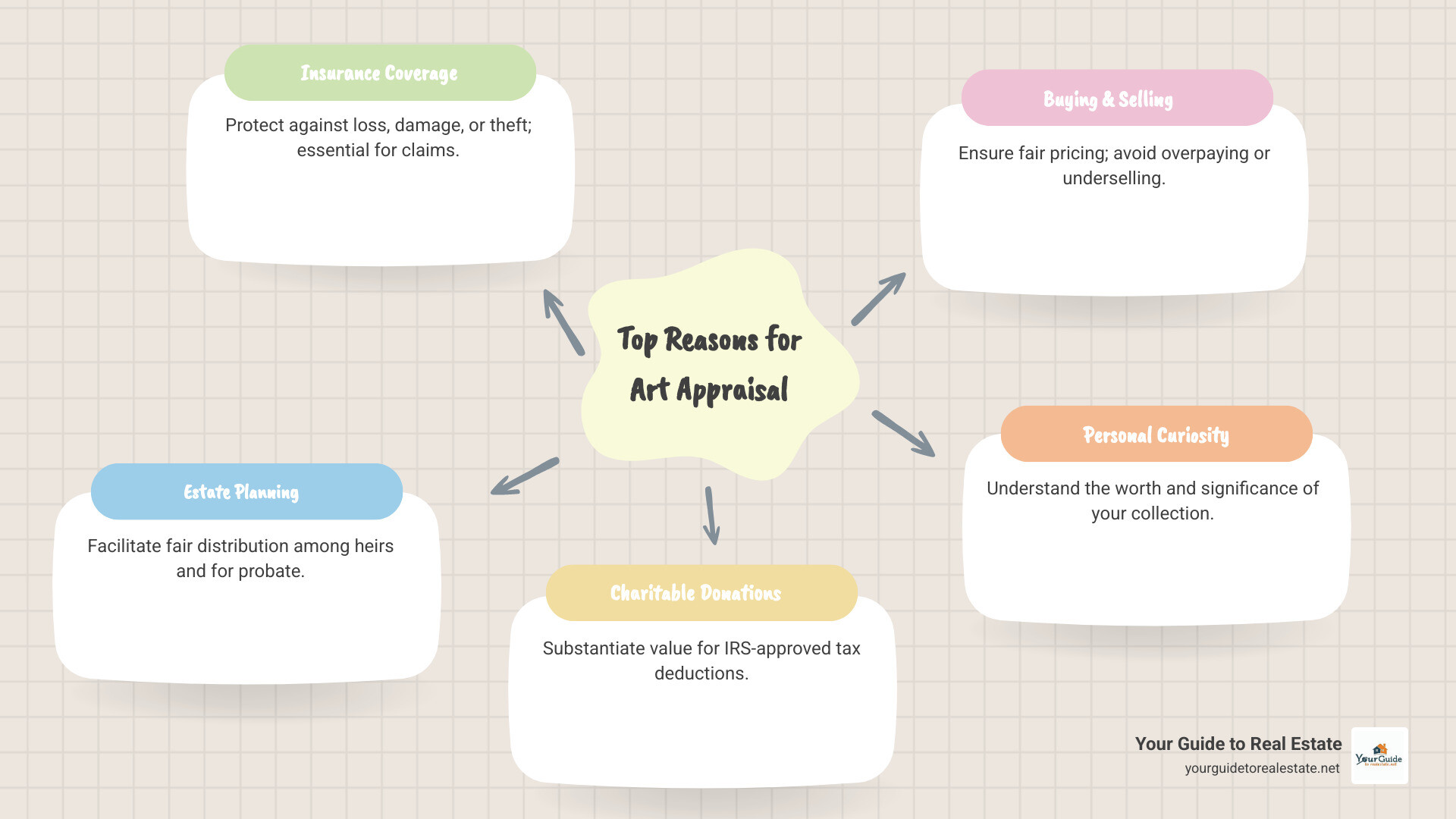
Basic art appraisal glossary:
Decoding Value: Types of Appraisals and Their Purpose
Here’s something that surprises many first-time collectors: your artwork doesn’t have just one value. Just like a house might be worth one amount for insurance purposes and another for a quick sale, art appraisal values change depending on why you need them.
Understanding these different types isn’t just academic – using the wrong appraisal type can cost you thousands in taxes, insurance claims, or poor buying decisions.
Fair Market Value (FMV) represents what your artwork would sell for between a willing buyer and seller, both knowledgeable about the piece and neither under pressure to complete the deal. Think of it as the “realistic sale price” in today’s market.
You’ll need an FMV appraisal for estate planning and probate when settling inheritances, charitable donations where you want tax deductions, sales and purchases to establish fair pricing, and property division during divorce proceedings. The IRS specifically requires FMV appraisals for donation tax deductions, and they have strict guidelines about it. Check the IRS guidelines for donations before claiming any art-related tax benefits.
Replacement Value answers a different question: what would it cost to replace this exact piece with something similar in today’s retail market? This includes dealer markups, shipping costs, and all the expenses of actually acquiring a comparable work.
Insurance companies almost always require replacement value appraisals because they need to know the true cost of making you whole again after a loss. Your general homeowner’s insurance rarely covers valuable art adequately, so this appraisal type protects your investment when disaster strikes.
Liquidation Value represents what you’d get in a forced or quick sale – think auction houses or estate sales where speed matters more than maximizing price. This value typically runs significantly lower than FMV and helps in bankruptcy situations or when you need cash fast.
| Feature | Fair Market Value (FMV) | Replacement Value |
|---|---|---|
| Definition | Price between willing buyer/seller in open market | Cost to replace with similar item in current retail market |
| Purpose | Estate, donation, sales, property division | Insurance coverage, damage claims |
| Includes | Actual sale price expectation | Retail markups, acquisition costs |
| Typically | Lower than Replacement Value | Higher than FMV |
| IRS Acceptance | Yes, for donations and estate taxes | No, not for tax purposes |
The key insight? Replacement values almost always exceed Fair Market Values because retail prices include dealer profits and acquisition costs that don’t exist in direct buyer-to-seller transactions.
Investment Value takes a forward-looking approach, analyzing an artwork’s potential appreciation based on market trends, the artist’s career trajectory, and historical performance. While useful for portfolio planning, this type works best alongside traditional appraisals rather than replacing them.
Some appraisers also provide Historical Value assessments that focus on cultural significance rather than pure monetary worth. While not always directly translatable to dollars, historical importance often drives market value over time.
Getting the wrong appraisal type creates real problems. Use an FMV appraisal for insurance, and you’ll likely be underinsured. Use a replacement value appraisal for estate taxes, and the IRS will reject it entirely.
Understanding these valuation methods connects to broader asset analysis principles. For deeper insights into how professional valuation works across different asset classes, explore our comprehensive guide on valuation and market analysis in real estate.
The bottom line: match your art appraisal type to your specific need, and you’ll get accurate protection and realistic expectations for your investment.
What Factors Influence an Artwork’s Value?
Understanding what makes one painting worth $50 and another worth $50,000 might seem like solving a mystery. But just like real estate, where location, condition, and market demand determine property values, art appraisal follows predictable patterns based on specific factors that professionals evaluate systematically.
The artist’s reputation stands as the single most powerful value driver. A signature from Picasso transforms canvas and paint into a million-dollar treasure, while the same materials by an unknown artist might sell for hundreds. Established artists with strong auction histories, museum exhibitions, and critical acclaim create market confidence that translates directly into higher values.
But reputation means nothing without authenticity. This is where the detective work begins. Is that “Monet” signature genuine, or is it a hopeful fake? Professional appraisers spend considerable time researching brushwork techniques, paint analysis, and historical records to verify attribution. A single authentication can multiply an artwork’s value by thousands, while proving it’s a forgery can render it nearly worthless.
Provenance tells the story of who owned the artwork throughout its lifetime. Think of it as the artwork’s resume – the more impressive previous owners, exhibitions, and documented history, the more valuable it becomes. A painting owned by a famous collector or displayed in a prestigious gallery carries that prestige forward to future buyers.

The artwork’s condition can make or break its value. Even masterpieces lose significant worth when damaged by water, fading, tears, or poor restoration attempts. Professional appraisers document every crack, stain, and repair because collectors pay premium prices for pristine examples while heavily damaged pieces often sell at deep discounts.
Rarity creates the scarcity that drives collector passion. Limited edition prints, unique experimental pieces, or works from an artist’s most celebrated period become more valuable simply because few examples exist. When everyone wants something and only a handful are available, prices naturally climb.
The medium and materials used significantly impact value. Original oil paintings typically command higher prices than watercolors by the same artist, while prints and reproductions sell for fractions of original artwork values. The quality of canvas, paper, or sculptural materials also influences long-term value and collector desirability.
Subject matter can surprisingly affect pricing. Some artists’ portraits sell for more than their landscapes, or their early abstract works outperform later realistic pieces. Market preferences for specific themes, colors, or artistic periods shift over time, creating opportunities for savvy collectors.
Market trends keep the art world dynamic and sometimes unpredictable. Economic conditions, cultural movements, and even social media can suddenly increase demand for particular artists or styles. What sells slowly today might become tomorrow’s hottest collecting category. For deeper insights into how market analysis works across different asset classes, explore our guide to market analysis.
Size and overall artistic quality round out the major value factors. While bigger isn’t always better, significant works that represent an artist’s peak creativity and skill typically achieve higher prices than minor or transitional pieces.
When conducting a professional art appraisal, experts weave all these elements together, comparing recent sales data, auction results, and market trends to arrive at well-supported valuations. It’s this comprehensive approach that separates legitimate appraisals from simple guesswork.
The Professional Art Appraisal Process Explained
Getting a professional art appraisal doesn’t have to feel overwhelming. Think of it like finding the right real estate agent – you want someone qualified, trustworthy, and experienced in your specific market. The same principles apply when valuing your artwork.
Finding a Qualified Art Appraiser
Here’s something that might surprise you: unlike real estate appraisers, personal property appraisers aren’t federally licensed. This means literally anyone can hang out a shingle and call themselves an art appraiser. That’s why doing your homework is absolutely crucial.
The gold standard is finding an appraiser who follows USPAP compliance – the Uniform Standards of Professional Appraisal Practice. These are the ethical and performance standards that ensure you’re getting an unbiased, professional evaluation rather than someone’s best guess.
Look for appraisers with strong credentials and education in art history and appraisal theory. Many have advanced degrees and have undergone rigorous training and testing through recognized organizations. The most reputable professionals belong to established appraiser associations that require members to meet strict educational requirements and follow codes of ethics.
The International Society of Appraisers (ISA) is one of the largest and most respected organizations in the field. The Appraisers Association of America (AAA) is another leading non-profit that maintains high standards for personal property appraisers. The American Society of Appraisers (ASA) accredits specialists across various disciplines, including fine art.
Experience matters tremendously. You wouldn’t ask a commercial real estate expert to appraise your vintage home, right? The same logic applies here. Choose an appraiser who specializes in your type of artwork. Someone who knows 19th-century European paintings inside and out might not be your best choice for contemporary digital art.
The appraiser should also understand legal, financial, and technical requirements for different types of appraisals. IRS tax forms have specific documentation needs that differ from insurance requirements.
To find qualified professionals in your area, check the Appraisers Association of America directory for certified experts.
Avoiding conflicts of interest is absolutely critical. A legitimate art appraisal must be completely objective. Never use an appraiser who’s also trying to sell you something or buy your artwork. Their “appraisal” will likely be inflated to serve their sales pitch rather than give you honest market value. The fee should never be based on the artwork’s appraised value – that’s a huge red flag.
The Appraisal Itself: Online vs. In-Person
Once you’ve found your qualified appraiser, you’ll need to decide between an in-person or online evaluation. Each has its place, much like choosing between a virtual home tour and an actual walkthrough.
In-person physical inspection remains the gold standard, especially for valuable or complex pieces where authenticity matters. The appraiser examines your artwork firsthand, using specialized tools and taking detailed measurements. They can assess the actual brushstrokes, examine the canvas backing, and spot details that photos simply can’t capture.
This method gives you the most accurate assessment for condition and authenticity, making it ideal for insurance and legal purposes. The downside? It’s more expensive and requires scheduling around the appraiser’s availability.
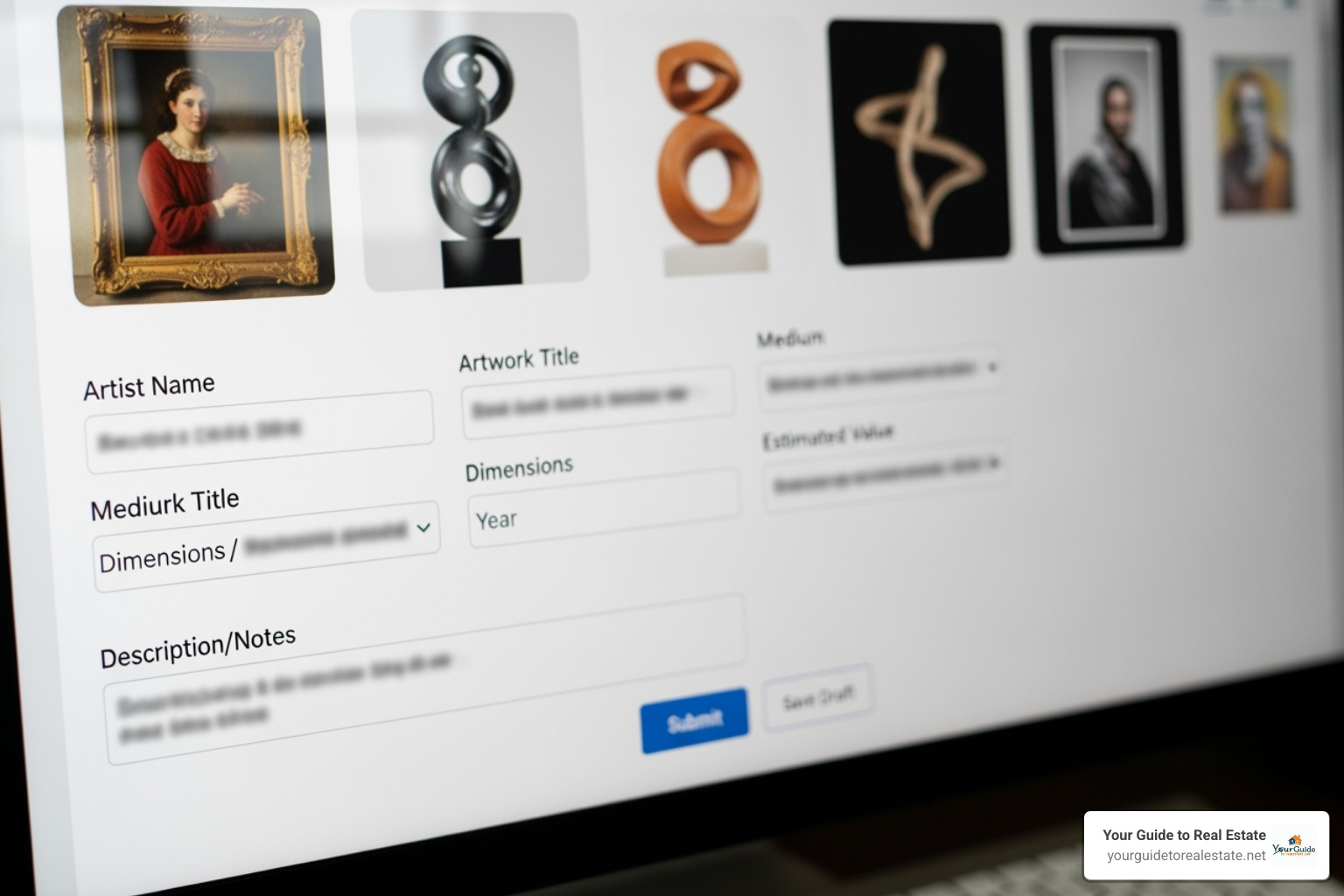
Online appraisal process has revolutionized accessibility in the art world. You submit high-quality photos of your piece – front, back, signature, and detail shots – along with any information you have about the artist, dimensions, and history. Expert appraisers then research and deliver a valuation report, often within 48-72 hours.
Photo submission requirements are crucial for online success. Take direct, straight-on shots in good lighting, avoiding glare and reflections. Close-ups of signatures, gallery labels, and any markings on the back are essential. Think of it like listing photos for a house – quality matters enormously.
Online appraisals offer convenience and affordability, starting as low as $25-$49 for single items. However, they can’t confirm authenticity since that requires physical examination. They also provide less detailed condition assessments and might not satisfy all insurance company requirements.
Free auction evaluations from auction houses serve a different purpose entirely. These are estimates of what your piece might bring at their specific auction, designed primarily to attract consignments. They’re helpful for gauging auction potential but aren’t formal appraisals for insurance or estate purposes.
What’s in a Formal Art Appraisal Report?
A professional art appraisal report is like a comprehensive property inspection report – it’s far more than just a final number. It’s a detailed, legally binding document that supports every aspect of the determined value.

A complete report includes your client information and clearly states the purpose of the appraisal – whether for insurance, estate planning, or charitable donation. It specifies the type of valuation used and provides the definition, plus explains the methodology behind the assessment.
The detailed object description covers everything: artist name, title, date, medium, dimensions, signatures, and identifying marks. Think of it as the “listing details” for your artwork. An artist biography provides context about the creator’s significance and market position.
Provenance documentation traces the ownership history, while any exhibition and publication history adds to the piece’s credibility. The condition statement offers a thorough assessment of physical state, noting any damage, repairs, or restoration work.
The market analysis and comparables section shows similar artworks that have sold recently, explaining how these sales influenced your piece’s valuation. This is similar to how real estate appraisers use comparable home sales to determine property values.
Appraiser’s qualifications detail their education, experience, and certifications, while limiting conditions outline any assumptions made during the process. The statement of value provides the final determination, and the appraiser’s signature makes it official.
Costs of a Professional Art Appraisal
Understanding art appraisal costs helps you budget appropriately and ensures you get fair value for the service. Fees vary based on complexity, the appraiser’s experience, and your location – much like how real estate services vary by market.
Average cost ranges typically run $100-$500 for single items. Complex pieces or entire collections cost more due to extensive research requirements. Hourly rates from experienced, accredited appraisers can reach several hundred dollars per hour, while flat fees for single items offer more predictable pricing.
Online appraisal pricing has made professional valuations much more accessible. Services start around $25-$49 for single items, with package deals available for multiple pieces. This represents a significant cost savings compared to traditional in-person appraisals.
Several factors affect cost beyond the basic service. Rare artists or unusual mediums require more intensive research. Travel fees apply for on-site inspections. Appraisals for IRS purposes or legal cases need more extensive documentation, increasing the investment required.
Here’s a crucial point: legitimate appraisers never base fees on the artwork’s determined value. That creates a direct conflict of interest and compromises objectivity. Fees should reflect only the time, expertise, and resources needed to complete the evaluation properly.
While professional appraisal represents an upfront investment, it’s small compared to the financial protection and peace of mind it provides – especially in a global art market worth over $65 billion.
Smart Collecting: Using Appraisals When Buying and Selling
The art world can feel like a maze, especially when money changes hands. Whether you’re eyeing that perfect piece for your living room or ready to part with something you’ve treasured for years, understanding how art appraisals work in real transactions can save you thousands of dollars and countless headaches.

Differentiating an Appraisal from a Sales Pitch
Here’s where many collectors get burned. A seller waves around an “appraisal” showing their painting is worth $15,000, so naturally, that’s their asking price. But hold on—not all appraisals are created equal, and some aren’t really appraisals at all.
Think of it like buying a house where the seller shows you an old property tax assessment from 2019 and claims that’s the current market value. You’d laugh, right? The same skepticism should apply to art transactions.
Always ask to see the actual document. A legitimate art appraisal comes as a formal, written report, not just someone’s verbal claim. If they can’t produce the paperwork, consider it a major red flag.
Check what type of appraisal it is. Remember our earlier discussion about different valuation types? An insurance appraisal (replacement value) will typically show a much higher number than what you should actually pay (fair market value). A seller might wave around their insurance appraisal to justify an inflated price—but that’s like using the cost to rebuild your house after a fire as the selling price.
Look at who did the appraisal. If the “appraiser” is the same gallery selling the piece, the dealer representing the artist, or anyone with skin in the game, you’re looking at a sales pitch dressed up as professional evaluation. Real appraisers maintain independence from the transaction.
How to Evaluate a Seller-Provided Appraisal
When someone hands you an appraisal, become a detective. We always tell our clients to approach seller-provided documentation with healthy skepticism—it’s your money on the line.
Date matters tremendously. Art markets shift just like real estate markets. An appraisal from five years ago might be completely irrelevant today. Even a three-year-old evaluation could be outdated, especially if it was done during a market peak.
Research the appraiser’s credentials. Look for membership in reputable organizations like the International Society of Appraisers (ISA) or Appraisers Association of America (AAA). Do they specialize in this type of art? An expert in 19th-century landscapes might not understand the contemporary sculpture market.
Read the fine print. A professional report should clearly state the appraiser has no financial interest in the sale. It should explain the methodology used and provide comparable sales data. If these elements are missing, the document might not be worth the paper it’s printed on.
Verifying Fair Market Value Independently
Smart buyers do their homework, just like smart real estate investors research comparable properties. Don’t rely solely on what the seller tells you—verify independently.
Dive into auction records. Major auction houses publish their results, giving you real-world data on what similar pieces actually sold for. Heritage Auctions and others maintain searchable databases of past sales. These numbers represent what collectors actually paid, not what someone hoped to get.
Consider hiring your own appraiser. For significant purchases, investing in an independent art appraisal is like getting your own home inspection. Yes, it costs money upfront, but it can save you from overpaying by thousands.
Understand different market levels. Gallery retail prices include overhead, marketing costs, and profit margins. Private sellers shouldn’t expect to get full retail prices any more than homeowners should expect to get new construction prices for their used homes.
Protecting Yourself from Overpaying
The art market has no shortage of inflated prices and wishful thinking. Your best defense is knowledge and independent verification of value.
Never base your offer on what the seller originally paid or what their potentially biased appraisal claims. A painting with a $20,000 gallery price tag might have a fair market value of $5,000. This vigilance becomes even more crucial when you consider art as part of your broader investment strategy, much like understanding asset investment in other markets.
Emotional attachment doesn’t equal market value. The seller might have deep feelings about their piece, but the market determines what it’s actually worth.
Using an Appraisal as a Selling Tool
If you’re on the selling side, a professional art appraisal becomes your best friend and most credible sales tool.
Price realistically from the start. An up-to-date, independent appraisal helps you set competitive prices that attract serious buyers rather than dreamers. It removes emotion from what can be a very emotional process and grounds your expectations in market reality.
Build instant credibility. When potential buyers see a professional appraisal from a qualified, independent expert, it immediately lifts their confidence in both the artwork and your asking price. It’s like having a professional home inspection already completed when listing your house.
Get strategic advice. A good appraiser doesn’t just tell you what something’s worth—they can guide you on the best places to sell, whether that’s through auction houses, galleries, or private sales. They understand market timing and can advise when conditions favor sellers.
The art market rewards informed participants and punishes those who operate on assumptions. With proper art appraisal knowledge, you can steer transactions confidently, whether you’re building your collection or cashing in your investments.
Conclusion: Securing Your Asset’s Value
Think of this moment as standing in front of your art collection with completely new eyes. What once might have seemed like beautiful objects with mysterious values now reveals itself as a portfolio of assets you can confidently understand, protect, and manage.
We’ve walked through the essential world of art appraisal together, from the basic definition of professional valuation to the intricate details of formal appraisal reports. You now understand that Fair Market Value serves different purposes than Replacement Value, and you can spot the difference between a legitimate appraisal and a sales pitch from a mile away.
The journey hasn’t just been about numbers and processes. It’s been about empowerment. When someone shows you an artwork with a claimed “appraised value,” you’ll know exactly what questions to ask. When your insurance agent mentions coverage limits, you’ll understand why that recent art appraisal matters so much. And when you’re considering adding a new piece to your collection, you’ll approach it with the same analytical mindset that savvy real estate investors bring to property acquisitions.
Professional art appraisal serves as your financial compass in a market worth over $65 billion annually. Just as we emphasize thorough property valuations and market analysis at Your Guide to Real Estate, the same principles of careful assessment and expert guidance apply to your artistic investments.
The peace of mind that comes from knowing your collection’s true value extends far beyond simple curiosity. Whether you’re planning your estate, updating insurance coverage, or making that once-in-a-lifetime charitable donation, you now have the framework to protect both your financial interests and your artistic legacy.
Your art collection represents more than aesthetic choices—it’s part of your overall asset portfolio. With the right knowledge and professional support, these pieces can serve your financial goals while continuing to bring joy and cultural enrichment to your life.
At Your Guide to Real Estate, we believe that informed decisions lead to confident outcomes, whether you’re navigating property markets or art valuations. Our commitment remains providing you with expert insights and stress-free guidance for managing all your valuable assets.
Ready to dive deeper into valuation principles that can serve you across different asset classes? Explore our comprehensive resource on asset valuation and market analysis to strengthen your investment decision-making skills even further.