

Understanding How Others Shape Your Self-Image
Reflected appraisal is how you see yourself based on what you think others think of you. It’s one of the most powerful forces shaping your self-concept, yet most people don’t even realize it’s happening.
Quick Answer: What is Reflected Appraisal?
- Definition: Your perception of how others view and judge you
- Origin: Based on Charles H. Cooley’s “looking-glass self” theory (1902)
- Process: You imagine how you appear to others, guess their judgment, then develop feelings about yourself
- Impact: Shapes self-esteem, behavior, and major life decisions
- Key Point: It’s about your perception of others’ views, not their actual opinions
For example, when you dress for an important event, you imagine how others will see you. That mental process is reflected appraisal in action.
This concept affects your confidence, your behavior, and even how you present your home for sale. Our self-concepts are often shaped more by these perceived judgments than by others’ actual opinions.
Understanding this process explains variations in self-confidence and highlights the importance of objective feedback—whether for personal performance or a property’s value.
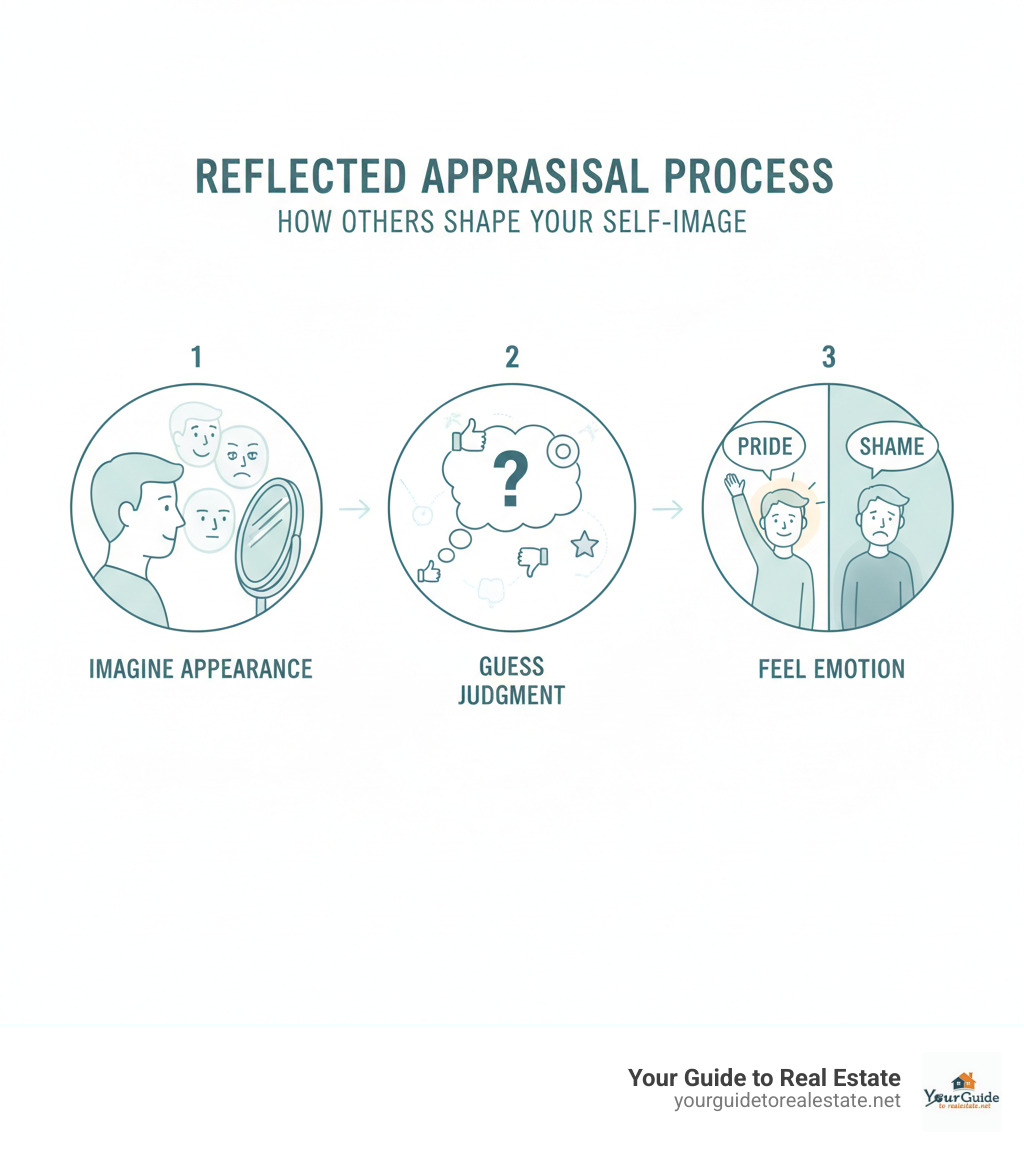
Basic reflected appraisal terms:
What is Reflected Appraisal? The Psychology of the “Looking-Glass Self”
Ever catch yourself wondering what someone really thinks about you after a conversation? That mental back-and-forth isn’t just curiosity – it’s your mind engaging in reflected appraisal, a core concept in social psychology.
Reflected appraisal is how we understand ourselves through the lens of others’ perceived opinions. The APA Dictionary of Psychology defines it as “the process by which individuals come to know themselves by observing or imagining how others view them.” It’s like an invisible social mirror constantly reflecting who we think we are.
We actively interpret what we believe others think, and these interpretations become part of our self-concept, shaping us in ways we might not even realize.
The Origins and Definition
The concept originates with sociologist Charles H. Cooley’s 1902 “looking-glass self” theory, which states that we use other people as mirrors to see ourselves. When you get ready for an interview, you’re imagining how they’ll see you—that’s the looking-glass self in action.
Psychologist Harry Stack Sullivan later named it reflected appraisal, linking social interactions to our mental health and self-perception. This fits within symbolic interactionism, a theory where social interactions create the story we tell ourselves about who we are.
Cooley identified a three-step process that happens almost automatically:
- First, we imagine our appearance to others. (“They probably notice I’m dressed professionally.”)
- Second, we imagine their judgment of that appearance. (“They must think I’m serious about this meeting.”)
- Third, we develop a self-feeling based on that imagined judgment. (A surge of pride or a pang of shame.)

This entire process often happens in seconds, without us even noticing.
How Reflected Appraisal Shapes Your Self-Concept
Crucially, reflected appraisal is based on our perception of others’ views, not their actual opinions. How we think others see us often becomes how we see ourselves.
Research shows we’re poor judges of what others think, yet our self-concept is built on these often-inaccurate perceptions. The resulting feelings and behaviors, however, are very real.
This internalization of perceptions is gradual. If you believe people see you as funny, you’ll start to see yourself that way. If you believe they see you as awkward, that too becomes part of your self-story.
This gap between perception and reality is significant. Your self-esteem and self-worth develop based on your perceptions, which may not align with objective truth.
The process is intense during adolescence, a key time for developing self-knowledge, as noted in the Handbook of Self and Identity. Teenagers are highly sensitive to perceived peer opinions. Positive appraisals build confidence, while negative ones can create lasting self-doubt.
Fortunately, our self-concept remains flexible. New interactions offer chances to update our internal story based on our interpretation of social feedback.
The Mechanics of Influence: How Appraisals Impact Us
Not every opinion carries the same weight. A comment from your boss impacts you differently than one from a neighbor. The power of an appraisal depends on several key factors.
Key Factors That Amplify Impact
Think about the last time someone’s opinion really stuck with you. Chances are, it was influenced by one of these factors:
- Credibility of the source: We give more weight to people we respect or see as experts. A compliment from a mentor means more than one from a stranger.
- Consistency of feedback: Hearing the same message repeatedly, especially from a trusted source, makes it feel true and integrates it into your self-concept.
- Number of confirmations: Widespread agreement amplifies the impact. If an entire room laughs at your joke, your mind treats it as evidence you’re funny.
- Relationship significance: The opinions of those closest to you—family, friends, partners—carry the most weight. These “significant others” heavily influence your self-concept.
- Challenging appraisals: Appraisals that challenge your self-concept can also be powerful. If a respected person sees you as confident when you see yourself as shy, it can spark self-reflection and change.
The Interaction Between Appraisal Types
Three types of appraisals are always at play, and they don’t always align: 1) what others actually think, 2) what you believe they think (reflected appraisal), and 3) what you think of yourself (self-appraisal). This interplay shapes your self-concept.
For example, studies show people often misjudge how peers view them, yet their reflected appraisals—what they believe others think—still powerfully influence their self-perception.
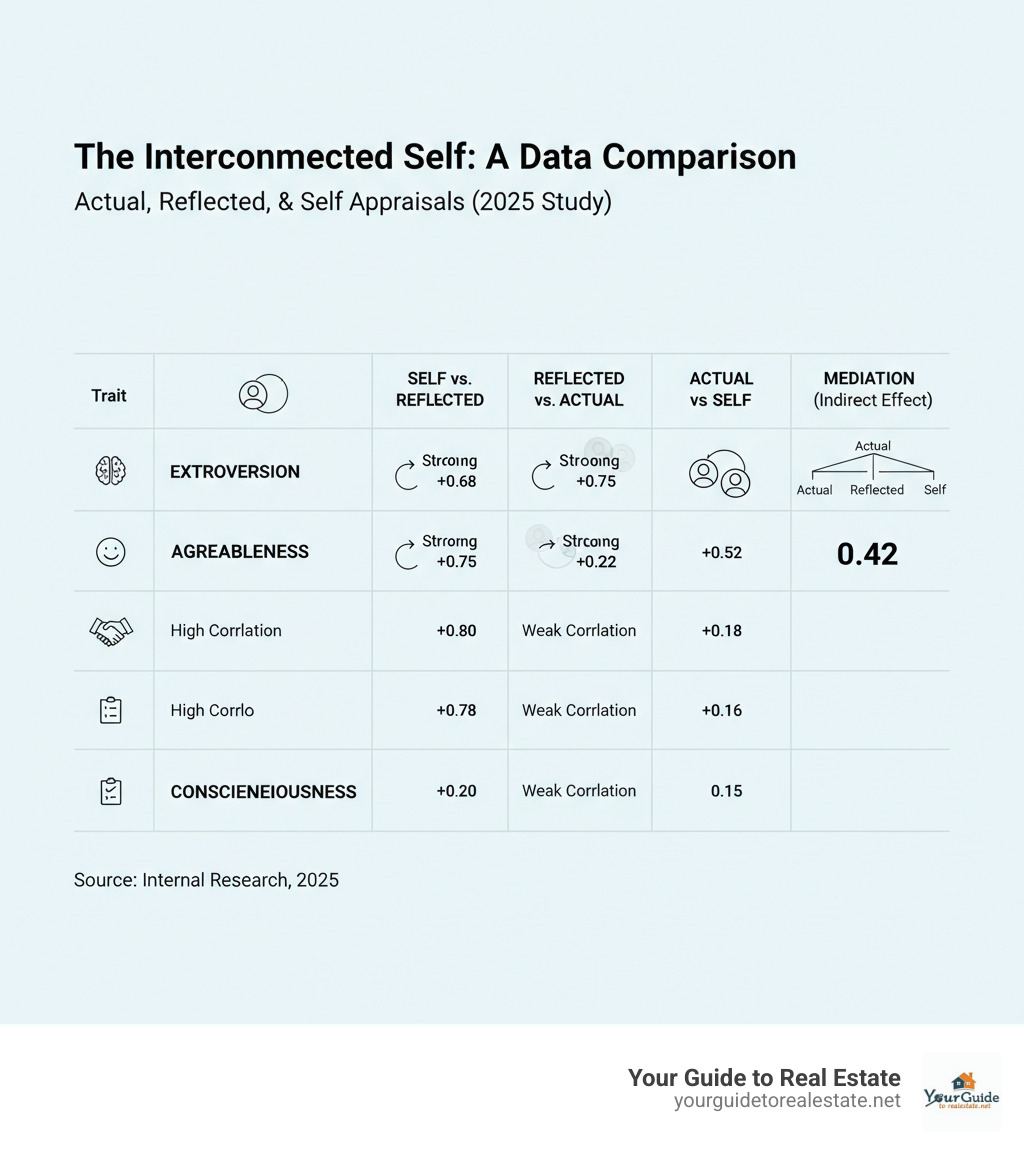
The strength of these connections varies by trait. For a visible trait like extroversion, the three appraisals align well. How others see you influences your self-view mainly through what you believe they think (a powerful indirect effect of 0.42). For less visible traits like agreeableness, your perception of others’ views shapes your self-concept, even if that perception is inaccurate.
Can Reflected Appraisal Lead to Self-Fulfilling Prophecies?
This is where reflected appraisal can become a self-fulfilling prophecy. Believing others see you a certain way can cause you to act in ways that confirm that belief.
For instance, if you think coworkers see you as disorganized, you may become anxious and make more mistakes, thus becoming disorganized. Your belief creates the reality.
This is the observer-expectancy effect (or Pygmalion effect). For example, when teachers expect certain students to succeed, they treat them differently, and those students’ performance improves as they internalize the positive expectations.
The mechanism is behavioral confirmation: your beliefs change your actions, which influences how others respond, creating a self-reinforcing cycle.
A sobering example is delinquency research: when children believe their parents see them as “rule violators,” that perception can predict future delinquent behavior.
But the hopeful side is that positive reflected appraisals work the same way. When children believe they are seen as capable and hard-working, they develop motivation and resilience, rising to meet those expectations.
The key insight? Your perception of how others see you is often more powerful than how they actually see you. This is why getting clear, objective feedback—whether about your performance at work or your home’s market value—matters so much more than you might realize.
Reflected Appraisals in Different Social and Cultural Contexts
Reflected appraisal isn’t universal; it varies based on your relationships and cultural background. Some social mirrors, like family, have a stronger reflection than others, like strangers. Your culture also shapes how you interpret these reflections.

How Appraisals Vary Across Relationships
The closer the relationship, the more powerful the reflected appraisal tends to be.
- Family influence is foundational. Early on, perceived parental appraisals shape a child’s self-esteem, confidence, and motivation for years to come.
- In adolescence, peer influence becomes paramount. Teens are highly sensitive to perceived peer judgments, and the fear of negative appraisal can lead to conformity to fit in.
- Romantic partners are powerful mirrors in adulthood, significantly impacting self-concept. Research shows a partner with higher perceived social status may have more influence on their spouse’s self-views.
- Broader social circles like colleagues and teachers also contribute. The cumulative effect of this feedback shapes our professional and public self-image.
Cultural Differences: Individualist vs. Collectivist Views
The process of reflected appraisal is also deeply influenced by culture.
In individualistic Western cultures, people often overestimate how positively others see them. This tendency is linked to a cultural focus on self-improvement and uniqueness.
Conversely, in collectivist societies like Chinese culture, people tend to underestimate how peers see them. This reflects cultural values of modesty and maintaining social harmony, or “face.” Valuing a low profile and avoiding self-praise leads people to interpret feedback more critically. As neural evidence shows, these cultural patterns are deeply ingrained.
These differences impact self-development. Individualistic cultures may foster self-improvement through optimism, while collectivist cultures encourage self-modesty to prioritize group harmony.
Understanding these cultural differences helps explain why people from different backgrounds might interpret the same social situation completely differently. What feels like encouragement in one culture might feel like pressure in another.
Reflected Appraisal in Real Estate: Seeing Your Home Through Others’ Eyes
Reflected appraisal plays a huge role in real estate. Your home is a reflection of how you want others to see you. When you buy or sell, you’re not just looking at the property; you’re imagining it through the eyes of friends, family, and potential buyers. This concern about buyer psychology and seller anxiety creates a subjective value that can differ from the actual market price.

Buying and Selling with an Audience in Mind
When house hunting, you’re often buying a lifestyle and projecting an image. A gourmet kitchen or a large garage can be as much about impressing others as they are about functionality.
Status symbols and neighborhood choice are heavily influenced by reflected appraisal. Buyers may choose a prestigious area for the reflected status or avoid another due to worry about others’ judgment.
For sellers, managing perceptions is key. Staging and presentation are all about controlling the buyer’s reflected appraisal. You declutter and paint neutral colors to avoid negative judgments about your space or style. Curb appeal is crucial for the same reason; a well-maintained exterior is meant to create a positive first impression in the buyer’s mind.
Every staging decision, from fresh flowers to throw pillows, is designed to create positive reflected appraisals in buyers’ minds.
From Perceived Social Value to Objective Market Value
The challenge is that your assumptions about what others value can create a gap between your perceived value and the actual market value. Your friends might love your vintage wallpaper, but a buyer may see it as a costly renovation project.
This subjectivity of social perceptions leads to unrealistic expectations. Sellers may overprice based on compliments from friends, while buyers might overpay to impress others.
This is exactly why you need objective data. Smart real estate decisions require looking beyond the social mirror. A professional market analysis provides facts about your property’s value and your financial standing, cutting through the emotional noise.
At Your Guide to Real Estate, we help you balance the emotional and social aspects of homeownership with cold, hard market realities. We understand that your home is deeply personal, but we also know that successful real estate decisions require separating feelings from facts. More info about property valuation can help you make decisions based on data, not just on what you think others might think.
Frequently Asked Questions about Reflected Appraisal
What’s the difference between reflected appraisal and what people actually think of me?
Reflected appraisal is your perception of what others think, not what they actually think. Research shows we’re often inaccurate at guessing others’ opinions, yet our self-concept is built on these perceptions.
For example, you might feel self-conscious about an outfit, believing others are judging you, when in reality they may not have noticed or even like it. Your self-worth is shaped by your belief about their judgment, not the reality. This is why the same compliment can make one person feel proud and another feel suspicious.
Can I change the impact of negative reflected appraisals?
Yes. Since reflected appraisal is about your perception, you can change its impact. Here’s how:
- Evaluate the source: Is the person’s opinion credible? Don’t give undue weight to unqualified or biased criticism.
- Seek diverse feedback: Don’t rely on a small group. Expand your “social mirrors” by asking for input from trusted friends, mentors, or new groups.
- Challenge your perceptions: When you assume negative judgment, pause and question it. Is it a fact, or is it your own fear or insecurity talking? Reframe the assumption into a more realistic one.
Is reflected appraisal the same as a self-fulfilling prophecy?
They are closely related but not the same. Reflected appraisal is the belief you form about yourself based on perceived opinions. A self-fulfilling prophecy is the outcome where that belief causes you to act in ways that make the perceived opinion a reality.
For example, if your reflected appraisal is that your boss sees you as incompetent, you might become anxious and perform poorly, thus fulfilling the prophecy. The reverse is also true: believing others see you as capable can lead you to act more confidently and competently.
Conclusion
The simple act of imagining how others see you is reflected appraisal in action—a powerful force shaping your self-concept. As we’ve seen, our sense of self is not formed in a vacuum but through our perception of others’ judgments. The weight of these judgments depends on the source’s credibility and our relationship with them, and this process can even lead to self-fulfilling prophecies.
This psychological concept extends into major life decisions, including real estate. We often choose and present our homes based on how we imagine others will perceive our taste and success. This creates a subjective value that can cloud our judgment.
This is where understanding becomes power. At Your Guide to Real Estate, we recognize the emotional side of property decisions. However, we also stress the importance of separating subjective perceptions from objective market realities. While it’s natural to care what others think, your financial success shouldn’t depend on guesswork.
Our proven framework provides the data-driven insights you need to make decisions based on facts, not feelings. We help you steer these psychological currents with confidence.
Ready to ground your real estate decisions in solid facts? Get a clear picture of your home’s value with a market analysis from Your Guide to Real Estate. We’re here to provide the stress-free guidance that turns real estate dreams into reality.