

The Foundation of Ethical Social Work Practice
The social work code of ethics serves as the cornerstone of professional practice, guiding social workers in their daily interactions with clients, colleagues, and communities. Developed by the National Association of Social Workers (NASW), this comprehensive framework defines the values, principles, and standards that shape how social workers approach their vital work of enhancing human well-being and addressing social problems.
Quick Overview: What You Need to Know About the Social Work Code of Ethics
- Primary Purpose: Improve human well-being and meet basic human needs, especially for vulnerable populations
- Six Core Values: Service, Social Justice, Dignity and Worth of the Person, Importance of Human Relationships, Integrity, and Competence
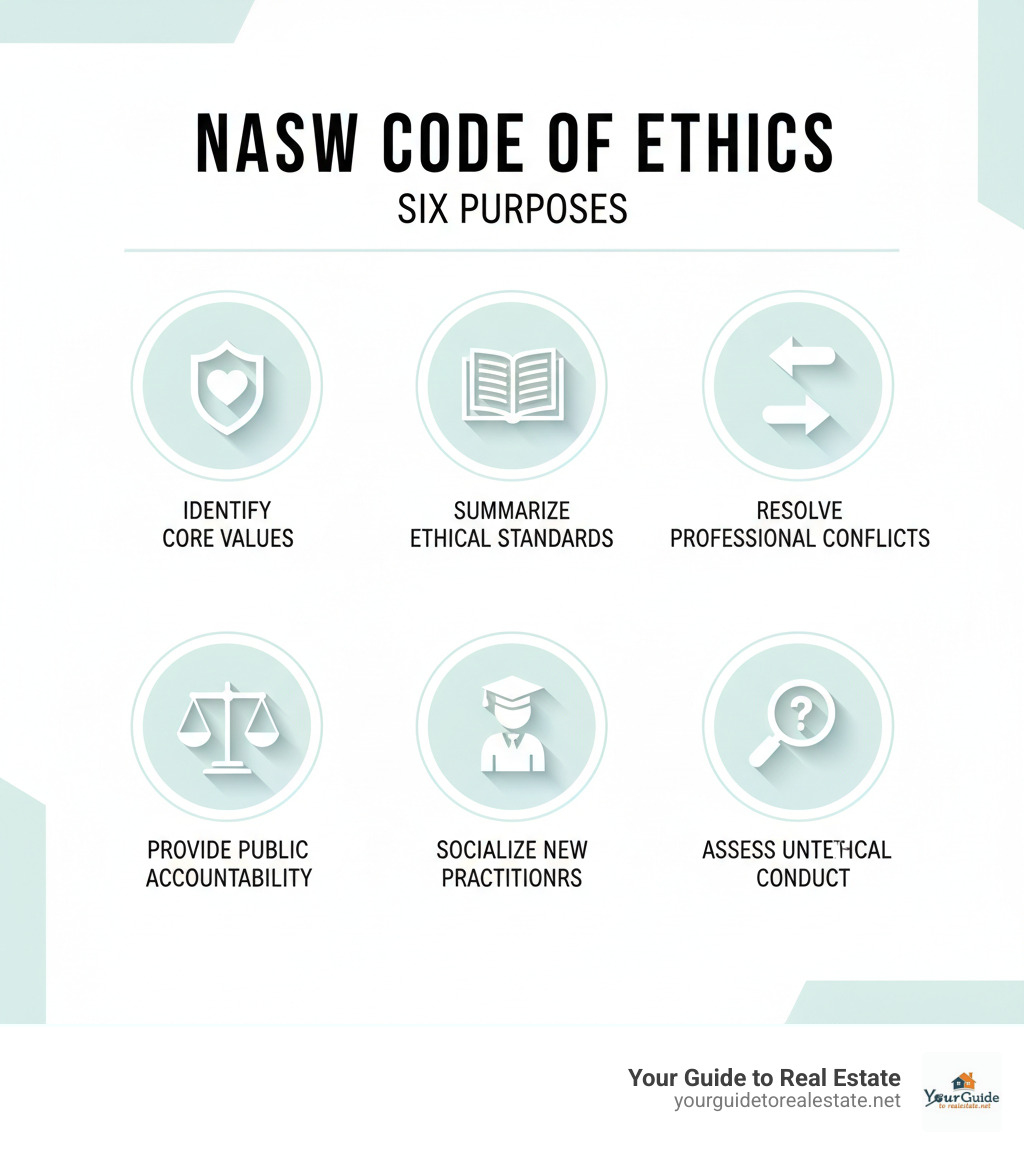
- Six Key Functions: Identify values, establish standards, guide decisions, ensure accountability, train practitioners, and assess conduct
- Scope: Over 150 specific guidelines covering responsibilities to clients, colleagues, practice settings, the profession, and society
- Legal Status: Adopted by many state licensing boards, making violations grounds for disciplinary action
The code has evolved significantly since its first edition in 1960, with major revisions in 1996, 2017, and 2021 addressing contemporary challenges like technology use and professional self-care. As social worker Sherry Saturno notes, “The Code of Ethics after 55 years remains the principal tool in making a difference in a client’s life. It empowers us with the strength to advocate for the oppressed and emboldens us with the courage to speak for the voiceless.”
This living document doesn’t just set rules – it establishes a moral foundation that helps social workers steer complex ethical dilemmas while maintaining their commitment to social justice and human dignity.
Simple social work code of ethics word guide:
The Guiding Framework: Core Values and Principles of the Social Work Code of Ethics
Think of the social work code of ethics as more than just a rulebook—it’s the heart and soul of what makes social work such a meaningful profession. The NASW has carefully crafted this ethical framework to reflect something truly special: a profession dedicated to improving human well-being while paying special attention to those who need it most.
What sets social work apart is this beautiful dual focus. Social workers don’t just help individuals—they work to strengthen entire communities and challenge the systems that keep people down. It’s about seeing the person and the bigger picture at the same time.
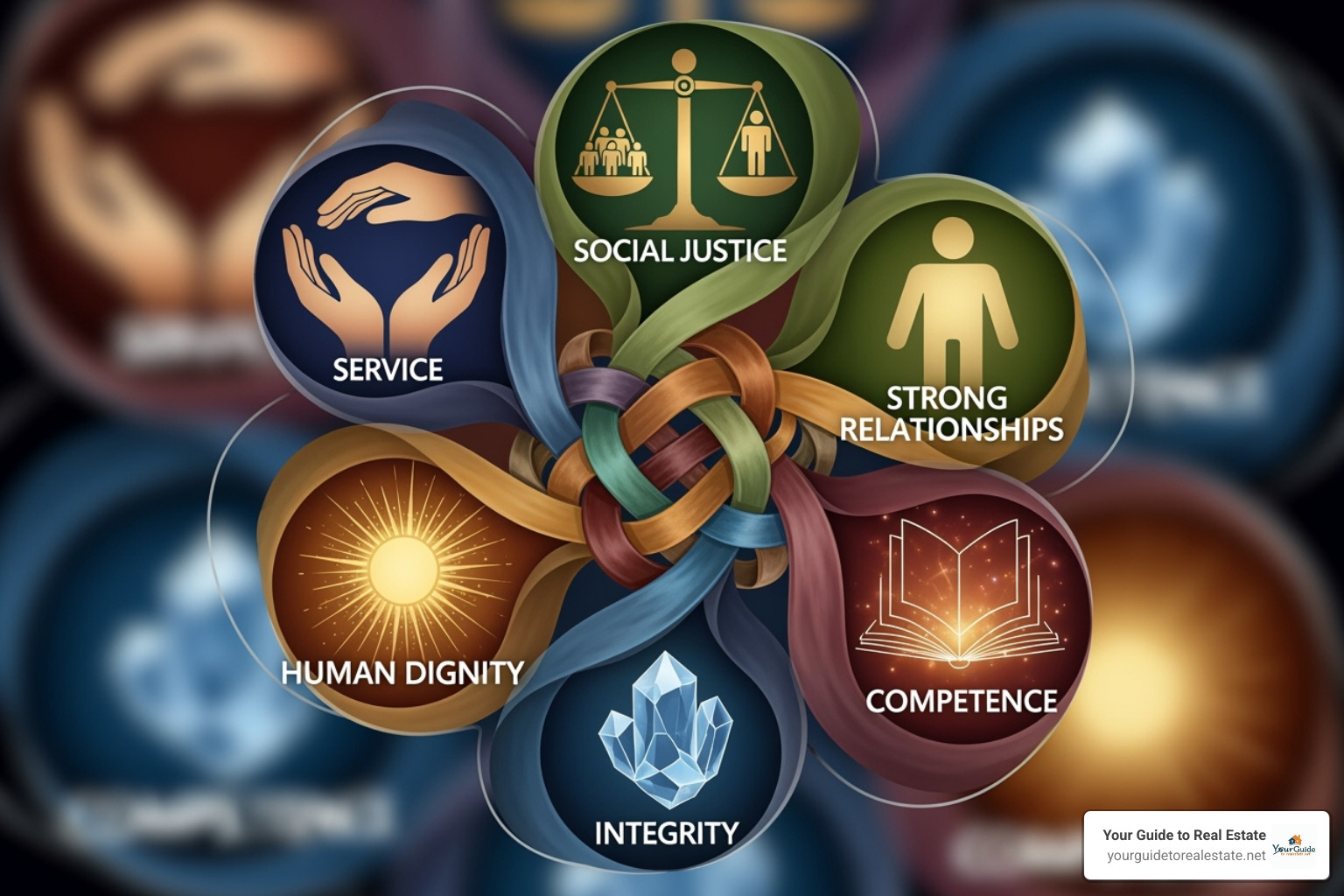
The Six Core Values of Social Work
The social work code of ethics rests on six powerful values that aren’t just nice ideas—they’re the foundation for every decision a social worker makes. These values guide everything from how they talk to clients to how they advocate for policy changes.
Service puts helping others first, always. Social workers genuinely care more about their clients’ needs than their own comfort or convenience. Many volunteer their skills for free because they believe everyone deserves help, regardless of their ability to pay.
Social Justice means social workers can’t just sit back when they see unfairness. They’re the ones speaking up for people who don’t have a voice, fighting for equal access to resources, and working to change systems that harm vulnerable populations.
Dignity and Worth of the Person reminds us that every single person matters. Whether someone is struggling with addiction, living in poverty, or facing mental health challenges, social workers see their inherent value and treat them with genuine respect and care.
Importance of Human Relationships recognizes something we all know deep down—connections heal. Social workers understand that strong, healthy relationships can transform lives and communities. They work hard to build trust and strengthen the bonds between people.
Integrity means being completely honest and trustworthy. Social workers don’t just talk the talk—they live these values every day, even when no one is watching. Their word means something.
Competence keeps social workers learning and growing throughout their careers. They know that good intentions aren’t enough—they need the skills and knowledge to truly help people. This commitment to continuous improvement ensures clients get the best possible care.
From Values to Action: Key Ethical Principles
These core values come alive through specific ethical principles that guide daily practice. When a social worker faces a tough decision, these principles help them figure out the right path forward.
The principle of socially responsible self-determination grows from respecting people’s dignity. It means helping clients make their own choices while also considering how those choices affect others and the community.
Challenging social injustice turns the value of social justice into action. Social workers don’t just feel bad about inequality—they actively work to change it, whether that’s advocating for a single client or pushing for broader policy reforms.
Respect for diversity ensures that social workers appreciate and celebrate differences rather than just tolerating them. They understand that cultural background, ethnicity, and personal experiences shape how people see the world.
Strengthening relationships happens when social workers recognize that healing often comes through connection. They work to repair damaged relationships and build new, supportive ones.
Trustworthiness means clients can count on their social worker to be honest, reliable, and consistent. This trust forms the foundation for all effective helping relationships.
Professional expertise requires social workers to stay current with best practices and research. Just like other professionals need ongoing education—more info about professional development in various fields—social workers commit to lifelong learning to serve their clients better.
The Six Purposes of the NASW Code of Ethics
The social work code of ethics isn’t just a philosophical document gathering dust on a shelf. It serves six very practical purposes that make it a living, breathing guide for the profession.
Identifying core values gives everyone—from brand-new social work students to seasoned professionals—a clear understanding of what the profession stands for. There’s no guessing about what matters most.
Summarizing principles provides both broad guidelines and specific standards that help social workers steer tricky situations. It’s like having a trusted mentor available 24/7.
Guiding ethical decisions becomes crucial when social workers face conflicts between different obligations or encounter situations where the right choice isn’t obvious. The code helps them think through complex decisions systematically.
Public accountability means the community can hold social workers to high standards. People know what to expect from social work professionals and have grounds for complaint if those standards aren’t met.
Socializing new practitioners helps newcomers understand not just the technical aspects of social work, but its deeper mission and values. It’s like an orientation to the profession’s culture and expectations.
Assessing unethical conduct gives the NASW and licensing boards clear criteria for evaluating whether a social worker has crossed ethical lines. This protects both clients and the profession’s reputation.
These six purposes show how the code serves as both a moral compass and a practical tool, ensuring social workers maintain the highest professional standards while staying true to their mission of helping others.
Evolution and Structure of the NASW Code of Ethics
The social work code of ethics isn’t just something that appeared one day and stayed the same forever. Think of it more like your favorite family recipe that gets tweaked and improved over time – keeping the essential flavors while adapting to new ingredients and changing tastes.
Understanding how this code has evolved helps us appreciate why it works so well today. The historical context shows us that social work has always been willing to examine itself and make changes when needed. This isn’t about being wishy-washy; it’s about being responsive to the real world where social workers practice every day.

A Living Document: How the Code Has Evolved
When the first edition of the code appeared in 1960, it was pretty basic compared to what we have today. But that was just the beginning of an ongoing conversation about what ethical social work really means.
The key revisions tell an interesting story. In 1979, the profession expanded the principles, setting up the foundation for more detailed guidance. But the real game-changer came in 1996 with a major overhaul that gave us the current format. This revision added the “purpose” section we discussed earlier and made social justice an explicit core value – a big deal that reflected the profession’s growing commitment to systemic change.
Technological advances brought us to the 2017 revision. Suddenly, social workers were dealing with questions their predecessors never imagined: What about confidentiality in electronic communications? How do professional boundaries work in the digital world? The code needed to catch up with reality, and it did.
The most recent updates in 2021 included something that might seem obvious now but was for the profession: self-care inclusion. The code finally acknowledged that social workers can’t help others effectively if they’re burning out themselves. These cultural competence updates also reflected hard lessons learned during the COVID-19 pandemic and the social justice movements of 2020.
Want to see how all these changes look today? You can view the current full code of ethics on the NASW website to explore the complete document.
The Code as a ‘Structure’: Its Role and Limitations in the Profession
Here’s where things get really interesting. The code isn’t just a nice document that sits on a shelf – it has serious structural power in the profession. The CSWE adoption means every social work student learns these principles as part of their education. It’s literally built into how we train new social workers.
But the code’s influence goes beyond education. It often serves as the standard of care in legal situations. When there’s a malpractice lawsuit, courts look to this code to understand what reasonable professional conduct should look like. That’s a lot of responsibility for one document.
The risk management focus has drawn some criticism, though. Some argue that having over 150 specific guidelines makes the code feel more like a legal manual than an ethical guide. There’s concern that focusing too much on avoiding liability might actually hurt the client-social worker relationship.
Critiques and limitations point out that the code sometimes emphasizes “fitting in” to existing social structures rather than challenging them. This tension between individual client needs and broader social change has always been tricky for the profession to steer.
When we look at comparison with other codes, the differences become clear. The NABSW developed their own code in 1968 because they felt the NASW code didn’t adequately address racism within the profession. The IFSW Global Statement pushes harder for transformative social change. These alternatives remind us that the NASW code, while comprehensive, reflects a particular US social work context and isn’t the only way to think about social work ethics.
This critical examination doesn’t mean the code is flawed – it means it’s human. Like any important document, it reflects the values and limitations of the people and time period that created it. The key is using it thoughtfully while staying open to continued growth and improvement.
Navigating Ethical Responsibilities in Practice
When you’re working as a social worker, the social work code of ethics becomes your daily companion – like a trusted GPS helping you steer through complex professional situations. With over 150 specific guidelines, it might seem overwhelming at first, but think of it as having a comprehensive roadmap that covers every possible scenario you might encounter.
The beauty of the Code lies in how it organizes these responsibilities into clear domains. You’re not just responsible to your clients (though they’re your primary focus), but also to your colleagues, your workplace, the profession itself, and society as a whole. It’s like being part of an interconnected web where each relationship matters.

A Social Worker’s Responsibilities to Clients and Colleagues
Your clients come first – that’s the heart of social work. Every interaction should be guided by a genuine commitment to their well-being and helping them meet their basic human needs. But what does this look like in practice?
Informed consent is where it all begins. Before you start working with someone, they need to truly understand what they’re signing up for. This means explaining the purpose of your services, any potential risks, what the limits are, and what other options might be available. Most importantly, they need to know they can say no or change their mind at any time. It’s about respecting their autonomy and empowering them to make decisions that feel right for them.
Privacy and confidentiality form the foundation of trust in your relationship. When someone shares their deepest struggles with you, they’re placing enormous faith in your ability to keep that information safe. You can only share what they’ve told you with their permission, or in very specific circumstances – like when there’s a serious risk of harm to them or someone else. Even then, you only share the absolute minimum necessary.
Professional boundaries might seem like they create distance, but they actually create safety. Avoiding conflicts of interest and maintaining clear, appropriate boundaries protects both you and your clients. This means not using your professional relationship for personal gain and being thoughtful about any dual relationships that could muddy the waters.
One of the most challenging aspects of social work is balancing individual client needs with broader societal interests. You want to support your client’s choices and self-determination, but you also need to consider how those choices affect the wider community. It’s a delicate dance that requires wisdom, compassion, and sometimes difficult conversations.
Your relationships with colleagues are equally important. Treating them with respect, cooperating when it benefits clients, and engaging in interdisciplinary collaboration creates a stronger support system for everyone you serve. When you see unethical behavior, you have a responsibility to address it – first through direct conversation when possible, and then through formal channels if necessary. It’s not about being the ethics police; it’s about maintaining the integrity that makes social work effective.
Broader Obligations: Practice Settings, the Profession, and Society
Your ethical responsibilities extend far beyond individual relationships. In your practice setting, you’re an advocate for creating an environment that supports ethical practice. This means pushing for adequate resources, fair procedures, and policies that align with the social work code of ethics. You’re also responsible for maintaining accurate records, ensuring fair billing practices, and handling client transfers appropriately.
As a member of the social work profession, you carry the responsibility of upholding its values and advancing its mission. This involves staying competent through continuous learning, accurately representing your qualifications, and contributing to the profession’s knowledge base. When personal problems arise, you need to ensure they don’t interfere with your professional judgment – sometimes this means seeking help or taking time to address your own needs.
Your commitment to social justice extends to society as a whole. You’re not just helping individuals steer their challenges; you’re working to create conditions where everyone can thrive. This means advocating for policies that promote social justice, facilitating public participation in shaping social policies, and providing services during emergencies when your community needs you most.
The work of challenging discrimination, oppression, and poverty happens at both individual and systemic levels. When you advocate for a single client, you’re often also working to change systems that affect many others in similar situations. It’s this dual focus – on individual well-being within a broader social context – that makes social work unique and powerful.
This interconnected approach means you’re constantly balancing different interests and responsibilities. Sometimes what’s best for an individual client might conflict with broader social concerns, or your agency’s policies might not align perfectly with ethical standards. The Code doesn’t provide easy answers to these dilemmas, but it gives you a framework for thinking through complex situations with integrity and purpose.
Applying the Code: Modern Challenges and Ethical Dilemmas
The social work code of ethics isn’t just a document you read once in school and forget about. It’s your daily companion, helping you work through those tricky situations that don’t have clear-cut answers. Real-world practice is messy, and the Code recognizes this by providing a framework for professional judgment rather than rigid rules for every possible scenario.
Think of it this way: the Code gives you the compass, but you still need to chart your course through complex ethical terrain. Whether you’re dealing with conflicting loyalties, unclear boundaries, or emerging challenges that previous generations of social workers never faced, the Code’s values and principles remain your North Star.
Ethics in the Digital Age: Technology and the social work code of ethics
Remember when the biggest technology concern was whether to use email with clients? Those days are long gone. Today’s social workers steer video therapy sessions, encrypted messaging apps, electronic health records, and the constant presence of social media in both their professional and personal lives.
The 2017 revisions to the NASW Code were a game-changer in addressing these digital realities. The Code now explicitly states that all ethical standards apply to technology-assisted social work services, whether you’re conducting therapy via video call, communicating through secure messaging platforms, or using any other digital tools.
Electronic communication brings unique challenges that didn’t exist in face-to-face practice. You need to inform clients about the confidentiality risks that come with digital platforms – things like data breaches, intercepted messages, or the possibility that others might access their devices. It’s not about scaring clients away from technology, but ensuring they can make informed decisions about their care.
Digital boundaries have become just as important as physical ones. This means being thoughtful about your social media presence, avoiding friend requests from clients, and understanding how your online activities might affect your professional relationships. The Code guides you to ensure that your digital footprint supports rather than undermines your professional integrity.
The Importance of Professional Self-Care
Here’s something that might surprise you: taking care of yourself isn’t selfish – it’s an ethical obligation. The 2021 revisions to the Code made this crystal clear by explicitly emphasizing professional self-care as essential for competent practice.
Why did this become so important that it warranted inclusion in the Code? Social work exposes you to trauma, challenging workplace conditions, and emotionally demanding situations on a regular basis. Without proper self-care, you risk burnout, impaired judgment, and ultimately, your ability to serve clients effectively.
Preventing burnout isn’t just about feeling better (though that’s important too). When you’re overwhelmed, exhausted, or emotionally depleted, your professional integrity suffers. You might make poor decisions, miss important cues from clients, or struggle to maintain appropriate boundaries.
The Code encourages organizations to create supportive workplace climates that promote self-care policies and practices. This recognition that self-care is a systemic issue, not just an individual responsibility, represents a significant shift in how the profession views practitioner well-being. After all, you can’t help others heal if you’re running on empty yourself.
When Ethics, Policies, and Laws Collide
This is where social work gets really challenging. Sometimes your ethical obligations, your agency’s policies, and legal requirements all point in different directions. What do you do when following one means violating another?
The NASW Code acknowledges these conflicts of obligation and provides guidance for working through them. Your goal is to find a resolution that stays true to the Code’s values and principles while respecting legal requirements and working within your agency’s constraints.
Consider a common scenario: your agency policies might limit the services you can provide to a client, but you ethically believe those services are crucial for their well-being. Or a legal requirement might force you to disclose information that conflicts with your commitment to client confidentiality. These aren’t theoretical problems – they happen regularly in practice.
When facing these dilemmas, the Code encourages you to seek consultation, advocate for policy changes when possible, and always strive for the least harmful outcome for your clients. State licensing boards play a crucial role here, as many have adopted the NASW Code into their regulations. For example, North Dakota’s adoption of the code gives it legal force, meaning violations can result in disciplinary action.
This legal backing underscores something important: ethical practice isn’t just about doing the right thing morally – it’s also about maintaining your professional license and ability to practice. The intersection of ethics, policy, and law requires careful consideration, ongoing consultation, and sometimes difficult decisions that balance competing obligations while keeping client welfare at the center.
Frequently Asked Questions about the Social Work Code of Ethics
If you’re new to social work or simply curious about how the profession maintains its standards, you likely have questions about the social work code of ethics. We’ve gathered the most common questions we hear and provided clear, straightforward answers to help you understand this important framework.
What are the six core values of social work?
The heart of social work beats with six fundamental values that shape everything we do. These aren’t just nice ideas on paper – they’re the driving force behind every decision and interaction in our profession.
Service comes first, reminding us that our primary goal is helping people in need and tackling social problems. We put others before ourselves, often volunteering our skills when people can’t afford help.
Social Justice pushes us to challenge unfairness wherever we find it. This means fighting for vulnerable and oppressed groups, making sure everyone has equal access to resources and opportunities.
Dignity and Worth of the Person means we treat every single person with respect and care, no matter their background or circumstances. We celebrate diversity and support people in making their own responsible choices.
The Importance of Human Relationships recognizes that connections between people are powerful tools for positive change. We work to strengthen these bonds to improve lives and communities.
Integrity calls us to be trustworthy and honest, always staying true to our profession’s mission and values. People need to know they can count on us.
Finally, Competence means we only work within our areas of expertise and never stop learning. We’re committed to providing the best possible service by continuously improving our skills.
What happens if a social worker violates the Code of Ethics?
Breaking the social work code of ethics has serious consequences, and for good reason – these standards protect both clients and the profession’s reputation.
State licensing boards take violations seriously. Depending on the severity of the breach, a social worker might face sanctions, have their license suspended, or even lose their license permanently. This isn’t just a slap on the wrist – it can end a career.
The NASW also has its own formal process for handling ethics complaints against members. This creates multiple layers of accountability, ensuring that unethical behavior doesn’t go unnoticed or unpunished.
These consequences might seem harsh, but they serve an important purpose. They protect vulnerable people who depend on social workers for help, and they maintain public trust in our profession. When people know that social workers are held to high standards, they feel safer seeking our services.
Is the NASW Code of Ethics legally binding?
This is where things get interesting. The Code itself isn’t technically a law that Congress passed, but it often carries the weight of law anyway.
Many state licensing boards have adopted the Code, either completely or in large part, into their official administrative rules. When this happens, the Code becomes legally enforceable in those states. For example, North Dakota’s Board of Social Work Examiners has officially adopted the 2017 version of the NASW Code of Ethics, making it a legal requirement for licensed social workers in that state.
Even when states haven’t formally adopted the Code, courts often use it to establish what’s called the “standard of care” in malpractice lawsuits. This means judges and juries look to the Code to decide whether a social worker acted appropriately in a given situation.
So while you won’t find the Code in your state’s criminal law books, violating it can still have very real legal consequences. For licensed social workers, following the Code isn’t just about being ethical – it’s about protecting their ability to practice and avoiding legal trouble.
Conclusion: Upholding Ethical Standards in Helping Professions
The social work code of ethics stands as far more than words on paper—it’s a living, breathing commitment that guides social workers toward the highest ideals of service, justice, and human dignity. Throughout this exploration, we’ve seen how this remarkable document has grown and adapted over more than six decades, evolving from a simple set of guidelines in 1960 to today’s comprehensive framework that addresses everything from digital boundaries to professional self-care.
At its heart, the Code remains anchored in those six core values: Service, Social Justice, Dignity and Worth of the Person, Importance of Human Relationships, Integrity, and Competence. These aren’t just lofty ideals—they’re practical guideposts that help social workers make tough decisions every single day. Whether it’s advocating for a vulnerable client, maintaining confidentiality in the digital age, or balancing competing interests between individuals and society, the Code provides that essential moral compass.
What makes this framework truly powerful is how it bridges the gap between values and action. The Code’s six purposes work together seamlessly: identifying core values, establishing standards, guiding decisions, ensuring public accountability, training new practitioners, and assessing conduct. This comprehensive approach ensures that social workers at every stage of their careers have the guidance they need to serve with integrity.
We’ve also seen how the Code functions as a critical structure within the profession, adopted by licensing boards across the country and serving as a legal standard of care. Yet it remains flexible enough to evolve with changing times—addressing modern challenges like technology ethics and recognizing the vital importance of professional self-care in maintaining effective practice.
The beauty of ethical practice lies not just in avoiding harm, but in actively working toward a more just and compassionate world. Social workers carry this responsibility with them every day, using the Code as their guide to steer complex ethical dilemmas while never losing sight of their fundamental mission to improve human well-being.
Just as social workers maintain rigorous ethical standards in their vital work, professionals in other fields also depend on strong codes of conduct to build trust and ensure integrity. In real estate, ethical practice is equally essential—whether you’re helping families find their perfect home or guiding investors through complex transactions, maintaining the highest professional standards creates the foundation for lasting success. Learn more about professional standards for real estate agents.
The social work code of ethics reminds us all that true professionalism isn’t just about expertise—it’s about carrying our values into action, day after day, in service of others.