

Why Understanding IRA Interest Rates Matters for Your Financial Future
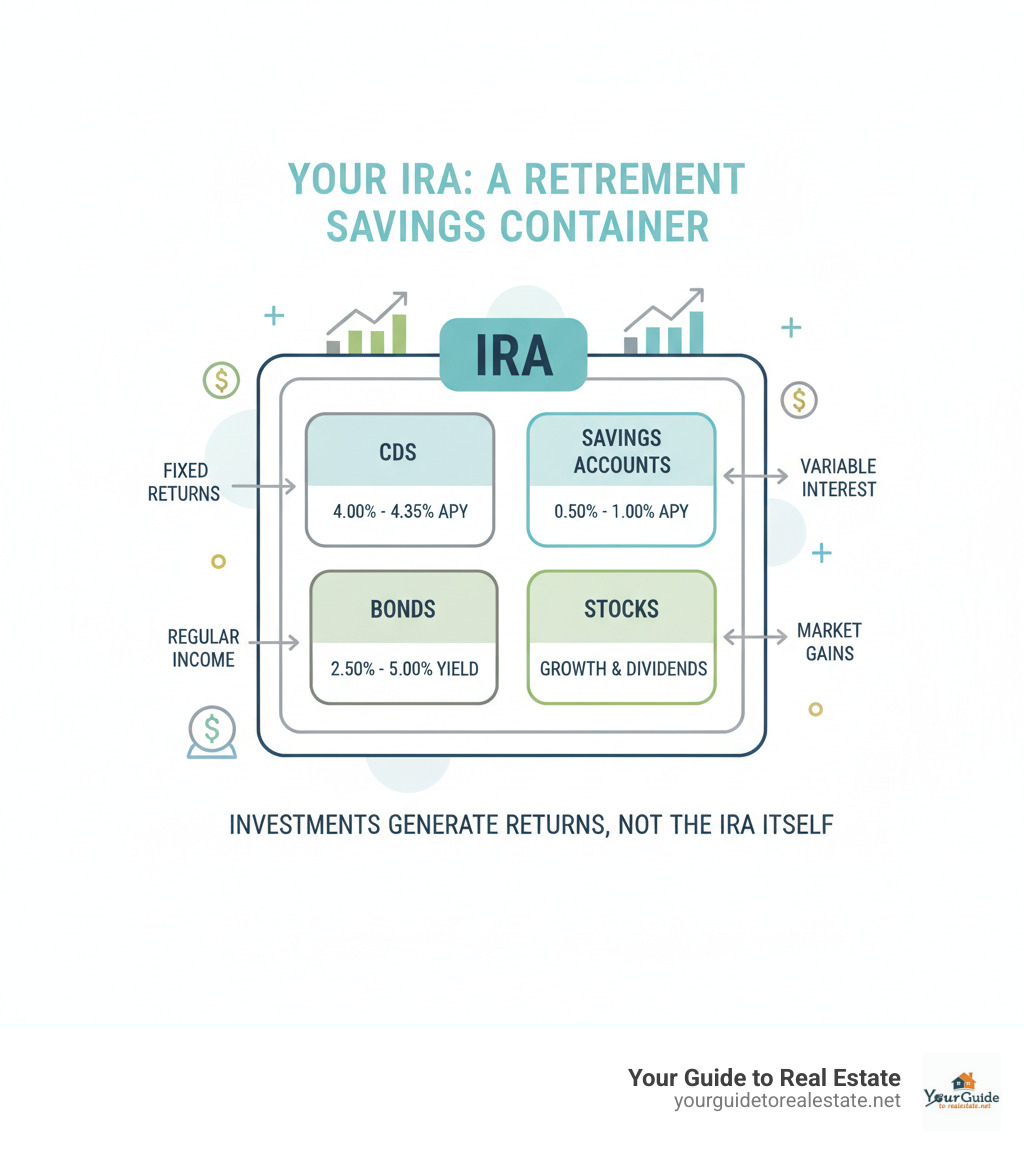
IRA interest rates refer to the returns on investments held within your Individual Retirement Account, such as CDs, savings accounts, and bonds.
Current IRA CD Rates (2024):
- Salem Five Direct: 4.15% APY (12-month term, $10,000 minimum)
- America First Credit Union: 4.35% APY (12-month term, $500 minimum)
- Synchrony Bank: 4.00% APY (various terms, $0 minimum)
- Mountain America Credit Union: 4.20% APY (12-month term, $500 minimum)
Key Point: An IRA is a container; it doesn’t earn interest by itself. The investments inside your IRA (like CDs or bonds) are what generate returns.
Many people mistakenly believe the IRA account itself pays interest. In reality, your IRA is a tax-advantaged wrapper that holds different investments. The rates you earn depend entirely on which investments you choose.
Understanding how IRA interest rates work can help you make smarter financial decisions, whether you’re planning for retirement or diversifying beyond real estate.
Money in IRA CDs is insured up to $250,000 by the FDIC (banks) or NCUA (credit unions), making them a popular choice for conservative investors seeking predictable, low-risk returns.
Ira interest rates word list:
Understanding IRA Investments and Their Returns
When people ask about IRA interest rates, they are asking about the returns their retirement money can earn. An IRA isn’t an investment itself but a tax-advantaged container that holds your investments.
You can choose between Traditional IRAs and Roth IRAs. Both offer tax advantages for retirement savings, but they differ in how taxes are handled. The investments inside these containers generate your returns.
At Your Guide to Real Estate, we know smart financial planning goes beyond property. A well-rounded retirement strategy includes diverse assets, and IRAs are often a foundational part of that strategy.
Common Interest-Earning Investments for Your IRA
Let’s look at the safe, predictable investments that earn those IRA interest rates.
IRA Savings Accounts are regular savings accounts within your IRA. They are very safe and offer easy access to your money, but interest rates are typically modest, often around 0.15% APY. For example, CIBC US Banking offers an IRA savings account with a $50 minimum deposit and no monthly fees for balances over $250.
IRA Money Market Accounts offer slightly better rates than savings accounts, often using tiered interest rates where larger balances earn more. Dollar Bank’s IRA Premium Money Market Account offers up to 1.00% APY for balances of $25,000 or more, versus 0.10% for smaller balances.
Certificates of Deposit (CDs) are popular with conservative investors. IRA CDs lock in a guaranteed interest rate for a set period, from three months to 10 years, offering predictability for retirement planning.
Currently, IRA CD rates are attractive. America First Credit Union offers 4.35% APY on a 12-month IRA CD ($500 minimum), while Salem Five Direct offers 4.15% APY ($10,000 minimum). For those starting out, Synchrony Bank and Find Bank both offer 4.00% APY with no minimum deposit.
Bonds pay regular coupon payments instead of traditional interest. They are excellent for diversification and are generally less volatile than stocks. To learn more, see our guide on Investing in Bonds vs. Stocks.
The key is matching investments to your timeline and risk tolerance. For steady, predictable growth, IRA CDs and money market accounts are an excellent foundation.
Traditional vs. Roth IRA: How Taxes Affect Your Earnings
The type of IRA you choose affects how much of your earnings you keep.
Traditional IRAs use a “pay later” system. Contributions are often tax-deductible, reducing your current tax bill. Your money grows tax-deferred, and you pay taxes on withdrawals in retirement.
This is ideal if you expect to be in a lower tax bracket when you retire. Withdrawals are taxed as regular income. A 10% penalty applies to withdrawals before age 59½ (with some exceptions), and Required Minimum Distributions (RMDs) start at age 72.
Roth IRAs are the opposite. You contribute after-tax money (no current deduction), but your money grows tax-free, and qualified withdrawals in retirement are also tax-free.
This is beneficial if you expect to be in a higher tax bracket during retirement. While there are income limits for contributing, you can withdraw original contributions anytime without taxes or penalties.
For example, with a 4.00% APY on an IRA CD, you’d eventually pay taxes on the principal and growth in a Traditional IRA. In a Roth IRA, that 4.00% return could be entirely yours, tax-free.
When comparing rates, always factor in the tax implications. A lower rate in a Roth IRA might yield more after-tax money than a higher rate in a Traditional IRA, depending on your tax situation.
Both IRA types allow rollovers from other retirement accounts like 401(k)s, offering flexibility. Understanding how taxes affect your returns is key to maximizing your retirement savings.
How to Compare and Find the Best IRA Interest Rates
Finding the best IRA interest rates requires looking beyond the headline number. You need to understand the details, market conditions, and how it all fits into your financial picture.
When shopping for rates, focus on APY (Annual Percentage Yield). This figure reflects your total earnings over a year, including compounding, giving you the full picture.
Different institutions offer varying opportunities. Traditional banks, credit unions, and online-only banks have different overhead costs. Online banks often provide competitive IRA interest rates because of their lower operational expenses.
Timing also matters. When the Federal Reserve adjusts its benchmark rate, it affects deposit rates across the financial system, including IRA CDs. Keeping an eye on these trends can be beneficial; you might even wonder Did Interest Rates Go Down Today? when planning your next investment.
Key Factors That Influence IRA Interest Rates
Several factors shape the IRA interest rates you’ll find.
Term length is a major factor. Generally, the longer you lock up your money, the better rate you’ll receive, as banks reward your commitment. However, promotional rates or unusual market conditions can sometimes alter this rule.
Minimum deposit requirements can open up better rates. Many institutions use tiered systems where larger deposits earn premium rates. For example, Dollar Bank offers a 7-month IRA CD at 4.00% APY with a $25,000 minimum. Conversely, institutions like Synchrony Bank and Find Bank offer competitive rates with no minimum deposit.
The choice between banks and credit unions is important. As non-profits owned by their members, credit unions often provide better rates for savers. America First Credit Union (4.35% APY) and Mountain America Credit Union (4.20% APY) are prime examples. Still, traditional banks like Salem Five Direct and Bread Savings remain competitive.
Economic conditions and Federal Reserve policy directly influence returns. When inflation is high, the Fed typically raises rates, leading to better rates for savers. The Federal Funds Rate guides rates across the system. While the IRS publishes Official Federal Rates for July 2024 for tax purposes, these differ from consumer rates.
A Look at Current IRA CD Rates
Based on our research, here is a snapshot of the current IRA interest rates for CDs:
| Term Length | Typical APY Range | Example Institutions (APY) | Minimum Deposit |
|---|---|---|---|
| 12-Month | 3.95% – 4.35% | America First CU (4.35%) | $500 |
| Mountain America CU (4.20%) | $500 | ||
| Salem Five Direct (4.15%) | $10,000 | ||
| Bread Savings (4.00%) | $1,500 | ||
| Synchrony Bank (4.00%) | $0 | ||
| Find Bank (4.00%) | $0 | ||
| SchoolsFirst FCU (4.25%) | $500 | ||
| American Airlines FCU (4.05%) | $1,000 | ||
| Alliant CU (4.00%) | $1,000 | ||
| Suncoast CU (3.95%) | $500 | ||
| 24-Month | 2.50% – 3.00% | Dollar Bank (2.50%) | $1,500 |
| Other high-yield banks may offer around 3.50% – 4.00% | Varies | ||
| 60-Month | 2.50% – 3.00% | Dollar Bank (3.00%) | $1,500 |
| Other high-yield banks may offer around 3.75% – 4.00% | Varies |
The 12-month terms are currently the most competitive, with rates between 4.00% and 4.35%. Some institutions offer special features, like Mountain America Credit Union’s one-time rate bump-up option or American Airlines Federal Credit Union’s pre-built CD ladders.
Rates can change daily, so always verify the current rate, minimum deposit, and terms before committing. The APY already includes compounding, so what you see is what you get if the CD is held to maturity.
Strategies and Considerations for IRA CD Investing
While real estate is our expertise, we recognize the importance of diversified financial strategies. Including IRA CDs in your retirement portfolio offers a balanced approach, providing stability alongside growth-oriented investments.

Think of IRA CD investing as the foundation of your retirement portfolio. The stable, predictable IRA interest rates on CDs serve an important purpose, even if they aren’t as exciting as rising property values.
This approach is particularly effective for those nearing retirement or anyone who prefers low-risk stability. Knowing exactly what your money will be worth provides peace of mind.
Pros and Cons of Using CDs in an IRA
Every investment has trade-offs. Understanding both sides of IRA CDs helps you make the right choice.
The biggest pro is safety. Your money is insured up to $250,000 per depositor, per institution, by the FDIC (banks) or NCUA (credit unions), protecting your principal from market volatility.
Predictable returns simplify planning. Once you lock in an IRA interest rate, you know exactly how much your money will grow, which is valuable as you approach retirement.
The tax advantages of an IRA make CDs even more attractive, allowing earnings to grow tax-deferred (Traditional) or tax-free (Roth).
On the downside, inflation risk is a concern; a fixed rate may not keep pace with rising prices. Early withdrawal penalties can reduce your returns if you need funds before the CD matures. Finally, the lower growth potential means you might miss out on higher returns from other investments, which can be a significant drawback for younger investors with long time horizons.
Building an IRA CD Ladder for Flexibility and Growth
A CD ladder is a strategy to improve flexibility. Instead of putting all your money into a single long-term CD, you spread it across several CDs with different maturity dates.
For example, with $10,000, you could buy five $2,000 CDs maturing in one, two, three, four, and five years. When the one-year CD matures, you reinvest it into a new five-year CD at current IRA interest rates.
This staggered approach offers several benefits. It provides regular access to a portion of your funds, improving liquidity without incurring penalties. It also helps manage interest rate risk, as you can reinvest maturing CDs at higher rates if they become available.
This strategy takes the guesswork out of timing the market. Some institutions, like American Airlines Federal Credit Union and Dollar Bank, offer pre-made CD ladders to simplify the process.
Building a CD ladder requires more initial effort but combines the safety of CDs with the flexibility to adapt to changing financial conditions.
Frequently Asked Questions about IRA Interest Rates
Questions about IRA interest rates are common when planning for retirement. Let’s clear up some of the most frequent ones.

Making smart, informed decisions about your IRA is crucial for your financial future.
How do I open an IRA for interest-earning investments?
Opening an IRA is straightforward and can often be done online in under an hour.
First, choose a provider. Banks are convenient and offer competitive IRA interest rates on CDs. Credit unions often provide the best rates, like America First Credit Union’s 4.35% APY on 12-month IRA CDs. Brokerages offer the most investment options, but a bank or credit union may be better if you’re focused on CDs.
Next, gather your documents. You’ll need a government-issued ID, proof of address, and your Social Security number. Most institutions allow you to upload these documents.
Then, decide between a Traditional or Roth IRA. This choice affects how your earnings are taxed. A Traditional IRA may be better if you expect to be in a lower tax bracket in retirement, while a Roth IRA is often preferred if you anticipate being in a higher bracket.
Finally, fund your account via electronic transfer, check, or direct deposit. The entire process usually takes just a few days.
To diversify beyond interest-earning investments, our guide on How to Invest in Real Estate can help you explore other strategies.
Are IRA interest rates fixed?
It depends on the investment.
An IRA Certificate of Deposit (CD) has a fixed rate. When you open a 12-month IRA CD at 4.00% APY, you’ll earn that rate for the entire year, regardless of market changes. This predictability is ideal for retirement planning.
An IRA savings or money market account has a variable rate. These IRA interest rates can change after the account is opened. Your rate could go up or down with market conditions. Dollar Bank, for example, notes that its “Money Market rates may change after account opening.”
Fixed rates offer certainty, while variable rates provide flexibility. Many people use a mix of both: fixed-rate IRA CDs for stability and a variable-rate account for liquidity.
Can I lose money in an IRA CD?
IRA CDs are among the safest investments, but it’s important to understand the risks.
Your principal is federally insured up to $250,000 per depositor, per institution, through the FDIC (banks) or NCUA (credit unions). If the institution fails, the government protects your money.
The main risk is early withdrawal penalties. If you need to access funds before your CD matures, you will face a penalty, which is typically a few months’ worth of interest. In some cases, this could reduce your original deposit.
Inflation risk is another factor. While you won’t lose your principal, inflation can erode your purchasing power. If your IRA CD earns 4.00% and inflation is 5.00%, your real return is negative.
Overall, IRA CDs are very safe for preserving your principal. As long as you avoid early withdrawals, you are highly unlikely to lose your initial investment. This safety makes them a key part of a balanced retirement strategy.
Conclusion: Integrating Your IRA into Your Financial Future
Your IRA interest rates and investment choices are a key piece of your financial puzzle. Like building equity in real estate, an IRA creates lasting wealth with significant tax advantages.
Whether you prefer the predictable returns of IRA CDs earning 4.00% APY or higher or other investments, your IRA is a powerful wealth-building tool.
At Your Guide to Real Estate, our philosophy of providing a proven framework and stress-free guidance extends to retirement planning. Diversification is key. Spreading money across different CD terms or combining Traditional and Roth IRAs creates a resilient financial foundation.
As shown, IRA interest rates vary significantly. The difference between America First Credit Union’s 4.35% APY and a basic savings account’s 0.15% APY adds up over decades.
Also, consider the tax implications. A 4.00% APY in a Roth IRA could be tax-free in retirement, while the same rate in a Traditional IRA will be taxed. It’s not just the rate you earn, but what you keep.
Your IRA is an active part of your wealth-building strategy. Using tactics like CD laddering or timing contributions helps secure your financial future.
For those looking to diversify further, our guide on Understanding Mortgages: A Beginner’s Guide to Home Loans can help you fit real estate into your strategy.
Smart IRA interest rate decisions today mean more financial security during retirement.