

Understanding Disparate Impact: When Fair Policies Have Unfair Results
What is disparate impact? It’s a legal concept that describes when a seemingly neutral policy or practice unintentionally discriminates against a protected group of people. Unlike intentional discrimination, disparate impact focuses on the effect of a policy, not the intent behind it.
Here’s what you need to know:
- Definition: A policy that appears fair on its face but disproportionately harms people based on race, color, religion, sex, disability, familial status, or national origin
- Key Characteristic: The discrimination is unintentional – there’s no malicious intent required
- Where It Applies: Employment, housing, lending, and other areas covered by civil rights laws
- Legal Standard: Even neutral policies can be illegal if they create disparate impact unless they serve a legitimate business necessity
- Proof Required: Statistical evidence showing the policy affects protected groups more than others
The concept emerged from a landmark 1971 Supreme Court case, Griggs v. Duke Power Company. Before the Civil Rights Act of 1964, Duke Power openly restricted Black workers to the lowest-paying jobs. After the law passed, they implemented a new requirement: employees needed a high school diploma and had to pass standardized tests to advance. On paper, this seemed fair. In practice, it excluded Black workers at much higher rates – and the company couldn’t prove these requirements were actually necessary for the job.
This is the heart of disparate impact. A policy can look completely neutral – no discriminatory language, applied to everyone equally – but still violate civil rights laws if it creates barriers for protected groups without a valid business reason.
For real estate professionals, understanding disparate impact is critical. Policies around tenant screening, occupancy limits, zoning, and lending can all create unintentional discrimination. The consequences are serious: organizations found liable face significant fines, legal fees, and reputation damage. Target Corporation, for example, paid $2.8 million when their pre-employment tests were found to have disparate impact based on race, sex, and disability.
The good news? Disparate impact is preventable. By understanding how it works, regularly reviewing your policies, and ensuring your practices serve legitimate business needs, you can create fair systems that comply with the law.
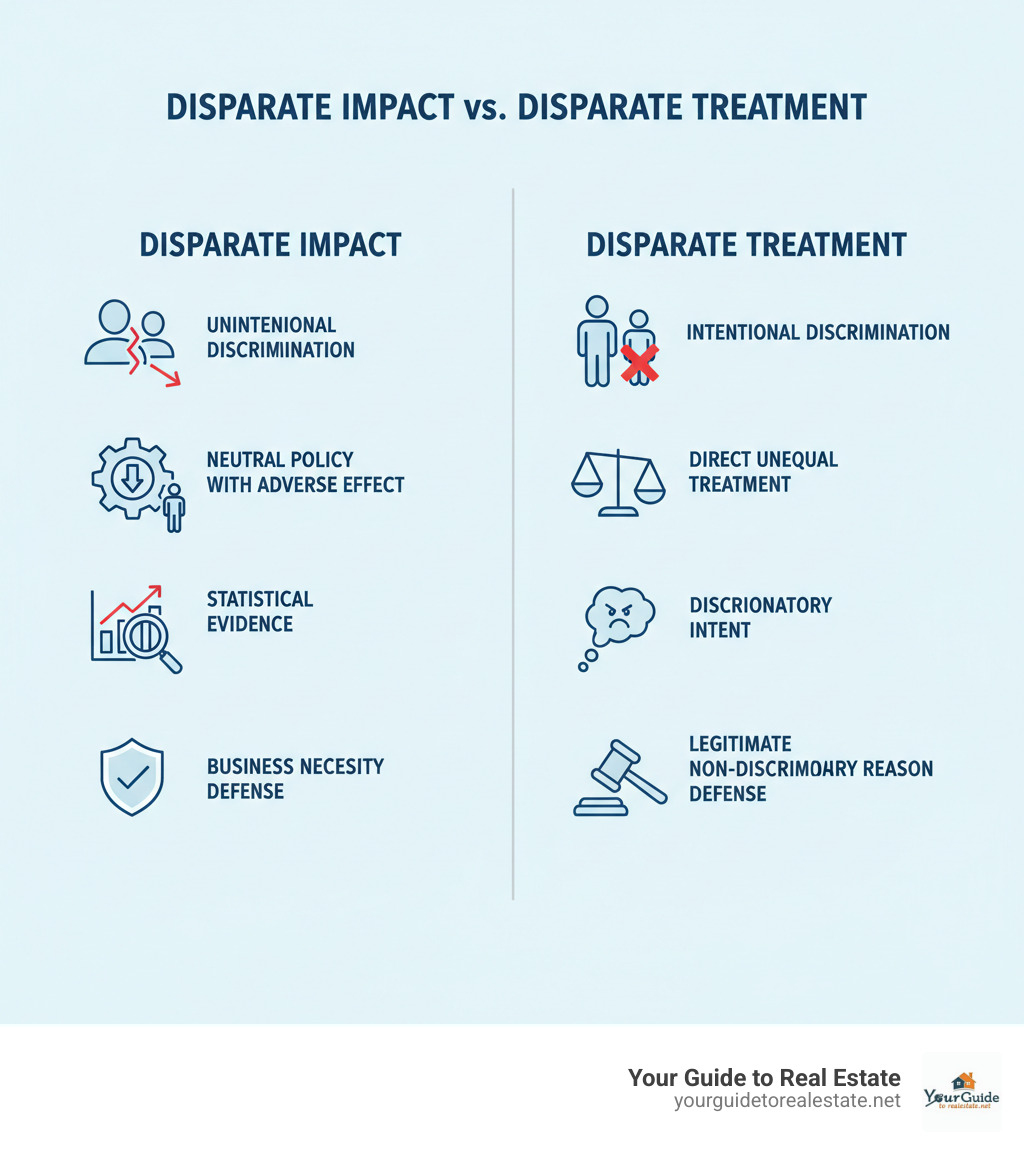
Defining Disparate Impact vs. Disparate Treatment
Not all discrimination looks the same in the eyes of the law. In fact, there are two very different types that real estate professionals need to understand: disparate impact and disparate treatment. Both are illegal under civil rights laws, but they work in completely opposite ways.
The main difference? Intent versus effect.
Disparate treatment is what most people picture when they think of discrimination – someone deliberately treating another person unfairly because of who they are. Disparate impact, on the other hand, happens when a neutral-looking policy accidentally creates barriers for protected groups, even when there’s no intention to discriminate.
Think of it this way: disparate treatment asks “Did someone mean to discriminate?” while disparate impact asks “Does this policy result in discrimination, regardless of intent?”
Here’s how they compare:
| Feature | Disparate Impact | Disparate Treatment |
|---|---|---|
| Intent | Unintentional | Intentional |
| Policy/Action | Neutral on its face, but has an adverse effect | Overtly discriminatory |
| Focus | Outcome/Effect of a policy | Motive/Intent behind an action |
| Evidence | Statistical data showing disproportionate harm | Direct evidence of unequal treatment or motive |
| Defense | Business necessity; no less discriminatory alternative | Legitimate, non-discriminatory reason |
| Key Question | Does this policy disproportionately harm a protected group? | Was this person treated differently due to their protected characteristic? |
Understanding this distinction isn’t just legal trivia – it’s essential for protecting yourself and your clients in the real estate world. Let’s break down each type in more detail.
What is Disparate Impact?
What is disparate impact? It’s unintentional discrimination that happens when a policy looks completely fair on paper but ends up creating barriers for people in protected classes. The legal definition of disparate impact describes it as a neutral policy or rule that has a disproportionately negative effect on a specific protected group.
The critical point here is that no one meant to discriminate. There’s no smoking gun email, no whispered prejudice, no overt bias. The policy itself seems reasonable and gets applied to everyone equally. But when you look at the actual results – the outcomes – certain groups face significantly worse consequences than others.
Here’s a real-world example: imagine a property management company requires all tenants to have a minimum credit score of 700. That sounds neutral, right? Everyone faces the same standard. But what if historical economic disparities and systemic barriers mean that certain racial groups are statistically less likely to meet that threshold? Suddenly, your “fair” policy is excluding protected classes at much higher rates than others.
That’s adverse impact in action – and it’s where many real estate professionals accidentally stumble into legal trouble.
To prove a disparate impact claim, you need statistical evidence showing that a policy creates substantially different outcomes for protected groups. We’ll dig into the specifics of statistical analysis later, including the famous “Four-Fifths Rule,” but the key is demonstrating the disparity with numbers, not proving anyone’s intentions.
The focus is entirely on the negative consequences and outcomes of the policy, not what was going on in anyone’s head when they created it.
What is Disparate Treatment?
Disparate treatment is the flip side of the coin – and it’s what most people think of when they hear the word “discrimination.” This is intentional discrimination where someone deliberately treats a person differently because of their race, color, religion, sex, national origin, disability, familial status, or age.
This is overt prejudice in action. It’s the real estate agent who refuses to show homes in certain neighborhoods to families with children. It’s the landlord who tells applicants of a particular religion that the unit is already rented, then shows it to the next person who walks through the door. It’s unequal treatment based on a discriminatory motive.
With disparate treatment, the evidence looks very different. You’re looking for direct evidence of bias – emails with discriminatory language, witnesses who heard prejudiced statements, clear patterns of treating protected groups differently than others in identical situations.
The legal question centers on intent: Did this person act with the purpose of discriminating? Did they treat someone worse because of their protected characteristic?
While proving someone’s inner thoughts can be challenging, disparate treatment cases often involve situations where the discrimination is pretty obvious once you examine the facts. When a policy explicitly mentions a protected class (“No families with children”) or when someone admits to their bias, that’s disparate treatment.
For real estate professionals, understanding both types of discrimination is essential for maintaining ethical standards. The industry has worked hard to eliminate overt discrimination, but the subtler challenges of disparate impact require constant vigilance. You can learn more about maintaining high ethical standards in our guide to the Realtor Code of Ethics.
The bottom line? Disparate treatment is about what you intend to do. Disparate impact is about what actually happens. Both can land you in serious legal trouble, and both require your attention as a real estate professional.
The Legal and Historical Foundations of Disparate Impact
Understanding what is disparate impact requires looking back at where this concept came from. It didn’t emerge in a vacuum – it grew out of the Civil Rights movement and decades of Americans fighting for genuine equality, not just equality on paper.
The beauty of disparate impact theory is that it acknowledges a hard truth: discrimination doesn’t always wear a white hood or announce itself loudly. Sometimes it hides in policies that look perfectly reasonable but create barriers for people based on their race, gender, or other protected characteristics. The legal system had to evolve to catch these more subtle forms of discrimination, and that evolution continues today.
Landmark Case: Griggs v. Duke Power Company
The story that changed everything happened in Draper, North Carolina, at a power company that thought it could outsmart civil rights law.
Before 1964, Duke Power Company didn’t even try to hide its discrimination. Black workers were openly restricted to the lowest-paying jobs in the Labor Department, while white employees got the better positions in the company’s steam station. When the Civil Rights Act of 1964 made this kind of blatant discrimination illegal, Duke Power changed tactics.
They introduced what seemed like reasonable new requirements: employees transferring to higher-paying departments now needed either a high school diploma or passing scores on two standardized aptitude tests. Applied to everyone equally, right? Fair on its face.
But here’s the problem – and this is where Griggs v. Duke Power Co. (1971) became groundbreaking. These requirements excluded Black workers at much higher rates than white workers, and Duke Power couldn’t prove these tests or diplomas had anything to do with actually performing the job successfully.
The Supreme Court ruled that Title VII of the Civil Rights Act “prohibits not only overt discrimination but also practices that are fair in form, but discriminatory in operation.” This was revolutionary. The Court established that employment practices causing disparate impact are illegal unless they’re genuinely necessary for the business and related to job performance.
This case created the foundation we still use today: business necessity. A policy might have a discriminatory effect, but it’s legal if it serves a legitimate business purpose and there’s no less discriminatory way to achieve that purpose.

Key Anti-Discrimination Laws
The disparate impact principle didn’t stop with employment law. It spread across several major pieces of legislation that shape how we work, live, and access financial services today.
Title VII of the Civil Rights Act of 1964 is where it all started. This law prohibits discrimination in employment based on race, color, religion, sex, and national origin. It covers everything from hiring and firing to promotions, compensation, and working conditions. After Griggs, courts recognized that Title VII protects against both intentional discrimination and policies with discriminatory effects.
The Fair Housing Act (FHA), passed in 1968, brought these protections into housing. It prohibits discrimination in the sale, rental, and financing of homes based on race, color, religion, national origin, sex, familial status, and disability. For years, there was debate about whether disparate impact applied to housing. The Supreme Court settled that question in 2015 with Texas Department of Housing and Community Affairs v. The Inclusive Communities Project, Inc., confirming that yes, the FHA recognizes disparate impact claims. This matters enormously for real estate professionals.
The Age Discrimination in Employment Act (ADEA) protects workers who are 40 or older from employment discrimination. The Supreme Court extended disparate impact theory to age discrimination in the 2005 case Smith v. City of Jackson, though with some different standards than other protected classes.
Finally, the Equal Credit Opportunity Act (ECOA) prohibits creditors from discriminating based on race, color, religion, national origin, sex, marital status, age (if you can legally contract), or because your income comes from public assistance. Disparate impact claims arise here too, particularly in lending practices that affect homeownership opportunities.
Federally Protected Classes
So who exactly gets protection under these laws? Federal anti-discrimination laws recognize specific protected classes – characteristics that you can’t legally use as a basis for treating people differently in employment, housing, or credit decisions:
- Race – your racial background or ethnicity
- Color – your skin color
- Religion – your religious beliefs or practices
- National Origin – where you or your ancestors came from
- Sex – your gender, including sexual orientation and gender identity
- Disability – physical or mental impairments that substantially limit major life activities
- Familial Status – whether you have children under 18 or are pregnant (primarily in housing)
- Age – being 40 or older (in employment contexts)
It’s worth noting that some states and cities add additional protected classes beyond these federal standards, so checking your local laws is always smart practice. But these are the baseline protections that apply nationwide and form the foundation of disparate impact claims across the country.
What is Disparate Impact in Housing and Employment?
Now that we understand the legal framework, let’s look at how what is disparate impact actually shows up in everyday situations. This isn’t just an abstract legal theory—it affects real people trying to find homes and jobs, and it creates genuine legal risks for businesses that aren’t paying attention.
Examples in Housing
The housing sector is full of policies that seem perfectly reasonable on paper but can create serious barriers for protected groups. Let’s walk through some of the most common scenarios.
Zoning ordinances are a prime example. A city might designate large areas exclusively for single-family homes on spacious lots. Sounds nice, right? The problem is, this effectively blocks apartments, townhomes, and other affordable housing options. When lower-income families or racial minorities are disproportionately priced out of entire neighborhoods as a result, you’ve got a disparate impact problem. This is especially relevant in rapidly growing cities like Dallas and Oklahoma City, where development decisions shape who gets to live where for generations.
Then there are occupancy limits. A landlord sets a rule: “no more than two people per bedroom.” That might seem like a reasonable way to prevent overcrowding. But if this policy systematically excludes larger families—many of whom are protected under familial status laws—it could be challenged as discriminatory in effect, even if that wasn’t the intent.
Blanket bans on criminal records are another hot-button issue. A property manager decides that anyone with any criminal history is automatically rejected. No exceptions, no context. Given the well-documented disparities in the criminal justice system, this type of policy often hits racial and ethnic minorities hardest, making it extremely difficult for them to secure housing. The Fair Housing Act specifically addresses these kinds of practices.
Minimum income requirements present similar challenges. Requiring tenants to earn three times the monthly rent sounds like standard business practice. But when this systematically excludes people who rely on public assistance or who belong to groups with lower average incomes due to historical discrimination, you’re looking at potential disparate impact.
The newest frontier is algorithmic bias in lending. As lenders increasingly use computer algorithms to make loan decisions, there’s a real risk that these systems can perpetuate historical biases. If an algorithm is trained on decades of biased lending data, or if it uses factors that serve as proxies for protected characteristics, it can deny loans or offer worse terms to protected groups—all without anyone consciously intending to discriminate.
Even a simple “no pets” policy can create problems if it’s applied rigidly to people with disabilities who need service animals or emotional support animals. The law requires reasonable accommodations in these situations.
For those navigating the housing market, understanding these protections matters. We’ve put together comprehensive guidance for first-time homebuyers to help you recognize and avoid these discriminatory barriers.
Examples in Employment
Employment is the other major arena where disparate impact plays out. The scenarios here can be just as subtle—and just as harmful.
Height and weight requirements are a classic example. A police department requires all officers to be at least 5’7″ tall. That might seem neutral, but if women or certain ethnic groups are disproportionately shorter on average, and if that height isn’t actually necessary to do the job effectively, you’ve got a disparate impact problem.
Remember the Target Corporation case we mentioned earlier? Their pre-employment assessments seemed like a smart way to screen candidates. But these tests ended up creating barriers for applicants based on race, sex, and disability—barriers that weren’t justified by actual job requirements. The result? A $2.8 million settlement.
Education requirements can trip up employers too. Following the logic of Griggs v. Duke Power Company, requiring a college degree for a position where the necessary skills could be learned through experience or training can have disparate impact. If this requirement disproportionately excludes older workers or people from socioeconomically disadvantaged backgrounds, and you can’t prove it’s truly necessary for the job, you’re on shaky legal ground.
Credit history checks have become increasingly controversial. Using someone’s credit score as a hiring criterion can disproportionately affect people from lower-income backgrounds or certain racial groups—not because they can’t do the job, but because of systemic economic factors completely unrelated to their work performance.
Physical ability tests round out our examples. While some jobs genuinely require specific physical capabilities—firefighting comes to mind—tests that aren’t directly related to essential job functions and that disproportionately exclude women or people with disabilities can create legal liability.
The common thread in all these examples? Policies that look fair and neutral on the surface can create very real, very unequal outcomes. Understanding what is disparate impact means recognizing that good intentions aren’t enough—you need to look at the actual results your policies create.
Identifying, Proving, and Preventing Disparate Impact
Now that we understand what is disparate impact, let’s talk about how to spot it, prove it in court, and most importantly, prevent it from happening in the first place. This isn’t just about legal compliance—it’s about building fair systems that work for everyone.
For real estate professionals, staying ahead of these issues is as crucial as understanding market trends. If you’re building your business on a foundation of fairness and compliance, you might also appreciate our tips for choosing a brokerage that shares your values.
The Role of Statistical Analysis
When someone claims a policy has disparate impact, they can’t just point to a single instance and say “that’s not fair.” They need numbers. Statistical analysis is how we prove that a neutral policy creates barriers for protected groups at rates that can’t be explained by chance alone.
The most widely used tool is the Four-Fifths Rule, sometimes called the 80% Rule. The Uniform Guidelines on Employee Selection Procedures established this simple benchmark: if a protected group’s selection rate is less than 80% of the highest-performing group’s rate, you might have a problem.
Here’s how it works in practice. Imagine a landlord reviews 100 applications from white tenants and 100 from Black tenants. They approve 60 white applicants (60% selection rate) but only 30 Black applicants (30% selection rate). Calculate 80% of the highest rate: 0.80 × 60% = 48%. Since 30% falls well below that 48% threshold, this suggests potential disparate impact worth investigating.
But here’s the thing: the Four-Fifths Rule is a starting point, not the final word. It can flag situations that aren’t actually discriminatory, and it might miss more subtle forms of bias. That’s why more sophisticated methods—tests for statistical significance and practical significance—often come into play during legal proceedings. These help distinguish between random variation and meaningful patterns of discrimination.
The Three-Step Burden-Shifting Framework
When a disparate impact case goes to court, it follows a specific dance of legal responsibilities. Understanding these three steps helps you see how the law balances protecting civil rights with allowing legitimate business practices.
Step one puts the burden on the plaintiff—the person claiming discrimination. They need to show, usually with statistical evidence, that your specific policy causes a disparate impact on a protected group. They’re not just showing that outcomes differ; they’re demonstrating a causal link between your policy and those different outcomes.
If they succeed, step two shifts the burden to you as the defendant. Now you need to prove business necessity. In employment cases, this means showing the practice is job-related and consistent with business necessity. In housing, you need to demonstrate it serves a substantial, legitimate, non-discriminatory interest. This isn’t about having a good reason—it’s about proving the practice is genuinely essential to your operations or safety.
But even if you clear that hurdle, there’s step three. The burden shifts back to the plaintiff, who can still win if they identify a less discriminatory alternative that would accomplish your legitimate goals just as well. This is where many cases are won or lost. If there’s a fairer way to achieve the same business objective, why wouldn’t you use it?
Proactive Strategies for Prevention
The best defense against disparate impact claims is never facing one in the first place. Prevention isn’t just about avoiding lawsuits—it’s about creating systems that genuinely give everyone a fair shot.
Start by regularly auditing your policies. Take a hard look at every rule and practice in your organization. Those minimum income requirements? That blanket criminal background policy? Your credit score thresholds? Run the numbers. Do they disproportionately affect protected groups? If you don’t know, find out. This audit should cover everything from tenant screening and lending criteria to marketing strategies and property management rules.
Fair housing training isn’t a one-and-done checkbox exercise. Your team needs ongoing education about how disparate impact works and how to spot potential issues before they become problems. Everyone who interacts with clients—especially agents and managers in the field—should understand both the letter and the spirit of fair housing laws.
Standardize your criteria wherever possible. Subjective decision-making opens the door to bias, even unintentional bias. Clear, objective, consistently applied standards help ensure everyone is evaluated fairly. Document those standards, and just as importantly, document your decisions. If someone questions why you approved one application but denied another, you should be able to point to specific, legitimate reasons that have nothing to do with protected characteristics.
Take a fresh look at your marketing materials too. Are your ads and listings reaching diverse communities? Or do they inadvertently signal that certain groups aren’t welcome? The images you use, the language you choose, and where you advertise all matter.
Finally, foster an inclusive culture throughout your organization. When fairness and diversity are genuine values—not just words in a policy manual—your team naturally makes better decisions. They’re more likely to question practices that might create barriers and more invested in finding solutions that work for everyone.
Prevention takes work, but it’s worth it. Not only does it protect you from legal liability and reputation damage, it also helps you serve a broader market and build a business that truly lives up to the promise of equal opportunity.
Consequences and Regulatory Oversight
When organizations violate disparate impact laws, the fallout can be devastating. We’re not just talking about a slap on the wrist here. The consequences reach far beyond courtroom settlements, affecting everything from your bottom line to your reputation in the community.
Let’s be clear: enforcement actions for what is disparate impact violations are serious business. Financial penalties can run into the millions of dollars. Legal liability can drag on for years, consuming resources and management attention. And perhaps most damaging of all, the reputational harm can follow an organization for decades, making it harder to attract talent, secure partnerships, and maintain customer trust.
The Role of the EEOC and HUD
Two federal agencies serve as the primary watchdogs for disparate impact violations, and understanding their roles is crucial for anyone in real estate or employment.
The Equal Employment Opportunity Commission (EEOC) handles the employment side of things. They’re the ones who investigate workplace discrimination claims, including those based on disparate impact. The EEOC doesn’t just sit around waiting for complaints to roll in, either. They actively issue guidance documents to help employers understand their obligations, conduct targeted investigations, and when necessary, file lawsuits against organizations that violate anti-discrimination laws.
The Department of Housing and Urban Development (HUD) focuses on housing discrimination. HUD investigates complaints related to the Fair Housing Act, provides resources to help landlords and property managers comply with the law, and takes enforcement action when they find violations.
The regulatory landscape isn’t static, either. HUD’s approach to disparate impact has evolved over time, reflecting changing political priorities and legal interpretations. In 2013, HUD issued a comprehensive rule that clearly defined how disparate impact works under the Fair Housing Act. A 2020 attempt to weaken this standard was blocked by the courts, and on March 31, 2023, HUD issued a final rule reinstating the stronger 2013 protections. This rule took effect on May 1, 2023, and you can read the full details in HUD’s 2023 Final Rule.
What does this regulatory back-and-forth mean for you? It means the government is serious about protecting people from unintentional discrimination, and the rules aren’t going away anytime soon.
Potential Penalties for Violations
The price tag for disparate impact violations can be staggering. Organizations found liable face a menu of penalties that can quickly add up to millions of dollars and years of oversight.
Monetary fines are often the most visible consequence. Remember Target Corporation’s $2.8 million settlement over their pre-employment tests? That’s not an outlier. These fines are designed to hurt enough that organizations take compliance seriously.
Back pay awards compensate victims for wages they would have earned if not for the discriminatory practice. If someone was denied employment or housing due to a policy with disparate impact, they may be entitled to the income they lost during that period. Compensatory damages go further, covering emotional distress, out-of-pocket expenses, and other harms the victim suffered.
In cases of particularly egregious conduct, courts may also award punitive damages. These are specifically designed to punish the wrongdoer and send a message to others who might consider similar practices.
Beyond financial penalties, organizations often face court-ordered policy changes. A judge can mandate that you completely overhaul your hiring practices, tenant screening procedures, or lending criteria. These aren’t suggestions—they’re legally binding orders that must be followed.
Consent decrees take this a step further. These are formal agreements, typically negotiated to avoid or settle litigation, that require an organization to take specific corrective actions. They often include ongoing monitoring by a third party or the government to ensure compliance. You might be required to submit regular reports, undergo audits, and demonstrate that you’ve eliminated the discriminatory practice. This oversight can continue for years.
Don’t forget attorney’s fees, either. If you lose a disparate impact case, you’ll likely be on the hook for the plaintiff’s legal costs on top of everything else. These fees can easily run into hundreds of thousands of dollars, especially in complex cases that drag on.
Finally, there’s the damage to your reputation that no dollar amount can fully capture. News of discrimination findings spreads quickly in today’s connected world. Potential employees may avoid working for you. Customers and clients may take their business elsewhere. Partners may distance themselves. In real estate, where trust and relationships are everything, this kind of reputational harm can be the most costly consequence of all.
The message is clear: preventing disparate impact isn’t just about following the law—it’s about protecting your organization’s future.
Conclusion
We’ve covered a lot of ground together, and by now, you should have a solid understanding of what is disparate impact and why it matters so much in the real estate world. At its core, disparate impact is about recognizing that discrimination doesn’t always come with obvious red flags or malicious intent. Sometimes, the most harmful barriers are the ones we don’t even see—neutral-looking policies that create unequal outcomes for protected groups.
The distinction between disparate impact and disparate treatment is crucial. While disparate treatment involves someone deliberately treating people differently because of their race, religion, or another protected characteristic, disparate impact focuses on the consequences of our policies. It’s the difference between intent and effect. A landlord might genuinely believe their blanket criminal background check policy is fair, but if it disproportionately excludes certain racial groups without serving a true business necessity, it’s still discriminatory under the law.
For those of us working in real estate—whether you’re in Dallas, Oklahoma City, or anywhere else—this isn’t just legal theory. These principles shape everyday decisions about tenant screening, zoning ordinances, lending practices, and property management policies. The good news is that disparate impact is preventable. Regular policy audits, comprehensive fair housing training, standardized criteria, and thorough documentation aren’t just boxes to check. They’re how we build a business that’s both legally compliant and genuinely fair.
The consequences of getting this wrong are serious: substantial fines, legal battles, mandatory policy changes, and lasting damage to your reputation. But beyond avoiding penalties, there’s something more important at stake. By understanding and preventing disparate impact, we contribute to a real estate market where everyone has equal access to housing and opportunity. That’s not just good business—it’s the right thing to do.
As you continue your real estate journey, success isn’t just about closing deals or maximizing profits. It’s about creating systems and practices that work fairly for everyone. If you’re looking to deepen your understanding of market dynamics and ensure your business practices are sound, we encourage you to explore our resources on market analysis in real estate. After all, a truly successful real estate professional is one who builds their business on a foundation of fairness, knowledge, and integrity.