

Why the 2025 SALT Deduction Changes Matter for Homeowners
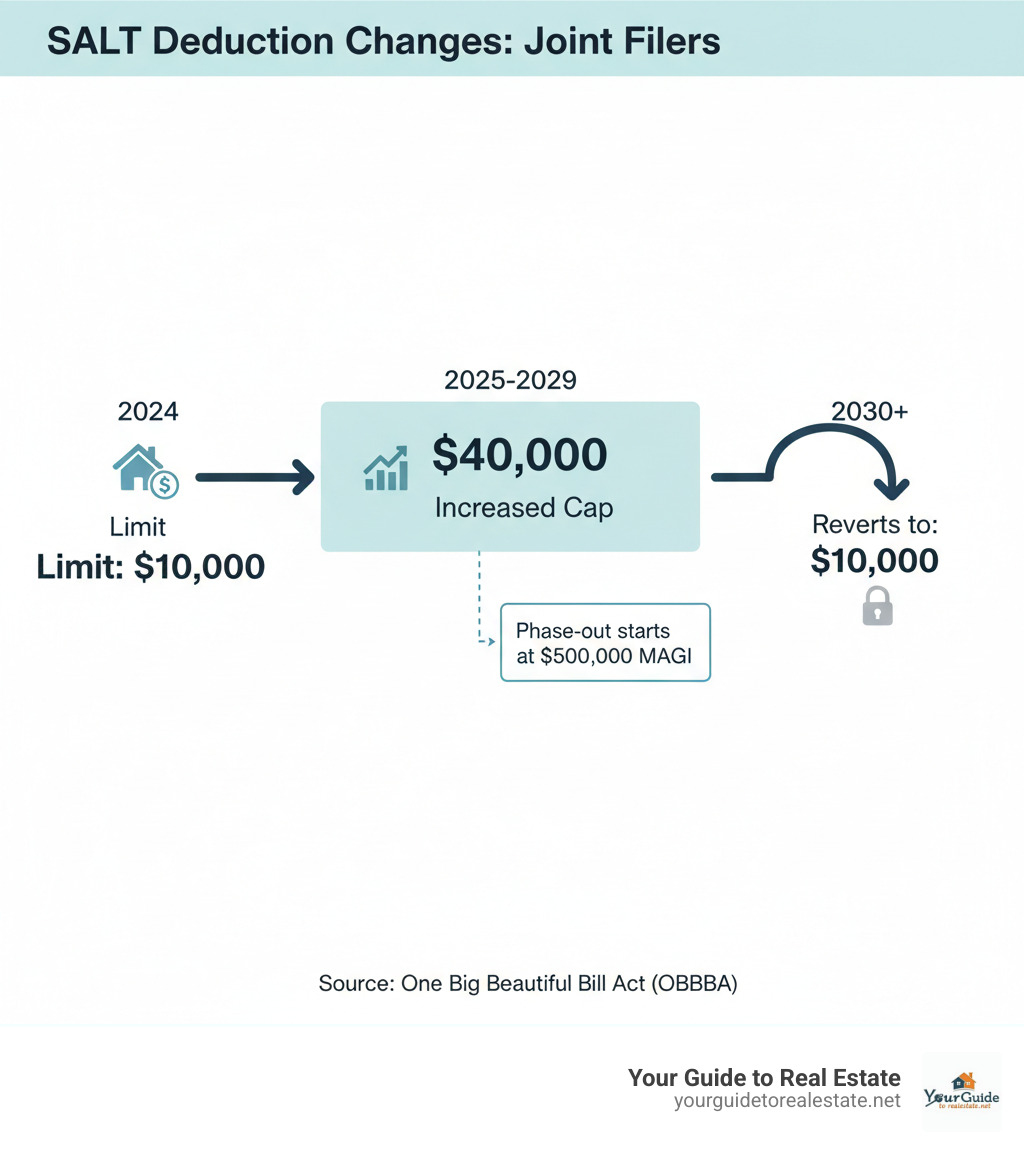
The salt deduction 2025 marks a significant shift for homeowners and taxpayers in high-tax states. Here’s what changed:
- New cap: $40,000 for single filers and married filing jointly (up from $10,000)
- Married filing separately: $20,000 cap
- Income limits: Phases out starting at $500,000 MAGI
- Timeline: Temporary increase from 2025-2029, then reverts to $10,000
- Who benefits most: Upper-middle-income households in states like California, New York, and New Jersey
On July 4, 2025, President Trump signed the One Big Beautiful Bill Act (OBBBA) into law. This legislation temporarily quadrupled the State and Local Tax (SALT) deduction cap from the $10,000 limit imposed by the 2017 Tax Cuts and Jobs Act (TCJA).
For homeowners paying significant property taxes and state income taxes, this change creates a massive planning opportunity. A household that was previously capped at deducting $10,000 can now potentially deduct up to $40,000 in state and local taxes—if they meet certain income requirements and itemize their deductions.
But there’s a catch. This increased limit isn’t permanent, and it comes with income-based phase-outs that reduce the benefit for high earners. Understanding these rules is critical for maximizing your tax savings while the window remains open.
The temporary nature of this change means you have roughly five years to take full advantage before the cap drops back to $10,000 in 2030. Whether you’re a current homeowner, planning to buy, or investing in real estate, knowing how to steer these rules can save you thousands of dollars each year.
Salt deduction 2025 terms explained:
Understanding the New $40,000 SALT Deduction Cap
The One Big Beautiful Bill Act (OBBBA) has certainly made waves, especially for those of us living in states with higher property and income taxes. This legislation significantly increased the salt deduction 2025 cap to $40,000 for most taxpayers—a welcome change from the $10,000 limit that’s been squeezing homeowners since 2018.
If you’re married and filing separately, your cap is set at $20,000 for 2025. This means that for the upcoming tax year, you might be able to deduct a much larger portion of the state and local taxes you pay, directly reducing your federal taxable income. For homeowners in places like California, New York, and New Jersey, this change isn’t just helpful—it’s potentially worth thousands of dollars.
To give you a clearer picture of what’s changed, let’s compare the old rules with the new ones:
| Feature | 2024 SALT Deduction Rules | 2025 SALT Deduction Rules (OBBBA) |
|---|---|---|
| Cap (Single/MFJ) | $10,000 | $40,000 |
| Cap (MFS) | $5,000 | $20,000 |
| Phase-out Threshold | Not applicable | Starts at $500,000 MAGI (Single/MFJ), $250,000 MAGI (MFS) |
| Phase-out Rate | Not applicable | 30% of excess MAGI |
| Deduction Floor | $10,000 | $10,000 (Single/MFJ), $5,000 (MFS) |
| Annual Adjustment | No | 1% annually (2026-2029) |
| Reversion | N/A | Reverts to $10,000 ($5,000 MFS) in 2030 |
The table shows something important: this isn’t a permanent change. The cap will gradually increase by 1% each year through 2029, then drop back to $10,000 in 2030. That gives you a limited window to maximize this benefit.
What Taxes Are Covered by the SALT Deduction?
Before you start celebrating your potential tax savings, it’s important to know exactly what counts towards this deduction. The OBBBA didn’t change the types of taxes that qualify—only the amount you can deduct.
The salt deduction 2025 covers state and local income taxes, which is a big one for many homeowners, especially in states with high income tax rates. But if you live in a state without an income tax (like Texas or Florida), you’re not out of luck. You can choose to deduct general sales taxes instead of income taxes. You can’t deduct both, so it’s worth calculating which option gives you the bigger benefit.
For most homeowners, real property taxes are the star of the show. These are the property taxes you pay on your primary residence and any other non-business real estate you own. If you’re paying hefty property taxes in a place like Dallas (where property taxes can be substantial), this deduction becomes even more valuable.
You can also include personal property taxes on items like cars, boats, or RVs—but only if they’re based on the value of the property and charged annually.
For the complete details on what you can and can’t include, the IRS has helpful guidance on what you can deduct under the SALT cap. Just remember: federal income taxes, Social Security taxes, and fees like HOA dues don’t count toward your SALT deduction.
How the SALT Deduction Interacts with AMT
Here’s where things get a bit tricky (but stay with me—this is important). The Alternative Minimum Tax (AMT) can still affect your tax savings, even with the new, higher salt deduction 2025 cap.
The AMT is essentially a parallel tax system designed to ensure that certain taxpayers—often high-income earners—pay at least a minimum amount of federal tax. When calculating your Alternative Minimum Taxable Income (AMTI), SALT deductions are typically “added back.” This means that even if you legally deduct $40,000 in state and local taxes on your regular return, that amount might still count as income for AMT purposes.
The result? Your expected tax savings could be reduced, or you might even trigger the AMT entirely. The OBBBA includes an “accelerated claw-back provision” that kicks in starting in 2026, which means more taxpayers might find themselves facing the AMT than in previous years.
If you’re in the income range where AMT becomes a concern, it’s worth calculating your potential liability using the IRS Form 6251 instructions or consulting with a tax professional. Nobody wants a nasty surprise when they file their return—especially if you’ve been counting on those tax savings for other financial goals.
Who Qualifies and How Income Limits Affect the Salt Deduction 2025
The expanded salt deduction 2025 isn’t available to everyone in the same way. Understanding who qualifies—and how much you can actually claim—depends on a few key factors that can make a huge difference in your tax bill.
First things first: you need to itemize your deductions rather than taking the standard deduction. This means you’ll need enough qualifying expenses (including SALT, mortgage interest, charitable contributions, and medical expenses) to exceed the standard deduction amounts for your filing status. For many homeowners, especially those paying significant property taxes and state income taxes, itemizing often makes financial sense.
Your filing status matters tremendously here. Whether you’re filing as single, married filing jointly, head of household, or married filing separately will directly impact both your deduction limit and when you might start losing that benefit.
And here’s the big one: your Modified Adjusted Gross Income, or MAGI. This is essentially your AGI with certain deductions and exclusions added back in. Your MAGI determines whether you’ll face any reduction in your SALT deduction through the phase-out mechanism.

Homeowners in high-tax states like California, New York, New Jersey, Connecticut, and Illinois are positioned to benefit most from this change. These states have historically imposed higher property and income taxes, which means residents there were hitting the old $10,000 cap regularly. Now, with the increased limit, they have real breathing room.
How the Phase-Out Works for High-Income Taxpayers
While the $40,000 cap sounds generous, Congress built in guardrails to limit the benefit for very high earners. The salt deduction 2025 includes a phase-out provision that gradually reduces your deduction as your income climbs above certain thresholds.
For single filers and married couples filing jointly, the phase-out kicks in when your MAGI exceeds $500,000. If you’re married filing separately, that threshold drops to $250,000 MAGI.
Once you cross these thresholds, your deduction gets reduced by 30 cents for every dollar your MAGI exceeds the limit. However, there’s a floor: your deduction won’t drop below $10,000 (or $5,000 for married filing separately) during this temporary period.
Let me walk you through a real example to make this concrete. Say you’re a married couple filing jointly with a MAGI of $550,000 in 2025, and you paid $42,000 in qualifying state and local taxes. Your MAGI exceeds the $500,000 threshold by $50,000. That excess gets multiplied by 30%, which equals $15,000. Your maximum deduction becomes $40,000 minus $15,000, leaving you with a $25,000 SALT deduction.
The phase-out is complete when your MAGI reaches $600,000 for joint filers (or $300,000 for married filing separately). At that point, your deduction drops to the $10,000 floor and stays there regardless of how high your income climbs.
Tax professionals have nicknamed the income range between $500,000 and $600,000 the “SALT torpedo” because of the artificially high effective tax rate it creates. For every additional dollar earned in this range, you’re not just paying income tax on that dollar—you’re also losing 30 cents of deduction value. It’s a double whammy that makes strategic planning absolutely essential.
Filing Status Matters: Single vs. Married Rules for the salt deduction 2025
Your filing status creates very different outcomes when it comes to the salt deduction 2025. Let’s break down how each status is treated.
Single filers and married couples filing jointly get the full $40,000 cap, with phase-outs beginning at $500,000 MAGI. This is the most favorable treatment under the new rules.
Married filing separately taxpayers face a $20,000 cap—exactly half of the joint filers’ limit—with phase-outs starting at $250,000 MAGI. This isn’t just proportionally smaller; it’s strategically limiting.
For married couples, this creates an interesting planning question. In some situations, filing separately might seem appealing for other tax reasons, but the reduced SALT cap and lower phase-out threshold could eliminate any advantage. You might save in one area only to lose more in another.
We’ve seen situations where couples assume filing separately will help them, only to find that the SALT limitation costs them thousands more than they saved elsewhere. The math needs to be run carefully, considering all deductions and credits available under each filing status. When in doubt, calculate your tax liability both ways or work with a tax professional who can model different scenarios.
Who Benefits Most (and Who Doesn’t)?
The expanded salt deduction 2025 creates clear winners, but it won’t move the needle for everyone. Understanding where you fall can help set realistic expectations.
The biggest winners are upper-middle-income households earning between roughly $200,000 and $450,000 in MAGI. These households typically face substantial state and local tax bills but remain comfortably below the phase-out thresholds. They can claim the full $40,000 deduction, which can translate into significant federal tax savings.
Homeowners in high-tax states are the other major beneficiaries. If you own property in New York, California, New Jersey, Connecticut, Illinois, or similar states, you’re likely paying enough in combined property and income taxes to make the increased cap meaningful. For some families in these areas, we’re talking about thousands of dollars in annual tax savings compared to the old $10,000 limit. Understanding Dallas property taxes or similar local tax structures can help you gauge your potential benefit.
But not everyone sees major gains. Renters, for instance, typically don’t have property tax deductions, so their SALT deductions come primarily from state income or sales taxes. Unless you’re paying extraordinarily high state income taxes, you might not reach levels that make itemizing worthwhile compared to the standard deduction.
Taxpayers in low-tax states face similar limitations. If you live in a state with no income tax and relatively modest property taxes, your total SALT payments might not come anywhere near $40,000. The increased cap doesn’t help if you’re not using it.
And finally, high-earners with MAGI significantly above $600,000 (or $300,000 for married filing separately) will find themselves capped at the $10,000 floor. They’re essentially in the same position they were before the OBBBA passed. The temporary increase offers them no additional benefit beyond what they were already claiming.
This is why personalized planning matters so much. The same tax law change can be changeal for one family and barely noticeable for another, all depending on where you live, how much you earn, and whether you own real estate.
Strategic Planning: How to Maximize Your Deduction
The temporary nature of the increased salt deduction 2025 means that strategic tax planning is more important than ever. We have a window of opportunity from 2025 through 2029 to maximize these benefits.
Key strategies include:
- Timing of payments: If you have control over when you pay certain state or local taxes (like property taxes), consider accelerating payments into a year where you can fully use the higher cap. For example, if your property tax bill for early 2026 can be paid in December 2025, it might make sense to “double pay” in 2025 to maximize that year’s deduction.
- Bundling deductions: This involves concentrating deductible expenses into specific tax years. For instance, if you usually make charitable donations annually, you might consider making a larger donation every other year to push your itemized deductions above the standard deduction threshold.
- Income deferral: For those close to the MAGI phase-out thresholds, strategies to defer income (like maximizing 401(k) contributions) could help keep your MAGI below the limits and preserve your full SALT deduction.

Itemizing vs. Standard Deduction: Making the Right Choice
With the new salt deduction 2025 rules, many taxpayers who previously took the standard deduction might find themselves reconsidering. The standard deduction also increased for 2025, but the significantly higher SALT cap could make itemizing a more attractive option.
For 2025, the standard deduction amounts are:
- Single filers: $15,750
- Married Filing Jointly: $31,500
- Head of Household: $23,625
To decide whether to itemize, you simply compare your total itemized deductions (including SALT, mortgage interest, charitable contributions, and certain other expenses) against your standard deduction amount. If your itemized deductions exceed the standard deduction, then itemizing will lead to a lower taxable income.
For instance, a married couple with $15,000 in mortgage interest, $5,000 in charitable contributions, and $20,000 in deductible SALT (totaling $40,000) would clearly benefit from itemizing over the $31,500 standard deduction. Before the OBBBA, 90% of taxpayers claimed the standard deduction, but this new cap might shift that trend. We’ve certainly seen this happen in the past; back in 2022, 90% of taxpayers claimed the standard deduction. The increased SALT cap could be a game-changer for many.
The Role of Pass-Through Entity Tax (PTET) Workarounds
For business owners, especially those with pass-through entities (PTEs) like S-corporations and partnerships, the PTET workaround continues to be a highly relevant strategy. Many states have implemented elective PTETs, which allow the business itself to pay state and local taxes at the entity level.
Why is this a big deal? Because taxes paid by the business are deductible by the business, and they do not count against the individual salt deduction 2025 cap. This effectively allows business owners to bypass the individual cap, potentially deducting their full state and local tax burden at the federal level. Even with the higher $40,000 cap, this strategy remains crucial for those whose state and local tax liability, combined with their business’s, would still exceed the individual limit.
We’re always keeping an eye on how these tax provisions interact with other financial changes, like More on Social Security changes. Every piece of the financial puzzle matters!
Documentation and Common Pitfalls for the salt deduction 2025
When it comes to claiming any deduction, especially one as significant as the salt deduction 2025, meticulous recordkeeping is your best friend. The IRS is always on the lookout for inconsistencies, and proper documentation is your shield against audits.
You’ll need to keep:
- Property tax bills and payment receipts: Show proof of payment for your real estate taxes.
- Form W-2: For state income taxes withheld.
- K-1s (if applicable): For pass-through income and any state taxes paid by the entity.
- Electronic records: Bank statements, canceled checks, or credit card statements showing tax payments.
- Sales tax receipts: If you’re deducting sales tax instead of income tax, keep detailed records, especially for large purchases.

Common pitfalls to avoid include:
- Deducting non-qualifying taxes: Things like franchise fees, payroll taxes, or certain business-related fees don’t count towards the personal SALT deduction.
- Overreporting or double-counting: Ensure you’re only deducting what you actually paid and aren’t claiming the same tax twice.
- Missing state-level elections: For PTE owners, failing to properly elect into your state’s PTET program can mean missing out on significant deductions.
- Lack of documentation: If the IRS asks, you need to prove every deduction. No records, no deduction.
Taxpayers claim itemized deductions on Schedule A, which is attached to Form 1040. This is where all these pieces come together.
Timeline and Future Outlook: 2025-2030 and Beyond
Here’s something we need to talk about honestly: the expanded salt deduction 2025 isn’t sticking around forever. While it’s a fantastic opportunity right now, understanding the timeline is crucial for making smart financial decisions.
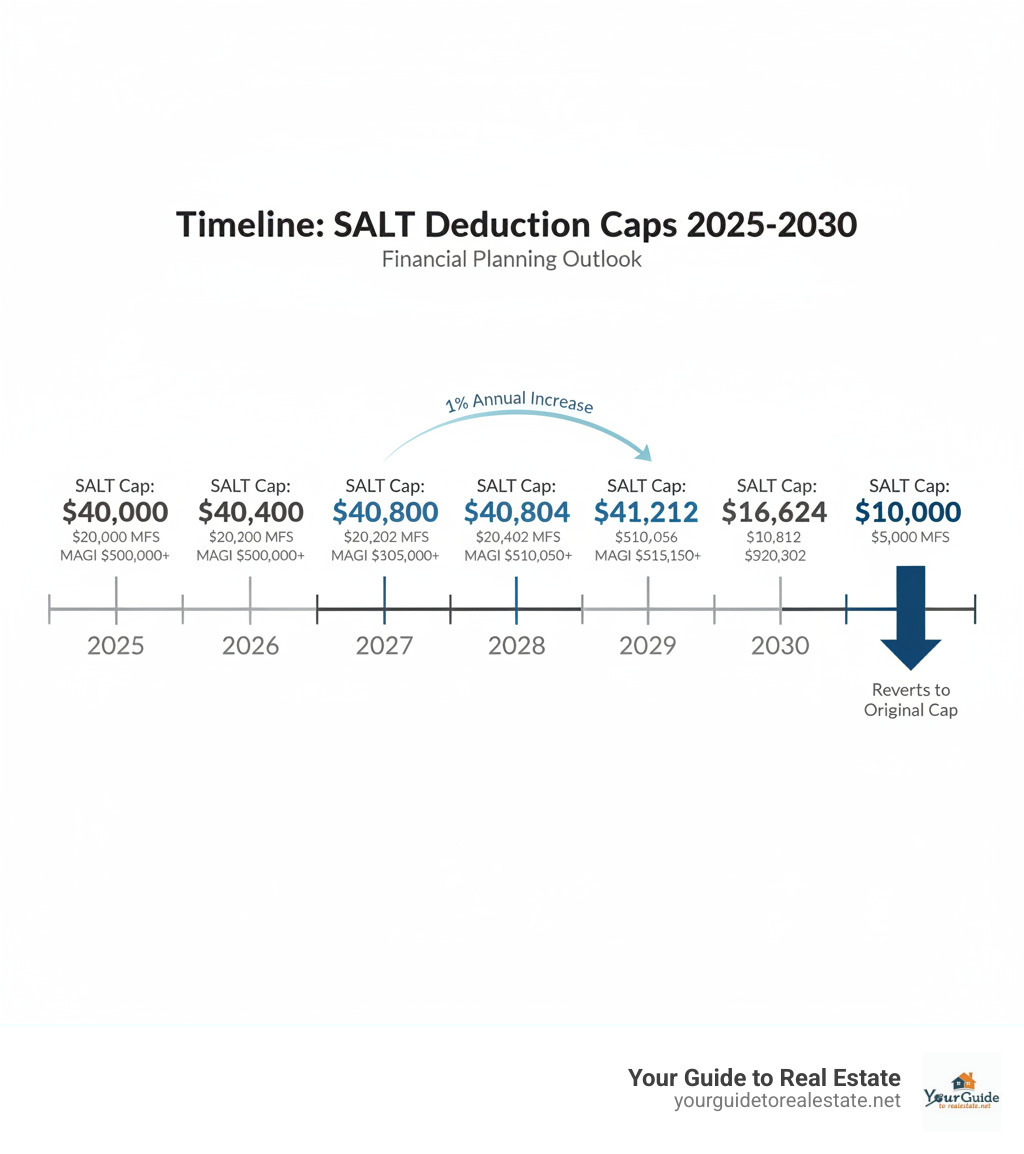
The increased $40,000 cap runs from 2025 through 2029—a five-year window that gives us a real chance to optimize our tax strategies. But there’s actually a silver lining built into these years: the cap doesn’t just sit still. Starting in 2026, both the $40,000 cap and the $500,000 MAGI phase-out threshold will increase by 1% annually through 2029. This means in 2026, the cap bumps up to $40,400, with the phase-out starting at $505,000 MAGI. By 2029, we’re looking at a cap of around $41,600 (assuming the 1% increases compound).
These annual adjustments help account for inflation, which is a thoughtful touch that many temporary tax provisions don’t include. It means the benefit won’t erode quite as much over time due to rising property values and tax rates.
But here’s the hard truth: come January 1, 2030, the party ends. The cap reverts right back to the original $10,000 limit ($5,000 for married filing separately) that we’ve been dealing with since the 2017 Tax Cuts and Jobs Act. No phase-out, no inflation adjustments—just a hard drop back to the old rules.
This timeline has real implications for your long-term financial planning. If you’re thinking about buying a home in a high-tax state, the next few years might be your sweet spot. Similarly, if you’re considering selling or relocating, understanding how your tax liability changes in 2030 should factor into your decision-making process.
We’ve seen this movie before with temporary tax provisions. Sometimes they get extended, sometimes they don’t. Banking on an extension would be risky, so the smartest approach is to plan as if the reversion will happen exactly as written. That means maximizing the benefit during these five years while also preparing for what your tax situation will look like when we’re back to the $10,000 cap.
For homeowners, this might mean accelerating certain expenses or strategically timing major purchases during this window. For those considering a move, it might influence whether you choose a high-tax or low-tax state. The key is to look at your entire financial picture—not just this year, but through 2030 and beyond.
At Your Guide to Real Estate, we’re all about helping you make informed decisions that set you up for long-term success. Whether you’re planning your next real estate move or just trying to make sense of your tax situation, understanding these timelines is part of building that solid foundation. Check out our housing market forecast to see how these tax changes might interact with broader market trends as we head into the next decade.
Frequently Asked Questions about the 2025 SALT Deduction
Tax season always brings a flood of questions, and with the new salt deduction 2025 rules, we’ve been hearing from homeowners and taxpayers across the country. Let’s clear up some of the most common points of confusion we’ve encountered.
What is Modified Adjusted Gross Income (MAGI) for the SALT deduction?
You’ve probably heard us mention MAGI quite a bit when discussing the phase-out thresholds. So what exactly is it? For the salt deduction 2025 phase-out calculation, your Modified Adjusted Gross Income (MAGI) starts with your Adjusted Gross Income (AGI)—that’s the number at the bottom of page one of your Form 1040—and then adds back certain exclusions and deductions that you might have claimed.
The most common items added back to calculate MAGI include foreign earned income exclusion (if you work abroad), exclusion of income from U.S. possessions, exclusion of income from Puerto Rico, and sometimes tax-exempt interest from municipal bonds, depending on the specific calculation.
Why does this matter? Because it’s your MAGI, not your AGI, that determines whether you’ll hit those critical $500,000 (or $250,000 for married filing separately) thresholds where the increased deduction starts to phase out. If you’re anywhere near these income levels, understanding your MAGI is absolutely essential for accurate tax planning.
Can I deduct both state income taxes and state sales taxes?
This is one of the questions we get asked most often, and the answer is straightforward: no, you cannot deduct both. When you’re itemizing your deductions, you must choose between deducting your state income taxes or your state sales taxes. You can’t have both, though you can always add your real property taxes and personal property taxes on top of whichever option you choose.
The decision between income tax and sales tax usually comes down to where you live and your spending patterns. Taxpayers in states with no income tax—like our friends in Texas, Washington, or Florida—will naturally benefit more from deducting their sales taxes. The IRS provides helpful tables that estimate your average sales tax based on your income and family size. Alternatively, if you’re someone who made major purchases during the year (think new car, boat, or home renovation materials), you can keep detailed records of all your actual sales tax payments and use that higher figure instead.
We always recommend running the numbers both ways to see which option gives you the larger deduction. Every dollar counts!
Are taxes on my rental property limited by the SALT cap?
Here’s some genuinely good news for real estate investors and landlords: no, taxes on income-producing property are not limited by the personal SALT cap. This is a critical distinction that can save you thousands of dollars.
Real estate taxes that you pay on rental properties, commercial buildings, or any other property that generates income for you are considered ordinary and necessary business expenses. These taxes are deducted on Schedule E (Supplemental Income and Loss) of your tax return, completely separate from your personal itemized deductions on Schedule A. This means they don’t count toward your $40,000 salt deduction 2025 limit at all.
For example, if you own a rental property in California and pay $8,000 in property taxes on it, that full $8,000 is deductible as a business expense on Schedule E. Meanwhile, you can still claim up to $40,000 in personal SALT deductions for your primary residence and state income taxes on Schedule A. It’s the best of both worlds for real estate investors.
This separation between personal and business deductions is one of the many reasons why real estate continues to be such a powerful wealth-building tool. If you’re interested in learning more about the broader benefits of homeownership and real estate investing, we encourage you to check out the resources available throughout our site. Understanding these distinctions can make all the difference in your financial success.
For more detailed guidance on claiming itemized deductions, taxpayers can reference the official Schedule A instructions from the IRS, which walks through exactly how to report these deductions on your tax return.
Conclusion
We’ve covered a lot of ground today, and if your head is spinning a little, that’s completely understandable! The salt deduction 2025 changes brought by the One Big Beautiful Bill Act are honestly one of the most significant tax shifts we’ve seen for homeowners in years. It’s not just about numbers on a form—it’s about real money that can stay in your pocket instead of going to Uncle Sam.
Let’s bring it all together. The cap jumped from $10,000 to $40,000 (or $20,000 if you’re filing separately), which is a massive opportunity if you’re paying substantial property and state income taxes. But here’s the catch: those income phase-outs starting at $500,000 MAGI are absolutely critical to understand. If you’re earning in that range, you need to know exactly where you stand and what your actual deduction will be after the phase-out kicks in.
And we can’t stress this enough—this isn’t a permanent change. You’ve got a window from 2025 through 2029 to make the most of this increased cap. Come 2030, we’re back to the old $10,000 limit. That’s why planning now, not later, is so important. Whether it’s timing your property tax payments, maximizing mortgage interest deductions, or exploring Pass-Through Entity Tax workarounds if you’re a business owner, every strategic move counts.
Documentation is your best friend here. Keep those property tax bills, W-2s, K-1s, and payment receipts organized and accessible. The last thing you want is to claim a deduction you can’t prove if the IRS comes knocking. Trust us, meticulous recordkeeping might feel tedious, but it’s worth every minute when it saves you thousands of dollars—and potential headaches.
At Your Guide to Real Estate, we’re passionate about helping you understand how homeownership and smart financial planning go hand in hand. The tax benefits of owning real estate are substantial, and the salt deduction 2025 is just one piece of that puzzle. We want you to feel confident and empowered as you make decisions about your home and your financial future.
The housing market is always evolving, and so are the rules that govern it. Don’t steer these changes alone or let this limited-time opportunity slip through your fingers. Plan for your future with our housing market forecast and stay ahead of what’s coming next. Your future self will thank you for the planning you do today.