

Understanding How Neutral Policies Can Lead to Discrimination
Disparate impact discrimination occurs when a seemingly neutral policy or practice has a disproportionately negative effect on members of a protected group—even when there’s no intention to discriminate. Unlike traditional discrimination, which is intentional, disparate impact focuses on outcomes rather than motives.
Quick Answer: What You Need to Know
- Definition: A facially neutral policy that disproportionately harms a protected class (race, gender, age, etc.)
- Key Difference: No discriminatory intent required—the effect matters, not the motive
- Where It Applies: Employment decisions, housing policies, lending practices, tenant screening
- Legal Basis: Title VII of the Civil Rights Act of 1964, Fair Housing Act of 1968
- Test Used: The “Four-Fifths Rule” (80% Rule) helps identify statistical disparities
- Defense: Employers/landlords must prove “business necessity” if impact is shown
This concept is particularly important in real estate, where policies like minimum credit scores, criminal background checks, or income requirements might unintentionally exclude certain protected groups at higher rates. For example, a landlord’s policy requiring a specific credit score might appear neutral, but if it disproportionately excludes applicants of a particular race or national origin, it could constitute disparate impact discrimination—even if the landlord never intended to discriminate.
The legal framework emerged from the landmark 1971 Supreme Court case Griggs v. Duke Power Co., where the Court ruled that Title VII “proscribes not only overt discrimination but also practices that are fair in form, but discriminatory in operation.” This shifted the focus from proving intent to examining the consequences of employment and housing practices.
Understanding disparate impact is essential for anyone involved in real estate transactions. Whether you’re a buyer facing lending criteria, a seller working with agents on marketing strategies, or an investor establishing tenant screening policies, recognizing how neutral-sounding rules can create unintended barriers helps ensure fair and legal practices.
Related content about disparate impact discrimination:
What is Disparate Impact?
Here’s something that might surprise you: a policy can be discriminatory even when nobody meant for it to be. That’s the essence of disparate impact discrimination—it’s when a rule or practice looks perfectly fair on paper but ends up hitting certain groups harder than others.
Think of it this way. A landlord creates a “no exceptions” policy requiring all tenants to have a credit score above 700. Sounds reasonable, right? The landlord isn’t saying “I won’t rent to people of X background.” But if that credit requirement consistently screens out applicants from a particular racial or ethnic group at much higher rates, we’ve got a disparate impact problem—regardless of whether the landlord had any discriminatory intent.
The key breakthrough here is recognizing that systemic barriers don’t always come with a villain twirling their mustache. Sometimes inequality gets baked into policies that seem neutral, even sensible. And that’s exactly what disparate impact discrimination law is designed to address.
This legal theory primarily comes from Title VII of the Civil Rights Act of 1964 in employment contexts, and the Fair Housing Act when we’re talking about housing and lending. Both laws recognize that focusing only on intentional discrimination misses a huge part of the picture. After all, if we only stopped people who openly admitted to discriminating, we’d leave countless unfair practices in place.
The Core Principle: Effect Over Intent
The idea behind disparate impact discrimination is that outcomes matter more than intentions. It doesn’t matter if you’re the most well-meaning landlord or the most progressive employer—if your policies consistently disadvantage people based on race, gender, age, or another protected characteristic, there’s a problem.
This shifts the entire conversation. Instead of trying to prove what was in someone’s heart when they made a rule, we can look at the actual results. Did one group get rejected at dramatically higher rates? Do the numbers show a pattern? That’s what counts.
This approach aims for something deeper than just treating everyone the same on paper. It pushes toward what legal scholars call “substantive equality”—the idea that true fairness means examining whether policies create equal opportunities in practice, not just in theory. A policy might apply to everyone equally, but if it creates barriers that one group faces far more often due to historical disadvantages or societal factors, it’s not really creating a level playing field.
By focusing on statistical disparities rather than hunting for smoking-gun evidence of bias, we can identify and remove barriers that perpetuate inequality. It’s about making sure the rules of the game don’t accidentally favor some players over others.
Protected Classes Under Federal Law
So who exactly does disparate impact discrimination law protect? Federal law identifies specific “protected classes”—groups of people who can’t legally be disadvantaged based on certain characteristics.
Under employment law (Title VII) and housing law (Fair Housing Act), these protected classes include race, color, religion, sex (which now encompasses gender identity and sexual orientation), and national origin. The Age Discrimination in Employment Act protects workers who are 40 and over from age-based disparate impact. The Fair Housing Act also prohibits discrimination based on disability and familial status—meaning you can’t have policies that disproportionately harm families with children under 18 or pregnant women.
Here’s what this means in practical terms: if a policy has a disparate impact on any of these groups, it could violate federal law. A “no children” rule in an apartment complex? That’s direct discrimination against familial status. But a seemingly neutral policy—like requiring all applicants to work night shifts—that disproportionately excludes women who are often primary caregivers? That could be disparate impact discrimination, even if the employer never intended to disadvantage women.
Understanding these protections matters whether you’re screening tenants, setting workplace policies, or making lending decisions. The law recognizes that certain characteristics have historically been used to exclude and disadvantage people, and it won’t tolerate policies—intentional or not—that continue those patterns.
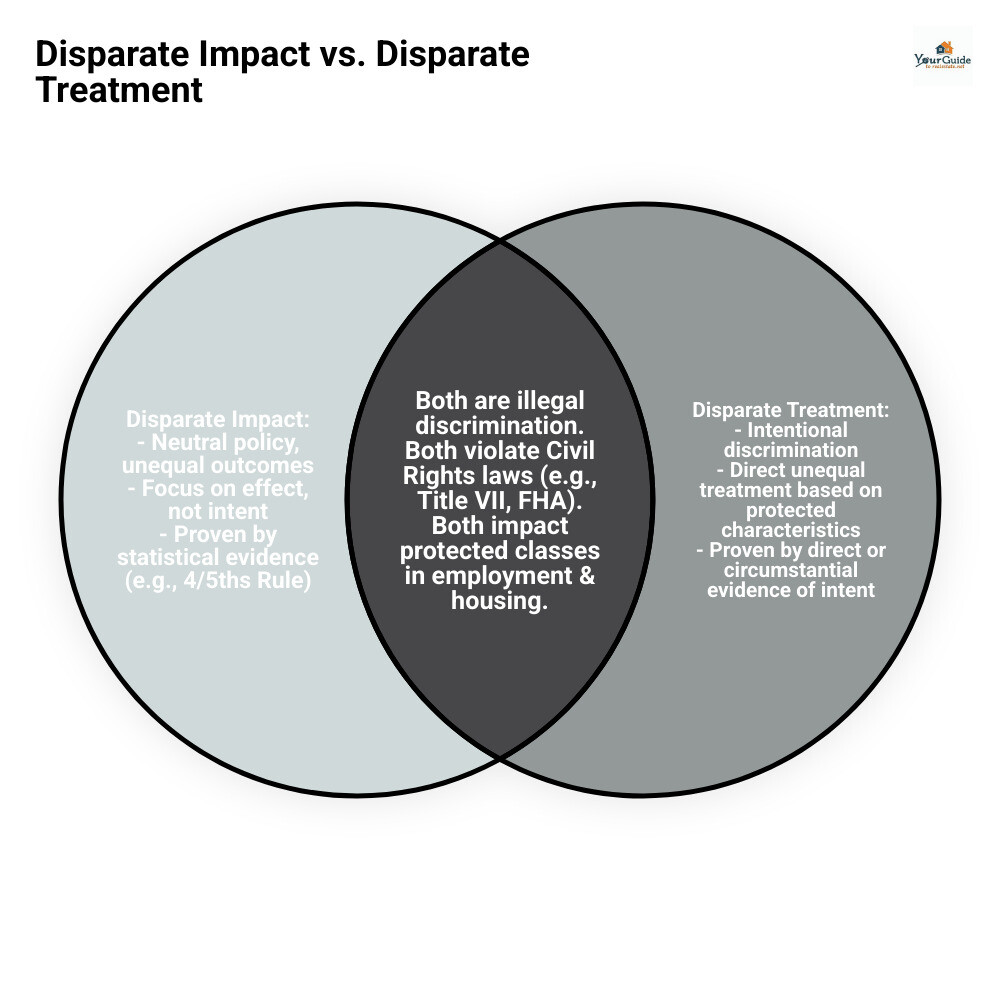
Disparate Impact vs. Disparate Treatment: Understanding the Key Differences
When you’re learning about discrimination law, you’ll encounter two terms that sound similar but represent very different situations: disparate impact and disparate treatment. Grasping this distinction is essential for anyone working in real estate, whether you’re screening tenants, setting lending criteria, or making hiring decisions.
Disparate treatment is the type of discrimination most people picture when they think about unfair practices. It’s intentional. Someone deliberately treats another person differently because of their race, gender, age, or another protected characteristic. Think of a landlord who openly says, “I don’t rent to families with kids,” or a loan officer who steers Hispanic applicants toward subprime loans while offering better terms to white applicants. The smoking gun here is intent—the person meant to discriminate.
Disparate impact discrimination works differently. There’s no malicious intent required, no bigoted comments, and often no awareness that discrimination is even happening. Instead, a policy that looks perfectly fair on paper ends up hurting one protected group more than others. The landlord genuinely believes their strict credit score requirement just ensures financially responsible tenants. They don’t realize (or perhaps don’t want to examine) that this policy disproportionately excludes certain racial groups due to historical economic inequalities. The harm is in the effect, not the motive.
Here’s how these two types of discrimination stack up against each other:
| Feature | Disparate Treatment | Disparate Impact |
|---|---|---|
| Intent | Required (intentional discrimination) | Not required (unintentional discrimination) |
| Policy Type | Overtly discriminatory or applied differently to individuals | Facially neutral policy or practice |
| Evidence | Direct (e.g., “smoking-gun” comments) or circumstantial evidence of discriminatory motive | Statistical evidence showing disproportionate adverse effect |
| Legal Burden | Plaintiff proves intent; defendant offers non-discriminatory reason (pretext) | Plaintiff proves adverse effect; defendant proves “business necessity”; plaintiff shows less discriminatory alternative |
| Example | Refusing to rent to someone because of their race | A credit score requirement that disproportionately excludes a protected group |
Proving a Case
The path to proving discrimination looks completely different depending on which type you’re dealing with.
When someone alleges disparate treatment, they need to show that discrimination was intentional. This can happen through direct evidence—the clearest kind, like an email saying “Don’t hire anyone over 50” or a recorded conversation where a manager admits to avoiding certain applicants based on their religion. But direct evidence is rare. Most people who discriminate aren’t that obvious about it.
More commonly, cases rely on circumstantial evidence. This involves building a picture through patterns and inconsistencies. Maybe every time a qualified Black applicant applies for an apartment, the landlord suddenly remembers a “policy” that wasn’t mentioned to white applicants. Or perhaps a company consistently passes over women for promotions, always finding reasons why the male candidate was “just slightly better.” The evidence creates an inference that discrimination was the real reason behind the decisions.
Disparate impact discrimination cases follow a completely different playbook. You don’t need to prove anyone’s intentions at all. Instead, you need statistical evidence demonstrating that a neutral-looking policy creates unequal outcomes. This typically means comparing how different groups fare under the policy. If a physical fitness test screens out 80% of female applicants but only 20% of male applicants, those numbers tell a story—regardless of whether anyone intended that result.
Once the statistical disparity is established, the burden shifts to the organization to justify why the policy is necessary. This is where the “business necessity” defense comes into play, which we’ll explore more later.
Legal Consequences
Both types of discrimination carry serious consequences, but the remedies and liabilities can vary.
When someone proves disparate impact discrimination, the court can order several types of relief. Monetary damages often come first to mind—compensation for lost wages, emotional distress, or in some cases, punitive damages designed to punish particularly egregious conduct. But money isn’t the only remedy.
Courts frequently mandate policy changes, requiring organizations to abandon or modify the discriminatory practice. A housing provider might need to revise their criminal background screening criteria. An employer might have to validate their employment tests to ensure they actually measure job-related skills. These changes aren’t optional—they’re court orders.
Injunctive relief can prevent future discrimination by requiring ongoing monitoring, regular reporting, or implementation of new procedures. And if you win a discrimination case, the losing party typically pays your attorney’s fees, which can add up quickly.
For real estate professionals and property owners, a finding of disparate impact discrimination means more than financial penalties. Your reputation takes a hit. Your business practices come under scrutiny. You might face ongoing oversight from federal agencies like HUD or the EEOC. The entire experience is stressful, expensive, and completely avoidable with the right proactive approach.
That’s why understanding these concepts isn’t just about legal compliance—it’s about building fair, sustainable practices that serve everyone in your community while protecting your business from unnecessary risk.
The Legal Framework of Disparate Impact Discrimination
The legal concept of disparate impact discrimination has a fascinating history. It didn’t emerge from a single law or decision, but rather evolved through decades of court battles and legislative action. Understanding this legal framework helps us see why these protections exist and how they actually work in practice.

Landmark Supreme Court Cases
The story of disparate impact discrimination really begins with the Supreme Court stepping in to interpret what Congress meant when they passed civil rights laws. These landmark cases shaped how we understand discrimination today.
The foundation was laid in Griggs v. Duke Power Co. (1971), which remains the most important case in this area. Before Title VII of the Civil Rights Act became law, Duke Power Company openly segregated its workforce by race. After the law passed, they couldn’t do that anymore, so they changed tactics. Instead of openly discriminating, they required employees to have a high school diploma and pass two standardized tests to transfer into higher-paying departments.
These requirements seemed neutral enough on paper. But here’s the problem: they disproportionately excluded Black employees who had been denied educational opportunities due to past discrimination. Meanwhile, white employees who didn’t have diplomas were already working successfully in these same positions. The Supreme Court saw through this and ruled that Title VII “proscribes not only overt discrimination, but also practices that are fair in form, but discriminatory in operation.” This was revolutionary. The Supreme Court’s landmark decision in Griggs v. Duke Power Co. established that employers had to prove these requirements were actually related to job performance—the “business necessity” standard.
The numbers told the story: white employees were almost 10 times more likely than Black employees to meet these supposedly neutral requirements.
A few years later, Dothard v. Rawlinson (1977) tested the boundaries of the business necessity defense. Alabama set height and weight requirements for prison guards that excluded about 40 percent of all women but only 1 percent of men. The Court recognized this as disparate impact discrimination, though they ultimately upheld restrictions on female guards in certain maximum-security positions based on safety concerns.
Then came Wards Cove Packing Co. v. Atonio (1989), which made things much harder for workers trying to prove discrimination. The Court shifted the burden of proof, requiring plaintiffs to identify the specific policy causing the disparity and prove it wasn’t a business necessity. This decision made it extremely difficult to win disparate impact cases. Congress was so concerned about this that they passed the Civil Rights Act of 1991 to restore the original, more balanced approach from Griggs.
For those of us in real estate, the most relevant case came much more recently. In Texas Dept. of Housing and Community Affairs v. Inclusive Communities Project, Inc. (2015), the Supreme Court confirmed that disparate impact claims are absolutely valid under the Fair Housing Act. This was a major victory for fair housing advocates. The Court made it clear that the Fair Housing Act’s purpose is to eliminate artificial barriers to housing, even when those barriers aren’t intentionally discriminatory. This case ensures that housing policies—from zoning laws to tenant screening criteria—can be challenged if they create unfair obstacles for protected groups.
The Three-Step Burden-Shifting Framework
When someone brings a disparate impact discrimination case, it follows a specific three-step process that shifts the burden of proof back and forth between the parties. Think of it as a legal dance where each side gets their turn to make their case.
First, the plaintiff (the person claiming discrimination) has to establish what lawyers call a “prima facie case.” In plain English, this means showing that a seemingly neutral policy actually has a statistically significant, disproportionately negative effect on a protected group. For example, imagine a landlord requires all tenants to have a credit score above 700. If statistical analysis shows this requirement rejects applicants of a particular race at much higher rates than others, that’s the kind of disparity that gets the case started. The plaintiff needs solid numbers here—not just a feeling, but actual statistical proof of the adverse impact.
Second, once the plaintiff makes this showing, the ball moves to the defendant’s court. Now the employer or housing provider must prove “business necessity”—that the policy serves an essential purpose for their business operations. In employment cases, they need to show the requirement is job-related and consistent with business necessity. In housing, they must demonstrate it serves a substantial, legitimate, non-discriminatory interest. This is where a landlord might explain why that credit score requirement is necessary to ensure tenants can pay rent, or an employer might justify why a physical fitness test is essential for a particular job’s safety requirements.
Third, even if the defendant successfully proves business necessity, the plaintiff gets one more chance. They can still win by showing there are alternative practices that would meet the defendant’s legitimate needs without causing the same discriminatory effect. If such alternatives exist and the defendant refuses to adopt them, the plaintiff prevails. This final step ensures that businesses can’t hide behind “necessity” when less discriminatory options are available.
This framework tries to balance competing interests—protecting people from discrimination while allowing businesses to set legitimate requirements. It’s not perfect, but it forces everyone to think carefully about whether their policies are truly necessary or just convenient.
The Role of the EEOC and HUD
Two federal agencies stand as guardians against disparate impact discrimination, each focusing on different areas of American life.
The U.S. Equal Employment Opportunity Commission (EEOC) handles workplace discrimination. They enforce federal laws prohibiting discrimination based on race, color, religion, sex (including pregnancy, gender identity, and sexual orientation), national origin, age (40 or older), disability, and genetic information. When someone files a discrimination charge, the EEOC investigates. They also issue guidance to help employers understand their obligations and can file lawsuits when necessary.
It’s worth noting that enforcement priorities can shift with different administrations. Recently, an internal EEOC memorandum indicated they might close almost all pending charges based solely on disparate impact allegations by September 30, 2025, focusing instead on disparate treatment claims. However—and this is crucial—the legal theory of disparate impact discrimination itself remains completely valid. Private individuals can still file lawsuits, and many state laws provide even stronger protections. The legal framework isn’t going anywhere.
The Department of Housing and Urban Development (HUD) serves a similar role for housing discrimination. They enforce the Fair Housing Act, investigating complaints about discriminatory housing practices, providing guidance to housing providers and lenders, and taking enforcement actions when policies result in disparate impact. HUD’s work is particularly relevant for anyone in real estate, as they actively monitor tenant screening criteria, lending policies, zoning ordinances, and other practices that might create barriers to housing.
Both agencies serve as resources, not just enforcers. They publish guidelines, conduct training, and help organizations understand how to comply with the law. Think of them as partners in creating fairer systems, even though they certainly have teeth when violations occur.
Identifying and Mitigating Disparate Impact Risks
Here’s the thing about disparate impact discrimination: it often happens when we’re genuinely trying to make good business decisions. A landlord wants financially responsible tenants. An employer wants qualified candidates. But sometimes, these well-intentioned policies create unexpected barriers for protected groups. The key is knowing how to spot these risks before they become problems.

Statistical Analysis: The “Four-Fifths Rule”
When it comes to identifying potential disparate impact, enforcement agencies like the EEOC use a straightforward tool called the “Four-Fifths Rule” (also known as the 80% Rule). Think of it as an early warning system that flags policies worth examining more closely.
The math is surprisingly simple. Let’s say you’re reviewing your tenant approval rates. You calculate the approval rate for each group—maybe 50% of male applicants get approved. Now, if female applicants are approved at only 20%, you divide that by the male rate: 20% ÷ 50% = 40%. Since 40% is less than 80%, this raises a red flag for potential disparate impact discrimination.
But here’s an important caveat: this rule is a guideline, not a courtroom verdict. It helps us identify patterns that deserve a closer look. Sometimes smaller differences can still indicate real problems if they’re statistically significant and affect many people. Other times, a flagged disparity might have legitimate explanations. That’s why more sophisticated statistical methods—like odds ratios or regression analysis—often come into play for deeper investigation. The EEOC’s “four-fifths rule” guideline provides more technical details if you want to dive deeper.
Common Policies with Potential for Disparate Impact Discrimination
Let’s talk about real-world examples. Many policies that seem perfectly reasonable on paper can inadvertently create barriers for protected groups.
In employment, requiring a high school diploma might sound like a basic qualification. But remember Griggs v. Duke Power Co.? That requirement excluded Black applicants at much higher rates because of historical inequities in education access. Similarly, credit checks for job candidates can disproportionately affect people from lower-income backgrounds or certain racial groups who face systemic economic disadvantages. Even physical fitness tests for jobs like firefighting, while seemingly neutral, can screen out women at higher rates. If female applicants pass a 100-pound strength test at less than 80% of the rate men do, and the test isn’t carefully validated as essential for the job, you’ve got a potential disparate impact problem.
The housing world has its own set of risky policies. Restrictive zoning ordinances that only allow single-family homes on large lots might seem like community planning, but they can effectively exclude racial minorities and lower-income families who need more affordable, multi-family housing options. A minimum income policy requiring tenants to earn three times the monthly rent could inadvertently exclude higher percentages of protected groups if those groups face income disparities due to historical discrimination. And criminal background screening—particularly blanket policies that reject anyone with any criminal record, no matter how old or minor—can have serious disparate impact because certain racial and ethnic groups are overrepresented in the criminal justice system due to systemic biases.
None of these examples necessarily mean the policy-maker had bad intentions. That’s exactly why understanding disparate impact discrimination matters so much.
Proactive Audits and Best Practices for Real Estate
For those of us working in real estate, preventing disparate impact isn’t just about avoiding lawsuits—it’s about creating fair opportunities for everyone. Here’s how we can stay ahead of potential problems.
Start by reviewing your tenant screening criteria regularly. Look at every element—credit scores, criminal background checks, income requirements, rental history. Ask yourself: Is this requirement directly related to whether someone will be a good tenant? Does it create unnecessary barriers for protected groups? For criminal records, consider individualized assessments that look at the nature and age of the offense rather than automatic rejections.
If you’re involved in lending, validate your lending policies thoroughly. Scrutinize loan qualification criteria and underwriting standards. Make sure they’re based on sound financial principles, not assumptions that might disadvantage certain groups.
Think carefully about marketing reach. Relying only on word-of-mouth or advertising in select neighborhoods can unintentionally exclude protected groups. Use diverse platforms and channels. Always display fair housing logos prominently—they signal your commitment to equal opportunity.
Regular training for everyone on your team is essential. Agents, property managers, loan officers—they all need to understand fair housing laws and how disparate impact discrimination works. Education helps people recognize problems before they happen.
Whenever you have a policy that might create disparities, document your business justifications clearly. Why do you require that credit score? What makes that income threshold necessary? If you ever face a disparate impact claim, this documentation becomes your evidence that the policy serves a legitimate business need.
Finally, conduct periodic assessments of your policies and practices—ideally at least once a year. Use statistical analysis where appropriate to spot emerging patterns. The earlier you catch a potential disparate impact issue, the easier it is to fix.
These practices aren’t just legal protection—they’re good business. When we remove unnecessary barriers, we expand our potential client and tenant base while ensuring everyone gets a fair shot at their real estate goals.
Frequently Asked Questions about Disparate Impact
We get a lot of questions about disparate impact discrimination, and honestly, that makes sense. The idea that you can discriminate without meaning to feels counterintuitive at first. But once you understand how it works, it becomes clear why this legal concept is so important for creating truly fair practices in real estate and beyond.
Can a policy be discriminatory if there was no intent to discriminate?
Yes, and this is exactly what makes disparate impact discrimination different from other forms of discrimination. You don’t need to prove anyone had bad intentions or harbored prejudice. The law looks at what actually happens when a policy is applied, not what was in someone’s head when they created it.
Think of it this way: imagine a landlord who genuinely believes they’re being fair by requiring all applicants to have a credit score above 700. They’re not thinking about race, religion, or any protected characteristic—they just want financially responsible tenants. But if that requirement ends up excluding a disproportionate number of people from a particular racial or ethnic group due to historical economic disparities, it could still constitute disparate impact discrimination. The effect matters more than the motive.
This doesn’t mean the landlord is a bad person or that they intended harm. It simply means the policy creates an unintended barrier that the law requires us to examine and justify.
What is the “business necessity” defense?
The “business necessity” defense is how employers and housing providers can justify a policy that’s been shown to have a disparate impact. It’s essentially saying, “Yes, this policy affects some groups more than others, but here’s why we absolutely need it.”
To successfully use this defense, you need to prove that the challenged policy is essential for the safe and efficient operation of your business and has a clear, demonstrable relationship to the job requirements or housing objectives. It’s not enough to say a policy is convenient or that you’ve always done things this way. You need to show it’s truly necessary.
For example, a fire department requiring candidates to carry a certain weight might disproportionately exclude women. But if the department can prove that firefighters regularly need to carry unconscious adults out of burning buildings, and that the weight requirement directly relates to this essential job function, they might prevail with a business necessity defense.
In housing, a property owner might require proof of income, which could have disparate effects. But they can likely justify this by demonstrating that verifying a tenant’s ability to pay rent is fundamental to operating a rental business and protecting their legitimate financial interests.
The key is that the policy must be directly related to actual business needs, not just preferences or traditions. And even if you prove business necessity, a plaintiff can still win if they show there’s a less discriminatory alternative that would accomplish the same goal.
Does disparate impact apply to age discrimination?
Yes, disparate impact claims can be brought under the Age Discrimination in Employment Act (ADEA), which protects workers who are 40 and older. The Supreme Court confirmed this in the 2005 case Smith v. City of Jackson, where older police officers challenged a pay plan that gave proportionally larger raises to younger officers.
However, there’s an important twist. The standards for age-related disparate impact claims are slightly different from those under Title VII. Under the ADEA, an employer has an additional defense: they can avoid liability if they can show the practice is based on a “reasonable factor other than age,” often abbreviated as RFOA.
What does this mean in practice? Let’s say a company implements a policy that ends up affecting older workers more than younger ones. Maybe they’re eliminating positions held primarily by senior employees or changing compensation structures. If the company can demonstrate that their decision was based on legitimate business factors—like cost reduction, efficiency, or adapting to market changes—and not on age itself, they might avoid liability even if older workers are disproportionately impacted.
This reflects Congress’s recognition that some employment decisions naturally correlate with age (like salary, which often increases with tenure) without being discriminatory. The law tries to balance protecting older workers from discrimination while allowing employers reasonable flexibility in making business decisions.
Conclusion
As we wrap up this deep dive into disparate impact discrimination, I hope you’re walking away with a clearer picture of why this concept matters so much—especially in real estate. The beauty of this legal framework is that it challenges us to look beyond our intentions and examine the actual outcomes of our policies. A rule might seem perfectly fair on paper, but if it consistently creates barriers for certain groups, we need to take a hard look at whether it’s truly serving everyone equitably.
This isn’t about questioning anyone’s motives or assuming bad faith. Most of us genuinely want to make fair decisions. But the reality is that systemic inequalities can creep into even the most well-intentioned practices. That’s where understanding disparate impact discrimination becomes so powerful—it gives us the tools to spot these hidden barriers and address them before they cause harm.
For anyone working in real estate—whether you’re buying your first home, listing a property, managing rentals, or investing in new opportunities—being aware of these principles helps create a more level playing field. It means questioning whether that credit score requirement, criminal background check, or minimum income threshold is truly necessary, or if there’s a fairer way to achieve your legitimate business goals. It means ensuring your marketing reaches diverse communities and that your screening criteria don’t inadvertently exclude protected groups at disproportionate rates.
At Your Guide to Real Estate, we’re committed to helping you steer these complexities with confidence. We believe that understanding the difference between effect and intent, recognizing protected classes, and knowing how to proactively audit your practices aren’t just legal necessities—they’re fundamental to building trust and creating equitable opportunities in our communities. When we focus on outcomes rather than just intentions, we all benefit from a more inclusive, fair real estate market.
Making informed and fair decisions doesn’t have to be overwhelming. With the right knowledge and a commitment to examining our practices through this lens, we can all contribute to dismantling unnecessary barriers and opening doors for everyone.
Learn how to conduct a competitive market analysis for data-driven real estate decisions.