

Understanding Buyer Concessions in Real Estate Transactions
Buyer concessions are a critical part of real estate negotiations, but they’re often misunderstood. When most people talk about “buyer concessions,” they’re actually referring to seller concessions—where the seller agrees to pay some of the buyer’s costs to help close the deal.
Here’s what you need to know right away:
Quick Answer: What Are Buyer Concessions?
- True buyer concessions: When a buyer gives something up to make their offer more attractive (like waiving inspections or accepting the home as-is)
- Seller concessions (commonly called “buyer concessions”): When a seller agrees to pay some of the buyer’s closing costs, repairs, or other expenses
- Typical amounts: Usually 2-6% of the purchase price, depending on loan type
- Common uses: Covering closing costs, paying for repairs, buying down interest rates, or including a home warranty
Why This Matters
Closing costs can add up to thousands of dollars—typically 2% to 5% of your home’s price. If you’re buying a $300,000 home, that’s $6,000 to $15,000 in upfront expenses beyond your down payment.
Concessions help buyers reduce the cash they need at closing. For sellers, offering concessions can make their property more attractive and help seal the deal faster, especially in a buyer’s market.
The key is understanding how concessions work, what limits apply based on your loan type, and when to negotiate them. Getting this right can save you thousands of dollars and make the difference between getting your dream home or losing it to another buyer.
Buyer concessions glossary:
What Are Buyer Concessions vs. Seller Concessions?
Let’s clear up one of the most confusing terms in real estate. When you hear “buyer concessions,” you might naturally think it means something the buyer receives. And technically, you’d be right—but here’s where it gets interesting.
In everyday real estate conversations, people often use “buyer concessions” to describe what are actually seller concessions. It’s like how we say “Kleenex” when we mean tissue. The terminology got a bit mixed up along the way, but once you understand the difference, navigating your home purchase becomes much easier.

Think of concessions as bargaining chips in the negotiation game. They’re tools that either party can use to make the deal work better for everyone. Whether you’re buying in a hot market or one where homes sit for months, understanding concessions gives you real power at the negotiating table.
The type of market you’re in makes a huge difference. In a seller’s market, where buyers are competing for limited homes, sellers hold the cards and rarely need to offer concessions. Instead, buyers might need to sweeten their offers with true buyer concessions to stand out. Flip that around to a buyer’s market, where homes outnumber eager buyers, and suddenly sellers are offering generous concessions to attract offers and get to closing day. The purchase agreement is where all these negotiated concessions get spelled out in black and white.
Defining true buyer concessions
True buyer concessions happen when you, as the buyer, give something up to make your offer more appealing to the seller. You’re essentially saying, “I’m willing to be flexible on certain things to get this home.”
This strategy really shines in competitive markets. When a seller is weighing multiple offers, your willingness to make things easier for them can tip the scales in your favor—even if your price isn’t the highest.
One powerful move is agreeing to an as-is purchase. You’re telling the seller you’ll accept the property exactly as it stands, no repairs requested. This can be incredibly attractive to sellers who want a straightforward transaction without the hassle of fixing things. Similarly, waiving contingencies shows serious commitment. You might waive the appraisal contingency (meaning you’ll cover any gap if the home appraises low) or even the inspection contingency—though that’s a riskier move that requires careful thought. Our Home Contingencies Complete Guide walks through all the details if you want to explore this further.
Other true buyer concessions include offering a flexible closing date that works with the seller’s timeline, whether they need to close quickly or want extra time to move. Putting down a higher earnest money deposit signals you’re financially solid and serious about the purchase. You might even offer a rent-back agreement, letting the seller stay in the home for a period after closing while they figure out their next move.
All these concessions demonstrate you’re a motivated, flexible buyer who’ll make the transaction as smooth as possible for the seller.
Understanding seller concessions (what most people mean)
Now here’s what most people actually mean when they talk about “buyer concessions“—they’re really describing seller concessions. This is when the seller agrees to pay for some of the buyer’s costs or throw in extras to make the deal happen.
Why would a seller do this? Sometimes it’s to make their home stand out in a crowded market. Other times it’s to address concerns that came up during inspection. Maybe the house has been sitting on the market longer than expected, or perhaps they just want to close quickly and are willing to sweeten the pot.
The most common seller concession is a closing cost credit. The seller agrees to cover part of your closing costs—things like loan origination fees, title insurance, appraisal fees, and recording fees. This directly reduces the upfront cash you need to bring to closing, which can be a game-changer if you’re stretching to afford the down payment.
Repair credits work similarly. Instead of fixing issues finded during the home inspection, the seller gives you money at closing to handle the repairs yourself. Some sellers opt to pay for mortgage points on your behalf, which buys down your interest rate and lowers your monthly payments. A home warranty that covers major systems and appliances for the first year can provide valuable peace of mind.
The beauty of seller concessions is they make homeownership more accessible by reducing what you need to pay upfront. The National Association of Realtors explains how these concessions get structured and what limits apply.
Understanding both types of concessions—what you can offer as a buyer and what you can request from the seller—gives you powerful negotiating tools whether you’re in a buyer’s market or seller’s market.
The Financial Impact of Concessions on Your Home Purchase
Understanding the money side of concessions is where things get really interesting—and where smart buyers can save thousands. Whether you’re negotiating true buyer concessions or seller concessions, every move has financial consequences that ripple through your entire home purchase.
Let’s start with the big number everyone worries about: closing costs typically eat up 2% to 5% of your home’s purchase price. If you’re buying a $400,000 home, that’s anywhere from $8,000 to $20,000 you’ll need on top of your down payment. For many buyers, especially first-timers, that’s a huge chunk of change.
This is where seller concessions become incredibly valuable. When a seller agrees to cover part of your closing costs, you’re reducing the cash you need to bring to the table. It’s like finding money in your couch cushions—except it’s thousands of dollars.
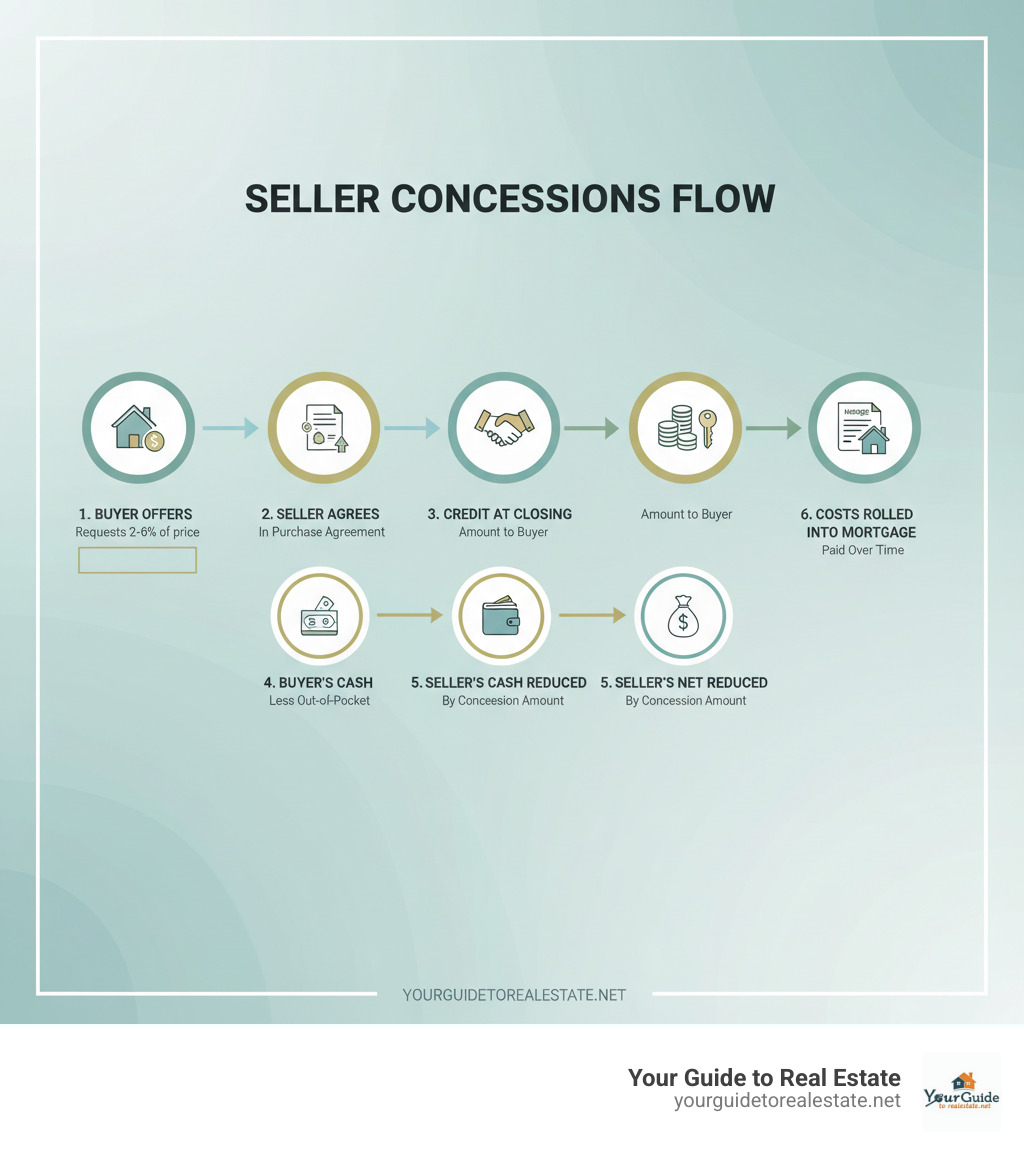
But here’s the part that catches buyers off guard: seller concessions aren’t free money. When a seller gives you a $10,000 credit for closing costs, that money comes directly out of their proceeds from the sale. If the purchase price stays at $300,000, you’re essentially financing that extra $10,000 into your loan amount. The seller walks away with $10,000 less, and you’re borrowing $10,000 more.
What does that mean for you? You’ll pay interest on that concession amount for the life of your loan—potentially 30 years. That $10,000 concession could actually cost you significantly more in the long run when you factor in all that interest.
The appraisal value also matters here. If you negotiate a high purchase price with big concessions, the home still needs to appraise at that higher value. If it doesn’t, you might need to renegotiate or come up with extra cash.
Think of concessions as a trade-off: less cash needed now, but potentially higher long-term mortgage costs. For many buyers, especially those with limited savings, this trade-off makes perfect sense. You just need to go in with your eyes open. Our guide on Understanding Mortgages: A Beginner’s Guide to Home Loans can help you understand these long-term costs better.
How seller concessions affect your mortgage
Seller concessions work like a financial sleight of hand—they reduce what you pay today by rolling those costs into what you’ll pay tomorrow. It’s a powerful strategy, but understanding exactly how it affects your mortgage keeps you from any unwelcome surprises down the road.
Here’s the basic mechanics: When a seller agrees to give you $5,000 toward closing costs, that amount gets credited to you at closing. Your out-of-pocket expenses drop by $5,000, which is fantastic. But the purchase price typically stays the same, so you’re still getting a mortgage for the full amount. The seller just receives $5,000 less in their net proceeds.
From your mortgage perspective, you’re effectively financing those closing costs into your loan. Instead of paying $5,000 in cash at closing, you’re paying it back (with interest) over 30 years as part of your monthly mortgage payment.
Let’s say you’re paying 6.5% interest on a 30-year mortgage. That $5,000 concession will cost you roughly $11,370 in total payments over the life of the loan when you include all the interest. That’s more than double the original amount. This doesn’t make concessions a bad deal—it just means you’re trading immediate cash savings for long-term financing costs.
Another thing to watch for is inflated purchase prices. Sometimes sellers agree to concessions but bump up the listing price to cover their contribution. You might negotiate a $350,000 home with $10,000 in concessions, when the home is really worth $340,000. Now you’re borrowing more than the home’s true value, which could create problems if you need to sell in a few years.
Your lender has to approve any seller concession before it becomes official. They’ll scrutinize the numbers to make sure the loan amount makes sense and that the concession doesn’t push the loan-to-value ratio into risky territory. Some lenders are more flexible than others, which is why working with an experienced loan officer matters.
If any concession money exceeds your actual closing costs, you won’t get the difference back in cash. Instead, that overage typically gets applied to your loan principal, reducing what you owe. This is an important lender rule designed to prevent buyers from essentially “cashing out” through seller concessions.
Understanding this process helps you make smarter decisions about how much to ask for and whether a concession-heavy offer actually saves you money. For a detailed walkthrough of how lenders evaluate these factors, check out The Loan Process for Buying a House.
Lender limits on seller concessions by loan type
Here’s something that surprises many buyers: you can’t just ask for unlimited seller concessions. Lenders set specific caps on how much a seller can contribute, and these limits vary widely based on your loan type and down payment amount. These rules exist to protect everyone involved—buyers, sellers, and lenders—from inflated home prices and risky loan structures.
For conventional loans backed by Fannie Mae and Freddie Mac, your down payment percentage determines your concession limit. Put down less than 10%, and sellers can contribute up to 3% of the purchase price. Make a down payment between 10% and 25%, and that limit jumps to 6%. Put down more than 25%, and you can receive up to 9% in seller concessions. The logic is simple: bigger down payments mean lower risk for lenders, so they allow more flexibility.
FHA loans allow up to 6% in seller concessions regardless of your down payment amount. This makes FHA loans particularly attractive for buyers who need help with closing costs but don’t have a large down payment saved up.
VA loans, which are available to eligible veterans and service members, cap seller concessions at 4% of the purchase price. While this limit is lower than some other loan types, VA loans don’t require any down payment, which already gives buyers significant financial flexibility.
USDA loans, designed for rural properties, allow up to 6% in seller concessions. Like VA loans, USDA loans offer 100% financing, so the concession limits are balanced against the zero-down-payment benefit.
Most buyers typically request somewhere between 3% and 6% of the purchase price to cover their closing costs. This range falls within the limits for most loan types and is generally considered reasonable by sellers.
What happens if you ask for more than your loan allows? Your lender will either reject the excess amount or require you to reduce the concession to the allowable limit. This could mean you’ll need to cover the difference out of pocket, or you might need to renegotiate the purchase price. Neither situation is ideal, which is why knowing your limits before making an offer is crucial.
These limits are non-negotiable—they’re set by the loan programs themselves, not individual lenders. However, some lenders might have additional “overlays” or stricter requirements, so always confirm the exact limits with your specific lender before submitting an offer.
Understanding these caps helps you craft a realistic offer that won’t fall apart during underwriting. For more information about different loan types and how they work, explore our Mortgage Options Explained guide.
Navigating Buyer Concessions in Today’s Real Estate Market
The real estate market never stands still. It shifts with interest rates, job growth, inventory levels, and countless other factors. What worked six months ago might not work today. That’s why understanding how to negotiate buyer concessions in the current market requires both awareness of these changing conditions and a solid strategy.

Here’s the reality: In a hot seller’s market where homes get multiple offers within days, asking for seller concessions can be tricky. Sellers hold the cards and can simply pick an offer with fewer demands. But when the market shifts and inventory rises, sellers become much more willing to negotiate. They want to close the deal, and concessions become a valuable tool to attract serious buyers.
Market conditions can vary dramatically even within the same city. A neighborhood in Dallas might be red-hot while another area sees homes sitting for weeks. This local knowledge is where an experienced real estate agent becomes invaluable. They know which sellers are motivated, what concessions are standard in your area, and how to position your offer to stand out.
The negotiation process is where everything comes together. It’s not just about throwing out a number and hoping it sticks. You need to understand what the seller wants, what you can reasonably ask for, and how to package your entire offer to make it irresistible. Your real estate agent acts as your advocate and strategist, helping you read the situation and craft an approach that maximizes your chances of success.
How to effectively negotiate for concessions
Getting seller concessions isn’t about being pushy or unreasonable. It’s about being smart, prepared, and strategic. The best negotiations happen when you’ve done your homework and you understand what makes sense for both sides.
Start by researching your local market thoroughly. Look at recent sales in the neighborhood. How long are homes staying on the market? Are other sellers offering concessions? What percentage are they offering? This information gives you a baseline for what’s realistic. Tools like a Competitive Market Analysis Real Estate can provide this crucial intelligence.
Make your request reasonable based on what you’ve learned. If closing costs typically run around 3% in your area and most sellers are offering 2-3%, don’t ask for 6% unless you have a compelling reason. Unrealistic requests can sour negotiations before they even start, especially if you’re already in a competitive situation.
Be very specific about what you’re asking for in your offer. Don’t just say “seller concessions.” Spell it out: “$8,000 credit towards buyer’s closing costs” or “seller to pay for termite treatment and roof repair up to $3,500.” This clarity prevents confusion and shows you’re serious and organized. Your real estate agent will help you word this precisely in the purchase agreement.
The home inspection often provides your best opportunity to negotiate concessions. When issues surface—maybe the HVAC system is on its last legs or the roof needs work—you have legitimate grounds to ask the seller to address them. You can request repairs, or more commonly, a credit so you can handle the work yourself. This isn’t about being nitpicky over minor cosmetic issues. It’s about addressing real concerns that affect the home’s value and safety.
Consider simplifying other aspects of your offer to make concessions more palatable to the seller. If you’re asking for help with closing costs, maybe you can offer a quicker closing date that works with their timeline, or reduce the number of contingencies that might hold up the sale. The easier you make the transaction for them, the more willing they might be to help with your costs.
Finally, and this cannot be stressed enough, work with an experienced real estate agent. They’ve negotiated hundreds of deals and know exactly how to position your request. They understand the psychology of negotiation, know what buttons to push, and can read between the lines when communicating with the seller’s agent. They’ll help you decide when to stand firm and when to compromise. For guidance on finding the right professional, check out How to Choose the Right Real Estate Agent: A Complete Buyer’s Guide.
Recent trends and the impact of the NAR settlement
The real estate industry has seen some significant shake-ups recently, and these changes directly affect how buyer concessions work, particularly around agent compensation and what sellers can contribute.
One major development involves changes to Interested Party Contributions (IPCs) rules from Fannie Mae and Freddie Mac. Here’s what’s new: seller credits to buyers for closing costs or even buyer’s agent commissions will now fall outside the traditional IPC caps. This is a big deal. It means sellers have more flexibility to help buyers with their expenses, including potentially covering the buyer’s agent fees, without bumping up against previous contribution limits.
Then there’s the NAR settlement agreement, which is reshaping how buyer’s agent commissions are handled. While it’s still working through final approval, the settlement prohibits listing agents from advertising what a seller will pay to a buyer’s agent through the MLS. This information, which used to be right there in the listing details, now has to be communicated through direct conversations between agents.
What does this mean for you as a buyer? The negotiation around your agent’s compensation becomes more explicit. Instead of it being a behind-the-scenes arrangement, you might need to specifically include it as part of your offer. This could look like a seller concession that covers your agent’s fee, or you might need to budget to pay your agent directly.
The upside is greater transparency about who pays what and why. The potential challenge is that it adds another layer to your negotiations. Sellers might still be willing to pay a buyer’s agent—many will, to attract more buyers—but it needs to be clearly structured as a seller concession in the purchase agreement, and it must stay within lender limits for your loan type.
These industry changes highlight why having a knowledgeable agent is more important than ever. They need to understand these new rules inside and out, and they need the Real Estate Agent Skills to steer them effectively on your behalf. The landscape is shifting, but with the right guidance, you can still negotiate favorable concessions and make your home purchase more affordable.
Special Cases: Builder Incentives and Non-Monetary Concessions
When it comes to buyer concessions, most people think about resale homes and traditional negotiations. But there’s a whole other world out there—new construction homes with builder incentives and creative non-monetary concessions that can add tremendous value to your purchase. Whether you’re drawn to that fresh-paint smell of a brand-new build or the charm of an existing home, understanding these special cases can open up opportunities that go far beyond simple price reductions.
The beauty of these special concessions is that they often create genuine win-win solutions. Sometimes what one party considers a burden is exactly what the other party values most. A seller who’s overwhelmed by the logistics of moving might treasure a flexible timeline more than an extra thousand dollars. A builder sitting on the last few homes in a community might happily throw in granite countertops to close the deal. These aren’t just negotiation tactics—they’re ways to add real value beyond the purchase price alone.
Builder incentives vs. seller concessions
Shopping for new construction? You’re entering a different ballpark when it comes to concessions. Builders have their own playbook of incentives that function similarly to seller concessions but come with unique twists and considerations. Understanding these differences can help you make smarter decisions and avoid common pitfalls.
New home communities typically offer incentives at strategic times—either during the initial phases to pre-sell homes and generate buzz, or toward the end when they’re eager to move those final few units and close out the project. The timing matters because it often determines how generous builders are willing to be.
Builder incentives commonly include closing cost assistance, where the builder pays a percentage of your closing costs if you use their preferred lender and title company. They might offer free or discounted upgrades on flooring, appliances, countertops, or even structural additions like a finished basement or covered patio. Rate buydowns are another popular incentive, where builders pay points to your lender to reduce your interest rate, either permanently or for the first few years of your loan (a “2-1 buydown” is particularly common). Some builders sweeten the deal with preferred lender perks, offering special interest rates or reduced fees when you finance through their in-house or affiliated lender.
Here’s the catch, though—and it’s an important one. You need to ask yourself: Has the home’s base price been inflated to cover these “free” incentives? Sometimes that “complimentary” granite upgrade is already baked into a slightly higher purchase price. The builder isn’t really giving you something for free; they’re just moving numbers around on paper.
We always encourage our clients to shop around, even when builders offer attractive incentives for using their preferred lender. Yes, you might get $5,000 toward closing costs, but if that lender’s interest rate is half a percent higher than what you could get elsewhere, you’ll pay far more over the life of your loan. Run the numbers. Compare the total cost, not just the upfront savings.
The goal is to evaluate the true value of what you’re getting. Are these upgrades you actually want, or are they pushing features you don’t need? Would you be better off with a lower base price and choosing your own finishes? A skilled real estate agent can help you steer these decisions and ensure you’re making a sound long-term investment, not just being impressd by short-term perks. For comprehensive guidance on your first home purchase, explore our First-Time Homebuyers Toolkit: Everything You Need to Know Before You Buy.
The power of non-monetary concessions
Not every valuable concession shows up as a dollar amount on your closing statement. Some of the most powerful concessions don’t involve money at all—they’re about convenience, timing, flexibility, and peace of mind. These non-monetary concessions can be absolute game-changers, especially in competitive markets or when you’re dealing with sellers who have specific needs beyond just getting the highest price.
Think about flexible closing dates. If a seller is relocating for a job and needs to close within two weeks, offering that quick timeline might matter more to them than an extra $5,000. Conversely, if they haven’t found their next home yet and are stressed about moving, offering them a longer closing period removes that pressure. This simple flexibility can make your offer the clear winner, even against higher bids.
A rent-back agreement takes this concept even further. With a rent-back, the seller stays in the home for a period after closing—maybe a week, maybe a month—and pays you rent during that time. This arrangement gives them breathing room to move at their own pace without the panic of being homeless between properties. For you, it provides some rental income and often makes your offer far more attractive than competing offers that demand immediate possession. It’s a true win-win scenario.
Then there’s including personal property—and we’re not just talking about the refrigerator. Sometimes sellers are happy to leave behind items that would be a hassle to move: a riding lawnmower, patio furniture, a workshop full of tools, outdoor play equipment, or even that beautiful dining room set that won’t fit in their new condo. These items might feel like burdens to them but represent real value and convenience for you. A simple conversation about what they’re planning to do with certain items can uncover opportunities neither party had considered.
Don’t forget about taking the home as-is. We mentioned this earlier as a true buyer concession, but it’s worth emphasizing here. For sellers who are overwhelmed, elderly, or simply want a hassle-free transaction, knowing they won’t have to deal with repair negotiations or contractor schedules is incredibly valuable. This concession saves them time, money, and stress—sometimes more than any cash offer could provide.
The secret to successful non-monetary concessions is understanding what the other party truly values. Your real estate agent can help you uncover these “pain points” through careful listening and strategic questions. Maybe the seller is emotionally attached to the home and wants to know it’s going to a family who’ll love it. Maybe they’re exhausted and just want the simplest, easiest transaction possible. When you address these deeper needs, you create agreements that feel good for everyone involved and often get your offer accepted over higher but less flexible bids.
For more insights on how flexibility and contingencies can impact your home purchase strategy, read our article on What Does Contingent Mean in Real Estate?. These non-monetary concessions are all about adding value beyond price—and sometimes, that’s exactly what seals the deal.
Frequently Asked Questions about Buyer Concessions
We’ve covered a lot of ground on buyer concessions, and we know your head might be spinning with questions. That’s completely normal! This is one of those topics where the details really matter, and getting clarity now can save you from surprises later. Let’s tackle some of the most common questions we hear from buyers just like you.
Can a buyer get cash back from a seller concession?
Here’s the straight answer: no, you cannot pocket cash from a seller concession. We know that might sound disappointing at first, but there’s a good reason for this rule.
Lenders have very strict guidelines about seller concessions. These funds are specifically intended to cover legitimate costs that you’re already paying as part of the transaction—things like closing costs, prepaid property taxes, homeowners insurance, or necessary repairs. They’re not meant to be a cash bonus.
The total amount of seller concessions you receive cannot exceed your actual closing costs and prepaid expenses. If your seller agrees to give you $8,000 in concessions, but your closing costs only add up to $6,500, your lender won’t approve the full $8,000. In most cases, that excess amount simply won’t be allowed. Sometimes, if there’s a small overage, the lender might apply it to reduce your loan’s principal balance, but you’ll never walk away from closing with a check in your pocket.
These rules exist to prevent fraud and ensure that loan amounts accurately reflect the property’s true value. Your lender will carefully review your Closing Disclosure to verify that every dollar of concession is properly applied to eligible expenses.
When is the best time to ask for concessions?
Timing is everything in real estate negotiations, and knowing when to ask for concessions can make the difference between getting them and losing out.
Your initial offer is often the most straightforward time to request seller concessions. When you submit your purchase offer, you can include a request for a specific dollar amount or percentage towards closing costs right from the start. This puts everything on the table and lets the seller consider your full proposal as a package deal. It’s clean, it’s clear, and it gives everyone a chance to negotiate from a known starting point.
After the home inspection is the other prime opportunity, and sometimes the most powerful one. If your inspector finds issues—maybe the roof needs work, the HVAC system is on its last legs, or there’s evidence of water damage—you’ve got legitimate grounds to go back to the seller. At this point, you can request that they either make the repairs themselves or provide a credit at closing to cover the cost. This isn’t about being difficult; it’s about protecting your investment.
Throughout the negotiation phase, concessions can be a valuable tool for bridging gaps. If you and the seller are $10,000 apart on price, the seller might be more willing to offer $5,000 in concessions than to drop their asking price. It’s often a psychological win for both sides.
Market conditions play a huge role in your timing strategy. In a buyer’s market where homes are sitting longer, you can often ask for concessions upfront with confidence. In a competitive seller’s market, you might want to present a cleaner initial offer and save concession requests for issues finded during inspection. Your real estate agent will help you read the room and time your requests perfectly.
Do concessions have to be included in the purchase agreement?
This one’s non-negotiable: yes, all concessions must be in writing in your purchase agreement or a signed addendum. There are no handshake deals in real estate, and verbal promises won’t hold up when it comes time to close.
The purchase agreement is your legally binding contract. If a concession isn’t written into this document, it essentially doesn’t exist. Courts and lenders won’t recognize side agreements or verbal promises, which means you’d have no recourse if the other party backs out.
Your lender absolutely requires all concessions to be documented. They’ll review your purchase agreement and your final Closing Disclosure line by line to ensure everything matches up and complies with their guidelines. If they see concessions on the closing documents that weren’t in the original agreement, they can halt the entire transaction.
Proper documentation needs to be specific. You can’t just write “seller to help with costs.” Instead, you need clear language like “Seller to provide $7,500 credit towards buyer’s closing costs” or “Seller to provide 3% of purchase price towards buyer’s closing costs and prepaid expenses.” This specific dollar amount or percentage eliminates any confusion about what was agreed to.
This clarity protects everyone involved. You know exactly what financial help you’re getting. The seller knows exactly what they’re paying. And the lender can verify that everything complies with their loan limits. Your real estate agent will ensure all concession language is properly drafted and included in your offer from the start, so there are no surprises at closing.
Conclusion
You’ve just taken a deep dive into buyer concessions, and if your head is spinning a little, that’s completely normal. Real estate has a language all its own, and terms like “buyer concessions” can mean different things depending on who’s talking. But here’s what matters: you now understand the real distinction between what you might give up as a buyer to strengthen your offer and what a seller might offer to help you close the deal.
Think of concessions as one of the most versatile tools in your home-buying toolkit. They’re not just about saving money at closing (though that’s certainly a big part of it). They’re about creating flexibility, solving problems, and finding common ground between you and the seller. Whether it’s a seller covering a few thousand dollars in closing costs, you offering a flexible move-out date, or a builder throwing in upgraded appliances, these strategic moves can make or break a deal.
The financial side of concessions—understanding how they affect your mortgage, knowing the lender limits for your specific loan type, and recognizing when they truly save you money versus when they just shift costs around—is crucial knowledge. This isn’t about gaming the system. It’s about making informed decisions that protect your financial future while helping you get into the home you want.
We’ve also seen how the real estate landscape is shifting. With recent changes to how buyer agent commissions are handled and new flexibility in how seller contributions are structured, having a knowledgeable guide by your side isn’t just helpful—it’s essential. The market dynamics in your specific area, whether you’re in Dallas, Oklahoma City, or anywhere else, will influence how aggressively you can negotiate and what concessions make sense.
Remember those builder incentives and non-monetary concessions we discussed? They’re perfect examples of thinking creatively. Sometimes the most valuable concession isn’t measured in dollars. A stressed seller might value your flexible closing date more than another buyer’s slightly higher offer. A builder might offer upgrades that would cost you far more to add later. These opportunities exist when you know what to look for and how to ask.
At Your Guide to Real Estate, we believe that real estate doesn’t have to be overwhelming. Our goal has always been to give you the proven framework and stress-free guidance you need to make confident decisions. Understanding buyer concessions is just one piece of that puzzle, but it’s an important one that can save you thousands of dollars and countless headaches.
The truth is, knowing about concessions and successfully negotiating them are two different things. That’s where having the right real estate professional becomes invaluable. They know your local market, understand current trends, can spot opportunities you might miss, and will advocate fiercely for your best interests throughout the entire process.
So what’s your next step? Take what you’ve learned here and put it into action. Whether you’re ready to make an offer tomorrow or you’re still in the early stages of your home search, having an experienced agent who can steer these waters with you will make all the difference.
Find a trusted agent to help you navigate your home purchase
Your dream home is out there, and with the right knowledge and the right team, you’re going to get it on terms that work for you.