

Understanding the 2025 Housing Market Outlook
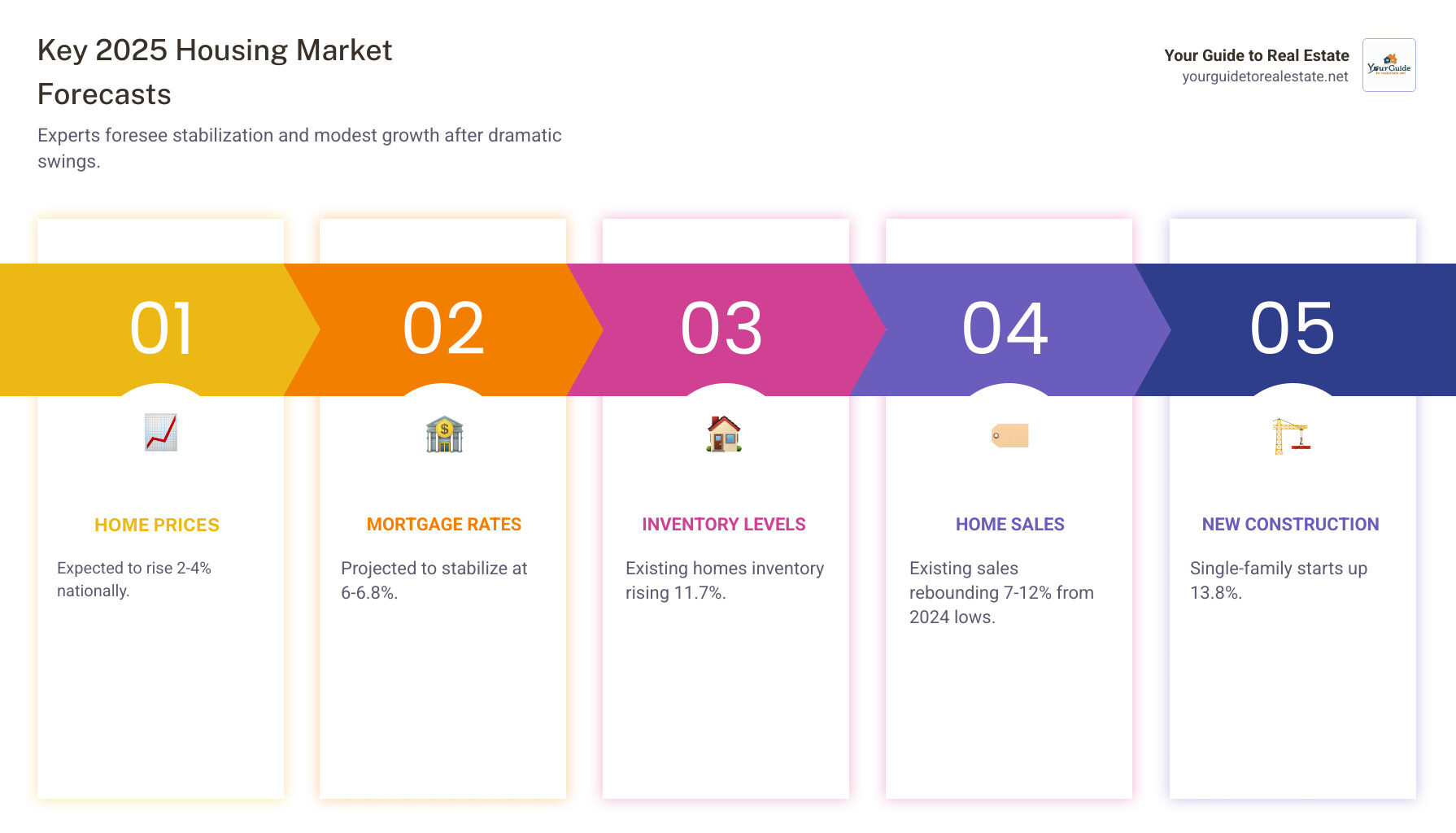
The 2025 housing market is entering a period of stabilization after years of dramatic swings, with experts forecasting modest price growth of 2-4%, mortgage rates holding steady around 6-6.8%, and gradually increasing inventory levels. Here’s what you need to know:
Key 2025 Housing Market Forecasts:
- Home Prices: Expected to rise 2-4% nationally, with regional variations
- Mortgage Rates: Projected to stabilize in the 6-6.8% range throughout the year
- Home Sales: Existing sales near 30-year lows, but rebounding 7-12% from 2024
- Inventory: Rising 11.7% for existing homes, offering buyers more choices
- New Construction: Single-family starts up 13.8%, multifamily declining
- Rental Market: Flattening rent growth, improving affordability for renters
After enduring a “trade war [that] disrupted what had been an early recovery in demand for existing homes” and drove “transactions to cyclical lows,” the market is showing clear signs of recovery. But this isn’t a return to the wild price surges of the pandemic era—it’s something different.
What makes 2025 unique is the collision of competing forces. Pent-up buyer demand is finally starting to open up as economic uncertainty eases. Yet persistent affordability challenges, the mortgage rate “lock-in effect,” and cautious buyer sentiment continue to temper activity. Meanwhile, regions like Ontario and British Columbia face price declines, while Alberta, Quebec, and parts of the U.S. Midwest see stronger growth.
The market is transitioning from extremes to something more balanced. For buyers, that means more inventory and less frantic competition. For sellers, it means pricing strategy matters more than ever. And for everyone, it means understanding your local market is critical—because national trends only tell part of the story.
2025 housing market word guide:
Navigating the 2025 Housing Market: A National Overview
When you step back and look at the 2025 housing market from a national perspective, something interesting emerges: we’re watching a market catch its breath. After years of wild swings—pandemic frenzy, rate shock, inventory drought—things are finally settling into a more predictable rhythm. It’s not boring, mind you. It’s just… healthier.
Both the United States and Canada are moving away from the chaos toward something that feels more sustainable. In the U.S., most experts predict home values will tick up between 1.5% and 4% this year. That’s growth you can actually plan around—not the double-digit surges that left everyone breathless (and often priced out). The reason? Inventory is finally increasing, giving buyers actual choices instead of frantic bidding wars on the only house available in their price range.
Canada’s story is a bit different. The national average home price in June 2025 sat at $691,643—basically flat from the month before and down 0.7% from the previous year. Economic uncertainty, trade tensions, slower population growth, and rising unemployment are all putting pressure on prices, particularly in Ontario and British Columbia. Canadian home sales are expected to dip 3.5% this year before bouncing back with a solid 7.9% rebound in 2026, reaching 504,100 units. That’s still slightly below pre-pandemic averages, but it’s movement in the right direction.
The big picture? Pent-up demand is slowly trickling back into the market as people realize they can’t put life on hold forever. But affordability challenges and that stubborn mortgage rate “lock-in effect” are keeping many would-be movers on the sidelines a bit longer.
For a deeper look at what these numbers mean for your specific situation, check out our real estate market projections for 2025.

Key Predictions for the US 2025 Housing Market
Let’s get specific about what the U.S. 2025 housing market actually looks like when you zoom in. While the overall trend points to modest growth, the details tell a more nuanced story.
Home prices are expected to grow between 2% and 4% across the country. Fannie Mae predicts a 2.6% increase, Redfin leans toward 4%, and Realtor.com splits the difference at 3.7%. The consistency across these forecasts is reassuring—nobody’s predicting wild swings in either direction. This is steady, sustainable appreciation that won’t leave you wondering if you’re buying at a peak.
Existing home sales remain the challenge. Fannie Mae expects them to stay near 30-year lows, largely because of that “lock-in effect” we keep mentioning. When you’re sitting on a 3% mortgage rate, moving to a new home with a 6.5% rate feels like financial self-sabotage. That said, some experts see a gradual thaw happening, with sales potentially rebounding 7% to 12% from 2024 levels as buyers slowly accept the new rate reality and life circumstances force necessary moves.
New home construction is the bright spot. Builders are stepping up to fill the gap left by homeowners who won’t (or can’t) sell. New construction offers buyers modern floor plans, energy efficiency, and most importantly—availability. Plus, builders are often willing to offer incentives like rate buydowns or closing cost assistance that you won’t find with existing homes.
Want the full breakdown on how these trends affect prices, inventory, and what buyers are actually doing? Our U.S. Housing Market Update 2025 has you covered.
Here’s how the key metrics stack up:
| Metric | 2024 Forecast (Approx.) | 2025 Forecast (Approx.) | Trend in 2025 | Sources (Examples) |
|---|---|---|---|---|
| Home Sales (Existing) | Low (e.g., 3.9M units) | 4.07M – 4.4M units | 2-12% Rebound | Fannie Mae, Realtor.com, Redfin |
| Price Growth | Modest (e.g., 1-2%) | 2.6% – 4% | Modest Appreciation | Fannie Mae, Realtor.com, Redfin |
| Inventory (Existing) | Low | +11.7% | Gradual Increase | Realtor.com |
| Mortgage Rates | High (e.g., 7%) | 6-6.8% | Stabilization | Fannie Mae, Realtor.com, Redfin |
New Construction and Inventory Levels
The supply side of the 2025 housing market tells you a lot about where things are headed. After years of chronic shortages, we’re finally seeing some relief—though it’s arriving unevenly across regions and property types.
In Canada, housing starts are expected to slow from 2025 through 2027, mainly because fewer condominium apartments are being built. Despite this slowdown, total starts will still run above their 10-year average, which shows underlying demand remains strong. Multi-unit construction will stay liftd nationally, but Ontario and British Columbia are seeing sharp declines as developers hit the pause button. Rising construction costs and shaky investor confidence are forcing many condo projects to be delayed, cancelled, or converted to rentals instead.
The U.S. presents a brighter picture, particularly for single-family homes. Realtor.com forecasts single-family housing starts will jump 13.8% to reach 1.1 million homes. That’s significant progress toward addressing the housing shortage that’s plagued the market for years.
Inventory levels are improving across the board. In Ontario, active listings hit approximately 78,605 units in June 2025—the highest June level in over a decade and 47% above the 10-year average. That translates to 4.6 months of inventory, compared to the long-run average of 2.6 months. In the U.S., existing home inventory is forecast to grow 11.7% according to Realtor.com.
Why does “months of supply” matter? It’s the clearest indicator of market balance. Under 4 months favors sellers. Between 4 and 6 months is balanced. Above 6 months tilts toward buyers. You can see how this metric has evolved over time in this chart of month’s supply.
Developers aren’t having an easy time, though. They’re dealing with cautious buyer sentiment, tight financing conditions, and liftd construction costs—partly due to lingering tariff concerns. Many are missing presale targets, leading to growing unsold inventory. The path to increased supply isn’t smooth, even when demand exists.
For more on the broader trends reshaping construction and the market overall, explore our guide to the top 7 real estate trends shaping 2025 and beyond.
The 2025 Rental Market Outlook
While homeownership gets most of the headlines, the rental market is a critical piece of the 2025 housing market puzzle. And this year, renters are catching a bit of a break.
Vacancy rates are creeping up in major centers as new supply comes online and demand softens. That softening is partly driven by slower population growth and reduced immigration targets, especially in Canada, where newcomers typically rent for their first few years. Fewer new renters means less competition for available units—and that means you’re less likely to find yourself in a bidding war over a one-bedroom apartment.
Rent growth is slowing significantly. Redfin expects the median U.S. asking rent to remain essentially flat year-over-year in 2025. When you combine stable rents with rising wages, you get something we haven’t seen in a while: improving rental affordability. It’s not a dramatic shift, but for people stretched thin by years of rent increases, it’s meaningful relief.
Investor demand in urban condo markets is also staying subdued, which keeps rental supply from being snapped up by speculators. More units available for actual renters means a more balanced market where landlords have to compete on price and quality rather than just accepting the highest bidder.

The Economic Forces Shaping Real Estate in 2025
The 2025 housing market doesn’t operate in isolation—it’s deeply connected to the broader economic landscape, and understanding these forces is essential whether you’re planning to buy, sell, or simply stay informed.
Right now, economic uncertainty is casting a long shadow over real estate decisions. For our Canadian neighbors, trade tensions with the United States are creating real headaches. If tariffs become permanent fixtures rather than negotiating tactics, they could significantly dampen business confidence, slow investment, reduce job availability, and push inflation back up. None of this is good news for housing. When businesses pull back and uncertainty rises, households naturally become more cautious about making major financial commitments like buying a home.
Inflation trends continue to be a double-edged sword. While central banks have made progress bringing inflation down from its recent peaks, it’s not quite defeated yet. Projections suggest inflation could climb back above 3% by mid-2026, influenced by trade policies and geopolitical events. Higher inflation erodes your purchasing power—what your dollar can buy today won’t stretch as far tomorrow—and it typically keeps interest rates liftd, making mortgages more expensive.
The employment picture tells two different stories on either side of the border. In Canada, we’re expecting the unemployment rate to peak at 7.1% in late 2025, which would naturally dampen buyer confidence and slow market activity. Meanwhile, U.S. forecasts are more optimistic, with approximately 2 million job gains anticipated for both 2025 and 2026. More jobs mean more people who can afford homes, which supports demand and helps with affordability in the long run.
Immigration levels are another crucial economic lever, particularly in Canada. Substantial cuts to immigration targets will inevitably slow population growth and household formation. This primarily affects rental demand—since newcomers typically rent for their first few years—but it also ripples through urban condo markets where investor activity is expected to remain subdued.
These economic forces don’t just affect whether people can buy homes; they shape what types of properties are in demand, where growth happens, and how quickly markets can recover from downturns. For a deeper dive into the numbers that define today’s market, explore our 10 Must-Know Real Estate Statistics That Define Today’s Market.
The Decisive Role of Interest Rates
If there’s one factor that dominates conversations about the 2025 housing market, it’s interest rates. For most of us, mortgage rates are the difference between affording our dream home and settling for something less—or waiting on the sidelines altogether.
The good news for 2025 is that we’re expecting mortgage rates to stabilize, though they’ll remain above 6%. Various forecasts place them in the 6-6.8% range throughout the year. Fannie Mae predicts rates will decline modestly but stay above 6%, while Realtor.com suggests an average of 6.3%, potentially edging down to 6.2% by year-end. Redfin takes a slightly more conservative view, expecting rates around 6.8%. You can review historical trends for context at the 30-Year mortgage rates data from the Federal Reserve.
These aren’t the rock-bottom 3% rates that some homeowners locked in during the pandemic, but they represent something valuable: predictability. After the volatility of recent years, knowing roughly what to expect makes planning much easier.
Central bank policies will continue to be the main driver here. The Bank of Canada has been implementing rate cuts since June 2024 and is projected to hold its policy rate steady at 2.75% through 2026. In the United States, the Federal Reserve is expected to lower the federal funds rate multiple times in 2025. It’s worth noting that while the Fed influences mortgage rates, it doesn’t set them directly—they’re shaped by broader economic factors and bond markets.
The infamous “lock-in effect” remains a powerful force in 2025. Imagine you have a mortgage at 3.5%, and moving to a new home means taking on a 6.5% rate. Many homeowners are choosing to stay put rather than more than double their borrowing costs, even if their current home no longer fits their needs perfectly. This hesitancy keeps existing home inventory constrained, even as builders work to increase new construction.
Despite some relief from stabilizing rates, mortgage affordability will remain challenging. The share of household income required to cover ownership costs will likely stay well above pre-pandemic levels, especially in high-cost areas. This persistent affordability gap will continue to influence how quickly the market recovers and who can participate in it.
For those wondering about the future trajectory of borrowing costs, our article Will Mortgage Rates Go Down? offers further analysis and context.
Government Policies and Housing Supply
Government policies might not make headlines as often as interest rates, but they’re powerful tools that shape the 2025 housing market in fundamental ways, particularly when it comes to housing supply and affordability.
In Canada, the federal government has launched a housing plan aimed at boosting supply. However, there’s a reality check here: homebuilding takes time. Between policy approval, planning, permitting, and actual construction, there are inherent lags. We don’t anticipate a material boost to housing completions until late 2026 at the earliest. This means that for 2025, the market will largely work with the supply dynamics already in motion.
Immigration policy also plays a surprisingly large role in housing. While immigration fuels economic growth and creates demand for housing, substantial cuts to immigration targets can slow population growth and household formation. This particularly impacts rental demand and urban condo markets where investor activity is expected to remain subdued. Finding the right balance—enough immigration to support economic vitality while ensuring adequate housing supply—is one of the trickiest challenges policymakers face.
Zoning changes and reduced construction regulations represent areas where policy can directly influence supply. Redfin suggests that fewer construction regulations could lead to more homebuilding, particularly a rebound in multifamily housing starts. Streamlining approval processes and encouraging higher-density development are often cited as practical ways to increase housing stock more quickly, though they can face local resistance.
Mortgage rule adjustments—such as changes to stress tests or first-time buyer incentives—can also affect buyer demand and market accessibility. While no major federal shifts were highlighted specifically for 2025 in our research, these remain important levers that governments can pull to influence market conditions.
These policies collectively aim to address the chronic housing supply shortage that has plagued many regions for years. For a comprehensive understanding of how such interventions can lead to significant market shifts, our Housing Market Correction: Complete Guide provides valuable context.
Primary Risks and Uncertainties
Even with the best forecasts and most careful analysis, the 2025 housing market comes with its share of wild cards. Several risks and uncertainties could shift our projections, reminding us that flexibility and staying informed are essential.
Trade tensions remain a major concern, particularly for the Canadian market. Lingering disputes between the U.S. and Canada, along with the potential for new tariffs, could significantly weigh on economic confidence. This leads to slower investment, reduced labor demand, and ultimately dampens buyer sentiment and transaction volumes. The phrase “tariff concerns” has become a regular feature in economic forecasts, highlighting just how fragile global trade relations can be.
Geopolitical events are, by their very nature, unpredictable. International conflicts, shifts in global alliances, or unexpected political developments can trigger economic instability, spike commodity prices, and renew inflationary pressures. All of these ripple through the housing market, sometimes in ways we don’t anticipate until they’re already happening.
Closer to home, higher-than-expected unemployment poses a real risk. If job losses accelerate beyond current projections, it would severely impact consumer confidence and household ability to afford mortgage payments. This could lead to increased listings and downward pressure on prices. In Canada, we’re watching closely as the unemployment rate is projected to peak at 7.1% in late 2025.
Persistent inflation is another worry that keeps economists up at night. If inflation proves more stubborn than anticipated, central banks might be forced to maintain higher interest rates for longer—or even implement further hikes. This would make affordability challenges even worse and keep many potential buyers waiting on the sidelines.
Beyond these major concerns, other wild cards could emerge. Potential government spending cuts could theoretically lower mortgage rates, while any unexpected reforms or privatization of entities like Fannie Mae and Freddie Mac in the U.S. could significantly impact mortgage availability and affordability. Even the sheer scale of national debt levels could influence long-term mortgage rate trends.
While a housing market crash is generally deemed unlikely for 2025—experts predict stabilization rather than collapse—understanding these risks is essential for preparing for various scenarios. Our guide, A look at a potential housing market crash, digs into the factors that could lead to such an event and why the fundamentals suggest a more balanced market ahead rather than a dramatic downturn.
Regional Deep Dive: Diverging Paths Across North America
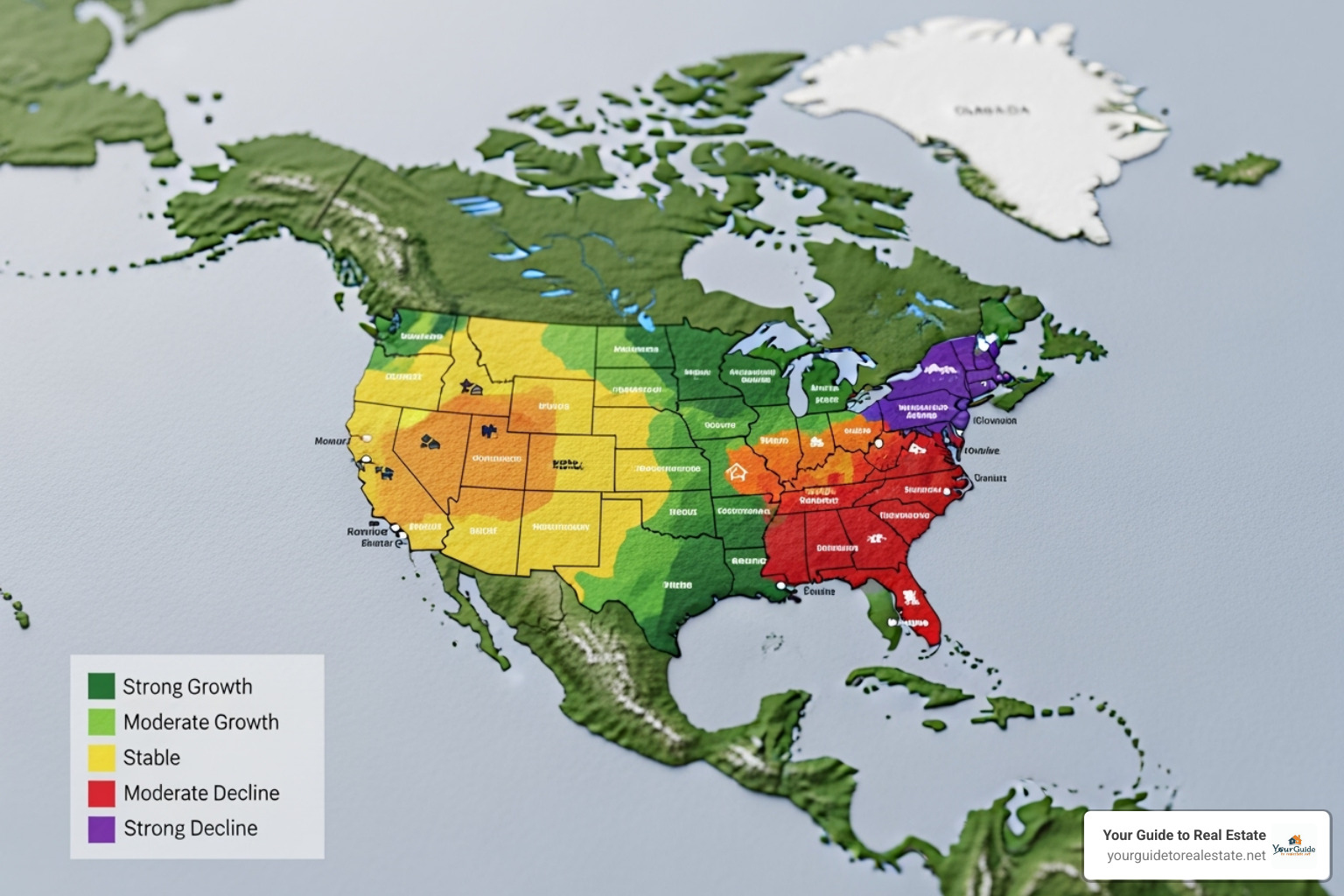
Here’s something crucial to understand about the 2025 housing market: it’s not one market—it’s dozens, each with its own personality and quirks. What’s happening in Vancouver right now looks nothing like what’s unfolding in Indianapolis. Toronto’s story is completely different from Dallas’s. This year more than ever, these regional differences matter tremendously to your success as a buyer or seller.
Across North America, we’re witnessing a fascinating split. Some regions are firmly in buyer’s market territory, where inventory is plentiful and sellers need to compete for attention. Other areas remain solidly in seller’s market mode, with multiple offers still common and prices climbing steadily. Then there’s a growing middle ground—balanced markets where neither buyers nor sellers hold a clear advantage. Knowing which type of market you’re in changes everything about your strategy.
Regional Hotspots and Cool Downs in the 2025 Housing Market
The 2025 housing market map shows hot spots and cold zones scattered across the continent in patterns that might surprise you. Understanding these regional performance differences is essential whether you’re buying your first home or your fifth investment property.
In the United States, we’re watching several emerging hotspots that offer real opportunity for buyers and investors alike. Cities like Buffalo, Indianapolis, and Providence are attracting serious attention this year, along with Hartford and Philadelphia. These markets often combine strong local economies with prices that haven’t spiraled out of reach. They represent what many consider the sweet spot—growth potential without the sticker shock of coastal metros. If you’re exploring specific markets, our Regional Property Market Guide 2025 digs deep into the Dallas area, and similar dynamics are playing out in places like Oklahoma City.
Canada’s story is particularly dramatic this year, with the country essentially split between two very different market realities. Alberta and Quebec are experiencing stronger growth, with sales reaching historically high levels and prices growing faster than the national average during the first half of the forecast period. Construction activity remains robust in Atlantic Canada, the Prairies, and Quebec—these regions are showing the kind of momentum that typically defines seller’s markets.
Meanwhile, Ontario and British Columbia are facing a different reality entirely. These traditionally expensive markets are projected to see larger price drops, with some forecasts predicting declines around 2% nationally but more significant dips in these specific provinces. The Greater Toronto Area’s average home price, for instance, decreased by 5.0% year-over-year to $1,051,719 in June 2025, while Ontario’s average home price edged down by 3.7% annually. High prices, reduced investor activity, and lingering interest rate impacts are all contributing to this cooling trend.
A Tale of Two Markets: Ontario vs. The Prairies
Nothing illustrates the diverging paths of the 2025 housing market quite like comparing Ontario to the Prairie provinces. These two regions might as well be on different planets right now.
Ontario, especially the Greater Toronto Area, is squarely in buyer’s market territory. The numbers tell a compelling story: the Sales-to-New-Listings Ratio hit just 38% in June 2025. In major cities like Mississauga and Brampton, that ratio dropped even lower to 29% and 27% respectively. What does this mean in practical terms? Buyers have leverage. They have time. They have choices.
We’re also seeing record new listings in Ontario—the highest number ever recorded for the month of June. Active listings reached approximately 78,605 units, sitting 47% above the 10-year average. This translates to 4.6 months of inventory, compared to the long-run average of just 2.6 months. That’s a comfortable cushion that gives buyers breathing room to negotiate and really think through their decisions.
Here’s what’s particularly interesting: despite the Bank of Canada implementing multiple interest rate cuts between June 2024 and March 2025, Ontario’s market hasn’t responded with the enthusiasm seen in other provinces. Unaffordability and economic uncertainty continue to weigh heavily on buyer sentiment. Most major cities around the Greater Toronto and Hamilton Area remain firmly in buyer’s market mode. Ottawa stands out as an exception, maintaining a more balanced market with a 55% Sales-to-New-Listings Ratio.
The Prairie provinces paint an entirely different picture. These regions are on track to reach historically high levels of sales, with prices growing faster than national averages. We’re maintaining our forecast that quarterly price growth will be strongest in the Prairies during the second half of 2025. Cities like Calgary and Edmonton are experiencing robust activity, driven by stronger economic fundamentals and relatively better affordability compared to coastal markets.
In the Prairies, inventory levels remain below pre-pandemic norms, creating more competitive conditions for buyers and supporting sustained price growth. While Ontario buyers are leisurely touring multiple properties with time to spare, Prairie buyers are often still facing multiple offers and moving quickly when they find the right home. It’s a reminder that in real estate, location doesn’t just affect price—it affects the entire experience of buying or selling.
Strategic Moves for Buyers and Sellers in 2025
After years of extremes, the 2025 housing market is settling into something closer to normal—and that’s actually good news for everyone involved. We’re moving away from the chaos of pandemic-era bidding wars and the anxiety of sky-high rates into a more balanced environment where thoughtful strategy matters more than speed.
This normalization means different things depending on which side of the transaction you’re on. For buyers, it’s about taking advantage of more choices and less frantic competition. For sellers, it’s about understanding that pricing strategy isn’t just important—it’s everything. Homes that sit overpriced while the market moves on rarely recover that lost momentum.
What both buyers and sellers share in 2025 is the need for financial preparedness and realistic expectations. The market rewards those who do their homework, understand their local conditions, and work with professionals who know what they’re doing. Whether you’re eyeing a first home in Oklahoma City, selling a family property in Dallas, or exploring investment opportunities elsewhere, having a clear strategy makes all the difference.
We believe in providing a proven framework and stress-free guidance for success in the real estate market. That starts with surrounding yourself with the right team. Our Best Real Estate Agent Guide 2025 can help you find someone who truly understands your goals and your market.
Advice for Homebuyers
If you’ve been sitting on the sidelines waiting for your moment, the 2025 housing market might just be extending an invitation. The landscape has shifted in ways that favor patient, prepared buyers.
More options mean you’re no longer forced to make split-second decisions on homes that are just “okay.” Inventory is rising—up 11.7% for existing homes in many markets—giving you actual choices. You can take time to find a home that fits your life, not just one that happens to be available when you’re ready to buy.
Less competition doesn’t mean homes are sitting empty for months, but it does mean you’re less likely to find yourself in a bidding war against fifteen other buyers. Popular properties in desirable neighborhoods will still move quickly, but the days of waiving inspections and offering $50,000 over asking just to get in the door are largely behind us. You can breathe a little.
Stabilizing rates around 6-6.8% aren’t the rock-bottom 3% rates some homeowners locked in during the pandemic, but they offer something almost as valuable: predictability. When rates aren’t bouncing around every week, you can actually plan your budget with confidence. You know what your monthly payment will look like, and you can make decisions based on solid numbers rather than guesswork.
None of this means buying a home has become easy or cheap. The importance of pre-approval cannot be overstated. Getting pre-approved for a mortgage does two crucial things: it tells you exactly what you can afford (so you don’t waste time looking at homes outside your budget), and it signals to sellers that you’re serious. In a market where sellers have learned to be more selective, being a qualified buyer matters.
Real estate is local. What’s happening nationally gives you context, but what’s happening on your specific street determines your experience. Working with a knowledgeable agent who understands your market—whether that’s Dallas, Oklahoma City, or anywhere else—can save you time, money, and stress. Find the Right Agent who can guide you through the specific dynamics of your area.
Advice for Home Sellers
Selling in the 2025 housing market requires a different mindset than it did a couple of years ago. The good news? Demand hasn’t disappeared. People still need to buy homes. The reality? Buyers have become more selective, and your home needs to earn their attention.
Accurate pricing is where most successful sales begin—and where many unsuccessful ones falter. Overpricing your home because you remember what the neighbor’s place sold for in 2022 is a recipe for disappointment. Today’s buyers have access to extensive market data, and they know when a home is priced too high. An overpriced listing sits, gets stale, and eventually requires price cuts that make buyers wonder what’s wrong with it. Starting with a realistic price based on current comparable sales in your neighborhood attracts serious buyers right away and often leads to better final outcomes.
Highlighting move-in readiness has become increasingly important. Buyers, especially first-timers and millennials who make up a large portion of today’s market, are looking for homes they can move into without immediately tackling major projects. This doesn’t mean you need to renovate your entire kitchen, but it does mean addressing obvious repairs, applying fresh paint, and presenting your home in its best light. Staging matters. Professional photos matter. These investments often return multiples of their cost in final sale price.
Understanding local inventory means knowing your competition. If there are ten similar homes for sale within a mile of yours, you need to understand what makes yours stand out—or how to price it competitively if it doesn’t. Your real estate agent should be providing detailed market insights about what’s selling, what’s sitting, and why. This local intelligence is invaluable.
Attracting serious buyers is about quality over quantity. A well-marketed listing with professional photography, virtual tours, and a compelling description will reach motivated buyers who are ready to act. Focus your efforts on presenting your home as the solution to someone’s housing needs, not just another listing in the feed.
The market has shifted, but opportunity hasn’t disappeared. It’s just wearing a different outfit. Sellers who adapt their strategies to today’s conditions—realistic pricing, excellent presentation, and strategic marketing—will find willing buyers ready to make their move.
Frequently Asked Questions about the 2025 Market
As we talk with people trying to make sense of today’s real estate landscape, certain questions keep coming up. The 2025 housing market can feel confusing, especially with so much conflicting information out there. Let’s address the concerns we hear most often, with straightforward answers based on the data we’ve been tracking.
Is a housing market crash likely in 2025?
Here’s the good news: a widespread housing market crash in 2025 is generally considered unlikely by experts across the board. What we’re seeing instead is a market correction or stabilization—a cooling off rather than a collapse.
Think of it this way: a crash requires specific conditions that simply aren’t present right now. We’re not seeing the reckless lending practices that led to 2008. We’re not drowning in excess inventory. Instead, housing shortages remain a persistent problem. Freddie Mac estimates the U.S. housing stock is 3.7 million units below what’s needed to meet actual demand. That fundamental shortage acts as a safety net under prices.
There’s also significant pent-up demand from buyers who’ve been waiting on the sidelines, watching and hoping for better conditions. As rates stabilize and more homes become available, these buyers provide steady support for the market. And unlike the pre-2008 era, today’s lending standards are much stricter, meaning homeowners generally have healthy equity cushions.
That said, some regions might experience modest price declines—particularly overpriced markets that got ahead of themselves. But the overall picture points to recalibration rather than catastrophe. For a deeper exploration of what would need to happen for a true crash to occur, our guide on a potential housing market crash breaks down the specific factors and why 2025 looks different.
Will it be easier to buy a house in 2025?
For many frustrated buyers, 2025 should feel like a breath of fresh air. The experience won’t be effortless—buying a home never is—but several factors are shifting in buyers’ favor.
Increased inventory is the big story here. With Realtor.com projecting an 11.7% jump in existing home inventory for the U.S., you’ll simply have more choices. No more feeling like you have to jump on the first decent house you see or lose out forever. You’ll have time to think, to compare, to find something that actually fits your needs rather than just settling.
Stabilizing mortgage rates also bring much-needed predictability. Yes, rates are higher than the pandemic lows we all got spoiled by, but knowing they’ll likely hover in the 6-6.8% range throughout the year means you can actually plan your finances without constantly second-guessing. Some experts even suggest that temporary dips in rates might create windows of opportunity for savvy buyers to lock in better terms.
The frenzied competition that defined recent years is finally easing. You probably won’t be competing against fifteen other offers on every property. That means less pressure to waive inspections or offer thousands over asking price just to get your foot in the door.
But let’s be honest: affordability remains a key challenge. Just because the process is less stressful doesn’t mean homes are suddenly cheap. In high-cost areas like the greater Dallas region, the share of household income needed for ownership costs stays well above pre-pandemic levels. The market might be easier to steer, but budgeting wisely and getting pre-approved for financing are still absolutely essential steps.
Where are home prices expected to fall in 2025?
This is where understanding regional differences becomes crucial. The 2025 housing market isn’t one uniform landscape—it’s a patchwork of distinct local conditions.
In Canada, we’re seeing clear examples of price declines, particularly in Ontario and British Columbia. These provinces have consistently been cited for expected price drops or continued downward trends. Ontario’s average home price, for instance, decreased by 3.7% annually in June 2025, with the Greater Toronto Area seeing a 5.0% year-over-year decline to $1,051,719. High existing prices, increased inventory levels, reduced investor activity, and lingering economic uncertainty are all contributing factors.
In the United States, the picture is different. Most forecasts predict slow but steady price growth of 2-4% nationally rather than widespread declines. That doesn’t mean every single market will appreciate, though. Some overpriced markets or less desirable micro-markets might experience slight adjustments or corrections. But the prevailing sentiment across most U.S. regions is modest appreciation rather than significant drops.
The key takeaway? National averages only tell part of the story. A home in Buffalo might behave completely differently than one in Vancouver or Dallas. Understanding your specific city or neighborhood trends is absolutely crucial for making informed decisions. That’s why working with a knowledgeable local agent who understands these nuances can make all the difference in your buying or selling strategy.
Conclusion: Finding Your Path in a More Balanced Market
After months of analysis and observation, one thing is clear: the 2025 housing market is settling into something we haven’t seen in years—a more balanced, predictable environment. The wild swings are behind us. What lies ahead is a market where patience, strategy, and local knowledge matter more than speed and desperation.
Yes, affordability challenges persist. Mortgage rates hovering above 6% and liftd ownership costs mean that buying a home still requires careful financial planning and realistic expectations. But here’s the encouraging part: the increase in inventory means you actually have time to think. Time to compare. Time to find the right home, not just the first available one. For sellers, it means pricing matters again, and for buyers, it means competition has eased enough to breathe.
The long-term implications of this shift point toward sustainable growth rather than the boom-and-bust cycles that have rattled so many would-be homeowners. Homeownership remains a valuable long-term investment, but the path there looks different depending on where you are. A cooling market in Ontario requires a different approach than navigating a burgeoning hotspot in Oklahoma City or understanding the nuances of the Dallas market. Regional divergences aren’t just statistics—they’re the reality you’ll face when you walk through that first showing or list your home.
This is where the opportunity lies for informed buyers and sellers. The market is no longer moving so fast that you have to make split-second decisions. You can be strategic. You can negotiate. You can work with someone who knows your specific area inside and out. That’s the kind of market where thoughtful planning wins.
At Your Guide to Real Estate, we believe navigating this landscape shouldn’t feel overwhelming. We’re here to provide that stress-free guidance and proven framework that turns market data into personal success stories. Whether you’re a first-time buyer trying to understand pre-approval, a seller wondering how to position your home, or an investor looking for the next smart move, we’ve got your back.
The 2025 housing market isn’t perfect, but it’s moving toward balance. And in that balance, there’s real opportunity for those ready to take it. To gain even deeper insights and stay ahead of the curve, we invite you to Explore our complete 2025 housing market forecast for more insights. Your path forward starts with understanding where the market is—and where it’s going.