

What Does Concessions Meaning Really Tell You?
Concessions meaning refers to something given up or granted by one party to another, often to reach an agreement or end a dispute. The word comes from the Latin concēdere, meaning “to yield.”
Quick Answer: The 5 Main Meanings of Concession
- The act of yielding – Giving up a point in an argument or acknowledging defeat
- A granted right or privilege – Permission from a government or authority to operate a business or use land
- A price reduction – Special discounts for students, seniors, or other groups (mainly British English)
- A retail space – A small business operating within a larger venue, like a stadium or airport
- In real estate – Financial incentives offered by sellers, such as paying closing costs or providing repair credits
When you’re navigating a real estate transaction, understanding concessions can save you thousands of dollars. A seller might agree to pay your closing costs. A buyer might accept a home “as-is” if the price drops. These trade-offs happen because both sides want the deal to close.
The concept shows up everywhere – from political negotiations where leaders make concessions to end conflicts, to the concession stand where you buy popcorn at a baseball game. In each case, one party grants something to another party, usually in exchange for something else.
For real estate buyers and sellers, concessions are a powerful negotiation tool. They let you solve problems without killing the deal. Maybe the inspection found issues with the roof. Instead of walking away, the seller offers a $5,000 credit at closing. That’s a concession that keeps everyone moving forward.
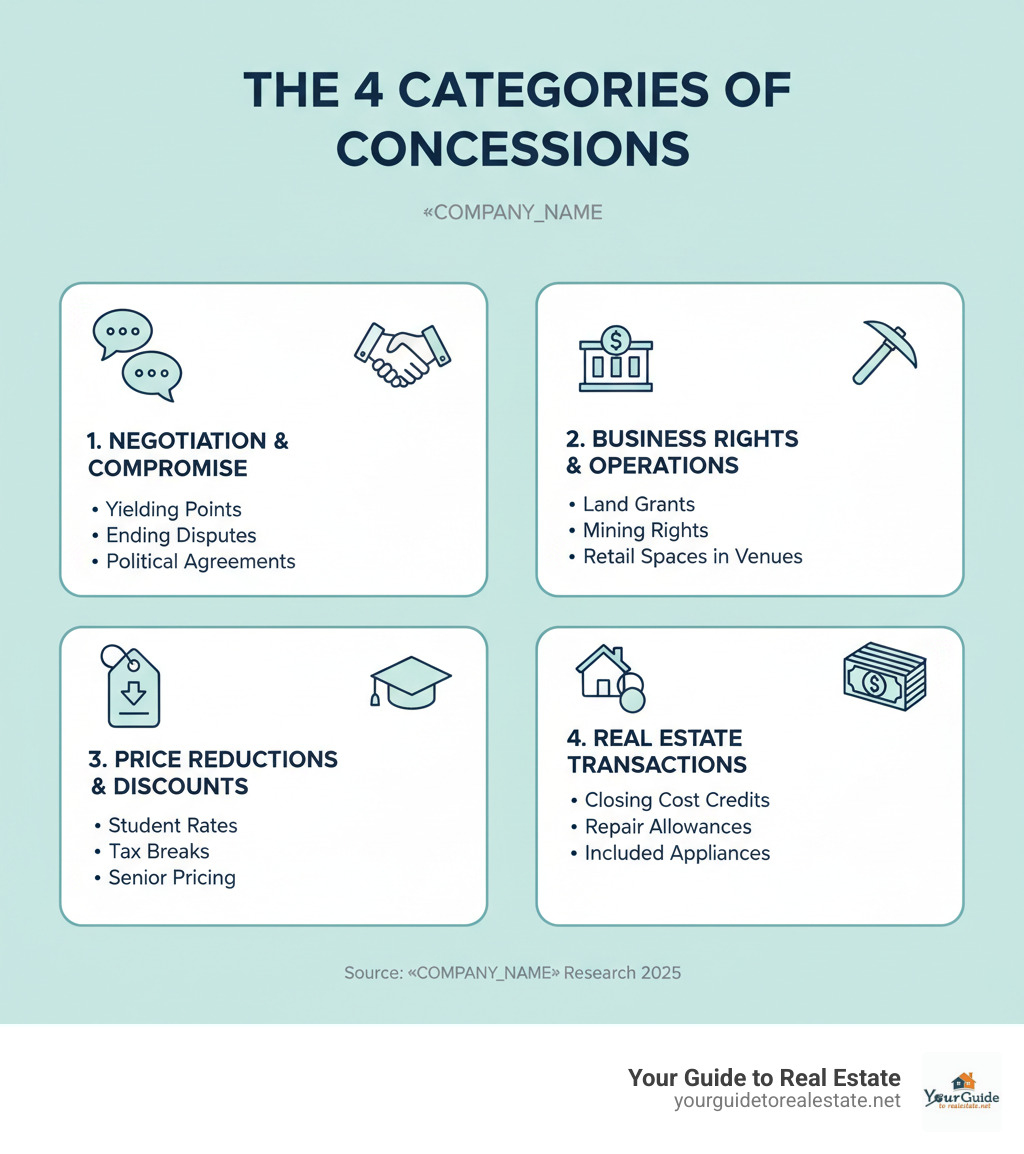
Basic concessions meaning glossary:
Understanding the Core Concessions Meaning
Let’s get to the heart of what concessions meaning really involves. At its simplest, a concession is about giving something up. One person or group decides to yield, to step back from their original position, usually to help reach an agreement or resolve a conflict.
Think about it this way: when you make a concession, you’re granting something to someone else. Maybe you’re admitting you were wrong in an argument. Maybe you’re giving someone permission to do something. Or maybe you’re formally acknowledging that they won and you lost. The thread that connects all these situations is movement – you’re shifting away from where you started.
The primary definition of concession centers on the act or instance of conceding. This could mean granting something as a right, accepting something as true, or acknowledging defeat. You see this play out in real life all the time. A union negotiates with management, pushing for better wages and benefits. Before they’ll sign on the dotted line, they might demand further concessions from the company. Or consider a political candidate on election night. When the votes are counted and they’ve lost, they deliver a concession speech – a formal acknowledgment that their opponent won and they’re stepping aside.
These examples show how versatile the term really is. It’s not just about simple agreements. It covers everything from everyday compromises to major public acknowledgments of defeat.
The word itself has been around for centuries. Concession comes from the Latin word concēssiō, which literally means “a yielding” or “a granting.” That comes from the verb concēdere – “to yield, to give up, to grant, to allow.” When you trace the word back to its roots, you can see why we use it in so many different situations today. Whether you’re talking about a business deal, a political negotiation, or a real estate transaction, that core idea of yielding or granting something always applies.

The Act of Yielding: Concession vs. Compromise
People often use concessions meaning and compromise as if they’re the same thing, but there’s actually a meaningful difference worth understanding.
A compromise happens when both sides adjust their positions to meet in the middle. It’s a true give-and-take situation where the final outcome blends elements from both original positions. Imagine you and your partner are deciding on dinner. You want Italian, they want Mexican. A compromise might be choosing a fusion restaurant or picking Thai food because you both enjoy it. Neither of you got exactly what you wanted, but you found a middle ground together.
A concession works differently. It’s when one side yields a specific point or grants a particular request to move things forward. Sometimes it’s a one-sided move to break a deadlock. Other times, several concessions get traded back and forth as part of a larger negotiation. The key is that someone is giving ground on something specific.
Here’s a real-world example: during labor negotiations, the company might make a concession on wages, offering a 4% raise instead of the 2% they initially proposed. That might lead the union to make a concession on scheduling flexibility. Each side is yielding on specific points, and together, those concessions create a broader compromise everyone can accept.
Sometimes a concession is simpler and more direct. If you’re in an argument and realize you’re wrong about something, admitting your mistake is a concession. You’re yielding your previous stance and acknowledging the other person was right.
The most dramatic example of conceding is probably the concession speech in politics. When a candidate loses an election, they deliver a speech formally acknowledging their opponent’s victory. They’re yielding their claim to office and accepting defeat. It’s a powerful moment that helps ensure peaceful transitions of power.
Etymology and Pronunciation
We’ve already touched on where concession meaning comes from, but it’s worth digging a bit deeper because the history of the word explains so much about how we use it today.
The word entered English through Old French concession, which came directly from Latin concēssiō – “a yielding” or “a granting.” That noun traces back to concēdere, the Latin verb meaning “to yield,” “to give way,” “to grant,” or “to allow.” This linguistic journey shows why the word works in so many contexts. Whether you’re discussing mining rights, student discounts, or selling your home, that core idea of granting or yielding something always applies.
As for saying the word correctly, it’s pretty straightforward. The pronunciation is [kənˈsɛʃən](https://blog.collinsdictionary.com/ipa-pronunciation-guide-ced/), with the stress falling on the second syllable – “CESS.” So it sounds like “kun-SESH-un.”
The good news is that British and American English pronounce it almost identically. Whether you’re negotiating a deal in New York or London, everyone will know exactly what you mean when you talk about concessions.
Concessions in Different Contexts
The beauty of understanding concessions meaning is seeing how it weaves through so many parts of our lives. Whether you’re watching a political debate, grabbing snacks at a baseball game, or reading about mining operations in another country, the word “concession” keeps showing up. And while the core idea of yielding or granting something stays the same, each context adds its own flavor to the definition.

What is the concessions meaning in negotiations?
When people sit down to negotiate, concessions become the currency of progress. In its simplest form, a concession in negotiations means one party agrees to relax their demands or grant something the other side wants. It’s how deals get done when both sides start far apart.
Labor negotiations show this perfectly. Picture a union asking for a 10% wage increase while management offers 2%. The back-and-forth that follows involves each side making concessions. Maybe the company moves to 5% but asks the union to concede on vacation days. The company has been unwilling to make concessions to the strikers becomes a headline when talks stall. But when progress happens, you’ll read that the strikers have won important concessions from the company.
Political agreements work the same way. World leaders make concessions to end conflicts. Lawmakers grant concessions to pass bills. The city has made some concessions, such as allowing homeless families to stay in shelters for longer, shows how this applies to local policy too. These aren’t signs of weakness. They’re strategic moves that help everyone move forward.
You’ll notice certain words always seem to travel with “concessions” in negotiations. People grant concessions, make concessions, or seek concessions. Adjectives like major, important, and key often appear right before the word, signaling just how significant these give-and-takes really are. Understanding this language helps whether you’re negotiating a business contract or learning More info about selling your home, where knowing how to negotiate terms can save you thousands.
Concessions in Retail and Public Venues
Now let’s shift gears to a completely different use of the word. When you’re at a stadium and someone says “let’s hit the concessions,” they’re not talking about anyone yielding anything. They’re talking about the concession stand where you buy your overpriced nachos and soda.
This concessions meaning refers to a business operating inside another venue under a special agreement. He runs a concession that sells hot dogs and hamburgers at the ballpark captures this perfectly. These stands exist everywhere people gather in large numbers: movie theaters, airports, concert halls, and sports arenas. Spectators spend an average of $5 per game on concessions, which explains why these little operations are so common.
The concept extends beyond food stands too. Think about that coffee shop tucked inside your local bookstore, or the cosmetics counter in a department store. A local butcher operates a concession in the large general food store demonstrates this “shop-in-shop” model. These businesses pay for the right to operate in that space, usually through a percentage of sales or a fixed rental fee.
Even outside retail, you’ll hear about companies winning concessions. The company has just won a mining concession in the north of the country uses the same principle. Someone granted them the right to operate in a specific location for a specific purpose. Whether it’s selling popcorn or extracting minerals, it’s about securing permission to do business in a defined space.

Legal and Governmental Concessions
When governments get involved, the concessions meaning becomes more formal and often involves significant resources. Here we’re talking about official grants of rights, privileges, or land from a government or authority to individuals or companies.
Land grants represent one major category. Governments might transfer ownership or usage rights for specific territories. Historically, this meant giving settlers land to develop. Today it often involves natural resources. Mining concessions and logging rights are huge examples. The Bolivian government has granted logging concessions covering 22 million hectares shows the massive scale these agreements can reach. Companies also receive grants for drilling for oil, which can reshape entire regional economies.
But concessions aren’t just about extracting resources from the ground. Governments also grant operating rights for public services. A private company might receive a concession to run a subway system, manage a toll road, or operate a public utility. The government plans to sell a 50-year concession to operate the southeastern rail line illustrates how infrastructure projects often work under these arrangements. It’s essentially a franchise agreement where a private entity takes on what’s traditionally been a public service.
The legal definition makes this clear: a concession is a grant of land or property by a government, or a right to undertake and profit by a specified activity. You can explore the technical details at CONCESSION. Understanding these legal frameworks matters whether you’re involved in large-scale development or simply trying to grasp your rights as a property owner. Much like getting First-Time Homebuyer Tips helps you steer your first purchase, knowing how governmental concessions work helps you understand the bigger picture of property rights and land use.
A Deep Dive into Real Estate Concessions
Now, let’s bring the concessions meaning closer to home – literally. In real estate, concessions are financial incentives or helpful perks that one party offers to another to make a deal work. Most often, you’ll see sellers offering these to buyers, though it can go the other way too. Think of them as sweeteners that help everyone get to the closing table with a smile.
These aren’t random acts of generosity. They’re smart negotiation tools that solve real problems. Maybe you’re a buyer who loves a house but worries about the upfront costs. Or you’re a seller who needs to move quickly and wants to make your property irresistible. That’s where concessions come in.
Seller concessions are the most common type. This is when the seller agrees to pay for things that would normally come out of the buyer’s pocket. We’re talking about closing costs, repair credits after an inspection reveals issues, or even throwing in a home warranty. Sometimes sellers will leave behind appliances or furniture that weren’t part of the original listing. These extras can make a huge difference, especially for first-time buyers who are already stretching their budget.
Buyer concessions happen too, though they’re less frequent. A buyer might agree to accept the home “as-is” without asking for repairs, or they might offer to close faster than the seller expected. In exchange, they might negotiate a lower purchase price or other favorable terms.
The beauty of concessions is how they solve problems without killing deals. Let’s say the home inspector finds a roof that needs work in five years. Instead of walking away, the buyer asks for a $5,000 credit at closing. The seller agrees. The deal moves forward, and everyone wins. The buyer gets money to address the issue later, and the seller doesn’t have to coordinate repairs while still living in the house.
Here’s a quick look at how seller concessions and buyer requests differ:
| Feature | Seller Concessions | Buyer Requests |
|---|---|---|
| Definition | Financial or non-monetary incentives from seller to buyer | Specific demands made by the buyer to the seller |
| Purpose | Facilitate sale, attract buyers, overcome objections | Improve deal terms, address concerns |
| Examples | Closing cost credits, repair credits, home warranty | Lower sales price, specific repairs, inclusion of items |
| Impact on Price | Sale price remains same (but net cost for buyer lower) | Directly lowers sale price |
| Timing | Typically negotiated after offer acceptance | Part of the initial offer or during inspection period |
Understanding these dynamics helps whether you’re buying your first home or selling your tenth. For sellers, offering concessions can bring in more qualified buyers, particularly those who might struggle with upfront costs. For buyers, securing concessions can mean the difference between affording a home and having to keep looking.
The Concessions Meaning in Real Estate Transactions
Let’s get specific about what real estate concessions actually look like in practice. The most popular type involves the seller paying some or all of the buyer’s closing costs. These costs – loan origination fees, title insurance, appraisal fees, attorney fees – can easily reach several thousand dollars. When a seller offers to cover them, it directly reduces the cash a buyer needs to bring to closing. This is huge for buyers who have saved up for a down payment but don’t have much left over for additional expenses.
The key thing to understand here is that this doesn’t change the home’s purchase price. If you’re buying a house for $300,000 and the seller agrees to pay $5,000 of your closing costs, you’re still buying a $300,000 house. But you’re bringing $5,000 less cash to the closing table. Your loan amount stays the same, but your immediate out-of-pocket expense drops significantly.
Repair credits are another major form of concession. After your home inspection (and you should always get one), you’ll likely have a list of issues that need attention. Maybe the water heater is ancient, or there’s evidence of a roof leak, or the HVAC system needs service. Instead of the seller actually fixing these things – which can lead to arguments about quality and timing – they often offer a credit at closing. This puts cash in your pocket after you take ownership, and you can handle the repairs on your own timeline with contractors you trust.
Some sellers will also purchase a home warranty for the buyer. This typically costs a few hundred dollars and covers major appliances and systems for the first year of ownership. It’s a relatively small expense for the seller but provides real peace of mind for a buyer worried about unexpected breakdowns.
Then there are the non-monetary concessions that still add real value. The seller might agree to leave behind the refrigerator, washer and dryer, or even some furniture pieces. While these don’t reduce your purchase price, they save you from having to buy these items immediately after moving in. For a buyer furnishing their first home, this can be a genuine lifesaver.
One important note: lenders typically limit how much sellers can offer in concessions, usually expressed as a percentage of the loan amount. These limits vary based on your loan type and down payment size. Your lender can tell you the specific caps that apply to your situation. This is part of why understanding Understanding Mortgages: A Beginner’s Guide to Home Loans matters so much – these financial details are all interconnected.
How to Negotiate Real Estate Concessions
Negotiating concessions is both an art and a science. Whether you’re buying or selling, success comes down to knowing what you want, understanding the market, and being willing to find middle ground.
If you’re buying a home, start by understanding your market conditions. In a buyer’s market where inventory is high and homes sit for months, you have more room to ask for concessions. Sellers are motivated, and they might welcome an offer even if it includes requests for help with closing costs or repairs. In a hot seller’s market, you’ll need to be more strategic. Focus on the issues that matter most rather than asking for everything under the sun.
Your home inspection is your best negotiating tool. This is where you find real problems that need addressing. Be specific in your requests. Don’t just say “the roof looks old” – point out the missing shingles and evidence of leaks that the inspector documented. Legitimate issues backed by professional inspection reports carry weight. But here’s the thing: asking for too many concessions, especially minor ones, can make you look unreasonable. Even if you’ve offered the highest price, a seller might accept a slightly lower offer from someone who isn’t nickel-and-diming them over every scuffed wall.
Think about what really matters to you. Do you desperately need help with closing costs because your savings are tight? Or is the bigger issue that the furnace is on its last legs? Prioritize your requests around your actual needs, not just because you can ask. Also consider the seller’s situation. Are they downsizing and need to move by a certain date? That urgency might make them more willing to offer concessions to ensure the deal closes on time.
If you’re selling a home, start by pricing it right for your market. A competitively priced home attracts more offers, which reduces pressure on you to grant large concessions. Consider getting your own pre-listing inspection. This lets you find and fix major issues before buyers see them, or price the home accordingly from the start. Either way, you avoid surprise requests during negotiations that could derail your deal.
Know your bottom line before you start negotiating. What’s the minimum amount you need to walk away with after the sale? Factor in potential concessions when you set your asking price. If you’re willing to pay up to $5,000 in closing costs for the right buyer, price accordingly. Sometimes offering a small concession strategically – like a home warranty that costs you $500 – can make a buyer feel valued and secure your deal without significantly affecting your proceeds.
Negotiations are business, not personal. When a buyer asks for repairs or credits, they’re not insulting your home. They’re trying to make the numbers work for their situation, just like you’re trying to make the sale work for yours. Stay flexible, communicate clearly, and look for solutions that let both sides feel good about the deal.
This whole negotiation process ties directly into Home Contingencies Complete Guide, because most concession requests arise from inspection or appraisal contingencies. Understanding how these pieces fit together gives you confidence as you steer your transaction.
Specific Types and Regional Variations
The concessions meaning is wonderfully flexible, adapting to different situations while keeping that core idea of granting or yielding at its heart. You’ll find it popping up in everything from your tax bill to old land records, and the way people use it can change depending on where you are in the world.
Financial Discounts: Tax and Student Concessions
One of the most practical ways the concessions meaning shows up in daily life is through financial discounts. These aren’t random acts of generosity. They’re strategic decisions by governments and businesses to make services more accessible or to encourage certain behaviors.
Think about tax concessions first. Governments regularly offer these “tax breaks” to businesses and individuals. Maybe they want to attract foreign investment, or perhaps they’re trying to support non-profit organizations doing good work in the community. Tax concessions will be made available to non-profit organizations to help them fulfill their missions, for instance. These concessions reduce what you owe, essentially granting you a financial advantage that others might not receive.
Student concessions are another everyday example. If you’ve ever been a student, you’ve probably flashed that student ID for a discount. Public transport fares, museum entry fees, movie tickets, even software subscriptions often come with special student rates. You might see something like “Tickets are £3; there is a £1 concession for students” at a local attraction. It’s a recognition that students typically have tighter budgets and deserve a break.
Senior citizens get similar treatment, particularly in British English where they’re often called OAPs (Old Age Pensioners). Travel concessions are available to older people on buses and trains, and you’ll frequently see reduced admission prices at events and attractions. A sign might read “Admission £1.10 with concessions for children and OAPs,” welcoming families and retirees with more affordable access.
The beauty of these reduced ticket prices extends beyond just students and seniors. Many railways offer fare concessions for passengers with disabilities, ensuring that everyone can access public services regardless of their circumstances. These concessions function as a form of societal support, making essential goods and services more equitable for everyone.
Regional Variations in Usage
Here’s where things get interesting. While the core concessions meaning stays consistent, how people actually use the word can vary quite a bit depending on where you are.
In British English, when someone mentions “concessions,” they’re most likely talking about special lower prices. If you’re at a cinema in London and see “concessions available,” that’s your cue to check if you qualify for a discount. Student concessions, OAP concessions, child concessions—these phrases are part of everyday British vocabulary. It’s such a common usage that most Brits wouldn’t even think twice about it.
Cross the Atlantic, and American English usage shifts slightly. Americans certainly understand the discount meaning, but they’re more likely to associate “concession” with that beloved snack bar at the ballpark or movie theater. Tell an American “I’m heading to the concession,” and they’ll picture you grabbing popcorn and a soda. The term also gets used frequently for business arrangements, like when a company wins a concession to operate a specific service or facility. It’s less about ticket discounts and more about physical spaces and business rights.
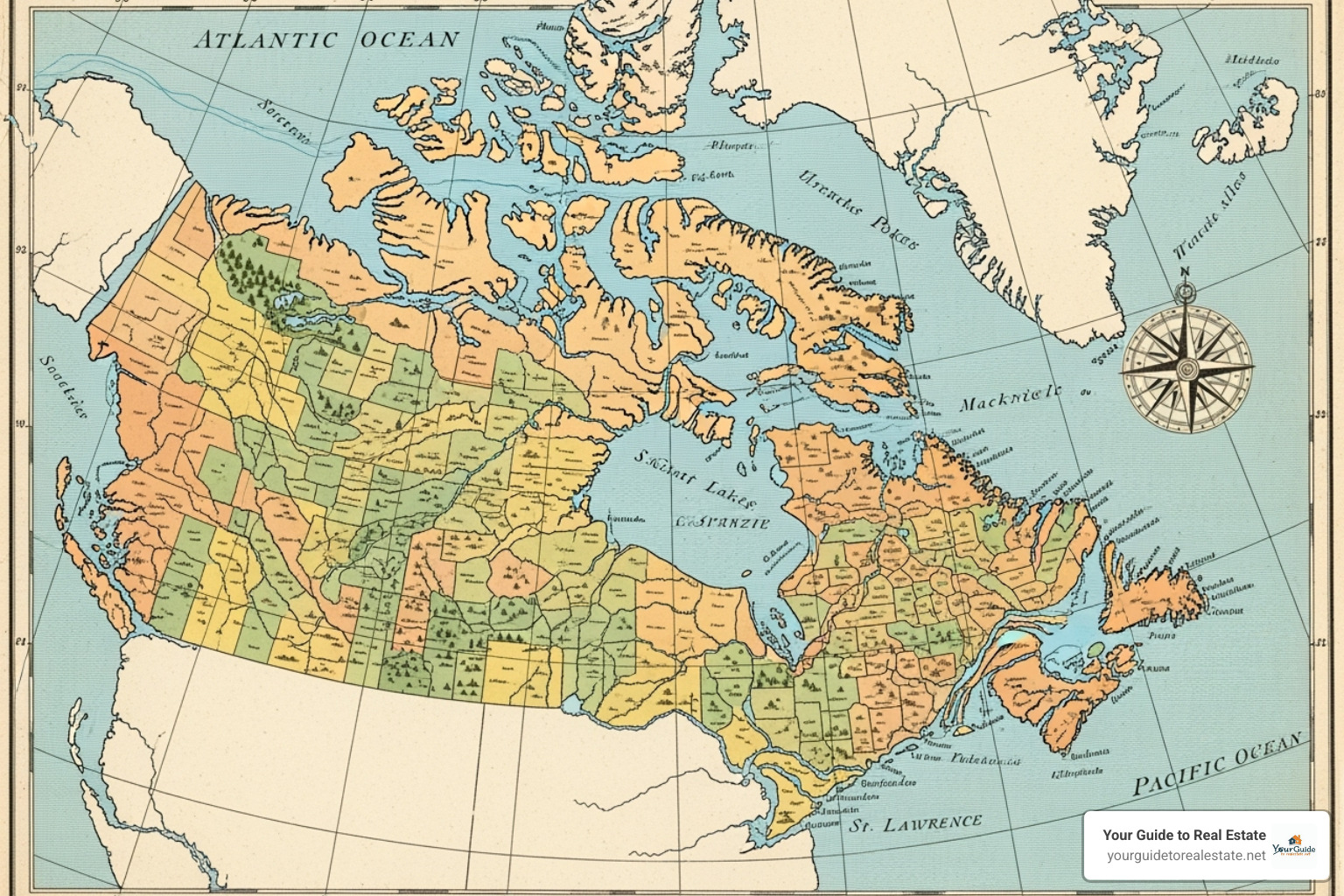
Canadian English throws in a fascinating historical twist. Up in Canada, particularly when you’re looking at older land records or rural areas, a “concession” can refer to an actual division of land. These were systematic land grants given to settlers, creating a grid system for farming communities. You might hear about a family farm located on “Lot 4, Concession 4” within a township. These concessions were typically rectangular strips, sometimes covering 10 square miles (26 sq. km), divided into 200-acre lots. It’s a unique usage that reflects Canada’s history of organized settlement and land distribution.
These regional differences don’t make the word confusing. They actually enrich it, showing how a single term can adapt to local history and culture while keeping that fundamental sense of something granted or yielded. Whether you’re getting a student discount in Britain, buying popcorn in America, or finding an address in rural Canada, you’re experiencing different facets of the same core concept.
Frequently Asked Questions about Concessions
We know that wrapping your head around all the different ways concessions meaning applies in real estate can feel overwhelming. You’re not alone in wondering how this all works in practice. Let’s walk through some of the most common questions that come up when buyers and sellers are working through their deals.
What is the most common type of concession in real estate?
If we had to pick the single most common concession you’ll encounter, it’s hands down seller concessions that cover the buyer’s closing costs. These are real money from the seller that goes directly toward paying those pesky fees that pile up at closing – things like loan origination charges, title insurance, appraisal fees, and prepaid property taxes. For many buyers, especially those buying their first home, scraping together both the down payment and several thousand dollars in closing costs feels nearly impossible. When a seller offers to chip in on those costs, it can be the difference between getting the keys or walking away.
The other type of concession that shows up constantly? Repair credits after a home inspection. Picture this: you’ve made an offer, it’s been accepted, and then the inspector finds issues with the roof or the HVAC system. Instead of the seller hiring contractors and managing repairs themselves (which can drag on for weeks), they’ll often just give you a credit at closing. You get the money, you handle the repairs after you move in, and everyone moves forward without the headache.
Now, here’s something important to know: there are limits on how much sellers can offer in concessions. Lenders set these rules, usually as a percentage of your loan amount or the purchase price. For a conventional loan, you might see limits anywhere from 3% to 9% depending on your down payment size. FHA and VA loans have their own rules too. These limits exist to prevent situations where someone inflates the sale price just to funnel more money back to the buyer through concessions.
Is a price reduction the same as a concession?
This question comes up all the time, and it’s a smart one to ask because the answer affects your wallet in different ways.
A price reduction means the seller is lowering the actual sale price of the home. Let’s say you’re looking at a house listed for $300,000, and the seller agrees to drop it to $290,000. That’s a straight-up price cut. Your mortgage will be based on that lower number, which means smaller monthly payments and less interest paid over the life of your loan.
A concession works differently. Using that same $300,000 house, imagine the seller offers you a $5,000 credit toward your closing costs. The sale price stays at $300,000. Your loan is still for $300,000 (assuming you’re putting down the same amount either way). But when you sit down at the closing table, you’re getting $5,000 from the seller to help cover those upfront costs.
The big difference? Price reductions lower what you borrow, while concessions lower the cash you need right now. If you’re stretched thin on savings but can handle the monthly payments, a concession might actually help you more than a price reduction of the same amount. On the flip side, if you’ve got cash to spare but want to keep your monthly payments low, push for that price reduction instead.
Can a buyer ask for too many concessions?
Oh yes, you absolutely can overdo it. We’ve seen it happen, and it rarely ends well for the buyer who goes overboard.
Here’s the thing: asking for concessions is totally normal and expected in real estate. But when you start piling on request after request – fix this, credit me for that, throw in the appliances, pay all my closing costs, and oh, can you replace the carpet too? – you risk turning off the seller completely. In a market where the seller has multiple offers to choose from, they’ll often go with the buyer who seems easiest to work with, even if that offer is slightly lower than yours.
Excessive demands can make you look unreasonable, plain and simple. The seller might start wondering if you’re going to be difficult through the entire process. Will you demand more changes after the appraisal? Will you try to renegotiate again before closing? These worries can push them toward another buyer.
The smart approach? Focus on what really matters. If the inspection revealed a cracked foundation or a failing septic system, absolutely ask for concessions to address those major issues. If you’re genuinely short on cash for closing, it’s reasonable to ask the seller to help with those costs. But asking for money to repaint the bedroom in your favorite color or replace perfectly functional light fixtures you just don’t like? That’s pushing it.
A good real estate agent will help you figure out what’s reasonable based on the local market, the condition of the property, and how motivated the seller seems. The goal is to protect your interests and get a fair deal without torpedoing the whole transaction by asking for too much. The best negotiation is one where both sides walk away feeling okay about the outcome.
Conclusion
So, what have we learned about concessions meaning? Well, it turns out this one word carries a lot more weight than you might expect. It’s not just about giving in or backing down – though that’s certainly part of it. It’s about finding pathways to agreement, creating opportunities, and making things possible that otherwise might not be.
Think about where we’ve been together. We started with the basic idea of yielding – that fundamental act of stepping back from a position to let something else happen. We saw how this plays out in heated negotiations between labor and management, where making concessions can mean the difference between a prolonged strike and a fair contract. We watched politicians make concessions to forge alliances and pass legislation that moves everyone forward.
Then we shifted gears and finded concessions in completely different contexts. The concession stand at your favorite ballpark? That’s a granted business right. The student discount on your movie ticket? That’s a financial concession. Even the historical division of Canadian townships into rectangular land plots involved concessions. The same word, adapted to fit so many different needs.
But for anyone thinking about buying or selling a home, the real estate application of concessions meaning is where things get personal. We’ve seen how seller concessions – whether covering closing costs or providing repair credits – can transform an impossible deal into a done deal. These aren’t just numbers on paper. They’re the difference between a first-time buyer making it to closing day or having to wait another year. They’re the tool that lets a seller move their property in a tough market without simply slashing the price.
Understanding concessions gives you power. When you know what’s possible, what’s reasonable, and what’s strategic, you can approach any real estate transaction with confidence instead of confusion. You can ask for what you need without overreaching. You can offer what makes sense without giving away the farm.
At Your Guide to Real Estate, we’re all about giving you that kind of practical knowledge. The real estate market doesn’t have to be intimidating or overwhelming. When you understand concepts like concessions – how they work, when to use them, and what they really mean for your bottom line – you’re already ahead of the game.
Whether you’re buying your first home, selling a property you’ve loved for years, or just trying to understand the language of real estate, knowing about concessions is essential. It’s part of being an informed participant in what’s likely the biggest financial transaction of your life.
Ready to take the next step? Understanding your property’s true market position is crucial before you even start thinking about what concessions to ask for or offer. Perform a competitive market analysis for your property to see where you stand and what strategies might work best for your unique situation. Knowledge is power, and in real estate, it’s also profit.