

Gaining Your Unfair Advantage
A competitive product analysis report is a systematic evaluation of your competitors’ products and strategies. It helps you identify market opportunities and inform your business decisions. Key components include:
- Competitor identification – Direct and indirect competitors.
- Product feature comparison – Side-by-side analysis of offerings.
- Pricing strategy analysis – How competitors price their products.
- Marketing approach evaluation – Channels, messaging, and tactics.
- SWOT analysis – Strengths, weaknesses, opportunities, and threats.
- Market gap identification – Unmet customer needs.
Imagine launching a new tool only to find a competitor beat you to market with the same features. This happens more often than you’d think. Research shows 79% of retail companies use competitive analysis, reporting 12-15% faster response times to market changes. The companies that win are those who understand their competitive landscape inside and out.
Whether you’re in real estate technology or property management, knowing what competitors are doing (and missing) gives you a strategic advantage. A well-executed analysis helps you avoid costly mistakes, find market opportunities, and position your offerings for maximum impact.
What is a Competitive Product Analysis and Why is it Crucial?
A competitive product analysis report is a business intelligence tool for systematically examining competitors’ offerings—their features, pricing, strengths, and weaknesses. This isn’t about copying; it’s strategic reconnaissance to see how your products measure up. By understanding the market, you can spot gaps that need filling, identify opportunities, and make data-driven decisions instead of relying on hunches. This saves time, money, and prevents “why didn’t we see that coming?” moments.
For anyone in real estate, this market intelligence is essential. Understanding your competitive landscape impacts your growth, whether you’re creating content or developing tools. Learn more about building a thriving business with our guide on real estate business growth.
The Importance for Your Business Strategy
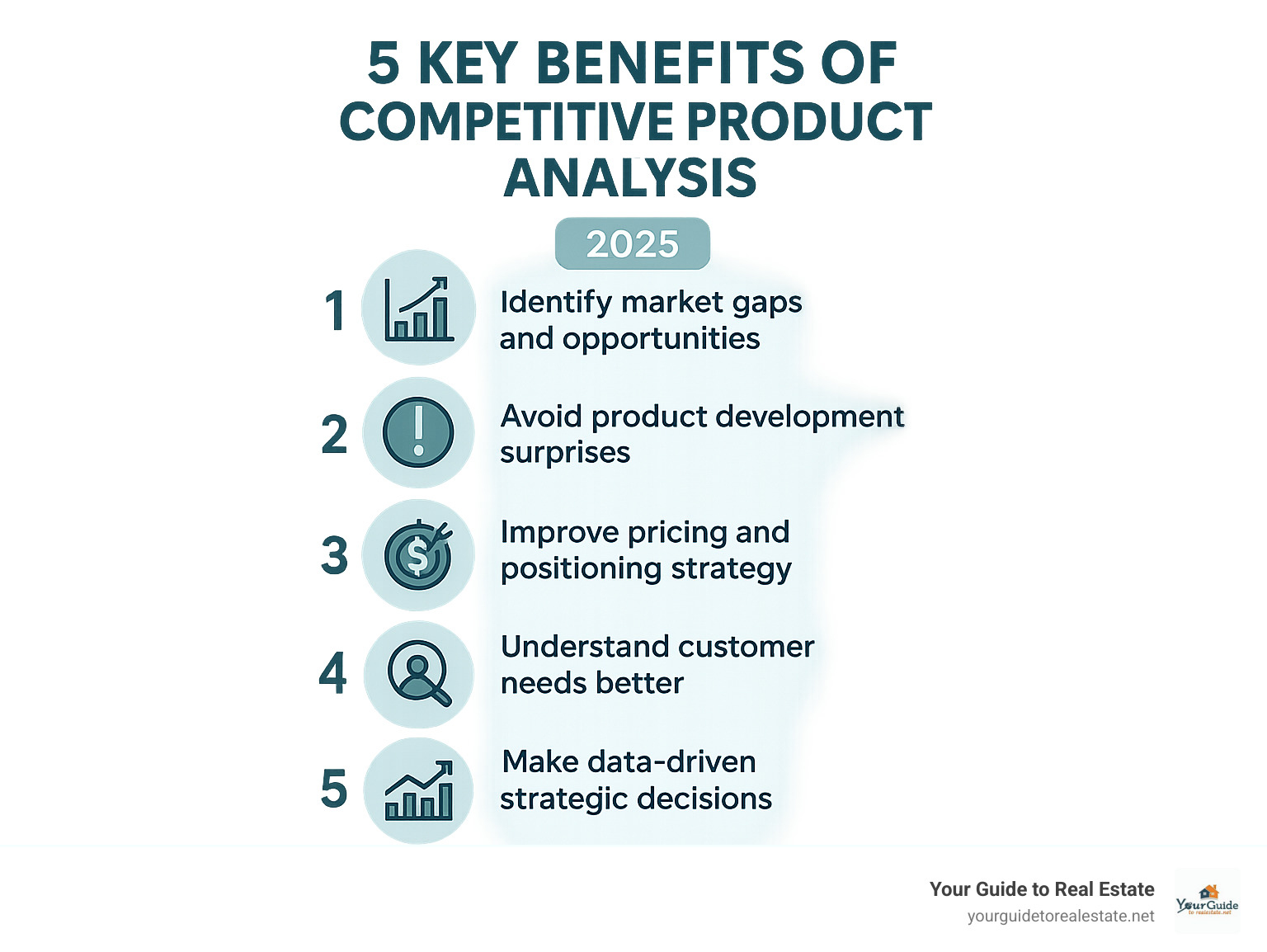
A competitive analysis is crucial for your strategy. It helps you:
- Gain market share: By understanding competitor vulnerabilities, you can position your offerings to resonate with customers.
- Avoid surprises: Regular analysis helps you stay ahead of competitor moves and act proactively.
- Sharpen marketing: Knowing how competitors position themselves helps you craft messaging that highlights your unique advantages.
- Improve pricing strategy: Seeing how others structure their prices helps you find the sweet spot between competitive and profitable.
- Understand customer needs: Competitor reviews are a goldmine of information about what customers want.
The real estate industry is evolving rapidly. Stay current with the latest developments by exploring our insights on How Technology Is Revolutionizing Real Estate: 2025 Trends to Watch.
Product vs. General vs. UX Competitive Analysis
Not all analyses are the same. Choosing the right type is key:
- Product competitive analysis (our focus) zeroes in on offerings, examining product features, pricing, and value propositions.
- General competitive analysis takes a broader view of the entire business model, including marketing, sales, and company positioning.
- UX competitive analysis focuses on the user experience, examining user flow, navigation, and overall usability.
While each serves a different purpose, they work best together for a holistic view. Understanding the scope difference helps you focus your efforts where they’ll have the most impact.
How to Conduct a Thorough Competitive Product Analysis in 6 Steps

Creating a thorough competitive product analysis report is a manageable process when broken down into clear steps. We’ve simplified it into a six-step guide to help you understand your competitive landscape.
Step 1: Define Your Scope and Identify Competitors
First, clarify your goals. Are you launching a new product or improving an existing one? Next, identify your competitors. This includes:
- Direct competitors: Businesses with nearly identical products.
- Indirect competitors: Those solving the same problem differently (e.g., a mentor vs. a course).
- Substitute products: The free or simple solutions customers currently use (e.g., a spreadsheet).
Start with three to five key competitors to avoid being overwhelmed by data. Our competitive analysis template can help you get started.
Step 2: Gather Comprehensive Data
Now for the detective work. Collect information from various sources:

- Experience their products: If possible, buy their products or sign up for their services for first-hand insights.
- Read customer reviews: Sites like G2 and Capterra offer honest feedback on strengths and weaknesses.
- Monitor social media: Check LinkedIn, Reddit, and forums for unfiltered opinions.
- Analyze their website: Their pricing pages and marketing copy reveal their positioning strategy.
- Examine their sales process: Sign up for a demo to understand how they convert prospects.
Tools like SEMrush or Ahrefs can provide deeper insights into their web traffic and content strategies. For more on market research, see our guide on valuation and market analysis in real estate.
Step 3: Analyze Key Product Components and Marketing
Organize your data to tell a story. A feature matrix is a great tool for this—a table comparing your product against competitors on key features. This visual makes it easy to spot where you lead or lag.
Analyze their pricing models (e.g., subscription, one-time purchase), user experience (e.g., onboarding, support), and marketing and messaging. What is their unique value proposition? How do they communicate it? Understanding their brand voice and positioning (e.g., budget, premium) helps you find your own space in the market.
Step 4: Use a SWOT Analysis to Synthesize Findings
SWOT analysis (Strengths, Weaknesses, Opportunities, Threats) helps organize your findings into a clear picture of where you stand.
- Strengths: Your internal advantages (e.g., better features, superior support).
- Weaknesses: Internal areas for improvement (e.g., higher price, missing features).
- Opportunities: External factors to capitalize on (e.g., unmet customer needs).
- Threats: External challenges (e.g., a new competitor, market shifts).
This framework provides a realistic foundation for your strategic decisions.
Step 5: Identify Market Gaps and Your Unique Position
This is where analysis reveals hidden opportunities. Look for unmet customer needs in reviews and feedback. What are people complaining about? These are your product development cues.
Identify underserved niches—segments of the market that current offerings don’t serve well. The goal is to find your differentiation opportunities, a unique space where you can be genuinely better. This isn’t about copying others; it’s about finding what they’re missing. For more on this, see our guide on how to do a competitive market analysis real estate.
Step 6: Create and Present Your Findings
Your research only matters if it leads to action. Create a report that your team will actually use.
- Start with an executive summary of the most important insights.
- Include competitor profiles and your detailed analysis (feature matrix, pricing, etc.), using visuals like charts and tables.
- Present your SWOT analysis.
- Conclude with key insights and recommendations for specific actions.
Ensure your report is data-driven and consistent across all competitors. A great analysis becomes your roadmap for gaining an unfair advantage.
The Core Components of a Competitive Product Analysis Report

A competitive product analysis report is your strategic blueprint, changing raw data into actionable intelligence. It should tell a clear story about your market position and guide your next steps.
How to Structure Your Competitive Product Analysis Report
A well-organized report follows a logical flow. As discussed in the previous section, your structure should guide the reader from a high-level overview to specific, actionable recommendations. Key elements include an executive summary, competitor overview, feature comparison, marketing analysis, SWOT analysis, and actionable recommendations.
Best Tools and Resources for Your Analysis
The right tools make your analysis more efficient. Consider using:
- SEO and traffic analysis tools (e.g., Ahrefs, SEMrush) to understand competitor marketing strategies.
- Review platforms (e.g., G2, Capterra) for honest customer sentiment.
- Social listening tools (e.g., Mention) to track brand conversations online.
- Google Trends to see what topics are gaining or losing interest.
- Template and workflow tools to keep your analysis organized.
Combining multiple tools provides a more complete picture of the competitive landscape.
Common Challenges in Creating a Competitive Product Analysis Report
Creating a report has its challenges. Being aware of them helps you steer the process more effectively:
- Finding accurate data: Competitors aren’t always transparent. You’ll need to piece together information from multiple sources.
- Confirmation bias: It’s easy to look for data that confirms your existing beliefs. Actively seek contradictory evidence.
- Analysis paralysis: Too much data can be overwhelming. Focus on insights that directly relate to your objectives.
- Keeping reports current: Markets move fast. Schedule regular reviews to keep your analysis relevant.
Successful teams acknowledge these challenges and build processes to address them. Your analysis doesn’t need to be perfect—it just needs to be good enough to guide smart decisions.
Frequently Asked Questions about Competitive Product Analysis
Here are answers to the most common questions about creating a competitive product analysis report.
How often should you update a competitive product analysis?
Your analysis isn’t a one-time project. The frequency of updates depends on your market’s pace:
- The annual deep dive: A comprehensive review to see the big picture.
- Quarterly refreshes: Lighter updates to stay current on key competitors.
- Trigger events: Immediate analysis following a major competitor launch, a new market entrant, or before your own big move.
Staying proactive means you see market shifts coming instead of reacting to them.
What are the main limitations of a competitive product analysis?
Even a great analysis has blind spots. Be aware of these limitations:
- You’re looking in the rearview mirror. The data shows what competitors have done, not what they’re planning.
- Information gaps are inevitable. You won’t have access to internal data like roadmaps or retention rates.
- The imitation trap is real. The goal is to find your unique position, not to become a clone of your competitors.
- Features aren’t everything. A competitor with fewer features might solve the core customer problem better.
Use your analysis as one important input, balanced with your own customer research and strategic vision.
What is the difference between a competitive product analysis and a CMA in real estate?
This is a common question in real estate. While both involve market analysis, they serve different purposes.
- A competitive product analysis report is for business strategy. It helps a real estate education company or software business understand competing businesses by comparing their products, pricing, and marketing.
- A Comparative Market Analysis (CMA) is for property valuation. Real estate agents use it to determine a specific property’s worth by comparing it to similar, recently sold homes.
In short, one is for improving your business, and the other is for pricing a property. For more on property-focused analysis, see our guide on Competitive Market Analysis Real Estate.
Conclusion: Turning Analysis into Action
A competitive product analysis report is more than just a document; it’s a roadmap for action. The real value comes from turning insights about your competitors into concrete steps for your business.
Strategic implementation is key. When your analysis reveals an overlooked niche or a competitor’s weakness, it’s an opportunity to be seized. This process empowers you to make data-driven decisions instead of guessing what might work. It also fosters a cycle of continuous improvement, keeping you ahead of market shifts rather than reacting to them.
At Your Guide to Real Estate, this approach is fundamental. We constantly analyze the real estate education space to ensure our proven framework and stress-free guidance truly stand out.
Gaining a competitive edge isn’t about copying others; it’s about understanding the landscape to find your unique path. Use your findings to refine your service offerings, sharpen your marketing messages, and position yourself for the biggest impact. When you know how you’re different and better, your entire business becomes more effective.
Ready to put these insights to work? The knowledge you’ve gained is just the beginning. Master your market with our expert real estate analysis guides and learn how to apply these skills to achieve real success in today’s market.