
Why Understanding Earnest Money Matters for Your Home Purchase
Does earnest money go towards closing costs? Yes, earnest money is typically applied as a credit towards your total amount due at closing. It’s first applied to your down payment, and any remaining amount goes towards your closing costs. In most cases, you don’t receive it back as cash—it reduces what you owe.
Quick Answer:
- Earnest money = 1-3% of home price (can be 5-10% in competitive markets)
- Held in escrow by a neutral third party until closing
- Applied at closing to reduce your cash needed
- Refundable if you back out for reasons covered by contract contingencies
- Not refundable if you back out without a valid reason
When you’re buying a home, understanding where your money goes can feel overwhelming. You’ve made an offer, written a check for earnest money, and now you’re wondering if you’ll see that money again—or if it just disappears into the real estate process.
The good news? Your earnest money doesn’t vanish. It’s a good-faith deposit that shows the seller you’re serious about buying their home. Think of it as a down payment on your down payment. It proves you’re committed and gives the seller confidence to take their home off the market while you finalize financing and inspections.
At closing, this deposit becomes a credit that reduces the total amount of cash you need to bring to the table. It’s applied first to your down payment, and if there’s anything left over, it goes towards your closing costs—things like title insurance, attorney fees, and lender charges.
The key is understanding when you can get it back if something goes wrong, and how it’s applied when everything goes right.
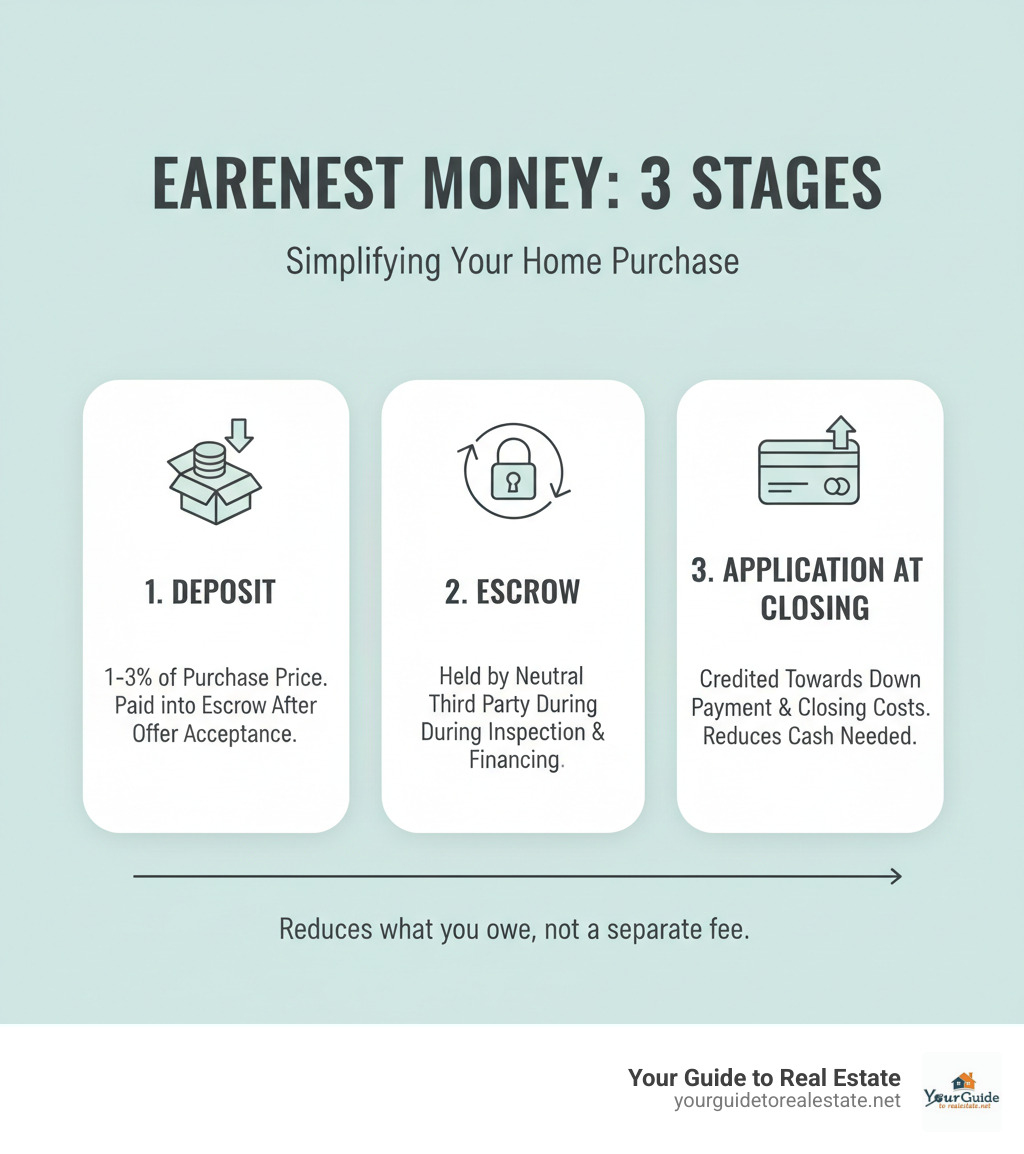
Simple guide to does earnest money go towards closing costs:
Understanding Earnest Money: Your Good-Faith Deposit
So you’ve found the perfect home—the one with the kitchen you’ve been dreaming about and the backyard where you can already picture summer barbecues. You’re ready to make an offer, and suddenly your real estate agent mentions “earnest money.” What exactly is that, and why does it matter?
Think of earnest money as your way of saying, “I’m not just browsing—I really want this house.” It’s a good-faith deposit that proves to the seller you’re serious about buying their home. This isn’t just a formality; it’s a financial commitment that sets your offer apart from someone who might be casually testing the waters.
Here’s why sellers care so much about this deposit: When they accept your offer, they’re taking their home off the market. That means they’re turning away other potential buyers who might be interested. They’re betting on you to follow through. If you were to back out without a valid reason, they’d have to start the whole process over—and they might have lost other great offers in the meantime.
Your earnest money deposit gives the seller confidence that you’re committed. It shows you have skin in the game right from the start. In competitive markets, a solid earnest money deposit can actually make your offer more attractive than others, even if the offer prices are similar. Sellers know that buyers who put down meaningful earnest money are more likely to see the deal through to closing.
This deposit isn’t just about protecting the seller, though. It’s a crucial first step in the home buying process that sets everything else in motion. For first-time buyers who are navigating these waters for the first time, understanding how earnest money works is essential. Our First-Time Homebuyers Toolkit: Everything You Need to Know Before You Buy can walk you through all these foundational concepts.
Earnest Money vs. Down Payment: What’s the Difference?
One of the most common questions we hear is: “Wait, isn’t earnest money the same as my down payment?” It’s an understandable mix-up—after all, you’re putting money down in both cases. But these two payments serve completely different purposes and happen at different times in your home purchase journey.
Earnest money is your initial deposit that shows you’re serious. It’s typically a small deposit—usually between 1% and 3% of the home’s purchase price—that you pay shortly after your offer is accepted. This money gets held in an escrow account by a neutral third party (not the seller) until closing. The key thing to remember is that earnest money is generally refundable if you back out for reasons covered by your contract contingencies, like a failed home inspection or financing falling through.
Your down payment, on the other hand, is a much larger chunk of money—often anywhere from 3% to 20% or more of the purchase price. This is money required by your lender to secure your mortgage, and it’s paid at closing when you officially become the homeowner. Unlike earnest money, your down payment is non-refundable because it becomes part of your equity in the home.
| Feature | Earnest Money | Down Payment |
|---|---|---|
| Purpose | Shows good faith and commitment to the seller. | A portion of the home’s purchase price, required by lenders to secure financing. |
| Amount | Typically 1-3% of the purchase price (can be higher in competitive markets). | Usually a much larger percentage, ranging from 3% to 20% or more of the purchase price. |
| Timing | Paid shortly after the purchase agreement is signed. | Paid at closing, when the property officially transfers ownership. |
| Refundability | Generally refundable if the buyer backs out due to a valid contingency in the contract. | Non-refundable; it’s part of the purchase price and equity in your home. |
| Application | Held in escrow, then applied as a credit towards your down payment and/or closing costs at closing. | Directly applied to the home’s purchase price, reducing the amount you need to borrow. |
Here’s the good news: does earnest money go towards closing costs? Absolutely! Your earnest money doesn’t just disappear into the real estate void. At closing, it’s applied as a credit that reduces the total cash you need to bring. It typically goes toward your down payment first, and if there’s any left over, it’s applied to your closing costs—things like title insurance, attorney fees, and lender charges.
So while they’re different payments with different purposes, they work together to get you into your new home. For a more detailed comparison that breaks down all the nuances, take a look at our guide on Earnest Money vs. Down Payment: What You Need to Know.
The Nuts and Bolts of Your Earnest Money Deposit
Now that we understand what earnest money is and how it differs from a down payment, let’s get into the practical details of how much you’ll need and how it’s handled.

How Much Earnest Money is Required?
The amount of earnest money you’ll need isn’t carved in stone. It’s actually negotiable between you and the seller, though there are some common guidelines that most buyers and sellers follow.
In most markets, you can expect to put down 1% to 3% of the home’s purchase price as earnest money. So if you’re buying a $300,000 home, that’s somewhere between $3,000 and $9,000. Not exactly pocket change, but it’s manageable for most buyers who are already preparing for a down payment.
But here’s where things get interesting. In competitive markets—think multiple offers, bidding wars, and homes selling within days—sellers often expect more. In these hot markets, earnest money deposits can jump to 5% or even 10% of the purchase price. Why? Because a larger deposit signals to the seller that you’re really serious and less likely to back out. When there are five other offers on the table, that extra commitment can make your offer stand out.
Sometimes, particularly with lower-priced homes or in certain local markets, you might see a fixed earnest money amount instead of a percentage. A seller might simply request $5,000 regardless of whether the home is $200,000 or $250,000.
Your real estate agent will be your best resource here. They know your local market conditions and can advise you on what’s competitive without putting you at unnecessary financial risk.
How is Earnest Money Paid and Where is it Held?
Once you’ve agreed on an amount, you’ll need to actually hand over the money. But don’t worry—there’s a very specific (and safe) process for this.
When it comes to payment methods, you have a few options. Most commonly, buyers pay earnest money by certified check, wire transfer, or sometimes a personal check. While personal checks might be accepted in some cases, certified checks and wire transfers are usually preferred because they clear faster and provide immediate verification of funds. If you’re wiring the money, be extra cautious. Scammers love to intercept wire transfer instructions, so always verify the wiring details directly with the escrow agent by phone—never rely solely on emailed instructions.
Now here’s the most important part: you never pay the seller directly. Never. Your earnest money goes into an escrow account managed by a neutral third party. This is a huge protection for you.
The escrow agent—which could be a title company, a real estate brokerage, an escrow company, or even a real estate attorney’s office—holds your money safely until closing. Think of them as the referee in the transaction. They make sure nobody can touch that money inappropriately. The seller can’t grab it and run, and you can’t change your mind and pull it back without a valid reason.
This escrow arrangement protects both parties. It gives you time to complete your home inspection, secure your financing, and make sure everything checks out with the property. Meanwhile, the seller has confidence that you’re financially committed and the funds are available when it’s time to close. Our guide on Understanding Escrow Process explains this protective mechanism in more detail, including how title and escrow services work together to keep your transaction secure.
The bottom line? Your earnest money is safe in escrow, and yes, does earnest money go towards closing costs at the end? Absolutely—it’s credited back to you at closing, reducing the total cash you need to bring to finalize your home purchase.
So, Does Earnest Money Go Towards Closing Costs at the End of the Day?
Here’s the answer you’ve been waiting for: Yes, your earnest money absolutely does go towards closing costs! Even better, it’s not an extra fee that vanishes into thin air. Instead, it’s a credit that reduces the total amount of cash you need to bring when you sit down at the closing table.
Think of your earnest money as a head start on your final payment. You’re essentially prepaying a portion of what you’ll owe, and that money stays yours throughout the entire transaction. It’s just held safely in escrow until everything is finalized.
When closing day arrives and the deal goes smoothly, your earnest money deposit is applied as a credit to your financial obligations. The way it works is pretty straightforward, but the order matters.
Your earnest money is first credited towards your down payment. Let’s say you need to put down $20,000 and you’ve already deposited $5,000 in earnest money. At closing, you’d only need to bring $15,000 for your down payment because that initial $5,000 has already been credited to your account.
Then, any remaining earnest money goes towards your closing costs. This scenario happens more often than you might think. If you’re using a VA or USDA loan that requires no down payment, or if you’re putting down a very small percentage, your entire earnest money deposit will be applied to closing costs like appraisal fees, loan origination fees, title insurance, attorney fees, and all those other expenses that pop up at settlement.
In some cases, you might even get a refund. It’s not super common, but it can happen. If your earnest money combined with other credits—like seller concessions or lender credits—exceeds your total down payment and closing costs, you could actually walk away from closing with a check in your hand. Most buyers plan things so their earnest money covers a portion of their final costs, but it’s nice to know a refund is possible. Speaking of seller concessions, understanding how they work can really benefit your bottom line. Check out our guide on What are Seller Concessions? to see how they might reduce your out-of-pocket expenses even further.
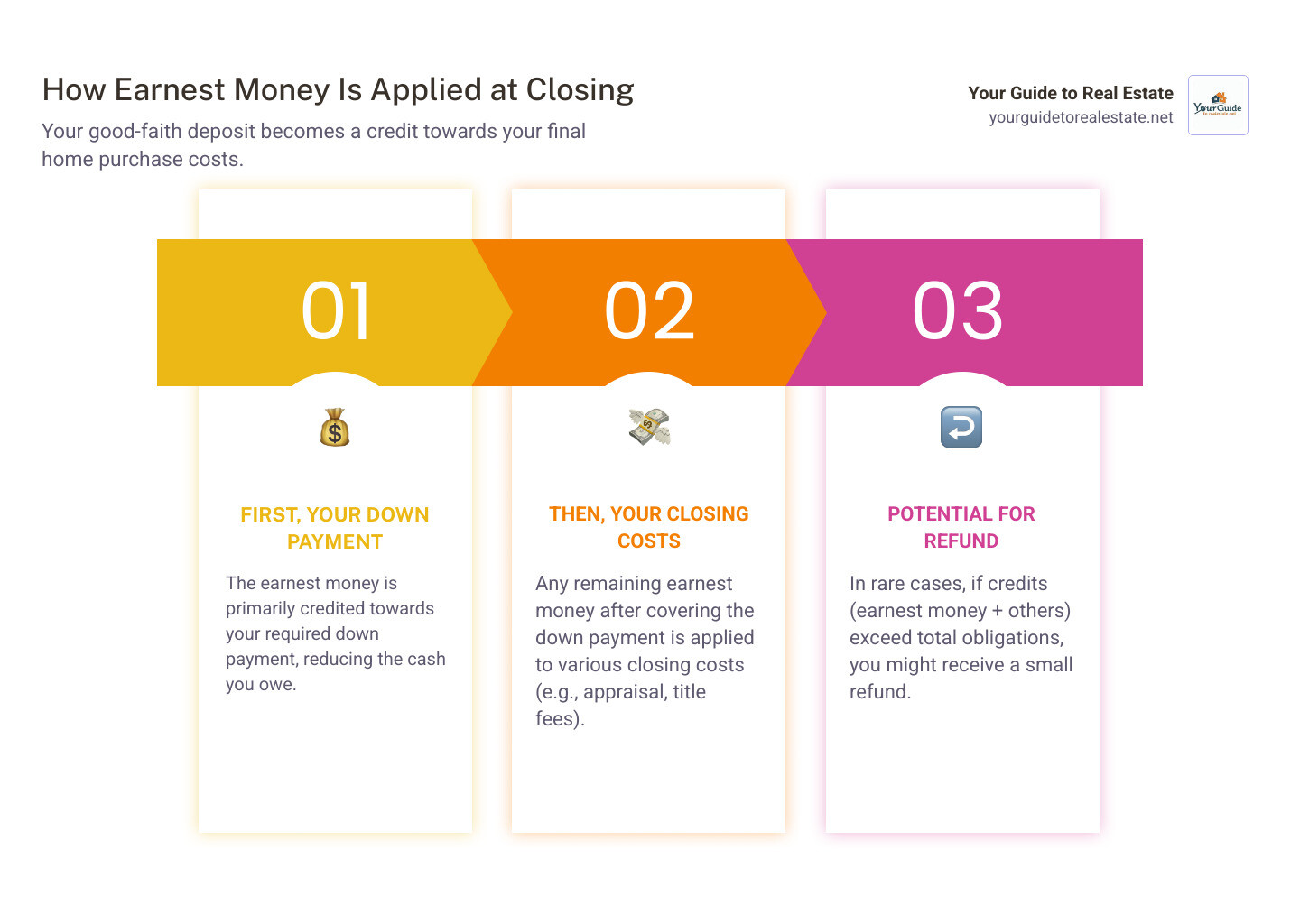
The key takeaway here is that your earnest money isn’t gone forever. It’s working for you, reducing what you owe at the finish line. Understanding exactly how earnest money goes towards closing costs helps you budget more accurately and removes some of the mystery from the home buying process.
How does earnest money go towards closing costs on the settlement statement?
When you finally arrive at closing, you’ll receive an important document called the Closing Disclosure, or CD for short. This is your itemized receipt for the entire home purchase—every dollar accounted for, every credit listed, every fee explained.
Your earnest money deposit will show up on the Closing Disclosure as a credit in your favor. Look for a line item that says something like “Deposit” or “Earnest Money Deposit.” The amount you paid upfront will be listed there, clear as day.
This credit directly reduces your “Cash to Close”—that’s the final number you need to bring to the closing table. Here’s a real-world example to make it crystal clear: if your total down payment and closing costs add up to $30,000, and you’ve already made a $5,000 earnest money deposit, your Closing Disclosure will show that you only need to bring $25,000 to close. That $5,000 earnest money has been accounted for and subtracted from your total.
The beauty of the Closing Disclosure is that it provides complete transparency. You’ll see exactly how your earnest money, along with any other credits or concessions from the seller or lender, is applied to reduce what you owe. It’s the official confirmation that your good-faith gesture has indeed gone towards your down payment and closing costs, just as promised.
Review your Closing Disclosure carefully when you receive it—usually at least three business days before closing. Make sure the earnest money amount matches what you deposited, and don’t hesitate to ask your real estate agent or closing attorney if anything looks off. This document is your financial roadmap for the transaction, and understanding it gives you confidence and peace of mind.
Protecting Your Deposit: When Is Earnest Money Refundable?
One of the biggest concerns for buyers is, “What if the deal falls through? Do I get my earnest money back?” The answer largely depends on the purchase agreement and, specifically, the contingencies included in your contract.

Here’s the good news: earnest money is generally refundable if you back out of the deal for reasons covered by specific contingencies written into your purchase agreement. Think of these contingencies as your “escape clauses”—they allow you to withdraw your offer and get your deposit back without penalty if certain conditions aren’t met.
If you back out due to a contingency, you’re typically in the clear. Let’s say the home inspection reveals significant structural damage, or your financing falls through despite your best efforts. As long as these issues are covered by contingencies in your contract, you can walk away with your earnest money intact.
The most common contingencies that protect your earnest money include the home inspection contingency (if major problems are finded), the financing contingency (if you can’t secure a mortgage), the appraisal contingency (if the home appraises for less than the purchase price), and the title search contingency (if ownership issues arise). Some buyers also include a sale of prior home contingency, though this is less common in competitive markets.
If you back out for no valid reason, that’s a different story. Let’s say you simply change your mind or get cold feet about a reason not covered by your contract. In this case, you’ll likely forfeit your earnest money to the seller. This compensates them for taking their home off the market and potentially missing other opportunities.
If the seller backs out, you should absolutely receive your earnest money back in full. If they decide to cancel the deal without a contractually allowed reason—maybe they received a higher offer and want to renege on your agreement—you’re protected. In some cases, depending on your contract and local laws, you might even have grounds to pursue additional damages.
Understanding these scenarios is crucial to protecting your investment. Contingencies aren’t just legal jargon—they’re your financial safety net. To avoid common pitfalls and protect your deposit, be sure to review our guide on Earnest Money Deposit Mistakes to Avoid.
How to Protect Your Earnest Money Deposit
While earnest money is a show of good faith, it’s also your money. Protecting it requires diligence and smart practices throughout the transaction.
Never give your earnest money directly to the seller. This is rule number one. Always ensure your deposit goes into an escrow account managed by a neutral, reputable third party—like a title company, licensed escrow agent, or real estate attorney. This ensures the funds are held securely until all conditions are met.
Understanding all your contract contingencies is your biggest shield. Work closely with your real estate agent to include all necessary contingencies in your purchase agreement. Make sure you fully understand what each contingency means and the timeframe associated with it. These clauses are your legal “outs” if something unexpected arises.
Meeting your deadlines is absolutely critical. Contingencies often come with strict timeframes—for example, “inspection must be completed within 7 days.” Missing these deadlines can cause a contingency to expire, potentially jeopardizing your earnest money if you then try to back out based on that issue. Stay organized, set reminders, and communicate regularly with your agent.
Keep everything in writing. All agreements, amendments, and communications regarding your earnest money and the purchase contract should be documented in writing. This provides a clear paper trail in case of any disputes down the road.
Verify wire instructions carefully. If you’re paying by wire transfer, always verify the wire instructions directly with the escrow agent via a confirmed phone number—not one from an email. Wire fraud is a significant and growing risk in real estate transactions. Take the extra few minutes to confirm before sending any funds.
Always get a receipt when your earnest money is deposited into the escrow account. This confirms the transaction and provides documentation for your records.
By following these best practices, you can ensure your earnest money deposit is protected throughout the home buying process. We’re here to offer stress-free guidance, and part of that is empowering you with the knowledge to make informed decisions. For more essential advice as you steer your purchase, check out our First-Time Homebuyer Tips.
Frequently Asked Questions about Earnest Money
We know that earnest money can raise a lot of questions, especially for first-time buyers navigating this process. Here are some of the most common questions we hear from clients, along with clear, helpful answers to put your mind at ease.
How much earnest money is considered normal?
The typical earnest money deposit ranges from 1% to 3% of the home’s purchase price. So if you’re buying a $400,000 home, you’d generally expect to put down somewhere between $4,000 and $12,000 as earnest money. But here’s the thing—”normal” really depends on your specific situation and market.
In hot, competitive markets, you might see buyers offering 5% or even 10% to make their offer stand out. When multiple buyers are bidding on the same property, a larger earnest money deposit signals to the seller that you’re exceptionally serious and financially capable. It can be the difference between your offer getting accepted and losing out to someone else.
In slower, buyer-friendly markets, you might get away with offering less—sometimes even a fixed amount rather than a percentage. Your real estate agent will be invaluable here, as they know what’s customary in your local area and can advise you on an amount that’s competitive without being unnecessarily high.
The property’s price point matters too. For luxury homes or higher-value properties, sellers often expect a larger dollar amount, even if the percentage stays within that typical range. And remember, the amount is negotiable. Work with your agent to find the sweet spot that protects your interests while making your offer attractive.
Can a seller keep my earnest money if I back out?
This is one of the biggest concerns we hear from buyers, and rightfully so. The short answer is: it depends entirely on why you’re backing out and what your contract says.
If you back out for a reason covered by a contingency in your purchase agreement—like a failed home inspection, financing falling through, or a low appraisal—you should get your full earnest money deposit back. These contingencies exist specifically to protect you in situations where the deal legitimately can’t or shouldn’t move forward.
However, if you back out simply because you changed your mind, found another house you like better, or for any reason not covered by your contract’s contingencies, the seller typically has the legal right to keep your earnest money. This is called forfeiture, and it compensates the seller for taking their home off the market and potentially losing other buyers during that time.
There’s also the matter of deadlines. If you fail to meet the deadlines specified in your contract—for example, not completing your inspection within the agreed timeframe or not removing contingencies by the stated date—you could lose your protection even if you had a valid reason to back out. The contract might be considered breached.
This is why we always stress the importance of understanding every detail of your purchase agreement and working with an experienced agent who can help you steer the timelines. The contingencies are your safety net, but only if you use them correctly and on time.
What happens if my closing costs are less than my deposit?
Your earnest money does earnest money go towards closing costs and your down payment—it’s a credit, not an extra fee. So if your total financial obligation at closing ends up being less than your earnest money deposit, you don’t lose that money.
Here’s what happens: Your earnest money is applied first to your down payment, then to your closing costs. If there’s still money left over after covering both, that excess amount is refunded to you at closing. You’ll typically receive it via check or wire transfer from the escrow agent.
This scenario happens more often than you might think, particularly in a few specific situations. Buyers using VA loans or USDA loans often don’t need to make a down payment at all, which means their entire earnest money deposit goes toward closing costs. If the closing costs are less than the deposit, they get money back.
Similarly, if you’ve negotiated seller concessions—where the seller agrees to cover some of your closing costs—or if your lender provides credits, these reduce your out-of-pocket expenses. When these credits combine with your earnest money, you might end up with more credits than costs, resulting in a refund.
The Closing Disclosure you receive before closing will show exactly how your earnest money is applied and whether you’ll receive any funds back. It’s all clearly itemized, so there are no surprises on closing day. Your earnest money is working for you throughout the entire process, reducing what you owe and making homeownership more affordable.
Conclusion
Buying a home is one of the biggest financial decisions you’ll ever make, and we know it can feel overwhelming at times. But here’s the good news: understanding the pieces of the puzzle—like earnest money—makes the entire process much less intimidating and far more manageable.
Throughout this guide, we’ve walked through what earnest money really is: your good-faith deposit that proves to sellers you’re genuinely committed to buying their home. We’ve clarified how it’s different from your down payment (smaller, earlier, and refundable under the right conditions), explored typical amounts you might expect to pay, and explained how it’s safely held in escrow by a neutral third party until closing day.
But the question that brought you here—does earnest money go towards closing costs?—has a clear and reassuring answer: Absolutely, yes. Your earnest money isn’t an extra fee that disappears into the ether. It’s your money, held in trust, and it comes back to you as a credit at closing. First, it reduces your down payment obligation. Then, any remaining balance is applied to your closing costs—those various fees like title insurance, appraisal charges, and lender costs. In some cases, if you have enough credits from seller concessions or other sources, you might even see a small refund. It all works together to reduce the total cash you need to bring to the closing table.
We’ve also covered how to protect your earnest money by using reputable escrow agents, understanding your contract contingencies inside and out, meeting all your deadlines, and keeping everything documented. These safeguards ensure that if something unexpected happens—a failed inspection, financing issues, or appraisal problems—you can walk away with your deposit intact.
The bottom line? Earnest money is a fundamental part of the home-buying process that benefits both you and the seller. It shows commitment, provides protection, and ultimately reduces your final costs when the deal closes successfully.
At Your Guide to Real Estate, we’re passionate about giving you the knowledge and confidence to steer every step of your real estate journey. Our goal is to provide you with a proven framework and stress-free guidance, turning what could be an anxious experience into an empowering one.
If you’re ready to continue building your home-buying knowledge, we invite you to explore our comprehensive resource: Understanding Mortgages: A Beginner’s Guide to Home Loans. It’s packed with insights that will help you understand financing options, interest rates, and how to choose the right loan for your situation.
You’ve got this, and we’re here to guide you every step of the way.