
Why Understanding Appraisal Reports Matters in Real Estate
An appraisal report is a detailed document prepared by a licensed or certified appraiser that provides an unbiased opinion of a property’s market value. It’s a critical piece of nearly every real estate transaction, whether you’re buying your first home, refinancing, or settling an estate.
Here’s what you need to know about appraisal reports:
- Purpose: Establishes fair market value to protect lenders and inform buyers
- Required By: Lenders for mortgage approval, especially when borrowing more than 80% of home value
- Prepared By: State licensed or certified appraisers following strict professional standards (USPAP)
- Key Components: Property details, neighborhood analysis, comparable sales, and final value opinion
- Common Forms: Form 1004 for single-family homes, Form 1073 for condos, Form 1025 for 2-4 unit properties
- Typical Length: 30+ pages with photos, maps, and detailed analysis
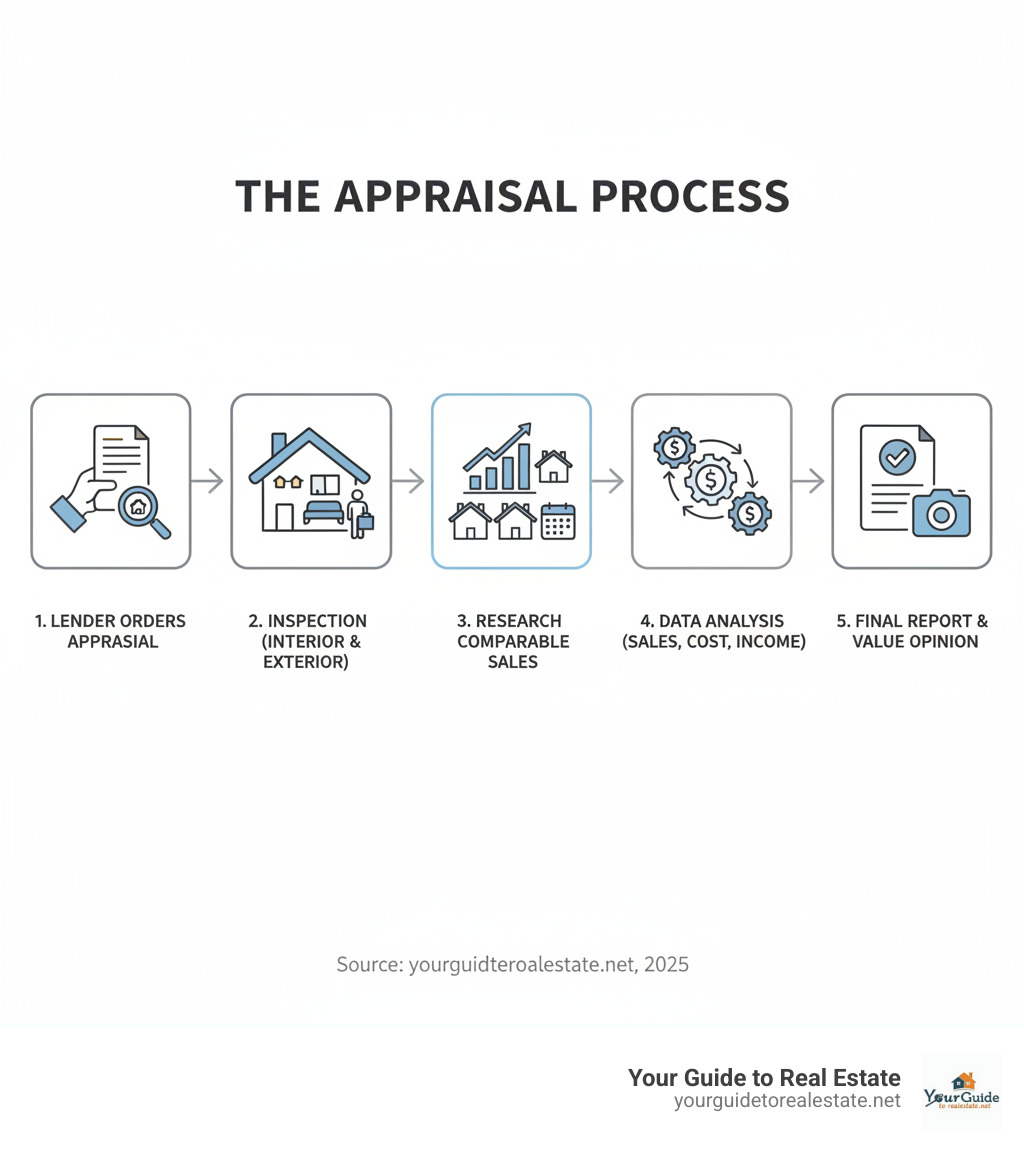
Many people assume an appraisal is just a quick comparison of your property to others nearby. The reality? It’s far more comprehensive. A complete appraisal report results from hours of preparation and research, analyzing everything from property condition and structural integrity to neighborhood features and market trends.
The appraisal serves as the lender’s primary tool for assessing whether a property provides sufficient collateral for a loan. Federal regulation requires lenders to obtain an appraisal prepared by an impartial and unbiased appraiser for loan purposes. This protects both the lender and you as the buyer from overpaying or making a poor investment.
Understanding what’s in an appraisal report helps you steer the real estate process with confidence. You’ll know what appraisers look for, how they determine value, and what to do if you believe a correction is needed.
Appraisal report terminology:
- appraisal contingency
- 4 surprising factors that can affect a home appraisal
- how long does an appraisal take
What’s Inside a Typical Appraisal Report?
When you first open an appraisal report, you might feel a bit overwhelmed. These documents aren’t light reading—most run 30 pages or more. But there’s a good reason for all that detail. Every section serves a specific purpose in building a complete, defensible picture of what a property is truly worth.
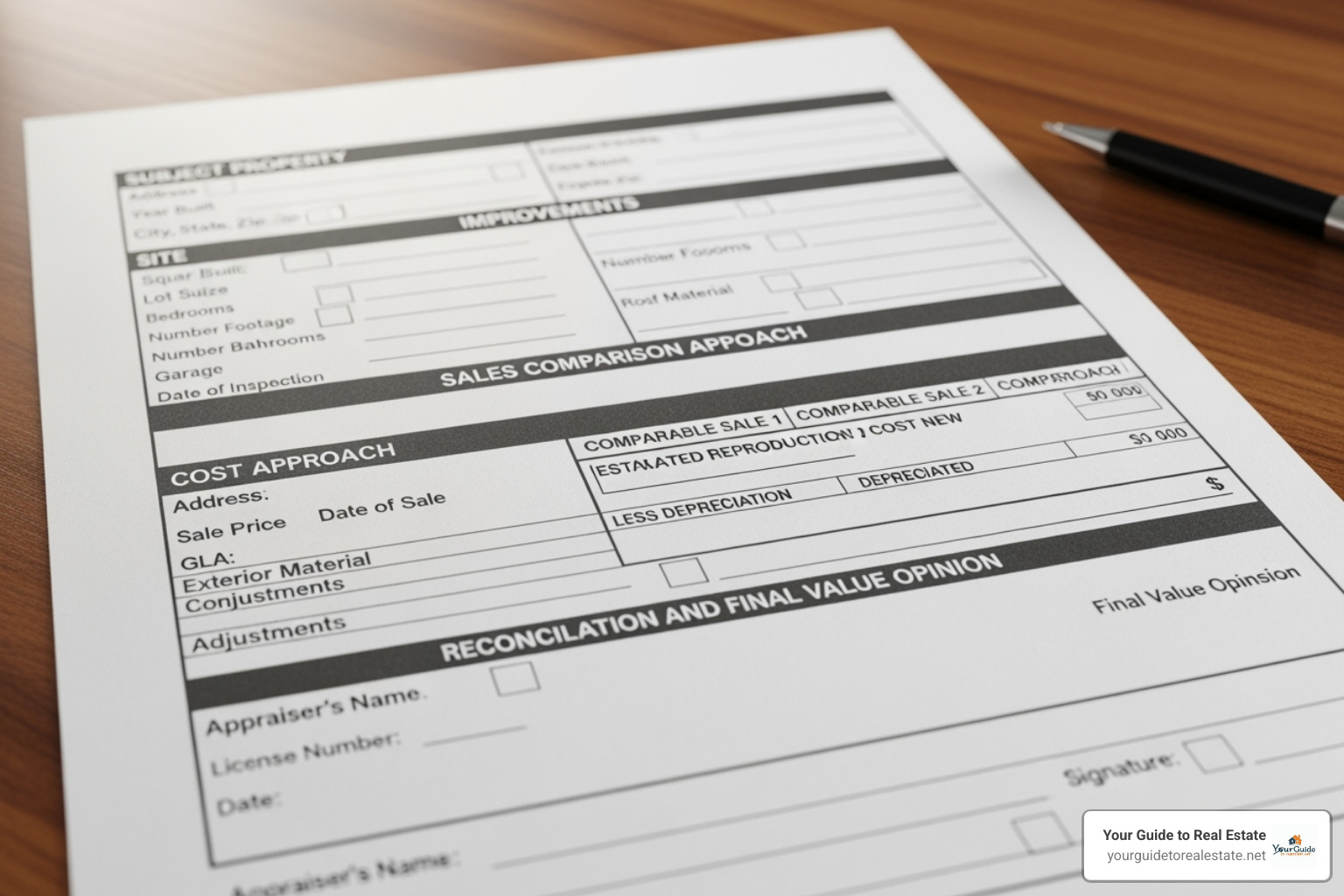
Think of an appraisal report as a story about a property. It starts with the basics, explores the neighborhood, describes the home in detail, and then makes a compelling case for its value. Let’s walk through what you’ll actually find inside.
Subject Property Details open the report by establishing exactly what’s being appraised. You’ll see the full address, legal description, tax ID number, and the current owner’s name. The appraiser also notes any recent sales of the property, current listings, or pending agreements. This section answers the fundamental question: “What property are we talking about?”
From there, the Neighborhood Analysis zooms out to look at the bigger picture. What’s happening in the surrounding area? Are home values rising or falling? How quickly are properties selling? In a hot market, homes might fly off the market in days. In slower areas, they could sit for months. The appraiser considers economic trends, housing supply and demand, and overall neighborhood characteristics. All of these factors influence your property’s value.
The Site Description gets specific about the land itself. How big is the lot? What’s the shape and topography? Does water drain properly? What utilities are available? Is the property in a flood zone? The appraiser documents zoning information and notes any issues that could affect value, like easements or encroachments.
Next comes the Description of Improvements—essentially, everything built on the land. This section reads like a detailed inventory of your home. Foundation type, exterior materials, roof condition, interior finishes, room count, square footage (called Gross Living Area or GLA), heating and cooling systems, appliances—it’s all here. The appraiser notes the overall condition and quality of construction. If there’s a cracked foundation or a brand-new kitchen, you’ll find it documented in this section.
Now we get to the valuation methods. The Sales Comparison Approach is typically the most important for residential properties, and we’ll explore it in depth below. The Cost Approach estimates what it would cost to rebuild the home from scratch, subtracts depreciation, and adds the land value. This method works well for new construction or unique properties where comparable sales are hard to find.
For income-producing properties like duplexes or investment homes, the Income Approach comes into play. It analyzes potential rental income and applies market-based calculations to estimate value. Most single-family homes won’t use this approach, but it’s essential for multi-unit properties.
Finally, the Final Reconciliation of Value brings everything together. The appraiser weighs the results from each valuation approach and explains their reasoning. Why did they rely more heavily on comparable sales than the cost approach? What factors tipped the scales? This section presents the final opinion of value with clear supporting logic.
Understanding these components helps you see the full picture. Sometimes small details can make a surprising difference in the final number. To learn more about unexpected elements that can influence valuations, check out our guide on 4 Surprising Factors That Can Affect a Home Appraisal.
The Sales Comparison Approach
Here’s where the rubber meets the road. The Sales Comparison Approach is the heart of most residential appraisals. The logic is straightforward: a smart buyer won’t pay more for your home than they’d pay for a similar one down the street.
The appraiser starts by finding Comparable Sales—recently sold homes that closely match the subject property in size, age, style, condition, and location. Lenders typically require at least three comparables from the past year, though appraisers give more weight to the most recent sales. In a rapidly changing market, a sale from last week tells you more than one from six months ago.
But here’s the thing: no two homes are exactly alike. Maybe one comparable has an extra bathroom. Another has a bigger lot. A third sold during the holiday slowdown. This is where Market Adjustments come in.
The appraiser adjusts each comparable’s sale price up or down to account for differences. If a comparable has a two-car garage and the subject property only has a one-car garage, the appraiser reduces that comparable’s price to reflect what buyers in that market typically pay for the extra garage space. These adjustments aren’t guesses—they’re based on market data showing what features actually cost in that specific area.
Proximity to Subject matters enormously. The best comparables come from the same neighborhood or a very similar one. A home three blocks away tells you more than one across town, even if the specs look similar on paper.
Sale Date also factors into the equation. Recent sales reflect current market conditions. Older sales might need adjustments if the market has shifted—prices could have risen or fallen since the transaction.
Gross Living Area (GLA) is one of the biggest adjustment factors. This measures the total finished, above-grade living space. Basements don’t count, even if they’re finished. If a comparable has 200 more square feet than the subject property, the appraiser adjusts its price downward to reflect that difference.
Other Value Adjustments cover a wide range of features. Did the seller pay the buyer’s closing costs? That’s a financing concession that requires an adjustment. Does one home have a stunning view while another faces a busy street? That affects value. The appraiser considers design and appeal, construction quality, age and condition, room count and layout, and amenities like garages, decks, pools, or finished basements.
After making all these adjustments, the appraiser analyzes the adjusted prices to arrive at an Indicated Value for your property. The comparables might cluster around a certain price range, giving the appraiser confidence in their final number.
Supporting Documentation and Exhibits
An appraisal report isn’t just words and numbers—it’s packed with visual evidence that backs up the appraiser’s conclusions. These exhibits help you see what the appraiser saw and understand how they reached their value opinion.

Every report includes a Floor Plan or footprint sketch. This drawing shows the layout of the home with dimensions and square footage calculations. It’s especially important for verifying the Gross Living Area and understanding properties with unusual layouts.
A Street Map shows where the subject property sits in relation to all the comparable sales. This visual helps you see why the appraiser chose certain comparables and whether they’re truly in similar locations.
Exterior Photographs give you a clear view of the property and its context. You’ll see the front and back of the home, a street scene showing the surrounding neighborhood, and photos of each comparable property used in the analysis. These images help confirm the appraiser’s descriptions and show the property’s curb appeal.
Interior Photographs document the home’s condition and features from the inside. The appraiser captures the kitchen, all bathrooms, main living areas, and any below-grade finished spaces. If there’s significant deterioration or recent updates, those get photographed too. These images provide evidence of the quality and condition noted in the written description.
Sometimes Legal Documents like deeds or surveys appear in the exhibits. These confirm property boundaries, easements, or other legal matters that could affect value.
You might also find market data presented as graphs, charts, or tables. These illustrate trends in the local market—things like how quickly homes are selling, whether prices are rising or falling, and how supply compares to demand.
Required photos typically include:
- Front and back views of the subject property
- Street scene showing the home in its neighborhood context
- Kitchen
- All bathrooms
- Main living area
- Any signs of deterioration or recent updates
All these exhibits work together to create a complete, transparent picture. Anyone reviewing the appraisal report can follow the appraiser’s reasoning and verify that the conclusions make sense. It’s this thorough documentation that gives lenders, buyers, and sellers confidence in the final value.
The Foundation of a Credible Report: Professional Standards
Every reliable appraisal report stands on a foundation of professional standards, ethics, and proven competency. These aren’t just nice-to-have qualities—they’re the backbone that makes an appraisal trustworthy and legally defensible.
The Uniform Standards of Professional Appraisal Practice (USPAP) serves as the authoritative guide for appraisers across the United States. Think of it as the rulebook that ensures every appraiser develops and communicates their analysis in a way that’s meaningful, transparent, and—most importantly—not misleading.
USPAP Standards Rule 2-1 lays out three essential requirements that every appraisal report must meet, whether it’s written or oral. First, the report must clearly and accurately present the appraisal without misleading anyone. Second, it needs to contain enough information so that intended users can properly understand it. And third, it must clearly disclose all assumptions, extraordinary assumptions, hypothetical conditions, and limiting conditions that were part of the assignment.
These requirements aren’t suggestions. They’re strict standards that protect everyone involved in a real estate transaction—from lenders and buyers to sellers and investors. When you’re reviewing an appraisal report, you can feel confident knowing these professional guardrails are in place. For a deeper understanding of these foundational principles, take a look at The 3 Basic Requirements for Real Property Appraisal Reports.
Clarity and Accuracy
When USPAP Standards Rule 2-1(a) talks about clarity and accuracy, it’s addressing something fundamental: an appraisal report must present findings in a straightforward way that doesn’t mislead anyone. No ambiguity. No convenient omissions. Just the facts, presented clearly.
Picture this: You’re buying a charming craftsman home in Oklahoma City. The appraisal report comes back, and you notice the appraiser glossed over some foundation cracks or exaggerated the quality of recent renovations. That’s not just poor practice—it’s a violation of professional standards.
Clarity means using language that’s easy to understand. Appraisers should avoid unnecessary jargon, and when technical terms are needed, they should explain them. Accuracy demands that every data point, calculation, and property description is factually correct and verifiable. When an appraiser states that a home has 2,400 square feet of living space, that number should be based on actual measurements, not guesswork.
This commitment to truthfulness in reporting builds trust throughout the entire transaction. When lenders, buyers, and sellers can rely on the report’s conclusions, everyone makes better decisions.
Sufficient Information for Understanding
Standards Rule 2-1(b) recognizes something important: not every appraisal report needs the same level of detail. The amount of information included depends on who’s reading it and why they need it.
The intended user matters significantly. A seasoned mortgage lender who reviews dozens of appraisals each week will have different needs than a first-time homebuyer trying to understand why their offer fell through. The intended use also shapes the report’s depth—a straightforward refinance appraisal typically requires less extensive detail than one prepared for complex litigation or estate settlement.
Property complexity plays a role too. A standard ranch-style home in a typical Dallas subdivision needs less explanation than a custom-built property with unique features or a complicated history. And the user’s sophistication level helps determine how much explanation is necessary. If the intended users already understand appraisal terminology and local market conditions, some details can be summarized. But if they’re less experienced, more context helps them grasp the full picture.
Here’s a practical example: If you’re refinancing a conventional single-family home in a well-established neighborhood, the appraiser probably doesn’t need to explain every detail of local zoning regulations—especially if the property is clearly compliant and the lender is familiar with the area. But if that same home has an accessory dwelling unit or sits in a transitional neighborhood, the appraisal report should provide much more background to ensure proper understanding.
The goal is always to provide enough context without overwhelming readers with unnecessary information. It’s a balancing act that experienced appraisers steer carefully.
Disclosing Assumptions and Conditions
One of the most critical transparency requirements in any appraisal report is the clear disclosure of all assumptions, extraordinary assumptions, hypothetical conditions, and limiting conditions. USPAP Standards Rule 2-1(c) mandates this because these elements can significantly affect the final value opinion.
Let’s break down what these terms actually mean. Assumptions are facts the appraiser takes as true without specific verification, but which are reasonable in context. For instance, appraisers typically assume a property has good and marketable title and that there aren’t hidden problems like environmental contamination affecting value. These are standard assumptions, but they still need to be disclosed.
Extraordinary assumptions are trickier. These are assumptions that, if proven false, could change the appraiser’s conclusions. Imagine a home with a visible foundation crack. The appraiser might make an extraordinary assumption that the foundation is structurally sound, pending review by a structural engineer. If that assumption turns out to be wrong, the value opinion would need to change. That’s why these must be clearly stated, along with a note that their use might have affected the results.
Hypothetical conditions involve valuing a property as if something were true, even though the appraiser knows it isn’t. The most common example is valuing new construction “subject to completion per plans and specifications” when the home is only partially built. The appraiser is determining value as if the home were finished, which contradicts its actual state on the effective date. Like extraordinary assumptions, these must be disclosed prominently.
Limiting conditions define the boundaries of the appraiser’s responsibility. These are often standardized on forms from Fannie Mae and other institutions. For example, an appraiser typically isn’t responsible for verifying legal title or guaranteeing the exact accuracy of approximate floor plan sketches. While appraisers generally can’t add their own limiting conditions to standardized forms, they can include additional certifications on separate pages when required by law or professional organizations.
These disclosures ensure transparency throughout the appraisal process. They help you understand the framework within which the appraiser worked and recognize any factors that could lead to a different value opinion if circumstances change. When you see these clearly stated in an appraisal report, you’re seeing professional standards in action—protecting everyone involved in the transaction.
A Guide to Standard Appraisal Forms and Methods
The world of real estate appraisal might seem like a maze of paperwork, but there’s actually a method to the madness. Most residential appraisal reports follow standardized forms and methodologies, especially when mortgage lending is involved. These forms aren’t just bureaucratic red tape—they ensure consistency, make reviews easier, and help keep the loan process moving smoothly.
Here’s something important to understand: the form itself doesn’t box in the appraiser’s analysis. A skilled appraiser goes well beyond simply filling in blanks. They’re conducting a thorough investigation to truly capture your property’s value. The type of property and the complexity of the assignment determine which form gets used.
If you’re curious about the timeline for the entire process, we’ve put together a helpful resource on How Long Does an Appraisal Take?.
Common Appraisal Report Forms
Fannie Mae provides a suite of standardized appraisal report forms that have become industry standards. Each one is designed for specific property types and appraisal scenarios. Think of them as specialized tools in an appraiser’s toolkit—each one perfectly suited for a particular job.
The Uniform Residential Appraisal Report (Form 1004) is the workhorse of the industry. It’s the most common form you’ll encounter for traditional appraisals of single-family homes and units in Planned Unit Developments (PUDs). When you imagine an appraiser walking through your home with a clipboard, they’re likely completing a Form 1004. This form requires both interior and exterior on-site physical inspection by the appraiser. You can view a sample of the Uniform Residential Appraisal Report (URAR) to see what lenders and appraisers work with.
For condo owners, the Individual Condominium Unit Appraisal Report (Form 1073) serves a similar purpose. It’s specifically designed for one-unit properties in condominium projects and also requires a complete interior and exterior inspection.
If you own a manufactured home, there’s a dedicated form for that too. The Manufactured Home Appraisal Report (Form 1004C) addresses the unique characteristics of manufactured housing.
Investment property owners dealing with small multi-family properties will encounter the Small Residential Income Property Appraisal Report (Form 1025). This form handles two- to four-unit properties, whether they’re in PUDs, condos, or co-op projects.
Finally, the Appraisal Update and/or Completion Report (Form 1004D) serves a specific purpose: updating previous appraisals or reporting the completion of improvements on any one- to four-unit property.
All these forms are completed according to the Uniform Appraisal Dataset (UAD) Specification, which standardizes data fields and definitions across the industry. This standardization ensures that whether your property is in Oklahoma City or Dallas, the appraisal report follows the same consistent format and data standards.
Types of Appraisals
Beyond the specific forms, the way appraisers collect property data has evolved significantly in recent years. Technology and efficiency have introduced new inspection methods that balance thoroughness with speed and cost.
The traditional in-person appraisal is what most homeowners picture. A licensed appraiser visits your property, walks through every room, examines the exterior, inspects the neighborhood, and often drives by comparable sales. They’re gathering data through direct observation, supplemented by public records, MLS listings, and market data. This comprehensive approach takes more time and costs more, but it provides the most detailed on-site information.
Desktop appraisals represent the other end of the spectrum. For these reports, the appraiser never sets foot on your property. Instead, they rely entirely on readily available information from public records, Multiple Listing Services, and third-party data providers. Sometimes a property data collector (who isn’t necessarily an appraiser) might provide property-specific data and photos. Desktop appraisals are faster and less expensive, but they have limitations. Lenders typically restrict their use to specific, lower-risk loan scenarios.
Hybrid appraisals split the difference between these two approaches. The appraiser conducts an exterior-only inspection themselves, while a third-party data collector gathers interior property information. The appraiser then combines this collected data with their exterior observations and market research to complete the report. This method offers a middle ground—faster and more affordable than traditional appraisals, but with more direct property information than desktop appraisals.
Your lender’s requirements and the specific loan product determine which type of appraisal you’ll receive. A conventional loan for a straightforward single-family home might qualify for a hybrid or desktop approach, while a jumbo loan or unique property will almost certainly require a traditional, full-inspection appraisal report. The Uniform Appraisal Dataset policy ensures that regardless of the inspection method, the data is standardized and consistent across the industry.
The Appraiser’s Role and Responsibilities
Think of the appraiser as the neutral referee in a real estate transaction. They don’t work for the buyer, the seller, or even the real estate agent. Their job is to provide an honest, unbiased opinion of value that everyone can trust. This independence isn’t just professional courtesy—it’s legally required and absolutely essential for protecting all parties involved, especially the lender who’s putting up the money.
When you have an appraisal contingency in your purchase agreement, you’re banking on this appraiser’s expert, impartial judgment to make sure you’re not overpaying for your new home. The appraiser’s responsibilities go far beyond simply arriving at a number. They must adhere to strict ethical standards, clearly define the boundaries of their work, maintain their independence, and ensure every appraisal report they produce is credible and defensible.
The appraiser’s role involves careful due diligence, from researching market data and inspecting the property to analyzing comparable sales and documenting everything thoroughly. They must also understand and communicate any limiting conditions that apply to their work. It’s a job that requires technical expertise, local market knowledge, and unwavering professional integrity.
Defining the Scope of Work
Before an appraiser even steps foot on a property, they need to establish exactly what they’re going to do and how they’re going to do it. This is called defining the scope of work, and it’s the foundation of every credible appraisal report.
The scope of work outlines the extent of the appraiser’s research and analysis, customized to meet the specific needs of each assignment. It’s not a one-size-fits-all approach. A simple refinance on a typical suburban home requires a different scope than appraising a unique historic property or a complex multi-unit building.
The appraiser determines the appropriate scope by considering what data they’ll need to collect, how extensively they’ll analyze that data, and what the client specifically requires from the report. For instance, will they conduct a full interior and exterior inspection, or just an exterior inspection? Will they rely on third-party data collection, as in some hybrid appraisals? Which approaches to value will they apply—sales comparison, cost, income, or all three?
The property inspection level is a critical component of the scope. A traditional appraisal involves the appraiser personally walking through the home, examining the kitchen, bathrooms, living areas, and overall condition. A desktop appraisal, on the other hand, involves no physical inspection at all, relying instead on public records and third-party data.
Client requirements also shape the scope. Lenders might have specific needs based on the loan type, property characteristics, or risk factors. The appraiser’s job is to determine what scope of work will produce a credible result for the intended use and users, then clearly disclose that scope within the appraisal report itself. This transparency ensures everyone understands exactly what was—and wasn’t—included in the appraiser’s analysis.
Understanding the Appraiser’s Certification

Flip to the final pages of any appraisal report and you’ll find the appraiser’s certification. This isn’t just a formality or a place to scribble a signature. It’s a solemn, professional declaration that carries real weight and legal significance.
The certification is where the appraiser puts their professional reputation and license on the line. They’re certifying that their opinions and conclusions are completely impartial and unbiased. They’re declaring that nobody pressured them to hit a certain number, and their compensation wasn’t tied to delivering a predetermined value. This is the cornerstone of appraiser independence—the principle that keeps the whole system honest.
The appraiser also certifies they have no personal interest in the property. They’re not secretly hoping to buy it themselves, they’re not related to the seller, and they don’t stand to benefit if the deal goes through at a particular price. For traditional appraisals, they confirm they personally inspected the subject property, walking through both the interior and exterior, and typically viewed the comparable sales from the street to verify their characteristics.
Compliance with standards is another crucial element. The appraiser certifies that everything in the appraisal report was developed and reported according to USPAP (those professional standards we discussed earlier) and all applicable state and federal regulations. They’re also confirming that they researched, verified, and analyzed data from reliable sources—not just pulling numbers out of thin air or relying on questionable information.
There’s also a confidentiality commitment. The report and all its contents, including those photos and floor plans, are confidential. They’re for the appraiser’s use and the client’s requirements, not for posting on social media or sharing with the neighbors.
Fannie Mae and other institutions provide standard certification language on their forms, and appraisers generally can’t add their own limiting conditions to these standardized certifications. However, if state law, professional organization membership, or privacy regulations require additional certifications, appraisers can include those on a separate page.
The appraiser’s certification is your assurance that the appraisal report is the product of diligent, ethical, and competent work. It’s a professional promise that the opinion of value you’re relying on was developed with integrity and can be trusted to guide one of the biggest financial decisions you’ll ever make.
Conclusion
You’ve just taken a comprehensive journey through appraisal reports, and here’s the truth: this knowledge puts real power in your hands. Whether you’re buying your first home in Dallas, refinancing in Oklahoma City, or helping a family member steer an estate settlement, understanding what’s inside that 30+ page document makes all the difference.
We’ve walked through the fundamental components together—from the detailed property descriptions and neighborhood analysis to the careful work of comparing your home to similar properties nearby. You now know that the appraisal report isn’t just a quick opinion scribbled on a napkin. It’s a carefully researched document that reflects hours of professional analysis, all designed to arrive at one crucial number: fair market value.
The professional standards we discussed, especially USPAP requirements, aren’t just bureaucratic red tape. They’re your protection. They ensure that every appraisal report is clear, accurate, and never misleading. When an appraiser discloses their assumptions and conditions, they’re being transparent about the framework they used to reach their conclusions. That transparency builds trust and helps everyone involved make better decisions.
The standardized forms—whether it’s the familiar Form 1004 for single-family homes or specialized reports for condos and manufactured homes—create consistency across the industry. And as appraisal methods evolve with technology, from traditional in-person inspections to hybrid and desktop approaches, the commitment to rigorous standards remains constant. Each method serves a purpose, balancing speed, cost, and the level of detail needed for different situations.
At the heart of every appraisal report is the appraiser themselves, bound by their professional certification to provide an unbiased, independent opinion. Their scope of work, carefully defined for each assignment, ensures they collect the right data and perform the appropriate analysis. When they sign that certification at the end of the report, they’re staking their professional reputation on the quality and integrity of their work.
This matters because lenders rely on these reports to make sound lending decisions. But more importantly, you rely on them to ensure you’re not overpaying for a property or making a risky investment. When you have an understanding of what goes into an appraisal report, you can review it with confidence, ask informed questions, and know when something might need a second look.
At Your Guide to Real Estate, we’re passionate about giving you the tools and knowledge you need to succeed. Real estate transactions can feel overwhelming, but they don’t have to be. We’re here to provide proven frameworks and stress-free guidance every step of the way. Think of us as your trusted companion on this journey, always ready to break down complex topics into clear, actionable insights.
Ready to expand your expertise even further? Dive deeper into the numbers and strategies that drive real estate decisions by exploring our comprehensive guide to property valuation and market analysis in real estate. Your next confident real estate decision starts with understanding the fundamentals—and you’re well on your way.