

Understanding How We Evaluate Our Ability to Cope
Secondary appraisal psychology definition refers to the evaluation of one’s available resources and ability to cope with a potentially stressful situation. This assessment occurs after an initial evaluation (primary appraisal) determines that a situation is personally significant.
Quick Answer:
- What it is: Secondary appraisal is your mental assessment of whether you have the resources, skills, and options to handle a challenging situation
- When it happens: After you’ve decided a situation matters to you (primary appraisal)
- What it evaluates: Your coping resources, including social support, financial stability, personal skills, knowledge, physical health, and psychological stamina
- Why it matters: Your secondary appraisal determines whether you’ll feel stressed or confident, and influences which coping strategies you’ll use
Have you ever received unexpected news about a major expense—like a home repair—and immediately started running through your options? Can I afford this? Do I know someone who can help? Do I have the skills to handle this myself? That mental checklist you’re creating is secondary appraisal in action.
Psychologist Richard Lazarus developed this concept as part of his cognitive appraisal theory of emotion in the 1980s. He recognized that stress isn’t just about what happens to us—it’s about whether we believe we can handle what happens to us.
If your secondary appraisal concludes you have sufficient resources, the situation won’t feel stressful and might even seem like an opportunity. But if you determine your resources are insufficient, you’ll experience stress and need to activate coping strategies.
This process shapes everything from how we handle workplace pressure to how we steer major life decisions like buying a home. Understanding secondary appraisal can help you recognize your stress patterns and build better coping strategies.
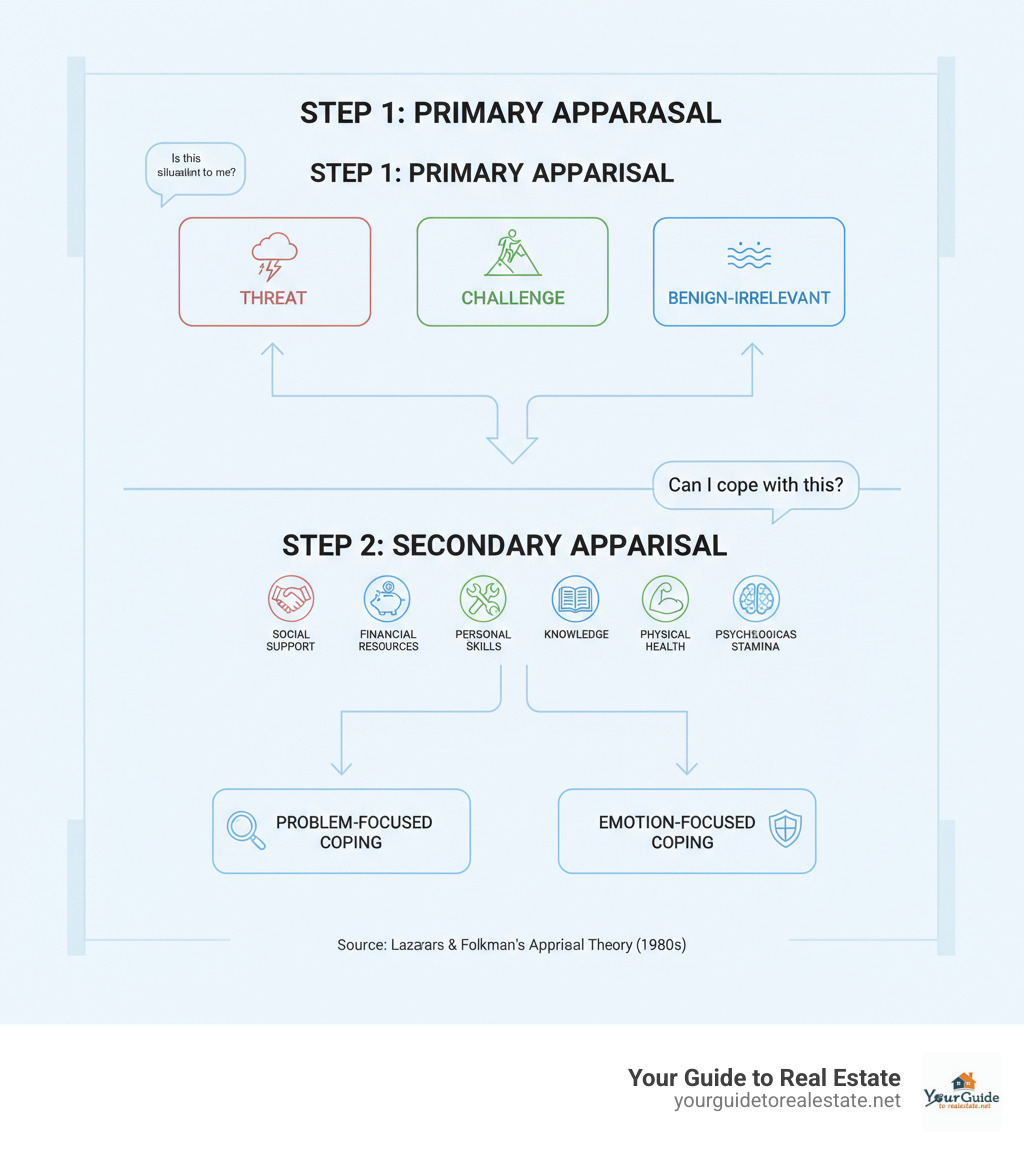
Secondary appraisal psychology definition vocab explained:
The Foundation: Lazarus and Folkman’s Appraisal Theory
Think about the last time it rained on a day you had outdoor plans. Did you feel frustrated and stressed? Or did you shrug it off and find something else to do? If you asked ten different people about the same rainy day, you’d probably get ten different reactions. This simple observation reveals something profound about how we experience stress: it’s not really about what happens to us, but how we think about what happens to us.
This idea sits at the heart of cognitive appraisal theory, and it fundamentally changed how psychologists understand stress and emotion. Early thinkers like Magda Arnold first suggested that our interpretation of events shapes our emotional responses. But it was Richard S. Lazarus and his colleague Susan Folkman who really brought this concept to life in the 1980s with their groundbreaking work.
Their transactional model of stress and coping introduced a fresh way of thinking about stress. Instead of viewing stress as something “out there” in the world—like a demanding boss or a tight deadline—Lazarus saw it as a person-environment transaction. In other words, stress happens in the relationship between you and your circumstances. The same situation can be devastating to one person and merely inconvenient to another, depending on how each person evaluates it.
The model centers on two types of evaluation: primary appraisal and secondary appraisal. These aren’t rigid steps that happen one after another like climbing stairs. Instead, they’re more like a continuous conversation your mind has with itself, constantly reassessing and adjusting as situations unfold. Together, these appraisals determine whether you’ll feel stressed and what you’ll do about it.
The APA Dictionary of Psychology defines secondary appraisal as “one’s evaluation of their ability to cope with the consequences of an interaction with the environment.” But before we can evaluate our ability to cope, we first need to figure out if a situation even matters to us in the first place.

Primary Appraisal: What Does This Situation Mean to Me?
Before you can figure out what to do about a situation, your brain performs a quick initial assessment. This happens fast—sometimes in milliseconds—and often without conscious thought. You’re essentially asking yourself: Does this matter to me? Should I care about this?
Lazarus identified two key factors your mind considers during this evaluation. First, there’s motivational relevance—how important is this event to your goals, needs, or well-being? If something has zero connection to anything you care about, your brain labels it benign-irrelevant and moves on. Hearing about a traffic jam on the other side of town when you’re staying home all day? Benign-irrelevant.
Second, there’s motivational congruence—does this situation help or hurt what you’re trying to accomplish? Is it consistent with your goals or working against them? This distinction shapes whether you’ll feel positive or negative emotions.
Based on this rapid evaluation, your primary appraisal lands in one of several categories. Something might be benign-irrelevant if it simply doesn’t affect you. It might register as harm or loss if damage has already occurred—like finding your basement flooded. It could feel like a threat if you’re anticipating future problems—like worrying about affording your mortgage if you lose your job.
But here’s where it gets interesting: sometimes demanding situations get appraised as a challenge rather than a threat. A challenging new project at work might require effort and push you outside your comfort zone, but if you see it as an opportunity to grow and prove yourself, you might actually feel excited rather than stressed. The situation hasn’t changed—only your interpretation of its personal significance has.
This initial judgment sets everything else in motion. Once you’ve decided a situation matters and might pose some difficulty, your mind immediately shifts to the next crucial question.
Secondary Appraisal: What Can I Do About It?
After determining that a situation is significant (and not just benign-irrelevant), you move into what Lazarus called secondary appraisal. This is where the secondary appraisal psychology definition really comes into focus. You’re now taking stock of everything you have available to handle the situation. You’re asking: Can I cope with this? What are my options?
This subsequent evaluation is like taking a mental inventory. You’re assessing your coping potential—do you have the skills, knowledge, and abilities to manage what’s happening? This connects directly to your sense of self-efficacy, which is your belief in your own capacity to handle challenges effectively.
You’re also evaluating your resources. Can you call on friends or family for support? Do you have enough money to address the problem? Do you have access to information or tools that might help? This is your resource evaluation phase, and it considers everything from social support to financial stability to your own physical and mental energy.
Another crucial piece is future expectancy—what do you think will happen if you try to cope? Do you believe your efforts will make things better, or do you feel like nothing you do will matter? This expectation shapes both your motivation to act and how stressed you’ll feel.
You might even consider accountability: Is this situation my fault? Someone else’s? Just bad luck? This can influence whether you feel guilty, angry, or simply resigned.
Here’s what makes secondary appraisal so powerful: if you conclude that you have sufficient resources and effective strategies available, the whole situation feels less threatening. The stress dial turns down. You might even start feeling capable and confident. But if you decide your resources are insufficient—if you answer “Can I handle this?” with a worried “I don’t think so”—the stress intensifies, and you’ll need to actively engage coping options to manage the situation.
This is the dynamic interplay at the heart of the stress process. Primary appraisal tells you what a situation means to you. Secondary appraisal tells you what you can do about it. Together, they shape your entire emotional experience and determine how you’ll respond when life throws challenges your way.
[TABLE] Comparing Primary and Secondary Appraisal
| Feature | Primary Appraisal | Secondary Appraisal |
|---|---|---|
| Focus of Evaluation | The significance of the event to oneself (Is this relevant? Is it a threat, challenge, or benign?). | One’s ability and resources to cope with the event (Can I handle this? What are my options?). |
| Timing | Initial, rapid assessment. Occurs first. | Follows primary appraisal. Occurs after the event is deemed significant. |
| Key Question | “Does this situation affect me, and if so, how?” | “What can I do about it? Do I have what it takes?” |
| Outcome | Determines if an emotional response is warranted and the basic nature of that response (e.g., fear, excitement). | Determines the intensity of the emotional response, the specific coping strategies employed, and the overall feeling of control or helplessness. |
| Example | Seeing a “for sale” sign on your neighbor’s house: “Oh, a new neighbor is moving in. Interesting.” (Benign) OR “Oh no, what if they’re loud?” (Threat) | If it’s a threat: “Do I know anyone in the neighborhood association? Can I talk to the current owner about the new buyers? Do I have time to research this?” |
The Core of the Secondary Appraisal Psychology Definition
Here’s what really matters about secondary appraisal psychology definition: it’s fundamentally about asking yourself, “Can I handle this?” It’s that moment when you’ve already decided something matters to you, and now you’re mentally scanning your toolkit to see what you’ve got to work with.
Think of it like standing at the base of a mountain you need to climb. Primary appraisal already told you, “Yes, this mountain is in your way.” Secondary appraisal is when you look down at your gear, check your fitness level, consider whether you’ve got friends who can help, and decide whether you’re equipped for the climb ahead.
This self-assessment isn’t just an abstract mental exercise—it directly shapes how stressed you feel and what you do next. The secondary appraisal psychology definition centers on evaluating your coping resources, your sense of control, your self-efficacy (your belief in your own abilities), and your overall resilience. When you conclude you have what it takes, that looming challenge suddenly feels manageable, maybe even exciting. But when you decide your resources fall short, stress intensifies and you need to figure out a game plan fast.

Key Components of the Secondary Appraisal Psychology Definition
When you’re sizing up whether you can handle a challenging situation, you’re unconsciously running through a mental checklist of resources. These aren’t just about money or material things—they span your entire personal ecosystem of support and capability.
Social support often tops the list. Do you have people you can call when things get tough? Friends who’ll listen, family who’ll show up, colleagues who’ll cover for you? Strong relationships act as a buffer against stress in ways that are hard to overstate.
Your financial stability plays a huge role, especially in real estate scenarios. Can you absorb an unexpected repair cost? Do you have savings to fall back on? When you’re confident in your finances, challenges feel less threatening. When money’s tight, even small problems can trigger significant stress.
Personal skills and knowledge matter tremendously. If your water heater breaks, do you know how to fix it yourself or at least how to find a trustworthy plumber? When buying a home, do you understand the process well enough to spot red flags? The more expertise you bring to a situation, the more capable you feel.
Your physical health and psychological stamina form your foundation. Are you well-rested and energetic, or already running on empty? Can you stay calm under pressure, or do you quickly feel overwhelmed? Your mental and physical reserves determine how much you can handle before breaking down.
Self-efficacy—your belief in your own competence—colors everything else. Two people might have identical resources, but the one who believes “I can figure this out” will experience far less stress than the one thinking “I’m going to fail.” This sense of confidence often matters more than the actual resources themselves.
Your perception of control also weighs heavily. Even a little bit of influence over the situation can dramatically reduce stress. Conversely, feeling completely powerless amplifies anxiety, even when you have other resources available.
Finally, practical considerations like time constraints, equipment and tools, and specific knowledge all factor into your assessment. Do you have enough time to address the problem properly, or is there an urgent deadline breathing down your neck?
From Appraisal to Action: Problem-Focused vs. Emotion-Focused Coping
Your secondary appraisal doesn’t just determine how stressed you feel—it directly shapes what you do about the situation. The conclusion you reach about your resources guides you toward one of two broad approaches: tackling the problem head-on or managing your emotional response to it.
When your secondary appraisal tells you “I’ve got this,” you naturally gravitate toward problem-focused strategies. You roll up your sleeves and take action. You gather information, make a plan, and start changing the situation itself. If you’re navigating a complicated home purchase and feel confident in your abilities (or your ability to learn), you might dive deep into research, consult with real estate professionals, and proactively address concerns as they arise. Understanding the escrow process becomes something you tackle systematically rather than something that overwhelms you.
Problem-focused coping works beautifully when you actually can influence the outcome. It reduces stress by eliminating or minimizing the source of the problem itself.
But what happens when your secondary appraisal concludes you don’t have the resources to change the situation? That’s when emotion-focused strategies become your lifeline. Instead of trying to fix what feels unfixable, you focus on managing your feelings about it. You might seek comfort from friends, distract yourself with activities you enjoy, or reframe how you’re thinking about the situation to make it feel less threatening.
Interestingly, research has found that people experiencing loneliness were less likely to use problem-based strategies and more likely to turn to emotion-based approaches compared to those with stronger social connections. When we feel isolated—when our secondary appraisal tells us we lack social resources—we often shift from trying to solve the problem to just trying to feel better about it. You can learn more about how loneliness impacts coping here.
Neither approach is inherently better. Sometimes you can’t change the situation, and managing your emotional response is the healthiest, most practical option. The key is matching your coping strategy to both your resources and the actual controllability of the situation you’re facing.
Secondary Appraisal in the Real World: Research and Applications
The beauty of understanding secondary appraisal psychology definition is that it’s not just theory—it’s something you can see playing out every single day. Whether you’re dealing with a flat tire on your way to work, navigating a difficult conversation with your boss, or making a major decision like buying your first home, your brain is constantly evaluating whether you have what it takes to handle the situation.
Think about it: the same event can feel completely different depending on what resources you believe you have available. A surprise $500 expense might be a minor inconvenience if you have a healthy emergency fund, but it could feel catastrophic if you’re already stretched thin financially. The expense hasn’t changed—what’s changed is your assessment of your ability to cope with it.
This is where the rubber meets the road in stress research. Scientists have spent decades studying how our appraisals affect everything from our daily mood to our long-term health outcomes. And the findings? They’re pretty eye-opening, especially when it comes to workplace stress and resilience.

Research Insights on Workplace Stress
Let’s talk about work stress for a moment, because it’s something most of us know all too well. The statistics paint a sobering picture: more than 80% of US workers report experiencing workplace stress, and over half say it follows them home. Even more concerning, about 40% of American adults have experienced negative mental or behavioral health effects from work-related stress, including anxiety and depression symptoms. The financial toll? A staggering $48 billion in healthcare costs nationally. You can find more data on workplace stress from the CDC here.
But here’s where secondary appraisal comes into play: workplace stress isn’t just about having a lot to do. It’s about the gap between what’s being asked of you and what you believe you have to work with. When job demands are sky-high but you lack control over your work, organizational support, or the skills to meet those demands, your secondary appraisal signals “insufficient resources.” That’s when stress really takes hold.
The opposite is also true. When employees feel they have adequate support, sufficient skills, and some degree of control over their work, even challenging projects can feel manageable—maybe even exciting. This is why some people thrive under pressure while others crumble: it’s not just about the pressure itself, but about how they appraise their ability to handle it.
Smart organizations are catching on to this. Instead of just trying to reduce workload (though that helps!), they’re investing in building employee resources. This might mean providing better training, creating stronger support systems, or giving workers more autonomy. For real estate professionals, this could mean having access to tools like a thorough competitive market analysis to make informed decisions with confidence.
How the Secondary Appraisal Psychology Definition Influences Resilience
Now let’s connect this to resilience—that quality that helps some people bounce back from setbacks while others struggle to recover. Your secondary appraisal psychology definition is actually at the heart of resilience. When you face a difficult situation, your resilience shows up in two key ways: first, you don’t immediately see everything as a catastrophic threat (that’s primary appraisal), and second, you genuinely believe you have the resources to handle whatever comes your way (that’s secondary appraisal).
Researchers have developed ways to measure this, like the Index of Stress Resilience (ISR). What they’ve found is fascinating: people with higher resilience scores have significantly better health outcomes. They’re less likely to develop serious illnesses, less likely to need medical care, and less likely to suffer from chronic conditions. You can explore more research on measuring stress resilience here.
But here’s something really interesting: resilience doesn’t prevent bad things from happening. The research distinguishes between endogenous stressors (problems that stem partly from our own choices or behaviors, like relationship conflicts or financial mismanagement) and exogenous stressors (external events we can’t control, like natural disasters or sudden illness).
Resilient people experience fewer endogenous stressors—perhaps because their positive secondary appraisals lead them to make better decisions in the first place. But they don’t experience fewer exogenous stressors. Random bad luck happens to everyone. What resilience does is act as a buffer, lessening the impact when those unavoidable challenges arise.
This is where self-efficacy becomes crucial. When you believe in your ability to figure things out, learn new skills, and find solutions, you’re more likely to make positive secondary appraisals. You see challenges as problems to solve rather than threats to avoid. For anyone facing a major life decision—like buying a home—understanding your own resilience and resources is essential. That’s why we created our First Time Homebuyers Toolkit: Everything You Need to Know Before You Buy, to help you build that confidence and assess whether you’re truly ready for the journey ahead.
The takeaway? Your brain’s assessment of “Can I handle this?” isn’t just a fleeting thought—it’s a powerful predictor of your stress levels, your coping choices, and ultimately, your well-being.
Frequently Asked Questions about Secondary Appraisal
How does secondary appraisal differ from primary appraisal?
Think of these two appraisals as a one-two punch in how we process stressful situations. Primary appraisal is that first, quick judgment about whether something matters to you at all. It’s your mind asking, “Is this relevant to me? Is it a threat, a challenge, or can I just ignore it?” It’s the what of the situation.
Secondary appraisal comes right after, and this is where the secondary appraisal psychology definition really shines. Now you’re asking, “Okay, this matters—but can I actually handle it? What resources do I have?” It’s the evaluation of your ability and available resources to cope with whatever you’ve just identified as significant. It’s the how of the situation.
To put it simply: primary appraisal tells you if there’s a problem, while secondary appraisal tells you if you have the tools to fix it (or at least manage it). Without the first, you wouldn’t know you need to act. Without the second, you wouldn’t know how to act or whether you even can.
Can secondary appraisal change over time?
Yes, absolutely! One of the most important things to understand about secondary appraisal is that it’s not set in stone. It’s a dynamic process that shifts and evolves as circumstances change. Your assessment of your coping resources today might look completely different tomorrow.
Maybe you feel overwhelmed by a complex situation right now because you lack information. But then you do some research, talk to a knowledgeable friend, or gain a new skill, and suddenly your secondary appraisal shifts from “I’m in over my head” to “Actually, I think I can handle this.” This is especially true in real estate transactions, where new information comes to light constantly. Understanding the steps involved—like reading through our guide on understanding the escrow process—can transform your appraisal from anxious to confident.
Your support system can shift too. Gaining a helpful mentor, joining a supportive community, or even just getting a good night’s sleep can change your perception of your available resources. This adaptability is actually a sign of healthy coping and emotional intelligence. The fact that our secondary appraisals can change means we’re always capable of growth and improvement.
Is a negative secondary appraisal always bad?
Here’s where things get interesting: not at all! While a negative secondary appraisal—concluding that you don’t have enough resources to cope—certainly feels uncomfortable and triggers a stress response, it’s not necessarily a bad thing in the long run.
In fact, recognizing that you’re currently ill-equipped can be incredibly motivating. It’s your mind’s way of saying, “Hey, we need to do something different here.” This realization can push you to seek help from others, acquire new skills, gather more information, or develop better coping strategies. It can be the catalyst for real personal growth.
Think about it this way: if you’re buying your first home and your secondary appraisal tells you that you lack knowledge about the process, that feeling of insufficiency might drive you to educate yourself thoroughly. You might dive into resources like our First Time Homebuyers Toolkit or learn how to do a competitive market analysis. That initial “I don’t know enough” becomes the springboard for becoming genuinely prepared and confident.
The key is what you do with that negative appraisal. If it paralyzes you, that’s problematic. But if it mobilizes you to build your resources and capabilities, it’s actually a powerful tool for self-improvement and building future resilience. Sometimes feeling temporarily inadequate is exactly what we need to become truly adequate.
Conclusion
You’ve just learned something powerful: the secondary appraisal psychology definition isn’t just academic jargon—it’s a practical tool that can transform how you handle life’s challenges. When you understand that stress isn’t just about what happens to you, but about whether you believe you can handle what happens, you suddenly have much more control over your emotional experience.
Think about it this way: two people can face the exact same situation—a last-minute home inspection issue, a demanding work project, or an unexpected expense—and have completely different reactions. The difference? Their secondary appraisal. One person mentally inventories their resources and thinks, “I’ve got this,” while another concludes, “I’m in over my head.” Same situation, different stress levels, different outcomes.
The beauty of understanding this process is that you can actively strengthen your resources. You can build your social network, develop new skills, improve your financial cushion, and cultivate psychological resilience. Each of these makes future challenges less daunting because your secondary appraisal will increasingly tell you, “Yes, I can handle this.”

At Your Guide to Real Estate, we see this play out constantly. Buying or selling a home is one of life’s biggest financial decisions, and it naturally triggers both primary and secondary appraisals. Is this house the right one? Can I afford it? Do I understand the process? What if something goes wrong? These questions reflect the appraisal process in action.
That’s exactly why we’re here—to strengthen your secondary appraisal by giving you the knowledge, tools, and confidence you need. When you understand the escrow process, know how to do a competitive market analysis, and have access to expert guidance, suddenly that daunting real estate transaction becomes manageable. Your secondary appraisal shifts from “This is overwhelming” to “I have what I need to succeed.”
The real world application extends far beyond real estate, of course. Whether you’re facing workplace pressure, personal challenges, or major life transitions, consciously assessing your resources and capabilities puts you in the driver’s seat. You’re no longer just reacting—you’re strategically responding based on an honest evaluation of what you can do and what support you might need.
Here’s the empowering truth: every time you seek information, ask for help, learn a new skill, or build a stronger support network, you’re investing in future positive secondary appraisals. You’re building a personal arsenal that makes future challenges less threatening and more manageable.
So the next time you face something stressful, pause and ask yourself: “What resources do I have? What can I do about this?” That simple question—the heart of secondary appraisal—can shift you from feeling helpless to feeling capable. And that shift makes all the difference in both your stress levels and your success.
Learn more about Valuation and Market Analysis in Real Estate