

Understanding Seller Concessions: Your Key to a Smoother Real Estate Transaction
Concessions in real estate are incentives that a seller offers to a buyer to help offset costs associated with purchasing a home. They’re a powerful negotiation tool that can make or break a deal in today’s competitive housing market.
What You Need to Know About Real Estate Concessions:
- What They Are: Credits or benefits from the seller that reduce the buyer’s out-of-pocket costs at closing
- Common Types: Closing cost credits, repair credits, home warranties, or included appliances/furniture
- Typical Coverage: 3-9% of the purchase price, depending on your loan type
- Who Benefits: Buyers save cash upfront; sellers attract more buyers and close deals faster
- When They’re Common: Buyer’s markets, high interest rate environments, or when repairs are needed
According to the National Association of Realtors’ 2023 data, 20 percent of sellers offered incentives to attract buyers. That number tells us concessions aren’t just a niche strategy—they’re a mainstream tool in real estate transactions.
Whether you’re a first-time homebuyer trying to stretch your savings or a seller looking to close a deal quickly, understanding how concessions work can save you thousands of dollars and weeks of stress. They’re not just about lowering costs—they’re about creating opportunities that make transactions possible when they might otherwise fall apart.
The key is knowing when to ask for them, how much to request, and what the lender rules allow. That’s exactly what this guide will help you master.
Concessions in real estate vocab to learn:
- Down payment assistance
- does earnest money go towards closing costs
- i make $70,000 a year how much house can i afford
What Are Seller Concessions and How Do They Work?
If you’ve ever wished you could negotiate more than just the price of a home, you’re in luck. Concessions in real estate give you exactly that flexibility. They’re essentially a way for sellers to help buyers cover some of the costs that come with purchasing a home—without necessarily dropping the asking price.
Think of it this way: You’ve saved up for a down payment, but when you add up all the other expenses—inspections, appraisals, loan fees, title insurance—your savings suddenly feel stretched thin. That’s where seller concessions come in. They’re like a helping hand extended across the closing table, making the deal work for everyone involved.
Defining Seller Concessions
A seller concession is a contribution the seller makes to help offset the buyer’s costs at closing. Here’s the important part: it’s not a price reduction. The home’s purchase price stays the same, but the seller agrees to cover specific expenses or provide benefits that reduce how much cash the buyer needs to bring to closing.
Let’s say you’re buying a $300,000 home and the seller agrees to a $9,000 concession. You’re still buying the home for $300,000, but the seller is essentially giving you a $9,000 credit to use toward your closing costs. This means instead of bringing, say, $15,000 to closing, you only need to bring $6,000. Same house, same price—but a much more manageable path to homeownership.
This distinction matters because it affects how your loan works and how much you’re financing. For buyers who’ve carefully saved for a down payment but are light on cash reserves, concessions can be the difference between making an offer and walking away. If you want to explore this concept more deeply, check out our guide on What are Seller Concessions?.
Common Types of Concessions in Real Estate
Concessions in real estate come in several flavors, each designed to solve different problems or smooth over potential deal-breakers. The most common type is a closing cost credit, where the seller simply contributes money toward the buyer’s closing costs. These typically range from 2% to 5% of the purchase price, though lender limits may apply.
Then there are repair credits. Imagine your home inspection reveals the roof needs $5,000 worth of work. Instead of fixing it themselves or lowering the price, the seller might offer a $5,000 credit so you can handle the repairs after you move in. You get the repairs done your way, and the seller doesn’t have to coordinate contractors before closing. Speaking of inspections, understanding what they cost upfront helps you budget—learn more about the Cost of Home Inspection.
A home warranty is another popular option. The seller pays for a one-year warranty that covers major systems and appliances, giving you peace of mind that if the water heater dies three months after you move in, you won’t be facing a huge unexpected bill.
Some sellers sweeten the deal by including personal property—things like furniture, appliances (think refrigerators, washers, dryers), or even that fancy backyard grill. These items don’t affect your loan amount but can save you thousands in move-in expenses.
In today’s higher interest rate environment, some sellers are even offering mortgage rate buydowns, contributing funds to temporarily lower your interest rate for the first year or two. This can significantly reduce your monthly payments when you need it most.
The Mechanics of a Concession
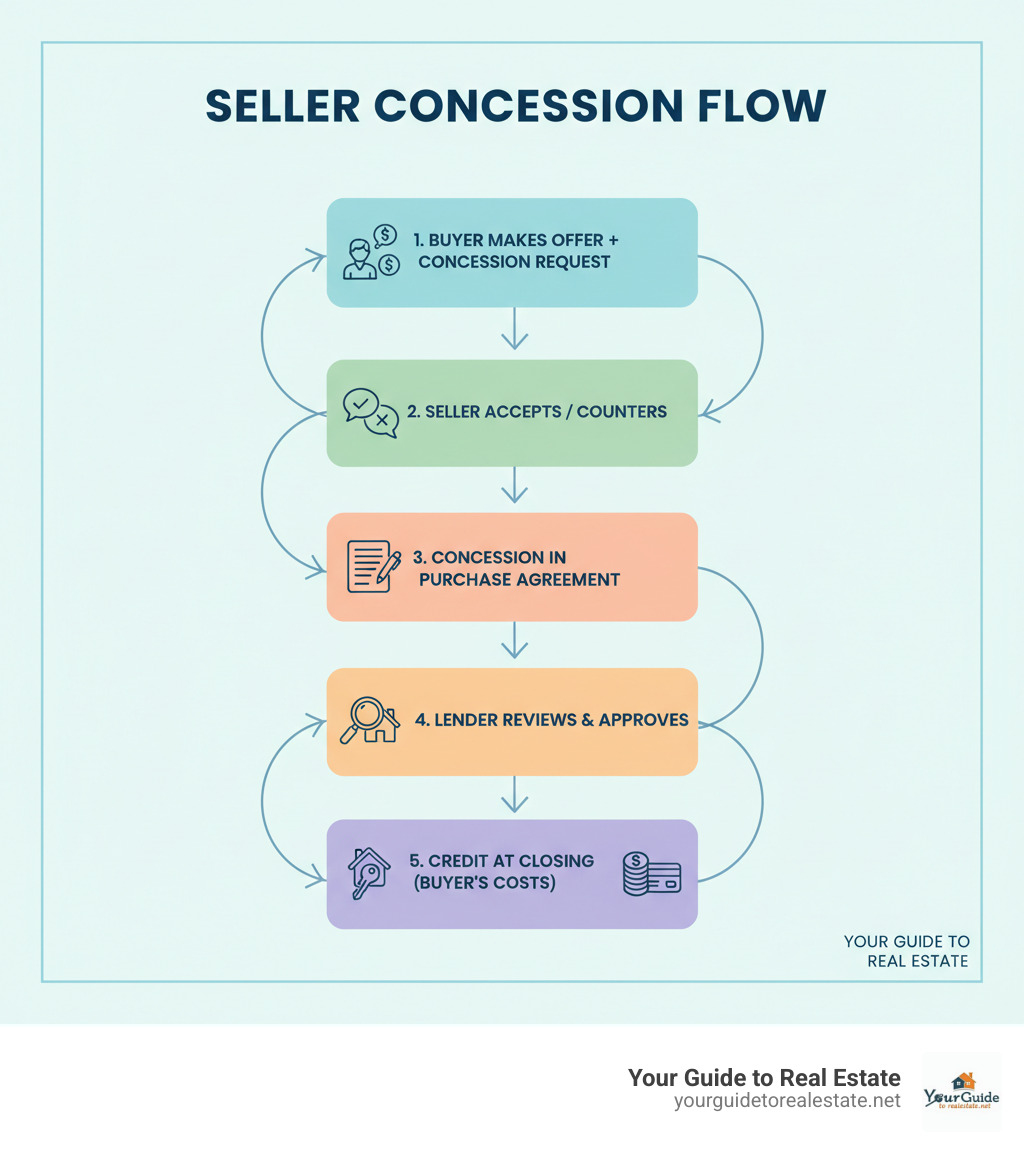
Here’s how concessions in real estate actually move from conversation to closing. Everything starts with your written offer. When you submit an offer on a home, you can include a request for seller concessions right there in the purchase agreement. You’ll specify what type of concession you’re requesting and how much.
If the seller agrees—either in your initial offer or after some back-and-forth negotiation—the concession gets written directly into the purchase contract. This isn’t a side deal or a gentleman’s agreement. It’s a legally binding part of your contract, which means everyone has to follow through.
Next, your lender reviews everything. Lenders have strict rules about concessions, including limits on how much a seller can contribute based on your loan type and down payment. If your requested concession fits within these guidelines, the lender approves it and factors it into your closing costs.
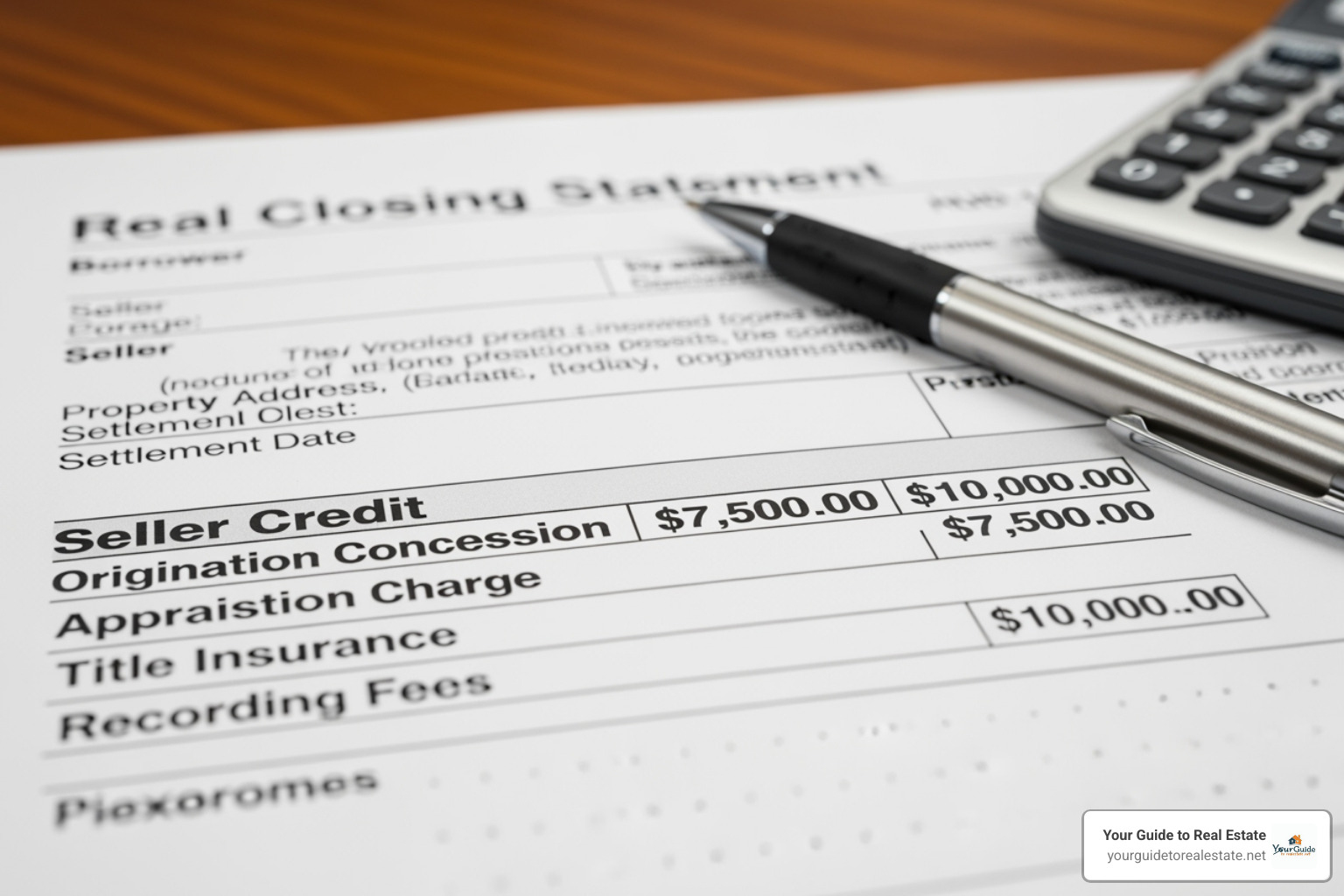
Finally, at closing, you’ll see the concession reflected on your closing statement. It appears as a credit from the seller to you, directly reducing the total amount of cash you need to bring. The escrow company or title company handles all the accounting, making sure every dollar goes where it’s supposed to go.
What Specific Costs Can Concessions Cover?
The beauty of seller concessions is their versatility. They can be applied to almost any legitimate closing cost, which typically catches first-time buyers off guard with how many fees are involved in buying a home.
Loan-related fees are fair game—things like origination fees (what your lender charges to process your loan) and discount points (upfront fees you pay to lower your interest rate). The appraisal fee, which covers a professional assessment of the home’s value, can be covered too.
Title and legal costs are another big category. This includes title insurance (which protects you from claims against your property’s ownership), attorney fees if your state requires a real estate attorney at closing, and recording fees to officially document the sale with your local government.
Prepaid items and escrow can also be covered. This includes property taxes that need to be paid at closing, homeowners insurance premiums for your first year, and any HOA fees if you’re buying in a community with a homeowners association.
Even inspection fees—the cost you paid to have the home professionally inspected—can sometimes be reimbursed through seller concessions. For VA loans, sellers can even cover the VA funding fee in some cases.
The key is that concessions must go toward legitimate costs associated with buying the home. Your lender won’t approve concessions for things like moving expenses, furniture shopping, or home renovations. Everything needs to show up as a line item on your closing statement.
The Strategic Use of Concessions in Real Estate
Here’s something most people don’t realize until they’re deep in a real estate transaction: concessions in real estate aren’t just about moving money around. They’re strategic tools that can completely change the game for both buyers and sellers. The key is understanding when and how to use them.
Benefits for Homebuyers
Let’s start with the obvious question: what’s in it for you as a buyer?
The most immediate benefit is lower upfront costs. When you’re staring at a closing statement with $15,000 in fees, and you only budgeted $10,000, that $5,000 seller concession suddenly looks like a lifeline. Closing costs typically run 2% to 5% of the purchase price, and having someone else cover even part of that burden can make the difference between buying your dream home and walking away disappointed.
But it goes deeper than just saving cash at closing. Concessions give you increased purchasing power. Think about it this way: if you’ve saved $30,000 and were planning to use $10,000 for closing costs and $20,000 for your down payment, a seller concession covering those closing costs means you can now put the full $30,000 toward your down payment. That could mean better loan terms, a lower monthly payment, or even avoiding private mortgage insurance altogether.
For buyers who are stretching their budget—and let’s be honest, most of us are—concessions can make affordability a reality rather than a dream. They can turn a home that was just out of reach into one that fits comfortably within your financial plan. And in competitive markets, having that extra financial breathing room means you can secure a home faster without worrying about scrambling for additional funds.
If you’re navigating this process for the first time, our First-Time Homebuyers Toolkit: Everything You Need to Know Before You Buy covers everything you need to know.
Benefits for Home Sellers
Now, if you’re a seller, you might be thinking, “Why would I give away my money?” Fair question. But here’s the thing: smart sellers know that concessions often cost less than the alternatives.
First, concessions are incredibly effective at attracting more buyers. According to industry data, 52% of top-performing agents believe that offering seller concessions helps close deals, especially when buyers are facing high interest rates or tight budgets. In today’s market, where buyers are more cautious than ever, a property offering concessions stands out like a guide.
Need to move quickly? Concessions can lead to a faster sale. When your listing says “seller will contribute $10,000 toward closing costs,” buyers who were on the fence suddenly become very interested. That can shave weeks or even months off your time on the market.
Think of concessions as your competitive advantage. In a neighborhood where three similar homes are for sale, yours is the one offering help with closing costs. Which one do you think gets the most showings?
Concessions are also invaluable for closing a difficult deal. Maybe your home has been sitting on the market for 60 days. Maybe the inspection revealed some issues. Instead of dropping your price—which can signal to buyers that something’s wrong—you can offer a strategic concession that addresses specific concerns while maintaining your home’s perceived value.
Here’s a strategy that might surprise you: some savvy sellers actually price their home slightly higher, knowing they’ll offer concessions. This can justify a higher asking price while still giving buyers the financial relief they need. Done right, you might actually net more than if you’d simply lowered your asking price.
To understand where your home stands in the current market, a Competitive Market Analysis: Complete Guide can give you the insights you need.
When Are Concessions Most Common?
The real estate market isn’t static, and neither is the role of concessions. They become more or less common depending on what’s happening in the broader market.
In a buyer’s market—when there are more homes for sale than people looking to buy—concessions become almost expected. Sellers have less leverage, and buyers know it. Offering concessions becomes less of a generous gesture and more of a necessity to compete.
High interest rates have a similar effect. When mortgage rates climb to 7% or higher, buyers face significantly higher monthly payments. Suddenly, that $8,000 in closing cost assistance or a temporary rate buydown becomes incredibly attractive. It’s the difference between an affordable monthly payment and one that keeps you up at night.
When a home needs repairs, concessions often become the path of least resistance. Instead of spending weeks coordinating contractors and making repairs themselves, sellers often prefer to offer a repair credit and let the buyer handle it after closing. We’ve seen situations where a $15,000 HVAC replacement was negotiated as a credit, allowing the deal to move forward smoothly. For more on what inspectors commonly flag, check out Things That Fail a Home Inspection.
Motivated sellers are naturally more willing to offer concessions. Maybe they’ve already bought another home and are carrying two mortgages. Maybe they’ve been transferred for work and need to relocate quickly. Whatever the reason, when a seller needs to move the property fast, concessions become a powerful tool.
And when a property has been on the market for a long time—say, 45 days or more—it starts to develop a stigma. Buyers wonder what’s wrong with it. Offering concessions can breathe new life into a stale listing and signal that the seller is serious about making a deal happen.
Common Scenarios and Examples
Let’s bring this down to earth with some real-world situations where concessions in real estate make all the difference.
Picture this: you’re buying a home, and the inspection reveals issues. The HVAC system is 20 years old and limping along on borrowed time. The seller doesn’t want to replace it before closing, and you don’t want to walk away from a home you love. Solution? The seller offers a $5,000 credit at closing, and you handle the replacement after you move in. Everyone wins.
Here’s another common one: the appraisal gap. You’ve agreed to buy a home for $310,000, but the appraisal comes back at $300,000. The lender will only finance based on the appraised value, leaving you with a $10,000 gap to fill. Rather than watching the deal fall apart, the seller might offer a $5,000 concession toward closing costs, and you bring an extra $5,000 to closing. Deal saved.
Or consider a buyer who’s short on cash. You’ve scraped together your down payment, but the $8,000 in closing costs feels like a mountain. The seller agrees to a $6,000 closing cost credit, and suddenly homeownership goes from impossible to achievable.
Sometimes a seller needs to move quickly—maybe there’s a job transfer with a tight deadline. They offer 3% of the purchase price in concessions, which attracts motivated buyers who appreciate the financial help and are ready to close fast.
And then there are the non-cash concessions that add tremendous value. A seller moving to a fully furnished retirement community doesn’t need their high-end washer, dryer, and refrigerator. Including these appliances in the sale sweetens the deal without the seller spending an extra dime, while the buyer saves thousands on appliances they’d otherwise need to purchase.

Understanding the Limits and Rules of Seller Concessions
While concessions in real estate can be incredibly helpful for both buyers and sellers, they’re not unlimited. Mortgage lenders have specific rules about how much a seller can contribute, and these limits exist for good reasons that protect everyone involved in the transaction.
Why Lenders Set Limits on Concessions
Think of lender limits as guardrails that keep the real estate market running smoothly. When lenders cap concessions, they’re not trying to make your life harder—they’re actually protecting the entire housing market from potential problems.
Preventing appraisal inflation is one of the biggest concerns. Without limits, sellers could artificially inflate a home’s price just to offer larger concessions. Imagine a home worth $300,000 being listed at $320,000 with $20,000 in concessions. The buyer ends up borrowing more than the home is actually worth, which creates risk for everyone. The lender is on the hook for a loan that exceeds the property’s true value, and the buyer could end up underwater if they need to sell.
Lenders also want to ensure buyers have “skin in the game.” When you invest your own money into a home purchase, you’re more likely to prioritize those mortgage payments, even when times get tough. If a buyer can finance nearly everything through seller concessions without putting in much of their own cash, they might be more likely to walk away if financial difficulties arise.
Market stability depends on home values reflecting actual market conditions rather than inflated incentives. By capping concessions, lenders help ensure that comparable sales data remains reliable and that neighborhoods maintain consistent property values.
Finally, it’s all about risk management. Excessive concessions can signal red flags—maybe the property has issues the seller is trying to compensate for, or perhaps the buyer is financially stretched too thin. Either scenario increases the lender’s risk of default.
Comparing Concession Limits by Loan Type
The maximum amount a seller can contribute varies significantly depending on which type of loan you’re using. Understanding these limits before you start negotiating can save you from disappointment later.
Conventional loans use a sliding scale based on your down payment. If you’re putting down less than 10%, the seller can contribute up to 3% of the purchase price. With a down payment between 10% and 25%, that limit increases to 6%. And if you’re making a down payment over 25%, or buying an investment property with at least 10% down, sellers can contribute up to 9%. These tiered limits reflect the idea that buyers with larger down payments have more financial cushion.
FHA loans allow seller concessions up to 6% of the purchase price, regardless of your down payment amount. This is particularly helpful for first-time homebuyers who might be stretching their budgets. For more details on FHA financing, check out our guide on FHA loan limits.
VA loans are exceptionally generous, permitting seller concessions up to 4% of the purchase price. However, VA loans also allow sellers to pay for virtually all closing costs without those payments counting toward the 4% cap. This makes VA loans incredibly buyer-friendly for eligible veterans and service members. Learn more in our article about VA loan limits.
USDA loans cap seller concessions at 6% of the purchase price. These loans, designed for rural and suburban homebuyers, already offer 100% financing, so the ability to get help with closing costs through seller concessions makes them even more accessible. You can read more about USDA loan limits on our site.
It’s crucial to note that these percentages are calculated based on the purchase price or appraised value, whichever is lower. If you agree to buy a home for $310,000 but it appraises at $300,000, your concession limit is calculated on that lower $300,000 figure.
Financing vs. Sales Concessions
Here’s where things get a bit more nuanced. Not all seller contributions are treated the same way by lenders. Understanding the difference between financing concessions and sales concessions can actually work to your advantage.
Financing concessions are contributions that help you pay for costs directly related to obtaining your mortgage. These include items like origination fees, appraisal fees, title insurance, attorney fees, property taxes, HOA fees, discount points, and recording fees. These are the concessions that count toward the percentage limits we just discussed.
Sales concessions, on the other hand, involve non-realty items that come with the property. Think of that washer and dryer the seller is leaving behind, or the riding lawn mower, or the custom window treatments. While these items have value, they’re treated differently in the loan calculation.
The value of sales concessions gets subtracted from the purchase price when calculating your Loan-to-Value (LTV) ratio. Let’s say you’re buying a home for $310,000, and the seller is including $5,000 worth of furniture and appliances. The lender will calculate your LTV based on $305,000 instead of $310,000. This means you’ll need a slightly larger down payment to hit your target LTV ratio, but it doesn’t count against your financing concession limits.
This distinction matters because savvy buyers and sellers can structure deals creatively. You might negotiate for the seller to include valuable personal property as a sales concession while also providing financing concessions up to the loan limit. Just remember that lenders will scrutinize sales concessions to ensure they’re reasonable—claiming that old patio furniture is worth $10,000 won’t fly.
Understanding these rules helps you negotiate more effectively and structure offers that maximize benefits without running afoul of lender guidelines. When you know the boundaries, you can work within them to create deals that truly work for everyone involved.