

Facing Mortgage Difficulties? You Have Options
Loan modification assistance is a lifeline when mortgage payments become unmanageable. If you’re struggling, you’re not alone; many homeowners have sought mortgage relief.
Quick Answer: What is loan modification assistance?
- Permanent solution: Changes your loan terms to make payments affordable
- Common changes: Lower interest rate, extended payment period, or reduced principal
- Who qualifies: Homeowners facing financial hardship who live in the property as their primary residence
- How to start: Contact your mortgage servicer’s loss mitigation department immediately
- Timeline: Typically takes 30-90 days to complete the process
The good news is that lenders prefer modifications over costly foreclosures, giving them a strong incentive to work with you.
Financial hardship from job loss, medical emergencies, or other life events can make mortgage payments overwhelming. Acting fast is key; contacting your lender sooner opens up more options.
Your mortgage servicer has processes to help. Keeping you in your home benefits everyone, but you must take the first step and reach out before falling too far behind.
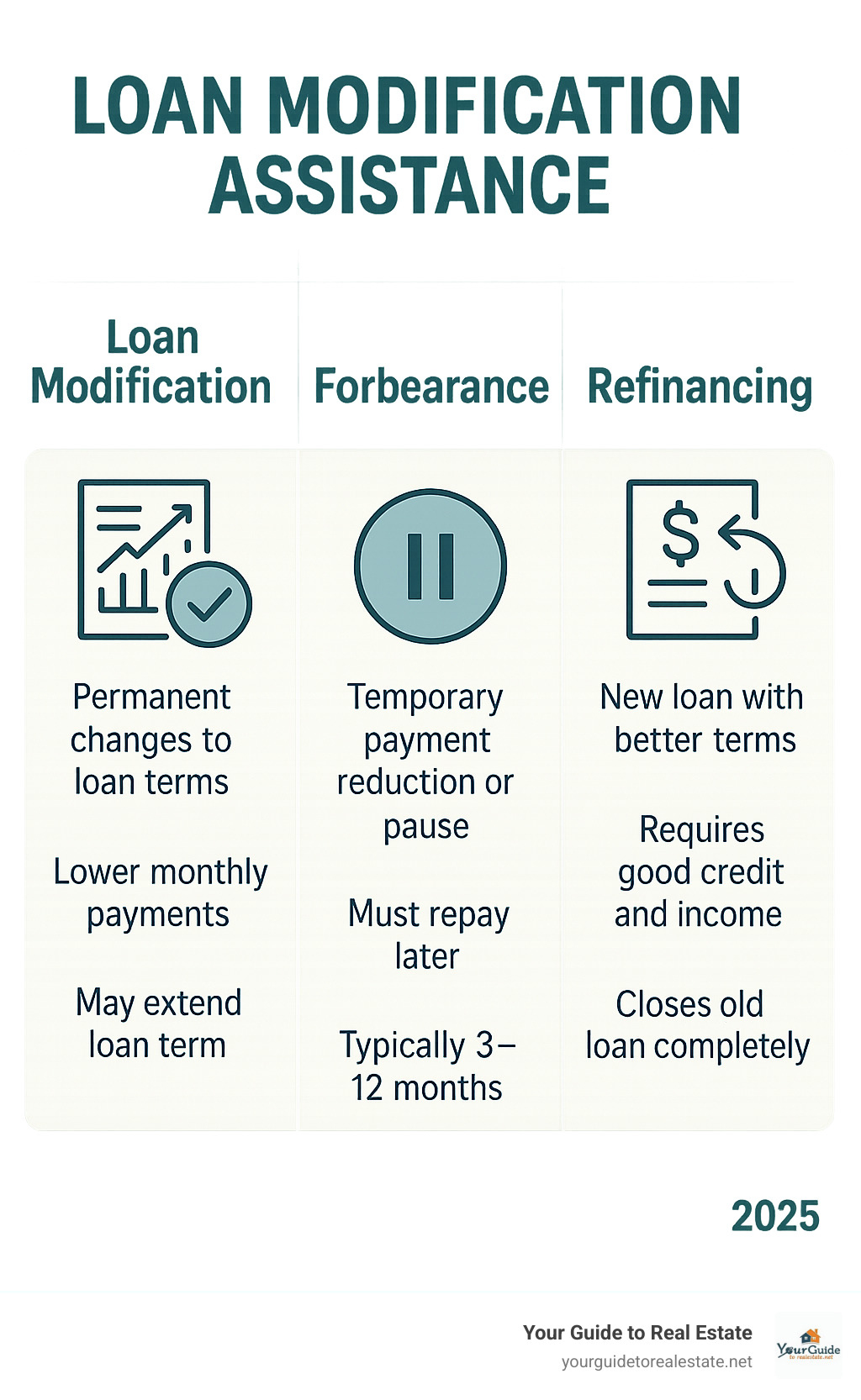
What Is a Loan Modification? A Permanent Solution to Mortgage Hardship
When mortgage payments become unmanageable, loan modification assistance offers a path to affordability. It’s an agreement with your lender to rewrite your original mortgage terms to fit your current financial reality.
Unlike temporary fixes, a loan modification creates permanent changes to your mortgage. Your lender might lower your interest rate, extend your payment timeline, or reduce your principal balance. The goal is to make your monthly payments affordable so you can keep your home.

This approach provides long-term relief by creating a sustainable payment plan that helps prevent foreclosure.
How It Works and How It Differs from Forbearance
A loan modification fundamentally changes your original mortgage agreement, creating new, permanent terms.
Forbearance, on the other hand, is a temporary pause. Your lender reduces or stops your payments for a short period, but you must make up those missed payments later. It’s a short-term solution, not a permanent fix.
| Feature | Loan Modification | Forbearance |
|---|---|---|
| Duration | Permanent change to your loan | Temporary relief, usually 3-12 months |
| Purpose | Make payments affordable long-term | Pause payments during short-term hardship |
| Outcome | New loan terms you can actually afford | Must repay paused amounts later |
If you’re facing ongoing financial challenges, a modification is usually the better choice.
Common Types of Loan Modifications
Lenders use several methods to make your mortgage more manageable:
- Interest rate reduction: Lowering your rate can significantly cut your monthly payment.
- Term extension: Stretching your loan to 40 years lowers your monthly payment, though you’ll pay more interest over time.
- Principal reduction: In some cases, the lender forgives part of what you owe. More commonly, they use principal forbearance, setting aside part of your balance to be paid at the end of the loan.
- Fixed-rate conversion: If you have an adjustable-rate mortgage, your lender might convert it to a fixed-rate mortgage for predictable payments.
The Pros and Cons of Modifying Your Loan
The biggest benefit of loan modification assistance is a lower monthly payment that fits your budget, allowing you to stay in your home and avoid foreclosure. You also gain stable, predictable payments if you switch to a fixed rate.
However, there are drawbacks. Your credit score might take a hit, though it’s usually less damaging than foreclosure. Extending your loan term means you’ll pay more total interest over the life of the loan. Additionally, if your lender forgives part of your principal, it could be considered taxable income. It’s wise to consult a tax professional.
If a modification helps you keep your home, the benefits often outweigh the drawbacks.
Qualifying for Loan Modification Assistance
Lenders and government programs want to help homeowners stay in their homes, but you must meet certain criteria to ensure the modification is a sustainable solution.
General Eligibility Requirements
Lenders need to see that you’re facing a real hardship and can afford a modified payment.
The most important requirement is demonstrating significant financial hardship. This could be due to:
- Job loss or reduced income
- Long-term illness or disability
- Divorce or death of a spouse
- A sudden increase in expenses, like property taxes
You’ll typically need to be at least one month behind on payments or show that default is imminent. The property must also be your primary residence, as these programs are designed to keep families in their homes.
Crucially, you still need enough stable income to afford the modified payment. Lenders want to set you up for success, not create a situation where you’ll struggle again.
For more background on how mortgages work, our guide on the loan process for buying a house provides helpful context.
Government-Backed and Conventional Loan Programs
Your modification options depend on your mortgage type.
- Conventional Loans (Fannie Mae/Freddie Mac): The Flex Modification program can reduce your monthly payment by up to 20% and extend your loan term to 40 years. It’s designed to be streamlined and borrower-friendly. See the Fannie Mae Flex Modification Fact Sheet for details.
- FHA Loans: Options can include an interest-free loan to bring your account current or extending your term to 40 years. Learn more about these loans in our guide on FHA Loan Requirements.
- VA Loans: The Department of Veterans Affairs offers assistance that can include rolling missed payments into your loan balance and establishing a new payment schedule, with terms up to 40 years. The VA provides resources at VA Help to Avoid Foreclosure.
- USDA Loans: For homeowners in rural areas, these modifications can extend the loan term to 40 years, reduce the interest rate, and provide a “mortgage recovery advance” to bring the loan current.
While the Home Affordable Modification Program (HAMP) ended in 2016, it paved the way for many of today’s more effective, streamlined programs.
The Step-by-Step Application Process
Applying for loan modification assistance takes organization and patience, but it’s a manageable process that typically takes 30-90 days. Start early for the best results.

Step 1: Contact Your Mortgage Servicer
Call your mortgage servicer the moment you anticipate trouble with payments. Ask for the loss mitigation department or “home retention” team. These specialists are trained to find solutions.
Be honest about your financial hardship and ask them to walk you through all available options, including loan modification. This first call is the most important step.
Step 2: Gather and Submit Your Documentation
Your servicer will send you a Request for Mortgage Assistance (RMA) form and a list of required documents. Your goal is to provide a complete financial picture. You’ll typically need:
- A hardship letter explaining your circumstances.
- Proof of income, such as recent pay stubs, tax returns, and statements for any other income sources.
- Bank statements from the last few months.
- A completed budget worksheet detailing your monthly income and expenses.
Make copies for your records and use certified mail or a secure online portal to submit your package. Incomplete paperwork is the most common cause of delays, so double-check everything. For more on financial documents, see our guide on understanding the escrow process.
Step 3: The Trial Period and Final Decision
If approved, you’ll likely begin a trial payment plan lasting three to six months. This involves making reduced payments at the proposed new amount.
Making every trial payment on time is crucial. It proves you can handle the new payment and allows your servicer to finalize the permanent modification.
After successfully completing the trial period, you’ll receive a final modification agreement. Review this document carefully before signing, as it contains your new permanent loan terms.
If your application is denied, your servicer must explain why, and you often have the right to appeal. Review the denial reasons and ask about the appeals process if you believe there was an error or have new information to provide.
Alternatives, Scams, and Finding Legitimate Help
Loan modification assistance isn’t always the right fit. It’s important to explore other options and be vigilant against scams targeting vulnerable homeowners.

What If You Don’t Qualify? Exploring Alternatives
If a modification doesn’t work out, you still have options:
- Forbearance: A temporary pause or reduction in payments, ideal for short-term hardships.
- Repayment Plan: Spreads overdue amounts over several months, adding them to your regular payment until you’re caught up.
- Refinancing: If you have good credit and equity, you can refinance your mortgage into a new loan with better terms.
- Short Sale: Your lender agrees to let you sell the property for less than you owe, which is less damaging to your credit than foreclosure.
- Deed-in-Lieu of Foreclosure: You voluntarily transfer the property title to the bank, avoiding a public foreclosure record.
How to Spot and Avoid Loan Modification Scams
Scammers prey on homeowners in distress. Watch for these red flags:
- Upfront fees: Legitimate counselors cannot charge you until they’ve delivered a written offer from your lender that you accept.
- Guaranteed approval: No one can guarantee a modification; the decision is up to your lender.
- Advice to stop paying your mortgage: Never pay a third party instead of your servicer.
- Pressure to sign over your title: This is a tactic to steal your home.
- Pressure tactics and unsolicited offers: Legitimate help doesn’t involve high-pressure sales.
The Consumer Financial Protection Bureau offers more guidance on what are mortgage loan modification scams?. If it sounds too good to be true, it probably is.
Where to Find Trustworthy Loan Modification Assistance
Seek help from reputable sources:
- HUD-approved housing counselors: These non-profits offer free or low-cost expert guidance. Find one through the HUD website.
- Your mortgage servicer: They know your loan and are required by law to work with you.
- Qualified attorneys: A real estate or foreclosure defense attorney can protect your legal rights, especially in complex cases. For servicemembers, the Legal Assistance Office provides support.
Always verify any company before working with them.
Frequently Asked Questions about Loan Modification Assistance
When facing mortgage troubles, you’ll have questions. Here are answers to the most common ones about loan modification assistance.
How long does the loan modification process take?
After you submit a complete application, expect the review process to take 30 to 90 days. The entire timeline, including document gathering and a potential trial period, can be longer. The key to a faster process is submitting a complete and accurate application from the start, as missing paperwork is the biggest cause of delays.
Can a loan modification stop an active foreclosure?
Yes, a loan modification application can pause an active foreclosure. Federal “dual tracking” rules generally prevent your servicer from proceeding with a foreclosure sale while they are reviewing a complete modification application.
However, timing is critical. You must submit your complete application well before the scheduled foreclosure sale date (typically at least 37 days prior). This pause provides the breathing room needed to find a solution.
Can you refinance your mortgage after a loan modification?
Yes. A loan modification is not the end of the road. After you’ve made consistent, on-time payments on your modified loan for a period—typically 12 to 24 months—you can often refinance into a new loan with potentially better terms. This waiting period demonstrates your financial stability to new lenders. Refinancing after a modification can be a great step toward long-term financial health.
Conclusion: Take Control of Your Mortgage Situation
When mortgage payments become a burden, you have options and power. Loan modification assistance can transform an overwhelming situation into a manageable one, but the key is taking action early.
The moment you anticipate financial hardship, contact your mortgage servicer. They prefer modifying your loan to costly foreclosure, giving you leverage. A modification is a permanent restructuring—through a lower interest rate, extended term, or principal reduction—that has helped countless homeowners.
Communication is your strongest tool. Be honest, provide complete documentation, and stay in contact with your servicer. For expert guidance, connect with a HUD-approved housing counselor.
At Your Guide to Real Estate, we believe the right information transforms stress into confidence. Mortgage difficulties don’t have to mean losing your home. With the strategies we’ve shared, you can take control and find a path forward.
Understanding Mortgages: A Beginner’s Guide to Home Loans