
Why Finding the Right Buyer’s Agent Makes All the Difference
Finding a buyers agent is one of the most important decisions in your home buying journey. With tens of thousands of agents in major markets, selecting the right professional can feel overwhelming—but it doesn’t have to be.
Quick Answer: How to Find a Buyer’s Agent
- Start with referrals from friends, family, and other professionals
- Search online directories and professional associations like NAEBA
- Interview at least 3 agents to compare their experience and approach
- Check credentials including designations like ABR® (Accredited Buyer’s Representative)
- Verify local market knowledge and recent sales in your target area
- Review client testimonials and online reviews carefully
Buying a home is likely the largest financial decision you’ll ever make. A skilled buyer’s agent is what one industry expert calls “a secret weapon in your home-buying arsenal”—someone legally obligated to look out for you and dedicated to getting you the best deal possible.
Your buyer’s agent is your advocate, negotiator, and guide. They help you avoid overpaying, spot red flags, and steer the complex paperwork of real estate transactions.
Sellers have professional representation through their listing agents. Without your own buyer’s agent, you’re representing yourself against seasoned professionals—much like going to court without a lawyer.
This guide will show you how to find, interview, and choose the right buyer’s agent for your needs and local market.
Explore more about finding a buyers agent:
What is a Buyer’s Agent and Why Do You Need One?
Think of a buyer’s agent as an experienced captain for your home-buying journey. They are a licensed real estate professional who works exclusively for you, representing your interests from the first property search to closing day.

What makes this relationship special is that your buyer’s agent has a fiduciary duty to you. This legal term means they are bound to put your best interests first. They must be loyal, honest, and work to get you the best possible deal—not the seller, not the brokerage, but you.
This is completely different from a seller’s agent (also called a listing agent). A seller’s agent works to get the highest price for the home seller, while your buyer’s agent fights to save you money and protect your interests.
Your buyer’s agent is your representative in every negotiation. They help you understand a home’s true worth through detailed market analysis and are negotiation experts who know how to structure winning offers. They are in your corner whether you’re dealing with multiple offers, tricky contract terms, or inspection issues.
For a complete overview of the home buying process, check out our guide on Easy Steps to Buying Your First Home.
The Key Benefits of Hiring a Buyer’s Agent
Finding a buyers agent is often the difference between a successful purchase and a costly mistake. Here’s why professional representation matters.
Market expertise is a huge advantage. Your agent knows your target neighborhoods inside and out, from school districts to future development plans. They can spot overpriced homes and help you understand what properties are really worth.
Access to MLS and other professional databases gives you an edge. Agents often see new listings first and have access to detailed property histories and market data you can’t get elsewhere. Many also know about off-market properties—homes not publicly listed that might be perfect for you.
Negotiation power is where agents truly earn their keep. They know how to write compelling offers, which contingencies to include, and how to structure deals that protect you while appealing to sellers.
Identifying red flags is another crucial skill. Experienced agents can spot potential problems with a property’s condition, pricing, or legal status that could cost you thousands later. They also have networks of trusted inspectors and contractors to help you make informed decisions.
Paperwork management is incredibly important. Real estate transactions involve dozens of forms and deadlines. Your agent ensures everything is filed correctly and on time, protecting you from legal issues.
Most importantly, a good buyer’s agent provides stress reduction. They handle the complex details so you can focus on finding your new home, with a knowledgeable partner guiding you every step of the way.
For more detailed preparation tips, explore our First-Time Homebuyers Toolkit: Everything You Need to Know Before You Buy.
Real Estate Agent vs. Realtor®: Understanding the Distinction
It’s important to understand the difference between a real estate agent and a Realtor® when finding a buyers agent.
A licensed agent is anyone who has passed their state’s real estate exam and maintains an active license. They can legally help you buy and sell property.
A Realtor®, however, is a member of the National Association of Realtors (NAR) and has agreed to follow a strict Code of Ethics. This code requires them to treat clients fairly, be honest, and put client interests above their own.
This higher standard means accountability. Realtors® can face disciplinary action from NAR if they violate ethical guidelines, giving you extra protection as a consumer.
When choosing an agent, look for the Realtor® designation. It shows a commitment to professional standards and ongoing education.
To learn more about what makes a great real estate professional, read our article on Real Estate Agent Skills.
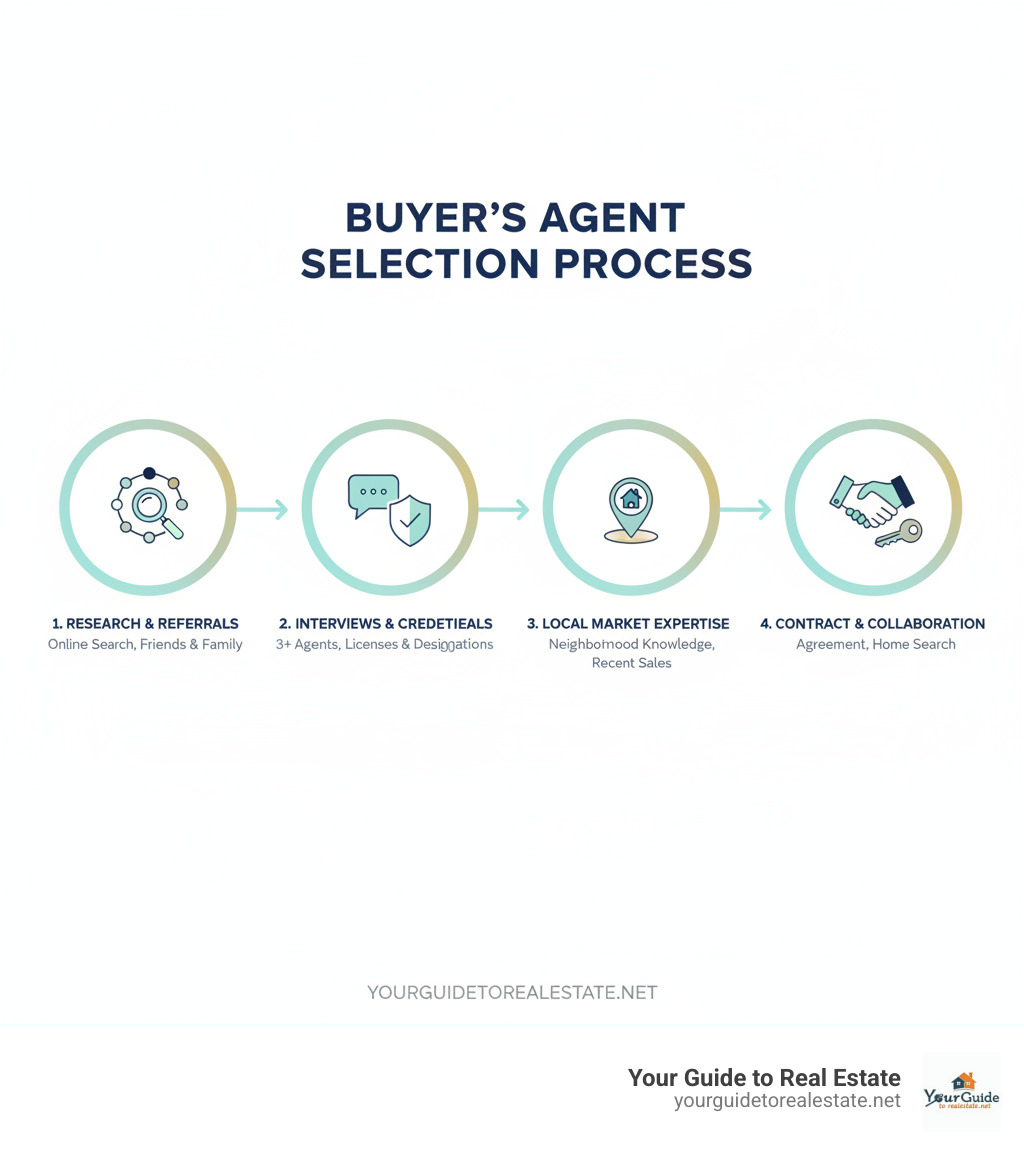
The Step-by-Step Process for Finding a Buyer’s Agent
Now that you know why you need a buyer’s agent, let’s walk through how to find the right one. Finding a buyers agent can seem daunting, but our proven framework provides a clear roadmap.

This process involves identifying potential candidates, vetting them, and making an informed decision based on who best fits your needs. Taking the time to find the right match will save you stress and money down the road.
For comprehensive guidance on this selection process, check out our detailed resource: How to Select the Best Real Estate Agent.
Where to Start Your Search for a Qualified Agent
The best place to begin finding a buyers agent is your own network. Personal referrals from friends, family, or colleagues who’ve recently bought homes are invaluable. Your mortgage lender or financial advisor may also have excellent recommendations.
While personal referrals are gold, don’t stop there. Online reviews and directories offer a wealth of information. Major real estate websites and search engines like Google showcase client testimonials and ratings that reveal an agent’s performance. Look for comments on responsiveness, negotiation skills, and overall satisfaction.
Professional organizations are another excellent resource. The National Association of Exclusive Buyer Agents (NAEBA) has a directory of agents who work only with buyers, eliminating potential conflicts of interest.
Brokerage websites can also be helpful, as many feature agent profiles with their specialties, recent sales, and client reviews.
What to Look For When Choosing an Agent
Once you have a list of candidates, it’s time to dig deeper. Look for a full-time professional. Real estate moves fast, and part-time agents often can’t keep up or be available when you need them.
Local market knowledge is crucial. Your agent should know your target neighborhoods inside and out—not just prices, but school districts, development plans, and traffic patterns. This expertise can make all the difference.
A proven track record speaks volumes. Look for someone who has completed multiple transactions recently, particularly with buyers in your price range and area. Ask for specific numbers, like how many homes they helped buyers purchase last year.
Communication style matters more than you might think. You’ll be talking to this person regularly, so make sure their preferences align with yours. Do they prefer calls, texts, or emails? How quickly do they respond?
Tech-savviness can give you an advantage. Agents who use technology effectively can search more efficiently, provide virtual tours, and streamline paperwork with e-signatures.
Finally, always ask for and contact client references. Past clients can give you the real story about what it’s like to work with an agent.
For more detailed guidance on making this important choice, read our How to Choose the Right Real Estate Agent: A Complete Buyer’s Guide.
The Importance of Designations for Finding a Buyer’s Agent
When finding a buyers agent, professional designations help identify committed professionals who have invested in specialized training beyond basic licensing.
The most relevant designation is the Accredited Buyer’s Representative (ABR®). This certification from the Real Estate Buyer’s Agent Council focuses on buyer representation, negotiation, and market analysis.
Other specialized certifications can be valuable depending on your situation. The SRES® (Seniors Real Estate Specialist) designation indicates expertise in helping buyers over 50, while the GREEN designation is for those interested in eco-friendly homes. For luxury properties, certifications in high-end marketing can be beneficial.
While designations aren’t everything, they show an agent’s commitment to professional development. They help identify agents who have gone the extra mile to excel at buyer representation.
The Interview: Key Questions to Ask Your Potential Agent
Finding a buyers agent is like hiring for a crucial role—you wouldn’t do it without a proper interview.

We strongly recommend interviewing at least three agents. This allows you to compare their personalities, experience, and approaches. The interview process helps you find someone who truly understands your style and needs. It’s also your chance to see how they handle questions under pressure—a skill you’ll want when they’re negotiating for you.
Here are the essential questions to ask:
- How long have you been a full-time agent, and how many buyers do you help each year?
- What is your experience in the neighborhoods I’m considering?
- Can you provide references from recent buyer clients?
- How do you prefer to communicate, and how often will I hear from you?
- What’s your strategy for finding properties, including off-market homes?
- How do you handle negotiations, especially in multiple-offer situations?
- How many clients are you currently working with?
- How do you help buyers identify potential problems with a property?
- Can you explain how you get paid, considering recent industry changes?
- What makes you different from other buyer’s agents?
Pay attention not just to their answers, but to how they answer. Are they confident? Do they ask good questions? A great agent will be as interested in learning about you as you are in them.
Questions About Their Experience and Strategy
Once you’ve covered the basics, dig deeper into what matters for your success.
Ask about recent sales in your target area. How close to the asking price did their buyers typically pay? This reveals their success rate in your specific market. An agent who consistently helps buyers win in tough markets has strategies that work.
Experience with your property type is also important. Buying a historic home is different from new construction, and condos have unique complexities. Ask directly: “How many [your property type] have you helped buyers purchase in the last year?”
Their strategy for multiple-offer situations is crucial. You want to hear about tactics beyond just offering more money. Do they help write personal letters or structure offers to be more appealing? Can they advise on when to compete versus when to walk away?
Discuss their communication planning and current client load. An agent juggling too many buyers may not give you the attention you deserve.
For insights into how agents analyze market conditions, check out our guide on Competitive Market Analysis Real Estate.
Understanding How Your Buyer’s Agent Gets Paid
This conversation is essential when finding a buyers agent. Understanding how your agent is compensated prevents surprises and helps you make informed decisions.
Traditionally, the seller paid both agents’ commissions from the sale price. This made the buyer’s agent service seem “free” to the buyer, though the cost was built into the home’s price.
The recent NAR settlement changed everything. This landmark agreement, approved in April 2024, altered how agent compensation works. Sellers are no longer required to offer compensation to buyer’s agents through the MLS.
What does this mean for you? You will likely need to pay your buyer’s agent directly. This could be a flat fee, an hourly rate, or a percentage of the purchase price, as negotiated with your agent.
Buyer-broker agreements are now incredibly important. These contracts outline the services your agent will provide and how much you’ll pay them. Don’t rush through this agreement—it protects both of you.
The silver lining is that fee negotiation is now more transparent. You’ll have direct conversations about what you’re paying for, giving you more control over the process.
Don’t be shy about discussing payment terms. A professional agent will be able to clearly explain their fee structure and the value they provide.
You can read about the recent NAR settlement from CNN to understand these industry changes better. For more context on agent earnings, visit How Much Do Real Estate Agents Really Make? With Real Numbers.
Frequently Asked Questions about Finding a Buyer’s Agent
Can I buy a house without a buyer’s agent?
Technically, yes, you can buy a house without an agent. But as one expert says, “Not having a buyer’s agent is like representing yourself in a court case – possible, but not advisable due to lack of expertise.”
Without professional representation, you’ll be at a significant disadvantage. The seller’s agent has a fiduciary duty to the seller, not you. You’d be negotiating against a seasoned professional while learning the rules as you go.
Dual agency, where one agent represents both buyer and seller, creates a conflict of interest that is never good for the buyer. Even with For Sale By Owner (FSBO) properties, the lack of expert guidance on both sides can lead to legal complexities and costly mistakes.
The paperwork alone can be overwhelming. Real estate contracts are legally binding, and missing a key detail can have serious consequences.
While you might save on agent fees, the potential financial and emotional costs of going solo far outweigh the savings. Finding a buyers agent gives you a professional advocate legally bound to protect your interests.
For more insight into contract terms, check out What Does Contingent Mean in Real Estate?.
How many agents should I interview before choosing one?
Our golden rule: interview at least three buyer’s agents. Think of it like getting multiple quotes for a major project—you want to compare your options to make the smartest choice.
The comparison benefits are huge. Each agent brings different experience, knowledge, and strategies. Interviewing several helps you see who truly understands your needs.
Finding the right fit is essential. You’ll be spending a lot of time with this person, so chemistry and trust are just as important as credentials.
Interviewing agents doesn’t obligate you to hire them. Be upfront that you’re speaking with multiple candidates; a good agent will respect your diligence.
What are the biggest red flags when choosing an agent?
When finding a buyers agent, knowing what to avoid is as crucial as knowing what to look for. Here are the warning signs that should make you look elsewhere:
- Part-time agents can be a problem. Real estate moves fast, and you need an agent who is fully available and plugged into the market.
- Poor communication is a deal-breaker. If an agent is slow to respond during the interview process, imagine how it will be when you’re under contract.
- High-pressure tactics are unacceptable. A good agent advises; they never push you into a decision you’re not comfortable with.
- Lack of local knowledge is a major red flag. If an agent isn’t an expert on your target area, they’re learning on your dime.
- A pattern of negative online reviews tells a story. One bad review might be an outlier, but multiple complaints about communication or ethics are a clear warning.
- Beware of agents who immediately slash their commission without a good reason. As experts note, you often get what you pay for, and a discount agent may be cutting corners elsewhere.
Trust your instincts. If something feels off, it probably is. Your agent should be a source of confidence, not stress.
Conclusion
Finding a buyers agent is about finding the right partner for one of life’s biggest adventures. This guide has walked you through how to make this crucial decision with confidence.
The right buyer’s agent is more than a real estate professional; they are your advocate, guide, and trusted advisor. Unlike a seller’s agent, your buyer’s agent is legally bound to put your interests first.
We’ve shown you our proven framework for identifying top candidates, from using personal referrals to looking for valuable designations like ABR®. The interview process is your chance to find an agent with the right experience, strategy, and local market knowledge.
Remember to discuss compensation upfront, especially with the recent NAR settlement changing how agents are paid. Most importantly, trust your instincts. If an agent seems unresponsive or unfamiliar with your target area, keep looking. The right agent will make your home buying experience feel empowering, not overwhelming.
At Your Guide to Real Estate, we’re passionate about providing the knowledge you need to succeed. Finding a buyers agent who fights for your best interests will transform your entire home buying journey.
Ready to take the next step? Begin your journey to finding the perfect agent with our complete guide and find how the right partnership can make your real estate dreams a reality.