
Why Understanding Home Values Matters for Every Real Estate Decision
Market vs. appraised value are two different ways to measure a home’s worth. Understanding the distinction can save you thousands and prevent deal-killing surprises.
Quick Answer:
- Market Value = What a buyer will actually pay for your home
- Appraised Value = What a licensed professional says your home is worth for lending purposes
- Key Difference = Market value drives your sale price; appraised value determines your loan amount
Here’s the reality: your home might sell for $400,000 (market value) but only appraise for $380,000. This $20,000 gap can derail the transaction if you’re unprepared.
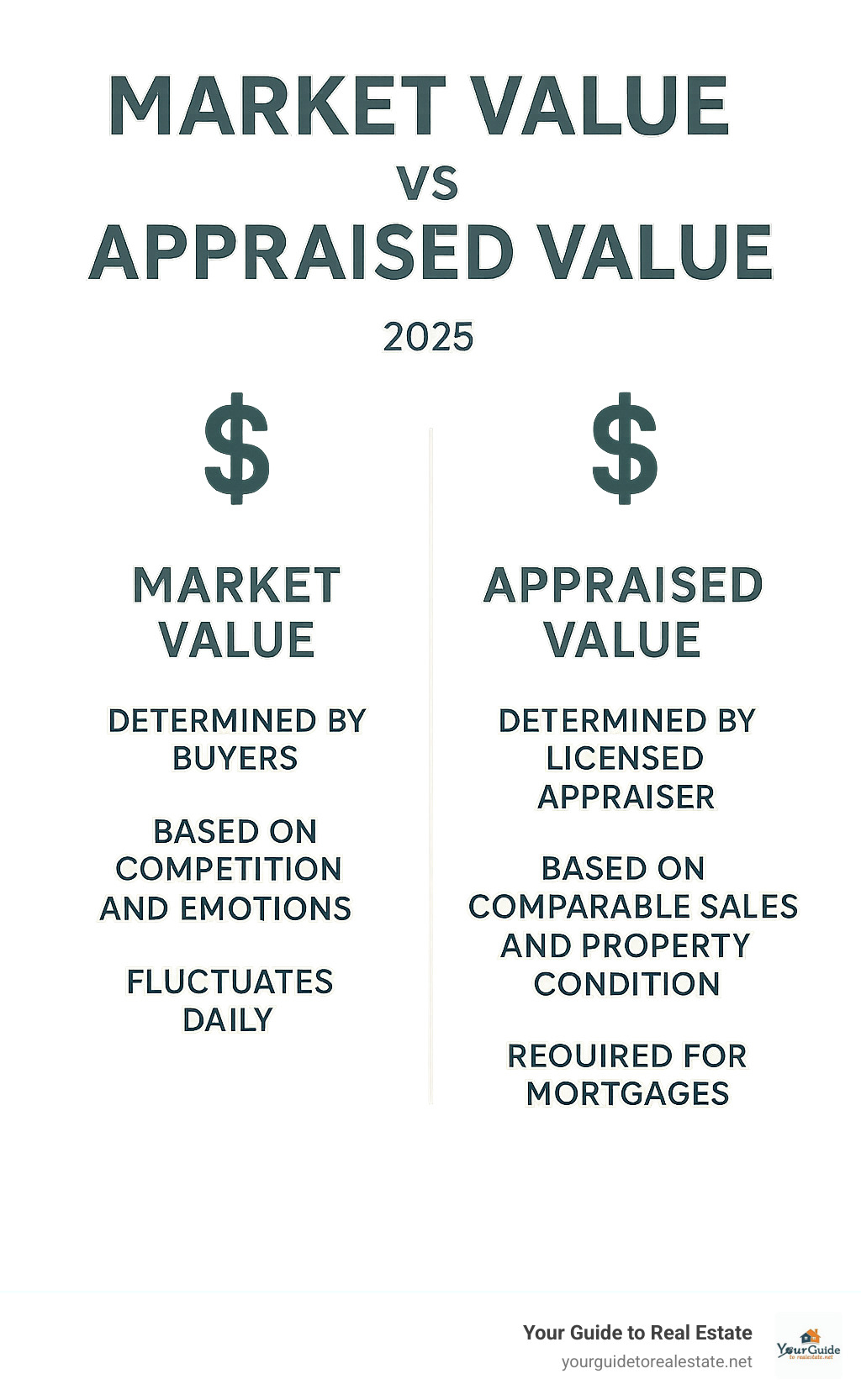
Market value is what buyers will pay based on emotion, competition, and market conditions. It’s driven by supply and demand and a home’s unique appeal.
Appraised value is an objective assessment by a licensed professional using standardized criteria. Lenders require it to protect their investment, ensuring they don’t loan more than the home is worth.
As real estate expert Sergio Llach notes: “The people who buy have been here at least 10 times before. They’re confident in what they want.” This buyer confidence can push market values above appraised values, especially in hot markets.
The stakes are high. A low appraisal can force buyers to bring more cash to closing or walk away. For sellers, it can mean lowering the price or losing the sale.
What is Market Value? The Price a Buyer is Willing to Pay
Market value is what a buyer is willing to pay for your home today. It’s the real-world price that emerges from buyer competition, not what you think it’s worth or what you paid for it.

Market value is a dynamic number that fluctuates with supply and demand, economic trends, interest rates, and local job growth. Buyer sentiment is also a major factor; confident buyers pay more, while nervous buyers are more cautious. Even location popularity can change, turning an up-and-coming neighborhood into today’s hottest market.
Market value is tricky because it’s emotional. A buyer might overpay for a kitchen they love, while another might lowball. The seller’s asking price is just the starting point.
How Market Value is Determined
Real estate agents determine market value with a Comparative Market Analysis (CMA), using data to find what buyers will pay for homes like yours.
The process starts with recent comparable sales (“comps”)—similar homes sold in the last few months. A nearby sale is the best clue to your home’s current value. We also analyze current listings to see your competition and expired listings to learn what prices were too high for buyers. Expired listings clearly show the market’s upper limit.
Market conditions are critical. In a seller’s market, bidding wars can push prices well above asking. In a buyer’s market, aggressive pricing may be needed to attract attention.
We also track U.S. housing market trends, as national factors like mortgage rates influence local buyers. For reliable data, many professionals consult resources like the National Association of REALTORS® Research and Statistics. When rates jump, fewer buyers can afford your price range.
Subjective factors like a large backyard, a quiet cul-de-sac, or a desirable open floor plan create emotional appeal that can boost market value beyond what the numbers suggest.
For a detailed look at how we analyze your local market, check out our guide on How to Do a Competitive Market Analysis (CMA) in Real Estate.
The Role of Market Value in Selling a Home
When selling, market value guides your listing price. Pricing too high deters buyers; too low leaves money on the table. Correct pricing is crucial for attracting buyers and starting the home selling process successfully.
Smart pricing creates momentum, leading to more showings, faster offers, and competing bids. This gives you leverage in your negotiation strategy. Understanding market value removes the guesswork from pricing, allowing you to set a price confidently, knowing it’s supported by market data.
Your final sale price is the ultimate proof of market value. Until a buyer closes the deal, everything else—from CMAs to online estimates—is just an educated guess.
For more insights on pricing your home strategically, explore our comprehensive Ultimate Guide to Selling Your Home.
What is Appraised Value? A Lender’s Professional Assessment
When you buy a home with a mortgage, the lender needs to protect their investment. Appraised value is a licensed appraiser’s objective opinion of a home’s worth, separate from what a buyer is willing to pay.

Lenders aren’t emotional; they focus on facts. If a borrower defaults, the lender must be able to sell the property to recoup their money. The appraisal provides this security.
This assessment impacts your loan-to-value (LTV) ratio, determining your loan amount. Lenders typically finance a percentage of the appraised value, not the purchase price. If you offer $350,000 but the home appraises for $320,000, your loan is based on the lower figure.
The appraisal typically costs $300-$400. The lender chooses the appraiser to ensure an unbiased opinion, acting as insurance for the transaction.
Factors That Influence Appraised Value
Licensed appraisers follow strict guidelines, viewing a home differently than buyers. They are trained to consider specific, measurable factors affecting a home’s worth.
Property condition is critical. Appraisers examine the foundation, roof, and any structural issues. They also precisely measure square footage and consider the age and quality of construction.
Recent upgrades and renovations, like kitchen and bath remodels or new HVAC systems, can boost appraised value. Documenting these improvements for the appraiser can make a significant difference.
Location factors like proximity to good schools and shopping increase value, while being next to a busy highway might decrease it. The appraiser also considers zoning.
The most important factor is comparable sales data. Appraisers use recent, similar home sales, making precise adjustments for differences. Their comparison standards are often stricter than those used in a market analysis.
Appraisers use three main approaches: the Sales Comparison Approach (comparing to similar sold homes), the Cost Approach (estimating replacement cost), and the Income Approach (for rental properties). For most homes, the Sales Comparison Approach is most important.
Why Appraised Value is Crucial for Mortgages
Understanding why lenders require appraisals explains the challenges that arise from market vs. appraised value differences.
Protecting the lender is the primary goal. The appraisal prevents the bank from lending more than a home is worth, acting as a safety net against borrower default.
Your loan amount is determined by the appraised value, not the offer price. If the appraisal is low, you may need to bring more cash to closing or renegotiate.
The appraisal also affects Private Mortgage Insurance (PMI). If your loan exceeds 80% of the appraised value, you’ll likely pay PMI. A higher appraisal can help you avoid this cost.
Refinancing and home equity loans also require a current appraisal to determine the property’s present value.
The bottom line: Appraisals protect everyone by ensuring the loan is supported by the home’s value. A low appraisal can be frustrating, but it prevents you from overpaying and taking on too large a mortgage.
The Core Differences: Market vs Appraised Value Explained
Market vs. appraised value sound similar but are fundamentally different. Think of it as a first date versus a job interview—both are evaluations, but with different purposes and outcomes.
Market value is the dynamic, emotional pulse of the current market, driven by buyers and sellers. Appraised value is a methodical, objective assessment designed to protect a lender’s investment.
| Feature | Market Value | Appraised Value |
|---|---|---|
| Purpose | Determine what buyers will actually pay | Protect lender and determine loan amount |
| Who Determines It | Buyers and sellers in the open market | Licensed professional appraiser |
| Basis | Mix of emotions, competition, and data | Objective data and standardized methods |
| Volatility | Changes daily with market conditions | Static snapshot at a specific moment |
The key distinction is that market value drives the sale price, while appraised value determines the loan amount. This difference is critical and can make or break a deal.
Understanding the purpose behind market vs appraised value
Market value is your sales strategy compass. Whether in Dallas or Oklahoma City, it tells you what’s realistic, reflecting buyer demand and economic conditions. Emotion and urgency can push market value beyond data-driven estimates.
Appraised value is about risk management for the lender. They need facts to ensure the property’s value can cover the loan in case of foreclosure. It’s their insurance policy.
The two values often align in a stable market with a standard property. When buyers and sellers are motivated and the home has had proper market exposure, the appraisal should ideally match the sales price. However, in hot markets, emotional buyers can push market values past what appraisers deem reasonable based on comps.
How market vs appraised value impacts buyers and sellers differently
The gap between these values creates different challenges depending on your role in the transaction.
For a buyer, financing depends on the appraisal. If you offer $350,000 and the home appraises for $330,000, the lender will only finance the lower amount. You must then cover the $20,000 gap, renegotiate the price, or walk away. This gives you negotiation leverage.
For a seller, profit depends on market value. If your home sells for $400,000 but only appraises for $380,000, the deal is at risk. Smart sellers anticipate the appraised value before listing to set realistic expectations.
This potential for conflict is where transactions often get rocky, with buyers caught between their dream and their financing, and sellers frustrated by an appraiser’s opinion.
The good news? Understanding both values from the start helps you steer these challenges with confidence. At Your Guide to Real Estate, our stress-free guidance helps both buyers and sellers prepare for these scenarios, turning potential roadblocks into manageable negotiations.
Navigating Valuation Gaps in a Real Estate Transaction
When market and appraised values don’t align, it can feel like a setback. This is common, especially in competitive markets. The good news is that there are clear solutions.

An appraisal gap is a negotiation opportunity, not a deal-killer. With the right guidance, most gaps can be bridged. The key is to understand your options early.
What Happens When the Appraisal is Lower Than the Offer?
Imagine you offer $350,000 for a home, but it appraises for only $330,000. Your lender will only finance the lower amount, leaving you with a $20,000 gap. Don’t panic. A low appraisal has several solutions, and most deals still close.
- Bring extra cash to closing. If you have the savings, you can cover the difference. Buyers in competitive markets often budget for this possibility.
- Renegotiate the purchase price. Asking the seller to lower the price to the appraised value is a practical solution. The low appraisal provides strong evidence for your request.
- Ask for seller concessions. If the seller won’t lower the price, they might agree to cover closing costs or pay for repairs, which helps offset your cash outlay.
- Use your appraisal contingency clause. This clause, common in purchase agreements, is your safety net. It lets you walk away with your earnest money if you can’t reach an agreement with the seller.
- Walk away. If the gap is too large or the seller is inflexible, your contingency protects you from overpaying.
You can also contest the appraisal if you suspect an error by providing better comps or documentation of improvements. A second appraisal is an option, but the lender may not accept it.
What Happens When the Appraisal is Higher Than the Offer?
Here’s a scenario every buyer loves: you offer $350,000, and the home appraises for $370,000. Congratulations, you’ve found a great deal!
You’ve gained instant equity. In this case, you’d have $20,000 in equity at closing, giving you a financial cushion from day one.
This confirms you made a smart offer. You’ve secured a property for less than its appraised worth, whether due to a motivated seller or your own sharp eye for value.
Your loan amount stays the same, based on the $350,000 purchase price. The lender won’t require you to borrow more.
Best of all, the seller can’t demand more money. The signed purchase agreement locks in the price, regardless of the appraisal outcome.
This scenario usually leads to a smooth closing. The lender is confident, and you can move forward knowing you’ve made a great investment.
Frequently Asked Questions about Home Valuation
Home valuation can be overwhelming. Between market vs. appraised value, tax assessments, and CMAs, the terminology is confusing. Here are answers to the most common questions.
How does a tax assessment differ from market and appraised value?
A property’s tax assessment is the value a local government uses to calculate your annual property taxes. This differs from market value (for pricing a sale) and appraised value (for securing a loan).
Government assessors use mass appraisal techniques, relying on broad data to value many properties at once. This is less detailed than an individual home appraisal. Because of this, assessed values often differ from true market values.
Texas is a good example. Properties are reassessed at least every three years at market value. However, mass appraisal methods mean these assessments often differ from actual sale prices.
If you believe your tax assessment is too high, you can protest it. Homeowners in Dallas, Oklahoma City, and other markets often succeed, saving significantly on property taxes.
Can a homeowner influence their property’s appraised value?
While you can’t dictate your home’s value to an appraiser, you can take steps to ensure they see its full worth.
- Provide documentation. Give the appraiser an organized folder with records of all major improvements, including receipts and permits. This can significantly support a higher valuation.
- Make basic repairs. Fixing leaky faucets, broken windows, and peeling paint shows the home is well-maintained. Deferred maintenance can lead to value reductions.
- Boost curb appeal. A tidy exterior and clean landscaping create a positive first impression, suggesting the home is well-cared for.
- Highlight permanent upgrades. Features like renovated kitchens, energy-efficient systems, and decks add lasting value and catch an appraiser’s eye.
For more detailed guidance on preparing your home, check out our Quick Home Sale Tips – many of these strategies work beautifully for appraisals too.
What is a CMA and how is it different from an appraisal?
CMAs and appraisals both analyze comparable sales, but they have different purposes and authority.
A Competitive Market Analysis (CMA) is a real estate agent’s educated opinion of a home’s potential sale price. It’s a tool to guide sellers on listing prices and buyers on offers. CMAs are typically complimentary and analyze recent sales, current listings, and expired listings. It’s an informed opinion, not a formal valuation.
Appraisals are formal, legal valuations performed by licensed professionals following strict standards. Lenders rely on this document for financing decisions.
The key difference is authority and purpose. A CMA is a pricing strategy tool, while an appraisal is a legally recognized valuation for lending purposes. A CMA is like getting directions from a knowledgeable local; an appraisal is like using a precise GPS. Both are valuable but serve different needs.
To learn more about how we conduct market analysis, visit our guide on How to Do a Competitive Market Analysis (CMA) in Real Estate.
Conclusion
Understanding market vs. appraised value is key to making smart property decisions that protect your financial future. These two values are different lenses for viewing your home’s worth, each with a vital purpose.
Here’s what you need to remember: market value is the real-world price a buyer will pay, influenced by competition, emotion, and market forces. This is what you can actually sell your home for.
Appraised value, on the other hand, is the methodical assessment lenders use to protect their investment. It’s based on hard data and professional standards, and it determines what a bank will lend against your property.
When these values don’t align—and they often do in dynamic markets—you’re prepared with options instead of surprised by obstacles. Knowledge gives you the confidence to negotiate an appraisal gap or celebrate instant equity.
At Your Guide to Real Estate, we believe that informed decisions lead to successful outcomes. Our proven framework takes the stress out of navigating these complexities, whether you’re buying your first home, selling a cherished property, or building an investment portfolio. We’re here to guide you through every twist and turn of the real estate market.
Ready to put this knowledge to work? Connect with our team today, and let’s turn your real estate goals into reality with clarity, confidence, and our signature stress-free approach.