
Why Choosing the Right Estate Agent Matters
How to find a good estate agent is a critical decision when buying or selling a home. With over 1.3 million licensed professionals in the US, the options are overwhelming. Still, 89% of sellers list with an agent because they are invaluable for marketing homes, finding buyers, and navigating the complex transaction process.
Here’s a quick overview to get you started:
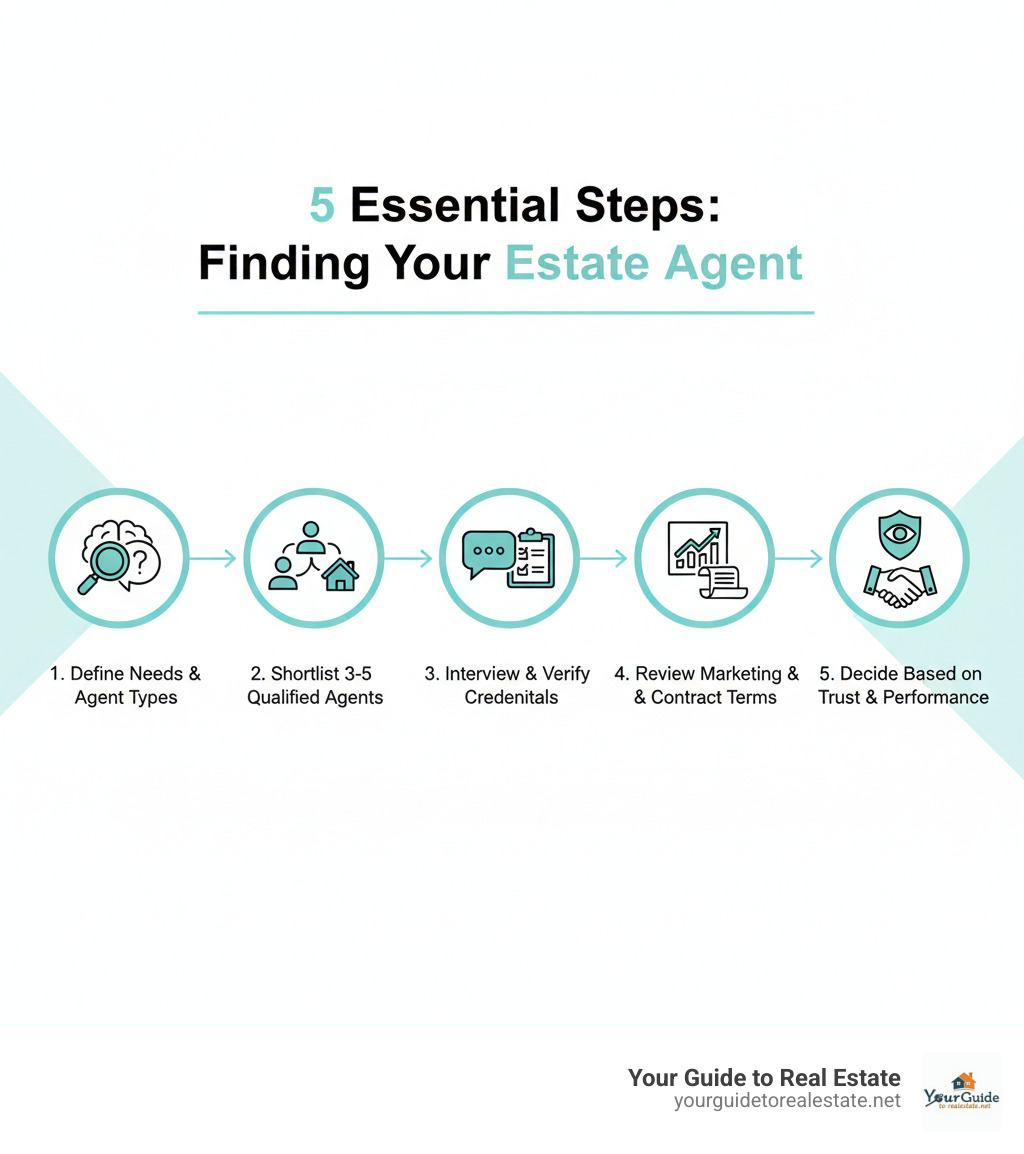
5 Essential Steps to Find a Good Estate Agent:
- Get referrals from friends, family, and neighbors.
- Research agents online by checking reviews and sales history.
- Interview at least three agents—don’t make the common mistake of stopping at one.
- Verify credentials, including licensing and disciplinary records.
- Compare marketing strategies to ensure a solid plan.
The stakes are high. The wrong agent can lead to a lower sale price and months of stress, while the right one becomes a trusted partner who negotiates on your behalf for the best outcome. However, many agents make similar claims, from high valuations to low fees, which can be red flags. This guide provides a proven framework to find a qualified and trustworthy agent for your specific needs.
Quick how to find a good estate agent terms:
Step 1: Laying the Groundwork Before You Search
Before searching, lay the groundwork to make the process less overwhelming. Start with referrals from friends, family, and neighbors. When asking for a recommendation, ask the most important question: “Would you use that person again?” A confident “yes” speaks volumes. However, a referral is just a starting point, as your needs may differ.
Next, define your needs clearly. Are you buying, selling, or both? A buyer’s agent advocates for you during a purchase, while a seller’s agent (or listing agent) markets your home for the best price. For more specific advice, see our guides on How to Choose a Selling Real Estate Agent and How to Find a Good Buyer’s Agent.
Understanding Agent Types
Knowing the terminology helps you make smarter choices.
- A real estate agent is licensed by the state to handle property transactions.
- A Realtor is a licensed agent and a member of the National Association of Realtors (NAR), who pledges to follow a strict code of ethics. This signals a commitment to higher professional standards.
- A real estate broker has an advanced license, indicating more training and experience. They can work independently or supervise other agents.
Comparing Service Models
Different agents have different service models. Understanding them helps you choose what fits your needs and budget.
| Service Model | Fees | Service Level | Process |
|---|---|---|---|
| Traditional Agent | Typically 5-6% of the sales price, usually paid by the seller and split between agents. | Full-service, hands-on guidance from start to finish, including staging, marketing, negotiations, and closing. | In-person consultations, property showings, extensive marketing efforts, and direct negotiation with buyers/sellers. |
| Online Agent | Often a cheaper fixed fee, sometimes paid upfront. | Varies widely; can range from basic listing services to more comprehensive packages. May require more DIY from the client. | Online platforms for listings, communication often digital, client may handle viewings or negotiations. |
| Transactional Agent | Commission structure varies, usually paid by seller. | Facilitates the transaction but has no fiduciary responsibility to either buyer or seller. Acts as a neutral party. | Handles paperwork, ensures legal compliance, but does not advise or negotiate on behalf of either party. |
| Dual Agent | Typically earns full commission from both sides. | Represents both buyer and seller in the same transaction. Can be a conflict of interest, as their fiduciary duty is split. | Manages both sides of the deal, but cannot advise either party on negotiation or strategy that would harm the other. Often restricted or illegal in some states. |
The most common model is the traditional agent, with a commission of 5% to 6% of the sales price, typically paid by the seller. The “no sale, no fee” approach aligns the agent’s success with yours. While the upfront fees of online agents seem appealing, you pay regardless of the outcome. Consider how much support you need. For comprehensive guidance and expert negotiation, a traditional agent often provides the best value.
Step 2: How to Find a Good Estate Agent to Shortlist

Now it’s time to build a list of potential agents. Avoid the common mistake made by 59% of sellers who only contact one agent. Your goal is to create a shortlist of 3-5 agents to interview and compare.
Finding Potential Agents Online
The internet is a powerful tool for finding agents, but use it wisely.
- Agent-matching services can connect you with local agents, but be aware that some “premier” placements are paid ads.
- Online reviews on sites with Realtor Reviews offer deep insights. Read the comments, not just the star ratings, and note how agents respond to negative feedback.
- An agent’s website is their digital storefront. A professional site with high-quality listings suggests attention to detail and modern marketing skills.
- A professional social media presence on platforms like Facebook and Instagram demonstrates marketing savvy.
Leveraging Your Local Area
Don’t underestimate the value of on-the-ground research.
- Notice the “For Sale” signs in your neighborhood. Which ones quickly turn to “Sold”? This shows who is getting results in your market.
- Attending open houses is a low-pressure way to observe an agent’s professionalism, knowledge, and interaction style.
- Look for agents with multiple local listings, but be cautious. An agent who is too busy may not give your property the attention it deserves.
- Community involvement shows an agent has deep local roots and genuinely cares about the area they’re selling.
For long-distance moves, ask your current agent for a referral or seek out a relocation specialist. Once you have your shortlist, you’re ready to start the interview process.
Step 3: The Interview and Vetting Process

The interview is the most crucial step in how to find a good estate agent. Treat it like a job interview: prepare questions in advance and ask each candidate the same ones for a fair comparison. Our Questions to Ask Realtor guide is an excellent starting point.
Pay attention to their communication style. A good agent listens to your goals rather than dominating the conversation. Also, test their responsiveness from your first contact. Slowness now could signal problems later.
Key Qualities to Look for When Deciding How to Find a Good Estate Agent
Look for these qualities that translate into results:
- Experience: Aim for an agent with at least five years in the business, as they’ve likely handled various market conditions.
- Local Market Knowledge: They must know your neighborhood inside and out, from recent sales to school districts. Test their knowledge by asking about a recent local sale.
- Specialization: An agent specializing in properties like yours (e.g., luxury condos vs. suburban homes) will be more effective. Ask about their specialty and any credentials like CRS (Certified Residential Specialist).
- Communication Skills: They should explain complex terms clearly, negotiate professionally, and adapt to your preferred communication style and frequency.
- Tech-Savviness: Modern agents should use professional photography, 3D virtual tours, and wide online listing syndication to maximize your property’s exposure.
- Professional Awards: Recognition from organizations like the National Association of Realtors can indicate peer-recognized excellence.
Verifying Credentials and Track Record
Trust but verify. Take these steps to vet your top candidates:
- Check their state license status on your state’s real estate commission website. Confirm it’s active and check for any disciplinary actions.
- Ask for and call recent client references. Ask specific questions about the sale price vs. asking price, time on the market, and whether they would hire the agent again. Our guide on Real Estate Agent Selection offers more vetting strategies.
- Analyze their track record. A high list-to-sale price ratio suggests strong pricing and negotiation skills, while a low average days on market indicates effective marketing.
Investing time in this vetting process will pay off when your property sells quickly and for the best price.
Step 4: Decoding the Marketing Strategy and Listing Agreement

A strong marketing plan is critical—more than half of sellers (52%) say their agent’s ability to get their home in front of the largest pool of interested buyers is among the most important factors. Ask agents to walk you through their specific strategy.
A solid plan must include professional photography, as high-quality images are essential for online listings. Look for agents who also use modern tools like virtual tours and 3D walkthroughs. Your agent must list your property on the Multiple Listing Service (MLS) to ensure it reaches the widest audience via other real estate websites. Also, ask about their approach to social media marketing, open houses, and traditional “For Sale” boards. Request to see examples of past marketing materials to judge their quality and strategic approach.
Understanding Commission and Contracts
Don’t be shy about discussing money and contracts. In the US, the typical real estate commission is 5% to 6% of the sales price, paid by the seller and split between the agents. For a detailed breakdown, see our guide on Who Pays Realtor Fees?.
While commission can sometimes be negotiated, choosing an agent based on the lowest fee can backfire. A discount agent might save you 1% on commission but cost you 5% on the final sale price due to poor marketing or negotiation. Focus on value, not just cost.
The listing agreement is your contract with the agent. Read it carefully before signing, paying close attention to:
- Contract Length: Aim for a reasonable period, like 3-6 months, to avoid being locked in with an underperforming agent.
- Cancellation Clauses: A confident agent will offer a cancellable agreement without penalty if you’re unsatisfied. A long, non-cancellable contract is a red flag.
- Fee Trigger: Ensure the commission is due upon the successful closing of the sale, not just on finding a buyer who might back out.
A good agent will welcome your questions about the contract. If they seem evasive, they are not the right agent for you.
Step 5: Red Flags and Making Your Final Decision

Before making your final decision, watch for red flags and trust your instincts. Your relationship with an agent is built on trust, so if something feels off, pay attention.
Key red flags to watch for include:
- Over-promising: Be wary of an agent who suggests a valuation significantly higher than comparable sales. This tactic, used to win your business, often leads to a stale listing that requires price drops later. A trustworthy agent provides an honest, data-backed analysis.
- Pressure Tactics: A good agent gives you space to make a decision. If someone rushes you to sign a contract, it’s a clear sign to walk away.
- Dual Agency: This is when one agent represents both buyer and seller, creating a conflict of interest. We recommend choosing an agent who has a history of dual agency in less than 10% of their transactions to ensure they are fully advocating for you.
- Excessive Workload: An agent juggling too many clients (e.g., more than seven active clients) may not give your property the attention it deserves. Ask about their current workload to ensure they have the bandwidth for you.
- Unclear Team Structure: If the agent works with a team, clarify who your primary point of contact will be. You should be comfortable with the person handling your day-to-day communications.
For more tips on making your choice, see our guide on How to Select the Best Real Estate Agent.
Final Checks Before You Decide How to Find a Good Estate Agent
Before you commit, run through this final checklist:
- Reconfirm dual agency history: Ensure it’s minimal (ideally under 10%).
- Verify current workload: Make sure they have time for you.
- Clarify the team structure: Know who you’ll be working with.
Once you’ve made your choice, inform the agent and establish the next steps. It’s also a professional courtesy to thank the other agents you interviewed for their time.
Frequently Asked Questions about Finding an Agent
Here are answers to common questions about how to find a good estate agent.
What is the difference between a real estate agent and a Realtor?
A real estate agent is licensed by the state to facilitate property sales. A Realtor, on the other hand, is a licensed agent who is also a member of the National Association of Realtors (NAR) and is bound by its strict code of ethics. This membership provides an extra layer of professional accountability.
How many estate agents should I interview?
We strongly recommend interviewing at least three agents. A surprising 59% of sellers only contact one agent, which means they can’t compare strategies, personalities, or marketing plans. Interviewing multiple candidates allows you to make an informed choice for one of your biggest financial transactions.
Is the agent with the lowest commission the best choice?
Not necessarily. It’s tempting to choose the cheapest option, but focus on overall value. A low-commission agent might lack the marketing or negotiation skills to get you the best price. For example, saving 1-2% on commission is a poor trade-off if their strategy results in a 5% lower sale price.
A top-performing agent who secures a higher sale price is often more valuable, even with a standard commission. While commission rates are often negotiable, don’t choose an agent on fee alone. The best value comes from the best result, not the lowest price.
Conclusion
Finding a good estate agent is about more than picking a name; it’s about finding a partner for one of your biggest financial decisions. The right agent understands your needs, communicates openly, and has a proven track record. They will guide you through pricing, negotiation, and the complexities of the transaction, whether you’re in Dallas, Oklahoma City, or elsewhere.
This framework was designed to give you the confidence to ask the right questions, compare candidates, and trust your final decision. At Your Guide to Real Estate, we believe that with the right information, anyone can succeed. You’re not just looking for an agent—you’re looking for peace of mind.
Ready to take the next step? Learn more about choosing the right real estate partner for your journey and see how our proven framework can guide you to success.