

Why Estate Agency News Matters More Than Ever
Estate agency news is evolving rapidly in the UK and US. Major regulatory changes, economic shifts, and tech innovations are reshaping how properties are bought and sold. Here’s what you need to know:
Key Developments:
- UK Regulatory Reform – Government proposals for mandatory upfront information disclosure, binding contracts, and professional qualifications for agents
- Market Pressures – US existing-home sales dropped 4.9% in January; inflation jumped to 3%, pushing mortgage rates higher
- Transaction Failures – Approximately one-third of UK property transactions fail, costing £400 million annually in wasted expenses
- Trust Crisis – Only 37% of people trust estate agents, driving calls for industry-wide standards
- Tech Integration – AI, digital property logbooks, and proptech innovations are changing how agents operate
The real estate industry is at a crossroads. In 2024, the UK’s Property Ombudsman investigated 617 cases of inadequate disclosure on issues like flood risk. Meanwhile, American homebuilders face slowing construction as single-family starts dropped 8.4% in a month.
These changes will impact your experience whether you’re buying, selling, or working as an agent. Proposed UK reforms aim to cut the home-buying process by four weeks and save first-time buyers an average of £710, while also requiring agents to meet new professional standards.
Understanding these shifts isn’t optional anymore—it’s essential for navigating today’s complex property market with confidence.
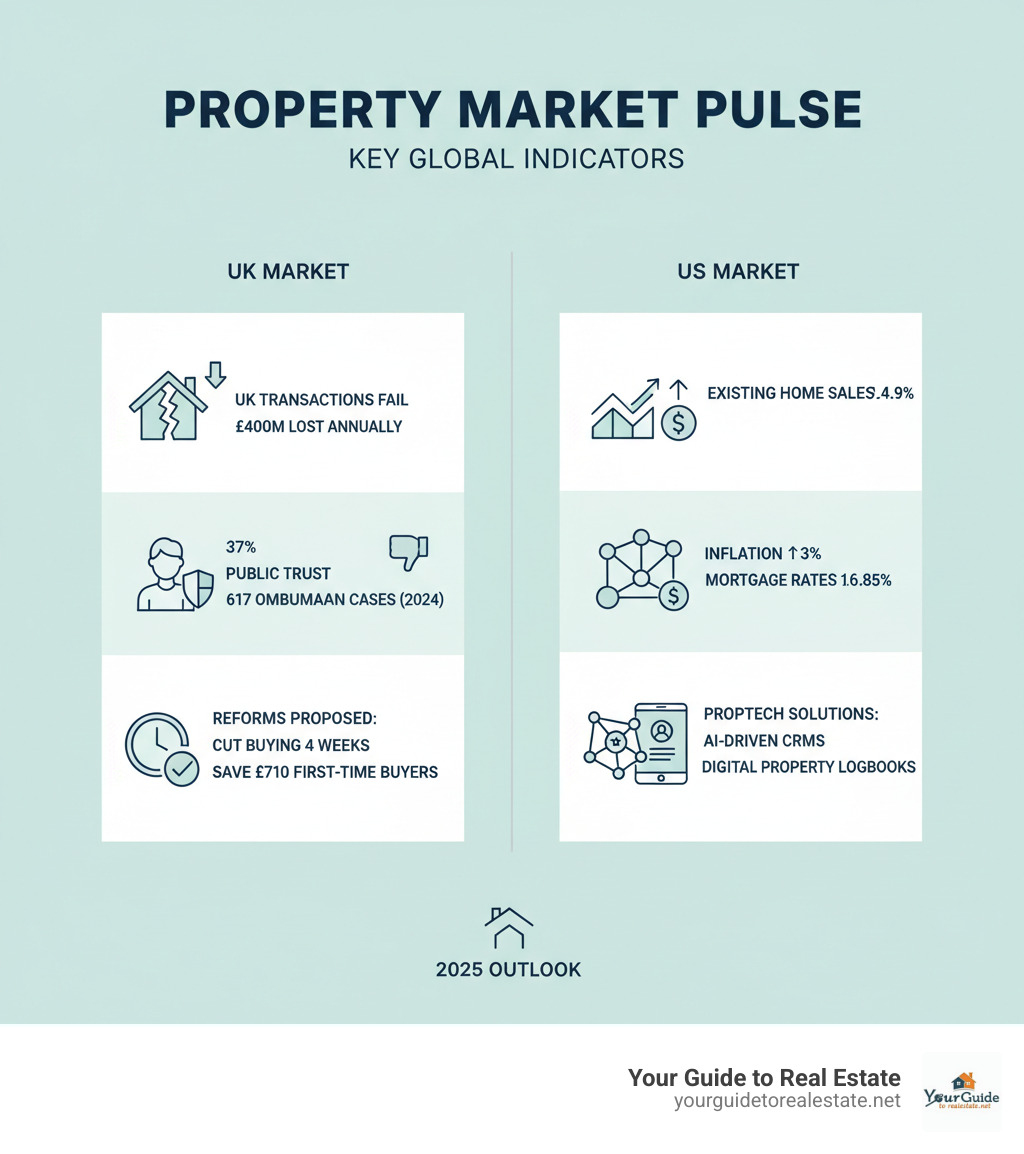
Global Market Pulse: Key Trends in the UK and US

Following estate agency news reveals the UK and US markets are related but distinct. Both face economic pressure but are responding differently. Let’s break down what’s happening.
UK Housing Market Update
The UK housing market is in a “wait and see” phase, with a patchwork of local conditions. High mortgage rates, influenced by economic uncertainty, are keeping many buyers on the sidelines.
The good news? The government is stepping up with serious money to boost construction. We’ve seen an emergency package for London and a massive £500m boost for the Oxford-Cambridge corridor—with up to £400m for affordable homes and infrastructure in Cambridge. These are real commitments aimed at tackling the housing shortage.
First-time buyer schemes are also getting a refresh to help people with deposits and upfront costs. Despite this, the market still feels stuck in places, and the conversation around how to unblock housing delivery continues.
US Market Snapshot
The US market started the year on shaky ground. Existing-home sales dropped 4.9% in January from December, to a seasonally adjusted annual rate of 4.08 million. This suggests many buyers are hitting pause.
Construction tells a similar story. Single-family starts fell 8.4% from December to a seasonally adjusted annual rate of 993,000 units. Builder sentiment has been hit by tariff fears, rising costs, and mortgage rate uncertainty.
For your wallet, January’s 3% inflation jump is pushing mortgage rates higher. Despite a recent dip to around 6.85-6.89%, affordability remains a major challenge. The spring selling season’s performance will depend on the tug-of-war between inflation, interest rates, and buyer confidence.
Regional Hotspots and Challenges
Real estate is local. In London, a proposed 54-storey residential tower in Canary Wharf shows strong demand for urban living. The US regional picture is varied. Texas shows strength, with Dallas and Houston leading in industrial construction. Other cities face unique challenges: Miami is wrestling with a condo fees crisis, while San Francisco is dealing with commercial foreclosures and housing delays. Even in luxury, select markets like Phoenix see high-end demand persist, proving that local dynamics are key.
Understanding these local dynamics is essential when you’re tracking estate agency news—what works in Dallas won’t necessarily work in San Francisco.
Luxury and Commercial Sector Performance
The luxury market operates on its own wavelength. High-value deals continue, like Barbara Corcoran’s $13.5 million penthouse sale, though tax fears are slowing some regions. These transactions can signal broader sentiment shifts.
Commercial real estate is also changing. Institutional investors have pulled back but are expected to return. We’re seeing creative adaptations like offices converting into hospitality venues and members’ clubs, reflecting new workspace needs.
The self-storage sector is attracting serious money from private equity firms. And sustainability is no longer optional—Great Portland Estates just secured a £525m revolving credit facility with ESG-linked financing, showing green credentials are now central to commercial investment.
These diverse segments all tell part of the larger real estate story. Understanding how these pieces fit together helps you make smarter decisions.
UK Regulatory Shake-Up: What the Latest Estate Agency News Means for You

If you’re planning to buy or sell property in the UK, brace for major changes. The government has proposed the most significant shake-up to the property market in decades. This estate agency news will affect everyone, from first-time buyers to seasoned agents.
The Case for Reform: Why Change is Needed
The current UK property transaction process is broken. Roughly one-third of all property transactions fall through, costing an estimated £400 million annually in wasted expenses, stress, and uncertainty for families.
A key cause is inconsistent information. In 2024, the Property Ombudsman investigated 617 cases where buyers weren’t informed about critical issues like undisclosed fire damage, flood risks, or hidden service charges.
The trust crisis runs deep. Only 37% of people trust estate agents. Unlike solicitors or surveyors, UK estate agents face no mandatory qualification requirements or unified code of practice. This light regulation has often come at the consumer’s expense.
Unpacking the Government’s Proposals
The UK government has launched a consultation to reform this “broken system.” Here’s what’s on the table:
The cornerstone is mandatory upfront information disclosure. Sellers and agents must provide buyers with all vital property information before offers are made. This includes tenure details, council tax, EPC ratings, leasehold terms, flood risk, and more, aiming to eliminate last-minute surprises.
The government is also considering optional binding pre-contract agreements. Once signed, these would prevent either party from walking away without financial penalties, discouraging gazumping and casual withdrawals.
Digital change is another key pillar, with proposals for digital ID verification and property logbooks—digital records that follow a property for life. These are already common in Europe and for new builds in the UK.
The reforms also promise clearer information on agents and conveyancers, including their track records, to help consumers make informed choices.
If implemented, these changes could speed up the average home purchase by four weeks and save first-time buyers an average of £710. The goal is to halve the number of failed transactions. You can learn more in the official government consultation.
Impact on Agents: New Requirements and Standards
For estate agents, these reforms are both a challenge and an opportunity. The days of operating without formal qualifications may be ending.
The government is considering mandatory minimum qualifications, possibly an NVQ Level 3 certificate, to operate in the industry. Propertymark, a leading professional body, has enthusiastically welcomed this.
Along with qualifications comes a new mandatory Code of Practice establishing clear professional and ethical standards that all agents must follow.
The responsibility for upfront information disclosure will fall on agents, requiring a shift from reactive to proactive service. Propertymark has urged agents to participate in shaping the guidance, ensuring the rules are clear and proportionate.
Organizations like The Property Ombudsman (TPO) will be crucial in enforcing these reforms. TPO welcomed the transparency push, noting it addresses the root cause of many complaints.
Yes, these changes require investment in training and systems. But the silver lining is that they are designed to lift the profession. Higher standards can help agents rebuild public trust and solidify their role as knowledgeable, ethical advisors.
The Tech Revolution: How AI and Proptech Are Reshaping Real Estate

Technology is fundamentally shifting how properties are bought, sold, and managed. These aren’t just buzzwords; they are real tools changing the daily reality of estate agency news and client service.
AI’s Growing Influence on the Market
Artificial Intelligence has moved from science fiction to everyday practice. AI is becoming an essential part of the agent’s toolkit, not a replacement for their expertise.
Predictive analytics is a powerful application. AI algorithms analyze massive datasets to spot opportunities, allowing agents to offer data-driven advice on pricing and forecast demand with greater accuracy.
Automated client communication tools like AI-powered chatbots handle initial inquiries and schedule viewings 24/7. This doesn’t replace the human touch; it frees agents to focus on complex conversations where their expertise truly matters.
We’re also seeing advances in AI-driven CRMs that help agents manage leads, personalize communication, and automate follow-ups. These systems streamline the transaction process, helping agents stay organized and provide better client service.
AI can also process complex market data in seconds to generate market insights, revealing investment opportunities and performance trends that were once only accessible to large institutions.
The consensus is clear: AI is a powerful tool for augmentation, not replacement. It empowers agents by handling repetitive work and surfacing key insights.
Key Proptech Innovations
Beyond AI, the broader proptech landscape is reshaping the transaction experience.
Digital property logbooks are becoming the new standard, especially with UK regulatory changes. These secure digital records contain a property’s complete history, improving transparency and smoothing transactions.
Virtual and 3D tours have evolved from a nice-to-have feature to an essential. High-quality immersive experiences allow buyers to explore properties from anywhere. The fundamental demand for these digital experiences continues to grow, as buyers now expect them for initial property screening.
Streamlined transaction platforms are tackling the complexity of getting from offer to closing by integrating legal, financing, and documentation stages into cohesive digital workflows.
Improvements in data access, through agreements that standardize data across the industry, mean more comprehensive market analysis and better-informed decisions for everyone.
These innovations are about creating a fundamentally better experience for buyers, sellers, and agents.
The Future of Estate Agency News and Agent Roles
Technology isn’t diminishing the role of estate agents—it’s elevating it. Agents who accept these tools are evolving from transaction coordinators into strategic advisors.
Agent responsibilities are evolving. Instead of spending hours on paperwork, agents are focusing on strategic advice, complex negotiations, and building client relationships.
The efficiency improvements are real. Automation allows agents to manage more clients without sacrificing quality, leading to greater productivity and job satisfaction.
This shift toward advisory services aligns perfectly with our philosophy at Your Guide to Real Estate. Technology provides the data and efficiency; agents provide the wisdom, context, and human connection.
Of course, this future requires new skills. The modern agent needs to be tech-savvy and analytical while maintaining strong interpersonal abilities. Continuous professional development around new technologies is no longer optional.
Frequently Asked Questions about Estate Agency News
When you’re keeping up with estate agency news, it’s natural to have questions about what all these changes mean for you. Whether you’re thinking about buying a home, selling a property, or just curious about where the industry is headed, we’ve got you covered.
What are the biggest changes coming for UK estate agents?
The UK government is rolling out significant reforms to reshape how estate agents operate. Here’s what’s on the horizon.
First is mandatory upfront information disclosure. Agents must provide comprehensive property details from the start, including condition, leasehold costs, flood risk, and planning permissions. This prevents unpleasant surprises and saves buyers time and money.
The government is also introducing a new Code of Practice that will set clear professional standards for all agents, enforced by industry bodies and potentially the courts.
Perhaps most significantly, there’s a strong push for required professional qualifications, likely an NVQ Level 3 certificate, to operate in the industry. Historically, anyone could become an estate agent, so this is a major shift.
These reforms aim to cut the high transaction failure rate (currently one-third of all sales) and rebuild public trust in the profession.
How are current economic factors affecting homebuyers?
The current economic landscape is challenging for homebuyers in both the UK and US. Several factors are creating headwinds you should understand.
Mortgage rates are the biggest challenge. In the US, January’s 3% inflation jump is putting upward pressure on mortgage rates, which recently hovered around 6.85-6.89%. Higher rates mean higher monthly payments, reducing how much house you can afford.
Inflation also strains household budgets, making it harder to save for a down payment or manage housing costs.
There is a silver lining in some markets, where rebounding seller activity means more homes are coming onto the market. More options can ease competition, but the overall picture remains mixed, with US existing-home sales and construction slowing recently.
The bottom line? Homebuyers today need to be strategic and financially prepared. Working with an expert who understands these pressures makes all the difference.
Will technology make estate agents obsolete?
We get this question a lot. The short answer is no. Technology is fundamentally changing what estate agents do for the better.
Think of AI and proptech as tools that handle administrative tasks. AI-powered CRMs can manage leads, and digital platforms can streamline paperwork. This automation frees up agents to focus on what really matters: you.
Technology also makes agents smarter, providing data-backed advice on market trends, pricing, and timing. But buying or selling a home is a deeply personal and emotional process. No algorithm can understand your unique needs or guide you through a stressful negotiation. That’s where human agents shine.
The agents who accept technology are becoming more valuable. They spend less time on paperwork and more time on complex negotiations, relationship building, and providing the expert, personalized guidance you need. That’s the kind of proven framework and stress-free guidance we believe in at Your Guide to Real Estate.
Conclusion
The real estate landscape is shifting significantly. From the UK’s bold regulatory reforms to economic headwinds on both sides of the Atlantic, estate agency news is more consequential than ever.
The UK’s proposed changes are a genuine attempt to fix a system where one-third of transactions fail and trust is low. At the same time, inflation and high mortgage rates mean every financial decision carries more weight for buyers and investors alike.
And then there’s technology. AI and proptech aren’t replacing the human touch—they’re amplifying it. Agents who accept these tools can focus on what really matters: understanding your unique situation, negotiating skillfully, and guiding you through one of life’s biggest financial decisions with wisdom and care.
This is exactly why we created Your Guide to Real Estate. We know this world can feel overwhelming. The jargon, the regulations, the market fluctuations—it’s a lot. But it doesn’t have to be stressful. Our proven framework cuts through the noise, giving you clear, actionable guidance whether you’re buying your first home, selling a property, or building a real estate investment portfolio.
The market will keep evolving, but the value of having expert guidance you can trust remains constant. We’re here to help you steer every twist and turn with confidence.
Ready to stay ahead of the curve? Stay informed with the latest real estate news and insights and find how our stress-free approach can transform your real estate journey into a success story.