

Why Traditional Financing Doesn’t Work for Everyone
Alternative financing methods are funding options outside of traditional bank loans. They offer faster approval, more flexible requirements, and diverse repayment structures for businesses and individuals who don’t fit the strict traditional lending mold.
Common options include:
- Crowdfunding & P2P Lending: Raise money from many small investors online.
- Invoice Financing: Get immediate cash by selling unpaid invoices.
- Venture Capital & Angel Investors: Exchange equity for funding and mentorship.
- Merchant Cash Advances: Receive upfront cash based on future sales.
- Government Grants: Access non-repayable funds for specific purposes.
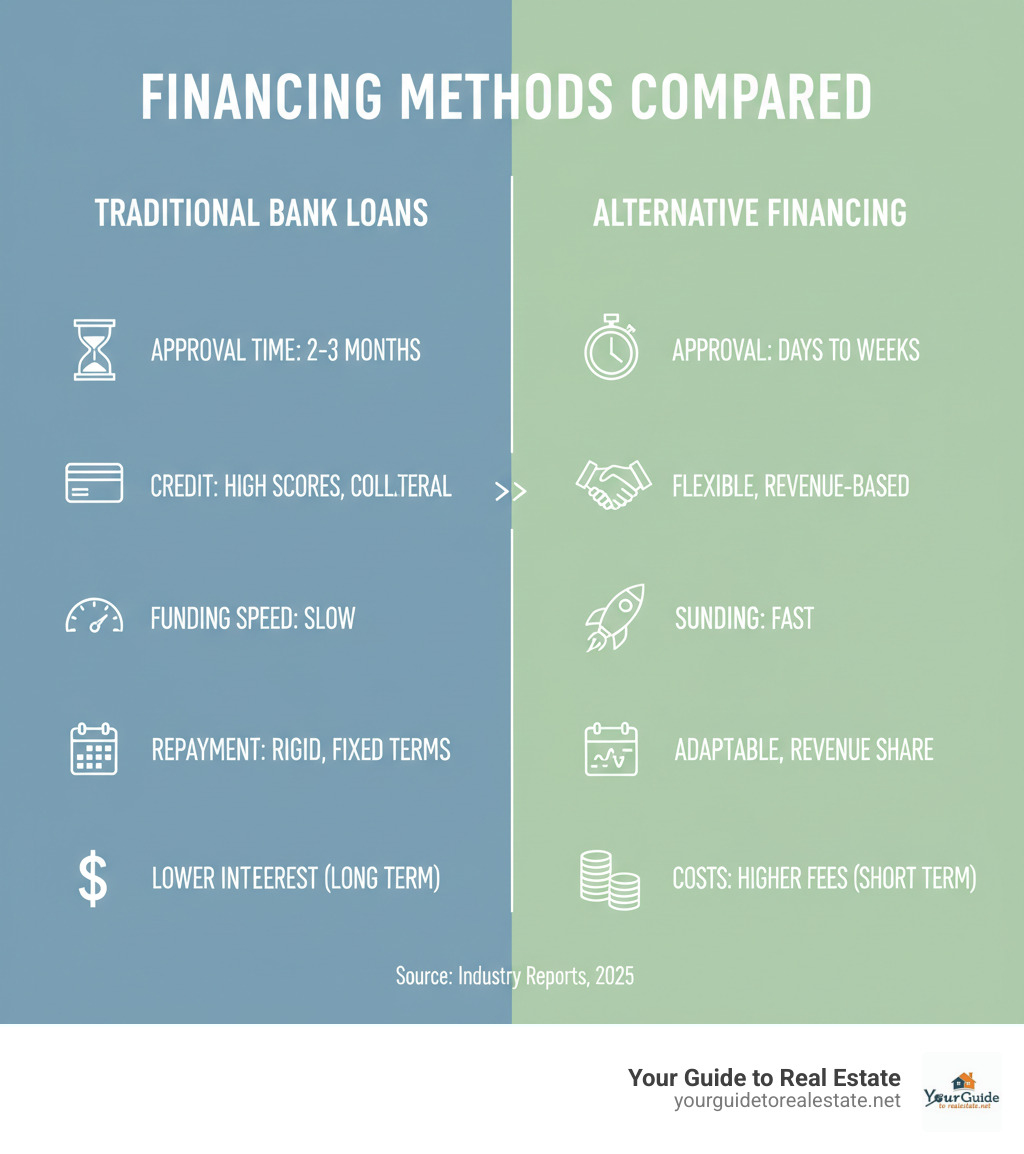
What if waiting 60-90 days for a bank loan means missing a critical opportunity? Traditional banks often require two to three years of operating history, strong credit, and substantial collateral, creating barriers for startups, fast-moving real estate investors, and businesses with non-traditional revenue.
The numbers tell the story: 69% of small businesses are “under-banked,” not receiving the full credit they need. About 60% of small businesses require loans under $100,000, a gap that alternative lenders fill.
Since the 2008 financial crisis, fintech companies and innovative funding platforms have stepped in. Non-bank lending is now expected to grow from $1.5 trillion to $3 trillion by 2028.
Alternative financing is no longer just a backup plan. It’s a strategic choice for speed and flexibility, whether you’re launching a startup, flipping properties, or growing an established business.
Alternative financing methods terms to remember:
A Spectrum of Funding: Exploring Key Alternative Financing Methods
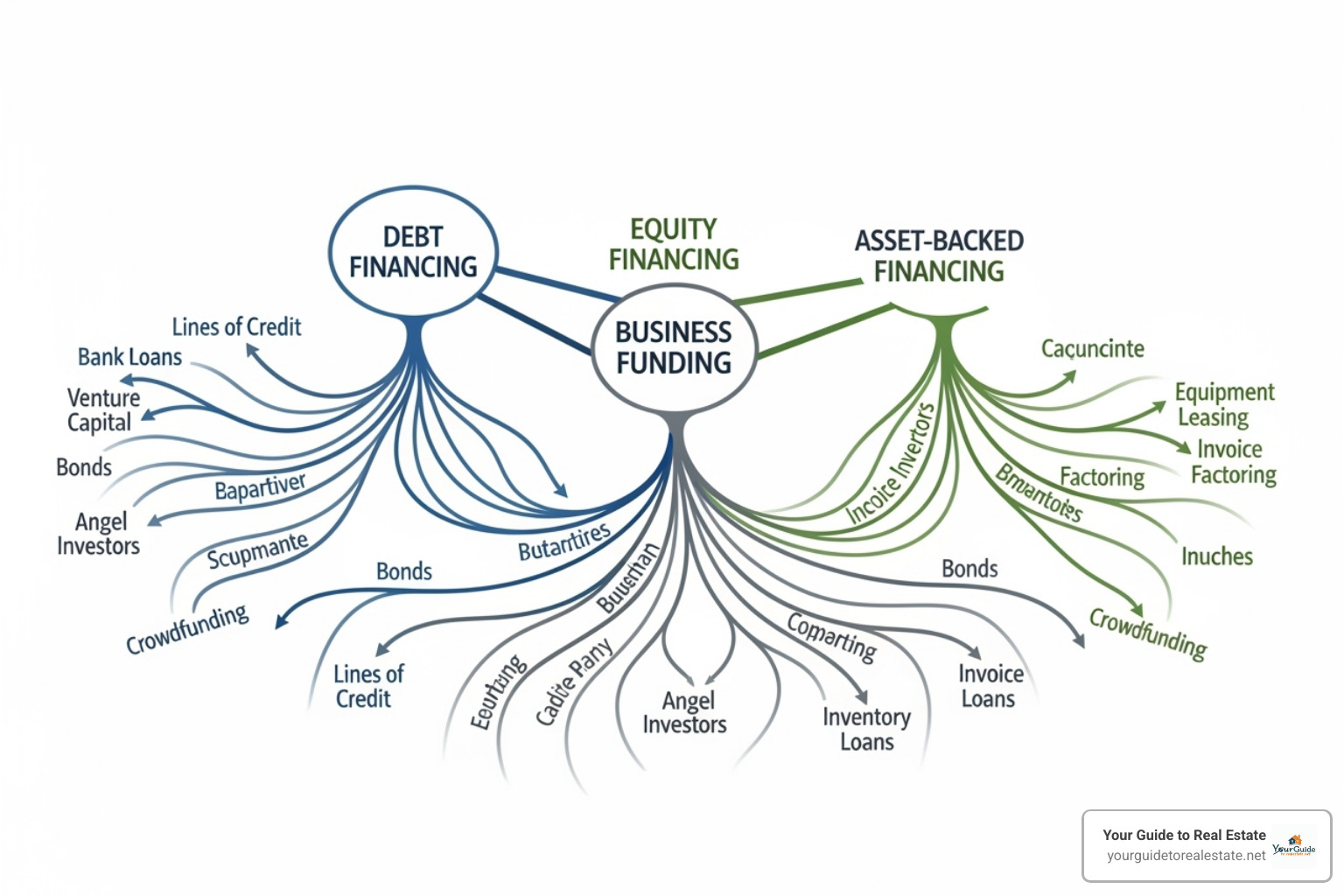
Think of alternative financing methods as a buffet of funding options. The fintech revolution has made these more accessible than ever, with non-bank lending projected to double to $3 trillion by 2028. This spectrum includes debt financing (borrowing), equity financing (exchanging ownership), asset-based lending (using your assets), and government programs. Let’s explore the most popular options.
Venture Capital (VC) and Angel Investors
For high-growth startups, venture capital and angel investors offer equity financing—trading a piece of your company for capital.
Angel investors are wealthy individuals who invest their own money ($25,000 to $100,000+) in early-stage businesses, often providing valuable mentorship and network access. The National Angel Capital Organization can help you connect with these investors.
Venture capital firms manage large institutional funds, investing $1 million or more in companies ready to scale fast. They typically take board seats and play an active role in strategy.
The trade-off for both is giving up equity and some control. VCs in particular look for clear exit strategies (like an acquisition or IPO) within three to seven years. As TechCrunch notes, this pressure doesn’t suit every founder.
| Feature | Angel Investors | Venture Capital (VC) Firms |
|---|---|---|
| Funding Amount | Smaller (typically $25K – $100K) | Larger (often $1M to tens of millions or more) |
| Stage | Seed/Early-stage startups | Early-stage to growth-stage companies with proven traction |
| Involvement | Often hands-on, providing mentorship and network | Strategic oversight, board seats, active management input |
| Source | Wealthy individuals | Institutional funds (from endowments, pension funds, etc.) |
| Risk Tolerance | High | High, but with more structured due diligence |
| Exit Expectation | Can be more patient | Clear exit strategy (acquisition, IPO) within 3-7 years |
Crowdfunding and Peer-to-Peer (P2P) Lending
Instead of one bank, why not pitch your idea to thousands of supporters?
Crowdfunding lets you raise small amounts from many people online, which is a great way to validate your market. Types include rewards-based (offering perks), equity-based (offering ownership), and debt-based (structuring contributions as loans). A successful campaign builds a community of early advocates. The QuickBooks guide to crowdfunding offers tips for success. The main downsides are the effort required and that funds raised may not cover long-term needs.
Peer-to-peer (P2P) lending platforms connect borrowers directly with individual lenders, cutting out banks. P2P lending often has faster approvals and less stringent credit requirements than traditional loans.
Invoice Financing and Merchant Cash Advances
These methods open up capital that’s tied up in unpaid invoices or future sales.
Invoice financing solves the problem of waiting 30-90 days to get paid. With invoice factoring, you sell invoices to a “factor” at a discount, and they collect from your customer. With invoice discounting, you use invoices as collateral for a loan while maintaining control of collections. This is ideal for B2B companies with inconsistent cash flow, as it’s not technically debt and doesn’t add liabilities to your balance sheet. For more context, see our guide on Real Estate Financing.
Merchant cash advances (MCAs) offer a lump sum in exchange for a percentage of your future credit card sales. Repayment is automatic but can carry very high effective interest rates. MCAs provide rapid funding with less focus on credit scores, but be extremely careful. The convenience comes at a steep price, so consider an MCA only after exhausting better options.
Government Grants, Subsidies, and Specialized Lenders
Government programs and specialized lenders exist specifically to support businesses.
Government grants and subsidies are ideal because they don’t need to be repaid. These funds are offered by federal, state, or local governments to stimulate specific economic activities, like job creation or innovation. They are competitive and have strict eligibility criteria. Tools like the Business Benefits Finder can help you find available programs.
Specialized lenders focus on underserved markets. In Canada, organizations like Futurpreneur Canada and the Business Development Bank of Canada (BDC) offer financing and advisory services. Similar programs exist in the U.S., such as Small Business Administration (SBA) loans and Community Development Financial Institutions (CDFIs), which are designed to support local economic growth. Researching what’s available in your area and industry is key, as these programs often have the most favorable terms.
Weighing the Pros and Cons of Alternative Financing

Smart financial decisions require looking at both sides of the coin. Alternative financing methods can be transformative when used strategically, but they can also become a burden if you don’t understand the trade-offs.
Key Benefits of Exploring Alternative Financing Methods
Alternative financing has opened doors for millions of entrepreneurs who were shut out by traditional banks.
- Speed and Accessibility: While a competitor waits 60+ days for bank approval, you can secure funding in days. For real estate investors, this speed is crucial for closing deals quickly. About 69% of small businesses are “under-banked,” and alternative financing directly serves this market.
- Flexibility: Many alternative lenders offer repayment models tied to your actual sales. If you have a slow month, your payment might adjust accordingly—a flexibility rarely offered by banks.
- Broader Qualification Criteria: Lenders often focus on future potential, customer contracts, or accounts receivable instead of demanding years of tax returns and perfect credit. This opens doors for startups and service-based businesses.
- More Than Just Money: Angel investors provide mentorship, crowdfunding validates your product and builds a customer base, and business incubators offer workspace and connections.
- Diversified Funding: Relying on multiple funding sources builds resilience. If one line of credit is reduced, your business isn’t left vulnerable.
Potential Risks and Drawbacks to Consider
Now for the reality check. These benefits come with potential downsides.
- Higher Costs: The convenience and accessibility often come with higher interest rates and fees. Some merchant cash advances can have an effective APR of 40-80%, far higher than a typical bank loan. This is the price for the lender taking on more risk.
- Loss of Equity and Control: With venture capital or angel investors, you’re selling a piece of your company. This means sharing profits and decision-making power. Some founders feel pressured to prioritize investor returns over their original vision.
- Complex Terms: Agreements can be filled with confusing clauses, hidden fees, prepayment penalties, and personal guarantees. It’s critical to read the fine print, preferably with a legal or financial advisor.
- Predatory Lenders: The industry has less regulatory oversight than traditional banking, creating opportunities for predatory lenders who trap business owners in cycles of high-interest debt.
- Impact on Future Financing: Taking on certain types of alternative financing, like an MCA that takes a large percentage of daily sales, can make it harder to qualify for traditional loans later.
Understanding how to manage multiple obligations is key. If you’re juggling various financing sources, our guide on Debt Consolidation Loans can offer helpful strategies. The bottom line is to treat alternative financing as a strategic choice, not a desperate last resort.
How to Choose the Right Option and Secure Funding

You’ve explored the landscape of alternative financing methods. Now it’s time to find the right fit for your business. The best approach starts with honest self-assessment and a clear strategy.
A Step-by-Step Guide to Finding the Best Alternative Financing Methods
Choosing the right funding is about matching your specific needs with the right tool.
- Define Your Needs: How much money do you need, and what for? Is it for inventory, equipment, or a property acquisition? What is your realistic repayment timeline? A short-term fix-and-flip project requires different capital than a long-term rental portfolio.
- Assess Your Business: Are you a pre-revenue startup or an established business with steady cash flow? What does your credit history look like? Your answers will narrow down which options are viable.
- Research Thoroughly: Explore all your options: venture capital, angel investors, crowdfunding, P2P lending, invoice financing, MCAs, and government grants. For real estate, look into hard money or private money lenders. Specialized lenders like Futurpreneur Canada or the Business Development Bank of Canada are also worth investigating.
- Compare the Real Costs: Look beyond the advertised interest rate. Calculate the total cost of capital, including origination fees, processing charges, and prepayment penalties. If you’re giving up equity, understand exactly what that means for your future ownership.
- Seek Professional Advice: Before signing anything, consult a trusted financial advisor. They can analyze your situation, recommend options, prepare financial packages, and help you negotiate better terms.
Just as you’d carefully plan a home purchase, financing requires similar diligence. For more on navigating complex financial processes, see our guide on the FHA Home Buying Process.
Preparing Your Application and Pitch
Once you’ve identified your best funding sources, you need to present your business compellingly.
- Business Plan: Your plan should clearly explain your business model, customers, competitive advantage, and team. For real estate investors, include detailed property analysis, projected returns, and a clear exit strategy.
- Financial Projections: Provide realistic profit and loss statements, cash flow projections, and balance sheets. Show how the funds will be used to generate a return. Overly optimistic numbers will damage your credibility.
- Know Your Numbers: Be prepared to discuss every line item of your financials. Knowing your profit margins, cash burn rate, and customer acquisition cost builds trust and shows you’re a serious business manager.
- Compelling Pitch Deck (for Equity Investors): This is your story. Introduce your team, showcase the market opportunity with data, explain your solution, and state your funding request clearly. Keep it concise—10-15 slides is ideal.
- Tailor Your Approach: A government grant application is very different from a VC pitch. Research what each funding source values most—whether it’s job creation, innovation, team experience, or collateral—and speak their language.
Frequently Asked Questions about Alternative Financing
Exploring alternative financing methods can raise many questions. Here are answers to some of the most common concerns we hear from entrepreneurs and real estate investors.
How does alternative financing differ from a traditional bank loan?
Traditional bank loans are defined by strict rules: they typically require two to three years of operating history, strong credit, and collateral. The application process can take 60-90 days. In return for meeting these criteria, you usually get lower interest rates.
Alternative financing methods, on the other hand, are built for flexibility and speed. They come from sources other than banks—like crowdfunding platforms, angel investors, or specialized lenders. Approval can take just days, and they often evaluate different criteria, such as monthly revenue, growth potential, or the strength of your business idea. The trade-off for this accessibility is typically a higher cost, whether through higher interest rates or giving up equity.
Can I get alternative financing with a poor credit history?
Yes, you absolutely can. Many alternative financing methods were created for those who don’t fit the traditional banking mold. Instead of focusing solely on your credit score, alternative lenders often look at other metrics.
For example, an invoice financing company cares more about the creditworthiness of your customers. A merchant cash advance provider looks at your daily sales volume. Angel investors and VCs are betting on your vision, team, and market opportunity. While a poor credit history might lead to less favorable terms (like higher fees), it doesn’t automatically disqualify you as it often does with a traditional bank.
Does alternative financing work for real estate investments?
Yes, and real estate is a sector where alternative financing methods are particularly effective. The market moves fast, and the lengthy approval process for traditional mortgages can cause investors to miss opportunities.
Alternatives like hard money loans and private money loans are short-term loans secured by the property itself, perfect for fix-and-flip projects where you need to close quickly. Approval is based more on the property’s value than your personal credit.
Real estate crowdfunding allows multiple investors to pool funds for larger projects, making it more accessible. For buy-and-hold investors, DSCR (Debt Service Coverage Ratio) loans are a fantastic option. These loans qualify you based on the property’s cash flow rather than your personal income. Our DSCR Loans Complete Guide is a great resource for investors looking to grow their portfolios with these non-traditional solutions.
Conclusion
You’ve now explored alternative financing methods, from venture capital to crowdfunding. The key takeaway is that these options are not just backup plans; they are strategic tools that offer speed, flexibility, and access to capital when traditional routes are closed.
However, these opportunities come with their own complexities, such as higher costs, equity dilution, and intricate terms. Due diligence is critical. Take time to understand what you’re signing up for, compare your options, and seek professional advice from a financial advisor to ensure your choice aligns with your long-term goals.
The future of business funding is evolving. Non-bank lending is projected to reach $3 trillion by 2028, and fintech innovations continue to create new possibilities for entrepreneurs who know where to look.
At Your Guide to Real Estate, we are passionate about providing the knowledge to make smart financial decisions. Whether you’re buying a home, building a rental portfolio, or launching a business, understanding your financing options is fundamental to success.
Don’t let traditional barriers hold you back. The capital you need might be closer than you think. If you’re starting your journey, check out our beginner’s guide to home loans to build a strong foundation.