

What is a Balloon Loan?
An amortization calculator with balloon payment is a specialized financial tool that helps you understand and plan for a partially amortized loan structure where you make smaller monthly payments followed by one large final payment.
Quick Answer for Balloon Payment Calculations:
- Loan Structure: Monthly payments based on a longer amortization period (like 30 years), but loan term is much shorter (5-7 years)
- Calculator Inputs: Loan amount, interest rate, amortization period, actual loan term
- Key Output: Monthly payment amount and final balloon payment due
- Common Use: Commercial real estate, some residential mortgages, bridge loans
Think of a balloon loan like this: you get the benefit of lower monthly payments as if you’re paying off a 30-year mortgage, but after just 5-7 years, you owe whatever balance remains in one big lump sum – that’s your balloon payment.
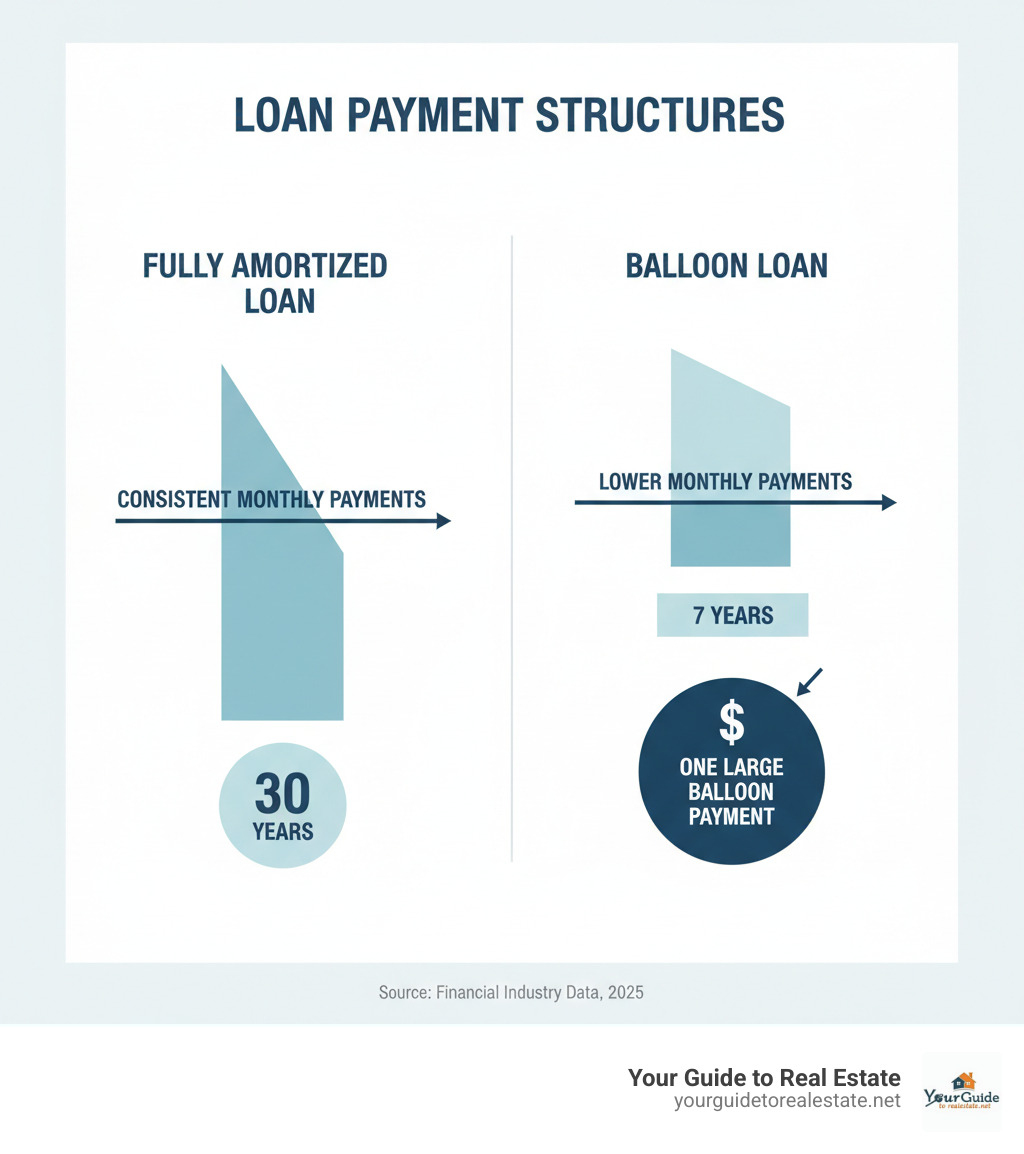
Unlike a traditional fully amortized loan where your payments gradually pay down the entire balance over the full term, a balloon loan is partially amortized. This means only part of the principal gets paid down through your monthly payments. The rest becomes that large final payment.
Why would someone choose this structure? Lower monthly payments can improve cash flow for investors, house flippers, or buyers who plan to sell or refinance before the balloon payment comes due. But there’s a catch – you need a solid plan for handling that final payment, whether through refinancing, selling the property, or having the cash ready.
The research shows that balloon mortgages were actually common in residential lending before the Great Depression, with many borrowers refinancing due to those large end-of-term payments. Today, they’re more commonly used in commercial real estate financing.
Amortization calculator with balloon payment helpful reading:
Understanding the Fundamentals of Balloon Financing
Let’s dive deeper into how balloon financing actually works. Think of it as the “pay less now, pay more later” approach to borrowing money. While it might sound intimidating at first, understanding these fundamentals will help you decide if this financing strategy makes sense for your situation.
What is a Balloon Loan and How Does it Differ from a Traditional Loan?
Here’s where things get interesting. A balloon payment mortgage flips the traditional loan script on its head. Instead of making consistent payments that gradually chip away at your debt over decades, you make smaller monthly payments for a short loan term – typically 5 to 7 years – followed by one massive lump-sum payment at the end.
Picture this: you borrow $200,000 with payments calculated as if you’re paying it off over 30 years, but the loan actually comes due in just 7 years. Your monthly payments stay low because they’re based on that longer timeline, but when year 7 rolls around, you owe whatever balance remains – often around $170,000 or more.
This is completely different from a traditional amortizing loan, where your monthly payments cover both principal and interest in a way that pays off the entire balance by the end of the term. With a traditional 30-year mortgage, payment number 360 zeros out your balance. With a balloon loan, payment number 84 (after 7 years) is followed by that big balloon payment.
The key difference? Traditional loans are designed for complete payoff, while balloon loans are designed for refinancing, selling, or having cash ready when that final payment comes due. If you’re curious about how different mortgage types compare, our Understanding Mortgages: A Beginner’s Guide to Home Loans guide breaks it all down.
Typical Terms and Common Uses
Most balloon loans follow predictable patterns. The loan duration typically ranges from 5 to 7 years, though you might see some as short as 2 years or as long as 10 years. The 5-year term and 7-year term options are most popular because they give borrowers enough time to execute their exit strategy.
Interest rates on balloon loans can sometimes be lower than traditional mortgages, especially in commercial lending. Lenders like the shorter commitment period, and borrowers enjoy the reduced monthly burden.
So where do these loans actually make sense? Commercial real estate is where balloon financing truly shines. Real estate investors use them to buy properties, renovate them, and either sell or refinance before the balloon payment hits. The lower monthly payments improve cash flow during the investment period – crucial when you’re managing multiple properties or major renovations.
Residential mortgages with balloon payments are less common today, but they still exist. Some homebuyers use them when they know they’ll be moving within a few years, or as part of creative financing strategies to avoid private mortgage insurance.
Even car loans sometimes feature balloon payments, though this is riskier since cars lose value so quickly. The appeal is the same – lower monthly payments with a large final payment.
For more insights on commercial applications, check out our Commercial Real Estate section.
The Difference Between Partially and Fully Amortized Loans
This is where your amortization calculator with balloon payment becomes essential. Understanding the math behind these loan structures helps you plan effectively.
A fully amortized loan follows a predictable amortization schedule. Each payment includes interest plus a portion that goes toward principal reduction. Month by month, your remaining balance shrinks until you reach complete loan payoff. It’s like climbing down a steady staircase – each step gets you closer to zero balance.
Partially amortized loans work differently. Your monthly payments are calculated using a longer amortization period (like 30 years), but your actual loan term is much shorter. This creates lower monthly payments, but here’s the catch – you’re barely touching the principal balance.
Let’s say you have a $200,000 loan with payments calculated on a 30-year schedule, but the loan comes due in 7 years. Your monthly payment might be around $1,200 instead of $2,400. Sounds great, right? But after 7 years of payments, you might still owe $170,000 or more. That remaining balance becomes your balloon payment.
The beauty of partially amortized loans is improved cash flow during the loan term. The challenge is having a solid plan for that final payment. Whether you’re planning to refinance, sell the property, or pay cash, that balloon payment date will arrive whether you’re ready or not.
This is exactly why an amortization calculator with balloon payment is so valuable – it shows you exactly how much you’ll owe and when, taking the guesswork out of your financial planning.
How to Use an Amortization Calculator with Balloon Payment

Ready to crunch some numbers? Using an amortization calculator with balloon payment might sound intimidating, but it’s actually your best friend when planning for a balloon loan. Think of it as your financial GPS – it shows you exactly where you’re headed and helps you avoid any surprises along the way.
The beauty of these online calculators is that they take the guesswork out of balloon loan planning. Instead of trying to figure out complex math in your head, you can run different scenarios and see exactly what you’ll owe and when.
Step-by-Step: Calculating Your Balloon Payment
Let’s walk through this together. Calculating your balloon payment is like baking a cake – you need the right ingredients in the right amounts, and the calculator does all the mixing for you.
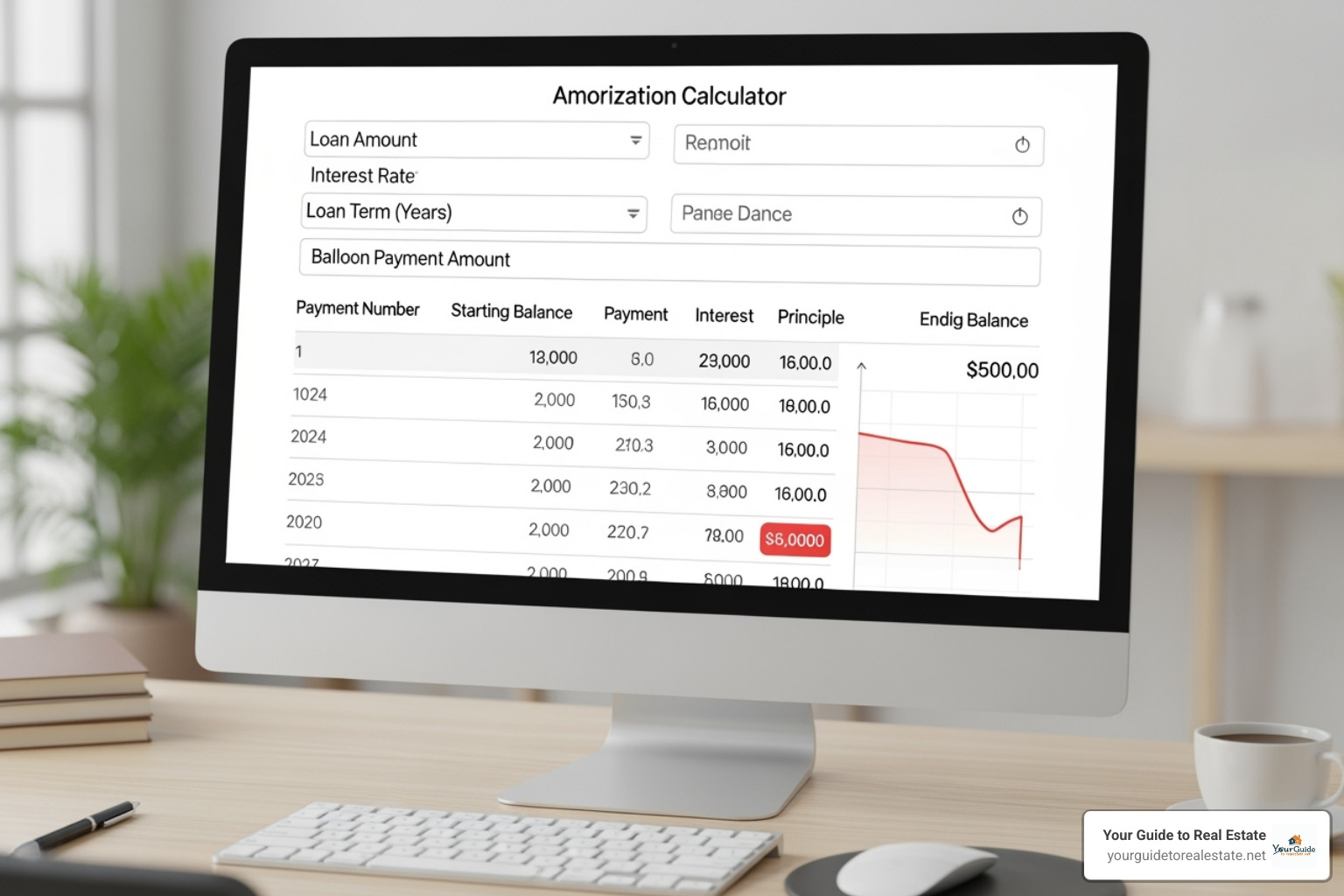
First, you’ll need to gather four key pieces of information. Your loan amount is the total principal you’re borrowing – pretty straightforward. Next comes your annual interest rate, which is the cost of borrowing that money. Here’s where it gets interesting: you’ll also need to specify the amortization period, which is typically much longer than your actual loan term (think 30 years). This longer period is what keeps your monthly payments manageable. Finally, you’ll enter your actual loan term – the shorter period after which your balloon payment comes due, usually 5 to 7 years.
The calculator works its magic in two steps. First, it figures out your monthly payment calculation based on that longer amortization period. This is why your regular payments stay relatively low – you’re paying as if you had decades to pay off the loan. Second, it determines what you’ll still owe after making all those monthly payments during your actual short loan term. That remaining balance becomes your final balloon payment calculation.
Let’s look at a real example to make this concrete. Say you borrow $800,000 at 8% interest. Your monthly payments are calculated as if you’re paying over 30 years, giving you manageable payments of $5,928.82. But your actual loan term is only 3 years. After making 36 of those monthly payments (totaling $213,437.44), you’d still owe a whopping $786,023.60 as your balloon payment. See how little principal actually gets paid down in those early years?
For hands-on practice, check out our Accurate Mortgage Calculator | Export Schedule to XLSX/DOCX to run your own calculations.
How to Read a Balloon Loan Amortization Schedule
Think of an amortization schedule as your loan’s story told month by month. It’s like reading a book where each chapter shows you exactly what happens with each payment you make.
When you generate a schedule using an amortization calculator with balloon payment, you’ll see several columns that tell this story. The payment number column counts each monthly payment from start to finish. The interest paid section shows how much of each payment goes toward interest costs – and you might be surprised how much this is, especially early on. The principal paid column reveals the (often disappointingly small) amount that actually reduces your debt each month.
But here’s the most important part: the remaining balance column. This is your reality check. You’ll watch this number decrease very slowly over your loan’s short term, and whatever amount shows up after your final regular payment – that’s your balloon payment staring you in the face.
For a 5-year balloon loan, your schedule will show 60 monthly payments. After payment number 60, that remaining balance doesn’t magically disappear – it becomes due in full. Many borrowers find it helpful to print out a Free Printable Balloon Mortgage Amortization Table to keep track of their progress and plan ahead.
The schedule also shows your total payments over the loan term, which helps you understand the true cost of your financing strategy.
How Extra Payments and Interest-Only Options Affect Your Loan
Here’s where things get really interesting – and where smart planning can save you thousands of dollars. Your amortization calculator with balloon payment isn’t just for showing standard payments; it’s also perfect for exploring “what if” scenarios.
Making extra principal payments can dramatically change your balloon loan’s outcome. Every extra dollar you put toward principal reduces your outstanding balance, creating a domino effect of benefits. Your reduced balloon payment becomes more manageable, and you’ll enjoy significant interest savings over the loan’s life. It’s like paying yourself back – money you put toward extra principal today is money you won’t have to come up with (plus interest) at balloon time.
You can test this by entering higher monthly payments into your calculator to see how much less you’ll owe at the end. The results might surprise you and motivate you to find room in your budget for extra payments.
On the flip side, some balloon loans offer interest-only payments during the initial term. This option gives you the absolute lowest monthly payments possible, which can be attractive if you’re an investor focused on cash flow or someone with irregular income.
But there’s a significant trade-off with interest-only payments. Since none of your monthly payment goes toward principal, your loan balance impact is zero – meaning your balloon payment will equal your entire original loan amount. You’re essentially borrowing money today and agreeing to pay back the full amount later, plus all the interest along the way.
For more detailed guidance on interest-only scenarios, our Interest Only Loan Calculator Guide 2025 provides comprehensive insights to help you make the right choice for your situation.
Weighing the Risks and Rewards of Balloon Loans
Let’s be honest – balloon loans aren’t your typical mortgage. They’re a bit like that friend who’s incredibly helpful in the short term but comes with some serious strings attached. Before you dive in, it’s worth understanding exactly what you’re signing up for.
| Feature | Advantages | Disadvantages |
|---|---|---|
| Monthly Payments | Lower monthly payments, improving short-term cash flow. | Requires a large lump sum payment at the end. |
| Interest Rates | Potentially lower interest rates than traditional, fully amortized loans. | If refinancing is needed, future interest rates might be higher. |
| Loan Term | Short initial term offers flexibility for quick asset turnover (e.g., house flipping). | Limited time to accumulate funds for the balloon payment. |
| Qualification | May be easier to qualify for compared to long-term, fully amortized loans. | High risk of default and potential foreclosure if the balloon payment cannot be met. |
| Market Changes | Beneficial in a rising market if asset value appreciates, making refinancing or selling easier. | Vulnerable to market downturns; property value decline can make refinancing difficult or selling at a profit impossible. |
| Financial Plan | Ideal for borrowers with a clear exit strategy (refinance or sell) and confidence in future funds. | Significant financial planning required; lack of a solid exit strategy can lead to severe financial distress. |
| Long-term Debt | Less long-term debt commitment if paid off or refinanced quickly. | Doesn’t build equity as quickly as fully amortized loans, as little principal is paid down initially. |
Advantages for Borrowers
Think of balloon loans as a financial tool designed for specific situations. When used correctly, they can be incredibly powerful.
The lower monthly payments are the star of the show here. Since your amortization calculator with balloon payment bases those monthly amounts on a longer period (like 30 years) while your actual loan term is much shorter, you get breathing room in your budget. This isn’t just about having extra pocket change – it’s about improved cash flow that can make or break an investment strategy.
Real estate investors absolutely love this feature. If you’re flipping houses or developing commercial properties, those lower payments during your holding period can free up cash for renovations, marketing, or your next deal. It’s a short-term financing strategy that works beautifully when you have a clear timeline for selling or refinancing.
House flippers, in particular, find balloon loans perfect for their business model. They can focus their capital on improvements rather than hefty monthly payments, knowing they’ll sell the property well before that balloon payment comes due. Our Property Investment guide explores how investors leverage these strategies effectively.
There’s also the practical side – balloon loans can be easier to qualify for than traditional mortgages. Lenders sometimes offer better interest rates too, since the shorter term reduces their long-term risk exposure.
Risks and Disadvantages to Consider
Now for the reality check. That big balloon payment isn’t just sitting quietly in the corner – it’s the elephant in the room that demands serious planning.
Refinancing risk is your biggest concern. When that balloon payment comes due, you’ll likely need to refinance into a new loan. But what if interest rates have jumped? What if your credit score took a hit? What if the lending market has tightened up? Suddenly, that refinancing you were counting on becomes expensive or impossible.
The interest rate changes alone can be a game-changer. If rates climb from 4% to 7% during your loan term, your refinancing costs could skyrocket. That affordable monthly payment you enjoyed? It might not be so affordable anymore.
Here’s where it gets really tricky: property value decline. If your property loses value, you could end up owing more than it’s worth. This makes refinancing nearly impossible since lenders won’t want to loan against a depreciated asset. Selling becomes equally challenging when you can’t get enough to cover what you owe.
The ultimate nightmare scenario? Default and foreclosure. If you can’t make that balloon payment and can’t refinance or sell, you risk losing everything. Your credit gets destroyed, and you lose the property. It’s not just about the money – it’s about your entire financial future.
For help understanding different loan options and their risks, check out our guide on How to Compare Mortgages.
Key Factors to Evaluate Before Choosing
Before you even think about signing on the dotted line, you need to take a hard look at your situation. This isn’t the time for wishful thinking.
Financial stability isn’t just about your current income – it’s about where you’ll be in 5-7 years. Are you confident in your career trajectory? Do you have multiple income streams? Can you weather unexpected financial storms?
Your future income projections need to be realistic, not optimistic. Don’t just hope you’ll earn more money by the time that balloon payment arrives. Have concrete reasons to believe it will happen, and even then, have backup plans.
Most importantly, you absolutely must have an exit strategy. This isn’t optional – it’s essential. Are you planning to sell the property? Do you have a lender already lined up for refinancing? Have you stress-tested your plan against different market conditions?
Market conditions can make or break your strategy. In a rising market, everything looks rosy. Property values climb, refinancing is easy, and selling is profitable. But markets don’t always cooperate. What’s your plan if the market tanks right before your balloon payment is due?
The bottom line? Balloon loans can be fantastic tools for the right borrower in the right situation. But they’re not forgiving if things go wrong. Make sure you’re not just hoping for the best – plan for it, and have backup plans for when things don’t go as expected.
If you’re new to real estate financing, our First Time Homebuyer Tips can help you understand your options better before making such a significant commitment.
Managing Your Final Payment: Strategies and Safeguards
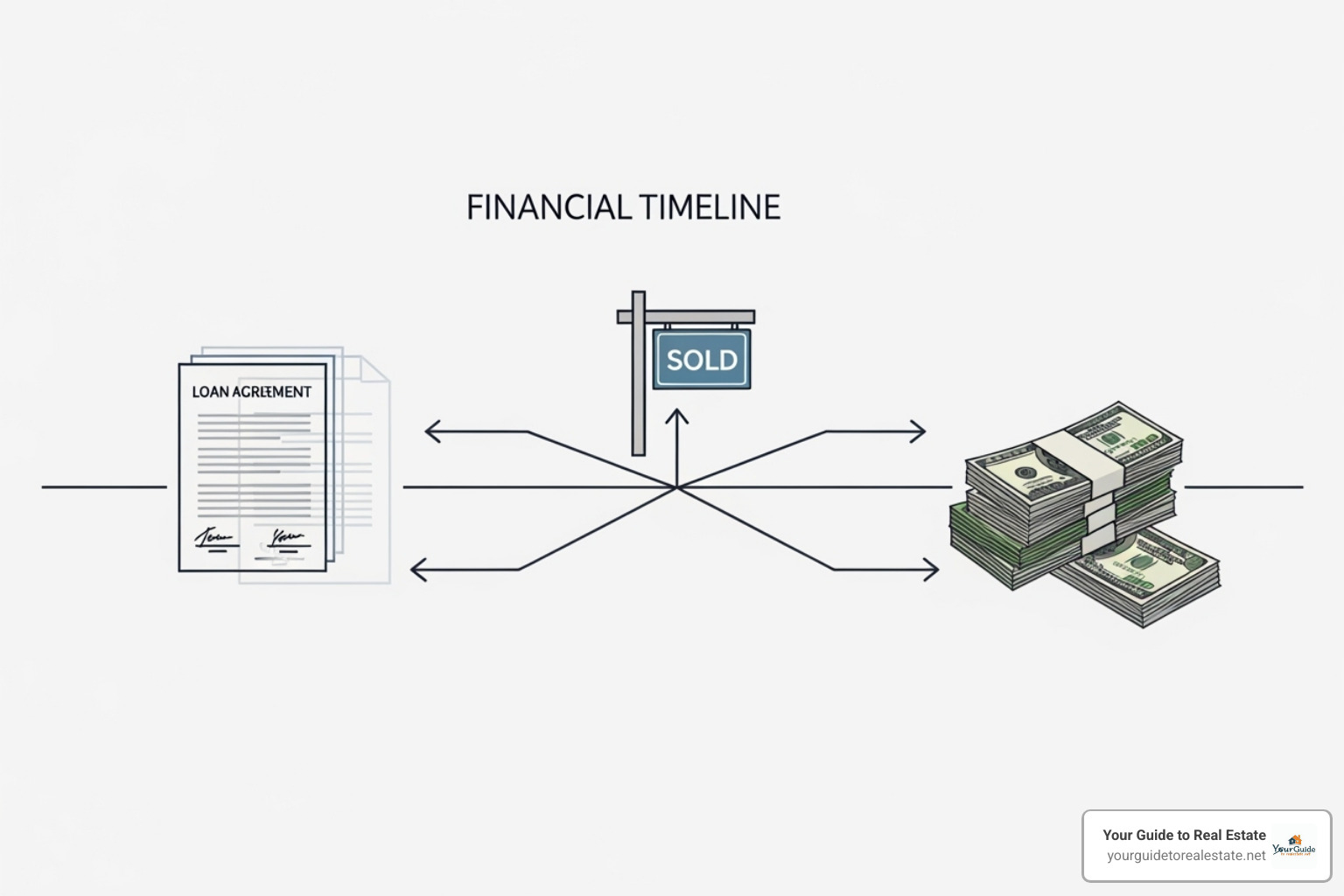
That big balloon payment date circled on your calendar doesn’t have to feel like financial doomsday. Think of it more like a planned event that you’ve been preparing for all along. The key to successfully managing a balloon loan is having a solid game plan well before that final payment comes due.
Most successful balloon loan borrowers start planning their exit strategy from day one. Whether you’re using an amortization calculator with balloon payment to track your progress or mapping out your next steps, preparation is everything.
What to Do if You Can’t Make the Balloon Payment
Life has a way of throwing curveballs, and sometimes even our best financial plans need adjusting. If you’re staring down that balloon payment and feeling overwhelmed, take a deep breath. You have several viable options, and none of them involve hiding under your desk.
Refinancing is often your first and best option. Many borrowers actually plan this from the start – they use the balloon loan to get lower payments for a few years, then refinance into a traditional mortgage when the balloon comes due. The trick is starting this process early, ideally six months to a year before your payment is due. This gives you plenty of time to shop around for the best rates and terms. Market conditions might have changed since you first got your loan, hopefully in your favor. Our comprehensive guide on Mortgage Refinancing Explained walks you through the entire process step by step.
Selling the property might align perfectly with your original strategy, especially if you’re an investor or house flipper. Many real estate professionals use balloon loans specifically because they plan to sell before that final payment hits. The goal is to sell for enough profit to cover your remaining loan balance and walk away with money in your pocket. If this is your path, start preparing your property for sale well in advance. Our resource The Ultimate Guide to Selling Your Home: Tips, Timelines, and Tools provides everything you need to maximize your sale price and timeline.
Loan modification represents your safety net option. If unexpected financial hardship has made your situation more challenging, your lender might work with you to modify the loan terms. This could mean converting to a fully amortizing loan, extending the term, or adjusting the interest rate. While not guaranteed, many lenders prefer working with borrowers over dealing with foreclosure proceedings.
The golden rule here? Don’t wait until the last minute. Procrastination is your enemy when managing balloon payments. Start exploring your options early and keep multiple backup plans ready.
A Brief History of Balloon Mortgages and Regulation
Understanding where balloon mortgages came from helps explain why they’re structured the way they are today – and why the regulations around them exist.
Back in the 1920s, balloon mortgages weren’t the exception – they were the norm for residential lending. Most home loans were five-year balloon mortgages, and the system seemed to work fine as long as property values kept climbing and credit remained easily available. Homeowners would simply refinance when their balloon payment came due, rolling into another short-term loan.
Then came the Great Depression, and this house of cards collapsed spectacularly. When property values plummeted and jobs disappeared, homeowners couldn’t refinance their loans or make those large balloon payments. The result was devastating: by 1933, an estimated 40-50 percent of all residential mortgages in the United States were in default. Families lost their homes in massive numbers, creating the mass foreclosures that became one of the defining features of that economic disaster.
Congress responded with the National Housing Act of 1934, fundamentally reshaping how home loans worked in America. This legislation created the Federal Housing Administration (FHA) and established new standards that promoted fully amortizing loans with longer terms – typically 15 years or more. The goal was simple: make homeownership more stable and predictable for average families.
The government also established what we now know as Fannie Mae in 1938, followed later by Freddie Mac in 1970. These agencies created a secondary market for mortgages, helping standardize the long-term, fixed-rate loans that became the backbone of American homeownership.
Fast forward to today, and balloon mortgages face much stricter oversight. The Truth in Lending Act (Regulation Z) requires lenders to carefully evaluate a borrower’s ability to repay any mortgage, including loans with a major balloon payment. These Ability-to-Repay (ATR) rules mean your lender must thoroughly investigate whether you can realistically handle that final payment, not just hope for the best.
This regulatory framework exists to protect borrowers from taking on loans they can’t handle. While it makes balloon loans less common for residential properties, it also makes them safer for those who do qualify and have solid repayment strategies.
Frequently Asked Questions about the Amortization Calculator with Balloon Payment
When we’re helping folks understand balloon loans, we get asked the same questions over and over again. And honestly, that makes perfect sense! These loans work differently than traditional mortgages, and the amortization calculator with balloon payment can feel a bit confusing at first. Let’s clear up the most common confusion points.
What’s the difference between the amortization term and the loan term in a balloon loan?
This question comes up in almost every conversation we have about balloon loans, and it’s absolutely crucial to understand the difference. Think of it this way: you’re essentially dealing with two different timelines.
The amortization term is the longer period – usually 30 years – that’s used purely for calculating your monthly payment amount. It’s like asking, “What would my payment be if I were paying this loan off over 30 years?” This longer timeline is what keeps your monthly payments nice and low.
But here’s the twist: the loan term is much shorter – typically 5 to 7 years. This is how long you’ll actually be making those monthly payments before the big balloon payment comes due. So while your payments are calculated as if you have 30 years to pay everything back, you only get 5 to 7 years before you need to handle that remaining balance.
It’s a bit like renting a car with payments calculated over 6 years, but the rental agreement only lasts 2 years. At the end of those 2 years, you’d still owe most of what you originally borrowed.
Can I get a balloon loan for a residential mortgage?
Yes, you absolutely can get a balloon loan for a residential property, though they’re much less common today than they were back in the day. After the Great Depression taught us some hard lessons about these loans, traditional 30-year mortgages became the go-to choice for most home buyers.
But balloon mortgages still pop up in specific situations. You might see them used by buyers who know they’ll be selling their home within a few years – maybe they’re planning to relocate for work or they’re in the military with upcoming transfers.
Another place you’ll find them is in “piggyback” loan structures. This is where a 15-year balloon mortgage acts as a second mortgage to help buyers avoid private mortgage insurance (PMI). By keeping their first mortgage at 80% of the home’s value and using the balloon loan to cover part of the remaining amount, buyers can sometimes save money on insurance costs.
The key thing to remember is that residential balloon loans require careful planning. You need to be confident about your exit strategy, whether that’s selling, refinancing, or having the cash ready when the balloon payment comes due.
What happens if I make interest-only payments on a balloon loan?
Interest-only payments on a balloon loan create the ultimate cash flow situation – but they come with a significant trade-off that you need to understand completely.
When you make interest-only payments, every dollar of your monthly payment goes toward covering the interest that’s accumulated on your loan balance. None of it touches the principal amount you originally borrowed. This results in the lowest possible monthly payments, which can be incredibly attractive if you’re an investor focused on maximizing cash flow or if you have fluctuating income.
But here’s what this means for your balloon payment: since you’re not paying down any principal during the loan term, your final balloon payment will equal the entire original loan amount. If you borrowed $500,000, you’ll owe $500,000 at the end, plus that final month’s interest.
This structure works well for real estate investors who plan to sell the property or refinance before the balloon payment is due. But it requires rock-solid planning because you’re essentially deferring the entire principal repayment to one moment in time. For more details on how these payments work, check out our Interest Only Loan Calculator Guide 2025.
The bottom line? Interest-only balloon loans offer maximum flexibility during the loan term, but they demand maximum preparation for the end of that term.
Conclusion: Plan Your Financial Future with Confidence
You’ve just taken a deep dive into balloon loans, and hopefully, you’re feeling more confident about whether this financing option makes sense for your situation. Understanding how to use an amortization calculator with balloon payment isn’t just about crunching numbers – it’s about taking control of your financial future and making decisions that align with your goals.
Throughout this guide, we’ve walked through the fundamentals together. You now know that balloon loans offer lower monthly payments by calculating them over a longer period (like 30 years) while requiring a large final payment after a much shorter term (typically 5-7 years). You’ve learned how to read amortization schedules, seen how extra payments can reduce your balloon amount, and explored the difference between interest-only and principal-plus-interest structures.
We’ve also been honest about the risks. The refinancing challenges, potential for property value decline, and the very real possibility of foreclosure if you can’t make that final payment are serious considerations. But we’ve also shown you the advantages: improved cash flow, easier qualification, and the flexibility that makes balloon loans attractive for investors, house flippers, and borrowers with clear short-term strategies.
The historical perspective matters too. The mass foreclosures during the Great Depression weren’t just statistics – they were real families losing their homes because they couldn’t handle balloon payments. Today’s regulations, including the Truth in Lending Act and Ability-to-Repay rules, exist because lawmakers learned from those painful lessons.
Your success with a balloon loan comes down to one crucial element: having a solid exit strategy. Whether that’s refinancing into a traditional mortgage, selling the property, or having the cash ready to pay off the balance, you need a plan from day one. Start exploring your options at least six months before your balloon payment is due – don’t wait until the last minute.
At Your Guide to Real Estate, we believe knowledge is your best tool for making smart financial decisions. An amortization calculator with balloon payment helps you see exactly what you’re signing up for, but understanding the bigger picture – the risks, rewards, and strategies – is what sets you up for success.
If you’re still exploring your mortgage options or want to deepen your understanding of home financing, our comprehensive Understanding Mortgages: A Beginner’s Guide to Home Loans is an excellent next step. The best financial decisions are informed decisions, and you’re well on your way to making choices that serve your long-term goals.