

Why Understanding Bonds vs Stocks Matters for Your Financial Future
Bonds vs stocks represent two of the most fundamental investment choices you’ll face when building wealth. Here’s what you need to know:
Key Differences at a Glance:
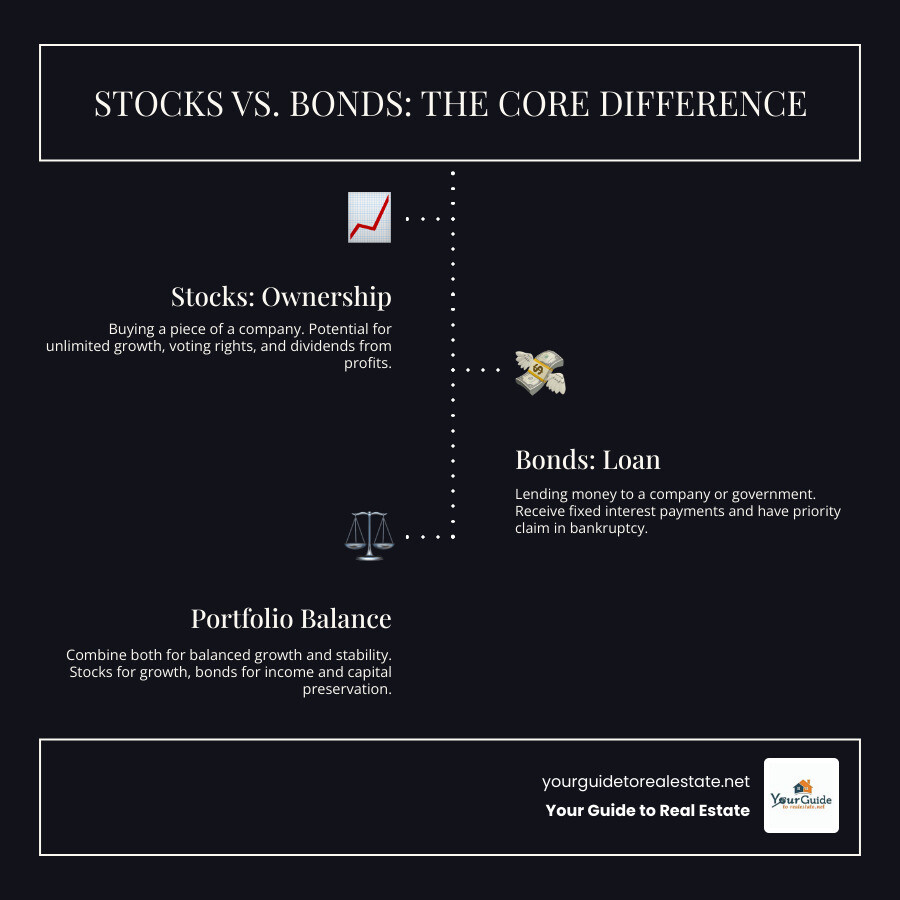
- Stocks = Buying ownership in a company (equity)
- Bonds = Lending money to a company or government (debt)
- Stock returns = Growth potential + dividends (historically ~10% annually)
- Bond returns = Fixed interest payments (historically ~5-6% annually)
- Stock risks = Can lose everything, but unlimited upside potential
- Bond risks = Lower risk, but inflation and interest rate concerns
Whether you’re building a real estate portfolio or planning for retirement, understanding these two asset classes is crucial. Stocks offer the potential for higher long-term returns but come with more volatility. Bonds provide steadier income and help preserve capital, but typically deliver lower returns over time.
The magic happens when you combine both. A 60/40 portfolio (60% stocks, 40% bonds) has historically earned almost 7% annually over the prior decade through September 2024, showing how these investments can work together to balance growth and stability.
As one financial expert put it: “Choosing the right mix of stocks and bonds can be one of the most basic yet confusing decisions facing any investor.” That’s exactly why we’re breaking it down in simple terms.
Basic bonds vs stocks vocab:
The Fundamental Difference: Ownership vs. Loan
When we talk about bonds vs stocks, we’re really diving into two very different ways to put your money to work. At its core, it’s about whether you want to own a piece of something or simply lend money to it. Simple, right? But this difference changes everything about your investment journey.
Think of it this way: when you buy stocks, you’re becoming a proud part-owner of a company. It’s like buying a tiny slice of a really big, delicious pie. We call this “equity.” If the company does well, your slice gets bigger and more valuable. But if the company struggles, well, your slice might shrink. You’re in it for the long haul, sharing in both the company’s wins and its wobbles.
Now, with bonds, you’re playing a different role entirely. You’re acting as a lender. You’re basically loaning your money to an entity – maybe a company, a local government, or even the federal government. In return, they promise to pay you back your original loan (your “principal”) by a certain date, and they’ll also pay you regular “interest” payments along the way. This is known as “debt.” You don’t own any part of them; you’re just a friendly creditor.
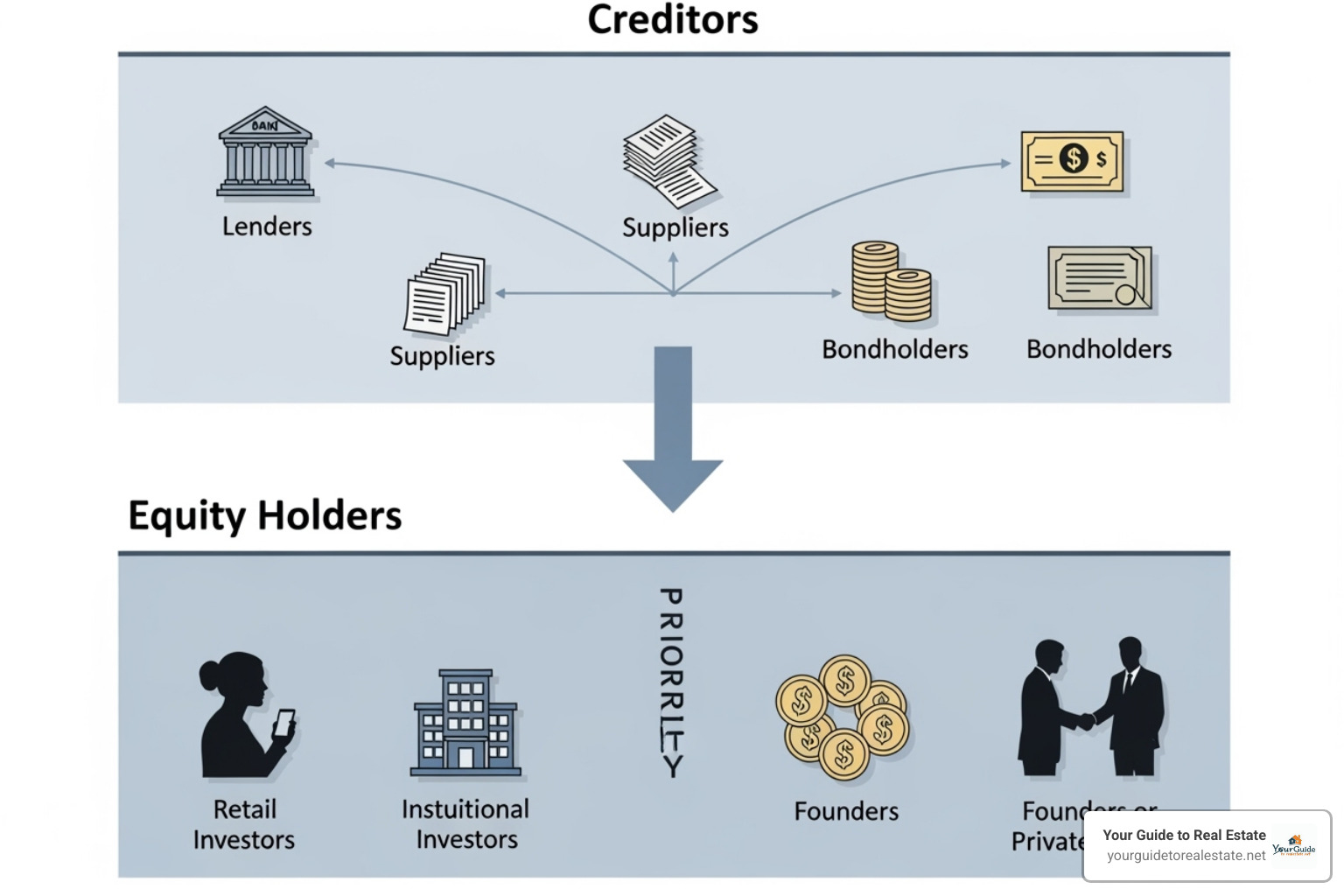
This fundamental difference between ownership and lending shapes everything. It affects how your money grows and what happens if things go wrong.
How Rights Differ in a Company’s Success
When a company is hitting it out of the park, shareholders and bondholders experience that success in different ways.
For folks holding stocks (shareholders), success can look like:
- Stock Appreciation: As the company grows, invents cool new things, and makes more money, the value of its stock usually goes up. This means your investment could grow a lot over time – sometimes, there’s no limit to how much it can appreciate! History shows that large stocks have returned an average of 10% per year since 1926.
- Dividend Payments: Many successful companies like to share their good fortune. They often pay out a piece of their profits to shareholders as dividends. These can be a nice little bonus check or you can reinvest them to buy even more shares, boosting your ownership even further. Just remember, these payments aren’t guaranteed; a company can decide to cut them if times get tough.
- Voting Rights: As an owner, you might even get a say in how the company is run! You could have the chance to vote on important decisions, like who sits on the company’s board of directors.
Now, for those who own bonds (bondholders), success is a bit more predictable:
- Fixed Interest Payments: No matter how wildly successful the company becomes (as long as it doesn’t run into major trouble), you’ll keep getting your predetermined, fixed interest payments. These are often called the “coupon rate” and they arrive like clockwork, giving you a steady stream of income. These payments are a promise, a contractual obligation.
- Principal Repayment: When the bond reaches its maturity date, the company (or government) pays you back your original investment in full. This makes bonds a favorite for people who value stable income and knowing their initial money is coming back. Unlike stocks, bonds come with fixed interest rates that promise a certain return, ensuring a specific percentage yield on your initial investment.
So, stock investors chase exciting growth and potential dividends, while bond investors prefer stable income and the safe return of their initial loan.
How Rights Differ in a Company’s Failure
The real difference between being an owner and a lender becomes crystal clear when a company faces tough times, like going bankrupt. This is where the “priority of payment” really matters, and it’s a huge contrast between bonds vs stocks.
- Bondholders Paid First: As lenders, bondholders have a stronger legal claim to the company’s assets than shareholders. If a company has to sell everything off, bondholders are first in line to get their money back. They usually recover most, if not all, of their investment before shareholders see anything. Even in tricky situations, like a country defaulting on its bonds (Argentina in 2001, for example), bondholders often go through a debt restructuring process and get at least some of their money back. They’re definitely ahead of the stockholders.
- Shareholders Paid Last: Stockholders, as owners, are at the very bottom of the pecking order when a company goes belly-up. If there’s any money left after bondholders and other creditors have been paid, shareholders might get something. But honestly, in most bankruptcy cases, there’s nothing left for shareholders. This means there’s a real risk of losing your entire investment if a company you own stock in goes under. Stocks can indeed drop to zero and become worthless.
This big difference in who gets paid first helps explain why bonds are generally seen as less risky than stocks, especially when you’re thinking about protecting your original investment during hard times.
Generating Returns: Growth vs. Income
When you’re building your financial future, you want your money to work for you, right? Both stocks vs bonds are fantastic tools for growing your wealth, but they go about it in very different ways. Understanding these differences is like having a secret superpower for your portfolio!
Think of stocks as the sprinters in your investment race – they’ve historically been the champions of long-term growth. Since 1926, large stocks have given investors an average return of about 10% per year. That’s pretty exciting! This impressive figure, which doesn’t account for inflation, is largely driven by capital gains, which is when the stock’s price goes up over time, and sometimes dividends, which are little payouts from the company.
Now, bonds are more like the steady, reliable marathon runners. They typically offer returns that are lower than stocks, but they’re often much more predictable. For example, long-term government bonds have averaged about 5-6% per year since 1926. The U.S. bond market, overall, has seen an all-time return of around 6%. With bonds, your returns usually come from fixed income – those regular interest payments you receive for lending your money.

Understanding Dividends vs. Interest Payments
The way you get paid from stocks vs bonds really highlights that core difference we talked about – ownership versus a loan.
With stocks, if you own a piece of a thriving company, it might decide to share some of its profits with you through dividends. Think of these as a ‘thank you’ for being an owner. But here’s the catch: dividends are discretionary. That means the company’s leaders can choose to pay them, lower them, or even stop them altogether, especially if they need to save money or invest in growth. So, while stocks known for their payouts (like those on 5 Stars Stocks.com Income Stocks or 5 Stars Stocks.com Dividend Stocks) can be wonderful, that income isn’t guaranteed.
Now, with bonds, the income you get is called interest (sometimes a ‘coupon payment’). This is a contractual obligation. It’s like a promise in writing! As long as the organization that issued the bond doesn’t go bankrupt, they’re legally bound to pay you a specific amount, on a specific schedule (maybe every six months or once a year), until the bond’s maturity date. This makes bond income wonderfully predictable – a real comfort for anyone looking for steady cash flow.
So, while dividends offer the potential for higher payouts linked to company success, interest payments from bonds provide a more reliable and predictable income stream.
The Power of Long-Term Growth
Now, let’s talk about a truly amazing concept, especially when it comes to stocks: the power of long-term growth. This is where your money really starts to stretch its legs and run!
A big part of this magic is called compounding returns. It’s often referred to as the ‘eighth wonder of the world’ for a reason! Imagine your initial investment earning money, and then that earned money starts earning money too. It’s like a snowball rolling downhill, getting bigger and bigger as it goes. Reinvesting those dividends from stocks or interest from bonds can make this snowball grow even faster.
Over many years, successful companies tend to see their stock prices appreciate. As they grow, make more money, or invent cool new things, their value goes up, and so does the value of your shares. This rise in price is a huge reason why stocks have delivered such impressive returns over the long haul.
This is also why starting your investing journey early is so incredibly important. The more time your money has in the market, the more compounding can work its wonders. For younger investors, stocks can be particularly appealing because you have a longer runway to ride out any bumps in the market and benefit from that long-term growth. As some smart folks have noted, over long periods, it would take a massive shift in the market for you to lose out by investing in stocks, as this article from DQYDJ suggests. It’s a proven strategy for building wealth, and advice like ‘start early’ (as highlighted by Investopedia) is a cornerstone of smart financial planning.
So, while bonds bring that wonderful stability and predictable income to your portfolio, stocks are your powerhouse for creating significant wealth over decades. They’re a cornerstone for big financial goals, whether you’re saving for retirement or eyeing that dream real estate investment.
The Risk-Reward Spectrum: A Deep Dive into Bonds vs Stocks
Every financial journey involves weighing potential rewards against the risks you’re willing to take. When it comes to bonds vs stocks, this balance is at the core of how you build your portfolio. Generally speaking, the bigger the potential reward, the more risk you might need to be comfortable with. Understanding these specific risks for each asset class is super important for making smart choices that align with your financial comfort zone.
For bonds, we often talk about risks like interest rate changes, inflation creeping in, and the chance of a borrower not paying you back (credit risk). Stocks, on the other hand, bring their own set of worries, mainly how the market moves and how individual companies perform.

This graph gives us a peek into how stocks and bonds can behave differently during good times and tough times in the economy. It’s like seeing how two different teammates perform under pressure – sometimes one shines, sometimes the other.
Key Risks for Stock Investors
Stocks are exciting because of their potential for big growth, but that excitement definitely comes with some bumps in the road.
First, there’s Market Risk. Think of the entire stock market as a big ocean. Sometimes, big waves (like economic slowdowns or global events) can cause all the boats (stocks) to dip, even the really sturdy ones. Even though the market has historically returned about 10% annually, it’s definitely not a smooth, straight line up. Short-term unpredictability is a big part of investing in stocks.
Then, we have Economic Downturns. When the economy slows down, companies often earn less money. This can make their stock prices fall. While some “defensive” stocks (like utility companies) might hold up better, most of the market feels the pinch.
You also face Company Performance risk. The value of your stock is directly tied to how well the company you own a piece of is doing. If management makes bad decisions, sales drop, or a new competitor comes along, your stock’s value can take a hit. In the worst-case scenario, a company can go bankrupt, and its shares could become completely worthless. Yes, as our research notes, stocks can drop in value and become worthless.
This means stocks can be quite unpredictable in the short term, with prices bouncing around a lot from day to day or week to week. If you’re looking to use your money in the near future, this kind of volatility can be pretty stressful.
Key Risks for Bond Investors
While bonds are generally seen as the “safer” choice compared to stocks, it’s important to remember they aren’t entirely risk-free. Even steady bonds have a few things you need to watch out for.
One of the biggest concerns for bondholders is Interest Rate Fluctuations. Imagine you bought a bond paying 3% interest. If new bonds come out paying 5% because overall interest rates have risen, your old 3% bond suddenly looks less attractive. This makes its market value go down. On the flip side, if interest rates fall, your bond becomes more valuable. As we’ve seen, “Bond prices fall when interest rates go up.” This effect is even more noticeable with long-term bonds.
Another quiet but powerful risk is Inflation Eroding Returns. Bonds usually offer fixed interest payments. If inflation (the rising cost of goods and services) goes up unexpectedly, the money you get back from your bond might not buy as much as you thought. Your “real” return, after accounting for inflation, could end up being quite a bit lower, or even negative.
Then there’s Credit/Default Risk. This is the risk that the bond issuer – whether it’s a company, a city, or a government – might not be able to make its promised interest payments or pay back your principal when the bond matures. The risk here really depends on who you’re lending money to. The U.S. government, for example, is considered extremely reliable (U.S. Treasury bonds are practically risk-free). But a less stable company or municipality might pose a higher risk.
To help investors understand this, agencies like Moody’s and Standard & Poor’s give out Bond Ratings. These ratings tell you about the issuer’s financial health and how likely they are to pay you back. Bonds with high ratings (like AAA) are very safe but offer lower interest. Bonds with lower ratings, sometimes called high-yield bonds or “junk bonds,” offer much higher interest because they come with a greater risk of default. As our research reminds us, “with bonds, there is interest rate, inflation and credit risk.” It’s all about balancing that risk with the reward!
Building Your Portfolio: Applying the Bonds vs Stocks Framework
So you understand the basics of bonds vs stocks – but how do you actually use this knowledge to build wealth? The secret sauce lies in creating a balanced investment portfolio that fits your unique situation like a perfectly custom suit.
Think of building a portfolio like cooking a great meal. You wouldn’t use only salt or only sugar – you need the right mix of ingredients. That’s where diversification comes in. By spreading your investments across different types of assets, you’re essentially not putting all your eggs in one basket. When stocks are having a rough day, bonds might be performing well, and vice versa. It’s like having a financial safety net that catches you when one investment stumbles.
The magic number that many investors swear by is the 60/40 portfolio – 60% stocks and 40% bonds. This tried-and-true recipe has earned almost 7% annually over the past decade through September 2024. It’s designed to capture the exciting growth potential of stocks while using bonds as a stabilizing force when markets get bumpy.
Your asset allocation – fancy talk for how you divide up your investment pie – should reflect three key things: your risk tolerance (how well you sleep when your investments fluctuate), your financial goals (retirement, house down payment, dream vacation), and your time horizon (when you’ll actually need the money).
For our clients across Dallas, Oklahoma City, and throughout the United States, this balanced approach often provides the financial foundation needed for real estate investments. Whether you’re saving for that first rental property or building wealth to expand your real estate portfolio, understanding how stocks and bonds work together can make all the difference.
Deciding Your Mix Based on Age and Goals
Here’s where investing gets personal. Your age isn’t just a number – it’s actually a pretty good guide for how to split your money between bonds vs stocks.
There’s an old rule called “100 minus your age” that’s surprisingly helpful. If you’re 30, you might put 70% in stocks and 30% in bonds. At 60, you’d flip toward 40% stocks and 60% bonds. The logic is beautifully simple: when you’re young, you have time on your side to ride out market storms and benefit from long-term growth.
Young investors can afford to be more aggressive with their stock allocation. As our research shows, stocks can be particularly appealing to younger investors because “you have more time to recoup potential losses.” That extra decade or two gives you the luxury of watching your investments compound and grow, even if there are some scary moments along the way.
Retirees and pre-retirees naturally shift toward a more conservative approach. When you’re living off your investments or getting close to retirement, capital preservation becomes more important than chasing the next big winner. Bonds provide that steady income stream and help protect your nest egg from major market swings.
But remember – these are guidelines, not gospel. Your personal situation matters more than any rule of thumb. Maybe you’re 25 but extremely risk-averse, or perhaps you’re 55 with a solid pension and can afford to take more risks. The key is being honest about what helps you sleep well at night.
Tax Implications of Bonds vs Stocks
Nobody loves talking taxes, but they’re a reality that can significantly impact your investment returns. The government treats bonds vs stocks differently when it comes to your tax bill, and understanding this can save you real money.
When you sell stocks for a profit, you’re dealing with capital gains tax. Hold that stock for more than a year, and you’ll likely pay the lower long-term capital gains rate. Sell within a year, and you’ll pay short-term capital gains at your regular income tax rate. Stock dividends usually get favorable tax treatment too, though the rules can be complex.
Bond interest is typically taxed as ordinary income at the federal level. But here’s where it gets interesting: municipal bonds offer a sweet tax advantage. The interest from these state and local government bonds is often exempt from federal taxes, and sometimes from state taxes too if you live in the issuing state. For investors in higher tax brackets, this can be a game-changer.
Treasury bonds also have a tax perk – while you’ll pay federal taxes on the interest, you’re off the hook for state and local taxes.
These tax differences might influence whether you hold certain investments in taxable accounts versus tax-advantaged retirement accounts. It’s definitely worth chatting with a tax professional to make sure you’re optimizing your strategy for your specific situation.
A Closer Look at Your Options
After exploring the ins and outs of bonds vs stocks, let’s bring it all together. Understanding the core differences is one thing, but knowing the specific types and their unique characteristics is where you truly start to build a smart investment plan. To kick things off, here’s a quick side-by-side comparison that sums up the main points:
| Feature | Stocks | Pros |
|---|---|---|
| Investment Type | Stocks (Equity) | Bonds (Debt) |
| Ownership | You own a small piece of the company. | You loan money to a company or government. |
| Return Potential | High; potential for significant capital gains and dividends. | Lower; predictable, fixed interest payments. |
| Risk | Higher; potential for total loss of investment, market volatility. | Lower; generally safer, but still subject to inflation, interest rate, and credit risk. |
| Priority in Bankruptcy | Last to be paid; high risk of total loss. | First in line (after secured creditors) to be repaid; potential for partial recovery. |
| Income Type | Dividends (discretionary, profit-sharing). | Interest (contractual obligation, fixed schedule). |
| Primary Goal | Capital appreciation, long-term growth. | Capital preservation, stable income. |
This table gives you a bird’s-eye view, but let’s dive into the fascinating variety within each category. It’s like choosing between different types of fruits – they’re all investments, but they offer different tastes and benefits!
Common Types of Stocks
The stock market isn’t just one big blob; it’s a vibrant ecosystem with many different kinds of shares, each with its own personality and potential.
First up is common stock, which is probably what you picture when you hear “stock.” When you buy common stock, you’re getting a slice of ownership in a company, which usually means you get voting rights on company matters and a chance to share in its profits through dividends or stock appreciation. Then there’s preferred stock. This type often doesn’t come with voting rights, but it usually offers a fixed dividend payment that takes priority over common stock dividends. It’s a bit of a hybrid, blending some features of both stocks and bonds.
You’ll also hear about blue-chip stocks. These are the big, well-known companies that have been around forever, like dependable old friends. They have a long history of stable earnings and are generally considered safer, though often with slower growth. On the other side of the coin are small-cap stocks, which come from smaller companies. These can be super exciting with huge growth potential, but they often come with more risk and volatility.
For those dreaming of rapid expansion, growth stocks are for companies expected to grow faster than the overall market. These companies often reinvest their profits back into the business, so they might not pay big dividends, but their stock price could soar. Finally, we have value stocks. These are companies that experts believe are trading for less than what they’re actually worth – like finding a fantastic product on sale! They can offer great returns if the market eventually catches on to their true value.
Common Types of Bonds
Just like stocks, bonds aren’t all the same. They come from different issuers and have different features, which can impact their risk and return.
Perhaps the safest option out there are government bonds. When you buy these, you’re basically lending money to the government, whether it’s the U.S. Treasury or another country’s treasury. They’re typically considered very low risk, especially U.S. Treasury bonds, because they’re backed by the government’s taxing power. Next, we have corporate bonds, which are issued by companies looking to borrow money for their operations or expansion. The risk here depends a lot on the company’s financial health – a giant, stable company will likely have safer bonds than a brand-new startup.
For those looking for a potential tax break, municipal bonds (often called “munis”) are a real gem. These are issued by state and local governments to fund public projects, and their interest is often exempt from federal income tax, and sometimes even state and local taxes if you live where the bond was issued. It’s like getting a little bonus!
If you’re feeling a bit more adventurous, you might look at high-yield bonds. These are sometimes jokingly called “junk bonds” because they come from companies with lower credit ratings, meaning there’s a higher chance of default. But to make up for that extra risk, they offer much higher interest payments. Lastly, some bonds offer a special twist: convertible bonds. These give you the option to trade them in for a certain number of shares of the issuing company’s stock under specific conditions. It’s like having a bond with a stock option built right in! While many bonds feature fixed interest rates, meaning the payments stay the same, some can have variable rates too.